Written by AT. Chintan Dalal, N.D. · Reviewed by Dr Krushal Pabari, Clinical Team, Cure4Pain · Updated 20 October 2026
Key facts
Magnesium helps muscles relax and acts as a brake on pain signals in the spinal cord [2]. In people with spinal nerve pain, low blood magnesium has been linked with more pain and a poorer response to treatment [5], and in one trial magnesium added to usual care eased chronic back pain with a nerve component [3]. No trial has yet tested magnesium tablets for neck pain or cervical spondylosis itself. Citrate was absorbed better than oxide in a trial in healthy adults [10]; in a small study after bowel surgery, overall absorption of glycinate and oxide did not differ, and glycinate was better tolerated [11]; creams and sprays have no good evidence of absorption through the skin [9]. Magnesium works best as one part of a plan that treats the muscles, joints and nerves of the neck [23] [24] [25]. People with kidney disease should take it only under medical supervision [21].

Scientific explainer videos in our Resources section
In our Resources section, our clinical team discusses vitamin D, its cofactors and how autoimmune, lifestyle and pain conditions develop.
Cervical spondylosis or spondylitis?
The two words sound alike but describe different problems.
- Cervical spondylosis is age-related wear of the discs and small joints of the neck. It is very common from middle age onwards and often causes neck pain and stiffness. When worn discs or bone spurs press on a nerve, pain, tingling or weakness can spread into the shoulder and arm (cervical radiculopathy) [1].
- Spondylitis means inflammation of the spine. The best-known form, ankylosing spondylitis, is an immune-mediated inflammatory condition that usually starts in younger adults and needs different care.
Many people, especially in India, say “cervical spondylitis” when they mean spondylosis. This article is about spondylosis and everyday neck pain.
Why magnesium matters for neck pain
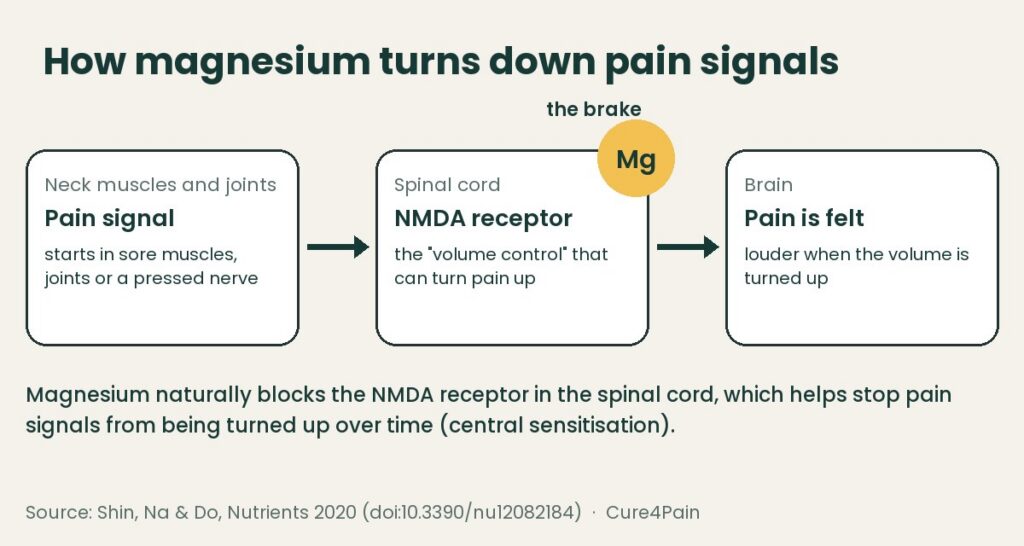
Magnesium is needed for muscles to relax after they contract, and for nerves to send signals normally. It also works on the NMDA receptor, a kind of “volume control” for pain in the spinal cord. When pain goes on for a long time, this receptor can turn the volume up, so that the nervous system becomes more sensitive and pain spreads or lingers (central sensitisation). Magnesium naturally blocks this receptor, which is why researchers have studied it in nerve pain, migraine, fibromyalgia and pain after surgery [2]. The same review is clear that more clinical studies are needed before magnesium’s place in pain care is settled [2]. The upper trapezius muscle runs from the neck to the shoulder, so neck and shoulder pain often come together; both neck trigger-point trials below treated this muscle [6] [7].
What the studies show, and what they do not
- Spinal nerve pain: in a randomized trial of 80 people with chronic low back pain with a nerve component, magnesium (given by drip for 2 weeks, then by mouth for 4 weeks) on top of usual care lowered pain from 7.5 to 4.7 out of 10 at 6 months and improved spinal movement [3]. This was in the low back, in a hospital setting, not the neck.
- Pain after surgery: across 25 trials, magnesium given by drip around surgery reduced the need for morphine by about a quarter in the first day [4].
- Low magnesium and nerve pain: in 121 people having spinal injections for nerve pain in the leg, those with low blood magnesium (below 0.85 mmol/L) had more pain to begin with and far fewer good results (21% versus 72% at one month) [5]. This study looked back at records, so it shows a link, not cause and effect.
- Neck muscle knots (trigger points): in two trials, magnesium pushed into the skin of the upper back with a mild electric current (iontophoresis) eased neck pain and improved function [6] [7]. In the 2026 trial of 60 people, dry needling did better than magnesium on every measure: pain, disability and muscle tension [6].
- Muscle cramps: a Cochrane review of 11 trials found that magnesium is unlikely to prevent ordinary muscle cramps in older adults [8].
In plain words: magnesium has a sound reason to matter for pain, and being low in it seems to make spinal nerve pain worse. But the trials so far were in the low back, around surgery or in neck muscle knots, and magnesium does not rebuild worn discs or joints. It is best seen as correcting a shortfall that can make pain harder to settle, not as a pain treatment on its own.
Magnesium cream or spray for neck pain: does it work?
Magnesium creams, sprays, oils and bath flakes are widely sold for neck and shoulder pain. A 2017 scientific review found no good evidence that meaningful amounts of magnesium pass through healthy skin [9]. The iontophoresis studies above are different: they used an electric current in a clinic to drive magnesium into the muscle [6] [7]. Rubbing a cream on a sore neck may feel soothing, partly from the massage and warmth, but it is not a reliable way to raise your magnesium.
Which magnesium is best for neck pain?
There is no proven best form for neck pain. In a trial in healthy adults, citrate and an amino-acid chelate form were absorbed better than oxide [10]. In one small study in people who had bowel surgery, overall absorption of glycinate and oxide did not differ (23.5% against 22.8%), and glycinate was better tolerated [11]. No study has compared magnesium forms in people with neck pain. The choice depends on how well a form is absorbed, how your gut handles it, and why you need it.
| Form | Absorption | Gut effects | What is known |
|---|---|---|---|
| Magnesium glycinate (bisglycinate) | No overall difference from oxide in one small study in people who had bowel surgery (23.5% against 22.8%), though higher in the 4 patients who absorbed oxide least [11]; amino-acid forms also did well in healthy adults [10] | Better tolerated than oxide in that study [11] | A common choice for a general top-up when the gut is sensitive |
| Magnesium citrate | Better than oxide [10] | Can loosen stools | General top-up; helpful if constipated |
| Magnesium oxide | Low; in one trial no different from placebo [10] | Often laxative | Mainly used for constipation and as an antacid |
| Magnesium malate | Little human research | Varies | One small fibromyalgia study found no clear effect in its blinded part [12] |
| Magnesium threonate | Little human research | Varies | Marketed for the brain; no neck pain trials in people |
Elemental magnesium, not the tablet weight. Every magnesium supplement is magnesium joined to a partner substance (glycine, citrate, oxide and so on). Only the magnesium part, called elemental magnesium, counts towards the daily amounts below, and the share of magnesium in each compound differs from form to form [21]. A label that says “500 mg magnesium glycinate” usually means the whole compound, which contains much less elemental magnesium; check the label for the elemental amount. How much of that magnesium the body actually absorbs also varies widely between forms and between people [10] [11] [21]. We do not recommend brands.
Sleep, stress and a stiff neck
Neck pain and poor sleep feed each other: pain disturbs sleep, and short or broken sleep makes pain feel worse. Good sleep, a comfortable pillow height and stress care are part of settling a stiff neck, whether or not magnesium is needed.
Magnesium and vitamin D
The enzymes that turn vitamin D into its active form appear to need magnesium [13]. In a randomized trial, magnesium raised vitamin D when levels were low-normal and lowered it when levels were high, so it helps keep vitamin D in balance [14]. This matters for anyone taking vitamin D, and especially in higher-dose vitamin D programmes such as the Coimbra Protocol. Read more in our article on magnesium and autoimmune disease.
Other shortfalls we look for: vitamin D, zinc and iron
In our clinic, when we assess people with long-standing neck or back pain, we often find more than one shortfall: low vitamin D and magnesium, and at times low zinc or iron. Many of these people also have weak, poorly toned muscles around the neck and spine (low muscle tone), which gives the discs and joints less support. These are observations from our own practice, not a controlled study, and they do not show that these shortfalls cause spondylosis or spondylitis. They do match what published research has found:
- Vitamin D: across 30 randomized trials, vitamin D gave a small improvement in muscle strength, larger in people who started very low [15]. Across 19 trials, it lowered pain scores more than placebo in people with chronic pain [16].
- Zinc: people with chronic myofascial pain (painful muscle knots, common in the neck and shoulders) had lower zinc stores in their red blood cells than people without pain, and lower zinc went with a higher chance of pain [17].
- Iron: muscles need iron to make energy, and low iron reduces this capacity, shown mainly in laboratory work and in people with chronic illness [18]. In a randomized trial of 198 menstruating women with tiredness and low iron stores but no anaemia, iron supplements reduced fatigue [19].
Further studies are needed to know how much correcting these shortfalls helps neck pain itself. This is also why we assess before suggesting anything: more is not better, and too much zinc, for example, can lower copper and iron [20].
How much magnesium is safe?
A normal blood test does not rule out low stores. According to the US National Institutes of Health, less than 1% of the body’s magnesium is in the blood, and blood (serum) levels do not accurately reflect total body magnesium [21], so a normal result can miss low body stores. This is why we assess magnesium status from the overall clinical picture, including your diet, symptoms and medicines.
Food first. Good sources are green leafy vegetables, legumes, nuts, seeds and whole grains [21]: for example pumpkin seeds, almonds, cashews, spinach, beans and lentils (dals), and whole grains and millets such as ragi and rajgira. In a large US study of people with chronic neck pain, those who ate more magnesium had lower CRP, a blood marker of inflammation [22]. This study observed people; it does not prove that magnesium caused the difference.
Official daily amounts (elemental magnesium from all sources, adults; US National Institutes of Health [21]):
| Age | Men | Women |
|---|---|---|
| 19 to 30 years | 400 mg | 310 mg |
| 31 years and over | 420 mg | 320 mg |
Upper limit for supplements: 350 mg of elemental magnesium a day for adults, unless a doctor advises otherwise [21]. This limit applies to supplements and medicines, not to magnesium from food. Your personal amount, and whether you need a supplement at all, is decided after a clinical assessment.
Take care if:
- your kidneys are not working fully: extra magnesium can build up to unsafe levels [21];
- you take acid-reducing tablets (proton pump inhibitors) for a long time, or some diuretics: these can lower magnesium, so it is worth checking [21];
- you take some antibiotics (tetracyclines, quinolones) or bone medicines (bisphosphonates): magnesium can reduce their absorption, so they need to be taken a few hours apart [21].
Do not start, stop or change any medicine or supplement without medical guidance.
Magnesium is one part of the plan
Cervical spondylosis is best managed with several approaches together. In a large review of 119 trials in chronic neck pain, combined non-drug treatments (for example exercise with manual therapy) helped for up to 3 to 6 months, while anti-inflammatory tablets did not; the evidence was of low to very low certainty [25]. The approaches with the best evidence include:
- Dry needling of tight muscle knots in the neck and upper back, which improves pain and disability in the short term [23], and did better than magnesium in a head-to-head trial [6];
- Acupuncture, which in an analysis of 39 trials and 20,827 patients with chronic pain, including neck pain, did better than sham and no acupuncture, with effects lasting at a year [24];
- Myofascial release, movement and posture work, building strength and range of motion in the neck and shoulders;
- Functional nutrition, which looks for shortfalls such as magnesium, vitamin D, zinc and iron that can make pain harder to settle.
Warning signs: see a doctor urgently if you notice clumsy hands (dropping things, trouble with buttons or writing), unsteady walking, electric-shock feelings down the spine or limbs, new weakness, or new bladder or bowel problems. These can mean pressure on the spinal cord, which needs prompt specialist assessment [1].
Read more on our Neck Pain & Cervical Spondylosis page and in Natural Remedies for Cervical Spondylosis: What Works and Why.
How we use magnesium at Cure4Pain
Magnesium is one small part of a functional nutrition plan, never a treatment on its own. We look at your diet, blood tests (including kidney function), medicines, sleep and symptoms, correct what is low, and recheck. Alongside this, the neck itself is treated with dry needling, myofascial release, acupuncture and naturopathy, with exercises you can continue at home. All of this happens under clinical guidance from Team Cure4Pain, who review your medicines and supplements together, including how they interact, in coordination with your existing consulting physician.
See all our care for musculoskeletal and pain conditions.
If you would like your magnesium and the rest of your plan reviewed properly, you can book a consultation, online from anywhere or at our Mumbai clinic.
Frequently asked questions
Does magnesium help neck pain?
Magnesium helps muscles relax and calms pain signals in the spinal cord [2], and low magnesium has been linked with worse spinal nerve pain [5]. But no trial has tested magnesium tablets for neck pain itself. Correcting a shortfall makes sense; it works best alongside treatment for the neck muscles and joints [23] [24] [25].
Is magnesium glycinate good for neck pain and stiffness?
In one small study in people who had bowel surgery, overall absorption of glycinate and oxide did not differ (23.5% against 22.8%), but glycinate was better tolerated [11], which is one reason it is often chosen. No study has tested it for neck pain or stiffness specifically, so think of it as a way to correct low magnesium, not as a neck treatment.
What is the best magnesium for cervical spondylosis?
No study has compared forms in cervical spondylosis. Citrate was absorbed better than oxide in healthy adults [10]; in a small study after bowel surgery, overall absorption of glycinate and oxide did not differ, and glycinate was better tolerated [11]. The right choice depends on your gut, your kidneys and whether you are low in magnesium at all.
Do magnesium creams or sprays help neck pain?
A 2017 scientific review found no good evidence that magnesium creams, sprays, oils or bath salts are absorbed through the skin in useful amounts [9]. Iontophoresis, a clinic treatment that uses a mild electric current, did help neck muscle pain in trials [6] [7].
Can magnesium cause neck pain?
Neck pain is not a recognised side effect of magnesium. The usual side effects of supplements are loose stools, stomach cramps and nausea [21]. Very high doses, especially with kidney disease, can cause muscle weakness and other serious problems, which is why the upper limit matters [21]. New or worse neck pain should be checked by a doctor.
How much magnesium should I take?
According to the US National Institutes of Health, adults need about 310 to 420 mg of elemental magnesium a day from all sources, and the upper limit for supplements is 350 mg of elemental magnesium a day unless a doctor advises otherwise [21]. These figures count only the magnesium itself, not the full weight of the compound, and how much is absorbed differs between forms [10] [21]. Your own amount is set after a clinical assessment.
What supplements help cervical spondylosis?
No supplement has been shown to treat cervical spondylosis itself. In our clinic we often find low vitamin D and magnesium, and at times low zinc or iron, in people with long-standing neck pain and weak neck muscles; research links these shortfalls with muscle strength, muscle pain and tiredness [15] [16] [17] [18] [19]. Assessing and correcting what is low, under clinical guidance, makes sense as part of a wider plan, though further studies are needed to measure the effect on neck pain [15] [16] [17] [18] [19] [20].
Will cervical spondylosis go away completely?
The wear in the discs and joints does not undo itself, and it is part of ageing for most people [1]. But pain and stiffness often settle well with the right care, and many people return to their normal activities [1] [25]. How much each person improves varies.
This article is for education and does not replace medical advice. Do not start, stop or change any medicine or supplement without medical guidance.
References
1. Theodore N. Degenerative cervical spondylosis. N Engl J Med 2020;383(2):159-168. doi:10.1056/NEJMra2003558
2. Shin HJ, Na HS, Do SH. Magnesium and pain. Nutrients 2020;12(8):2184. doi:10.3390/nu12082184
3. Yousef AA, Al-deeb AE. A double-blinded randomised controlled study of the value of sequential intravenous and oral magnesium therapy in patients with chronic low back pain with a neuropathic component. Anaesthesia 2013;68(3):260-266. doi:10.1111/anae.12107
4. Albrecht E, Kirkham KR, Liu SS, Brull R. Peri-operative intravenous administration of magnesium sulphate and postoperative pain: a meta-analysis. Anaesthesia 2013;68(1):79-90. doi:10.1111/j.1365-2044.2012.07335.x
5. Gözükızıl ST, Altun HI, Eren FA. Impact of serum magnesium levels on outcomes after transforaminal epidural steroid injections for lumbar radicular pain: a retrospective study. Pain Physician 2026;29(5):369-375. PubMed 42550529
6. Abu El Kasem ST, Moustafa EB, Abd El-Azeim AS. Dry needling versus magnesium sulfate iontophoresis of active trigger points of the axioscapular muscle in neck pain: a single blind randomized controlled trial. Acupunct Med 2026;44(1):3-13. doi:10.1177/09645284251410579
7. Ibrahim NA, Hamdy HA, Elbanna RHM, et al. Transdermal iontophoresis versus high power pain threshold ultrasound in mechanical neck pain: a randomized controlled trial. J Orthop Surg Res 2024;19(1):658. doi:10.1186/s13018-024-05078-z
8. Garrison SR, Korownyk CS, Kolber MR, et al. Magnesium for skeletal muscle cramps. Cochrane Database Syst Rev 2020;9:CD009402. doi:10.1002/14651858.CD009402.pub3
9. Gröber U, Werner T, Vormann J, Kisters K. Myth or reality: transdermal magnesium? Nutrients 2017;9(8):813. doi:10.3390/nu9080813
10. Walker AF, Marakis G, Christie S, Byng M. Mg citrate found more bioavailable than other Mg preparations in a randomised, double-blind study. Magnes Res 2003;16(3):183-191. PubMed 14596323
11. Schuette SA, Lashner BA, Janghorbani M. Bioavailability of magnesium diglycinate vs magnesium oxide in patients with ileal resection. JPEN J Parenter Enteral Nutr 1994;18(5):430-435. doi:10.1177/0148607194018005430
12. Russell IJ, Michalek JE, Flechas JD, Abraham GE. Treatment of fibromyalgia syndrome with magnesium and malic acid: a randomized, double blind, placebo controlled, crossover pilot study. J Rheumatol 1995;22(5):953-958. PubMed 8587088
13. Uwitonze AM, Razzaque MS. Role of magnesium in vitamin D activation and function. J Am Osteopath Assoc 2018;118(3):181-189. doi:10.7556/jaoa.2018.037
14. Dai Q, et al. Magnesium status and supplementation influence vitamin D status and metabolism: results from a randomized trial. Am J Clin Nutr 2018;108(6):1249-1258. doi:10.1093/ajcn/nqy274
15. Beaudart C, Buckinx F, Rabenda V, et al. The effects of vitamin D on skeletal muscle strength, muscle mass, and muscle power: a systematic review and meta-analysis of randomized controlled trials. J Clin Endocrinol Metab 2014;99(11):4336-4345. doi:10.1210/jc.2014-1742
16. Wu Z, Malihi Z, Stewart AW, et al. Effect of vitamin D supplementation on pain: a systematic review and meta-analysis. Pain Physician 2016;19(7):415-427. PubMed 27676659
17. Barros-Neto JA, Souza-Machado A, Kraychete DC, et al. Selenium and zinc status in chronic myofascial pain: serum and erythrocyte concentrations and food intake. PLoS One 2016;11(10):e0164302. doi:10.1371/journal.pone.0164302
18. Dziegala M, Josiak K, Kasztura M, et al. Iron deficiency as energetic insult to skeletal muscle in chronic diseases. J Cachexia Sarcopenia Muscle 2018;9(5):802-815. doi:10.1002/jcsm.12314
19. Vaucher P, Druais PL, Waldvogel S, Favrat B. Effect of iron supplementation on fatigue in nonanemic menstruating women with low ferritin: a randomized controlled trial. CMAJ 2012;184(11):1247-1254. doi:10.1503/cmaj.110950
20. Stiles LI, Ferrao K, Mehta KJ. Role of zinc in health and disease. Clin Exp Med 2024;24(1):38. doi:10.1007/s10238-024-01302-6
21. National Institutes of Health, Office of Dietary Supplements. Magnesium: Fact Sheet for Health Professionals. ods.od.nih.gov/factsheets/Magnesium-HealthProfessional
22. Zhao R, Yuan D, Li P, et al. Association analysis between dietary magnesium intake and all-cause and cause-specific mortality in individuals with chronic neck pain. Mol Nutr Food Res 2026;70(10):e70503. doi:10.1002/mnfr.70503
23. Navarro-Santana MJ, Sanchez-Infante J, Fernández-de-las-Peñas C, et al. Effectiveness of dry needling for myofascial trigger points associated with neck pain symptoms: an updated systematic review and meta-analysis. J Clin Med 2020;9(10):3300. doi:10.3390/jcm9103300
24. Vickers AJ, Vertosick EA, Lewith G, et al. Acupuncture for chronic pain: update of an individual patient data meta-analysis. J Pain 2018;19(5):455-474. doi:10.1016/j.jpain.2017.11.005
25. Castellini G, Pillastrini P, Vanti C, et al. Some conservative interventions are more effective than others for people with chronic non-specific neck pain: a systematic review and network meta-analysis. J Physiother 2022;68(4):244-254. doi:10.1016/j.jphys.2022.09.007