
Psoriasis: An Integrative and Functional Medicine Approach
Medically reviewed by Dr Krushal Pabari, MD, PGCP - Rheumatic & Musculoskeletal Diseases · Last reviewed: 4 November 2026
Key facts
Psoriasis is a long-term, immune-driven skin condition in which new skin cells build up too fast, forming thick, scaly, inflamed patches. It affects about 1.5 to 2% of adults in Europe, North America and Australasia [1]. People with psoriasis tend to have lower vitamin D levels [2]. At Cure4Pain, we combine functional medicine, functional nutrition, naturopathy and, where suitable, supervised vitamin D therapy (Coimbra Protocol), in coordination with your existing consulting physician, with regular blood tests.

Scientific explainer videos in our Resources section
In our Resources section, our clinical team discusses psoriasis and its management in detail: how integrative and functional medicine looks at the skin, the gut and the immune system, and how supervised vitamin D therapy (Coimbra Protocol) is used alongside functional nutrition.
What is psoriasis? Types and symptoms
In psoriasis the immune system sends faster-than-normal signals to the skin. Skin cells that normally take about a month to renew are pushed to the surface within days, and they pile up as raised, red or darker patches covered in silvery scale. Around 125 million people live with psoriasis worldwide [3]. It is not contagious.
Common types:
- Plaque psoriasis: thick, scaly patches on elbows, knees, scalp, lower back and feet. The most common type.
- Palmar-plantar psoriasis: painful cracks and thickened skin on the palms and soles.
- Scalp psoriasis: flaking and itching, often mistaken for dandruff.
- Nail psoriasis: pitting, discoloration or lifting of the nails.
- Guttate psoriasis: small drop-shaped spots, often after a throat infection.
Psoriasis is more than a skin condition. It is linked with psoriatic arthritis, heart and metabolic problems such as diabetes and raised cholesterol, liver problems and low mood [3][4]. That is why we look at the whole person, not only the skin.
Vitamin D and other nutrients in psoriasis
The most consistent finding is low vitamin D. A 2023 review of 23 studies with 1,876 people with psoriasis found average vitamin D levels of 21.0 ng/mL, compared with 27.3 ng/mL in people without psoriasis [2].
Vitamin D matters here because it is not only a vitamin but a hormone that helps steer the immune system, including the immune signals involved in autoimmune inflammation [5]. Low vitamin D does not mean it is the only cause: psoriasis has strong genetic roots, and triggers such as infections, stress, some medicines and smoking also play a part.
In a functional medicine work-up we also check the nutrients and markers that often run low or out of balance in people with chronic inflammation: vitamin B12, iron and ferritin, thyroid function, blood sugar (HbA1c) and parathyroid hormone (PTH). We assess magnesium from the overall clinical picture because, according to the US National Institutes of Health, less than 1% of the body’s magnesium is in the blood, and blood levels do not accurately reflect total body magnesium [21]. Correcting what is low is part of the plan; we do not guess.
Our article Which vitamin deficiencies are linked to psoriasis? explains what studies show for folate, vitamin B12, zinc and selenium, and which tests help.
Vitamin D and psoriasis: what the research shows
We want you to know exactly what the science says, including its limits:
- Vitamin D on the skin works. Creams with vitamin D analogues (for example calcipotriol) are a standard first-line psoriasis treatment recommended by dermatologists [3][6].
- Standard-dose vitamin D tablets have not been enough. In four randomized trials, ordinary oral doses did not improve psoriasis scores more than placebo [2].
- Higher, monitored doses are a different approach. In the 2013 pilot study by the Coimbra group, 9 people with psoriasis took 35,000 IU of vitamin D3 a day for six months with a low-calcium diet and at least 2.5 litres of water daily. Psoriasis scores improved in all nine, while calcium and kidney markers stayed stable [7]. This was a small study without a comparison group, so larger controlled trials are still needed.
- Safety depends on supervision. In 319 people with autoimmune conditions treated with the Coimbra Protocol for up to 3.5 years (average 35,000 IU a day), average calcium and kidney values stayed in the normal range under physician supervision with a low-calcium diet [8].
This is why we never recommend high-dose vitamin D on your own, and why every protocol at Cure4Pain runs with regular blood tests.
The Coimbra Protocol for psoriasis: how it works and how it is monitored
The Coimbra Protocol was developed by Dr Cicero Galli Coimbra in Brazil for autoimmune conditions. The idea is that many people with autoimmune disease have a reduced response to vitamin D (sometimes called “vitamin D resistance”), so they may need higher doses to get the same immune effect [9].
How it works in practice:
- Baseline tests: vitamin D (25-OH D), PTH, total and ionised calcium, kidney function (creatinine, eGFR), 24-hour urine calcium and other markers as needed.
- A personal dose: set and adjusted using your PTH level as the guide, not a fixed number.
- Low-calcium diet: no dairy and no calcium-fortified foods, to protect the kidneys while vitamin D is high.
- Hydration: at least 2.5 litres of fluid a day.
- Cofactors: magnesium, vitamin B2, vitamin K2 and others, which the body needs to use vitamin D well [10].
- Regular monitoring: blood and urine tests at set intervals, with dose changes when needed.
The protocol is not suitable for everyone. People with kidney disease, kidney stones, high calcium, sarcoidosis or some other conditions need a different plan. We decide this with you after the tests.
What is the conventional treatment for psoriasis? Treatments as per guidelines
Conventional psoriasis treatment is chosen by severity: creams and ointments for mild psoriasis, then light therapy, tablets or injections for moderate to severe psoriasis, according to the joint American Academy of Dermatology and National Psoriasis Foundation guidelines (AAD-NPF, 2019 to 2021) and the UK NICE psoriasis guideline [6][14][15][18][19].
- Creams and ointments (mild psoriasis): topical corticosteroids, and vitamin D analogues such as calcipotriol, alone or combined with a corticosteroid to lower steroid side effects, according to AAD-NPF [6][18]. NICE advises a potent corticosteroid plus a vitamin D analogue first for adults with psoriasis on the trunk or limbs [19].
- Vitamin D creams are not vitamin D tablets: vitamin D analogue creams are a guideline treatment. For oral vitamin D supplements, the AAD-NPF guideline gives no recommendation, because the evidence was lacking or conflicting [18]. Supervised vitamin D therapy (Coimbra Protocol) is not part of these guidelines.
- Light therapy: narrowband UVB, when creams alone cannot control plaque or guttate psoriasis, according to NICE [19][16].
- Conventional tablets and injections: NICE names methotrexate as the first choice, ciclosporin first when rapid or short-term control is needed or a pregnancy is planned, and acitretin when these are unsuitable or for pustular psoriasis [19]. AAD-NPF recommends methotrexate and apremilast for moderate to severe psoriasis in adults [14][18].
- Biological medicines and targeted tablets: used for moderate to severe psoriasis [15][19]. A 2026 European guideline adapted from EuroGuiDerm suggests a first-line biological medicine or deucravacitinib when systemic treatment starts, especially for particularly severe psoriasis [20].
| Group | Examples (generic names) |
|---|---|
| TNF inhibitors | adalimumab, etanercept, infliximab, certolizumab pegol [18][19] |
| IL-12/23 inhibitor | ustekinumab [18][19] |
| IL-17 inhibitors | secukinumab, ixekizumab, brodalumab, bimekizumab [18][19][20] |
| IL-23 inhibitors | guselkumab, tildrakizumab, risankizumab [18][19] |
| Targeted tablets | apremilast, deucravacitinib [14][19][20] |
- Safety tests: before systemic treatment, the 2026 European guideline lists a blood count, liver tests, a pregnancy test, hepatitis and HIV tests, and tuberculosis screening for some medicines [20].
- Screening for linked conditions: NICE advises a yearly check for psoriatic arthritis, a heart risk assessment in severe psoriasis, and asking about low mood [19]; AAD-NPF adds metabolic syndrome [17][18].
- Pregnancy: pregnancy plans shape the choice of systemic medicine, according to NICE [19]; acitretin is not used in pregnancy, when planning a pregnancy or when breastfeeding, according to AAD-NPF [18].
At Cure4Pain, Dr Krushal Pabari prescribes and adjusts systemic medicines as per guidelines, under clinical guidance from Team Cure4Pain, in coordination with your existing consulting physician, alongside supervised vitamin D therapy (Coimbra Protocol) and the integrative plan, and works with your dermatologist for skin treatments, phototherapy and biological medicines where needed; never stop or change them on your own.
Integrative care adds what these treatments are not designed to address: nutrient levels, vitamin D status, gut health, diet, sleep, stress and metabolic health.
Our integrative approach: vitamin D, cofactors, gut health and nutrition
- Coimbra Protocol (supervised vitamin D therapy): personalised dosing guided by PTH and regular blood tests.
- Cofactor support: magnesium, vitamin B2, B12, K2, selenium, omega-3 and zinc, based on your tests and overall clinical picture.
- Gut and liver support: digestive assessment, identifying possible triggers, gut barrier support where relevant, and clinician-guided nutritional or herbal support when indicated.
- Nutrition and lifestyle: a calcium-restricted diet during the protocol, millets, cold-pressed oils and ghee, and fewer processed wheat and high-lectin foods.
- Long-term follow-up: a maintenance plan with regular monitoring.
One of the therapies we use is the Coimbra Protocol (supervised vitamin D therapy): read how it works, who it may suit and how it is monitored.
Our article Psoriasis diet: foods to eat and avoid sets out what the research shows and how we apply it, with a 7-day Indian vegetarian list.
Psoriasis patient cases: three de-identified examples
These are individual case examples shared for education only, with patient consent. Results vary and are not typical. Do not self-treat.

Case 1: Severe Psoriasis with Diabetes
| Visit | Vitamin D (ng/mL) | PTH (pg/mL) | B12 (pg/mL) | HbA1c (%) | Ionised Ca (mmol/L) | eGFR | Creatinine | Triglycerides |
|---|---|---|---|---|---|---|---|---|
| Aug 2023 (first visit) | 6.76 | about 96 | 283 | 7.2 | – | – | – | – |
| Oct 2023 | 81.7 | – | – | – | – | – | – | – |
| Feb 2024 | – | 47.6 | – | – | 1.25 | – | – | – |
| Jun 2025 | >154 | – | – | 8.1 | 1.20 | 103.8 | 0.61 | 187 |
| Sep 2025 | >154 | – | – | 9.2 | 1.21 | – | – | 237 |
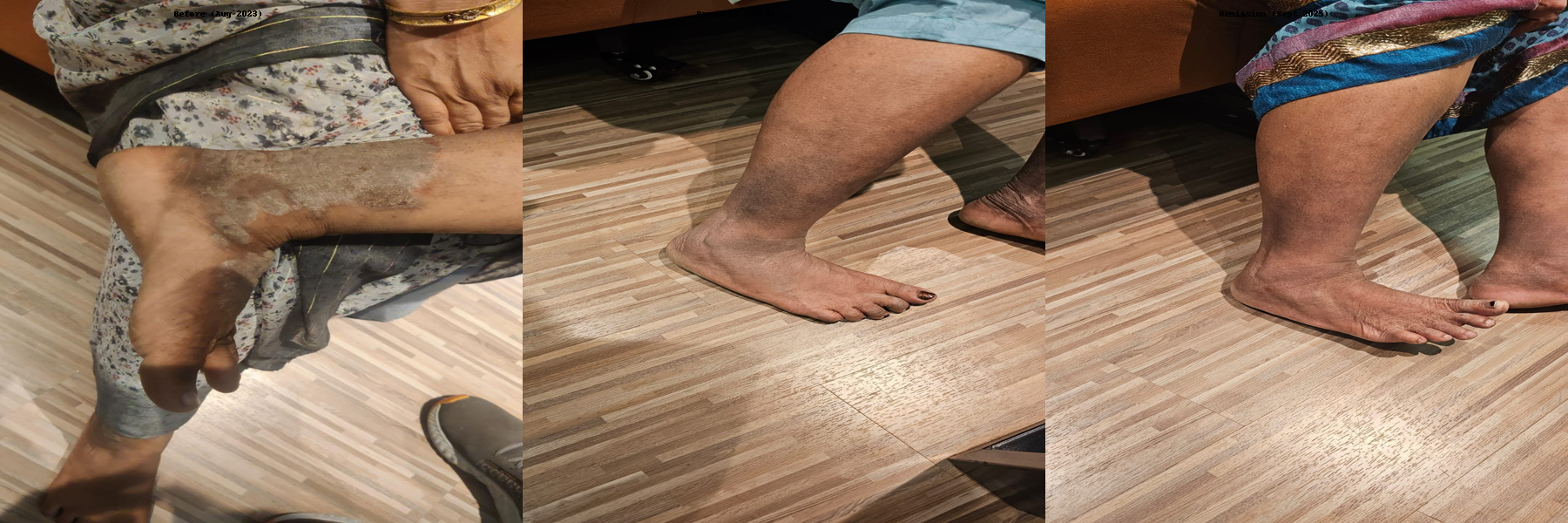
Read the details of case 1
Female, 57 years: severe plaque psoriasis with type 2 diabetes
She came to Cure4Pain in August 2023 with a severe flare of plaque psoriasis on both feet and legs. The plaques were bleeding, oozing and painful, and walking was difficult. She also had type 2 diabetes that was not well controlled, and signs of low nutrient levels.
- First visit (August 2023): vitamin D 6.7 ng/mL, HbA1c 7.2%, B12 283 pg/mL, PTH about 96 pg/mL.
- Plan: supervised vitamin D therapy (Coimbra Protocol) with cofactors, gut support and diet changes; the dose was set and adjusted by the clinic using blood tests.
- Observations at follow-up:
- 3 months: less scaling, and the bleeding had stopped.
- 12 months: further improvement in the plaques.
- 24 months: improvement maintained, with regular blood tests; she reported that walking was more comfortable.
- Challenge: her HbA1c rose to about 9.2% during follow-up, which showed that her blood sugar needed more attention.
Individual results vary; further studies are needed. Do not change any medicine without medical guidance.
Case 2: Psoriasis with Sustained Vitamin D Therapy

Read the details of case 2
- First visit: a severe flare with extensive, bleeding plaques; vitamin D 45 ng/mL, PTH 37.5 pg/mL, ionised calcium 1.27 mmol/L.
- Plan: supervised vitamin D therapy (Coimbra Protocol) with cofactors; the dose was set and lowered step by step by the clinic using blood tests.
- Observations at follow-up:
- 4 months: marked improvement in the plaques; PTH 21.2 pg/mL.
- 6 to 8 months: further improvement in the plaques, with regular monitoring.
- 2 years: improvement maintained during follow-up on a maintenance plan.
| Timeline | PTH (pg/mL) | Ionised calcium (mmol/L) | Clinical progress |
|---|---|---|---|
| First visit | 37.5 | 1.27 | Extensive plaques, bleeding |
| 4 months | 21.2 | 1.25 | Marked improvement in the plaques |
| 8 months | 35.9 | 1.30 | Further improvement in the plaques |
| 2 years | Stable | Within the laboratory range | Improvement maintained during follow-up |
Individual results vary; further studies are needed. Do not change any medicine without medical guidance.
Case 3: Palmar-Plantar Psoriasis with Hypothyroidism (9 months)
| Visit | ESR | Vitamin D (ng/mL) | B12 (pg/mL) | PTH (pg/mL) | TSH (µIU/mL) | eGFR | Ionised Ca (mmol/L) |
|---|---|---|---|---|---|---|---|
| Aug 2023 (first visit) | 23 | 23 | 239 | 123 | 2.03 | – | – |
| May 2024 (9 months) | 9 | 127 | 933 | 33 | 1.92 | 105 | 1.03 |
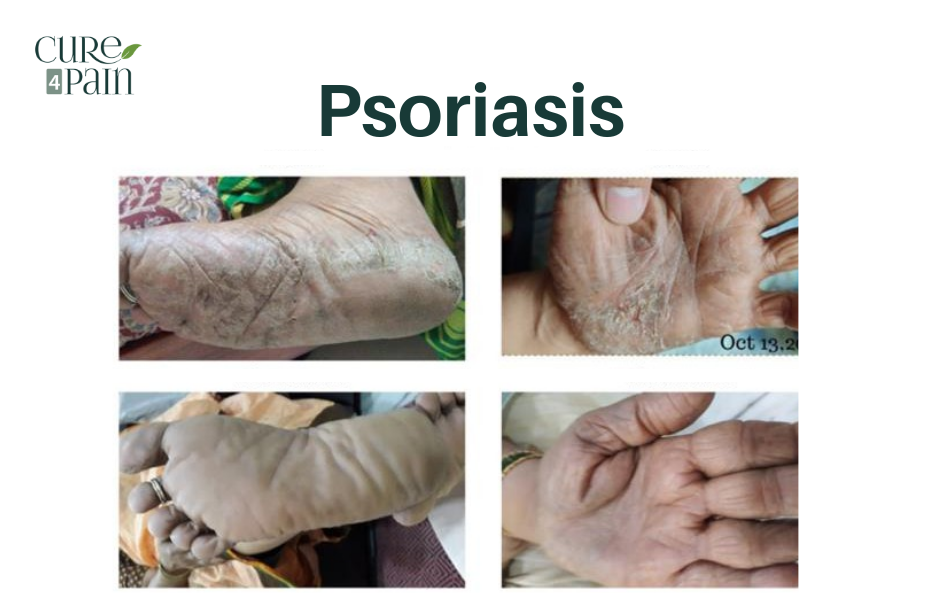
Read the details of case 3
- First visit (August 2023): cracked, bleeding and oozing patches on the hands and feet; vitamin D 23 ng/mL, PTH 123 pg/mL, B12 239 pg/mL, ESR 23, TSH 2.03.
- Plan: supervised vitamin D therapy (Coimbra Protocol) with cofactors; the dose was set and adjusted by the clinic using blood tests.
- Follow-up (9 months, May 2024): less pain and marked improvement in the skin; the lab values are in the table above. The patient then moved to a maintenance plan.
Individual results vary; further studies are needed. Do not change any medicine without medical guidance.
Psoriatic arthritis and vitamin D
About 1 in 5 people with psoriasis develop psoriatic arthritis: joint pain, swelling and stiffness, often in the fingers, toes, knees or lower back [11]. A 2023 review found that people with psoriatic arthritis have lower vitamin D levels than healthy people [12]. Whether raising vitamin D eases joint symptoms has not yet been shown in controlled trials, so we use it as one part of a monitored plan, in coordination with your existing consulting physician. If you have joint pain with psoriasis, please tell your doctor early: treating psoriatic arthritis early protects the joints.
See our Psoriatic Arthritis page for symptoms, tests, weight, exercise and how we treat it.
Psoriasis in pregnancy
Psoriasis often changes during pregnancy. In one study, about half of women improved during pregnancy, while about two in three had a flare in the months after delivery [13]. Many psoriasis medicines, and high-dose vitamin D protocols, are not used in pregnancy without specialist advice.
Our article Psoriasis in pregnancy: flares, treatments and planning ahead explains which treatments are used in pregnancy, how to plan ahead and what helps after delivery.
Evidence: key studies
| Study | What it found |
|---|---|
| Parisi et al., BMJ 2020 [1] | Psoriasis affects about 1.5 to 2% of adults in Europe, North America and Australasia. |
| Formisano et al., Nutrients 2023 [2] | Lower vitamin D in psoriasis; standard-dose tablets did not improve psoriasis scores in 4 trials. |
| Finamor et al., Dermato-Endocrinology 2013 [7] | Coimbra pilot: 35,000 IU/day for 6 months improved psoriasis scores in 9 of 9 patients; calcium and kidney markers stable. |
| Amon et al., Nutrients 2022 [8] | Safety data in 319 autoimmune patients on the Coimbra Protocol under supervision. |
| Alinaghi et al., J Am Acad Dermatol 2019 [11] | About 1 in 5 people with psoriasis have psoriatic arthritis. |
Psoriasis FAQs
Is psoriasis lifelong?
Psoriasis is a long-term condition that tends to come and go. Many people have long periods with few or no patches, especially when triggers are managed and treatment is followed. No clinic can promise that psoriasis will never return, and results differ from person to person.
What vitamin deficiency causes psoriasis?
No single deficiency causes psoriasis; genes and immune signalling are central. Low vitamin D is the deficiency most consistently linked with psoriasis [2]. We also check B12, iron and thyroid function and assess magnesium from the overall clinical picture, because low levels are common in chronic inflammation.
How much vitamin D is used for psoriasis, and is it safe?
There is no single dose. In the Coimbra Protocol the dose is personalised and adjusted using your PTH level and blood tests; in published studies it averaged about 35,000 IU a day [7][8]. High doses need a low-calcium diet, enough fluids and regular monitoring of calcium and kidney function. Please do not take high doses on your own.
How long does vitamin D take to work for psoriasis?
Some people notice early changes, such as less itching or bleeding, within 4 to 8 weeks. Visible changes in plaques usually take several months, and timelines vary widely.
Why is vitamin D taken with K2 and magnesium?
The enzymes that turn vitamin D into its active form need magnesium [10]. Vitamin K2 is needed by the proteins that handle calcium in bone and blood vessels. Because the protocol raises vitamin D, we support these cofactors based on your tests and overall clinical picture.
Do I still need my existing treatment?
Yes. Our care works in coordination with your existing consulting physician, not instead of it. If a medicine can later be reduced, that is decided under clinical guidance from Team Cure4Pain, with your test results in view.
Do I need supplements for life?
Some people may need longer-term maintenance, while others may reduce supplements over time based on blood tests, diet and how stable their skin is.
Can I consult online from outside India?
Yes. We see patients worldwide through online consultations. Blood tests are done at a laboratory near you, and we review them with you online.
Who treats you
- Dr Krushal PabariMD, PGCP - Rheumatic & Musculoskeletal Diseases. Assistant Professor, Cooper Hospital; Guest Professor, CMP Homoeopathic Medical College.
- AT. Chintan Dalal, N.D.BNYS, R.AP. Functional nutrition and Coimbra Protocol practitioner.
How consultations work: Mumbai or online worldwide
Book through our patient portal. You can see us in person at our clinic in Malad West, Mumbai, or online from anywhere. Your first consultation reviews your history and tests; we then agree a plan together and set the monitoring schedule.
Related conditions and articles
- Psoriatic ArthritisJoint, finger, toe and heel pain with psoriasis.
- Rheumatoid ArthritisJoint pain and stiffness; integrative care in coordination with your existing consulting physician.
- Hashimoto's ThyroiditisAutoimmune thyroid; antibodies, vitamin D, selenium and thyroid care.
- Gut Dysbiosis & Gut HealthImbalance of gut bacteria: bloating, bowel changes, SIBO and the gut and immune link.
This page is for education and does not replace medical advice. Do not start, stop or change any medicine or supplement without medical guidance.
References
1. Parisi R, et al. National, regional, and worldwide epidemiology of psoriasis. BMJ 2020;369:m1590. doi:10.1136/bmj.m1590
2. Formisano E, et al. Psoriasis and vitamin D: a systematic review and meta-analysis. Nutrients 2023;15(15):3387. doi:10.3390/nu15153387
3. Armstrong AW, Read C. Pathophysiology, clinical presentation, and treatment of psoriasis: a review. JAMA 2020;323(19):1945-1960. doi:10.1001/jama.2020.4006
4. Raharja A, Mahil SK, Barker JN. Psoriasis: a brief overview. Clin Med 2021;21(3):170-173. doi:10.7861/clinmed.2021-0257
5. Athanassiou L, et al. Vitamin D and autoimmune rheumatic diseases. Biomolecules 2023;13(4):709. doi:10.3390/biom13040709
6. Elmets CA, et al. Joint AAD-NPF guidelines of care for the management and treatment of psoriasis with topical therapy and alternative medicine modalities. J Am Acad Dermatol 2021;84(2):432-470. doi:10.1016/j.jaad.2020.07.087
7. Finamor DC, et al. A pilot study assessing the effect of prolonged administration of high daily doses of vitamin D on the clinical course of vitiligo and psoriasis. Dermatoendocrinol 2013;5(1):222-234. doi:10.4161/derm.24808
8. Amon U, et al. Safety data in patients with autoimmune diseases during treatment with high doses of vitamin D3 according to the “Coimbra Protocol”. Nutrients 2022;14(8):1575. doi:10.3390/nu14081575
9. Lemke D, et al. Vitamin D resistance as a possible cause of autoimmune diseases: a hypothesis confirmed by a therapeutic high-dose vitamin D protocol. Front Immunol 2021;12:655739. doi:10.3389/fimmu.2021.655739
10. Uwitonze AM, Razzaque MS. Role of magnesium in vitamin D activation and function. J Am Osteopath Assoc 2018;118(3):181-189. doi:10.7556/jaoa.2018.037
11. Alinaghi F, et al. Prevalence of psoriatic arthritis in patients with psoriasis: a systematic review and meta-analysis. J Am Acad Dermatol 2019;80(1):251-265. doi:10.1016/j.jaad.2018.06.027
12. Radić M, et al. Vitamin D in psoriatic arthritis: a systematic review and meta-analysis. Semin Arthritis Rheum 2023;60:152200. doi:10.1016/j.semarthrit.2023.152200
13. Murase JE, et al. Hormonal effect on psoriasis in pregnancy and post partum. Arch Dermatol 2005;141(5):601-606. doi:10.1001/archderm.141.5.601
14. Menter A, et al. Joint AAD-NPF guidelines of care for the management of psoriasis with systemic nonbiologic therapies. J Am Acad Dermatol 2020;82(6):1445-1486. doi:10.1016/j.jaad.2020.02.044
15. Menter A, et al. Joint AAD-NPF guidelines of care for the management and treatment of psoriasis with biologics. J Am Acad Dermatol 2019;80(4):1029-1072. doi:10.1016/j.jaad.2018.11.057
16. Elmets CA, et al. Joint AAD-NPF guidelines of care for the management and treatment of psoriasis with phototherapy. J Am Acad Dermatol 2019;81(3):775-804. doi:10.1016/j.jaad.2019.04.042
17. Elmets CA, et al. Joint AAD-NPF guidelines of care for the management and treatment of psoriasis with awareness and attention to comorbidities. J Am Acad Dermatol 2019;80(4):1073-1113. doi:10.1016/j.jaad.2018.11.058
18. American Academy of Dermatology. Psoriasis clinical guideline: guideline highlights (summary of the AAD-NPF psoriasis guidelines). aad.org/member/clinical-quality/guidelines/psoriasis
19. National Institute for Health and Care Excellence (NICE). Psoriasis: assessment and management. Clinical guideline CG153, 2012, with recommendations updated to 2025. nice.org.uk/guidance/cg153/chapter/Recommendations
20. Nast A, et al. S3 Guideline for the treatment of psoriasis vulgaris, adapted from EuroGuiDerm, part 1: treatment recommendations and monitoring. J Dtsch Dermatol Ges 2026;24(1):122-137. doi:10.1111/ddg.16002
21. Office of Dietary Supplements, US National Institutes of Health. Magnesium: Fact Sheet for Health Professionals. ods.od.nih.gov/factsheets/Magnesium-HealthProfessional