Written by AT. Chintan Dalal, N.D. · Reviewed by Dr Krushal Pabari, Clinical Team, Cure4Pain · Updated 30 October 2026
Key facts
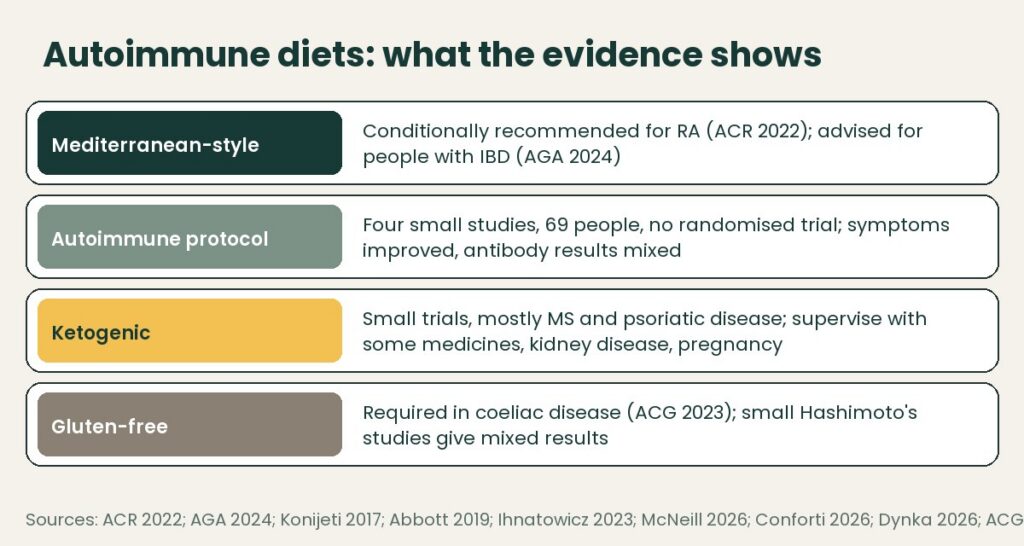
No single autoimmune diet has been proven. The review behind the 2021 EULAR (European rheumatology) recommendations found that, in rheumatic and musculoskeletal diseases, high-level evidence of a clinically meaningful effect from individual dietary factors is missing [1]. The 2022 American College of Rheumatology (ACR) guideline conditionally recommends a Mediterranean-style diet for rheumatoid arthritis and conditionally recommends against other formally defined diets [2]. The autoimmune protocol (AIP) diet has been tested in four small studies of 69 people with no comparison group, and our October 2026 PubMed search found no randomised trial [3] [4] [5] [6]. For the ketogenic diet in rheumatoid arthritis, psoriatic arthritis and psoriasis, a 2026 scoping review says the evidence is not yet sufficient to support efficacy claims [7]. A gluten-free diet is the required treatment for coeliac disease, according to the American College of Gastroenterology (2023) [8]. Guideline medicines continue with any of these diets: the ACR states that its recommendations do not replace disease-modifying medicines in rheumatoid arthritis [2], and the US National Psoriasis Foundation says diet changes should always be used with standard treatment for psoriasis and psoriatic arthritis [9].

Scientific explainer videos in our Resources section
In our Resources section, our clinical team discusses vitamin D, its cofactors and how autoimmune, lifestyle and pain conditions develop.
What is the best diet for autoimmune disease?
No diet has been shown to be best for all autoimmune diseases. A Mediterranean-style pattern has the most support, including a conditional recommendation for rheumatoid arthritis in the 2022 ACR guideline [2], and the right plan depends on your condition, blood tests and medicines. Autoimmune diseases are many different illnesses, and most diet studies cover only one of them.
- European guidance: the 2021 EULAR recommendations emphasise a healthy, balanced diet for people with rheumatic diseases [10]. Their review of 24 systematic reviews and 150 original studies found moderate evidence for small benefits from certain dietary components, such as omega-3 in rheumatoid arthritis [1].
- Why restriction needs care: according to the American Gastroenterological Association (AGA, 2024), dietary restrictions along with the complications of inflammatory bowel disease (IBD) can cause malnutrition, and all people with IBD should be monitored for vitamin D and iron deficiency [11]. A 2009 Cochrane review of 15 trials of diets in rheumatoid arthritis found 10% more drop-outs and 3.23 kg more weight loss on special diets than on ordinary diets, and warned that possible harms should not be ignored [12].
How do the main autoimmune diets compare?
Mediterranean-style eating has guideline support in some conditions (ACR 2022 for rheumatoid arthritis, AGA 2024 for IBD) [2] [11], while AIP, ketogenic and fasting plans rest mostly on small or short studies. A gluten-free diet has a clear role only in coeliac disease [8].
| Diet | Best evidence found | Main limits |
|---|---|---|
| Mediterranean-style | ACR 2022 for rheumatoid arthritis [2]; AGA 2024 for IBD [11]; a 38-person psoriasis trial [13] | Certainty often low [14] |
| Anti-inflammatory | Lower pain in rheumatoid arthritis across 7 trials [15] | High risk of bias, very low evidence [15] |
| Autoimmune protocol | Better symptom scores in IBD, Hashimoto’s and rheumatoid arthritis [3] [4] [6] | No comparison groups; very small |
| Ketogenic | Small trials in multiple sclerosis and psoriatic disease [16] [17] | Weight loss confounds results; not suitable for everyone [7] [18] |
| Gluten-free | Required in coeliac disease [8] | Without coeliac disease, small Hashimoto’s studies give mixed results [19] [20] |
| Fasting | Small trials in rheumatoid arthritis and Crohn’s disease [21] [22] | Effects of fasting alone may be short-lived [23] |
Does a Mediterranean or anti-inflammatory diet help autoimmune disease?
A Mediterranean or anti-inflammatory diet may help with quality of life and pain in some conditions, but it has not consistently changed disease markers. A 2026 systematic review of 15 studies of the Mediterranean diet found better quality of life with higher adherence in multiple sclerosis and coeliac disease (moderate certainty) and, to a lesser extent, rheumatoid arthritis (low certainty); C-reactive protein results were inconsistent [14].
- Rheumatoid arthritis: the ACR conditionally recommends a Mediterranean-style diet, based on low to moderate certainty evidence of less pain [2]. In a 2021 meta-analysis of 7 trials with 326 people, potentially anti-inflammatory diets lowered pain by about 9 mm on a 100 mm scale, but every study had a high risk of bias [15]. In the 2020 Swedish ADIRA crossover trial of 50 patients, the main analysis found no significant difference in disease activity; a difference appeared only in an unadjusted analysis of people who completed both diets [24].
- Psoriasis: in the 2025 MEDIPSO randomised trial of 38 adults with mild to moderate disease, Psoriasis Area and Severity Index scores fell 3.4 points more than with low-fat advice [13]. The US National Psoriasis Foundation strongly recommends weight reduction with a lower-calorie diet for people with psoriasis and overweight or obesity [9].
- Crohn’s disease and ulcerative colitis: the AGA advises a Mediterranean diet for overall health, and states that no diet has consistently lowered the rate of flares in adults [11]. It also calls exclusive enteral nutrition (a liquid formula diet) an effective therapy for settling active Crohn’s disease, with stronger evidence in children than adults, and says the Crohn’s disease exclusion diet may be effective in mild to moderate disease of relatively short duration [11]. In a trial of 194 adults with mild to moderate Crohn’s symptoms, the Specific Carbohydrate Diet was no better than a Mediterranean diet at settling symptoms (46.5% against 43.5%) [25].
- Multiple sclerosis: in a 2023 network meta-analysis of 12 trials with 608 people, Paleolithic, low-fat and Mediterranean diets eased fatigue more than a usual diet, but the credibility of the evidence was very low [26]. A 2020 Cochrane review of 30 trials found too little evidence to say whether dietary interventions change MS outcomes [27].
What is the AIP diet, and does it work?
The autoimmune protocol (AIP) is a phased elimination diet. According to Cleveland Clinic, the first phase lasts four to six weeks and up to a few months and removes grains, legumes, nightshade vegetables, dairy, eggs, nuts and seeds, processed foods, refined sugars, coffee and alcohol; foods are then reintroduced [28]. It allows vegetables, fruit, fish, meat and poultry. Whether AIP works is not yet known: our PubMed search in October 2026 found no randomised or other controlled trial, only four small studies of 69 people with no comparison group.
The table lists the four published groups, 69 people in all.
| Study | Who took part | What was reported |
|---|---|---|
| Konijeti 2017 | 15 adults with active IBD, 11 weeks [3] | Symptom scores improved; C-reactive protein did not change significantly; the fall in faecal calprotectin was not significant |
| Abbott 2019 | 17 women with Hashimoto’s, 10 weeks of online coaching [4] | Symptom scores and quality of life improved; high-sensitivity C-reactive protein fell 29%; no significant change in thyroid function or antibodies |
| Ihnatowicz 2023 | 28 people with Hashimoto’s, 12 weeks [5] | Fewer people reported symptoms; weight fell; TPO antibodies rose significantly and thyroglobulin antibodies fell slightly |
| McNeill 2026 | 9 adults with rheumatoid arthritis, 8 weeks [6] | 7 of 9 improved on self-reported scores; average body mass index fell |
With no comparison group, these four AIP studies cannot separate the diet from coaching, weight loss or expectation. Three further points matter:
- Reviews are cautious: a 2025 systematic review of IBD diets, AIP included, found limited evidence for any specific diet [29].
- It is demanding: Cleveland Clinic warns of a risk of vitamin and mineral deficiencies and advises working with a dietitian [28]. Participants in the rheumatoid arthritis study found the reintroduction stage burdensome [30].
- Fit for Indian diets: our PubMed search found no AIP study in Indian or vegetarian patients. A strict version removes dal, grains, dairy, eggs, nuts and seeds, which makes it hard for vegetarians. Cleveland Clinic’s AIP description also lists stopping non-steroidal painkillers [28]; that is a medicine decision, so never change these on your own.
Does a ketogenic diet help autoimmune disease?
A ketogenic (keto) diet, which is very low in carbohydrate and high in fat, may help some people, but the evidence is limited. A 2026 scoping review of rheumatoid arthritis, psoriatic arthritis and psoriasis described most studies as short, small and strongly confounded by weight loss [7]. Our PubMed search in October 2026 found no randomised trial of keto in rheumatoid arthritis, IBD, lupus or Hashimoto’s.
- Multiple sclerosis: in a 2022 phase II study of 65 people with relapsing MS and no comparison group, 83% stayed on the diet for 6 months, and fatigue and depression scores fell by nearly half [16]. In a 2021 randomised pilot of 15 people, the 5 on a keto diet reached ketosis but no clinical outcome changed significantly [31].
- Psoriatic disease: in a crossover trial of 26 people with obesity and psoriatic arthritis, psoriasis and arthritis scores and some inflammatory markers fell after 8 weeks on keto, compared with the start; they did not change significantly after a Mediterranean diet [17].
- Myasthenia gravis: a randomised 12-week pilot of 41 adults found numerical improvements, and the authors urge caution until larger studies report [32].
- Overall: a 2026 scoping review found the strongest signals in psoriatic disease, especially with obesity, said the evidence is not yet enough to support claims of efficacy, and described the rheumatoid arthritis evidence as mainly mechanistic [7].
What are the side effects of keto, and who needs supervision?
According to a 2026 review in Annals of Medicine, the most frequently reported side effects of a ketogenic diet range from transient fatigue, headache and nausea to digestive upset, frequent urination and low blood sugar, and some people should not start keto without medical supervision [18] [33].
- Type 1 diabetes: a 2026 review in Annals of Medicine advises particular caution with some glucose-lowering treatments [18]. A 2025 narrative review says low blood sugar and ketoacidosis are rarely reported in studies, but data are scarce, there are concerns about growth in children, and specialist team care is needed [34].
- Kidney disease: the 2026 Annals of Medicine review lists advanced kidney or liver disease as a relative contraindication to keto [18]. A 2024 nephrology review found limited evidence and considered it reasonable for people with kidney disease to avoid keto as a first-line option [35]. In a 2021 meta-analysis of 36 studies with 2,795 patients, kidney stones occurred in 5.9% of people on keto (7.9% of adults) [36].
- Pregnancy and breastfeeding: the 2026 Annals of Medicine review lists both as situations needing particular caution on keto [18].
- Some medicines: according to the 2026 Annals of Medicine review, relevant keto interactions include SGLT2 inhibitors, metformin, GLP-1 medicines, insulin, sulphonylureas, antiepileptic drugs, diuretics and corticosteroids [18].
- Other conditions: the 2026 Annals of Medicine review lists some inherited metabolic disorders and porphyria as absolute contraindications to keto, acute pancreatitis and familial high cholesterol as relative contraindications, and treated high blood pressure, gallbladder disease, electrolyte disturbances, heart rhythm problems and being underweight as situations needing particular caution [18].
Should you avoid gluten if you have an autoimmune disease?
Avoid gluten if you have coeliac disease; for other autoimmune diseases, the research does not support it for everyone. According to the American College of Gastroenterology (2023), coeliac disease needs a strict gluten-free diet and lifelong medical follow-up [8]. Test before you change anything: the NHS says you need to be eating gluten for the tests to be accurate, and should not start a gluten-free diet until a specialist confirms the diagnosis [37].
- Psoriasis: the US National Psoriasis Foundation weakly recommends a gluten-free diet only for people with positive blood tests for gluten sensitivity [9].
- Hashimoto’s: a 2023 meta-analysis of 4 studies with 87 patients reported lower TSH and higher free T4, with the positive effect seen particularly in people with gluten-related conditions, but said evidence is not yet enough to recommend a gluten-free diet for everyone [20]. A 2025 meta-analysis of 3 randomised trials with 110 people found no significant change in TSH or thyroid hormones; anti-thyroglobulin antibodies fell and anti-TPO antibodies rose, with very uncertain evidence [19].
- Mixed conditions: a 2022 review counted symptom reduction in 911 of 1,408 patients across 83 articles; this was a count across published reports, not a pooled result of randomised trials [38].
At Cure4Pain, as clinic practice, we generally advise most patients to replace wheat with jowar, bajra or other millets as a general health measure; research supports a gluten-free diet for coeliac disease and positive tests. Hashimoto’s patients are not asked to go gluten-free as a rule, and home-made roti from processed wheat is switched to jowar, bajra or millets. For Crohn’s disease and ulcerative colitis, we follow the guideline diet with individual elimination and no fixed list, and children with type 1 diabetes follow the guideline diet.
Does fasting help autoimmune disease?
Fasting may help some people for a time, but the studies we reviewed do not show that fasting on its own changes the long-term course of autoimmune disease; the one year-long trial, in rheumatoid arthritis, continued a special diet after the fast. In rheumatoid arthritis, a 2021 systematic review of 70 diet, supplement and fasting studies described significant but transient subjective improvements from fasting [23].
- Rheumatoid arthritis: in a 1991 Lancet trial of 53 patients, a 7 to 10 day partial fast followed by a year of gluten-free vegan and then lactovegetarian diets improved joint counts, pain and blood markers against an ordinary diet, with benefits still present after one year [21]. In a 2025 randomised trial of 44 overweight or obese postmenopausal women, 8 weeks of 16:8 fasting (eating within 8 hours a day) improved disease activity scores but not inflammation markers [39].
- Crohn’s disease: in a 2026 open-label randomised trial in Nature Medicine, five days a month of a fasting-mimicking diet for three months gave a clinical response in 69.2% against 43.8% on a usual diet, in adults with mild to moderate disease [22].
- Multiple sclerosis: a 2023 systematic review of 5 studies found possible benefits on symptoms and quality of life, and called the number of trials limited [40].
At Cure4Pain we consider intermittent fasting for suitable patients under supervision, for example in psoriasis and rheumatoid arthritis. We do not advise fasting without supervision for people with diabetes on medicines, pregnant or breastfeeding women, or anyone with a history of eating disorders.
Which foods should you avoid with autoimmune disease?
No food list has been proven for all autoimmune diseases. Most firm advice is general, and specific food rules vary by condition.
- Ultra-processed food, added sugar and salt: the AGA (2024) advises a diet low in these for people with IBD [11]. In a 2026 analysis of the Spanish SUN cohort, 15,874 people followed for about 15 years, the highest intake of ultra-processed food was linked with more self-reported psoriasis and rheumatoid arthritis; this observational study cannot show cause [41].
- Alcohol: the 2021 EULAR recommendations say small amounts are unlikely to harm people with rheumatic diseases, although people with rheumatoid arthritis and gout may risk flares after moderate drinking [10].
- Cruciferous vegetables: as an observational clinic practice, we generally suggest limiting cruciferous (Brassica) vegetables such as cabbage and cauliflower. Research on the thyroid does not show harm: a 2024 review found daily intake, particularly with enough iodine, had no adverse effect on thyroid function [42].
What to eat is simpler. For people with IBD, the AGA (2024) describes a Mediterranean diet as rich in fresh fruit and vegetables, monounsaturated fats, complex carbohydrates and lean proteins [11]. In an Indian kitchen this can mean vegetables, fruit, dal, millets, rice, nuts, seeds and fish or other lean protein, where your condition allows them. People with IBD and symptomatic intestinal strictures may not tolerate raw, fibrous foods, so softer cooked forms may be needed [11].
Do omega-3 and vitamin D belong in an autoimmune diet?
Omega-3 and vitamin D can be part of an autoimmune diet plan, but neither replaces treatment. The 2022 ACR guideline conditionally recommends following dietary recommendations over adding supplements in rheumatoid arthritis [2], and the European Crohn’s and Colitis Organisation (ECCO, 2025) does not recommend vitamin D or omega-3 supplements to keep IBD settled [43].
- Prevention trial: in VITAL (BMJ 2022), a randomised placebo-controlled trial, 25,871 US adults (men aged 50 and over, women 55 and over) were assigned vitamin D (2,000 IU a day), omega-3 (1,000 mg a day), both, or placebo and followed for about 5 years. Vitamin D reduced confirmed autoimmune diseases by 22% (P = 0.05); the 15% reduction with omega-3 was not statistically significant [44]. This tested prevention, not treatment.
- Omega-3 at Cure4Pain: part of every plan as an essential nutrient, unless contraindicated as per guidelines, as with bleeding risk, heart rhythm problems or upcoming surgery. Fish for people who eat it and algal sources for vegetarians and vegans, food first, with intake judged from your diet history. Read our article on omega-3 and autoimmune disease.
- Vitamin D at Cure4Pain: doses differ by condition, and vitamin D is used as an immune modulator, under supervision with regular blood tests. Depending on the condition we use supervised vitamin D therapy (Coimbra Protocol), supervised vitamin D therapy (Coimbra Protocol-based methods) or standard supplement doses. During supervised therapy, dairy and other high-calcium foods are limited, ghee is allowed and water intake is kept high. Our methods are derived from the work of Dr Coimbra. We found no randomised trial of the Coimbra Protocol in autoimmune disease in our October 2026 PubMed search; a 2022 report gives safety data for 319 patients on a strict low-calcium diet, describes no comparison group, and names high blood calcium and reduced kidney function as major concerns raised against this protocol [45]. The UK’s NICE guideline advises against vitamin D solely to treat MS [46]; an integrative plan may add options such as this alongside standard care, never in place of it. According to the US National Institutes of Health, the upper limit for adults is 4,000 IU a day [47]. See our Coimbra Protocol page.
Which diet fits your autoimmune condition?
The diet that fits depends on your autoimmune condition, so start with the one you have. Each article below sets out the trials and our clinic practice for that condition.
| Condition | What research shows | Read more |
|---|---|---|
| Psoriasis | Mediterranean diet improved scores in a small trial [13] | Psoriasis diet |
| Hashimoto’s | Gluten-free studies are small and results are mixed [19] [20] | Hashimoto’s diet |
| Crohn’s and ulcerative colitis | No diet has consistently lowered flares in adults [11] | Crohn’s and colitis diet |
| Multiple sclerosis | Evidence on fatigue is very low in credibility [26] | MS diet and vitamin D |
| Ankylosing spondylitis | A 2018 review called the evidence extremely limited [48] | Ankylosing spondylitis diet |
For rheumatoid arthritis, the 2022 ACR guideline is the main reference, conditionally recommending a Mediterranean-style diet [2]. Our rheumatoid arthritis diet article sets out the detail. For lupus, a 2024 review of 28 systematic reviews found that specific dietary recommendations are not yet established [49]. Our lupus diet article covers foods, supplements and herbs. All our autoimmune conditions are listed on our autoimmune care page.
Can diet replace medicines for autoimmune disease?
No, diet does not replace medicines for autoimmune disease. For rheumatoid arthritis, the 2022 ACR guideline states that its diet and lifestyle recommendations do not replace disease-modifying medicines [2]. For psoriasis and psoriatic arthritis, the US National Psoriasis Foundation (2018) says diet changes should always be used together with standard treatment [9]. Guideline medicines continue while any diet is tried, and a ketogenic diet has clinically relevant interactions with some medicines [18].
How we plan your diet at Cure4Pain
At Cure4Pain, your diet is one part of an integrative plan, chosen for you and used alongside guideline treatment, never instead of it.
- Choice of pattern: we consider an anti-inflammatory or autoimmune protocol plan, and at times a ketogenic diet, for suitable patients under supervision, chosen per patient. Research on keto is strongest in psoriatic disease, especially with obesity, with early studies in multiple sclerosis [7] [16]; AIP has small uncontrolled studies in IBD, Hashimoto’s and rheumatoid arthritis. We observe that these plans help some patients; as set out above, trials do not yet show this for most conditions. The people listed in the keto section above should not start keto without medical supervision [18].
- By condition: in rheumatoid arthritis, our psoriasis food rules as a base, with autoimmune protocol and anti-inflammatory eating added where they fit. The ACR conditionally recommends against formally defined diets other than Mediterranean-style [2]; an integrative plan may add options alongside standard care. In Hashimoto’s, balanced home-cooked meals, with the pattern varying from person to person. In Crohn’s disease and ulcerative colitis, guideline diet and individual elimination.
- Tests and nutrients: we read a panel of about 100 markers, adding tests for your condition when clinically indicated, such as coeliac antibodies while you still eat gluten [37] and, in IBD, vitamin D and iron [11]. Deficiencies are corrected as your tests guide, with supplements by mouth first and injections only when specifically needed or advised.
- Medicines: guideline medicines for your condition, including immunosuppressants and biologics where the guideline calls for them, continue alongside your diet. At Cure4Pain, Dr Krushal Pabari prescribes and adjusts these medicines as per guidelines, under clinical guidance from Team Cure4Pain, in coordination with your existing consulting physician and specialist; never stop or change them on your own.
This is our clinic practice; individual results vary, and further studies are needed. Read more on our autoimmune care page.
If you would like a diet plan built around your condition, tests and medicines, you can book a consultation, online from anywhere or at our Mumbai clinic.
Frequently asked questions
What foods should you avoid with an autoimmune disease?
No list is proven for all conditions. The American Gastroenterological Association (2024) advises a diet low in ultra-processed food, added sugar and salt for people with IBD; other rules depend on the condition, and at Cure4Pain they are stated as clinic practice. [11]
What can you eat on the AIP diet?
According to Cleveland Clinic, vegetables, fruit, fish, meat and poultry. Grains, legumes, nightshades, dairy, eggs, nuts, seeds, processed foods, refined sugars, coffee and alcohol are removed at first, then reintroduced. [28]
Does the AIP diet work?
It is not yet known. Four small studies of 69 people reported better symptom scores, but none had a comparison group. In the two Hashimoto’s studies, thyroid antibodies did not change significantly in one, and in the other TPO antibodies rose significantly while thyroglobulin antibodies fell slightly. [3] [4] [5] [6]
Is keto good for autoimmune disease?
Early studies in multiple sclerosis and psoriatic disease report some improvements, but a 2026 review said the evidence is not yet enough to support claims of efficacy. [16] [7]
Who should not try keto without supervision?
According to a 2026 review in Annals of Medicine and other reviews, people with type 1 diabetes, kidney disease or advanced liver disease, pregnant or breastfeeding women, and people on medicines such as insulin, SGLT2 inhibitors, diuretics or corticosteroids. [18] [34] [35]
Should everyone with an autoimmune disease go gluten-free?
No. A gluten-free diet is required in coeliac disease, and the US National Psoriasis Foundation weakly recommends it in psoriasis only for people with positive blood tests for gluten sensitivity. Get tested before stopping gluten, because the tests need gluten in your diet. [8] [9] [37]
Can fasting stop an autoimmune disease?
The studies we reviewed do not show that. Small trials in rheumatoid arthritis and Crohn’s disease report improvements, the one year-long trial continued a special diet after the fast, and a 2021 systematic review described the improvements from fasting in rheumatoid arthritis as transient. [21] [22] [23]
Is there one autoimmune diet chart that suits everyone?
No. Conditions, medicines and tests differ, and a food removed for one condition may have no evidence in another, so a plan is best set for each person. [1]
This article is for education and does not replace medical advice. Do not start, stop or change any medicine or supplement without medical guidance.
References
1. Gwinnutt JM, et al. Effects of diet on the outcomes of rheumatic and musculoskeletal diseases (RMDs): systematic review and meta-analyses informing the 2021 EULAR recommendations for lifestyle improvements in people with RMDs. RMD Open 2022;8(2). doi:10.1136/rmdopen-2021-002167
2. England BR, et al. 2022 American College of Rheumatology Guideline for Exercise, Rehabilitation, Diet, and Additional Integrative Interventions for Rheumatoid Arthritis. Arthritis Rheumatol 2023;75(8):1299-1311. doi:10.1002/art.42507
3. Konijeti GG, et al. Efficacy of the Autoimmune Protocol Diet for Inflammatory Bowel Disease. Inflamm Bowel Dis 2017;23(11):2054-2060. doi:10.1097/MIB.0000000000001221
4. Abbott RD, et al. Efficacy of the Autoimmune Protocol Diet as Part of a Multi-disciplinary, Supported Lifestyle Intervention for Hashimoto’s Thyroiditis. Cureus 2019;11(4):e4556. doi:10.7759/cureus.4556
5. Ihnatowicz P, et al. Effects of Autoimmune Protocol (AIP) diet on changes in thyroid parameters in Hashimoto’s disease. Ann Agric Environ Med 2023;30(3):513-521. doi:10.26444/aaem/166263
6. McNeill JJ, et al. The Effect of an Autoimmune Protocol (AIP) Diet in Adults With Rheumatoid Arthritis: A Single Arm Crossover Pilot Feasibility Study. Musculoskeletal Care 2026;24(2):e70214. doi:10.1002/msc.70214
7. Conforti A, et al. Ketogenic diet in rheumatoid arthritis, psoriatic arthritis and psoriasis: A scoping review of clinical and mechanistic evidence. Autoimmun Rev 2026;25(10):104137. doi:10.1016/j.autrev.2026.104137
8. Rubio-Tapia A, et al. American College of Gastroenterology Guidelines Update: Diagnosis and Management of Celiac Disease. Am J Gastroenterol 2023;118(1):59-76. doi:10.14309/ajg.0000000000002075
9. Ford AR, et al. Dietary Recommendations for Adults With Psoriasis or Psoriatic Arthritis From the Medical Board of the National Psoriasis Foundation: A Systematic Review. JAMA Dermatol 2018;154(8):934-950. doi:10.1001/jamadermatol.2018.1412
10. Gwinnutt JM, et al. 2021 EULAR recommendations regarding lifestyle behaviours and work participation to prevent progression of rheumatic and musculoskeletal diseases. Ann Rheum Dis 2023;82(1):48-56. doi:10.1136/annrheumdis-2021-222020
11. Hashash JG, et al. AGA Clinical Practice Update on Diet and Nutritional Therapies in Patients With Inflammatory Bowel Disease: Expert Review. Gastroenterology 2024;166(3):521-532. doi:10.1053/j.gastro.2023.11.303
12. Hagen KB, et al. Dietary interventions for rheumatoid arthritis. Cochrane Database Syst Rev 2009;2009(1):CD006400. doi:10.1002/14651858.CD006400.pub2
13. Perez-Bootello J, et al. Mediterranean Diet and Patients With Psoriasis: The MEDIPSO Randomized Clinical Trial. JAMA Dermatol 2025;161(12):1215-1223. doi:10.1001/jamadermatol.2025.3410
14. Gianfredi V, et al. Effects of the Mediterranean diet on inflammation, quality of life, and mortality in autoimmune diseases: A systematic review featured in the Italian National Guidelines “La Dieta Mediterranea”. Nutrition 2026;143:113026. doi:10.1016/j.nut.2025.113026
15. Schönenberger KA, et al. Effect of Anti-Inflammatory Diets on Pain in Rheumatoid Arthritis: A Systematic Review and Meta-Analysis. Nutrients 2021;13(12). doi:10.3390/nu13124221
16. Brenton JN, et al. Phase II study of ketogenic diets in relapsing multiple sclerosis: safety, tolerability and potential clinical benefits. J Neurol Neurosurg Psychiatry 2022;93(6):637-644. doi:10.1136/jnnp-2022-329074
17. Lambadiari V, et al. The Effect of a Ketogenic Diet versus Mediterranean Diet on Clinical and Biochemical Markers of Inflammation in Patients with Obesity and Psoriatic Arthritis: A Randomized Crossover Trial. Int J Mol Sci 2024;25(5). doi:10.3390/ijms25052475
18. Dyńka D, et al. The ketogenic diet is not for everyone: contraindications, side effects, and drug interactions. Ann Med 2026;58(1):2603016. doi:10.1080/07853890.2025.2603016
19. Araújo EMQ, et al. Effects of Gluten-Free Diet in Non-Celiac Hashimoto’s Thyroiditis: A Systematic Review and Meta-Analysis. Nutrients 2025;17(21). doi:10.3390/nu17213437
20. Piticchio T, et al. Effect of gluten-free diet on autoimmune thyroiditis progression in patients with no symptoms or histology of celiac disease: a meta-analysis. Front Endocrinol (Lausanne) 2023;14:1200372. doi:10.3389/fendo.2023.1200372
21. Kjeldsen-Kragh J, et al. Controlled trial of fasting and one-year vegetarian diet in rheumatoid arthritis. Lancet 1991;338(8772):899-902. doi:10.1016/0140-6736(91)91770-u
22. Kulkarni C, et al. A fasting-mimicking diet in patients with mild-to-moderate Crohn’s disease: a randomized controlled trial. Nat Med 2026;32(3):1023-1033. doi:10.1038/s41591-025-04173-w
23. Philippou E, et al. Rheumatoid arthritis and dietary interventions: systematic review of clinical trials. Nutr Rev 2021;79(4):410-428. doi:10.1093/nutrit/nuaa033
24. Vadell AKE, et al. Anti-inflammatory Diet In Rheumatoid Arthritis (ADIRA)-a randomized, controlled crossover trial indicating effects on disease activity. Am J Clin Nutr 2020;111(6):1203-1213. doi:10.1093/ajcn/nqaa019
25. Lewis JD, et al. A Randomized Trial Comparing the Specific Carbohydrate Diet to a Mediterranean Diet in Adults With Crohn’s Disease. Gastroenterology 2021;161(3):837-852.e9. doi:10.1053/j.gastro.2021.05.047
26. Snetselaar LG, et al. Efficacy of Diet on Fatigue and Quality of Life in Multiple Sclerosis: A Systematic Review and Network Meta-analysis of Randomized Trials. Neurology 2023;100(4):e357-e366. doi:10.1212/WNL.0000000000201371
27. Parks NE, et al. Dietary interventions for multiple sclerosis-related outcomes. Cochrane Database Syst Rev 2020;5(5):CD004192. doi:10.1002/14651858.CD004192.pub4
28. Cleveland Clinic. What Is the AIP (Autoimmune Protocol) Diet? health.clevelandclinic.org/aip-diet-autoimmune-protocol-diet
29. Gleave A, et al. Using Diet to Treat Inflammatory Bowel Disease: A Systematic Review. Am J Gastroenterol 2025;120(1):83-97. doi:10.14309/ajg.0000000000002973
30. McNeill J, et al. Exploring participant experiences with the autoimmune protocol (AIP) diet in rheumatoid arthritis: a longitudinal qualitative study. J Nutr Sci 2026;15:e73. doi:10.1017/jns.2026.10135
31. Lee JE, et al. A Modified MCT-Based Ketogenic Diet Increases Plasma β-Hydroxybutyrate but Has Less Effect on Fatigue and Quality of Life in People with Multiple Sclerosis Compared to a Modified Paleolithic Diet: A Waitlist-Controlled, Randomized Pilot Study. J Am Coll Nutr 2021;40(1):13-25. doi:10.1080/07315724.2020.1734988
32. Makus B, et al. Impact of a ketogenic diet on clinical outcomes and immunological markers in myasthenia gravis: A randomized pilot study. J Autoimmun 2026;160:103562. doi:10.1016/j.jaut.2026.103562
33. Skartun O, et al. Symptoms during initiation of a ketogenic diet: a scoping review of occurrence rates, mechanisms and relief strategies. Front Nutr 2025;12:1538266. doi:10.3389/fnut.2025.1538266
34. Korakas E, et al. Low-Carb and Ketogenic Diets in Type 1 Diabetes: Efficacy and Safety Concerns. Nutrients 2025;17(12). doi:10.3390/nu17122001
35. Joshi S, et al. Risks of the ketogenic diet in CKD – the con part. Clin Kidney J 2024;17(1):sfad274. doi:10.1093/ckj/sfad274
36. Acharya P, et al. Incidence and Characteristics of Kidney Stones in Patients on Ketogenic Diet: A Systematic Review and Meta-Analysis. Diseases 2021;9(2). doi:10.3390/diseases9020039
37. NHS (UK National Health Service). Diagnosing coeliac disease. nhs.uk/conditions/coeliac-disease/diagnosis
38. Lerner A, et al. Gluten-free diet can ameliorate the symptoms of non-celiac autoimmune diseases. Nutr Rev 2022;80(3):525-543. doi:10.1093/nutrit/nuab039
39. Ranjbar M, et al. Effects of intermittent fasting diet in overweight and obese postmenopausal women with rheumatoid arthritis: A randomized controlled clinical trial. Complement Ther Med 2025;91:103189. doi:10.1016/j.ctim.2025.103189
40. Lin X, et al. The effects of intermittent fasting for patients with multiple sclerosis (MS): a systematic review. Front Nutr 2023;10:1328426. doi:10.3389/fnut.2023.1328426
41. Menezes-Júnior L, et al. Degree of Food Processing and the Risk of Immune-Mediated Inflammatory Diseases: A Prospective Analysis of the SUN Cohort. Nutrients 2026;18(12). doi:10.3390/nu18121969
42. Galanty A, et al. Do Brassica Vegetables Affect Thyroid Function?-A Comprehensive Systematic Review. Int J Mol Sci 2024;25(7). doi:10.3390/ijms25073988
43. Svolos V, et al. European Crohn’s and Colitis Organisation consensus on dietary management of inflammatory bowel disease. J Crohns Colitis 2025;19(9). doi:10.1093/ecco-jcc/jjaf122
44. Hahn J, et al. Vitamin D and marine omega 3 fatty acid supplementation and incident autoimmune disease: VITAL randomized controlled trial. BMJ 2022;376:e066452. doi:10.1136/bmj-2021-066452
45. Amon U, et al. Safety Data in Patients with Autoimmune Diseases during Treatment with High Doses of Vitamin D3 According to the “Coimbra Protocol”. Nutrients 2022;14(8). doi:10.3390/nu14081575
46. National Institute for Health and Care Excellence (NICE). Multiple sclerosis in adults: management (NG220), published 2022, last updated 26 August 2026. nice.org.uk/guidance/ng220
47. National Institutes of Health, Office of Dietary Supplements. Vitamin D: Fact Sheet for Health Professionals. Updated 27 June 2025. ods.od.nih.gov
48. Macfarlane TV, et al. Relationship between diet and ankylosing spondylitis: A systematic review. Eur J Rheumatol 2018;5(1):45-52. doi:10.5152/eurjrheum.2017.16103
49. Sciascia S, et al. The Interconnection Between Systemic Lupus Erythematosus and Diet: Unmet Needs, Available Evidence, and Guidance-A Patient-Driven, Multistep-Approach Study. Nutrients 2024;16(23). doi:10.3390/nu16234132