
Written by AT. Chintan Dalal, N.D. · Reviewed by Dr Krushal Pabari, Clinical Team, Cure4Pain · Updated 30 October 2026
Key facts
New chest pain needs a heart cause ruled out first. According to the NHS, call emergency services for sudden chest pain that does not go away, pain that spreads to an arm, the neck, jaw, stomach or back, or pain with sweating, nausea, light-headedness or breathlessness [1]. Costochondritis is inflammation where the ribs join the breastbone through cartilage and is usually self-limited and benign, yet coronary artery disease is present in 3 to 6 percent of adults with chest pain and chest wall tenderness, according to a 2009 American Family Physician review [2]. A 2015 systematic review found chest wall conditions behind 24.5% to 49.8% of chest pain in general practice [3]. Evidence on treatment is thin: a 2021 American Family Physician review reports no clinical trials of anti-inflammatory medicines and no randomised studies of acupuncture for costochondritis [4].

Scientific explainer videos in our Resources section
In our Resources section, our clinical team discusses vitamin D, its cofactors and how autoimmune, lifestyle and pain conditions develop.
Is my chest pain serious? When to call for emergency help
Treat new, unexplained chest pain as a possible heart problem until a doctor has ruled it out, because you cannot reliably tell the difference at home. The NHS advises calling emergency services straight away for “sudden pain or discomfort in your chest that does not go away” [1].
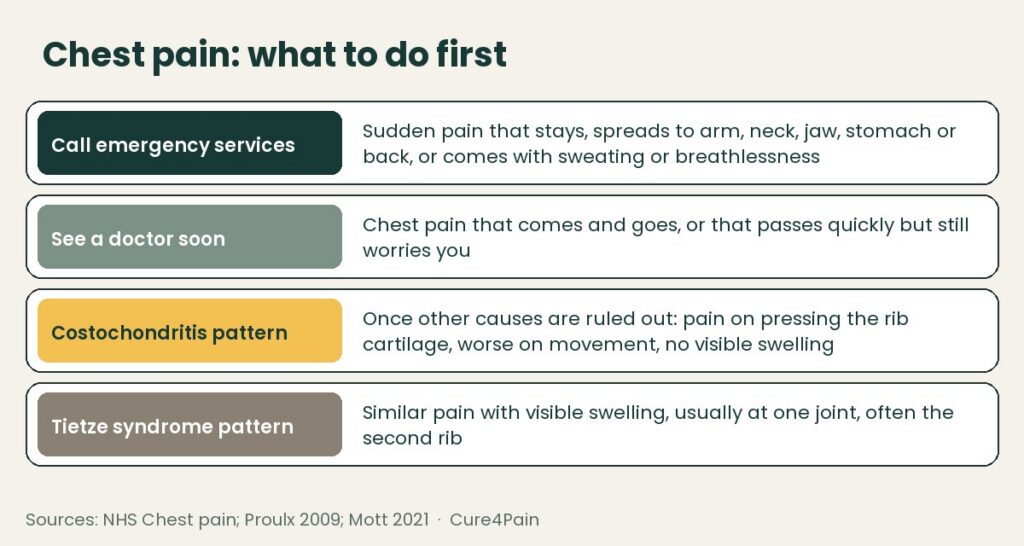
Call your local emergency number now if you have:
- Sudden pain that stays: it may feel like pressure, squeezing, burning or indigestion [1].
- Pain that spreads: to either arm, the neck, jaw, stomach or back [1].
- Pain with other symptoms: sweating, nausea, light-headedness or shortness of breath [1].
- Danger signs: severe difficulty breathing, pale, blue or grey lips or skin, or someone who has passed out. The NHS says not to drive yourself to hospital [5].
While you wait for help, if you think you or someone else is having a heart attack, the NHS advises sitting and resting, and taking aspirin (300mg) if you have any, unless you are allergic to it [5].
See a doctor soon if your chest pain comes and goes, or passes quickly but still worries you [1]. Your risk of a heart cause is higher with age, smoking, obesity, high blood pressure, diabetes, high cholesterol or a history of heart attacks or angina in family members under 60 [1].
The first office assessment of chest pain is a history, an examination and a 12-lead ECG, and anyone with signs of a heart attack or another life-threatening cause should travel to hospital by ambulance, according to a 2026 review for family doctors [6]. The 2021 American Heart Association and American College of Cardiology guideline sets out how clinicians should assess risk and choose tests [7]. A 2023 review of that guideline notes that women with acute coronary syndromes can face delays in diagnosis [8], so women with these symptoms should seek emergency help just as men should. According to a 2020 American Family Physician review, other serious causes of chest pain include a blood clot in the lung, a tear in the aorta, inflammation around the heart and pneumonia [9].
Can chest pain that hurts when pressed still be a heart problem?
Yes. Chest pain that hurts when pressed can still be a heart problem: pressing makes a chest wall cause more likely, but coronary artery disease is present in 3 to 6 percent of adults with chest pain and chest wall tenderness, according to a 2009 American Family Physician review [2]. A 2021 American Family Physician review warns that “a notable portion of patients with chest wall tenderness to palpation may also have acute myocardial infarction” (a heart attack) [4].
- In an emergency department: in a 1994 study of 122 people with chest pain, 6% of those with costochondritis had an acute heart attack, against 28% of those without it [10].
- In general practice: in a 2007 cohort study, among 300 people with chest wall pain across 58 practices, 19 also had coronary disease and 6 had a tumour [11].
- As a test: in a 2012 study of 672 primary care patients, 71% of those with chest wall pain had pain reproduced by pressing, but the authors state this sign is not proof, and three people with stable angina were wrongly classed as chest wall pain by their score [12].
- In recurrent chest pain: in a 2001 study of 71 people, chest wall tenderness alone did not appear to help exclude reduced blood flow to the heart, although the authors say differences between men and women stop this being conclusive [13].
- On the left side: most chest wall pain is left-sided, so the authors of a 2007 primary care cohort study advise careful thought about coexisting coronary disease [11].
What is costochondritis?
Costochondritis is inflammation of the joints where the rib cartilage meets the rib or the breastbone, felt as chest pain that is tender to press, according to a 2009 American Family Physician review [2].
- How it feels: typically sharp, aching or pressure-like, and worse with upper-body movement, deep breaths and exertion [2].
- Where it hurts: most often the second to fifth rib joints, especially ribs three and four, often at more than one level and usually on one side [2].
- Who gets it: most commonly adults aged 40 to 50, with slightly more women, according to a 2021 American Family Physician review [4].
- How common it is: a 2021 American Family Physician review reports costochondritis itself in 6% to 13% of primary care chest pain [4]. A 2021 meta-analysis of nine emergency department studies with 14,743 people found 16% of chest pain was musculoskeletal [14]. A 2015 systematic review found acute coronary syndrome or heart attack behind 1.5% to 3.6% of chest pain in general practice [3].
What causes costochondritis?
The cause of costochondritis is poorly understood, according to a 1994 emergency department study [10]. A 2009 American Family Physician review says a recent illness with coughing, strenuous exercise or physical activity that stresses the arms is a common history [2].
- A possible nutritional link, not proven: two adults diagnosed with costochondritis in a 2012 report also had vitamin D deficiency [15]. In a 2026 retrospective study of 610 children aged 3 to 18, lower vitamin D and folate went with higher odds of costochondritis; the comparison group was children with skeletal deformities after rickets, not healthy children, and the authors call for prospective studies [16]. A PubMed search in October 2026 found no trial testing whether correcting these changes the pain. Our article on deficiencies in joint and muscle pain explains these tests.
- Other diseases at the same joints, which need excluding: a 2009 American Family Physician review names infection, rheumatic disease and tumours in its passage on Tietze syndrome. Infection is linked particularly with chest wall trauma, such as stab wounds or surgery, and with intravenous drug use; less common causes are tumours of the rib, lung, pleura or muscle [2] [17].
What is Tietze syndrome, and how is it different?
Tietze syndrome presents like costochondritis but adds visible swelling at the joint; it is typically on one side at the second rib and is often set off by infection or trauma, according to a 2021 American Family Physician review [4]. A 2009 American Family Physician review compares the two as follows [2].
| Feature | Costochondritis | Tietze syndrome |
|---|---|---|
| Visible swelling | No | Yes |
| Site | Usually several joints, ribs 2 to 5 | Usually one cartilage, mostly rib 2 |
| Typical age | Older than 40 | Younger than 40 |
| How often seen | Common | Rarer |
Any swelling on the chest wall needs a doctor’s assessment. A 2024 review warns that spondyloarthritis and other rheumatic diseases can look like Tietze syndrome, so the diagnosis should be revisited over time [17]. A 2018 review describes Tietze syndrome as benign and self-limiting, assessed by examination, inflammatory blood markers, and ultrasound or MRI [18].
Trials in Tietze syndrome are small. In a 2022 randomised trial of 40 people with Tietze syndrome, adding a three-week oral steroid course to an anti-inflammatory medicine lowered pain more than the anti-inflammatory alone (65.4% against 46.7% at three weeks), yet visible swelling clearly improved in only 2 of 20 against 1 of 20 [19].
How is costochondritis diagnosed?
Costochondritis is diagnosed mostly by your history, an examination, and ruling out other causes: no blood test, scan or ECG finding is specific to it, according to a 2021 American Family Physician review [4].
| Step | Why it is done |
|---|---|
| Pressing the cartilage; arm and neck movements that provoke the pain | Reproducing your usual pain is the key finding [4] |
| ECG | Needed at a minimum for most people with chest pain; may be unwarranted in adolescents at low coronary risk [4] |
| Chest X-ray | With breathlessness, chest trauma, fever, cough or chest wall swelling [4] [2] |
| CT scan | Reserved for high suspicion of infection or tumour [2] |
| Blood tests | Not routine; used if the diagnosis is uncertain or there is fever or inflammation [2] |
A 2009 American Family Physician review advises an ECG, and possibly a chest X-ray, for anyone older than 35, anyone with coronary risk factors, and anyone with heart or lung symptoms [2].
How long does costochondritis last?
Costochondritis usually lasts weeks to months, according to a 2009 American Family Physician review [2], although studies disagree, partly because they studied different groups.
- Shorter estimates: a large observational study cited in a 2021 American Family Physician review found 91% of people with new costochondritis had no pain after three weeks of rest and anti-inflammatory medicine, with about 4% recurrence at two years [4].
- Longer estimates: the 2009 American Family Physician review describes weeks to months, usually settling by one year [2]. In a 1994 emergency department study, 11 of 21 people with costochondritis who were followed up still had chest pain a year later, though only a third still had definite costochondritis [10].
- Chest wall pain more broadly: it recurred in half of people over a year in a 2007 primary care cohort study, with a favourable outcome overall [11].
What is the treatment for costochondritis?
Once a doctor has ruled out other causes, treatment for costochondritis is conservative: reduce the activity that provokes it, use heat and simple pain relief where safe, and let it settle. A PubMed search in October 2026 found no treatment guideline specific to costochondritis, so a 2021 American Family Physician review is the closest guide, and its treatment advice carries the lowest evidence grade, which covers usual practice, expert opinion and case series [4].
| Option | What the evidence says |
|---|---|
| Less of the provoking activity | Traditional advice, with reassurance [2] |
| Heat | Often recommended; no clinical trials [4] |
| Oral anti-inflammatory medicines (NSAIDs) | Most commonly prescribed; no clinical trials of their effect [4] |
| Diclofenac gel, capsaicin cream, lidocaine patches | Recommended mainly from clinical experience [4] |
| Stretching guided by a physiotherapist | Small reduction in pain in people with symptoms for over a year [4] |
| Steroid injection | Inadequate evidence for costochondritis; only when usual care has not helped [4] |
What should you know before taking NSAIDs for chest pain?
Nonsteroidal anti-inflammatory drugs (NSAIDs) can harm the stomach, heart and kidneys, according to a 2013 Lancet analysis and the NHS, so ask a doctor or pharmacist before taking them for chest pain, especially if a heart cause has not yet been ruled out [20] [21].
- Stomach: in a 2013 Lancet analysis of hundreds of randomised trials, every NSAID regimen studied raised serious upper stomach and bowel complications [20]. Higher and more frequent doses can also worsen gastritis or reflux, which further complicates the diagnosis of chest pain, according to a 2021 American Family Physician review [4].
- Heart: at the doses tested in the 2013 Lancet analysis, heart failure risk roughly doubled with all NSAIDs, and major vascular events rose by about a third with coxibs and diclofenac [20].
- Kidneys: the NHS lists kidney problems among rare but serious side effects [21].
- Pregnancy, breastfeeding and other medicines: the NHS says NSAIDs are not usually recommended in pregnancy and breastfeeding, and advises against combining them with other NSAIDs, anticoagulants, steroids, antidepressants or blood pressure medicines without advice [21].
Our article on long-term painkiller side effects has more detail.
Can fibromyalgia cause chest pain?
It can be a source of chest wall pain: a 2021 American Family Physician review lists fibromyalgia among the possible causes once a chest wall source is identified [4]. In a 2022 study of 250 people with fibromyalgia in China, 55.3% of women and 75.8% of men reported chest pain [22]. That study and those below are observational and show how often the two occur together. Having fibromyalgia does not rule out a heart problem [13].
- With normal heart arteries: in a 1995 study, 30% of 40 people with chest pain and normal coronary angiograms had fibromyalgia, against 1 of 40 with coronary disease [23].
- Caution: a 2001 study of 71 people with recurrent chest pain found fibromyalgia does not preclude coexisting ischaemic heart disease [13].
Costochondritis and fibromyalgia overlap only partly. Only 8% of people with costochondritis met fibromyalgia criteria in a 1994 emergency department study, although widespread pain was more common in them (42% against 5%) [10]. Costochondritis is local and tender; in fibromyalgia, according to the NHS, “the main symptom is widespread pain” [24]. Our fibromyalgia page explains the condition and how we manage it.
Why does chest wall pain keep coming back?
Chest wall pain can return, and estimates differ: chest wall pain more broadly recurred in half of people over a year in a 2007 primary care cohort study [11], while a study of new costochondritis cited in a 2021 American Family Physician review reported about 4% recurrence at two years [4]. Pain that returns deserves a fresh look at the cause rather than an assumption that it is the same problem, so have any new or different chest pain assessed again.
- Heart and lungs: a previous normal result does not cover a new pattern of symptoms; use the emergency list above.
- Fibromyalgia: especially with widespread pain [24].
- Inflammatory arthritis: in a 2005 study of 50 people admitted with musculoskeletal chest pain, 12 had inflammatory joint disease [25], and spondyloarthritis can involve the same joints, according to a 2024 review [17].
- Ribs and spine: slipping rib syndrome, most symptomatic at the 10th rib in a study of 54 athletes [26], and problems in the neck and upper back, which a 2010 review lists among reported sources of chest pain [27].
- Reflux: often named as the most common cause of non-cardiac chest pain [28]. See our acidity page.
- Anxiety and panic: often undiagnosed in people with non-cardiac chest pain [29].
Our article on blood tests for chronic pain and fatigue covers tests a doctor may consider.
Do myofascial release and acupuncture help costochondritis?
Research on myofascial release and acupuncture for costochondritis is very limited. A PubMed search in October 2026, filtered to randomised controlled trials, found no trial of acupuncture, dry needling or myofascial release in costochondritis, Tietze syndrome or chest wall pain. A 2021 American Family Physician review states that “no randomized, controlled studies for effectiveness are available” for acupuncture, while listing acupuncture and physiotherapy as options that may be considered for stubborn symptoms, at its lowest evidence grade [4].
| Method | Closest evidence found | Limits |
|---|---|---|
| Acupuncture | Chart review of 3 adolescents with costochondritis; all reported less pain [30] | No comparison group |
| Acupuncture for spine pain | Trial in recent thoracic spine pain, reported in a 2015 systematic review: no difference from placebo electrotherapy [31] | Not costochondritis |
| Dry needling | One case: a 22-year-old with chest wall pain improved [32] | Single case |
| Myofascial release | No study in costochondritis. One case of soft tissue work with rib manipulation and stretching [33] | Single case, mixed methods |
| Manual therapy with exercise | 8 people with costochondritis for about 6 months; pain scores fell by 5.1 points [34] | No comparison group |
| Chiropractic care with spinal manipulation | Trial of 115 people with acute musculoskeletal chest pain: results favoured it over self-management on self-perceived change at 4 weeks and on pain intensity at 12 weeks [35], with no difference at one year [36] | Different methods; not blinded |
A 2014 meta-analysis of two trials with 229 people with musculoskeletal chest pain found manual therapy did better than usual care but not better than home exercise [37]. In recent chest wall pain, a 2015 systematic review reports that multimodal care (manual therapy, soft tissue therapy, exercises, heat or ice, and advice) reduced pain more than one education session, but not by a clinically important amount, although more people reported important improvement [31]. A 2026 anatomical review proposes that connected muscle and fascia of the neck, chest and arm may play a part in non-cardiac chest pain, and says their role remains unclear [28]. Because costochondritis often settles on its own, reports without a comparison group cannot show how much a treatment added.
A 2024 safety review found serious acupuncture adverse events to be rare, at about 0.04 to 0.08 per 10,000 treatments, and names pneumothorax (a collapsed lung) among the most likely of them, with deep needle penetration as one contributing factor [38]. New breathlessness or chest pain after needling needs the emergency list above.
How we treat costochondritis at Cure4Pain
At Cure4Pain, we treat costochondritis predominantly with myofascial release and acupuncture techniques.
- Main methods: myofascial release (hands-on work on muscles and the connective tissue around them) and acupuncture techniques.
- Heart safety: these methods do not replace an emergency or heart assessment of new chest pain. If your pain changes or a warning sign from the emergency list appears at any point, including during treatment, seek that help first.
- Evidence: our PubMed search found no randomised trial of either method in costochondritis, as set out in the section above. An integrative plan may add options alongside standard care.
- Tests: we read a panel of about 100 markers, adding tests for your condition when clinically indicated. We found no guideline specific to costochondritis. For a suspected heart cause, the UK NICE guideline CG95 sets out a resting 12-lead ECG and a high-sensitivity troponin blood test in hospital [39], and that assessment comes first.
- Painkillers: we generally avoid them for chest wall pain; where they are needed, Dr Krushal Pabari prescribes them short term, as needed. The 2021 American Family Physician review lists anti-inflammatory medicines as the most commonly prescribed option, with no clinical trials of their effect [4].
- Length of care: this is decided case by case and differs from person to person. According to a 2009 American Family Physician review, costochondritis usually lasts weeks to months [2].
- Medicines: any medicines you take stay under clinical guidance from Team Cure4Pain, in coordination with your existing consulting physician; never stop or change them on your own.
This is our clinic practice; individual results vary, and further studies are needed. Read more on our musculoskeletal and pain conditions page.
If your chest pain has been assessed and you would like to discuss chest wall pain with us, you can book a consultation, online from anywhere or at our Mumbai clinic.
Frequently asked questions
How can I tell costochondritis from a heart attack?
You cannot be sure on your own. Pain on pressing suggests the chest wall, but coronary disease is present in 3 to 6 percent of adults with chest pain and chest wall tenderness, according to a 2009 American Family Physician review, so new chest pain needs medical assessment, and an ambulance if it is sudden, spreading or comes with sweating or breathlessness. [2] [1]
Is costochondritis dangerous?
Costochondritis itself is usually self-limited and benign, according to a 2009 American Family Physician review. The danger lies in mistaking a heart or lung problem for it, which is why other causes must be ruled out first. [2]
Which side of the chest does costochondritis affect?
It most often affects one side, according to a 2009 American Family Physician review. Most chest wall pain is left-sided, according to a 2007 primary care cohort study, whose authors advise careful thought about coexisting coronary disease. [2] [11]
How long does costochondritis last?
Costochondritis often lasts a few weeks, but it can last months and usually settles by one year. In a 1994 emergency department study, 11 of 21 people followed up still had chest pain at a year, though only a third still had definite costochondritis. [4] [2] [10]
Can costochondritis cause shortness of breath?
Costochondritis can make deep breaths hurt, but shortness of breath should not be put down to it until other causes are checked. The NHS treats chest pain with shortness of breath as an emergency. [2] [1]
Can fibromyalgia cause chest pain?
It can be a source of chest wall pain, according to a 2021 American Family Physician review. Among 250 people with fibromyalgia in a 2022 study from China, 55.3% of women and 75.8% of men reported chest pain. A 2001 study found fibromyalgia does not rule out coexisting heart disease. [4] [22] [13]
What is the difference between costochondritis and Tietze syndrome?
Tietze syndrome adds visible swelling, usually at one cartilage at the second rib, and is rarer. Costochondritis has no visible swelling and usually affects several joints. [2] [4]
What is the best treatment for costochondritis?
No treatment for costochondritis has strong trial evidence. Once a doctor has ruled out other causes, usual care is less of the provoking activity, heat, and simple pain relief where safe; a 2021 American Family Physician review lists acupuncture, physiotherapy and steroid injections as options for stubborn symptoms, at its lowest evidence grade. [4]
Can low vitamin D cause costochondritis?
Low vitamin D has not been established as a cause of costochondritis. A 2026 study in children linked lower levels with higher odds of it and a 2012 report described two adults with both, but a PubMed search found no trial testing whether correcting low vitamin D changes the pain. [16] [15]
Why does costochondritis keep coming back?
Figures differ: a study cited in a 2021 American Family Physician review found about 4% recurrence of costochondritis at two years, while chest wall pain more broadly recurred in half of people over a year in a 2007 primary care cohort study. Repeat pain deserves a fresh assessment, including for fibromyalgia, inflammatory arthritis, rib and spine problems and reflux. [4] [11] [25]
This article is for education and does not replace medical advice. Do not start, stop or change any medicine or supplement without medical guidance.
References
1. NHS (UK National Health Service). Chest pain. nhs.uk/symptoms/chest-pain
2. Proulx AM, Zryd TW. Costochondritis: diagnosis and treatment. Am Fam Physician 2009;80(6):617-20. PubMed 19817327
3. Haasenritter J, et al. Causes of chest pain in primary care–a systematic review and meta-analysis. Croat Med J 2015;56(5):422-30. doi:10.3325/cmj.2015.56.422
4. Mott T, et al. Costochondritis: Rapid Evidence Review. Am Fam Physician 2021;104(1):73-78. PubMed 34264599
5. NHS (UK National Health Service). Heart attack: symptoms. nhs.uk/conditions/heart-attack/symptoms
6. Greenberg J, et al. Cardiovascular Signs and Symptoms: Chest Pain: Evaluation in the Office Setting. FP Essent 2026;562:7-16. PubMed 41838990
7. Gulati M, et al. 2021 AHA/ACC/ASE/CHEST/SAEM/SCCT/SCMR Guideline for the Evaluation and Diagnosis of Chest Pain: A Report of the American College of Cardiology/American Heart Association Joint Committee on Clinical Practice Guidelines. Circulation 2021;144(22):e368-e454. doi:10.1161/CIR.0000000000001029
8. Kaur G, et al. Chest Pain in Women: Considerations From the 2021 AHA/ACC Chest Pain Guideline. Curr Probl Cardiol 2023;48(7):101697. doi:10.1016/j.cpcardiol.2023.101697
9. McConaghy JR, et al. Acute Chest Pain in Adults: Outpatient Evaluation. Am Fam Physician 2020;102(12):721-727. PubMed 33320506
10. Disla E, et al. Costochondritis. A prospective analysis in an emergency department setting. Arch Intern Med 1994;154(21):2466-9. doi:10.1001/archinte.154.21.2466
11. Verdon F, et al. Chest wall syndrome among primary care patients: a cohort study. BMC Fam Pract 2007;8:51. doi:10.1186/1471-2296-8-51
12. Ronga A, et al. Development and validation of a clinical prediction rule for chest wall syndrome in primary care. BMC Fam Pract 2012;13:74. doi:10.1186/1471-2296-13-74
13. Ho M, et al. Chest wall tenderness is unhelpful in the diagnosis of recurrent chest pain. QJM 2001;94(5):267-70. doi:10.1093/qjmed/94.5.267
14. Mandrekar S, et al. Prevalence of musculoskeletal chest pain in the emergency department: a systematic review and meta-analysis. Scand J Pain 2021;21(3):434-444. doi:10.1515/sjpain-2020-0168
15. Oh RC, Johnson JD. Chest pain and costochondritis associated with vitamin d deficiency: a report of two cases. Case Rep Med 2012;2012:375730. doi:10.1155/2012/375730
16. Ma L, et al. Low vitamin D and folate levels are associated with costochondritis: a retrospective cross-sectional study on children with impaired bone health. BMC Pediatr 2026;26(1). doi:10.1186/s12887-025-06117-2
17. Matsuki Y, Nakamura T. Spondyloarthritis and Tietze’s syndrome: A re-evaluation. Mod Rheumatol 2024;35(1):1-6. doi:10.1093/mr/roae086
18. Rokicki W, et al. What do we know about Tietze’s syndrome? Kardiochir Torakochirurgia Pol 2018;15(3):180-182. doi:10.5114/kitp.2018.78443
19. Elsayed HH, et al. The efficacy of oral corticosteroids for treatment of Tietze syndrome: A pragmatic randomized controlled trial. J Clin Pharm Ther 2022;47(12):2279-2286. doi:10.1111/jcpt.13810
20. Bhala N, et al. Vascular and upper gastrointestinal effects of non-steroidal anti-inflammatory drugs: meta-analyses of individual participant data from randomised trials. Lancet 2013;382(9894):769-79. doi:10.1016/S0140-6736(13)60900-9
21. NHS (UK National Health Service). NSAIDs. nhs.uk/medicines/nsaids
22. Liang DF, et al. [Analysis of clinical and psychological characteristics in 250 patients with fibromyalgia]. Zhonghua Nei Ke Za Zhi 2022;61(12):1351-1356. doi:10.3760/cma.j.cn112138-20220110-00028
23. Mukerji B, et al. The prevalence of rheumatologic disorders in patients with chest pain and angiographically normal coronary arteries. Angiology 1995;46(5):425-30. doi:10.1177/000331979504600510
24. NHS (UK National Health Service). Fibromyalgia: symptoms. nhs.uk/conditions/fibromyalgia/symptoms
25. How J, et al. The causes of musculoskeletal chest pain in patients admitted to hospital with suspected myocardial infarction. Eur J Intern Med 2005;16(6):432-6. doi:10.1016/j.ejim.2005.07.002
26. Foley CM, et al. Diagnosis and Treatment of Slipping Rib Syndrome. Clin J Sport Med 2019;29(1):18-23. doi:10.1097/JSM.0000000000000506
27. Stochkendahl MJ, Christensen HW. Chest pain in focal musculoskeletal disorders. Med Clin North Am 2010;94(2):259-73. doi:10.1016/j.mcna.2010.01.007
28. Raja G P, et al. The Myofascial Continuum: Anatomical Insights Into Noncardiac Chest Pain. Clin Anat 2026;39(1):2-8. doi:10.1002/ca.70004
29. Wertli MM, et al. Diagnostic indicators of non-cardiovascular chest pain: a systematic review and meta-analysis. BMC Med 2013;11:239. doi:10.1186/1741-7015-11-239
30. Lin K, Tung C. Integrating Acupuncture for the Management of Costochondritis in Adolescents. Med Acupunct 2017;29(5):327-330. doi:10.1089/acu.2017.1233
31. Southerst D, et al. The effectiveness of noninvasive interventions for musculoskeletal thoracic spine and chest wall pain: a systematic review by the Ontario Protocol for Traffic Injury Management (OPTIMa) collaboration. J Manipulative Physiol Ther 2015;38(7):521-31. doi:10.1016/j.jmpt.2015.06.001
32. Westrick RB, et al. Evaluation and treatment of musculoskeletal chest wall pain in a military athlete. Int J Sports Phys Ther 2012;7(3):323-32. PubMed 22666647
33. Barranco-Trabi J, et al. Atypical Costochondritis: Complete Resolution of Symptoms After Rib Manipulation and Soft Tissue Mobilization. Cureus 2021;13(4):e14369. doi:10.7759/cureus.14369
34. Zaruba RA, Wilson E. IMPAIRMENT BASED EXAMINATION AND TREATMENT OF COSTOCHONDRITIS: A CASE SERIES. Int J Sports Phys Ther 2017;12(3):458-467. PubMed 28593100
35. Stochkendahl MJ, et al. Chiropractic treatment vs self-management in patients with acute chest pain: a randomized controlled trial of patients without acute coronary syndrome. J Manipulative Physiol Ther 2012;35(1):7-17. doi:10.1016/j.jmpt.2010.11.004
36. Stochkendahl MJ, et al. A randomized clinical trial of chiropractic treatment and self-management in patients with acute musculoskeletal chest pain: 1-year follow-up. J Manipulative Physiol Ther 2012;35(4):254-62. doi:10.1016/j.jmpt.2012.04.003
37. Burgstaller JM, et al. Treatment efficacy for non-cardiovascular chest pain: a systematic review and meta-analysis. PLoS One 2014;9(8):e104722. doi:10.1371/journal.pone.0104722
38. Huang CC, et al. Acupuncture: A Review of the Safety and Adverse Events and the Strategy of Potential Risk Prevention. Am J Chin Med 2024;52(6):1555-1587. doi:10.1142/S0192415X24500617
39. National Institute for Health and Care Excellence (NICE). Recent-onset chest pain of suspected cardiac origin: assessment and diagnosis. CG95, 2010. nice.org.uk/guidance/cg95

