Written by AT. Chintan Dalal, N.D. · Reviewed by Dr Krushal Pabari, Clinical Team, Cure4Pain · Updated 30 October 2026
Key facts
No blood test diagnoses chronic fatigue syndrome (ME/CFS) or fibromyalgia, according to the UK’s National Institute for Health and Care Excellence (NICE) and the 2012 Canadian fibromyalgia guideline; tests look for other conditions [1] [2]. NICE guideline NG206 (2021) lists these tests to exclude other diagnoses in suspected ME/CFS: a blood count, kidney, liver and thyroid tests, erythrocyte sedimentation rate (ESR), C-reactive protein (CRP), calcium, phosphate, HbA1c, ferritin, coeliac screening, creatine kinase and a urine test, with vitamin D, B12 and folate added by clinical judgement [1]. NICE’s chronic pain guideline (NG193, 2021) sets no test list and leaves the search for a cause to clinical judgement [3]. More tests are not always better: in the Dutch VAMPIRE trial (2009) of 325 people with new unexplained fatigue, 8% had an illness detectable by blood tests, and false positives rose with larger test sets [4]. Too few tests is also a problem: a 2013 meta-analysis of laboratory testing, not specific to pain or fatigue, reported mean rates of 20.6% for over-use and 44.8% for under-use [5]. According to the US National Institutes of Health, serum magnesium does not accurately reflect the body’s magnesium [6].

Scientific explainer videos in our Resources section
In our Resources section, our clinical team discusses vitamin D, its cofactors and how autoimmune, lifestyle and pain conditions develop.
Which blood tests should you ask for with fatigue?
For fatigue, ask about the tests that the UK’s National Institute for Health and Care Excellence (NICE) lists for suspected ME/CFS (myalgic encephalomyelitis/chronic fatigue syndrome), then add others according to your symptoms. NICE guideline NG206 (2021) names these investigations to exclude other diagnoses, and says the list is not exhaustive [1]:
- Blood count and iron stores: full blood count and serum ferritin.
- Organs and minerals: urea and electrolytes, liver function, calcium and phosphate.
- Hormones and sugar: thyroid function and HbA1c (average blood sugar).
- Inflammation: erythrocyte sedimentation rate (ESR) or plasma viscosity, and C-reactive protein (CRP).
- Gut and muscle: coeliac screening and creatine kinase.
- Urine: a test for protein, blood and glucose.
NICE then leaves further tests to clinical judgement, for example vitamin D, vitamin B12 and folate, infection tests if there is a history of infection, and a 9 am cortisol if adrenal insufficiency is suspected [1]. The NICE list was written for suspected ME/CFS, not for every person who feels tired, so your doctor may reasonably choose fewer tests after a short illness or poor sleep.
A 2023 review in American Family Physician says the history and examination should guide the first tests, and that testing without a specific reason may change treatment in only 5% of patients [7]. In PubMed searches on 30 October 2026, we did not find an Indian guideline that lists tests for chronic fatigue or chronic pain.
Which blood tests help with chronic pain?
Which blood tests help with chronic pain depends on the type of pain, because no single list exists. The UK’s NICE guideline NG193 (2021) defines chronic pain as pain that persists or recurs for more than 3 months and asks for a person-centred assessment; the decision to search for an underlying injury or disease is made by clinical judgement, in discussion with you, and the guideline names no blood tests [3]. Guidelines for specific conditions are more exact:
- Widespread pain and tiredness: the Canadian fibromyalgia guideline (2012) says no laboratory test confirms fibromyalgia, and limits testing to a full blood count, ESR, CRP, creatine kinase and thyroid-stimulating hormone (TSH), with more only if the examination suggests another condition [2].
- Swollen joints: NICE NG100 (2018) advises offering a rheumatoid factor test to people with suspected rheumatoid arthritis and joint inflammation (synovitis) on examination, and considering anti-CCP antibodies if that test is negative [8]. See our page on rheumatoid arthritis.
- Back pain with morning stiffness: NICE NG65 (2017) says a normal CRP, a normal ESR or a negative HLA-B27 result does not rule out spondyloarthritis, a group that includes ankylosing spondylitis [9].
- Sudden painful joint attacks: NICE NG219 (2022) uses a serum urate of 360 micromol/L (6 mg/dL) or more to confirm a clinical diagnosis of gout in people with symptoms and signs [10]. Our article on high uric acid and gout has the details.
- Muscle pain on a statin: NICE NG238 (2023) advises measuring creatine kinase [11].
Why check nutrient levels with chronic pain or fatigue?
Nutrient levels can be worth checking because low vitamin D and B12 are common in Indian studies and a deficiency can be missed, although correcting it does not always change the symptom: a 2015 Cochrane review found a large benefit of vitamin D across chronic painful conditions unlikely [12].
- Vitamin D in India: in a 2015 study of 328 people with chronic low back pain at the pain clinic of a tertiary hospital in India, 86% had below-normal levels and 66% were deficient; deficiency was linked with disability but not with pain severity, and there was no treatment comparison in this analysis [13]. A 2018 controlled study in India found overall deficiency was similar in chronic back pain and in healthy controls (53.6% and 51.6%), but levels of 16 ng/mL or less were more common in chronic back pain (43.6% and 20.1%) [14].
- Vitamin D elsewhere: in a 2003 study at an inner-city primary care clinic in Minneapolis, without a comparison group, 93% of 150 people with persistent non-specific muscle and bone pain had deficient levels (20 ng/mL or less) [15]. A 2015 Cochrane review of 10 trials with 811 participants found that a large benefit of vitamin D across chronic painful conditions is unlikely, and that specific conditions need more study [12].
- Vitamin B12: NICE NG239 (2024) lists unexplained fatigue among the common symptoms, and says the absence of anaemia does not rule out a deficiency [16]. In a 2019 study of records from a tier 3 north Indian city, 47% of 267 people had levels below 200 pg/mL [17]. Read more on vitamin B12 deficiency.
- Iron: in a 2018 BMJ Open review of 18 randomised trials with 1,170 iron-deficient adults without anaemia, iron reduced self-reported fatigue but did not improve measured physical capacity [18].
Our article on deficiencies linked with joint and muscle pain covers the wider evidence, and vitamin D deficiency has its own article.
What does each blood test show, and what can it miss?
Each blood test answers one narrow question and has a known limit. According to NICE NG239 (2024), the absence of anaemia does not rule out B12 deficiency [16]. In patient databases from Finland and the US, ESR and CRP were both normal at first record in 33% and 42% of people with rheumatoid arthritis [19].
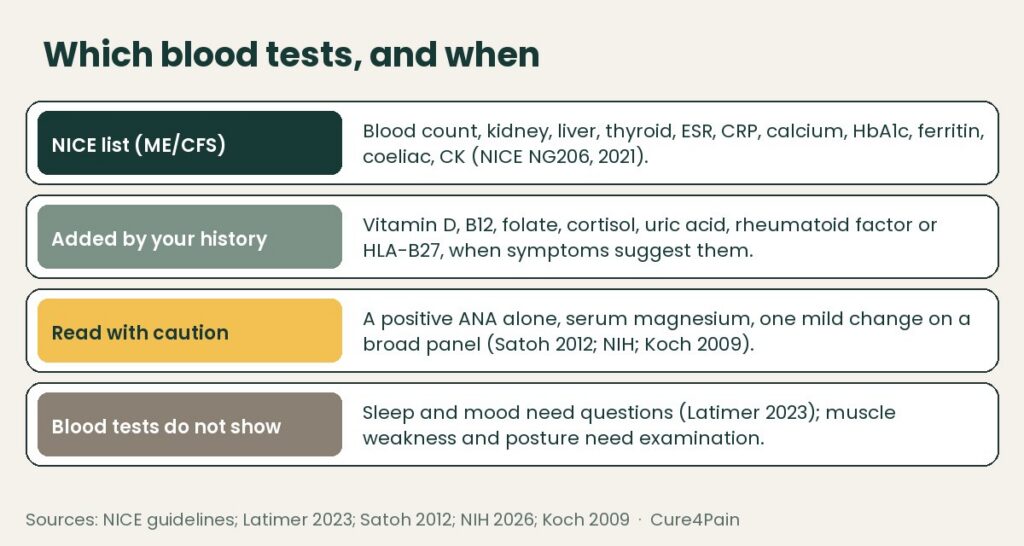
The first table covers the tests on the NICE NG206 (2021) list for suspected ME/CFS.
| Test | What it shows | Its limit |
|---|---|---|
| Full blood count | Anaemia and changes in blood cells | A normal count does not rule out B12 deficiency [16] |
| Ferritin | Iron stores | Can look normal with inflammation, according to the British Society of Gastroenterology (2021) [20]; the World Health Organization (2020) uses a higher cut-off when inflammation is present (70 µg/L against 15 µg/L in adults) [21] |
| Erythrocyte sedimentation rate (ESR) and C-reactive protein (CRP) | Signs of inflammation | Neither names a cause; both were normal at first record in 33% and 42% of people with rheumatoid arthritis in databases from Finland and the US [19] |
| Thyroid function (TSH first) | An under- or overactive thyroid | One symptom alone may not point to thyroid disease, and an acute illness can affect the result [22] |
| HbA1c | Average blood sugar | Iron deficiency can falsely raise it, and other anaemias may lower it [23] |
| Kidney, liver, calcium, phosphate | Organ function and minerals | Used to exclude other conditions; in a fatigue trial, wider test sets gave more false positives [1] [4] |
| Creatine kinase | Muscle cell damage | On a statin, a level below 5 times the upper limit makes the statin an unlikely cause, and other causes are explored [11] |
| Coeliac antibodies | An immune response to gluten | Accurate only if you are eating gluten: more than 1 meal a day for at least 6 weeks before testing [24] |
The second table covers tests that are usually added because of your symptoms, diet or medicines.
| Test | What it shows | Its limit |
|---|---|---|
| Vitamin B12 (total or active) | B12 in the blood | Supplements can raise the result without fully treating a deficiency. The combined pill can lower total B12 without one, although a low result may still mean a deficiency. Methylmalonic acid or homocysteine can help when the result is uncertain [16] |
| Vitamin D (25-hydroxy) | Vitamin D status | No single level defines deficiency, according to the US Preventive Services Task Force (2021) [25] |
| Serum magnesium | Magnesium in the blood only | Does not show tissue levels [6] |
| Antinuclear antibodies (ANA) | Antibodies seen in autoimmune disease | Positive in 13.8% of people aged 12 and over in a US national sample, so a positive result does not establish a disease [26] |
| Rheumatoid factor, anti-CCP | Antibodies linked with rheumatoid arthritis | Rheumatoid factor was negative in 37% to 38% of people with the disease [19]; NICE advises referral for some people with joint inflammation even if results are negative [8] |
| Uric acid | Serum urate | Can be lower during a gout attack; NICE advises repeating it at least 2 weeks after the attack settles [10] |
| HLA-B27 | A gene linked with spondyloarthritis | A negative result does not rule the condition out [9] |
The American College of Rheumatology (2013) advises against testing ANA subtypes without a positive ANA and a clinical suspicion of immune disease, and against broad antibody testing [27]. Our article on prediabetes and HbA1c explains that result in depth.
Can a blood test show your magnesium levels?
Not reliably: according to the US National Institutes of Health, less than 1% of the body’s magnesium is in blood serum, and serum levels do not accurately reflect total body magnesium or the levels in specific tissues [6]. A normal serum result therefore does not show that your tissues have enough. The National Institutes of Health also says a full evaluation may need both laboratory tests and a clinical assessment. Our article on forms of magnesium covers absorption.
Can too many blood tests cause problems?
Yes. In the Dutch VAMPIRE trial of new unexplained fatigue (2009), false positives rose with larger test sets [4], and in a 2013 meta-analysis of people at low risk of serious illness, tests did little to reduce worry [28]. Too few tests is also a problem: a separate 2013 meta-analysis of laboratory testing reported a higher mean rate of under-use than of over-use [5].
- False positives: in the VAMPIRE trial in the Netherlands (2009), 91 general practitioners tested 325 people with new unexplained fatigue. Only 8% had an illness detectable by blood tests, and false-positive results rose in particular with the expanded test set. The authors support limiting the number of tests [4].
- Serious disease is uncommon: a 2016 review of 26 primary care studies of tiredness found, in its high-quality studies, anaemia in 2.8%, cancer in 0.6%, serious physical disease in 4.3% and depression in 18.5%. The authors advise extensive tests only when the history or examination gives a specific reason [29].
- Reassurance: in a 2013 meta-analysis in JAMA Internal Medicine of 14 randomised trials with 3,828 people at low risk of serious illness, tests did little to reduce worry or symptoms, although they may slightly reduce later visits to primary care [28].
- Vitamin D testing: the Endocrine Society (2024) suggests against routine testing in the general population without an established reason [30], and the US Preventive Services Task Force (2021) finds the evidence insufficient for people without symptoms [25]. The Task Force statement does not cover people who have symptoms, and the Endocrine Society statement does not cover people with an established reason for testing.
- Too few tests: a 2013 meta-analysis of laboratory testing (PLoS One), not specific to pain or fatigue, reported a higher mean rate of under-use (44.8%) than of over-use (20.6%), and its authors call under-use widespread but understudied [5].
In a PubMed search of randomised trials on 30 October 2026, we found no trial comparing a broad panel with a shorter list in people with chronic pain or long-lasting fatigue, so the right number of tests for this group is not settled. The trials and reviews of testing cited here mostly involve new symptoms in general practice.
What if your blood tests are normal but you still feel unwell?
Normal results rule out some causes; they do not mean your symptoms are not real. NICE guideline NG206 (2021) says there is no diagnostic test for ME/CFS, which is recognised on clinical grounds alone [1], and the 2012 Canadian fibromyalgia guideline says no laboratory test confirms fibromyalgia [2]. NICE guideline NG193 (2021) also recognises chronic primary pain, in which no underlying condition adequately accounts for the pain or its impact [3].
The next step is usually questions and examination rather than more blood tests. A 2023 review in American Family Physician advises checking sleep, mood, substance use and medicines first [7]. Blood tests also do not show muscle weakness or posture. If poor sleep is part of the picture, see our page on insomnia.
How do you ask your doctor for the right blood tests?
Describe your symptoms, diet, medicines, supplements and family history first, then ask which tests fit them. These points change which tests are useful:
- Your symptoms: how long they have lasted, whether rest helps, and whether you have morning stiffness, swelling, or numbness.
- Your diet: according to NICE NG239 (2024), a vegan diet, or one low in animal foods, is a risk factor for low B12 [16].
- Your medicines: metformin and acid-reducing medicines are risk factors for low B12 [16], and statins are the reason to measure creatine kinase if your muscles hurt [11].
- Your supplements: tell the laboratory or doctor about any B12 you already take, and have B12 tests before starting it [16].
- Gluten: do not start a gluten-free diet before coeliac testing [24].
- Your family history: coeliac or other autoimmune disease [24] [16].
- Three useful questions: which result would change my care? What can this test miss? What will we do if it is slightly outside the range?
How we use blood tests at Cure4Pain
At Cure4Pain, we read a panel of about 100 markers, adding tests for your condition when clinically indicated, together with your history and examination.
- Add-on tests: when clinically indicated, these include tests named in guidelines, such as creatine kinase, HbA1c, kidney and liver tests, ferritin and folate from NICE NG206 (2021) [1], and rheumatoid factor or anti-CCP for swollen joints from NICE NG100 (2018) [8].
- Back pain: the panel includes ESR, CRP, vitamin D, B12, thyroid function and uric acid. We add HLA-B27 for inflammatory back pain and a DEXA bone scan when thin bones are suspected. Muscle testing, posture and gait assessment and scan review cover what blood tests cannot show. See our lower back pain page.
- Fibromyalgia: baseline tests include vitamin D, thyroid profile, B12, ferritin, CRP and ESR.
- Gut symptoms: the panel includes ANA, vitamin D, B12, iron and thyroid function, with stool tests (an inflammation marker and parasites), a breath test for small intestinal bacterial overgrowth, *H. pylori* and coeliac antibodies. Commercial microbiome tests are used little. See our gut health page.
- Vitamin D: a vitamin D deficiency on its own is managed with standard doses as per guidelines.
- Magnesium: we assess magnesium status from the overall clinical picture.
- Where: blood tests are done at a laboratory near you and reviewed with you in the consultation.
- Urgent signs: sudden or severe back pain and other warning signs go straight to a hospital or spine surgeon. We refer to a gastroenterologist for signs such as blood in the stool, weight loss or night symptoms.
- Medicines: painkillers and other medicines are reviewed under clinical guidance from Team Cure4Pain, in coordination with your existing consulting physician; never stop or change them on your own.
The Cure4Pain panel is wider than the NICE and Canadian guideline lists, and we found no trial comparing a broad panel with a shorter list in chronic pain or fatigue. An integrative plan may add options alongside standard care. This is our clinic practice; individual results vary, and further studies are needed.
If you would like your blood tests read together with your history and symptoms, you can book a consultation, online from anywhere or at our Mumbai clinic.
Frequently asked questions
What blood tests should I ask for if I am always tired?
Ask about the blood tests in the UK’s NICE guideline NG206 (2021) for suspected ME/CFS: a full blood count, kidney, liver and thyroid tests, ESR, CRP, calcium, phosphate, HbA1c, ferritin, coeliac screening and creatine kinase. Vitamin D, B12 and folate are added by clinical judgement. Your doctor may choose fewer tests if your history points to a clear cause. [1]
What blood tests are done for chronic pain?
No single list of blood tests exists for chronic pain. NICE NG193 (2021) leaves the search for a cause to clinical judgement. Tests depend on the pattern, such as ESR, CRP, creatine kinase and TSH for widespread pain (Canadian fibromyalgia guideline, 2012), or rheumatoid factor for swollen joints (NICE NG100, 2018). [3] [2] [8]
Why are my blood tests normal but I am still tired?
Normal results rule out some causes only. A 2023 review in American Family Physician advises checking sleep, mood, substance use and medicines, and NICE says ME/CFS has no diagnostic test and is recognised on clinical grounds. [7] [1]
Can a blood test diagnose fibromyalgia or chronic fatigue syndrome?
No. NICE guideline NG206 (2021) says no diagnostic test exists for ME/CFS, and the 2012 Canadian fibromyalgia guideline says no laboratory test confirms fibromyalgia. Blood tests are used to look for other conditions. [1] [2]
Should vitamin D be tested with chronic pain?
It is decided case by case. NICE NG206 (2021) leaves it to clinical judgement in suspected ME/CFS, and the Endocrine Society (2024) suggests against routine testing in the general population without an established reason. Low levels are common in Indian studies of chronic back pain, although one controlled study found overall deficiency similar in healthy controls, and a 2015 Cochrane review found a large benefit from vitamin D across chronic pain unlikely. [1] [30] [13] [14] [12]
Does a blood test show magnesium deficiency?
A serum test does not show tissue levels. The US National Institutes of Health says less than 1% of body magnesium is in serum and that a full evaluation may need laboratory tests and a clinical assessment. [6]
Does a positive ANA mean I have an autoimmune disease?
Not on its own. In a US national survey (NHANES 1999-2004), 13.8% of people aged 12 and over had a positive antinuclear antibody (ANA) test, so the result is read together with your symptoms and examination. [26]
Is a full-body checkup the same as the right tests?
Not necessarily. In the Dutch VAMPIRE trial in fatigue (2009), wider test sets gave more false positives, while a 2013 meta-analysis found under-use of laboratory tests is also common. At Cure4Pain we use a wide panel and read it with your history; we found no trial comparing a broad panel with a shorter list in chronic pain or fatigue. [4] [5]
This article is for education and does not replace medical advice. Do not start, stop or change any medicine or supplement without medical guidance.
References
1. National Institute for Health and Care Excellence (NICE). Myalgic encephalomyelitis (or encephalopathy)/chronic fatigue syndrome: diagnosis and management. Guideline NG206, 2021. nice.org.uk/guidance/ng206
2. Fitzcharles MA, et al. 2012 Canadian Guidelines for the diagnosis and management of fibromyalgia syndrome: executive summary. Pain Res Manag 2013;18(3):119-26. doi:10.1155/2013/918216
3. National Institute for Health and Care Excellence (NICE). Chronic pain (primary and secondary) in over 16s: assessment of all chronic pain and management of chronic primary pain. Guideline NG193, 2021. nice.org.uk/guidance/ng193
4. Koch H, et al. Ordering blood tests for patients with unexplained fatigue in general practice: what does it yield? Results of the VAMPIRE trial. Br J Gen Pract 2009;59(561):e93-100. doi:10.3399/bjgp09X420310
5. Zhi M, et al. The landscape of inappropriate laboratory testing: a 15-year meta-analysis. PLoS One 2013;8(11):e78962. doi:10.1371/journal.pone.0078962
6. National Institutes of Health, Office of Dietary Supplements. Magnesium: Fact Sheet for Health Professionals (updated 6 January 2026). ods.od.nih.gov
7. Latimer KM, et al. Fatigue in Adults: Evaluation and Management. Am Fam Physician 2023;108(1):58-69. PubMed 37440739
8. National Institute for Health and Care Excellence (NICE). Rheumatoid arthritis in adults: management. Guideline NG100, 2018. nice.org.uk/guidance/ng100
9. National Institute for Health and Care Excellence (NICE). Spondyloarthritis in over 16s: diagnosis and management. Guideline NG65, 2017. nice.org.uk/guidance/ng65
10. National Institute for Health and Care Excellence (NICE). Gout: diagnosis and management. Guideline NG219, 2022. nice.org.uk/guidance/ng219
11. National Institute for Health and Care Excellence (NICE). Cardiovascular disease: risk assessment and reduction, including lipid modification. Guideline NG238, 2023. nice.org.uk/guidance/ng238
12. Straube S, et al. Vitamin D for the treatment of chronic painful conditions in adults. Cochrane Database Syst Rev 2015;2015(5):CD007771. doi:10.1002/14651858.CD007771.pub3
13. Ghai B, et al. High Prevalence of Hypovitaminosis D in Indian Chronic Low Back Patients. Pain Physician 2015;18(5):E853-62. PubMed 26431139
14. Panwar A, et al. Prevalence of vitamin D deficiency in chronic and subacute low back pain patients in India: a triple-arm controlled study. Clin Rheumatol 2018;37(5):1367-1374. doi:10.1007/s10067-017-3798-z
15. Plotnikoff GA, Quigley JM. Prevalence of severe hypovitaminosis D in patients with persistent, nonspecific musculoskeletal pain. Mayo Clin Proc 2003;78(12):1463-70. doi:10.4065/78.12.1463
16. National Institute for Health and Care Excellence (NICE). Vitamin B12 deficiency in over 16s: diagnosis and management. Guideline NG239, 2024. nice.org.uk/guidance/ng239
17. Singla R, et al. Vitamin B12 Deficiency is Endemic in Indian Population: A Perspective from North India. Indian J Endocrinol Metab 2019;23(2):211-214. doi:10.4103/ijem.IJEM_122_19
18. Houston BL, et al. Efficacy of iron supplementation on fatigue and physical capacity in non-anaemic iron-deficient adults: a systematic review of randomised controlled trials. BMJ Open 2018;8(4):e019240. doi:10.1136/bmjopen-2017-019240
19. Sokka T, Pincus T. Erythrocyte sedimentation rate, C-reactive protein, or rheumatoid factor are normal at presentation in 35%-45% of patients with rheumatoid arthritis seen between 1980 and 2004: analyses from Finland and the United States. J Rheumatol 2009;36(7):1387-90. doi:10.3899/jrheum.080770
20. Snook J, et al. British Society of Gastroenterology guidelines for the management of iron deficiency anaemia in adults. Gut 2021;70(11):2030-2051. doi:10.1136/gutjnl-2021-325210
21. World Health Organization. WHO guideline on use of ferritin concentrations to assess iron status in individuals and populations. Geneva: WHO; 2020. who.int
22. National Institute for Health and Care Excellence (NICE). Thyroid disease: assessment and management. Guideline NG145, 2019. nice.org.uk/guidance/ng145
23. English E, et al. The effect of anaemia and abnormalities of erythrocyte indices on HbA1c analysis: a systematic review. Diabetologia 2015;58(7):1409-21. doi:10.1007/s00125-015-3599-3
24. National Institute for Health and Care Excellence (NICE). Coeliac disease: recognition, assessment and management. Guideline NG20, 2015. nice.org.uk/guidance/ng20
25. Krist AH, et al. Screening for Vitamin D Deficiency in Adults: US Preventive Services Task Force Recommendation Statement. JAMA 2021;325(14):1436-1442. doi:10.1001/jama.2021.3069
26. Satoh M, et al. Prevalence and sociodemographic correlates of antinuclear antibodies in the United States. Arthritis Rheum 2012;64(7):2319-27. doi:10.1002/art.34380
27. Yazdany J, et al. Choosing wisely: the American College of Rheumatology’s Top 5 list of things physicians and patients should question. Arthritis Care Res (Hoboken) 2013;65(3):329-39. doi:10.1002/acr.21930
28. Rolfe A, Burton C. Reassurance after diagnostic testing with a low pretest probability of serious disease: systematic review and meta-analysis. JAMA Intern Med 2013;173(6):407-16. doi:10.1001/jamainternmed.2013.2762
29. Stadje R, et al. The differential diagnosis of tiredness: a systematic review. BMC Fam Pract 2016;17(1):147. doi:10.1186/s12875-016-0545-5
30. Demay MB, et al. Vitamin D for the Prevention of Disease: An Endocrine Society Clinical Practice Guideline. J Clin Endocrinol Metab 2024;109(8):1907-1947. doi:10.1210/clinem/dgae290