Written by AT. Chintan Dalal, N.D. · Reviewed by Dr Krushal Pabari, Clinical Team, Cure4Pain · Updated 30 October 2026
Key facts
Cognitive behavioural therapy for insomnia (CBT-I) comes before any supplement: the American Academy of Sleep Medicine (AASM) strongly recommends it (2021), and the European Insomnia Guideline 2023 names it first-line [1] [2]. The AASM (2017) suggests not using melatonin for insomnia, as a weak recommendation [3]; a 2013 meta-analysis of 19 trials of primary sleep disorders, 14 of them on insomnia, showed small average effects, about 7 minutes faster sleep onset [4], and a 2022 network meta-analysis in The Lancet found no overall material benefit [5]. A 2026 review of 12 trials found magnesium results inconsistent, with low to very low certainty [6]. A 2018 meta-analysis linked vitamin D deficiency with sleep disorders (odds ratio 1.50 in 9 studies) [7], and a 2022 meta-analysis of 3 trials showed better sleep scores with vitamin D [8], but a 12-month trial in postmenopausal women found no overall gain [9]. According to the US National Institutes of Health (NIH), the adult upper limit from supplements is 350 mg of elemental magnesium a day, and the upper limit for vitamin D goes up to 4,000 IU a day, depending on age [10] [11].

Scientific explainer videos in our Resources section
In our Resources section, our clinical team discusses vitamin D, its cofactors and how autoimmune, lifestyle and pain conditions develop.
Do vitamin D, magnesium or melatonin help insomnia?
Vitamin D, magnesium and melatonin may help some people with insomnia a little, but none has strong evidence, and among the guidelines covered here the only support is the European Insomnia Guideline 2023’s allowance of prolonged-release melatonin at age 55 and over [2]. The summary below shows the evidence for each, with CBT-I for comparison. These figures come from separate studies and cannot be compared directly.
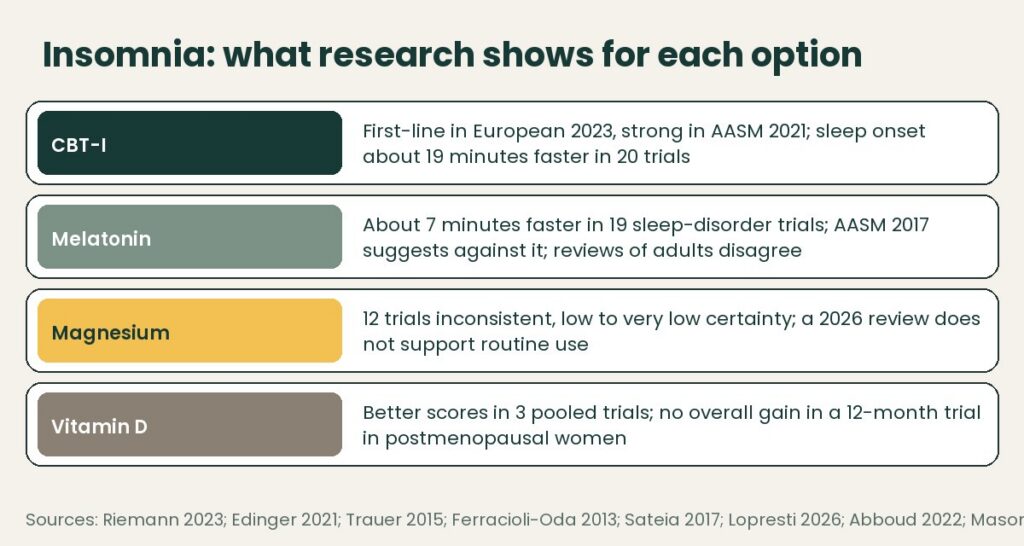
Many trials use questionnaires, the Pittsburgh Sleep Quality Index (PSQI) and the Insomnia Severity Index (ISI), where a lower score means better sleep.
Can low vitamin D or low magnesium cause insomnia?
Low vitamin D and low magnesium are both linked with poor sleep, but the studies show a link, not proof that either causes insomnia.
- Vitamin D: a 2018 meta-analysis of 9 studies (9,397 people, mostly cross-sectional) found that people with vitamin D deficiency had higher odds of sleep disorders (odds ratio 1.50), poor sleep quality (1.59) and short sleep (1.74) [7]. A 2020 review notes vitamin D receptors in brain areas that regulate sleep and a role in the pathways that produce melatonin, but finds scant evidence that supplements prevent or treat sleep problems [12].
- Magnesium: a 2023 systematic review of 9 studies (7,582 adults) found that observational studies suggest a link between magnesium status and sleep, while randomised trials gave contradictory results [13]. According to the NIH, symptomatic deficiency is uncommon in healthy people, and people with gut diseases, type 2 diabetes or alcohol dependence and older adults are more likely to run low [10].
- Why a blood test does not settle magnesium: less than 1% of the body’s magnesium is in blood serum, and serum levels do not accurately reflect total body magnesium or levels in specific tissues, according to the NIH [10]. At Cure4Pain we assess magnesium status from the overall clinical picture.
What do sleep guidelines recommend first?
Sleep guidelines recommend cognitive behavioural therapy for insomnia (CBT-I) first: the American College of Physicians (2016) names it the initial treatment for all adults [14], the European Insomnia Guideline 2023 names it first-line [2], and the American Academy of Sleep Medicine (AASM, 2021) strongly recommends it [1]. CBT-I combines a regular sleep schedule, changes to the habits and thoughts that keep you awake, and relaxation. In a 2015 meta-analysis of 20 trials (1,162 adults), face-to-face CBT-I shortened the time to fall asleep by about 19 minutes and time awake at night by about 26 minutes, and the changes seemed to last; total sleep time did not change significantly, and people whose insomnia came with a medical, sleep or psychiatric condition were excluded [15]. The table sets out each guideline’s position.
| Guideline | CBT-I | Melatonin |
|---|---|---|
| AASM 2021 (behavioural treatments) | Strong recommendation for multicomponent CBT-I; sleep hygiene alone is not suggested [1] | Not covered |
| AASM 2017 (medicines) | Not covered | Suggests not using it for falling or staying asleep (weak) [3] |
| American College of Physicians 2016 | Initial treatment for all adults (strong) [14] | Not enough strong evidence to recommend it, according to the NIH [16] |
| European Insomnia Guideline 2023 | First-line, in person or digital [2] | Fast-release not recommended; prolonged-release allowed for up to 3 months at age 55 and over [2] |
The American Academy of Sleep Medicine’s 2026 guideline on combination treatment suggests CBT-I plus medicine over medicine alone, and suggests against CBT-I plus medicine over CBT-I alone, except for some people who want more sleep time early in treatment, both with low certainty of evidence [17]. Neither magnesium nor vitamin D appears among the recommendations in the published summaries of the AASM 2017, AASM 2021 and European 2023 guidelines [3] [1] [2], so using them is a clinical choice beyond guideline treatment.
Does melatonin work for insomnia?
Melatonin works modestly at best for insomnia in adults, and reviews disagree on whether the effect matters. Part of the disagreement seems to come from the form of melatonin, the age of the people studied and what was measured.
- Small benefit: a 2013 meta-analysis of 19 trials in 1,683 adults and children with primary sleep disorders (14 trials on insomnia, 4 on delayed sleep phase and 1 on REM sleep behaviour disorder) found sleep onset 7 minutes faster and sleep 8 minutes longer, with effects that did not fade over time [4].
- No clear benefit: a 2022 review of 24 melatonin trials found no significant effect in adults whose insomnia had no other linked condition; the effect was seen in children and adolescents [18]. A 2022 systematic review and network meta-analysis in The Lancet, covering 170 trials of 36 interventions for insomnia (47,950 people), concluded that melatonin showed no overall material benefit [5].
- Older adults: in a 2010 trial of 791 adults aged 18 to 80, prolonged-release melatonin shortened sleep onset at 3 weeks by 19.1 minutes against 1.7 with placebo in the older patients, with no signs of tolerance over 6 months; low natural melatonin output did not predict who responded. The tablet’s manufacturer paid for the trial, and three of the authors worked there [19]. In a 2007 trial of 170 people aged 55 and over, 2 mg of prolonged-release melatonin for 3 weeks improved sleep quality and morning alertness, with no rebound insomnia on stopping [20].
How much melatonin should an adult take, and when?
There is no single right melatonin dose for adults; it depends on the product, your age and why you take it. In the UK melatonin is prescription only, and the NHS gives a usual adult dose of one 2 mg slow-release tablet 1 to 2 hours before bedtime, mainly for people aged 55 and over, for a maximum of 13 weeks for short-term sleep problems, or longer on specialist advice [21]. The US National Institutes of Health melatonin page gives no upper limit [16].
- Research on dose and timing: a 2024 dose-response meta-analysis of 26 melatonin trials in people with insomnia and healthy volunteers found that the effect peaked at 4 mg a day, and suggested that 4 mg taken 3 hours before bedtime might work better than the commonly used 2 mg taken 30 minutes before [22]. This is a study finding, not guideline advice.
- Labels can be wrong: a 2017 test of 31 melatonin supplements found content from 83% below to 478% above the label, more than 71% were not within 10% of the label, and 26% contained serotonin [23].
Is it safe to take melatonin every night?
Short-term melatonin use appears safe for most people, but information on long-term safety is lacking, according to the US National Institutes of Health (NIH) [16]. In a 2010 trial of nightly prolonged-release melatonin for 6 months, most adverse events were mild [19], and the UK’s NHS gives a maximum of 13 weeks for short-term sleep problems, or longer on specialist advice [21].
- Common side effects of melatonin: headache, dizziness, nausea and sleepiness, according to the NIH [16]; the NHS also lists stomach ache, irritability and strange dreams [21].
- Higher doses: in a 2022 review of melatonin trials using 10 mg or more (79 studies, 3,861 people), the 4 at low risk of bias showed no detectable rise in serious events but more drowsiness, headache and dizziness; safety reporting was limited [24].
- The heart question: a large health-record study presented at an American Heart Association meeting in 2025 reported a heart failure signal with long-term melatonin use in adults with insomnia. A 2026 analysis of US survey data (NHANES 1999-2018) in Open Heart found no significant link between recent melatonin use and existing cardiovascular disease or heart failure. It measured recent use, not long-term use, and its authors say observational data neither establish harm nor prove safety [25].
- Who should ask first: the NHS asks people with liver or kidney problems or autoimmune conditions such as rheumatoid arthritis, multiple sclerosis or lupus to tell their doctor before taking melatonin, and lists interactions with medicines including warfarin and benzodiazepines [21]. The NIH says people with epilepsy or on blood thinners need medical supervision, that research in pregnancy and breastfeeding is lacking, that melatonin may stay active longer in older people and cause daytime drowsiness, and that 2015 AASM guidelines recommend against its use in people with dementia [16].
Does magnesium help you sleep?
Magnesium may help sleep a little in some adults, but results are inconsistent. A 2026 systematic review of 12 randomised trials in the Journal of Dietary Supplements rated the certainty of evidence low to very low and concluded that current evidence does not support oral magnesium as a routine treatment for insomnia, although some adults may have modest benefits on selected self-reported measures [6].
- Older adults: a 2021 meta-analysis of 3 oral magnesium trials (151 people) found sleep onset 17 minutes faster when 2 of those trials (55 people) were pooled, with no significant change in total sleep and low to very low quality of evidence; all 3 trials were at moderate to high risk of bias [26].
- A small effect: in a 2025 trial of 155 adults aged 18 to 65 reporting poor sleep, 250 mg of elemental magnesium a day as bisglycinate lowered ISI scores by 3.9 points against 2.3 with placebo at 4 weeks, a small effect [27].
- A negative trial: in a 2010 trial of 100 adults over 51 with poor sleep, 320 mg of elemental magnesium a day as citrate did no better than placebo for sleep over 7 weeks; both groups improved, possibly a placebo effect, according to the authors [28].
Elemental magnesium is the amount of magnesium itself, not the weight of the whole compound, and it is the figure that counts against limits. Absorption varies by form: the NIH says the aspartate, citrate, lactate and chloride forms tend to be better absorbed than oxide and sulfate [10]. High doses of magnesium can cause diarrhoea, nausea and abdominal cramps, and magnesium supplements can interact with oral bisphosphonates and with tetracycline and quinolone antibiotics, according to the NIH [10]. Our article on magnesium forms compares them.
Does vitamin D improve sleep?
Some vitamin D trials show better sleep and some do not, and we found none in people selected for diagnosed insomnia. Our PubMed search of randomised trials of vitamin D and insomnia (October 2026) found none that enrolled people because of insomnia disorder.
- Pooled trials: a 2022 meta-analysis of 3 trials found Pittsburgh Sleep Quality Index (PSQI) scores 2.33 points lower with vitamin D than with placebo (moderate certainty), while results for sleep length and sleep disorders were mixed [8]. A second 2022 meta-analysis of 5 studies found a smaller gain of 1.32 points with high variation between studies, and reported no adverse effects from vitamin D [29].
- A positive trial: in a 2018 trial of 89 people aged 20 to 50 with poor sleep scores, 50,000 IU of vitamin D once a fortnight for 8 weeks improved PSQI scores against placebo [30].
- A negative trial: in a 2016 trial of overweight postmenopausal women with low vitamin D on a weight-loss programme, 2,000 IU of vitamin D a day for 12 months did not change overall sleep quality against placebo; those who reached vitamin D sufficiency reported worse sleep than those who did not, a comparison that cannot show cause [9].
- Dr Gominak’s papers: Dr Stasha Gominak, a US neurologist, described in 2012 about 1,500 neurology patients with abnormal sleep, most of whom slept better when vitamin D was kept within a narrow blood range [31]. In 2016 she reported recommending vitamin D plus B vitamins to over 1,000 neurology patients, with better sleep, less pain and fewer bowel symptoms after 3 months [32]. Both papers appeared in Medical Hypotheses, with uncontrolled observations recorded by the author. They are not controlled trials, and further studies are needed.
- A trial under way: a placebo-controlled trial in Malaysian women with vitamin D deficiency and insomnia symptoms, using the ISI and movement sensors, expects to finish recruiting in December 2026 [33].
Sleep is not among the conditions the NIH vitamin D fact sheet reviews. According to the NIH, too much vitamin D can cause high blood calcium, and the upper limit ranges from 1,000 to 4,000 IU a day depending on age [11].
Does taking vitamin D at night cause insomnia?
We found no trial that tested whether taking vitamin D at night causes insomnia: none compared morning with night-time vitamin D for sleep (PubMed search, October 2026), so advice either way rests on theory. Insomnia is not named in the NIH summary of vitamin D toxicity [11], while a 2016 trial in postmenopausal women, in which those who reached vitamin D sufficiency reported worse sleep, is a reason to take a report of worse sleep seriously [9]. If your sleep worsens after starting vitamin D, tell your doctor rather than changing the dose yourself.
Can you take melatonin and magnesium together?
The safety of taking melatonin with magnesium is not well established: the UK’s NHS says not to take herbal remedies that make you feel sleepy with melatonin, and that there is not enough information to say that other, non-drowsy herbal remedies and supplements are safe to take with it, so tell your doctor everything you take [21]. One small trial tested the two together, with zinc, and it cannot show which part helped. In this 2011 trial of 43 long-term care residents in Italy with an average age of 78, a nightly supplement of 5 mg melatonin, 225 mg of elemental magnesium and 11.25 mg zinc taken 1 hour before bed for 8 weeks improved PSQI scores by 6.8 points more than placebo [34]. We found no randomised trial of melatonin with vitamin D for sleep (PubMed search, October 2026).
How we use these nutrients at Cure4Pain
At Cure4Pain, nutrients are one part of a plan built around what disturbs each person’s sleep, together with sleep habits and CBT-I techniques, for adults and young people aged 16 and over. Guidelines place CBT-I first, and an integrative plan may add options alongside standard care, as listed below.
- Tests first: we read a panel of about 100 markers, adding tests for your condition when clinically indicated, such as vitamin D with PTH and calcium, B12, iron, thyroid, blood sugar and cortisol. The panel is our clinic protocol, not a guideline requirement. The European Insomnia Guideline 2023 advises additional measures where indicated, and a sleep study (polysomnography) if another sleep disorder such as a breathing disorder is suspected [2].
- Supervised-dose vitamin D therapy (Coimbra Protocol-based methods): used as an immune modulator, not only as a bone supplement, with doses that differ by condition and are set per person. For sleep, doses are above standard supplement amounts but below high-dose protocols, monitored with blood tests including PTH and calcium. We follow Dr Gominak’s approach, combined with our own clinical observations. Our methods are derived from the work of Dr Coimbra. We found no trial of the Coimbra Protocol for insomnia (PubMed search, October 2026), and the trials above used fixed supplement doses. See our Coimbra Protocol page.
- Magnesium: at times, mostly by mouth, mainly as bisglycinate, with L-threonate or citrate as advised, counted as elemental magnesium, and sometimes also on the skin for comfort during mobility exercises. This is clinic practice; no form has been shown to be better than another for sleep.
- B vitamins: a methylated B-vitamin complex in balanced amounts, with vitamin B6 decided case by case and supplements by mouth first, with injections only when specifically needed or advised. This is clinic practice, with no controlled trial in insomnia.
- Melatonin: where needed, as an under-the-tongue spray for a limited period, under supervision. The spray is an immediate-release form; the European guideline does not recommend fast-release melatonin and the AASM suggests not using melatonin, as shown above.
- Habits and food: a regular sleep routine, morning light, fewer screens at night, Buteyko and nose breathing, tongue posture, limiting caffeine and alcohol, as we advise, and cutting excess sugar and late-night dinners, with gut support where needed.
- Food: we generally advise most patients to replace wheat with jowar, bajra or other millets as a general health measure, including home-made roti from processed wheat; a gluten-free diet is supported for coeliac disease and positive tests [35]. Also, as an observational clinic practice, we generally suggest limiting cruciferous (Brassica) vegetables such as cabbage and cauliflower; a 2024 review found no harm to the thyroid with daily intake, particularly with adequate iodine [36]. Our PubMed search (October 2026) found no trial of these food changes for insomnia.
- Calming therapy: meridian-balancing acupuncture with moxibustion at our Mumbai clinic. Many patients report feeling calmer and more relaxed afterwards; these are patient reports, and our insomnia page sets out the inconclusive research.
- Sleeping pills: Dr Krushal Pabari reviews them and reduces them gradually together with the doctor who prescribed them, under clinical guidance from Team Cure4Pain, in coordination with your existing consulting physician, psychiatrist or sleep specialist; never stop or change them on your own.
- Timeline: this differs from person to person. Most people in our clinic report better sleep quality within 8 to 12 weeks; this is a clinic observation, not a controlled result, it cannot separate the nutrients from the habits and other parts of the plan, and individual results vary.
This is our clinic practice; individual results vary, and further studies are needed.
If you would like your sleep problem and these nutrients reviewed together, you can book a consultation, online from anywhere or at our Mumbai clinic.
Frequently asked questions
What is the best supplement for insomnia?
No supplement has strong guideline support for insomnia. Cognitive behavioural therapy for insomnia (CBT-I) is the recommended first treatment; melatonin has the most trials, with small effects, and magnesium and vitamin D have fewer and less consistent ones. [1] [2] [4] [6] [8]
Does melatonin work for insomnia?
Melatonin works modestly at best for insomnia. It shortened sleep onset by about 7 minutes across 19 trials of primary sleep disorders in a 2013 meta-analysis, and a 2022 Lancet analysis found no overall material benefit; prolonged-release melatonin looks more useful at age 55 and over. [4] [5] [19] [2]
How much melatonin should an adult take?
There is no single right melatonin dose for adults. The UK’s NHS gives a usual adult dose of one 2 mg slow-release tablet 1 to 2 hours before bedtime, by prescription, so ask your doctor before taking it. [21]
Is it safe to take melatonin every night?
Short-term melatonin use appears safe for most people, but long-term safety information is lacking, according to the US National Institutes of Health. The European Insomnia Guideline 2023 allows prolonged-release melatonin for up to 3 months at age 55 and over. [16] [2]
Which magnesium is best for sleep?
No form of magnesium has been shown to be better than another for sleep; we found no trial comparing forms for sleep. Bisglycinate had a small effect in a 2025 trial, and citrate did no better than placebo in a 2010 trial. At Cure4Pain we mainly use bisglycinate, as clinic practice. [27] [28]
Does taking vitamin D at night cause insomnia?
We found no trial that tested whether taking vitamin D at night causes insomnia. Insomnia is not named in the NIH summary of vitamin D toxicity, and a 2016 trial in postmenopausal women found worse sleep in those who reached sufficiency, so report any change to your doctor. [11] [9]
Can I take melatonin and magnesium together?
One small 2011 trial in care home residents tested melatonin and magnesium with zinc and found better sleep scores, but it cannot show which part helped. Ask your doctor first, because the UK’s NHS says the safety of combining melatonin with supplements is not well established. [34] [21]
Does a blood test show if I am low in magnesium?
A blood test does not reliably show if you are low in magnesium. Less than 1% of the body’s magnesium is in blood serum, and serum levels do not accurately reflect total body magnesium, according to the US National Institutes of Health. [10]
This article is for education and does not replace medical advice. Do not start, stop or change any medicine or supplement without medical guidance.
References
1. Edinger JD, et al. Behavioral and psychological treatments for chronic insomnia disorder in adults: an American Academy of Sleep Medicine clinical practice guideline. J Clin Sleep Med 2021;17(2):255-262. doi:10.5664/jcsm.8986
2. Riemann D, et al. The European Insomnia Guideline: An update on the diagnosis and treatment of insomnia 2023. J Sleep Res 2023;32(6):e14035. doi:10.1111/jsr.14035
3. Sateia MJ, et al. Clinical Practice Guideline for the Pharmacologic Treatment of Chronic Insomnia in Adults: An American Academy of Sleep Medicine Clinical Practice Guideline. J Clin Sleep Med 2017;13(2):307-349. doi:10.5664/jcsm.6470
4. Ferracioli-Oda E, et al. Meta-analysis: melatonin for the treatment of primary sleep disorders. PLoS One 2013;8(5):e63773. doi:10.1371/journal.pone.0063773
5. De Crescenzo F, et al. Comparative effects of pharmacological interventions for the acute and long-term management of insomnia disorder in adults: a systematic review and network meta-analysis. Lancet 2022;400(10347):170-184. doi:10.1016/S0140-6736(22)00878-9
6. Lopresti AL, et al. Magnesium Supplementation for Sleep in Adults: A Systematic Review of Randomized Controlled Trials. J Diet Suppl 2026;23(5):553-581. doi:10.1080/19390211.2026.2719670
7. Gao Q, et al. The Association between Vitamin D Deficiency and Sleep Disorders: A Systematic Review and Meta-Analysis. Nutrients 2018;10(10). doi:10.3390/nu10101395
8. Abboud M. Vitamin D Supplementation and Sleep: A Systematic Review and Meta-Analysis of Intervention Studies. Nutrients 2022;14(5). doi:10.3390/nu14051076
9. Mason C, et al. Repletion of vitamin D associated with deterioration of sleep quality among postmenopausal women. Prev Med 2016;93:166-170. doi:10.1016/j.ypmed.2016.09.035
10. Office of Dietary Supplements, US National Institutes of Health. Magnesium: Fact Sheet for Health Professionals. ods.od.nih.gov
11. Office of Dietary Supplements, US National Institutes of Health. Vitamin D: Fact Sheet for Health Professionals. ods.od.nih.gov
12. Romano F, et al. Vitamin D and Sleep Regulation: Is there a Role for Vitamin D? Curr Pharm Des 2020;26(21):2492-2496. doi:10.2174/1381612826666200310145935
13. Arab A, et al. The Role of Magnesium in Sleep Health: a Systematic Review of Available Literature. Biol Trace Elem Res 2023;201(1):121-128. doi:10.1007/s12011-022-03162-1
14. Qaseem A, et al. Management of Chronic Insomnia Disorder in Adults: A Clinical Practice Guideline From the American College of Physicians. Ann Intern Med 2016;165(2):125-33. doi:10.7326/M15-2175
15. Trauer JM, et al. Cognitive Behavioral Therapy for Chronic Insomnia: A Systematic Review and Meta-analysis. Ann Intern Med 2015;163(3):191-204. doi:10.7326/M14-2841
16. National Center for Complementary and Integrative Health, US National Institutes of Health. Melatonin: What You Need To Know. nccih.nih.gov
17. Buysse DJ, et al. Combination treatment for chronic insomnia disorder in adults: an American Academy of Sleep Medicine clinical practice guideline. J Clin Sleep Med 2026;22(1). doi:10.1007/s44470-025-00038-8
18. Choi K, et al. Efficacy of melatonin for chronic insomnia: Systematic reviews and meta-analyses. Sleep Med Rev 2022;66:101692. doi:10.1016/j.smrv.2022.101692
19. Wade AG, et al. Nightly treatment of primary insomnia with prolonged release melatonin for 6 months: a randomized placebo controlled trial on age and endogenous melatonin as predictors of efficacy and safety. BMC Med 2010;8:51. doi:10.1186/1741-7015-8-51
20. Lemoine P, et al. Prolonged-release melatonin improves sleep quality and morning alertness in insomnia patients aged 55 years and older and has no withdrawal effects. J Sleep Res 2007;16(4):372-80. doi:10.1111/j.1365-2869.2007.00613.x
21. NHS (UK National Health Service). Melatonin: medicines guide (about, who can take it, how to take it, side effects, other medicines). nhs.uk/medicines/melatonin
22. Cruz-Sanabria F, et al. Optimizing the Time and Dose of Melatonin as a Sleep-Promoting Drug: A Systematic Review of Randomized Controlled Trials and Dose-Response Meta-Analysis. J Pineal Res 2024;76(5):e12985. doi:10.1111/jpi.12985
23. Erland LA, Saxena PK. Melatonin Natural Health Products and Supplements: Presence of Serotonin and Significant Variability of Melatonin Content. J Clin Sleep Med 2017;13(2):275-281. doi:10.5664/jcsm.6462
24. Menczel Schrire Z, et al. Safety of higher doses of melatonin in adults: A systematic review and meta-analysis. J Pineal Res 2022;72(2):e12782. doi:10.1111/jpi.12782
25. Khan B, Lima BB. Melatonin and cardiovascular risk: an NHANES reality check after recent heart failure concerns. Open Heart 2026;13(1). doi:10.1136/openhrt-2026-004108
26. Mah J, Pitre T. Oral magnesium supplementation for insomnia in older adults: a Systematic Review & Meta-Analysis. BMC Complement Med Ther 2021;21(1):125. doi:10.1186/s12906-021-03297-z
27. Schuster J, et al. Magnesium Bisglycinate Supplementation in Healthy Adults Reporting Poor Sleep: A Randomized, Placebo-Controlled Trial. Nat Sci Sleep 2025;17:2027-2040. doi:10.2147/NSS.S524348
28. Nielsen FH, et al. Magnesium supplementation improves indicators of low magnesium status and inflammatory stress in adults older than 51 years with poor quality sleep. Magnes Res 2010;23(4):158-68. doi:10.1684/mrh.2010.0220
29. Mirzaei-Azandaryani Z, et al. The effect of vitamin D on sleep quality: A systematic review and meta-analysis. Nutr Health 2022;28(4):515-526. doi:10.1177/02601060221082367
30. Majid MS, et al. The effect of vitamin D supplement on the score and quality of sleep in 20-50 year-old people with sleep disorders compared with control group. Nutr Neurosci 2018;21(7):511-519. doi:10.1080/1028415X.2017.1317395
31. Gominak SC, Stumpf WE. The world epidemic of sleep disorders is linked to vitamin D deficiency. Med Hypotheses 2012;79(2):132-5. doi:10.1016/j.mehy.2012.03.031
32. Gominak SC. Vitamin D deficiency changes the intestinal microbiome reducing B vitamin production in the gut. The resulting lack of pantothenic acid adversely affects the immune system, producing a “pro-inflammatory” state associated with atherosclerosis and autoimmunity. Med Hypotheses 2016;94:103-7. doi:10.1016/j.mehy.2016.07.007
33. Puspitasari RM, et al. Vitamin D Supplementation and Improvement in Insomnia Symptoms Among Malaysian Women With Vitamin D Deficiency: Protocol for a Randomized Controlled Trial. JMIR Res Protoc 2026;15:e63804. doi:10.2196/63804
34. Rondanelli M, et al. The effect of melatonin, magnesium, and zinc on primary insomnia in long-term care facility residents in Italy: a double-blind, placebo-controlled clinical trial. J Am Geriatr Soc 2011;59(1):82-90. doi:10.1111/j.1532-5415.2010.03232.x
35. NHS (UK National Health Service). Coeliac disease: treatment. nhs.uk/conditions/coeliac-disease/treatment
36. Galanty A, et al. Do Brassica Vegetables Affect Thyroid Function?-A Comprehensive Systematic Review. Int J Mol Sci 2024;25(7). doi:10.3390/ijms25073988