
Written by AT. Chintan Dalal, N.D. · Reviewed by Dr Krushal Pabari, Clinical Team, Cure4Pain · Updated 30 October 2026
Key facts
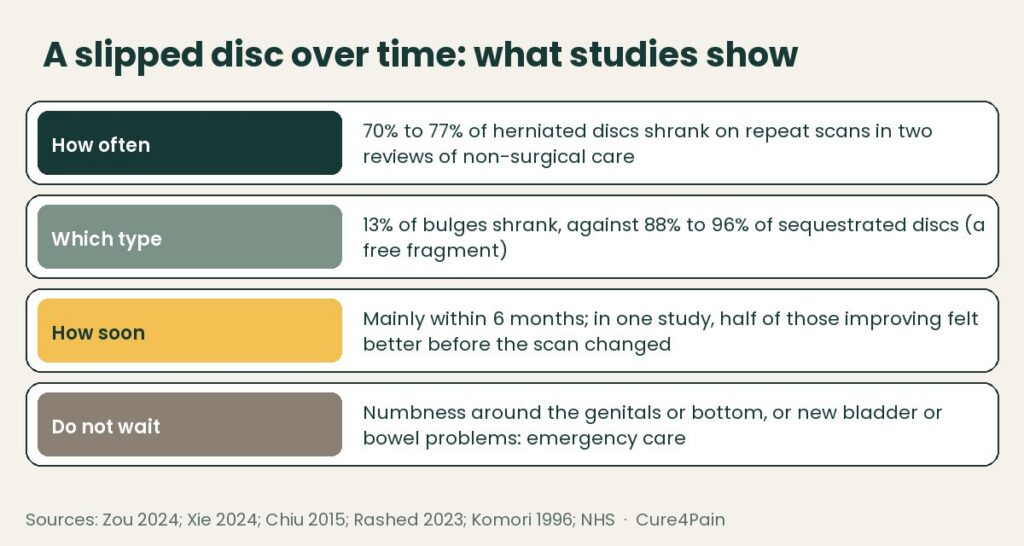
A slipped disc often settles without an operation: according to the NHS, it usually gets better slowly with rest, gentle exercise and painkillers [1]. In two reviews of people treated without surgery, 70% and 77% of herniated discs in the lower back shrank on repeat scans [2] [3], mainly within 6 months according to the 2024 meta-analysis [2]. Bulges shrank least (13%) and free fragments most (88% to 96%) [2] [4] [5]. A smaller disc is not the same as less pain: in a Dutch trial of 283 people with sciatica, some of whom had surgery, a herniation was still visible at 1 year in 35% of people who had recovered well and 33% of those who had not [6]. Numbness around the genitals or bottom, or new bladder or bowel problems, need emergency care [1]. No exercise, manual, needling or nutritional treatment has strong evidence of making a disc shrink, including the care we give at Cure4Pain.

Scientific explainer videos in our Resources section
In our Resources section, our clinical team discusses vitamin D, its cofactors and how autoimmune, lifestyle and pain conditions develop.
Can a slipped disc heal on its own?
Often, yes. According to the NHS, a slipped disc “usually gets better slowly with rest, gentle exercise and painkillers”, and surgery “is not usually needed” [1]. In two reviews of people treated without surgery, 70% and 77% of herniated discs in the lower back shrank on repeat scans [2] [3]. “Heal” can mean two things, the pain settling and the disc material shrinking, and they do not always go together. India’s ICMR Standard Treatment Workflow for lower back pain (July 2024) asks doctors to “keep a high threshold for invasive procedures” [7].
The figures for shrinkage are reassuring, with limits:
- Reviews: herniated lower back discs shrank in 70.4% across 31 studies with 2,233 people in a 2024 meta-analysis [2] and 76.6% (1,684 of 2,199) in a 2024 systematic review [3].
- Single studies vary widely: from 20% to 96.2% [3].
- Who is counted: these studies include only people treated without surgery who had a repeat scan [4] [5], so people who needed an early operation are mostly not in the figures.
- What is measured: the material that has pushed out, seen on a scan, mostly in the lower back. These studies do not test whether the disc itself returns to how it was before.
Why does a herniated disc shrink?
A herniated disc probably shrinks because the body treats the escaped disc material as something to clear: reviews from 2022 and 2024 describe immune cells called macrophages moving in, new blood vessels and enzymes breaking the material down [8] [3]. Material that has pushed further out has more contact with the blood supply, which may be why it triggers a stronger response [3], but a 2023 review notes that no single explanation is agreed yet [9].
Which types of slipped disc shrink the most?
Sequestrated discs, in which a free fragment has separated, shrink most (88% to 96%) and bulges shrink least (13%), according to three reviews from 2015, 2023 and 2024 [4] [5] [2]. Their figures differ, so the table gives the range; they are not independent, because the 2023 review combined its results with an earlier review.
| MRI wording | What it means | Shrank on repeat scans |
|---|---|---|
| Bulge | Disc spreads beyond its edges, outer ring intact | 13% |
| Protrusion | Focal push, outer ring mostly intact | 38% to 53% |
| Extrusion | Centre breaks through the outer ring | 67% to 70% |
| Sequestration | A free fragment has separated | 88% to 96% |
- Size: a 2023 meta-analysis linked larger herniations with more regression [5], while a smaller study found no link with size [10].
Does a bulging disc go away? Usually not on a scan: 13% regressed in all three reviews [2] [4] [5]. Bulges are also common without pain, so a bulge may or may not be the source of your symptoms [11]. Our slipped disc page explains each MRI term in English and Hindi.
How long does a slipped disc take to heal without surgery?
There is no fixed time. Shrinkage “mainly occurred within 6 months” in a 2024 meta-analysis of 2,233 people treated without surgery [2], and pain often eases over weeks to months. The studies below measured different people and outcomes.
| When | What studies and guidelines say |
|---|---|
| First weeks | The NHS advises seeing a GP if pain is not getting better after a few weeks [1]. The ICMR workflow advises reassessment at 2 to 6 weeks if function is not returning or symptoms worsen [7] |
| 12 weeks | Among 183 people with sciatica severe enough for bed rest, 87% reported improvement at 12 weeks, whether they rested or simply waited [12] |
| Within 6 months | Shrinkage “mainly occurred within 6 months” in a 2024 meta-analysis [2] |
| About 1 year | In a Dutch trial of people with severe sciatica for 6 to 12 weeks, 84% reported a favourable outcome at 1 year, including people who had surgery [6] |
Does the pain go away only if the disc shrinks?
No. Pain can settle while a herniation is still visible on a scan, although pain relief and shrinkage often travel together. Studies disagree on how closely.
- Link found: a 2023 meta-analysis confirmed that symptom improvement went with regression [5].
- Link weak: in 37 people with very large herniations, chosen because they had begun to improve, disc size fell by an average of 64%, but clinical improvement correlated poorly with the amount of shrinkage [13]. In a Dutch trial of 283 people with sciatica, some of whom had surgery, a favourable outcome was reported by 85% of people with a herniation still visible and 83% of those without one at 1 year, and the authors concluded that the scan did not distinguish between good and poor outcomes [6].
- Timing: in a study of 77 people, half of those who improved felt better before the MRI changed [14].
Numbness and weakness can be slow to recover. In a study of people with a recent slipped disc, most treated without surgery, 47% with a sensory loss at the start still reported it at 2 years, and 25% with weakness still reported weakness [15]. In a subgroup of 150 people with weakness from a Dutch trial of sciatica, severe weakness at the start was more likely to remain at 1 year [16]. Our neuropathy page covers other causes of numbness.
What does a disc finding on MRI mean if you have no pain?
A disc finding on MRI in someone with no pain often means little on its own. A 2015 systematic review of 3,110 people without symptoms, in the American Journal of Neuroradiology, found disc bulges in 30% of 20-year-olds and 84% of 80-year-olds, disc protrusions in 29% and 43% of the same age groups, and disc degeneration in 37% and 96% [11]. The authors concluded that many of these features are “likely part of normal aging”.
That does not make every finding meaningless. A second 2015 analysis, in adults aged 50 or under, found disc bulges, extrusions and protrusions more often in people with back pain than in people without it [17]. So a scan is read together with your symptoms and examination, not alone.
Do you need a repeat MRI to see whether the disc has healed?
A repeat scan just to check on the disc is unlikely to help: in a Dutch trial of 283 people with sciatica, the 1-year scan did not distinguish between people with good and poor outcomes [6]. NICE guideline NG59 (UK, 2016) advises against routine imaging in non-specialist settings, and advises considering imaging in specialist settings “only if the result is likely to change management” [18]. Your doctor decides when a new scan is needed.
Can anything make a slipped disc shrink faster?
No exercise, manual therapy, needling or supplement has strong evidence of making a slipped disc shrink faster. Few trials have measured disc size at all, and the ones we found are mostly small, single studies.
| What was tested | People | Effect on disc size |
|---|---|---|
| Steroid injection near the nerve vs saline [19] | Up to 34 per group | Shrank in both; no negative effect of the steroid |
| Spinal decompression machine with physiotherapy vs physiotherapy [20] | 20 | No difference between groups |
| Traction with physiotherapy vs physiotherapy [21] | 46 | Smaller only with traction, on CT |
| High-intensity laser vs sham, both with exercise [22] | 40 | Smaller with laser |
- Traction in context: a Cochrane review of 32 trials found that traction makes little or no difference to pain or function in low back pain with or without sciatica [23]. A smaller disc in one trial does not settle that.
- Acupuncture: in our PubMed search (October 2026), we found only single case reports of shrinkage during acupuncture [24] [25]. A case cannot separate treatment from natural shrinkage. Acupuncture trials have mostly measured pain, as our slipped disc page explains.
- Vitamins, magnesium or diet: our search found no randomised trial of these on disc shrinkage.
- Anti-inflammatory painkillers: some reviews ask whether they could slow shrinkage [9] [26], but we found no trial of painkiller tablets on disc size, and the NHS still suggests them where they suit you [1]. Do not change medicines because of this question.
Does a slipped disc in the neck heal on its own?
A slipped disc in the neck often improves over time, but there is far less data than for the lower back. In a 1998 study of 38 people with repeat scans, the herniated material became smaller in 15 (40%) [27]. A 2014 systematic review of neck disc herniation with arm pain found substantial improvement within the first 4 to 6 months, and complete recovery in about 83%, taking 24 to 36 months; only three of its eight studies had a low risk of bias [28]. Clumsy hands, unsteady walking or new bladder or bowel problems can mean pressure on the spinal cord and need medical assessment without delay; a 2018 review in the BMJ says an urgent MRI is required when symptoms are progressing or substantially affect quality of life [29]. See our neck pain and pinched nerve pages.
When does a slipped disc need surgery instead of waiting?
A slipped disc may need surgery when symptoms have not improved with other treatments, or when muscle weakness or numbness is getting worse: according to the NHS, a GP might then refer you to a specialist to discuss surgery [1]. NICE guideline NG59 (UK, 2016) advises considering decompression for people with sciatica when non-surgical treatment has not improved pain or function and the scan matches the symptoms [18]. India’s ICMR workflow (July 2024) reserves surgery for “carefully selected patients after expert opinion” and refers unresolving nerve symptoms to an orthopaedic surgeon [7].
- Waiting has a cost for some people: in a Dutch trial of 283 people with severe sciatica for 6 to 12 weeks, leg pain eased faster with early surgery, although perceived recovery at 1 year was 95% in both groups and 39% of the non-surgical group had surgery [30].
- Pooled trials: a 2023 BMJ review of 24 trials found a moderate leg pain benefit from discectomy in the first 3 months that became negligible at 12 months, on very low to low certainty evidence [31].
A spine surgeon is the right person to weigh these points with you. Natural shrinkage is a reason to discuss options calmly, not a reason to delay when warning signs appear. Our article on sciatica without surgery compares the surgery trials one by one.
When is a slipped disc an emergency?
Go to a hospital emergency department straight away if you have back pain with numbness around your bottom or genitals, cannot pee, cannot control when you pee or poo, lose feeling in one or both legs, or have had a serious accident, according to the NHS [1]. Some of these signs can mean cauda equina syndrome, in which the nerves at the base of the spine are compressed, a surgical emergency [32].
India’s ICMR workflow (July 2024) lists further red flags: severe worsening pain, especially at night or when lying down; weight loss, a history of cancer or fever; prolonged steroid or intravenous drug use; and a first episode of severe pain after 50 [7]. In India, call 112 for emergencies (108 for an ambulance in most states). Do not wait for a clinic appointment.
What helps while a slipped disc settles?
Gentle activity, as far as pain allows, helps a slipped disc settle, according to the NHS: you may need to rest at first if the pain is very bad, but you will get better more quickly if you gradually start gentle exercise such as walking, swimming and yoga [1].
Pain can return after it settles. Among people in the SPORT study whose leg pain had resolved with usual non-surgical care, recurrence reached 23% at 1 year and 51% at 3 years, on a broad definition that included any leg pain, an injection or surgery [33].
How we approach a slipped disc at Cure4Pain
At Cure4Pain, slipped disc care is non-surgical, with referral to a spine surgeon whenever it is needed. Many discs improve on their own, so we do not suggest that our treatment makes a disc shrink: we found no controlled study showing this. An integrative plan may add options alongside standard care.
- Who we see: recent and long-standing slipped discs in the lower back and neck, only after their investigation reports and an assessment: your MRI read with your symptoms, and muscle testing.
- Tests: we read a panel of about 100 markers, adding tests for your condition when clinically indicated: for example, methylmalonic acid when symptoms suggest low B12 and the first result is uncertain (NICE NG239, 2024) [34], and HLA-B27 when long-lasting low back pain that began before age 45 has some of the features of spondyloarthritis (NICE NG65) [35].
- Referral: sudden or severe pain, severe or worsening weakness, foot drop, a suspected fracture, cyst or tumour, and the emergency signs go first to a spine surgeon or hospital. We take patients on afterwards under the surgeon’s guidance.
- Needling and hands-on care: nutritional supplementation with twitch-response deep fascial acupuncture, with electroacupuncture, dry needling and myofascial release where needed, usually twice a week for 6 weeks, within 4 to 12 weeks of care, which differs from person to person. We found no controlled trial of this combination, and NICE advises against offering acupuncture for low back pain with or without sciatica [18].
- Nutrition: magnesium, with vitamin B12, vitamin B1, omega-3 and protein set after blood tests. Supplements are given by mouth first, with injections only when specifically needed or advised. Magnesium is mainly given as magnesium bisglycinate, with L-threonate or citrate as advised, always counted as elemental magnesium; absorption varies by form [36]. Vitamin D is at standard doses in most people, and supervised vitamin D therapy (Coimbra Protocol-based methods) where needed. Our methods are derived from the work of Dr Coimbra. We found no trial of the Coimbra Protocol in slipped disc.
- Movement: the NHS suggests gradually starting gentle exercise such as walking, swimming and yoga [1]. Daily activity and gentle walking continue as comfort allows, and as a clinic precaution against re-injury, we ask patients to pause other exercise programmes, including yoga, for the first 4 weeks until strength improves in sessions. A home programme follows.
- Medicines and injections: Dr Krushal Pabari reviews and manages painkillers, nerve-pain tablets and muscle relaxants, reducing them where appropriate, under clinical guidance from Team Cure4Pain, in coordination with your existing consulting physician and spine surgeon; never stop or change them on your own. Epidural injections are a guideline option that we do not give at the clinic, and we do not recommend back belts.
In our clinic, many people report less pain within about 4 weeks; this is a clinic observation, and it does not show that care makes a disc shrink or works faster than natural recovery. Because many discs improve with time, part of any improvement during care may be natural recovery. This is our clinic practice; individual results vary, and further studies are needed. Read more on our slipped disc, sciatica and lower back pain pages.
If you would like your MRI and options reviewed, you can book a consultation, online from anywhere or at our Mumbai clinic. Hands-on treatments are given only in Mumbai.
Frequently asked questions
Can a herniated disc heal on its own?
Often. Two reviews of people treated without surgery found that 70% and 77% of herniated lumbar discs shrank on repeat scans, though some people still need surgery. [2] [3]
Can a bulging disc heal on its own?
A bulge rarely shrinks on a scan: 13% did in three reviews. Bulges are also common without pain, so a scan alone does not say whether one is causing your symptoms. [2] [11]
Can a ruptured disc heal on its own?
It can. Ruptured herniations shrink more often than contained ones, according to a 2024 meta-analysis. Warning signs or worsening weakness still need urgent assessment. [2] [1]
How long does a herniated disc take to heal without surgery?
There is no fixed time. Shrinkage comes mainly within 6 months, according to a 2024 meta-analysis. See a doctor if pain is not getting better after a few weeks. [2] [1]
Does numbness from a herniated disc go away?
For about half of people within 2 years, in one study of 59 people: 47% of those with sensory loss at the start still reported it at 2 years. Loss of feeling in a leg, or numbness around the genitals or bottom, is an emergency. [15] [1]
Do I need another MRI to check if my disc has healed?
Usually not just to check. In a trial of 283 people, the 1-year scan did not distinguish good from poor outcomes, and NICE advises imaging in specialist care only if the result is likely to change management. [6] [18]
Can a slipped disc heal completely?
The material that pushed out can disappear on a scan: this happened in 43% of sequestrated and 15% of extruded discs in one review. These studies do not test whether the disc itself returns to how it was, and pain can return. [4] [33]
Does a slipped disc heal faster with acupuncture, traction or vitamins?
This has not been shown. We found only case reports of shrinkage with acupuncture and no vitamin trials on disc size. One small trial reported smaller discs after traction, but a Cochrane review found little or no effect on pain or function. [24] [21] [23]
This article is for education and does not replace medical advice. Do not start, stop or change any medicine or supplement without medical guidance.
References
1. NHS (UK National Health Service). Slipped disc. nhs.uk/conditions/slipped-disc
2. Zou T, et al. Incidence of Spontaneous Resorption of Lumbar Disc Herniation: A Meta-analysis. Clin Spine Surg 2024;37(6):256-269. doi:10.1097/BSD.0000000000001490
3. Xie L, et al. Prevalence, clinical predictors, and mechanisms of resorption in lumbar disc herniation: a systematic review. Orthop Rev (Pavia) 2024;16:121399. doi:10.52965/001c.121399
4. Chiu CC, et al. The probability of spontaneous regression of lumbar herniated disc: a systematic review. Clin Rehabil 2015;29(2):184-95. doi:10.1177/0269215514540919
5. Rashed S, et al. Systematic review and meta-analysis of predictive factors for spontaneous regression in lumbar disc herniation. J Neurosurg Spine 2023;39(4):471-478. doi:10.3171/2023.6.SPINE23367
6. el Barzouhi A, et al. Magnetic resonance imaging in follow-up assessment of sciatica. N Engl J Med 2013;368(11):999-1007. doi:10.1056/NEJMoa1209250
7. Indian Council of Medical Research, Department of Health Research, Ministry of Health and Family Welfare, Government of India. Standard Treatment Workflow: Lower Back Pain, July 2024. icmr.gov.in (PDF)
8. Yu P, et al. Characteristics and mechanisms of resorption in lumbar disc herniation. Arthritis Res Ther 2022;24(1):205. doi:10.1186/s13075-022-02894-8
9. Hornung AL, et al. Resorption of Lumbar Disk Herniation: Mechanisms, Clinical Predictors, and Future Directions. JBJS Rev 2023;11(1). doi:10.2106/JBJS.RVW.22.00148
10. Splendiani A, et al. Spontaneous resolution of lumbar disk herniation: predictive signs for prognostic evaluation. Neuroradiology 2004;46(11):916-22. doi:10.1007/s00234-004-1232-0
11. Brinjikji W, et al. Systematic literature review of imaging features of spinal degeneration in asymptomatic populations. AJNR Am J Neuroradiol 2015;36(4):811-6. doi:10.3174/ajnr.A4173
12. Vroomen PC, et al. Lack of effectiveness of bed rest for sciatica. N Engl J Med 1999;340(6):418-23. doi:10.1056/NEJM199902113400602
13. Benson RT, et al. Conservatively treated massive prolapsed discs: a 7-year follow-up. Ann R Coll Surg Engl 2010;92(2):147-53. doi:10.1308/003588410X12518836438840
14. Komori H, et al. The natural history of herniated nucleus pulposus with radiculopathy. Spine (Phila Pa 1976) 1996;21(2):225-9. doi:10.1097/00007632-199601150-00013
15. Suri P, et al. Predictors of patient-reported recovery from motor or sensory deficits two years after acute symptomatic lumbar disk herniation. PM R 2012;4(12):936-944.e1. doi:10.1016/j.pmrj.2012.08.023
16. Overdevest GM, et al. Recovery of motor deficit accompanying sciatica–subgroup analysis of a randomized controlled trial. Spine J 2014;14(9):1817-24. doi:10.1016/j.spinee.2013.07.456
17. Brinjikji W, et al. MRI Findings of Disc Degeneration are More Prevalent in Adults with Low Back Pain than in Asymptomatic Controls: A Systematic Review and Meta-Analysis. AJNR Am J Neuroradiol 2015;36(12):2394-9. doi:10.3174/ajnr.A4498
18. National Institute for Health and Care Excellence (NICE). Low back pain and sciatica in over 16s: assessment and management. NG59, 2016. nice.org.uk/guidance/ng59
19. Autio RA, et al. Effect of periradicular methylprednisolone on spontaneous resorption of intervertebral disc herniations. Spine (Phila Pa 1976) 2004;29(15):1601-7. doi:10.1097/01.brs.0000132511.46818.67
20. Demirel A, et al. Regression of lumbar disc herniation by physiotherapy. Does non-surgical spinal decompression therapy make a difference? Double-blind randomized controlled trial. J Back Musculoskelet Rehabil 2017;30(5):1015-1022. doi:10.3233/BMR-169581
21. Ozturk B, et al. Effect of continuous lumbar traction on the size of herniated disc material in lumbar disc herniation. Rheumatol Int 2006;26(7):622-6. doi:10.1007/s00296-005-0035-x
22. Mohammed WAA, et al. Effect of High-Intensity Laser Therapy on Disc Size and Functional Outcome in Patients with Lumbar Disc Herniation. Photobiomodul Photomed Laser Surg 2026;44(8):505-512. doi:10.1177/25785478261465275
23. Wegner I, et al. Traction for low-back pain with or without sciatica. Cochrane Database Syst Rev 2013;2013(8):CD003010. doi:10.1002/14651858.CD003010.pub5
24. Liang H, Huang J. Case report: Spontaneous regression of extruded lumbar disc herniation with acupuncture therapy. Front Neurol 2024;15:1381292. doi:10.3389/fneur.2024.1381292
25. Li B, et al. Electroacupuncture Might Promote the Spontaneous Resorption of Lumbar Disc Herniation: A Case Report. Complement Med Res 2021;28(2):169-174. doi:10.1159/000509336
26. Cunha C, et al. Lumbar Disc Herniation Resorption: When and How Does It Occur? Neurospine 2026;23(1):82-93. doi:10.14245/ns.2551538.769
27. Mochida K, et al. Regression of cervical disc herniation observed on magnetic resonance images. Spine (Phila Pa 1976) 1998;23(9):990-5; discussion 996-7. doi:10.1097/00007632-199805010-00005
28. Wong JJ, et al. The course and prognostic factors of symptomatic cervical disc herniation with radiculopathy: a systematic review of the literature. Spine J 2014;14(8):1781-9. doi:10.1016/j.spinee.2014.02.032
29. Davies BM, et al. Degenerative cervical myelopathy. BMJ 2018;360:k186. doi:10.1136/bmj.k186
30. Peul WC, et al. Surgery versus prolonged conservative treatment for sciatica. N Engl J Med 2007;356(22):2245-56. doi:10.1056/NEJMoa064039
31. Liu C, et al. Surgical versus non-surgical treatment for sciatica: systematic review and meta-analysis of randomised controlled trials. BMJ 2023;381:e070730. doi:10.1136/bmj-2022-070730
32. Hoeritzauer I, et al. What is the incidence of cauda equina syndrome? A systematic review. J Neurosurg Spine 2020;32(6):832-841. doi:10.3171/2019.12.SPINE19839
33. Suri P, et al. Recurrence of Pain After Usual Nonoperative Care for Symptomatic Lumbar Disk Herniation: Analysis of Data From the Spine Patient Outcomes Research Trial. PM R 2016;8(5):405-14. doi:10.1016/j.pmrj.2015.10.016
34. National Institute for Health and Care Excellence (NICE). Vitamin B12 deficiency in over 16s: diagnosis and management. NG239, 2024. nice.org.uk/guidance/ng239
35. National Institute for Health and Care Excellence (NICE). Spondyloarthritis in over 16s: diagnosis and management. NG65, 2017. nice.org.uk/guidance/ng65
36. National Institutes of Health, Office of Dietary Supplements. Magnesium: Fact Sheet for Health Professionals. ods.od.nih.gov

