
Written by AT. Chintan Dalal, N.D. · Reviewed by Dr Krushal Pabari, Clinical Team, Cure4Pain · Updated 30 October 2026
Key facts
Plantar fasciitis comes from strain on the band under the foot, and the NHS notes that it is not always clear why this happens [1]. Higher body weight has the most consistent link: a 2016 meta-analysis of observational studies found about 3.7 times the odds with a body mass index (BMI) above 27, strongest in people who are not athletes [2]. In about 720,000 patients of a US health system, plantar fasciitis was recorded 64% more often in type 2 diabetes than without diabetes [3]. Small studies link plantar fasciitis with higher cholesterol, while findings on triglycerides disagree [4] [5]. Harder-heeled shoes and heel spurs are also more common in people with heel pain [6] [7]. These are associations, not proven causes, and in our PubMed searches on 30 October 2026 we found no randomised trial of weight loss, lipid lowering or blood sugar control for heel pain.

Scientific explainer videos in our Resources section
In our Resources section, our clinical team discusses vitamin D, its cofactors and how autoimmune, lifestyle and pain conditions develop.
What causes plantar fasciitis?
Plantar fasciitis is caused by straining the plantar fascia, the band that connects the heel bone to the toes, and “it’s not always clear why this happens”, according to the NHS [1]. The 2024 Singapore consensus guideline describes it as usually multifactorial, often with more than one risk factor in the same person, and says risk factors should be assessed and addressed [8]. Beyond the foot itself, this article covers body weight, diabetes, blood fats, footwear and time spent standing.
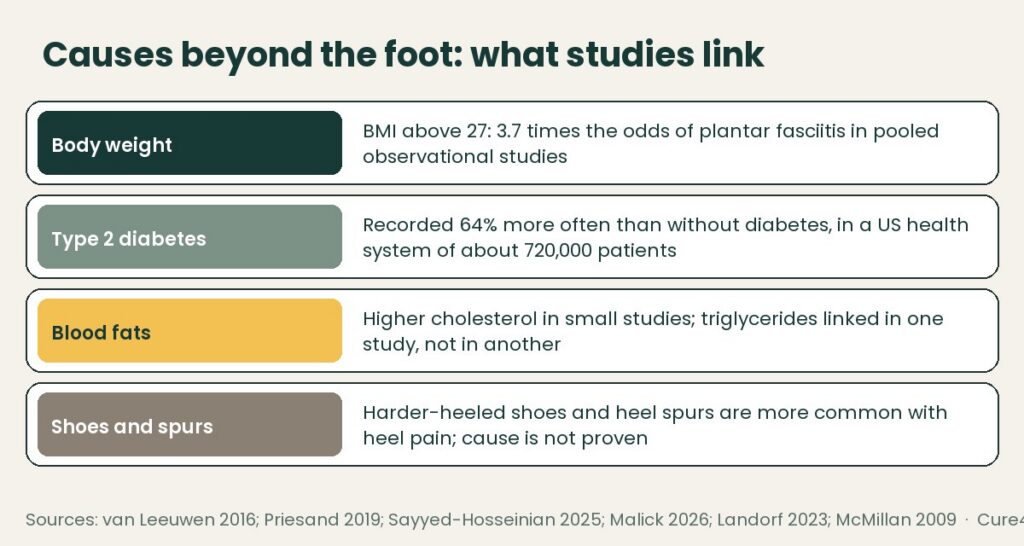
| Factor | What studies show | Strength of the evidence |
|---|---|---|
| Higher body weight | About 3.7 times the odds with BMI above 27 [2] | Consistent, but observational |
| Type 2 diabetes | Recorded 64% more often than without diabetes [3] | One large records study; shared risk factors |
| Cholesterol | Higher in people with plantar fasciitis in small studies [9] [4] | Small studies; one links it to severity only [5] |
| Triglycerides | Higher in one study [4], no link in another [5] | Conflicting |
| Shoes | Harder heels in people with heel pain [6] | Small cross-sectional studies |
| Long standing | Linked in a 2015 systematic review of 4 studies [10] | Low quality |
| Heel spur | About 8.5 times the odds on X-ray [7] | Strong link; spurs are common without pain |
Most research on the causes of plantar fasciitis cannot prove a cause. Of the 51 studies in the 2016 van Leeuwen meta-analysis, 46 were case-control and only 1 followed people forward in time, so most cannot show which came first [2]. The role of the foot itself is also debated: a 2003 case-control study found 23.3 times the odds of plantar fasciitis with a very tight calf, with a wide margin of error (4.3 to 124.4) [11], yet the 2016 van Leeuwen meta-analysis found a lack of evidence for clinical and mechanical measures of foot and ankle function [2].
Does being overweight cause plantar fasciitis?
Higher body weight is the most consistently reported link with plantar fasciitis, especially in people who are not athletes, but no study has proven that it is the cause. A 2016 meta-analysis of observational studies found about 3.7 times the odds with a BMI above 27 [2]. The NHS lists being overweight as a risk factor [1], the American Academy of Orthopaedic Surgeons says heel pain is often seen in overweight people [12], and the 2023 American Physical Therapy Association guideline lists higher body weight in people who are not athletes [13].
- A step-wise pattern: among 4,957 US adults in the 2009-2010 NHANES national survey, the odds of heel pain were 1.5 times as high with a BMI of 25 to 30, 2.1 times with 30 to 35 and 2.7 times with 35 or more, compared with a BMI below 25 [14].
- In active people: the evidence disagrees. A 2006 review found no link with BMI in athletes [15], while a 2021 meta-analysis in physically active people found BMI about 2.1 points higher in those with plantar fasciitis [16].
- Weight gain: almost all of the studies in the 2016 meta-analysis measured people at one point in time, so they cannot show whether weight or heel pain came first [2].
Does losing weight help plantar fasciitis?
Losing weight may help some people with plantar fasciitis, but in our PubMed searches on 30 October 2026 we found no randomised trial of it, and a 2012 systematic review called the evidence for weight loss and foot pain limited [17]. The NHS still advises trying to lose weight if you are overweight [1], and the 2023 American Physical Therapy Association guideline advises counselling on healthy body weight [13].
- After weight-loss surgery: in a 2018 US record review of 163 people with plantar fasciitis, mean BMI fell from 45 to 34.8 and 90% were recorded as having their symptoms settle. There was no comparison group [18].
- Weight may not act through load alone: in a 2018 Australian study of 45 candidates for weight-loss surgery (29 had surgery, 16 were on a waiting list), general foot pain fell after surgery, but the fall was not linked to changes in foot pressure. It was linked to an improvement in depressive symptoms [19].
- Weight-loss medicine: in a 2025 Chinese cohort, the 92 of 2,902 people with long-lasting heel pain who used semaglutide for diabetes or weight improved more than non-users. It was not randomised, and the authors call for a trial [20].
Does diabetes cause plantar fasciitis?
Type 2 diabetes is linked with plantar fasciitis, but it has not been shown to be a cause, and part of the link may come from shared factors such as body weight. In a 2019 five-year study of about 720,000 patients of one US health system, plantar fasciitis was recorded in 1.31% of people with type 2 diabetes, 0.92% with type 1 and 0.80% without diabetes, so it was recorded 64% more often in type 2 than without diabetes; the type 1 difference was not statistically significant. Women and people with higher BMI were also recorded more often [3].
- Shared risks: a 2020 review says people with diabetes are at risk partly because of common factors such as obesity and a sedentary lifestyle [21].
- A thicker fascia: in a 2025 Indian ultrasound study, the plantar fascia measured 3.4 mm in type 2 diabetes without heel pain, 5.6 mm in plantar fasciitis and 2.6 mm in healthy people. Reduced echo on ultrasound appeared in 90% of the plantar fasciitis group and 7% of the diabetes group, so the two changes are not the same [22].
- Weight again: in 51 people recently diagnosed with type 2 diabetes, plantar fascia thickness rose closely with BMI [23].
- A proposed mechanism, not a proven one: high blood sugar may thicken the fascia through sugar-bound proteins (advanced glycation end products) [3].
Read more on our type 2 diabetes page.
Is it plantar fasciitis or diabetic neuropathy?
Symptoms give the first clue to whether foot pain is plantar fasciitis or diabetic neuropathy. According to the NHS, plantar fasciitis typically hurts most with the first steps after rest and is felt around the heel and arch [1]. Tingling or loss of feeling suggests a nerve may be involved, and the NHS advises seeing a GP for this, or if you have diabetes and foot pain at all, because “foot problems can be more serious if you have diabetes” [1]. See our neuropathy page.
- Recovery: in a 2025 cohort of 220 people with long-lasting heel pain, rising scores for nerve-type symptoms went with poorer pain recovery over 12 months [24].
- Soaking: the US NIDDK says “do not soak your feet because your skin will get too dry” [25], and Diabetes UK also advises avoiding it [26]. If you have diabetes or numb feet, ask us before soaking.
Can high cholesterol or triglycerides cause plantar fasciitis?
No study has shown that high cholesterol or triglycerides cause plantar fasciitis, and in our PubMed searches on 30 October 2026 we found no trial of lowering blood fats for heel pain. Studies do find links, mostly with cholesterol, and they disagree on triglycerides.
- Cholesterol: in a 2022 study in Turkey, 22.7% of 238 people with plantar fasciitis had high total cholesterol, against 10.8% of 240 other orthopaedic patients [9].
- Triglycerides and LDL: in a 2025 Iranian study of 68 patients and 136 controls, total cholesterol, LDL (“bad”) cholesterol and triglycerides were all higher in plantar fasciitis, and an LDL above 130 mg/dL went with 3.3 times the odds of plantar fasciitis [4].
- A study that disagrees: in a 2026 Australian study with fasting blood from 197 people with long-lasting heel pain and 100 controls, no blood marker was linked with having heel pain. Cholesterol measures were linked with how severe the pain was; triglycerides were not [5].
- Clinic observation: at Cure4Pain, heel pain without a spur on X-ray is at times seen with raised triglycerides, and it often eases when they are brought down, in coordination with your existing consulting physician. No trial has tested this, and the 2026 Australian study found no link with triglycerides; further studies are needed.
Do uric acid, thyroid or vitamin D problems cause plantar fasciitis?
No study has shown that uric acid, thyroid or vitamin D problems cause plantar fasciitis, and the few small studies available disagree on vitamin D. In a 2023 study of 40 South Indian adults with heel pain, random blood sugar, uric acid, thyroid-stimulating hormone and vitamin D showed no significant link with heel pain; there was no separate healthy group [27]. In a 2022 Turkish study of 50 people with heel pain and a heel spur against 50 healthy volunteers, vitamin D and HDL cholesterol were lower, while LDL cholesterol, triglycerides and parathyroid hormone were higher; it cannot show which came first [28]. A sudden, red, swollen joint is a different matter: see our article on high uric acid and gout. Our article on deficiencies and joint pain covers nutrients more widely.
Can shoes or long hours standing cause plantar fasciitis?
Poor shoes and long hours of standing are linked with plantar fasciitis, but the studies are small and cannot prove cause. The NHS lists shoes with poor cushioning or support as a risk factor and advises against high heels, tight pointy shoes, flip-flops and backless slippers [1].
- Harder heels: in a 2023 study, 50 people with heel pain, matched with 25 without for age, sex and BMI, wore harder-heeled shoes and stood 3.4 hours more a day. Shoe style and heel height did not differ [6].
- High heels: in an online survey of 401 Saudi women, frequent high-heel use was linked with pain after standing, while general shoe type was not [29].
- In South Asia: of 101 patients in Pakistan, 83.2% wore shoes the authors rated as unsuitable, and these people had more severe pain; there was no comparison group [30]. In 50 non-athletic Indian patients, poorly cushioned shoes and BMI were linked with pain [31].
- Work: a 2015 systematic review found low-quality evidence for a link between plantar fasciitis and standing and walking on hard surfaces [10].
Do heel spurs cause plantar fasciitis?
The American Academy of Orthopaedic Surgeons states that “heel spurs do not cause plantar fasciitis pain”, and adds that most people with spurs have no heel pain [12]. Studies still find a strong link, so a spur often comes with the condition, but whether it contributes is unsettled.
- The link: a 2009 meta-analysis found about 8.5 times the odds of a spur on X-ray in people with long-lasting heel pain [7].
- Often painless: among 74 people with one painful heel, spurs appeared in 85.1% of painful feet and 71.6% of painless ones [32].
- Weight matters here too: in a 2023 study of 100 people who all had spurs, those with plantar fasciitis more often had a BMI above 30 (odds 2.7) [33].
- Where studies disagree: a Danish study of 174 people found that a spur did not change the long-term outlook [34], while two smaller studies linked larger spurs with more pain [35] [36].
What causes heel spurs?
The cause of heel spurs is not settled. The American Academy of Orthopaedic Surgeons describes a heel spur as a possible result of long-standing tension where the fascia meets the heel bone [12]. In a 2008 study of 216 older adults, however, spurs were linked with obesity (odds 7.9) and not with foot posture, which the authors read as a response to vertical pressure [37]. In a 2014 Irish study of 1,103 ankle X-rays, spurs were more common in women and older patients, and people with spurs were 4 times more likely to have diabetes [38].
What do guidelines advise?
Plantar fasciitis guidelines name body weight, shoes and time on the feet as risk factors. The 2023 American Physical Therapy Association guideline lists limited ankle bending, higher body weight in people who are not athletes, running and weight-bearing work as risk factors [13]. The 2024 Singapore guideline names obesity, worn-out shoes with poor support and jobs with prolonged standing, and suggests podiatrist review for orthoses when BMI is high [8]. A 2021 best practice guide in the British Journal of Sports Medicine advises taping, stretching and individual education, with footwear advice, as core treatment [39]. Neither the 2024 Singapore guideline nor the NHS page lists blood-fat or blood-sugar treatment among plantar fasciitis treatments [8] [1].
How we look for causes beyond the foot at Cure4Pain
At Cure4Pain, we examine the foot and the whole picture together, starting with muscle testing and blood work.
- Muscle testing first: the calf, foot and leg muscles, because in our clinic the calves are often tighter and at times weaker.
- Blood work: we read a panel of about 100 markers, adding tests for your condition when clinically indicated, such as blood fats including triglycerides and blood sugar. The 2024 Singapore guideline says risk factors should be assessed and addressed, without naming these blood tests [8]. According to the US National Institutes of Health, less than 1% of the body’s magnesium is in the blood and serum levels do not accurately reflect total body magnesium [40], so we assess magnesium from the overall clinical picture.
- Heel pain with no spur: raised triglycerides addressed in coordination with your existing consulting physician, nutrient shortfalls corrected, with supplements by mouth first and injections only when specifically needed or advised, and regular Epsom salt foot soaks for comfort. A 2017 review concluded that claims for magnesium through the skin are scientifically unsupported [41]; no trial has tested soaks for heel pain, and we use them to support comfort.
- Diabetic neuropathy, poor circulation, or burning or tingling feet with known diabetes or high blood fats: we do not needle the foot. We first wait for blood sugar and HbA1c to come into a healthy range, which can take months, under clinical guidance from Dr Krushal Pabari and, where needed, your existing consulting diabetologist. Gentle myofascial release is used only after their approval and is rarely needed. If you have diabetes or numb feet, ask us before soaking.
- Medicines: Dr Krushal Pabari prescribes cholesterol medicines beyond statins where needed. Any change to diabetes, cholesterol or other medicines is made under clinical guidance from Team Cure4Pain, in coordination with your existing consulting physician; never stop or change them on your own.
This is our clinic practice; individual results vary, and further studies are needed. Treatment details are on our plantar fasciitis page, and weight and blood fats are covered on our metabolic syndrome page.
If you would like your heel pain looked at together with your weight, blood sugar and blood fats, you can book a consultation, online from anywhere or at our Mumbai clinic; muscle testing and needling need an in-person visit.
Frequently asked questions
What is the main cause of plantar fasciitis?
Plantar fasciitis comes from strain on the plantar fascia, and the NHS notes that it is not always clear why. Higher body weight has the most consistent link in studies; long standing and a tight calf are also linked in some studies, on weaker evidence. [1] [2] [11] [10]
Can being overweight cause plantar fasciitis?
Higher body weight is strongly linked with plantar fasciitis, especially in people who are not athletes, with about 3.7 times the odds at a BMI above 27 in a 2016 meta-analysis of observational studies. These studies cannot prove cause. [2]
Will losing weight help plantar fasciitis?
Losing weight may help, but we found no randomised trial of it in PubMed. In a 2018 US record review of people who had weight-loss surgery, 90% were recorded as having their symptoms settle, without a comparison group. The NHS advises trying to lose weight if you are overweight. [18] [1]
Does diabetes cause plantar fasciitis?
Type 2 diabetes is linked with plantar fasciitis, but a cause has not been shown. In a 2019 US records study of about 720,000 patients, plantar fasciitis was recorded 64% more often in type 2 diabetes than in people without diabetes. Body weight is a shared factor, and the type 1 difference was not statistically significant. [3] [21]
How do I tell plantar fasciitis from diabetic neuropathy?
Plantar fasciitis usually hurts most with the first steps after rest, under the heel and arch. Tingling or loss of feeling needs a doctor’s review, as does any foot pain if you have diabetes. [1]
Can high cholesterol cause plantar fasciitis?
No study has shown that high cholesterol causes plantar fasciitis. Small studies find higher cholesterol in people with plantar fasciitis, while a 2026 study of 297 people linked cholesterol with how severe the pain was, not with having heel pain. [9] [5]
Are high triglycerides linked with heel pain?
Studies disagree on whether high triglycerides are linked with heel pain: a 2025 study found higher triglycerides in plantar fasciitis and a 2026 study found no link. At Cure4Pain we at times see heel pain ease when raised triglycerides are brought down; this is a clinic observation, and further studies are needed. [4] [5]
Can shoes cause plantar fasciitis?
The NHS lists shoes with poor cushioning or support as a risk factor, and people with heel pain wore harder-heeled shoes in a 2023 matched study. No study proves that shoes alone cause plantar fasciitis. [1] [6]
This article is for education and does not replace medical advice. Do not start, stop or change any medicine or supplement without medical guidance.
References
1. NHS (UK National Health Service). Plantar fasciitis. nhs.uk/conditions/plantar-fasciitis
2. van Leeuwen KD, et al. Higher body mass index is associated with plantar fasciopathy/’plantar fasciitis’: systematic review and meta-analysis of various clinical and imaging risk factors. Br J Sports Med 2016;50(16):972-81. doi:10.1136/bjsports-2015-094695
3. Priesand SJ, et al. Plantar fasciitis in patients with type 1 and type 2 diabetes: A contemporary cohort study. J Diabetes Complications 2019;33(10):107399. doi:10.1016/j.jdiacomp.2019.06.004
4. Sayyed-Hosseinian SH, et al. Comparison of Lipid and Glucose Levels in Individuals with and Without Plantar Fasciitis: A Cross-Sectional Observational Study. J Am Podiatr Med Assoc 2025;115(1). doi:10.7547/22-084
5. Malick WH, et al. Chronic plantar heel pain severity is associated with lipid biomarkers. Musculoskelet Sci Pract 2026;85:103624. doi:10.1016/j.msksp.2026.103624
6. Landorf KB, et al. Activity and footwear characteristics in people with and without plantar heel pain: A matched cross-sectional observational study. Musculoskeletal Care 2023;21(1):35-44. doi:10.1002/msc.1663
7. McMillan AM, et al. Diagnostic imaging for chronic plantar heel pain: a systematic review and meta-analysis. J Foot Ankle Res 2009;2:32. doi:10.1186/1757-1146-2-32
8. Tan VAK, et al. Consensus statements and guideline for the diagnosis and management of plantar fasciitis in Singapore. Ann Acad Med Singap 2024;53(2):101-112. doi:10.47102/annals-acadmedsg.2023211
9. Çatal B, et al. Is there a relation between plantar fasciitis and total cholesterol levels? Foot Ankle Surg 2022;28(3):390-393. doi:10.1016/j.fas.2021.05.005
10. Waclawski ER, et al. Systematic review: plantar fasciitis and prolonged weight bearing. Occup Med (Lond) 2015;65(2):97-106. doi:10.1093/occmed/kqu177
11. Riddle DL, et al. Risk factors for Plantar fasciitis: a matched case-control study. J Bone Joint Surg Am 2003;85(5):872-7. doi:10.2106/00004623-200305000-00015
12. American Academy of Orthopaedic Surgeons (OrthoInfo). Plantar fasciitis and bone spurs. orthoinfo.org
13. Koc TA Jr, et al. Heel Pain – Plantar Fasciitis: Revision 2023. J Orthop Sports Phys Ther 2023;53(12):CPG1-CPG39. doi:10.2519/jospt.2023.0303
14. Liu P, et al. Prevalence, characteristics, and associated risk factors of plantar heel pain in americans : The cross-sectional NHANES study. J Orthop Surg Res 2024;19(1):805. doi:10.1186/s13018-024-05300-y
15. Irving DB, et al. Factors associated with chronic plantar heel pain: a systematic review. J Sci Med Sport 2006;9(1-2):11-22; discussion 23-4. doi:10.1016/j.jsams.2006.02.004
16. Hamstra-Wright KL, et al. Risk Factors for Plantar Fasciitis in Physically Active Individuals: A Systematic Review and Meta-analysis. Sports Health 2021;13(3):296-303. doi:10.1177/1941738120970976
17. Butterworth PA, et al. The association between body mass index and musculoskeletal foot disorders: a systematic review. Obes Rev 2012;13(7):630-42. doi:10.1111/j.1467-789X.2012.00996.x
18. Boules M, et al. Effect of Surgical Weight Loss on Plantar Fasciitis and Health-Care Use. J Am Podiatr Med Assoc 2018;108(6):442-448. doi:10.7547/15-169
19. Walsh TP, et al. Changes in foot pain, structure and function following bariatric surgery. J Foot Ankle Res 2018;11:35. doi:10.1186/s13047-018-0277-y
20. Yang F, et al. Association of semaglutide use with outcomes in chronic plantar heel pain: a prospective observational cohort and a pilot interventional study. Int J Surg 2025;111(12):9333-9341. doi:10.1097/JS9.0000000000003156
21. Gariani K, et al. Plantar Fasciitis in Diabetic Foot Patients: Risk Factors, Pathophysiology, Diagnosis, and Management. Diabetes Metab Syndr Obes 2020;13:1271-1279. doi:10.2147/DMSO.S184259
22. Chincholikar S, et al. Ultrasound Imaging of Plantar Fascia in Apparently Healthy Individuals, Diabetics and Patients With Plantar Fasciitis: A Case-Control Study. Cureus 2025;17(7):e88609. doi:10.7759/cureus.88609
23. Abate M, et al. Achilles tendon and plantar fascia in recently diagnosed type II diabetes: role of body mass index. Clin Rheumatol 2012;31(7):1109-13. doi:10.1007/s10067-012-1955-y
24. Rogers J, et al. Pain Catastrophizing Beliefs and Neuropathic Symptoms Are Associated With a Poorer Long-Term Recovery in Chronic Plantar Heel Pain: A Cohort Study. Phys Ther 2025;105(12). doi:10.1093/ptj/pzaf134
25. US National Institute of Diabetes and Digestive and Kidney Diseases (NIDDK). Diabetes and foot problems. niddk.nih.gov
26. Diabetes UK. Taking care of your feet. diabetes.org.uk
27. Balaji G, et al. Clinical, Metabolic, and Radiological Risk Factors in Individuals With Plantar Heel Pain From a South Indian Population: A Cross-Sectional Observational Study. Cureus 2023;15(8):e42834. doi:10.7759/cureus.42834
28. Adanaş C, et al. The levels of 25-hydroxy vitamin D, parathyroid hormone, calcitonin and lipid profiles in patients with calcaneal spur. Turk J Phys Med Rehabil 2022;68(1):55-61. doi:10.5606/tftrd.2022.6799
29. Alwhaibi RM, et al. Footwear choices and their association with plantar fasciitis among adult women in Saudi Arabia: a cross-sectional study. Sci Rep 2025;15(1):40292. doi:10.1038/s41598-025-24122-4
30. Umar H, et al. Impact of routine footwear on foot health: A study on plantar fasciitis. J Family Med Prim Care 2022;11(7):3851-3855. doi:10.4103/jfmpc.jfmpc_637_21
31. Choudhary R, Kunal K. Modifiable Risk Factors of Plantar Fasciitis in Non-Athletic Patients and Proposal of a New Objective Assessment System – RKISP. Rev Bras Ortop (Sao Paulo) 2021;56(3):368-371. doi:10.1055/s-0040-1716762
32. Okçu M, et al. Do the presence, size, and shape of plantar calcaneal spurs have any significance in terms of pain and treatment outcomes in patients with plantar fasciitis? Turk J Med Sci 2023;53(1):413-419. doi:10.55730/1300-0144.5598
33. Lee W, et al. Association of Obesity and Plantar Fasciitis in Patients With Plantar Heel Spurs. Foot Ankle Orthop 2023;8(4):24730114231213625. doi:10.1177/24730114231213625
34. Hansen L, et al. Long-Term Prognosis of Plantar Fasciitis: A 5- to 15-Year Follow-up Study of 174 Patients With Ultrasound Examination. Orthop J Sports Med 2018;6(3):2325967118757983. doi:10.1177/2325967118757983
35. Cho BW, et al. Age, Body Mass Index, and Spur Size Associated with Patients’ Symptoms in Plantar Fasciitis. Clin Orthop Surg 2022;14(3):458-465. doi:10.4055/cios21263
36. Kuyucu E, et al. The association of calcaneal spur length and clinical and functional parameters in plantar fasciitis. Int J Surg 2015;21:28-31. doi:10.1016/j.ijsu.2015.06.078
37. Menz HB, et al. Plantar calcaneal spurs in older people: longitudinal traction or vertical compression? J Foot Ankle Res 2008;1(1):7. doi:10.1186/1757-1146-1-7
38. Moroney PJ, et al. The conundrum of calcaneal spurs: do they matter? Foot Ankle Spec 2014;7(2):95-101. doi:10.1177/1938640013516792
39. Morrissey D, et al. Management of plantar heel pain: a best practice guide informed by a systematic review, expert clinical reasoning and patient values. Br J Sports Med 2021;55(19):1106-1118. doi:10.1136/bjsports-2019-101970
40. National Institutes of Health, Office of Dietary Supplements. Magnesium: Fact Sheet for Health Professionals. ods.od.nih.gov
41. Gröber U, et al. Myth or Reality-Transdermal Magnesium? Nutrients 2017;9(8). doi:10.3390/nu9080813

