Written by AT. Chintan Dalal, N.D. · Reviewed by Dr Krushal Pabari, Clinical Team, Cure4Pain · Updated 30 October 2026
Key facts
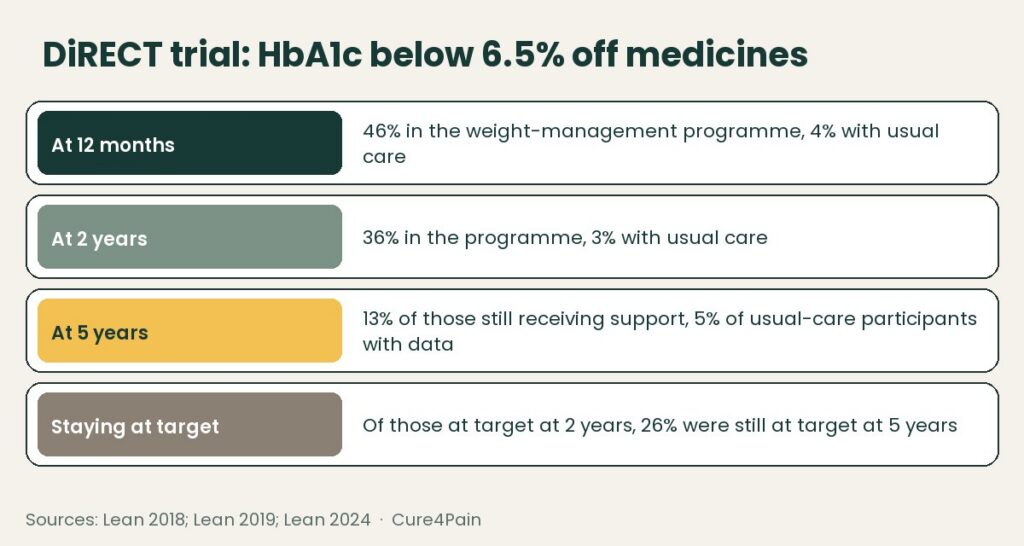
Remission of type 2 diabetes is a defined medical term: according to a 2021 consensus report from an expert group that included the American Diabetes Association (ADA), the European Association for the Study of Diabetes (EASD) and Diabetes UK, it means an HbA1c below 6.5% (48 mmol/mol) lasting at least 3 months without glucose-lowering medicines, and it still needs monitoring because high glucose frequently returns [1]. In the UK DiRECT trial of adults diagnosed within 6 years and not on insulin, 46% in a weight-management programme had an HbA1c below 6.5% after at least 2 months off medicines at 12 months, against 4% with usual care [2]; the figure was 36% at 2 years [3] and 13% of those still receiving support at 5 years [4]. As of October 2026, we found no large randomised Indian trial of a food-based programme.

Scientific explainer videos in our Resources section
In our Resources section, our clinical team discusses vitamin D, its cofactors and how autoimmune, lifestyle and pain conditions develop.
What is type 2 diabetes remission?
Remission of type 2 diabetes means an HbA1c below 6.5% (48 mmol/mol) that lasts at least 3 months without the usual glucose-lowering medicines, whether it happens on its own or after treatment, according to the 2021 consensus report convened by the American Diabetes Association [1]. The report is expert opinion, written to standardise research; it does not set treatment guidelines [1].
- When it can be judged: at least 6 months after starting a lifestyle programme, at least 3 months after surgery, and always at least 3 months after the last glucose-lowering medicine [1].
- If you still take metformin: remission (HbA1c below 6.5% without glucose-lowering medicines) cannot be diagnosed while a glucose-lowering medicine continues, even if it is taken for another reason [1].
- If HbA1c is unreliable: a fasting glucose below 126 mg/dL, or an HbA1c estimated from a continuous glucose monitor, can be used instead [1]. Our article on prediabetes and HbA1c explains what can mislead the test.
- Why experts chose this word: the 2021 consensus group rejected “no evidence of diabetes”, because insulin deficiency and insulin resistance are “rarely completely normalized” by treatment [1]. It also rejected stronger words that suggest the condition is over and needs no follow-up [1].
Why can HbA1c fall below the diabetes range?
HbA1c can fall below the diabetes range after weight loss, and the best-studied proposed root cause is excess fat in the liver: in a small UK study of 20 people with a body mass index (BMI) below 27, with no randomised comparison, liver fat fell to normal after repeated 5% weight-loss cycles, insulin-making (beta) cell function improved and 14 met an HbA1c below 6.5% off all medicines [5].
In the same 2023 UK study, insulin release after meals rose but stayed below normal [5].
What do the trials of type 2 diabetes remission show?
In randomised trials, structured weight-loss programmes brought more people to the study’s target (an HbA1c below 6.5% off medicines, or the study’s own definition) than comparison groups did at about 12 months, but the size of the effect varied: 46% against 4% in the UK DiRECT trial [2], 61% against 12% in Qatar’s DIADEM-I trial [6] and 11.5% against 2.0% in year 1 of the US Look AHEAD trial [7]. People, programmes and definitions differ: DiRECT required at least 2 months off medicines [2], the consensus 3 months [1].
| Trial and people | What was tested | Share meeting the study’s target, programme vs comparison |
|---|---|---|
| DiRECT, UK [2]: 298 adults aged 20 to 65, diagnosed within 6 years, BMI 27 to 45, no insulin | Formula diet of 825 to 853 kcal a day for 3 to 5 months, then food and support; medicines withdrawn within the trial | 46% vs 4% at 12 months |
| DIADEM-I, Qatar [6]: 147 adults aged 18 to 50, Middle East and north Africa, up to 3 years of diabetes, BMI 27 or more | Formula low-energy diet, then food and activity support | 61% vs 12% at 12 months (definition not in the abstract) |
| Look AHEAD, US [7]: 4,503 adults, BMI 25 or more | Intensive lifestyle counselling over 4 years | Fasting glucose below 126 mg/dL and HbA1c below 6.5% with no medicine: 11.5% vs 2.0% in year 1; 7.3% vs 2.0% at year 4; 3.5% vs 0.5% for all 4 years |
What else the research adds:
- Weight lost: in DiRECT, an HbA1c below 6.5% off medicines at 12 months was reached by none of those who gained weight, 7% with up to 5 kg lost, 34% with 5 to 10 kg, 57% with 10 to 15 kg and 86% with 15 kg or more [2].
- Outside trials: in England’s NHS programme, which starts with 3 months of formula diet, 27% of the 710 people with two HbA1c results were below 6.5% off medicines at 1 year, and only 55% completed the programme [8].
- Calorie restriction overall: a 2023 meta-analysis of 28 trials found, from the 4 trials reporting this at 12 months, 13 more people per 100 below 6.5% without medicines than with usual diet or usual care, with moderate certainty [9].
- Low-carbohydrate diets: a 2021 BMJ meta-analysis found 57% against 31% below 6.5% at 6 months, but the difference was smaller and not significant when people also had to be off medicines, and 12-month data were sparse [10].
- Without a programme: an HbA1c below 6.5% off medicines is uncommon. In 122,781 US adults not treated with surgery, 1.6% met a 1-year version of this target over 7 years, or 4.6% among those diagnosed within 2 years [11].
- Safety: in DiRECT, 7 of 157 people on the programme had serious adverse events, against 2 with usual care [2]. Trials withdrew medicines within a supervised plan, which is not something to copy alone.
How long does type 2 diabetes remission last?
Type 2 diabetes remission often does not last for life: the share of people with an HbA1c below 6.5% off medicines falls over time, and the 2021 consensus report says high glucose frequently returns and that the expected duration is still not well defined [1]. In the UK DiRECT trial, of those below 6.5% off medicines at 2 years, 26% were still there at 5 years [4].
Other studies point the same way, although their definitions differ:
| Study | Earlier | Later |
|---|---|---|
| Hospital records, Thailand [12]: 29,706 newly diagnosed people | 8.32% had an HbA1c below 6.5% for at least 90 days off medicines by 5 years | 38.38% of those relapsed within 1 year |
| Surgery trial, Italy [13]: BMI 35 or more, over 5 years of diabetes | 34 people met the study’s target at 2 years | 20 of them (58.8%) relapsed by 10 years; mean HbA1c in that group was 6.7% |
What seems to matter, according to DiRECT:
- Keeping the weight off: in DiRECT, 29 of the 45 people who kept off at least 10 kg were below 6.5% off medicines at 2 years, in a post-hoc analysis [3].
- Continued support: in the DiRECT 5-year extension, people who continued low-intensity support met the trial’s target at 34% of visits against 12% for those without it. This comparison was not randomised [4].
Who does type 2 diabetes remission apply to?
The strongest evidence for type 2 diabetes remission (an HbA1c below 6.5% off medicines) applies to adults with recently diagnosed diabetes who are not on insulin, carry excess weight and can join a supervised weight-loss programme. The 2021 consensus report says a return to near-normal glucose is most likely early in the condition [1], and Diabetes UK notes that not everyone who tries reaches it [14].
- Recent diagnosis: DiRECT and the NHS programme enrolled people within 6 years of diagnosis, and DIADEM-I within 3 years [2] [8] [6]. Inside DiRECT’s group, duration did not predict the result [15], but that range cannot show what happens with longer diabetes.
- Insulin: DiRECT excluded people on insulin [2]. In the low-carbohydrate meta-analysis, rates fell markedly in studies that included insulin users [10].
- Lower BMI: evidence is limited to small studies, which matters in South Asia, where diabetes tends to occur at lower body weight [5] [16]. In UK South Asian adults (BMI 25 to 45) in the STANDby trial, 5 of 13 had an HbA1c below 6.5% off diabetes treatment for at least 3 months, against 0 of 12 on usual care [17].
- Type 1 diabetes: the consensus definition covers type 2 only, and Diabetes UK says people with type 1 cannot go into remission [1] [18].
If you do not fit these groups, Diabetes UK says any lowering of blood sugar and weight can have a large effect on health, whether or not HbA1c stays below 6.5% off medicines [14].
What does the evidence on type 2 diabetes remission show in India?
As of October 2026, our PubMed searches found no large randomised Indian trial of a food-based programme testing an HbA1c below 6.5% off medicines, so Indian figures rest on small trials and clinic records.
| Study | Design | Result |
|---|---|---|
| Online 1-year lifestyle programme, 2025 [19] | Records of 2,384 people, no comparison group; authors linked to the programme | 31.2% below 6.5% for 3 months off medicines |
| DiaRem-1, 2025 [20] | Randomised trial of 29 adults, under 5 years of diabetes, 3 months on one of two medicine combinations, then 3 months off | 4 of 14 and 5 of 15 below 6.5% off treatment |
In nearby Nepal, a single-arm study of 70 people with BMI 23 or more on about 850 kcal a day of traditional foods found 29% of those evaluated below 6.5% off medicines at 52 weeks [16].
Does type 2 diabetes remission lower the risk of complications or lengthen life?
Type 2 diabetes remission (HbA1c below 6.5% off medicines) is linked with fewer complications, but these are observational findings and cannot prove that it is itself the cause. The 2021 consensus report described the long-term effects on death, heart events and quality of life as unknown [1].
- Heart and kidneys: in the US Look AHEAD trial, people with any period below 6.5% without medicines had a 33% lower rate of chronic kidney disease and a 40% lower rate of cardiovascular disease; the authors note that improved weight, fitness and cholesterol may play a part [21]. In the same trial’s randomised comparison, the lifestyle programme itself did not lower cardiovascular events (hazard ratio 0.95) [22].
- Life expectancy: in a Swedish study of 586 people with obesity and diabetes, those off medicines with an HbA1c below 6.5% or a fasting glucose below the diabetes range at 2 years, most of them after surgery, had a median life expectancy 2.5 years longer than those who were not. It was a post-hoc analysis, and the authors call for confirmation [23].
Can surgery or medicines lead to type 2 diabetes remission?
Surgery can, for some people with a high BMI; medicines count only once they have been stopped, because the definition of remission requires an HbA1c below 6.5% without them [1]. The 2021 consensus report adds that short-term medicine at first presentation can sometimes allow withdrawal, with quite variable duration afterwards [1]. In a randomised trial in Rome of people with a BMI of 35 or more and over 5 years of diabetes, using a stricter definition (HbA1c below 6.5% and normal fasting glucose off medicines for at least 1 year), 10-year rates were 50.0% after biliopancreatic diversion and 25.0% after Roux-en-Y gastric bypass against 5.5% with medical therapy, and biliopancreatic diversion had more serious adverse events [13]. In the ARMMS-T2D analysis of 262 people from four pooled US trials, 12.7% after surgery against 0.0% with medical and lifestyle care were reported in diabetes remission at 12 years, by a definition the abstract does not give, while anaemia, fractures and gut problems were more common after surgery [24].
What should continue after type 2 diabetes remission?
After type 2 diabetes remission, monitoring, complication checks and the habits that lowered HbA1c should all continue. The 2021 consensus report advises testing HbA1c at least once a year and not more often than every 3 months, with regular eye screening, kidney tests, foot checks, blood pressure and weight, and says there is no long-term evidence that any of these checks can safely be dropped [1].
- Complications: eye, kidney, nerve and heart problems can still occur with an HbA1c below 6.5% off medicines, because earlier high glucose has lasting effects [1]. Our neuropathy page covers nerve damage.
- Our caution: at Cure4Pain, an HbA1c below 6.5% off medicines is a result to keep monitoring, not the end of care. In our clinic, the most serious mistake we see is stopping monitoring, exercise, the food plan, or the protocols and medicines still advised once that result arrives. Blood glucose can then rise back into the diabetes range, sometimes with complications. This is an observation from our practice, not a trial result. The consensus report calls remission a state in which diabetes is not present but which needs continued observation [1]; in line with that, we continue monitoring for life.
How we manage type 2 diabetes at Cure4Pain, and where remission fits
At Cure4Pain, an HbA1c below 6.5% off medicines is one blood result we track within lifelong management, not a promise. No trial has tested our plan, so we cannot say whether or how often it leads to this result, or how it compares with standard treatment, which it does not replace.
- Diet: low carbohydrate and low glycaemic, home cooked and no processed foods. Fruit and raw foods are limited, with whole raw fruit once in a while, and three meals a day. We consider intermittent fasting for suitable patients under supervision. Also, as clinic practice, we generally advise most patients to replace wheat with jowar, bajra or other millets as a general health measure, including home-made roti from processed wheat, and as an observational clinic practice, we generally suggest limiting cruciferous (Brassica) vegetables such as cabbage and cauliflower.
- Movement: the aim is lean muscle and a smaller waist rather than a number on the scale, with resistance training and 5,000 to 7,000 steps a day.
- Tests: we read a panel of about 100 markers, adding tests for your condition when clinically indicated, such as the eye, kidney and foot checks in the 2021 consensus report [1]. Tests and nutrients are set out on our Type 2 Diabetes page.
- Medicines: Dr Krushal Pabari manages diabetes medicines and insulin under clinical guidance from Team Cure4Pain, in coordination with your existing consulting physician, with an endocrinologist and other specialists from the first visit in complex cases. Medicines are tapered step by step, never stopped abruptly, and only after measurable blood markers stay improved; never stop or change them on your own. Low blood glucose is common with insulin and some other diabetes medicines, according to NIDDK [25].
- Follow-up: blood tests and evaluations every 3 months for life, including after an HbA1c below 6.5%. For HbA1c, the consensus range is once a year to every 3 months [1].
How research compares with these rules:
- Low carbohydrate: in the 2021 BMJ meta-analysis, the effect was smaller and not significant once people also had to be off medicines, and 12-month data were sparse [10].
- Weight and food: weight loss was the strongest predictor in DiRECT [15], and DiRECT and DIADEM-I used formula diets [2] [6]. Aiming for lean muscle and a smaller waist on home-cooked food is our clinic practice, and those trials did not test it.
- Wheat, fruit and raw foods: these rules are clinic practice, and we found no trial of them for this target. In large US cohorts, some whole fruits were linked with a lower risk of developing diabetes and fruit juice with a higher risk [26]. Separately, a gluten-free diet is supported for coeliac disease and positive tests, and the NHS says people with coeliac disease must stop all gluten for life [27].
- Cruciferous vegetables: a 2024 review found that eating them, particularly with enough iodine, had no adverse effect on thyroid function [28]; limiting them is our observational clinic practice.
- Fasting: intermittent fasting is clinic practice, and the trials above did not test it. Fasting with diabetes medicines is planned only with Dr Krushal Pabari. ADA 2026 advises medical monitoring during fasting for people with diabetes on insulin or secretagogue medicines, and says rigid meal plans can be contraindicated for people at increased risk of maladaptive eating behaviours [29]. We also do not advise fasting in pregnancy or breastfeeding.
An integrative plan may add options alongside standard care. This is our clinic practice; individual results vary, and further studies are needed. Read more on our Type 2 Diabetes and Metabolic Syndrome pages, and in our article on insulin resistance.
If you would like your HbA1c, medicines and follow-up reviewed together, you can book a consultation, online from anywhere or at our Mumbai clinic.
Frequently asked questions
What are the criteria for type 2 diabetes remission?
An HbA1c below 6.5% (48 mmol/mol) lasting at least 3 months without glucose-lowering medicines, according to the 2021 consensus report. A fasting glucose below 126 mg/dL can be used when HbA1c is unreliable. [1]
Can type 2 diabetes go into remission?
Yes, for some people, meaning an HbA1c below 6.5% lasting at least 3 months without glucose-lowering medicines. In the DiRECT trial, 46% on a weight-management programme were below 6.5% after at least 2 months off medicines at 12 months, against 4% with usual care. High glucose frequently returns, so monitoring continues. [1] [2]
How long can you keep type 2 diabetes in remission?
It varies, and the 2021 consensus report says the expected duration is not well defined. In the UK DiRECT trial, of people below 6.5% off medicines at 2 years, 26% were still there at 5 years. [1] [4]
Can remission of type 2 diabetes last for life?
Studies cannot yet say whether it lasts for life. Long-term trial data come mainly from surgery: over 10 years, 15 of 40 people treated with surgery in an Italian randomised trial stayed below the study’s target throughout. The 2021 consensus report advises continued monitoring because high glucose frequently returns. [13] [1]
Am I in remission if my HbA1c is below 6.5% on metformin?
No. Remission means below 6.5% without glucose-lowering medicines, so it cannot be diagnosed while metformin continues. Do not stop metformin to test this without medical guidance. [1]
What diet was used in the remission trials?
DiRECT used a formula diet of 825 to 853 kcal a day for 3 to 5 months, followed by food reintroduction and support. A study in Nepal used about 850 kcal a day of traditional foods. These programmes were supervised, so do not start one alone, especially on medicines. [2] [16]
Is remission possible after 10 years of diabetes or on insulin?
Remission (an HbA1c below 6.5% off medicines) after 10 years of diabetes or on insulin is less studied. DiRECT enrolled people within 6 years of diagnosis and without insulin, and low-carbohydrate results fell markedly in studies with insulin users. The 2021 consensus report says a return to near-normal glucose is most likely early in the condition. [2] [10] [1]
Does remission increase life expectancy?
A longer life has not been proven. In a Swedish study of 586 people with obesity and diabetes, those off medicines with an HbA1c below 6.5% or a fasting glucose below the diabetes range at 2 years, most of them after surgery, had a median life expectancy 2.5 years longer than those who were not, but this was a post-hoc analysis. [23]
This article is for education and does not replace medical advice. Do not start, stop or change any medicine or supplement without medical guidance.
References
1. Riddle MC, et al. Consensus Report: Definition and Interpretation of Remission in Type 2 Diabetes. Diabetes Care 2021;44(10):2438-2444. doi:10.2337/dci21-0034
2. Lean ME, et al. Primary care-led weight management for remission of type 2 diabetes (DiRECT): an open-label, cluster-randomised trial. Lancet 2018;391(10120):541-551. doi:10.1016/S0140-6736(17)33102-1
3. Lean MEJ, et al. Durability of a primary care-led weight-management intervention for remission of type 2 diabetes: 2-year results of the DiRECT open-label, cluster-randomised trial. Lancet Diabetes Endocrinol 2019;7(5):344-355. doi:10.1016/S2213-8587(19)30068-3
4. Lean ME, et al. 5-year follow-up of the randomised Diabetes Remission Clinical Trial (DiRECT) of continued support for weight loss maintenance in the UK: an extension study. Lancet Diabetes Endocrinol 2024;12(4):233-246. doi:10.1016/S2213-8587(23)00385-6
5. Taylor R, et al. Aetiology of Type 2 diabetes in people with a ‘normal’ body mass index: testing the personal fat threshold hypothesis. Clin Sci (Lond) 2023;137(16):1333-1346. doi:10.1042/CS20230586
6. Taheri S, et al. Effect of intensive lifestyle intervention on bodyweight and glycaemia in early type 2 diabetes (DIADEM-I): an open-label, parallel-group, randomised controlled trial. Lancet Diabetes Endocrinol 2020;8(6):477-489. doi:10.1016/S2213-8587(20)30117-0
7. Gregg EW, et al. Association of an intensive lifestyle intervention with remission of type 2 diabetes. JAMA 2012;308(23):2489-96. doi:10.1001/jama.2012.67929
8. Valabhji J, et al. Early findings from the NHS Type 2 Diabetes Path to Remission Programme: a prospective evaluation of real-world implementation. Lancet Diabetes Endocrinol 2024;12(9):653-663. doi:10.1016/S2213-8587(24)00194-3
9. Jayedi A, et al. Effect of calorie restriction in comparison to usual diet or usual care on remission of type 2 diabetes: a systematic review and meta-analysis of randomized controlled trials. Am J Clin Nutr 2023;117(5):870-882. doi:10.1016/j.ajcnut.2023.03.018
10. Goldenberg JZ, et al. Efficacy and safety of low and very low carbohydrate diets for type 2 diabetes remission: systematic review and meta-analysis of published and unpublished randomized trial data. BMJ 2021;372:m4743. doi:10.1136/bmj.m4743
11. Karter AJ, et al. Incidence of remission in adults with type 2 diabetes: the diabetes & aging study. Diabetes Care 2014;37(12):3188-95. doi:10.2337/dc14-0874
12. Janram A, et al. Incidence of diabetes remission and association with microvascular and macrovascular complications in patients with newly diagnosed type 2 diabetes mellitus: a retrospective cohort study using real-world data in Thailand. BMJ Open 2026;16(10):e119475. doi:10.1136/bmjopen-2026-119475
13. Mingrone G, et al. Metabolic surgery versus conventional medical therapy in patients with type 2 diabetes: 10-year follow-up of an open-label, single-centre, randomised controlled trial. Lancet 2021;397(10271):293-304. doi:10.1016/S0140-6736(20)32649-0
14. Diabetes UK. Type 2 diabetes remission and mental health. diabetes.org.uk
15. Thom G, et al. Predictors of type 2 diabetes remission in the Diabetes Remission Clinical Trial (DiRECT). Diabet Med 2021;38(8):e14395. doi:10.1111/dme.14395
16. Karmacharya B, et al. A service evaluation of weight management for glycaemic control and remission of type 2 diabetes using traditional food in Nepal (Ho-DIRECT NEPAL): a single-arm trial. Lancet Reg Health Southeast Asia 2024;29:100465. doi:10.1016/j.lansea.2024.100465
17. Sattar N, et al. Dietary weight-management for type 2 diabetes remissions in South Asians: the South Asian diabetes remission randomised trial for proof-of-concept and feasibility (STANDby). Lancet Reg Health Southeast Asia 2023;9:100111. doi:10.1016/j.lansea.2022.100111
18. Diabetes UK. Reversing other types of diabetes. diabetes.org.uk
19. Tripathi P, et al. Type 2 diabetes remission and its predictors in an Indian cohort: A retrospective analysis of an intensive lifestyle intervention program. PLoS One 2025;20(10):e0333114. doi:10.1371/journal.pone.0333114
20. Sudhayakumar A, et al. Realisation of Remission of Diabetes Using Pharmacotherapy (DiaRem-1). Indian J Endocrinol Metab 2025;29(2):217-223. doi:10.4103/ijem.ijem_356_24
21. Gregg EW, et al. Impact of remission from type 2 diabetes on long-term health outcomes: findings from the Look AHEAD study. Diabetologia 2024;67(3):459-469. doi:10.1007/s00125-023-06048-6
22. Wing RR, et al. Cardiovascular effects of intensive lifestyle intervention in type 2 diabetes. N Engl J Med 2013;369(2):145-54. doi:10.1056/NEJMoa1212914
23. Carlsson LMS, et al. Mortality in relation to diabetes remission in Swedish Obese Subjects – a prospective cohort study. Int J Surg 2024;110(10):6581-6590. doi:10.1097/JS9.0000000000001807
24. Courcoulas AP, et al. Long-Term Outcomes of Medical Management vs Bariatric Surgery in Type 2 Diabetes. JAMA 2024;331(8):654-664. doi:10.1001/jama.2024.0318
25. National Institute of Diabetes and Digestive and Kidney Diseases (NIDDK), US National Institutes of Health. Low Blood Glucose (Hypoglycemia). niddk.nih.gov
26. Muraki I, et al. Fruit consumption and risk of type 2 diabetes: results from three prospective longitudinal cohort studies. BMJ 2013;347:f5001. doi:10.1136/bmj.f5001
27. NHS (UK National Health Service). Coeliac disease: treatment. nhs.uk/conditions/coeliac-disease/treatment
28. Galanty A, et al. Do Brassica Vegetables Affect Thyroid Function?-A Comprehensive Systematic Review. Int J Mol Sci 2024;25(7). doi:10.3390/ijms25073988
29. American Diabetes Association Professional Practice Committee for Diabetes. 5. Facilitating Positive Health Behaviors and Well-being to Improve Health Outcomes: Standards of Care in Diabetes-2026. Diabetes Care 2026;49(Supplement_1):S89-S131. doi:10.2337/dc26-S005