Written by AT. Chintan Dalal, N.D. · Reviewed by Dr Krushal Pabari, Clinical Team, Cure4Pain · Updated 30 October 2026
Key facts
According to the American Diabetes Association’s (ADA) 2026 Standards of Care, prediabetes is an HbA1c of 5.7% to 6.4% (39 to 47 mmol/mol), a fasting glucose of 100 to 125 mg/dL, or a 2-hour glucose of 140 to 199 mg/dL on a glucose tolerance test [1]. The World Health Organization (WHO) starts impaired fasting glucose higher, at 110 mg/dL [1]. India’s RSSDI-ESI 2020 recommendations advise against HbA1c as the only screening test, partly because anaemia and haemoglobin disorders are common in some populations [2], and iron deficiency can raise HbA1c with no matching rise in glucose [3]. Prediabetes can go back to normal glucose: in a Cochrane review of cohort studies, 33% to 59% of people did so within 1 to 5 years [4]. In the Indian Diabetes Prevention Programme, lifestyle advice lowered the relative risk of diabetes by 28.5% in Asian Indian adults with impaired glucose tolerance: 3-year incidence was 39.3%, against 55.0% in the control group [5]. The ADA advises monitoring people with prediabetes at least once a year [6].

Scientific explainer videos in our Resources section
In our Resources section, our clinical team discusses vitamin D, its cofactors and how autoimmune, lifestyle and pain conditions develop.
What is prediabetes?
Prediabetes means glucose or HbA1c is above normal but below the diabetes range, according to the ADA, and it is a significant risk factor for both diabetes and cardiovascular disease [1]. It usually causes no symptoms, according to the US National Institute of Diabetes and Digestive and Kidney Diseases (NIDDK) [7], so most people meet it as a number on a routine report.
- Root cause: a 2012 review in The Lancet links prediabetes to insulin resistance together with poorly working insulin-making cells (beta cells), and says these changes start before glucose changes can be detected [8].
- In India: the national ICMR-INDIAB study of 113,043 people found prediabetes in 15.3% of adults, using WHO criteria [9].
- A deficiency that can change the number: in the Pune Children’s Study of 116 young adults, 23.3% had prediabetes by HbA1c but only 7.8% by glucose tolerance test. In that group, 37% were iron deficient, and lower ferritin (iron stores) explained a small part (4.3%) of the variation in HbA1c [10].
- First test: the ADA suggests considering testing in adults of Asian ancestry with a BMI of 23 or more and a risk factor [1].
If you already have diabetes, our Type 2 Diabetes page covers treatment.
What HbA1c range is prediabetes?
Under the ADA’s 2026 Standards, an HbA1c below 5.7% is normal, 5.7% to 6.4% is prediabetes, and 6.5% or above is the diabetes range [1] [11]. A fasting glucose below 100 mg/dL and a 2-hour glucose below 140 mg/dL fall below the prediabetes range [1].
| Test | Prediabetes | Diabetes |
|---|---|---|
| HbA1c | 5.7% to 6.4% (39 to 47 mmol/mol) | 6.5% or above (48 mmol/mol or above) |
| Fasting plasma glucose | 100 to 125 mg/dL | 126 mg/dL or above |
| 2 hours after 75 g of glucose (OGTT) | 140 to 199 mg/dL | 200 mg/dL or above |
Not every body draws the line in the same place, so one report can be labelled differently by different guidance:
| Source | HbA1c | Fasting glucose |
|---|---|---|
| ADA 2026 [1] | 5.7% to 6.4% | 100 to 125 mg/dL |
| RSSDI-ESI 2020, India [2] | 5.7% to 6.4% | 100 to 125 mg/dL |
| WHO [1] [12] [4] | Its 2011 advice accepted 6.5% for diabetes but did not recommend HbA1c for identifying high risk | 110 to 125 mg/dL |
| SIGN, NHS Scotland [13] | 6.0% to 6.4% (42 to 47 mmol/mol) | 6.1 to 6.9 mmol/L (110 to 125 mg/dL) |
In short, an HbA1c of 5.8% counts as prediabetes in the ADA and Indian RSSDI-ESI tables but not in the NHS Scotland one. The ADA lowered its own HbA1c threshold from 6.0% to 5.7% in 2010 [4].
What does an HbA1c of 5.7, 6.0 or 6.2 mean?
According to the ADA’s 2026 Standards, an HbA1c of 5.7% is the first value in the prediabetes range, while 6.0% and 6.2% sit in its upper part, where risk is clearly higher. The ADA reports a 5-year diabetes risk of 9% to 25% for HbA1c 5.5% to 6.0%, and 25% to 50% for 6.0% to 6.5% [1].
| HbA1c | Estimated average glucose | ADA category |
|---|---|---|
| 5.6% | 114 mg/dL | Normal |
| 5.7% | 117 mg/dL | Prediabetes |
| 6.0% | 126 mg/dL | Prediabetes |
| 6.2% | 131 mg/dL | Prediabetes |
| 6.4% | 137 mg/dL | Prediabetes |
| 6.5% | 140 mg/dL | Diabetes range |
We calculated these estimated average glucose values with the formula from a 2008 study in Diabetes Care of 507 people, of whom 80 did not have diabetes: average glucose in mg/dL = 28.7 x HbA1c minus 46.7 [14]. Estimated average glucose describes glucose across the whole day, not a fasting reading, so an average of 126 mg/dL does not mean a fasting glucose of 126 mg/dL.
- One result near the diabetes line: the ADA advises repeating the test in 3 to 6 months when a result is close to the diagnostic threshold for diabetes [1].
- Older adults: in the US ARIC cohort of 3,412 adults with a mean age of 75.6, of those with HbA1c 5.7% to 6.4%, 9% developed diabetes, 13% went back to normal and 19% died during follow-up of up to 6.5 years (median 5.0). The authors questioned how useful the label is in older age [15].
What can make HbA1c falsely high or low?
Iron deficiency can make HbA1c read falsely high, and non-iron anaemias may make it read falsely low, according to a 2015 systematic review in Diabetologia [3]. According to the ADA’s 2026 Standards, HbA1c reflects glucose bound to haemoglobin over the life of a red blood cell (about 120 days), so factors that change haemoglobin or red cell turnover can affect the result [1].
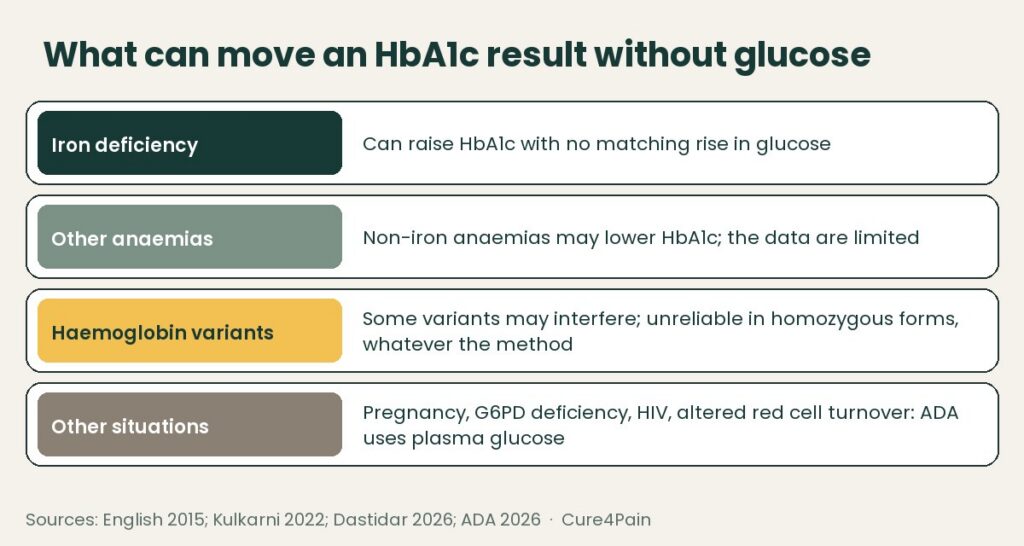
- Iron deficiency (can read high): a 2015 systematic review of 12 studies found that iron deficiency, with or without anaemia, raised HbA1c with no rise in glucose [3]. In a 2017 case-control study of Asian Indians, HbA1c averaged 5.51% in 62 people with iron deficiency anaemia against 4.85% in 60 healthy controls. After 3 months of iron, 14 of 20 people with an HbA1c in the prediabetes range moved to the normal range. The authors advise correcting iron deficiency before diagnosing on HbA1c alone [16].
- Other anaemias (can read low): a 2015 systematic review reports that non-iron anaemia may lower HbA1c, although the data are limited [3]. Recent blood loss, transfusion, dialysis, and kidney or liver disease can also change HbA1c, according to NIDDK [11].
- Thalassaemia and haemoglobin variants, relevant in India: the ADA names thalassaemia and folate deficiency among factors that can affect HbA1c [1]. One Indian laboratory found a variant in 70 of 9,595 HbA1c samples [17]. In Eastern India, 327 of 3,500 screened samples showed a haemoglobin disorder, mostly HbE trait and beta-thalassaemia carriers. Two modern laboratory methods agreed well in carriers, but HbA1c was unreliable in homozygous forms (two copies of the variant) with either method [18].
- What guidelines advise: the ADA’s 2026 Standards use plasma glucose to diagnose diabetes where the link between HbA1c and glucose is altered, such as with some haemoglobin variants, pregnancy, glucose-6-phosphate dehydrogenase (G6PD) deficiency, HIV and conditions that may alter red blood cell turnover, and say consistent, substantial disagreement between the two should be followed up [1].
Can HbA1c miss prediabetes?
Yes. According to the ADA’s 2026 Standards, HbA1c, fasting glucose and the 2-hour glucose test reflect different aspects of glucose metabolism and identify groups that only partly overlap, and the 2-hour test diagnoses more people with prediabetes and diabetes than the other two [1]. So one normal HbA1c does not always rule out prediabetes. India’s RSSDI-ESI 2020 recommendations do not recommend HbA1c as the only test for diabetes or prediabetes screening [2].
| Test | What it shows | Main limit |
|---|---|---|
| HbA1c | Glucose exposure over about 2 to 3 months; no fasting needed [1] | Affected by anaemia, low iron and some haemoglobin variants [1] |
| Fasting glucose | Glucose after at least 8 hours without food [1] | Identifies fewer people than the 2-hour test [1] |
| Glucose tolerance test (OGTT) | Glucose 2 hours after a 75 g glucose drink [1] | Needs about 2 hours at the laboratory |
How often should prediabetes be retested?
Prediabetes should be retested at least once a year, according to the American Diabetes Association’s (ADA) 2026 Standards of Care, which adds that the timing should be adjusted to individual risk [6]. India’s RSSDI-ESI 2020 recommendations also advise annual monitoring, and yearly or more frequent testing for some people [2]. NHS Scotland advises a blood test at least once a year, preferably using the same type of test [13].
- Sooner if near the diabetes line: the ADA advises repeating the test in 3 to 6 months when a result is close to the diagnostic threshold for diabetes [1].
- Why not every few weeks: according to the ADA, HbA1c reflects about 2 to 3 months, weighted towards recent weeks [1], so retests are planned in months.
Can prediabetes go back to normal?
Yes. Prediabetes can go back to normal glucose, and this is common. In a 2018 Cochrane review of 103 cohort studies, the 47 that reported it found that 33% to 59% of people returned to normal glucose within 1 to 5 years, and 17% to 42% were at normal glucose after 6 to 11 years [4]. A 2012 Lancet review estimates that 5% to 10% of people with prediabetes progress to diabetes each year, and about the same proportion return to normal glucose [8].
- Why it matters: in an observational analysis of the US Diabetes Prevention Program follow-up, people who returned to normal glucose even once had a 56% lower later risk of diabetes than those who stayed in prediabetes [19].
- What helps: a 2026 meta-analysis of 77 randomised trials linked losing 5% or more of body weight with a higher chance of returning to normal glucose [20].
- The risk in India: in the Chennai Urban Rural Epidemiology Study, followed for a median of 9.1 years, 58.9% of the 299 people with prediabetes who were re-examined developed diabetes [21]. Progression is common, although this study did not test whether lifestyle change alters it.
- It can change again: Cochrane notes that people may move between stages in both directions even after years [4], so testing continues once results no longer meet the criteria for prediabetes.
What lowers the risk of prediabetes becoming diabetes?
Lifestyle programmes have the strongest evidence, and metformin also lowers the risk. In the US Diabetes Prevention Program, new diabetes fell 58% with lifestyle and 31% with metformin against placebo at 2.8 years [22]; in the Indian Diabetes Prevention Programme, the relative risk fell 28.5% with lifestyle advice and 26.4% with metformin [5]. These trials selected people on glucose tests, not HbA1c.
| Trial | Who | Result |
|---|---|---|
| Diabetes Prevention Program, 2002 [22] | 3,234 US adults with raised fasting and after-load glucose | At 2.8 years, new diabetes fell 58% with lifestyle and 31% with metformin, against placebo |
| Diabetes Prevention Program Outcomes Study, 2009 [23] | 2,766 of the US participants, 10-year follow-up | At 10 years, diabetes incidence was 34% lower with lifestyle and 18% lower with metformin, against placebo |
| Indian Diabetes Prevention Programme, 2006 [5] | 531 Asian Indians with impaired glucose tolerance, mean BMI 25.8 | Against the control group, relative risk fell 28.5% with lifestyle advice, 26.4% with metformin and 28.2% with both; combining added nothing |
| Indian text message trial, 2013 [24] | 537 working Indian men with impaired glucose tolerance | 18% developed diabetes with mobile phone messages, against 27% with advice at baseline only |
The Indian participants were younger and leaner than those in the earlier trials [5], and the ADA notes that their lifestyle programme was less intensive than the US one [6].
- When diabetes is defined by HbA1c: in a 2015 analysis of the US Diabetes Prevention Program, new diabetes fell 49% with lifestyle and 44% with metformin during the trial [25].
- Programme goals: the ADA advises losing at least 5% to 7% of body weight and at least 150 minutes of moderate activity a week [6]. RSSDI-ESI 2020 advises losing 5% to 10% if overweight or obese [2].
- Metformin: the ADA says it should be considered in adults at high risk, especially those aged 25 to 59 with a BMI of 35 or more, higher fasting glucose (such as 110 mg/dL or above) and higher HbA1c (such as 6.0% or above), and after gestational diabetes, with periodic vitamin B12 checks on long-term use [6]. RSSDI-ESI 2020 considers it for some patients when lifestyle change shows no benefit after 6 months [2].
- Vitamin D: the evidence is mixed. The D2d trial of 2,423 adults did not show a significant reduction [26]. A pooled analysis of 3 trials found a 15% lower risk, an absolute fall of 3.3% over 3 years [27]. RSSDI-ESI 2020 does not recommend vitamin D for this purpose [2].
A 7-day Indian vegetarian diet chart for prediabetes
A prediabetes diet chart for Indian vegetarians can be built on millets, pulses, paneer and cooked vegetables, with no sugar or processed food, as in the week below. The ADA advises at least 5% to 7% weight loss and regular activity [6], and this week follows our clinic rules on food. It is a sample, not a prescription, and it has not been tested in a trial; your own plan depends on your tests, weight, medicines and other conditions. It has no wheat roti, cabbage or cauliflower, and whole raw fruit appears only once in a while. Our usual plan is three meals a day, so take the evening snack only if it is advised for you.
- Monday: Breakfast: Sorghum upma (jowar upma) with French beans. Lunch: Finger millet roti (ragi roti), moong dal, okra (bhindi) sabzi, buttermilk (chaas). Evening snack: Roasted chickpeas (bhuna chana). Dinner: Pearl millet roti (bajra roti), paneer and capsicum (shimla mirch) sabzi, tomato soup.
- Tuesday: Breakfast: Gram flour cheela (besan cheela) with spinach (palak). Lunch: Foxtail millet (kangni) rice, pigeon pea dal (toor dal), bitter gourd (karela) sabzi. Evening snack: Walnuts (akhrot). Dinner: Sorghum roti (jowar roti), black chickpea (kala chana) curry, bottle gourd (lauki) sabzi.
- Wednesday: Breakfast: Moong dal cheela with grated carrot (gajar). Lunch: Pearl millet roti, red lentil dal (masoor dal), fenugreek (methi) sabzi, curd (dahi). Evening snack: Roasted fox nuts (makhana). Dinner: Little millet (kutki) khichdi with moong dal and vegetables.
- Thursday: Breakfast: Finger millet dosa (ragi dosa) with sambar. Lunch: Sorghum roti, kidney beans (rajma), apple gourd (tinda) sabzi, buttermilk. Evening snack: Guava (amrood). Dinner: Tofu and spinach sabzi, finger millet roti, moong dal soup.
- Friday: Breakfast: Steamed sprouted moong (ankurit moong) with lemon. Lunch: Barnyard millet (sanwa) rice, mixed dal, ridge gourd (turai) sabzi, curd. Evening snack: Roasted pumpkin seeds (kaddu ke beej). Dinner: Pearl millet roti, spinach with paneer (palak paneer), French beans sabzi.
- Saturday: Breakfast: Moong dal idli with tomato chutney. Lunch: Sorghum roti, cowpea (lobia) curry, pumpkin (kaddu) sabzi, buttermilk. Evening snack: Almonds (badam). Dinner: Foxtail millet khichdi with vegetables, drumstick (sahjan) dal.
- Sunday: Breakfast: Paneer bhurji, finger millet roti. Lunch: Little millet rice, pigeon pea dal, okra sabzi, curd. Evening snack: Papaya (papita). Dinner: Pearl millet roti, red lentil dal, bottle gourd sabzi.
Notes for the week:
- If you eat eggs, fish or chicken: these can replace paneer or dal at a meal.
- If intermittent fasting is advised for you: the same meals are fitted into the eating window set with your doctor.
- If you take metformin or other medicines: do not change meal timing or size without your doctor.
How we manage prediabetes at Cure4Pain
At Cure4Pain, our plan for prediabetes and insulin resistance is almost the same as our Type 2 Diabetes plan, under clinical guidance from Team Cure4Pain and in coordination with your existing consulting physician. Where a larger waist, high triglycerides or fatty liver are also present, see our Metabolic Syndrome page.
- Who we see: adults and young people aged 16 and over. We refer children to a paediatrician and pregnant women to their obstetrician.
- Tests first: we read a panel of about 100 markers, adding tests for your condition when clinically indicated, such as a 2-hour glucose tolerance test where HbA1c may be unreliable, which the ADA’s 2026 criteria include [1]. It covers HbA1c, fasting glucose and fasting insulin, with C-peptide and HOMA-IR when needed, lipids, kidney and liver function, vitamin D with PTH, and vitamin B12. Complete blood count and iron studies are on the same panel.
- Diet: low carbohydrate and low glycaemic, home cooked and no processed foods. Fruit and raw foods are limited, with whole raw fruit once in a while, and three meals a day. We consider intermittent fasting for suitable patients under supervision. Also, as clinic practice, we generally advise most patients to replace wheat with jowar, bajra or other millets as a general health measure, including home-made roti from processed wheat, and as an observational clinic practice, we generally suggest limiting cruciferous (Brassica) vegetables such as cabbage and cauliflower.
- Movement: the aim is lean muscle and a smaller waist rather than a number on the scale, with resistance training, 5,000 to 7,000 steps a day, walking after meals and yoga. Buteyko breathing is part of stress management.
- Nutrients: vitamin D and vitamin B12 guided by blood tests, magnesium (mainly bisglycinate, with L-threonate or citrate as advised, counted as elemental magnesium; absorption varies by form) guided by diet, symptoms and history, and omega-3 as part of the nutrition plan unless contraindicated, food first, from fish or fish oil for non-vegetarians and algal sources for vegetarians and vegans. Doses are set for each person within official limits, with support for digestion and bile flow. Supplements are given by mouth first, with injections only when specifically needed or advised.
- Medicines: Dr Krushal Pabari prescribes and manages glucose-lowering medicines, including metformin in prediabetes where it is indicated, under clinical guidance from Team Cure4Pain, in coordination with your existing consulting physician, and involves an endocrinologist when needed. Medicines are reduced only gradually, after blood markers stay improved; never stop or change them on your own.
- Follow-up: how often we repeat tests, and how long care lasts, differs from person to person. The ADA’s minimum for prediabetes is once a year [6]; where your risk calls for it, we may repeat blood tests every 3 months, as in our Type 2 Diabetes plan.
How research compares with these rules:
- Weight: the ADA goal and the 2026 meta-analysis of lifestyle trials use body weight [6] [20]; aiming for lean muscle and a smaller waist instead is our clinic practice.
- Wheat and millets: replacing wheat with jowar and millets is our clinic practice. We found no long-term randomised trial of replacing wheat with millets in prediabetes. Separately, a gluten-free diet is supported for coeliac disease and positive tests, and the NHS says people with coeliac disease must stop all gluten for life [28].
- Fruit and raw foods: limiting fruit is our clinic practice. In three large US cohorts of people free of major chronic disease at baseline, greater intake of some whole fruits was linked with a lower risk of type 2 diabetes and fruit juice with a higher risk [29]. We found no trial of limiting raw foods in prediabetes.
- Cruciferous vegetables: limiting them is our observational clinic practice. A 2024 review found that these vegetables, with enough iodine, did not harm thyroid function [30], and in a 12-week trial of 74 people with prediabetes, a broccoli sprout extract lowered fasting glucose by 0.2 mmol/L but missed its target of 0.3 mmol/L [31].
- Intermittent fasting: we consider a daily eating window for suitable patients under supervision. A different pattern has been studied: in a 12-week study, 26 people with prediabetes (mean BMI 34.7) limited food to 600 to 650 kcal on 2 days a week. HbA1c fell from 43 to 41 mmol/mol with about 5% weight loss, but every participant followed this pattern, so there was no comparison without it [32]. ADA 2026 advises medical monitoring during fasting for people with diabetes on insulin or secretagogue medicines, and says rigid meal plans can be contraindicated for people at increased risk of maladaptive eating behaviours [33]. We also do not advise fasting in pregnancy or breastfeeding.
- Buteyko breathing: we found no randomised trial in prediabetes.
An integrative plan may add options alongside standard care. This is our clinic practice; individual results vary, and further studies are needed.
If you would like your HbA1c and related tests reviewed together, you can book a consultation, online from anywhere or at our Mumbai clinic.
Frequently asked questions
What HbA1c level is prediabetes?
An HbA1c of 5.7% to 6.4% (39 to 47 mmol/mol), according to the ADA’s 2026 Standards and India’s RSSDI-ESI 2020 recommendations. NHS Scotland uses 6.0% to 6.4%. [1] [2] [13]
Is an HbA1c of 5.7 bad?
An HbA1c of 5.7% is the first value in the ADA’s prediabetes range, not diabetes. The ADA reports a 5-year diabetes risk of 9% to 25% for HbA1c 5.5% to 6.0%. It is a reason to check fasting glucose, look for anaemia or low iron, and test again within the year. [1] [6] [2] [16]
Is an HbA1c of 6.0 or 6.2 prediabetes?
Yes, under the ADA and NHS Scotland ranges. An HbA1c of 6.0% or 6.2% sits in the upper part of the ADA range, where the ADA reports a 5-year diabetes risk of 25% to 50%. [1] [13]
Can prediabetes go back to normal?
Yes. In a Cochrane review of 103 cohort studies, 33% to 59% of people returned to normal glucose within 1 to 5 years. Glucose can rise again later, so testing continues. [4]
How long does it take to bring HbA1c down?
There is no fixed time. HbA1c reflects about 2 to 3 months of glucose, so changes are judged over months, and the ADA notes meaningful changes can appear in under 120 days. [1]
Can anaemia affect HbA1c?
Yes. Iron deficiency can raise HbA1c with no rise in glucose, while some other anaemias may lower it. The ADA uses plasma glucose to diagnose diabetes where the link is altered. [3] [1]
Does prediabetes have symptoms?
Usually not, according to NIDDK. Most people find out from a blood test. [7]
How often should I test HbA1c if I have prediabetes?
At least once a year, according to the ADA and RSSDI-ESI, and within 3 to 6 months if a result is close to the diabetes threshold. How often we repeat tests is case by case, at times every 3 months as in our Type 2 Diabetes plan; that is clinic practice, not a guideline requirement. [6] [2] [1]
Do I need medicine for prediabetes?
Not always. The ADA says metformin should be considered in adults at high risk, especially those aged 25 to 59 with a BMI of 35 or more, higher fasting glucose and higher HbA1c; RSSDI-ESI considers it for some patients after 6 months of lifestyle change without benefit. Decide this with your doctor. [6] [2]
Is there a diet chart for prediabetes?
No chart has been tested in a trial. Our 7-day Indian vegetarian chart above is a sample, not a prescription; the ADA’s programme goals are at least 5% to 7% weight loss and at least 150 minutes of moderate activity a week. [6]
This article is for education and does not replace medical advice. Do not start, stop or change any medicine or supplement without medical guidance.
References
1. American Diabetes Association Professional Practice Committee for Diabetes. 2. Diagnosis and Classification of Diabetes: Standards of Care in Diabetes-2026. Diabetes Care 2026;49(Supplement_1):S27-S49. doi:10.2337/dc26-S002
2. Chawla R, et al. RSSDI-ESI Clinical Practice Recommendations for the Management of Type 2 Diabetes Mellitus 2020. Indian J Endocrinol Metab 2020;24(1):1-122. doi:10.4103/ijem.IJEM_225_20
3. English E, et al. The effect of anaemia and abnormalities of erythrocyte indices on HbA1c analysis: a systematic review. Diabetologia 2015;58(7):1409-21. doi:10.1007/s00125-015-3599-3
4. Richter B, et al. Development of type 2 diabetes mellitus in people with intermediate hyperglycaemia. Cochrane Database Syst Rev 2018;10(10):CD012661. doi:10.1002/14651858.CD012661.pub2
5. Ramachandran A, et al. The Indian Diabetes Prevention Programme shows that lifestyle modification and metformin prevent type 2 diabetes in Asian Indian subjects with impaired glucose tolerance (IDPP-1). Diabetologia 2006;49(2):289-97. doi:10.1007/s00125-005-0097-z
6. American Diabetes Association Professional Practice Committee for Diabetes. 3. Prevention or Delay of Diabetes and Associated Comorbidities: Standards of Care in Diabetes-2026. Diabetes Care 2026;49(Supplement_1):S50-S60. doi:10.2337/dc26-S003
7. National Institute of Diabetes and Digestive and Kidney Diseases (NIDDK), US National Institutes of Health. Insulin Resistance & Prediabetes. niddk.nih.gov
8. Tabák AG, et al. Prediabetes: a high-risk state for diabetes development. Lancet 2012;379(9833):2279-90. doi:10.1016/S0140-6736(12)60283-9
9. Anjana RM, et al. Metabolic non-communicable disease health report of India: the ICMR-INDIAB national cross-sectional study (ICMR-INDIAB-17). Lancet Diabetes Endocrinol 2023;11(7):474-489. doi:10.1016/S2213-8587(23)00119-5
10. Hardikar PS, et al. Spuriously high prevalence of prediabetes diagnosed by HbA(1c) in young indians partly explained by hematological factors and iron deficiency anemia. Diabetes Care 2012;35(4):797-802. doi:10.2337/dc11-1321
11. National Institute of Diabetes and Digestive and Kidney Diseases (NIDDK), US National Institutes of Health. The A1C Test & Diabetes. niddk.nih.gov
12. Gholap NN, et al. Diagnosing type 2 diabetes and identifying high-risk individuals using the new glycated haemoglobin (HbA1c) criteria. Br J Gen Pract 2013;63(607):e165-7. doi:10.3399/bjgp13X663244
13. Right Decisions, NHS Scotland. Prevention and remission of type 2 diabetes (SIGN): Testing for prediabetes. rightdecisions.scot.nhs.uk
14. Nathan DM, et al. Translating the A1C assay into estimated average glucose values. Diabetes Care 2008;31(8):1473-8. doi:10.2337/dc08-0545
15. Rooney MR, et al. Risk of Progression to Diabetes Among Older Adults With Prediabetes. JAMA Intern Med 2021;181(4):511-519. doi:10.1001/jamainternmed.2020.8774
16. Madhu SV, et al. Effect of iron deficiency anemia and iron supplementation on HbA1c levels – Implications for diagnosis of prediabetes and diabetes mellitus in Asian Indians. Clin Chim Acta 2017;468:225-229. doi:10.1016/j.cca.2016.10.003
17. Kulkarni JD, Shivashanker S. Incidental Detection of Hemoglobin Variants During Evaluation of HbA1c. Indian J Clin Biochem 2022;37(2):242-246. doi:10.1007/s12291-020-00936-z
18. Dastidar R, Halder A. Evaluating HbA1c measurement in haemoglobinopathy patients: Is transition beyond HPLC warranted for improved clinical accuracy? J Chromatogr B Analyt Technol Biomed Life Sci 2026;1284:125262. doi:10.1016/j.jchromb.2026.125262
19. Perreault L, et al. Effect of regression from prediabetes to normal glucose regulation on long-term reduction in diabetes risk: results from the Diabetes Prevention Program Outcomes Study. Lancet 2012;379(9833):2243-51. doi:10.1016/S0140-6736(12)60525-X
20. Rong J, et al. Identifying Promising Practices in Lifestyle Intervention Programs for the Prediabetes Population: A Meta-Analysis and Meta-Regression of Randomized Controlled Trials. Worldviews Evid Based Nurs 2026;23(3):e70152. doi:10.1111/wvn.70152
21. Anjana RM, et al. Incidence of Diabetes and Prediabetes and Predictors of Progression Among Asian Indians: 10-Year Follow-up of the Chennai Urban Rural Epidemiology Study (CURES). Diabetes Care 2015;38(8):1441-8. doi:10.2337/dc14-2814
22. Knowler WC, et al. Reduction in the incidence of type 2 diabetes with lifestyle intervention or metformin. N Engl J Med 2002;346(6):393-403. doi:10.1056/NEJMoa012512
23. Knowler WC, et al. 10-year follow-up of diabetes incidence and weight loss in the Diabetes Prevention Program Outcomes Study. Lancet 2009;374(9702):1677-86. doi:10.1016/S0140-6736(09)61457-4
24. Ramachandran A, et al. Effectiveness of mobile phone messaging in prevention of type 2 diabetes by lifestyle modification in men in India: a prospective, parallel-group, randomised controlled trial. Lancet Diabetes Endocrinol 2013;1(3):191-8. doi:10.1016/S2213-8587(13)70067-6
25. Diabetes Prevention Program Research Group. HbA1c as a predictor of diabetes and as an outcome in the diabetes prevention program: a randomized clinical trial. Diabetes Care 2015;38(1):51-8. doi:10.2337/dc14-0886
26. Pittas AG, et al. Vitamin D Supplementation and Prevention of Type 2 Diabetes. N Engl J Med 2019;381(6):520-530. doi:10.1056/NEJMoa1900906
27. Pittas AG, et al. Vitamin D and Risk for Type 2 Diabetes in People With Prediabetes : A Systematic Review and Meta-analysis of Individual Participant Data From 3 Randomized Clinical Trials. Ann Intern Med 2023;176(3):355-363. doi:10.7326/M22-3018
28. NHS (UK National Health Service). Coeliac disease: treatment. nhs.uk/conditions/coeliac-disease/treatment
29. Muraki I, et al. Fruit consumption and risk of type 2 diabetes: results from three prospective longitudinal cohort studies. BMJ 2013;347:f5001. doi:10.1136/bmj.f5001
30. Galanty A, et al. Do Brassica Vegetables Affect Thyroid Function?-A Comprehensive Systematic Review. Int J Mol Sci 2024;25(7). doi:10.3390/ijms25073988
31. Dwibedi C, et al. Effect of broccoli sprout extract and baseline gut microbiota on fasting blood glucose in prediabetes: a randomized, placebo-controlled trial. Nat Microbiol 2025;10(3):681-693. doi:10.1038/s41564-025-01932-w
32. Tay A, et al. PROFAST: A Randomized Trial Assessing the Effects of Intermittent Fasting and Lacticaseibacillus rhamnosus Probiotic among People with Prediabetes. Nutrients 2020;12(11). doi:10.3390/nu12113530
33. American Diabetes Association Professional Practice Committee for Diabetes. 5. Facilitating Positive Health Behaviors and Well-being to Improve Health Outcomes: Standards of Care in Diabetes-2026. Diabetes Care 2026;49(Supplement_1):S89-S131. doi:10.2337/dc26-S005