
Written by AT. Chintan Dalal, N.D. · Reviewed by Dr Krushal Pabari, Clinical Team, Cure4Pain · Updated 30 October 2026
Key facts
Some deficiencies can directly cause pain or weakness: severe vitamin D deficiency can cause osteomalacia (soft bones), with bone pain and weak muscles, according to the NHS [1]; low potassium can cause muscle weakness and leg cramps, and muscle breakdown when severe, according to the US National Institutes of Health and a 2018 review [2] [3]; and magnesium deficiency can cause cramps as it progresses [4]. Low B12 mainly causes nerve symptoms such as numbness and tingling [5], and low iron mainly causes weakness and tiredness [6]; we found no study showing that either directly causes joint pain. For everyday joint and muscle pain the evidence is weaker: low vitamin D is linked with pain in 81 observational studies [7], but a 2015 Cochrane review of 10 trials found no consistent benefit from taking it [8]. Testing helps, but a low result does not prove it is the cause.

Scientific explainer videos in our Resources section
In our Resources section, our clinical team discusses vitamin D, its cofactors and how autoimmune, lifestyle and pain conditions develop.
Which deficiencies can cause joint and muscle pain?
Severe vitamin D deficiency, low potassium and magnesium deficiency can each directly cause bone or muscle symptoms. Low B12 and low iron cause other symptoms, and for ordinary joint and muscle pain most of the research shows links rather than proof of cause.
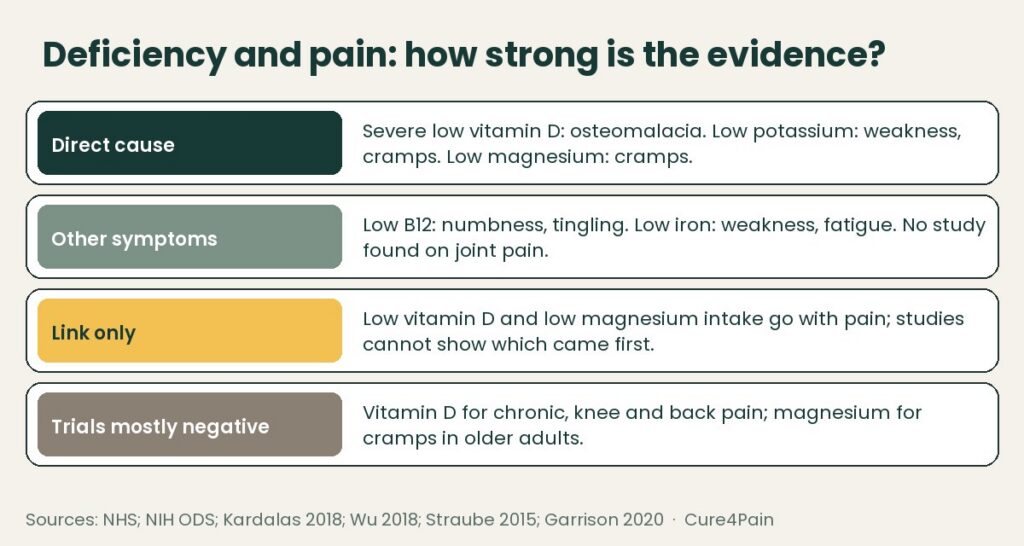
The table separates what a deficiency can cause from what happens when it is corrected, because these are different questions.
| Nutrient | Can low levels cause pain or weakness? | Do trials of correcting it reduce pain? |
|---|---|---|
| Vitamin D | Yes when severe: osteomalacia [1]. For ordinary joint or muscle pain, a link only [7] | Mostly no; a few trials disagree [8] [9] |
| Potassium | Yes: muscle weakness, leg cramps, muscle breakdown when severe [2] [3] | One pilot in rheumatoid arthritis [10]; a diet trial with normal potassium [11] |
| Magnesium | Yes as deficiency progresses: cramps and muscle contractions [4]. For joint pain, a link with low intake [12]; low blood levels raise susceptibility to calcium pyrophosphate arthritis [13] | No meaningful effect on cramps in older adults [14] |
| Vitamin B12 | Nerve symptoms [5]. We found no study showing it causes joint pain | One small back pain trial, in people without deficiency [15] |
| Iron | Weakness and tiredness [6]. We found no study showing it causes joint pain | One trial in fibromyalgia missed its main goal [16] |
Can low vitamin D cause joint pain or knee pain?
Severe vitamin D deficiency can cause bone and muscle pain through osteomalacia, according to the NHS. For joint and knee pain in general, low vitamin D is linked with pain, but raising it has mostly not reduced pain in trials.
- What it can cause: according to the US National Institutes of Health, vitamin D deficiency can appear as osteomalacia in adolescents and adults, and inadequate levels can lead to muscle weakness and pain [17]. The NHS lists pain in the back, shoulder, ribs, pelvis or legs, swollen painful wrists, and difficulty climbing stairs or getting out of a chair [1]. A 2021 review notes that osteomalacia is most likely under-recognised or misdiagnosed as osteoporosis [18].
- Links only: across 81 observational studies with 50,834 people, blood vitamin D was lower in people with arthritis, muscle pain and chronic widespread pain than in people without them [7]. A 2024 review of 30 studies called the direct relationship inconclusive, though lower levels went with stronger pain [19]. Studies like these cannot show which came first.
- Trials of correcting it: a 2015 Cochrane review (10 trials, 811 people) found no consistent benefit in any chronic painful condition and judged a large benefit unlikely [8]. In the US VITAL trial, 1,398 older adults with chronic knee pain had no less pain after about 5 years on vitamin D [20]. In an Australian trial of 413 adults with knee osteoarthritis and low vitamin D, 2 years of treatment made no significant difference to knee pain or cartilage [21]. A 2024 analysis of 10 trials in chronic low back pain found no significant reduction, whatever people’s starting level [22].
- Where trials disagree: a 2016 analysis of 19 trials found a greater fall in pain scores on its main measure, but no difference in final scores [9]. Among 84 non-Western immigrants with deficiency and persistent pain, 34.9% reported relief at 6 weeks against 19.5% on placebo [23]. In Norway, a trial of 251 adults originally from South Asia, the Middle East and Africa, with low levels on average, found no effect beyond placebo [24].
Our articles explain how common vitamin D deficiency is in India and what the trials show in fibromyalgia. See also our knee pain and osteoarthritis pages. According to the US National Institutes of Health, the upper limit for adults without medical supervision is 4,000 IU a day [17].
Can B12 deficiency cause joint pain?
We found no study showing that low B12 causes joint pain. What it clearly causes is nerve trouble, such as numbness and tingling in the hands and feet, which is a different problem from a painful joint.
- What it can cause: according to the US National Institutes of Health, neurological symptoms can occur without anaemia, and symptoms can take several years to appear [5]. The NHS also lists pins and needles and muscle weakness [25].
- Links only: in a 2025 analysis of fibromyalgia studies, the 3 studies that measured B12 showed no difference from healthy people [26].
- Trials of correcting it: we found none in people with proven deficiency and joint pain. In a small trial of 60 adults with chronic back pain, B12 injections reduced pain and disability more than placebo, but these people had no signs of deficiency, so it does not test correction [15]. A 2020 review found some evidence for B12 in nerve pain, not joint pain [27].
- Who is at risk: people on vegetarian diets, and people on long-term metformin or proton pump inhibitors, a type of acid-reducing medicine [5].
If numbness, burning or tingling is your main symptom, see our neuropathy page.
Does magnesium deficiency cause muscle pain or joint pain?
Magnesium deficiency can cause cramps and muscle contractions as it progresses, according to the US National Institutes of Health, but symptomatic deficiency is uncommon in healthy people, and trials in older adults with cramps have not shown a meaningful benefit [4] [14].
- What it can cause: early signs are tiredness and weakness; later come numbness, muscle contractions and cramps, and abnormal heart rhythms. Severe deficiency can also lower calcium and potassium [4].
- Links only: among 2,548 adults with knee osteoarthritis, lower magnesium intake went with worse pain and function over 4 years [12]. This does not show that low intake caused the pain.
- Trials of correcting it: a 2020 Cochrane review (11 trials, 735 people) concluded magnesium is unlikely to give meaningful protection from cramps in older adults; results in pregnancy conflict, and exercise cramps have not been tested [14]. Results in fibromyalgia are covered in our fibromyalgia article.
- Why a blood test does not settle it: less than 1% of the body’s magnesium is in serum, and according to the US National Institutes of Health serum levels do not accurately reflect total body magnesium or levels in tissues [4].
- Safe amounts: the upper limit from supplements is 350 mg of elemental magnesium a day for adults, absorption varies by form, and the risk of toxicity rises with poor kidney function, according to the US National Institutes of Health [4].
Our article on magnesium and cervical spondylosis pain covers forms and neck pain.
Can iron deficiency cause joint pain?
We found no study showing that low iron directly causes joint pain. Low iron causes weakness and tiredness, according to the US National Institutes of Health, and it is too much iron, not too little, that has the established link with joint disease.
- What it can cause: weakness, fatigue and difficulty concentrating, according to the US National Institutes of Health [6].
- Links only: ferritin (stored iron) was lower in fibromyalgia in a 2025 analysis [26]. This does not show that low iron caused the pain.
- Trials of correcting it: in a placebo-controlled trial of 81 adults with fibromyalgia and iron deficiency, iron by drip missed its main goal (77% against 67% improved), though pain scores improved more; the manufacturer funded it [16].
- Too much iron: haemochromatosis, an inherited iron overload most common in people of northern European background, can cause joint pain, according to the NHS [28].
This is why iron is taken only after tests. According to the US National Institutes of Health, the upper limit for adults is 45 mg a day [6].
Can low potassium cause back pain or muscle pain?
Low potassium can cause muscle weakness and leg cramps, and muscle breakdown when severe. We found no study showing that it causes ordinary back pain, only single case reports in which another illness lay behind the low potassium.
- What it can cause: according to the US National Institutes of Health, normal serum potassium is about 3.6 to 5.0 mmol/L. Mild low potassium brings fatigue, muscle weakness and constipation; below about 2.5 mmol/L it can cause muscle paralysis, poor breathing and dangerous heart rhythms [2]. A 2018 review adds leg cramps and, in severe cases, muscle breakdown [3].
- Back pain: one published case of back pain and leg weakness turned out to be thyrotoxic periodic paralysis, a complication of an overactive thyroid [29]. See our lower back pain page for the common causes.
- Why it happens: low potassium is rarely due to diet alone. Diarrhoea, diuretics, laxatives and heavy sweating are usual causes, and low magnesium can add to it [2].
- Trials of correcting it: in a pilot of 32 women with rheumatoid arthritis and low potassium, 7 of 16 on potassium reached a one-third fall in pain against 1 of 16 on placebo at 28 days [10]. In a trial of 172 people with rheumatoid arthritis on standard care, whose blood potassium stayed normal, a potassium-rich vegetarian diet with a food supplement reduced joint pain at 16 weeks; there was no placebo and the authors ask for confirmation [11]. We found no trials in back pain or osteoarthritis.
Do not take potassium supplements on your own. In chronic kidney disease, or with ACE inhibitors or potassium-sparing diuretics, even normal food intake can push potassium too high, according to the US National Institutes of Health [2].
Which blood tests check for these deficiencies?
Vitamin D, B12, iron studies and potassium can be measured directly, each with limits; magnesium cannot be judged from a blood test alone.
| Test | What it can show | Its limit |
|---|---|---|
| 25-hydroxyvitamin D | Vitamin D status. The US National Academies consider 20 ng/mL or more enough for most people, with deficiency risk rising below 12 ng/mL [17] | The levels that define deficiency have not been definitively identified [17] |
| PTH, calcium, phosphate, alkaline phosphatase | Signs of osteomalacia [18] | Calcium and phosphate can stay normal in the early stage [18] |
| Serum B12, with methylmalonic acid | Below 200 to 250 pg/mL is generally considered low; methylmalonic acid can confirm results between 150 and 399 pg/mL [5] | Symptoms can occur without anaemia, so a normal blood count does not rule it out [5] |
| Ferritin, blood count, transferrin saturation | Iron stores and anaemia [6] | Inflammation affects ferritin, so it can mislead in people with illness [6] [30] |
| Serum magnesium | Only the small amount in serum, under 1% of the body’s magnesium [4] | Does not accurately reflect total body or tissue levels [4] |
| Serum potassium, kidney function | Low (below about 3.6 mmol/L) or high potassium [2] | Blood levels often correlate poorly with tissue stores [2]; the cause still has to be found |
A low result shows that a nutrient is low, not that it is causing your pain, so other causes are checked at the same time.
What else causes joint and muscle pain?
Osteoarthritis, rheumatoid arthritis, gout, underactive thyroid, statins and polymyalgia rheumatica can also cause joint or muscle pain; several need their own medical checks.
- Joint conditions: osteoarthritis, rheumatoid arthritis, gout, bursitis, sprains and joint infection; perimenopause and menopause can also cause aching joints, according to the NHS [31]. See our rheumatoid arthritis page.
- Underactive thyroid: stiffness, muscle aches and cramps are reported by most people with overt hypothyroidism, and can be the only symptom [32]. See our hypothyroidism page.
- Medicines: statins are linked with muscle symptoms, reported in 7% to 29% of people in registries and observational studies [33]; the NHS lists statins and diuretics among causes of leg cramps [34]. Speak to your doctor; do not stop them on your own.
- Polymyalgia rheumatica: pain and stiffness around the shoulders, neck and hips, mainly in people over 65, according to the NHS [35].
- Fibromyalgia: widespread pain with fatigue and poor sleep; see our fibromyalgia page.
- Vitamin C deficiency (scurvy): rare, but the NHS lists joint, muscle or leg pain among its symptoms, and musculoskeletal symptoms occurred in 80% of cases in a 2005 review [36] [37].
When is joint or muscle pain an emergency?
Get urgent medical help for sudden weakness, a hot swollen joint with high temperature, or bladder or bowel changes; do not wait for test results or start supplements first. These lists come from the NHS and the US National Institutes of Health; our lower back pain page gives the Indian workflow.
- Joint pain: very bad pain after a fall or injury, being unable to walk or put weight on a joint, a joint out of place, loss of feeling around it after an injury, or a hot, swollen joint with a high temperature or feeling unwell [31].
- Back pain: pain, tingling, weakness or numbness in both legs, loss of feeling around the genitals or anus, changes in bladder or bowel control, chest pain, or pain after a serious accident [38].
- Muscle weakness: sudden weakness or paralysis, difficulty breathing or an irregular heartbeat, as severe low potassium can affect breathing and heart rhythm [2].
- Shoulder or hip stiffness with headache: a new headache, jaw pain when eating, or changes in sight need immediate attention, as they can mean temporal arteritis [35].
See a doctor soon if joint stiffness lasts more than 30 minutes after waking, or if pain or swelling keeps coming back [31].
How we check for deficiencies in joint and muscle pain at Cure4Pain
At Cure4Pain, we test first and correct real deficiencies as one part of a wider plan, not as a stand-alone treatment for pain.
- Tests: we read a panel of about 100 markers, adding tests for your condition when clinically indicated. Examples a named guideline supports: rheumatoid factor, then anti-CCP antibodies if it is negative, when suspected rheumatoid arthritis comes with joint inflammation on examination (NICE NG100) [39], and methylmalonic acid when symptoms suggest low B12 and the first result is uncertain (NICE NG239, 2024) [40].
- Magnesium: assessed from the overall clinical picture, because serum levels do not show tissue levels.
- Examination: muscle testing, posture and gait, and a review of your scans, so that muscle problems are not missed.
- Correcting what is low: vitamin D at standard supplement doses, with attention to cofactors, gut health and absorption; magnesium; potassium, B12, iron, omega-3 and protein when tests or diet show a need. Supplements are given by mouth first, with injections only when specifically needed or advised. Magnesium is mainly given as magnesium bisglycinate, with L-threonate or citrate as advised, always counted as elemental magnesium; absorption varies by form [4].
- Topical magnesium: used for comfort during mobility exercises, not as a pain treatment on its own. Research on absorption through the skin is limited, and a 2017 review called it scientifically unsupported [41].
- The rest of the plan: depending on the condition, twitch-response deep fascial acupuncture, dry needling and a home exercise programme.
- Medicines: Dr Krushal Pabari reviews and manages painkillers and muscle relaxants, and reduces them where appropriate, under clinical guidance from Team Cure4Pain, in coordination with your existing consulting physician; never stop or change them on your own.
- Referral: we do not give pain or joint injections and do not treat sudden or severe pain. If warning signs are present, we refer you to a hospital or the right specialist.
In our clinic, we see meaningful improvement in many people when low vitamin D and other deficiencies are corrected as part of the whole plan; this is a clinic observation, and the trials above show that correcting vitamin D alone has mostly not reduced pain. This is our clinic practice; individual results vary, and further studies are needed.
If you would like your symptoms and blood tests reviewed together, you can book a consultation, online from anywhere or at our Mumbai clinic; hands-on treatment needs an in-person visit in Mumbai.
Frequently asked questions
What deficiency causes joint pain?
Severe vitamin D deficiency can cause bone pain and painful wrists through osteomalacia, and scurvy from vitamin C deficiency can cause joint pain. We found no study showing that low B12 or iron directly causes joint pain. Low blood magnesium raises susceptibility to calcium pyrophosphate arthritis, and low vitamin D and low magnesium intake are linked with joint pain. [1] [36] [13] [7] [12]
What deficiency causes muscle pain and weakness?
Severe vitamin D deficiency, low potassium and magnesium deficiency can all cause muscle weakness or cramps. Low B12 can cause muscle weakness along with nerve symptoms, and low iron can cause general weakness and tiredness. [17] [2] [4] [25] [6]
Can low vitamin D cause knee pain?
Low vitamin D is linked with arthritis in observational studies, but in a 2-year trial of adults with knee osteoarthritis and low levels, vitamin D made no significant difference to knee pain, and a large US trial found the same in chronic knee pain. [7] [21] [20]
Does magnesium help joint pain?
No trial we found tests magnesium for joint pain on its own. Lower intake is linked with worse knee osteoarthritis pain, but this does not prove that taking magnesium helps. A Cochrane review found it unlikely to help cramps in older adults. [12] [14]
Can low potassium cause back pain?
We found only single case reports, in which another illness lay behind the low potassium. Low potassium does cause muscle weakness and leg cramps, and it is rarely due to diet alone, so the cause should be looked for. [29] [2] [3]
What deficiency causes muscle cramps?
Low magnesium and low potassium can both cause cramps. Cramps also have other causes: the NHS lists ageing, strain, pregnancy, dehydration and medicines such as statins and diuretics, and sometimes the reason is unknown. [4] [3] [34]
Can a deficiency cause arthritis?
Lower vitamin D is found in people with arthritis, but these studies cannot show which came first, and a 2-year trial in knee osteoarthritis found no effect on pain or cartilage. Osteoarthritis, rheumatoid arthritis and gout have their own causes and need their own checks. [7] [21] [31]
Will correcting a deficiency stop the pain?
It depends on the cause. Treatment of osteomalacia aims to relieve its symptoms, but in most trials of chronic joint, back and muscle pain, vitamin D alone did not reduce pain. A real deficiency is still worth correcting, usually as one part of a wider plan. [18] [8] [22]
This article is for education and does not replace medical advice. Do not start, stop or change any medicine or supplement without medical guidance.
References
1. NHS (UK National Health Service). Rickets and osteomalacia. nhs.uk/conditions/rickets-and-osteomalacia
2. National Institutes of Health, Office of Dietary Supplements. Potassium: Fact Sheet for Health Professionals. ods.od.nih.gov
3. Kardalas E, et al. Hypokalemia: a clinical update. Endocr Connect 2018;7(4):R135-R146. doi:10.1530/EC-18-0109
4. National Institutes of Health, Office of Dietary Supplements. Magnesium: Fact Sheet for Health Professionals. ods.od.nih.gov
5. National Institutes of Health, Office of Dietary Supplements. Vitamin B12: Fact Sheet for Health Professionals. ods.od.nih.gov
6. National Institutes of Health, Office of Dietary Supplements. Iron: Fact Sheet for Health Professionals. ods.od.nih.gov
7. Wu Z, et al. The association between vitamin D concentration and pain: a systematic review and meta-analysis. Public Health Nutr 2018;21(11):2022-2037. doi:10.1017/S1368980018000551
8. Straube S, et al. Vitamin D for the treatment of chronic painful conditions in adults. Cochrane Database Syst Rev 2015;2015(5):CD007771. doi:10.1002/14651858.CD007771.pub3
9. Wu Z, et al. Effect of Vitamin D Supplementation on Pain: A Systematic Review and Meta-analysis. Pain Physician 2016;19(7):415-27. PubMed 27676659
10. Rastmanesh R, et al. A pilot study of potassium supplementation in the treatment of hypokalemic patients with rheumatoid arthritis: a randomized, double-blinded, placebo-controlled trial. J Pain 2008;9(8):722-31. doi:10.1016/j.jpain.2008.03.006
11. Kianifard T, et al. Adjunct role of potassium-rich vegetarian diet and a novel potassium food supplement to improve pain in chronic rheumatoid arthritis on supervised standard care: a randomised controlled study. BMJ Nutr Prev Health 2024;7(1):14-25. doi:10.1136/bmjnph-2023-000674
12. Shmagel A, et al. Low magnesium intake is associated with increased knee pain in subjects with radiographic knee osteoarthritis: data from the Osteoarthritis Initiative. Osteoarthritis Cartilage 2018;26(5):651-658. doi:10.1016/j.joca.2018.02.002
13. Kim SY, et al. A Narrative Review of Chondrocalcinosis: Clinical Presentation, Diagnosis, and Therapies. Cureus 2024;16(5):e60434. doi:10.7759/cureus.60434
14. Garrison SR, et al. Magnesium for skeletal muscle cramps. Cochrane Database Syst Rev 2020;9(9):CD009402. doi:10.1002/14651858.CD009402.pub3
15. Mauro GL, et al. Vitamin B12 in low back pain: a randomised, double-blind, placebo-controlled study. Eur Rev Med Pharmacol Sci 2000;4(3):53-8. PubMed 11558625
16. Boomershine CS, et al. A Blinded, Randomized, Placebo-Controlled Study to Investigate the Efficacy and Safety of Ferric Carboxymaltose in Iron-Deficient Patients with Fibromyalgia. Rheumatol Ther 2018;5(1):271-281. doi:10.1007/s40744-017-0088-9
17. National Institutes of Health, Office of Dietary Supplements. Vitamin D: Fact Sheet for Health Professionals. ods.od.nih.gov
18. Minisola S, et al. Osteomalacia and Vitamin D Status: A Clinical Update 2020. JBMR Plus 2021;5(1):e10447. doi:10.1002/jbm4.10447
19. Alonso-Pérez JL, et al. Relationship Between Serum Vitamin D Levels and Chronic Musculoskeletal Pain in Adults: A Systematic Review. Nutrients 2024;16(23). doi:10.3390/nu16234061
20. MacFarlane LA, et al. The Effects of Vitamin D and Marine Omega-3 Fatty Acid Supplementation on Chronic Knee Pain in Older US Adults: Results From a Randomized Trial. Arthritis Rheumatol 2020;72(11):1836-1844. doi:10.1002/art.41416
21. Jin X, et al. Effect of Vitamin D Supplementation on Tibial Cartilage Volume and Knee Pain Among Patients With Symptomatic Knee Osteoarthritis: A Randomized Clinical Trial. JAMA 2016;315(10):1005-13. doi:10.1001/jama.2016.1961
22. Lee TJ, et al. Updated Meta-analysis Reveals Limited Efficacy of Vitamin D Supplementation in Chronic Low Back Pain. In Vivo 2024;38(6):2955-2967. doi:10.21873/invivo.13778
23. Schreuder F, et al. Vitamin D supplementation for nonspecific musculoskeletal pain in non-Western immigrants: a randomized controlled trial. Ann Fam Med 2012;10(6):547-55. doi:10.1370/afm.1402
24. Knutsen KV, et al. Effect of vitamin D on musculoskeletal pain and headache: A randomized, double-blind, placebo-controlled trial among adult ethnic minorities in Norway. Pain 2014;155(12):2591-2598. doi:10.1016/j.pain.2014.09.024
25. NHS (UK National Health Service). Vitamin B12 or folate deficiency anaemia. nhs.uk/conditions/vitamin-b12-or-folate-deficiency-anaemia
26. Ismail O, et al. Differences in Ferritin, Vitamin D, and Vitamin B12 Between Fibromyalgia Patients and Healthy Individuals: A Systematic Review and Meta-Analysis. Musculoskeletal Care 2025;23(1):e70057. doi:10.1002/msc.70057
27. Julian T, et al. B12 as a Treatment for Peripheral Neuropathic Pain: A Systematic Review. Nutrients 2020;12(8). doi:10.3390/nu12082221
28. NHS (UK National Health Service). Haemochromatosis. nhs.uk/conditions/haemochromatosis
29. Elenius H, et al. Thyrotoxic Periodic Paralysis Causing Back Pain and Leg Weakness: An Unusual Presentation of Hyperthyroidism. Case Rep Endocrinol 2021;2021:6622658. doi:10.1155/2021/6622658
30. Garcia-Casal MN, et al. Are Current Serum and Plasma Ferritin Cut-offs for Iron Deficiency and Overload Accurate and Reflecting Iron Status? A Systematic Review. Arch Med Res 2018;49(6):405-417. doi:10.1016/j.arcmed.2018.12.005
31. NHS (UK National Health Service). Joint pain. nhs.uk/symptoms/joint-pain
32. Sindoni A, et al. Hypothyroid myopathy: A peculiar clinical presentation of thyroid failure. Review of the literature. Rev Endocr Metab Disord 2016;17(4):499-519. doi:10.1007/s11154-016-9357-0
33. Stroes ES, et al. Statin-associated muscle symptoms: impact on statin therapy-European Atherosclerosis Society Consensus Panel Statement on Assessment, Aetiology and Management. Eur Heart J 2015;36(17):1012-22. doi:10.1093/eurheartj/ehv043
34. NHS (UK National Health Service). Leg cramps. nhs.uk/conditions/leg-cramps
35. NHS (UK National Health Service). Polymyalgia rheumatica. nhs.uk/conditions/polymyalgia-rheumatica
36. NHS (UK National Health Service). Scurvy. nhs.uk/conditions/scurvy
37. Fain O. Musculoskeletal manifestations of scurvy. Joint Bone Spine 2005;72(2):124-8. doi:10.1016/j.jbspin.2004.01.007
38. NHS (UK National Health Service). Back pain. nhs.uk/conditions/back-pain
39. National Institute for Health and Care Excellence (NICE). Rheumatoid arthritis in adults: management. NG100, 2018. nice.org.uk/guidance/ng100
40. National Institute for Health and Care Excellence (NICE). Vitamin B12 deficiency in over 16s: diagnosis and management. NG239, 2024. nice.org.uk/guidance/ng239
41. Gröber U, et al. Myth or Reality-Transdermal Magnesium? Nutrients 2017;9(8). doi:10.3390/nu9080813

