Written by AT. Chintan Dalal, N.D. · Reviewed by Dr Krushal Pabari, Clinical Team, Cure4Pain · Updated 29 October 2026
Key facts
No diet makes psoriasis go away, but diet can help alongside treatment. In a 2025 randomised trial in Spain of 38 adults with mild to moderate psoriasis using creams, a 16-week Mediterranean-style diet lowered PASI (Psoriasis Area and Severity Index) scores by 3.4 points more than standard low-fat advice [1]. Alcohol has the clearest single-food link: across 48 studies with 1.7 million people, drinking was linked with psoriasis, more strongly at higher intake [2]. The US National Psoriasis Foundation strongly recommends a lower-calorie diet for people who are overweight and, as a weaker recommendation, a gluten-free diet only for people whose blood tests show gluten sensitivity [3]. Most single-food rules, such as avoiding nightshades, rest on low-quality evidence or patient reports, not trials [3] [4] [5].

Scientific explainer videos in our Resources section
In our Resources section, our clinical team discusses vitamin D, its cofactors and how autoimmune, lifestyle and pain conditions develop.
Can diet help psoriasis?
Yes, as a support to treatment, not instead of it. Psoriasis is an immune-driven skin disease shaped by genes and triggers such as infections, stress, smoking, obesity and alcohol, according to a 2021 review in The Lancet [6], so food can only influence part of it.
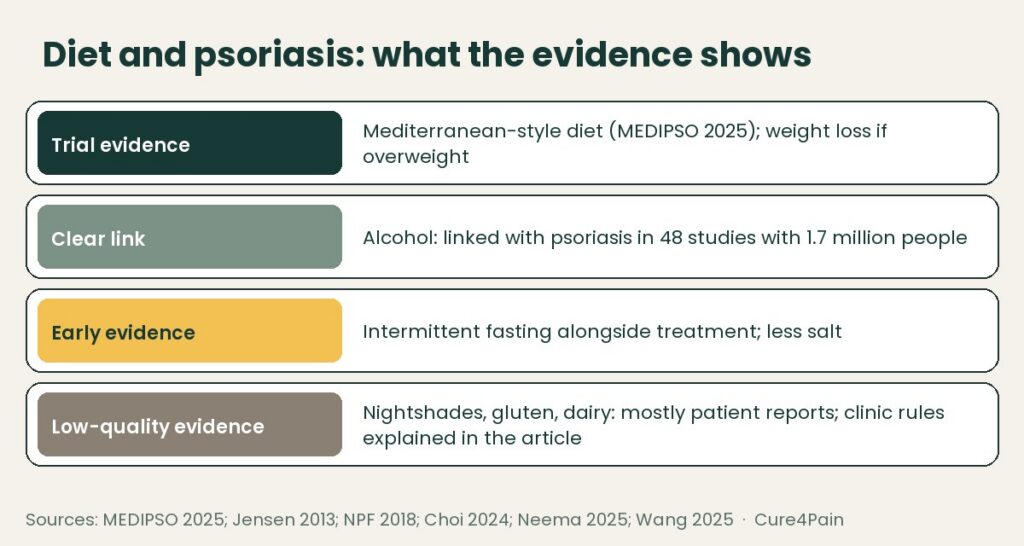
- Best evidence: the 2025 MEDIPSO trial in Madrid tested a dietitian-guided Mediterranean diet in 38 adults with mild to moderate psoriasis who were also using creams. PASI scores fell 3.4 points more than with standard low-fat advice, 9 of 19 people reached a 75% improvement against none in the comparison group, and HbA1c (average blood sugar) also improved [1]. It was a small, single-centre trial.
- Guideline view: after reviewing 55 studies, the US National Psoriasis Foundation advises that diet changes should always be used together with standard medical treatment [3].
- Research gaps: a 2025 review in Clinical Nutrition found that Mediterranean, calorie-restricted and, where relevant, gluten-free diets may help, and advised avoiding alcohol and high salt, but noted that high-quality evidence is still lacking [5].
What is the best diet for psoriasis?
A Mediterranean-style pattern has the strongest evidence: plenty of vegetables, fruit, whole grains, pulses, nuts and seeds, fish, and olive oil, with little sugar or processed food [1]. It translates easily into Indian food: millets and rice instead of refined flour, dal and vegetables at every meal, fruit, nuts and seeds, cold-pressed oils, and fish or eggs for those who eat them.
The NHS gives the same simple advice for everyone with psoriasis: “have a healthy, balanced diet”, get regular exercise, “try not to drink too much alcohol” and stop smoking [7].
Does losing weight help psoriasis?
Yes, for people who are overweight. The US National Psoriasis Foundation strongly recommends weight reduction with a lower-calorie diet in people who are overweight or obese [3].
- Trial result: in a Danish randomised trial of 60 overweight adults with psoriasis, a low-energy diet led to 15.4 kg more weight loss over 16 weeks, a trend toward lower psoriasis scores and a significant improvement in quality of life [8].
- Obesity as a trigger: the NHS lists living with obesity among the triggers of psoriasis [7].
Does intermittent fasting help psoriasis?
It may help as an add-on, but the evidence is early. A 2025 Indian randomised trial gave 120 people with moderate to severe plaque psoriasis methotrexate with or without 16:8 intermittent fasting (eating within 8 hours a day). At 16 weeks there was no difference. At 28 weeks, 54% of the fasting group kept at least a 50% improvement against 36% on methotrexate alone, a difference just short of statistical significance, and weight, waist size and inflammation markers were lower [9]. The authors name the small size and loss to follow-up as limitations [9].
- Ramadan fasting: in an observational study of 121 people with stable plaque psoriasis, severity scores were slightly lower after a month of Ramadan fasting, with no serious side effects; there was no comparison group [10].
- Who should not fast without advice: at Cure4Pain we do not advise fasting without supervision for people with diabetes on medicines, pregnant or breastfeeding women (see our article on psoriasis in pregnancy), or anyone with a history of eating disorders.
Which foods should you avoid with psoriasis?
Alcohol has the clearest evidence; most other food rules are based on smaller studies or patient reports. The table shows what research says and what we advise at Cure4Pain, side by side.
| Food | What research shows | Our clinic practice |
|---|---|---|
| Alcohol | Linked with psoriasis in 48 studies with 1.7 million people, more strongly with heavier drinking [2]; the NHS lists it as a trigger [7] | We advise limiting alcohol |
| Sugar and processed foods | Low-quality evidence; part of the healthier patterns in trials [5] [3] | Avoided |
| Wheat and gluten | A gluten-free diet is recommended only for people with positive blood tests for gluten sensitivity [3] | We ask psoriasis patients to avoid wheat, without a specific test, and use millets instead |
| Nightshades (potato, brinjal, chillies, tomato) | No trial; about half of people who tried cutting them reported better skin in a US survey [4] | Potato, brinjal and chillies avoided; tomato allowed |
| Cruciferous (Brassica) vegetables (cabbage, cauliflower, broccoli, radish, mustard greens) | No psoriasis studies; the usual concern is the thyroid, and a 2024 review found normal intake, with enough iodine, did not harm thyroid function [11] | As an observational clinic practice, we generally suggest limiting them |
| High-lectin foods (such as rajma, soy and peanuts) | We found no human study in psoriasis | Avoided |
| Prawns and fish with many fine bones | We found no study in psoriasis | Avoided; other fish allowed |
A 2025 review also advised avoiding high salt intake [5]; in Indian food that means going easy on pickles, papad and salty snacks (namkeen). Rules that are clinic practice are not research findings: we state them so that you know exactly what we advise and why the evidence is thinner.
Which foods are good for psoriasis?
Whole, home-cooked foods built on the Mediterranean-style pattern [1] [5]:
| Food group | Indian examples |
|---|---|
| Millets and grains | Jowar, bajra, ragi (nachni), foxtail millet (kangni), rice |
| Pulses | Well-cooked moong, masoor and toor dal |
| Vegetables | Bottle gourd (lauki), ridge gourd (turai), pumpkin (kaddu), spinach (palak), fenugreek (methi), carrot (gajar), okra (bhindi), beetroot, cucumber (kheera), French beans, tinda, drumstick (sahjan), tomato |
| Fruit | Papaya, guava (amrood), apple, pomegranate (anaar), banana, orange |
| Nuts and seeds | Walnuts (akhrot), almonds (badam), flaxseed (alsi), pumpkin seeds, fox nuts (makhana) |
| Protein | Paneer and curd (dahi), eggs, chicken, fish (not prawns or fine-boned fish) |
| Fats and spices | Cold-pressed oils, ghee; turmeric (haldi), ginger (adrak), cumin (jeera), coriander (dhania), black pepper |
At Cure4Pain, omega-3 is part of every plan unless there is a reason not to: from fish for people who eat it, and from algal oil for vegetarians and vegans. Our article on omega-3 and autoimmune disease explains the trials in psoriasis.
A 7-day Indian vegetarian psoriasis diet chart
This is a sample week built from the clinic rules above. It is a sample, not a prescription: your own plan depends on your tests, weight, medicines and other conditions. Drink tea or coffee without sugar, cook with cold-pressed oil or a little ghee, and cook sambar, kadhi, poriyal and chutneys without green or red chillies or chilli powder; use ginger, black pepper and cumin instead.
- Monday: Breakfast: Jowar upma with carrot and beans; papaya. Lunch: Bajra roti (bajre ki roti, bajri bhakri), moong dal, bottle gourd (lauki) sabzi, cucumber and tomato salad, curd (dahi). Evening snack: Roasted fox nuts (makhana), buttermilk (chaas). Dinner: Ragi dosa with coconut chutney, spinach dal (palak dal).
- Tuesday: Breakfast: Moong dal chilla with mint and ginger chutney. Lunch: Rice, toor dal, okra (bhindi) sabzi, carrot salad. Evening snack: Guava (amrood), walnuts (akhrot). Dinner: Jowar roti, paneer bhurji with tomato, ridge gourd (turai) sabzi.
- Wednesday: Breakfast: Idli with sambar (pumpkin and drumstick). Lunch: Ragi roti (nachni bhakri), masoor dal, fenugreek (methi) sabzi, beetroot salad, curd. Evening snack: Apple, roasted pumpkin seeds. Dinner: Moong dal and rice khichdi with ghee, kadhi.
- Thursday: Breakfast: Poha with carrot and peas; pomegranate (anaar). Lunch: Foxtail millet (kangni) rice, tomato dal, French beans sabzi, cucumber raita. Evening snack: Coconut water, almonds (badam). Dinner: Bajra roti, tinda sabzi, moong dal.
- Friday: Breakfast: Besan chilla with grated carrot; curd. Lunch: Jowar roti (jowar bhakri), moong dal, pumpkin (kaddu) sabzi, cucumber and carrot salad. Evening snack: Papaya, flaxseed (alsi) sprinkled on curd. Dinner: Millet pulao with carrot, beans and peas, cucumber raita.
- Saturday: Breakfast: Ragi porridge (ragi malt) with banana, no sugar. Lunch: Rice, sambar with drumstick and pumpkin, beans and coconut stir-fry (poriyal), buttermilk. Evening snack: Orange, roasted makhana. Dinner: Jowar roti, paneer and tomato curry (paneer tamatar), bottle gourd sabzi.
- Sunday: Breakfast: Green moong dosa (pesarattu) with coconut chutney. Lunch: Bajra khichdi with vegetables, curd. Evening snack: Pomegranate, walnuts. Dinner: Moong dal soup, ragi roti, spinach (palak) sabzi.
Swaps and notes for the week:
- If you eat eggs or meat: eggs, chicken or fish (not prawns or fine-boned fish) can replace paneer or dal at any meal.
- During supervised vitamin D therapy: milk, curd, paneer and buttermilk are replaced with low-calcium choices, as your plan specifies.
- If intermittent fasting is advised for you: the same meals are fitted into the eating window your doctor sets.
Can I eat paneer, eggs, tomato, fruit or fish with psoriasis?
At Cure4Pain, yes to all of these, with two exceptions for fish; no trial has tested any of these foods on their own in psoriasis.
- Paneer and other dairy: yes, except during supervised vitamin D therapy, when high-calcium foods are limited. A 2025 review lists dairy among foods that may worsen psoriasis when eaten in excess, but high-quality evidence is lacking and no trial has tested paneer [5].
- Eggs: yes.
- Tomato: yes, although it is a nightshade; we ask patients to avoid potato, brinjal and chillies instead.
- Fruit: yes, whole fruit rather than juice or sweetened fruit products.
- Fish and chicken: yes, except prawns and fish with many fine bones.
Diet during supervised vitamin D therapy
Some patients receive supervised vitamin D therapy (Coimbra Protocol) at Cure4Pain. During it, dairy and other high-calcium foods are limited and water intake is kept high, as part of the protocol’s safety rules explained on our Coimbra Protocol page. Vitamin D supplements are not part of psoriasis diet guidelines: the US National Psoriasis Foundation review weakly recommends them only for psoriatic arthritis [3], so this therapy is clinic practice, given only under supervision with regular blood tests. Our methods are derived from the work of Dr Coimbra. Which vitamins are low in psoriasis is explained in our article on vitamin deficiencies linked to psoriasis.
How we plan your diet at Cure4Pain
At Cure4Pain, your diet plan is one part of an integrative plan used alongside guideline psoriasis treatment, never instead of it.
- Tests first: a blood panel that includes vitamin D, vitamin B12, iron and ferritin, thyroid function, HbA1c and lipids, so the plan fits your results.
- Your food rules: millets instead of wheat; no sugar, and we advise limiting alcohol; no potato, brinjal or chillies (tomato is fine); as an observational clinic practice, we generally suggest limiting cruciferous (Brassica) vegetables such as cabbage and cauliflower; high-lectin foods avoided; paneer, eggs, fruit, chicken and most fish allowed.
- Weight and fasting: a lower-calorie plan when weight loss is needed, and supervised intermittent fasting for suitable patients.
- Medicines stay: Dr Krushal Pabari prescribes and adjusts psoriasis medicines as per guidelines, under clinical guidance from Team Cure4Pain, in coordination with your existing consulting physician and your dermatologist; never stop or change them on your own.
This is our clinic practice; individual results vary, and further studies are needed. Read more on our psoriasis, psoriatic arthritis and gut health pages.
If you would like a diet plan built around your blood tests and psoriasis treatment, you can book a consultation, online from anywhere or at our Mumbai clinic.
Frequently asked questions
What foods should you avoid with psoriasis?
Alcohol has the clearest link with psoriasis, in 48 studies. At Cure4Pain we also ask patients to avoid sugar, wheat, potato, brinjal, chillies, high-lectin foods, prawns and fine-boned fish, and we advise limiting alcohol. As an observational clinic practice, we generally suggest limiting cruciferous (Brassica) vegetables such as cabbage and cauliflower. These are clinic practice, and most are not tested in trials. [2]
What foods help psoriasis?
No food stops psoriasis, but a Mediterranean-style diet of vegetables, fruit, whole grains, pulses, nuts, seeds and fish improved psoriasis severity in a 2025 randomised trial. [1]
Can I eat paneer with psoriasis?
Yes. At Cure4Pain paneer and other dairy are limited only during supervised vitamin D therapy, which needs a low-calcium diet.
Can I eat eggs with psoriasis?
Yes. Eggs are part of the plan at Cure4Pain; no study has shown that eggs worsen psoriasis.
Is tomato bad for psoriasis?
No trial has shown that. Tomato is a nightshade, and some people report better skin after cutting nightshades, but at Cure4Pain tomato is allowed while potato, brinjal and chillies are avoided. [4]
Which fruit is not good for psoriasis?
No study has shown that any whole fruit worsens psoriasis. At Cure4Pain fruit is allowed; we suggest whole fruit rather than juice or sweetened fruit products, because of their sugar.
Should I stop eating wheat for psoriasis?
The US National Psoriasis Foundation weakly recommends a gluten-free diet only for people with positive blood tests for gluten sensitivity. At Cure4Pain we ask psoriasis patients to avoid wheat and use millets instead; this is our clinic practice. [3]
Is a vegetarian diet good for psoriasis?
No trial has compared vegetarian and other diets in psoriasis. In a US survey, 70% of people who tried a vegan diet reported better skin, but this was self-reported. A well-planned vegetarian diet fits the Mediterranean-style pattern that improved psoriasis in a trial, as long as protein is adequate. [4] [1]
Does intermittent fasting help psoriasis?
Early studies are encouraging but not conclusive: in a 2025 Indian trial, adding 16:8 fasting to methotrexate gave a trend toward better results at 28 weeks and lower weight and inflammation markers. Fast only under medical supervision. [9]
This article is for education and does not replace medical advice. Do not start, stop or change any medicine or supplement without medical guidance.
References
1. Perez-Bootello J, et al. Mediterranean Diet and Patients With Psoriasis: The MEDIPSO Randomized Clinical Trial. JAMA Dermatol 2025;161(12):1215-1223. doi:10.1001/jamadermatol.2025.3410
2. Choi J, et al. Dose-response analysis between alcohol consumption and psoriasis: A systematic review and meta-analysis. J Dtsch Dermatol Ges 2024;22(5):641-652. doi:10.1111/ddg.15380
3. Ford AR, et al. Dietary Recommendations for Adults With Psoriasis or Psoriatic Arthritis From the Medical Board of the National Psoriasis Foundation: A Systematic Review. JAMA Dermatol 2018;154(8):934-950. doi:10.1001/jamadermatol.2018.1412
4. Afifi L, et al. Dietary Behaviors in Psoriasis: Patient-Reported Outcomes from a U.S. National Survey. Dermatol Ther (Heidelb) 2017;7(2):227-242. doi:10.1007/s13555-017-0183-4
5. Wang Q, et al. Evidence-based dietary recommendations for patients with psoriasis: A systematic review. Clin Nutr 2025;47:68-82. doi:10.1016/j.clnu.2025.02.005
6. Griffiths CEM, et al. Psoriasis. Lancet 2021;397(10281):1301-1315. doi:10.1016/S0140-6736(20)32549-6
7. NHS (UK National Health Service). Psoriasis. nhs.uk/conditions/psoriasis
8. Jensen P, et al. Effect of weight loss on the severity of psoriasis: a randomized clinical study. JAMA Dermatol 2013;149(7):795-801. doi:10.1001/jamadermatol.2013.722
9. Neema S, et al. Efficacy of Intermittent Fasting in the Management of Chronic Plaque Psoriasis: A Phase IIb Clinical Trial. Indian Dermatol Online J 2025;16(3):389-396. doi:10.4103/idoj.idoj_635_24
10. Almutairi N, Shaaban D. Clinical implications of intermittent Ramadan fasting on stable plaque psoriasis: a prospective observational study. Postepy Dermatol Alergol 2022;39(2):368-374. doi:10.5114/ada.2021.107098
11. Galanty A, et al. Do Brassica Vegetables Affect Thyroid Function?-A Comprehensive Systematic Review. Int J Mol Sci 2024;25(7). doi:10.3390/ijms25073988