Written by AT. Chintan Dalal, N.D. · Reviewed by Dr Krushal Pabari, Clinical Team, Cure4Pain · Updated 30 October 2026
Key facts
No diet has consistently been shown to reduce flares in adults with inflammatory bowel disease (IBD), meaning Crohn’s disease or ulcerative colitis, according to the 2024 American Gastroenterological Association (AGA) expert review, which advises a Mediterranean-style diet low in ultra-processed food, added sugar and salt [1]. The 2025 European Crohn’s and Colitis Organisation (ECCO) consensus supports limiting ultra-processed food, access to an IBD dietitian, and a liquid formula diet or the Crohn’s disease exclusion diet (CDED) for selected people with Crohn’s disease [2]. In the DINE-CD trial of 191 adults with Crohn’s disease, a similar share had no active disease on a symptom score at 6 weeks: 43.5% on a Mediterranean diet and 46.5% on a specific carbohydrate diet [3]. A low FODMAP diet eases IBS-like symptoms but does not lower inflammation, according to a 2025 meta-analysis [4]. A better-established concern is under-nutrition: the AGA warns that dietary restriction and the disease itself can cause malnutrition, and advises monitoring everyone with IBD for low vitamin D and iron [1]. Diet is used alongside IBD medicines, not in place of them.

Scientific explainer videos in our Resources section
In our Resources section, our clinical team discusses vitamin D, its cofactors and how autoimmune, lifestyle and pain conditions develop.
What is the best diet for Crohn’s disease and ulcerative colitis?
The best-supported everyday diet for Crohn’s disease and ulcerative colitis is a Mediterranean-style pattern low in ultra-processed food, added sugar and salt, which the American Gastroenterological Association (AGA) advised in its 2024 expert review [1]. No single diet suits everyone or does the work of medicines, and what you eat also depends on the stage of the disease and on whether the bowel is narrowed.
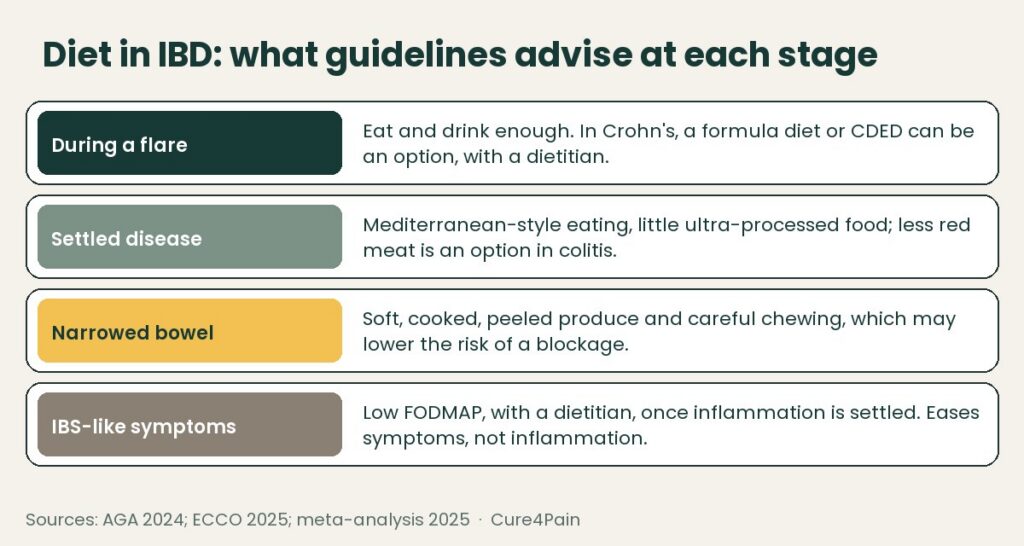
- AGA 2024: unless there is a reason not to, people with IBD should be advised to eat a Mediterranean diet of varied fresh fruit and vegetables, monounsaturated fats, complex carbohydrates and lean proteins, low in ultra-processed food, added sugar and salt [1].
- ECCO 2025: the European Crohn’s and Colitis Organisation consensus says general healthy eating advice applies to people with IBD, everyone with IBD should have access to an IBD dietitian, and ultra-processed food should be limited [2].
- ESPEN 2023: the European Society for Clinical Nutrition and Metabolism guideline gives 71 recommendations for active and settled disease [5]. It links a diet rich in fruit and vegetables with a lower risk of developing IBD, and advises checking vitamin D in active disease and on steroids [5].
- Evidence limits: a 2019 Cochrane review of 18 trials with 1,878 people could draw no firm conclusions about specific diets [6], and in a 2023 meta-analysis of 27 studies the certainty of evidence was low or very low [7].
- Official patient advice: the US National Institutes of Health says researchers have not found specific foods that cause or worsen symptoms [8] [9]. The NHS says there is no clear evidence that a special diet helps Crohn’s disease, and advises against big diet changes without advice [10].
What should you eat during a flare?
During a Crohn’s or ulcerative colitis flare, eat and drink enough and choose foods you can tolerate; Crohn’s & Colitis UK, a patient charity, advises plenty of fluids, protein-rich foods and easy-to-digest fibre [11]. ECCO 2025 finds insufficient evidence for the Mediterranean or specific carbohydrate diet to settle active disease, and in Crohn’s disease a formula diet can be an option under specialist care [2]. Severe symptoms need medical care first: see when to get urgent help on our ulcerative colitis and Crohn’s page.
Practical advice from Crohn’s & Colitis UK, a patient charity, because the guidelines we read do not list flare foods [11]:
- Fluids: drink plenty; oral rehydration solution can help if you are losing a lot of fluid. The NHS gives the same fluid advice for diarrhoea [12].
- Protein and energy: eggs, dairy, meat, fish, pulses and smooth nut butters, because the body uses more protein during a flare.
- Fibre that is easy to digest: well-cooked, peeled vegetables, bananas and melons; soups help when full meals are hard.
- Afterwards: return to a balanced diet, and add back any food you dropped gradually.
Formula diets are treatment, not self-care, and the guidelines differ on them:
- Crohn’s disease in adults: exclusive enteral nutrition (only liquid formula for several weeks) is rated effective by ECCO 2025 for mild to moderate disease [2], and ECCO 2024 suggests it, as a weak recommendation on very low certainty evidence, for motivated people with dietitian support who prefer to avoid steroids [13]. Formula was less effective than steroids in a 2026 meta-analysis of 5 trials with 315 adults: fewer people on formula had no active disease on a score (relative risk 0.65) [14]. The 2025 British Society of Gastroenterology guideline, as summarised in a published review, finds too little evidence for routine use [15].
- Crohn’s disease in children: the 2026 ECCO-ESPGHAN guideline prefers formula alone, or the Crohn’s disease exclusion diet (CDED) with partial formula, for low-risk disease [16].
- Ulcerative colitis: a 2025 meta-analysis of 10 studies with 334 adults found insufficient evidence for formula alongside standard care [17]. ECCO 2025 does not recommend removing cow’s milk protein to settle active colitis [2].
What do the diet trials show?
Most trials of diet in Crohn’s disease and ulcerative colitis are small and short, and most tested Crohn’s disease; a 2019 Cochrane review could draw no firm conclusions about specific diets [6]. In the table, results describe people with no active disease on a symptom score, not healing of the bowel, unless stated.
| Trial | Who | Result |
|---|---|---|
| CDED with formula, 2019 | 78 children with mild to moderate Crohn’s, against formula alone | Tolerated by 97.5% against 73.6%; no active disease without steroids at week 12 in 75.6% against 45.1% [18] |
| CDED-AD pilot, 2022 | 44 adults with mild to moderate Crohn’s, open-label, part-funded by a formula maker | No active disease at week 6 in 68% with formula and 57% without; no group without CDED [19] |
| Whole-food diet TASTI-MM, 2025 | 83 children and young adults with mild to moderate Crohn’s, against formula alone; the diet excludes processed food, gluten, red meat and dairy | Tolerated by 88% against 52%; symptom results not significantly different [20] |
| DINE-CD, 2021 | 191 adults with Crohn’s | Similar at week 6: specific carbohydrate 46.5%, Mediterranean 43.5%; the authors favour Mediterranean as easier to follow [3] |
| Mediterranean in colitis, 2023 | 28 adults with settled ulcerative colitis, in Canada | High faecal calprotectin (a stool marker of inflammation) at 12 weeks in 20% against 75% on the usual diet [21] |
| Low red meat FACES, 2019 | 214 adults with settled Crohn’s | No difference in time to relapse [22]; 66% relapsed on low meat, 63% on higher meat [6] |
What is the Crohn’s disease exclusion diet?
The Crohn’s disease exclusion diet (CDED) is a structured whole-food diet given with liquid formula in stages, designed to reduce exposure to food components that may affect the gut microbiome and barrier, and tested in mild to moderate Crohn’s disease [18]. It is not a general list of foods to avoid.
- The stages: in a 2019 trial in 78 children, up to half of calories came from formula for 6 weeks, then a quarter from weeks 7 to 12 [18]. Later trials added a third, longer phase [23].
- Guideline view: ECCO 2025 recommends CDED with partial formula for children and says it could be considered in adults [2]. The AGA says CDED may help mild to moderate Crohn’s disease of short duration [1].
- Pooled results: a 2026 meta-analysis of 16 studies of CDED-based diets put the share of people with no active disease at 6 to 8 weeks at 69%, with limited data on bowel healing, and asked for better trials [24].
- Food lists and phases: the list is detailed and changes by phase, so it is not reproduced here. The AGA advises working with a registered dietitian on this diet [1].
Which foods should you avoid with Crohn’s or colitis?
No food has to be avoided by everyone with Crohn’s disease or ulcerative colitis. The 2025 European Crohn’s and Colitis Organisation (ECCO) consensus advises limiting ultra-processed food and says eating less red and processed meat could be considered in ulcerative colitis [2]; other foods are individual, and the NHS and the US National Institutes of Health advise a food diary to find them [12] [8].
| Food | What guidelines and trials show |
|---|---|
| Ultra-processed food (salty snacks, sweet drinks, sweetened packaged foods, processed meat) | Limit it (ECCO 2025, AGA 2024) [2] [1]. In the PURE study of 116,087 adults in 21 countries, 5 or more servings a day was linked with a higher risk of developing IBD than under 1, with a hazard ratio of 1.82, and results were consistent for Crohn’s disease and ulcerative colitis [25]. ECCO 2025 links it with developing Crohn’s disease but not ulcerative colitis [2]. These findings concern risk, not flares |
| Added sugar and salt | Keep them low (AGA 2024) [1] |
| Red and processed meat | Eating less could be considered in ulcerative colitis (ECCO 2025) [2]; it did not reduce relapse in Crohn’s disease [22] [7] |
| Milk, curd and paneer | Removing cow’s milk protein is not recommended in colitis (ECCO 2025) [2]. In a 2019 Cochrane analysis of 2 trials with 77 people with settled colitis, 59% on milk-free diets relapsed at 12 months against 68% on control diets, with low certainty [6]. Avoid them only if they give you symptoms |
| Wheat and gluten | ECCO 2025 finds no evidence for a gluten-free diet to settle IBD [2] |
| Alcohol | The NHS advises people with colitis to stay within 14 units a week, as it can irritate the gut [12]; high-quality evidence on flares is lacking [11] |
| Caffeine, artificial sweeteners | May worsen diarrhoea in some people, according to Crohn’s & Colitis UK [11] |
ECCO 2025 also does not recommend diets guided by food-specific IgG blood tests [2]. If you cut out a whole food group, ask for advice first, so that the diet does not become a cause of poor nutrition [1].
Is fibre bad for Crohn’s or colitis?
Fibre is not a problem for most people with Crohn’s disease or ulcerative colitis. Crohn’s & Colitis UK says there is no need to limit fibre when the disease is under control unless you have a narrowing in the bowel [11], and a 2024 umbrella review linked low intake of fibre, fruit and vegetables with higher IBD risk or progression, although more fibre was linked with lower risk of developing Crohn’s disease but not clearly ulcerative colitis [26].
Does a low FODMAP diet help IBD?
A low FODMAP diet can ease IBS-like gut symptoms that continue when inflammation in Crohn’s disease or ulcerative colitis has settled, but it is not an IBD treatment: it did not change disease activity or faecal calprotectin in a 2025 meta-analysis [4]. FODMAPs are fermentable carbohydrates found in many foods, including onion, garlic, some pulses and milk.
- ECCO 2025: recommended for adults with settled IBD and persistent IBS-like symptoms; not recommended to keep Crohn’s disease settled [2].
- Trial: in 52 UK patients with settled IBD and persistent gut symptoms, 52% reported adequate relief after 4 weeks against 16% on a control diet, but the change in IBS severity score was not significantly different. Inflammation markers did not differ between the groups, and some gut bacteria were lower on the diet [27].
- Meta-analysis: 5 trials with 224 people found lower IBS symptom severity and better quality of life, with no effect on disease activity or faecal calprotectin [4].
Ongoing symptoms can also mean active disease, so inflammation needs checking first. Our irritable bowel syndrome page explains IBS itself.
What should you eat with a stricture?
A stricture is a narrowed section of bowel, and with one, food texture matters more than the type of food. The American Gastroenterological Association (AGA) advises careful chewing and cooking fruit and vegetables until soft, so that you can still eat a variety of plant foods and some fibre [1]. ECCO 2025 notes that less bulky fibre may reduce the risk of blockage, based on mechanism rather than trials [2].
- Foods you might be advised to avoid: skins, seeds and stalks of fruit and vegetables, wholegrain foods, nuts and seeds, and tough or gristly meat, according to Crohn’s & Colitis UK [11].
- Easier choices: well-cooked, peeled vegetables, bananas and melons, with plenty of fluid at meals [11].
- Urgent signs: if you cannot pass wind or stool, or have severe tummy pain, get urgent medical help [12].
Which deficiencies should the diet cover?
Iron, vitamin B12, folate, vitamin D and zinc are the main nutrients to check in Crohn’s disease and ulcerative colitis. The American Gastroenterological Association (AGA) advises regular screening for malnutrition in everyone with IBD and monitoring for low vitamin D and iron [1], and ECCO 2025 says serum folate should be monitored [2].
- Iron: ECCO 2024 recommends iron into a vein first when IBD is active, and tablets when anaemia is mild and the disease is quiet, so food alone may not be enough [28].
- Vitamin B12: people with Crohn’s disease who have had more than 20 cm of the end of the small bowel removed, and people on a vegan diet, are at high risk (ECCO 2025) [2].
- Zinc: low in about half of people with IBD in a 2022 meta-analysis, with wide differences between studies [29].
- Calcium and vitamin D: ECCO 2024 advises supplements on steroids or with thinning bones [28].
Our ulcerative colitis and Crohn’s page covers vitamin D research and nutrient tests in more detail. ESPEN 2023 and ECCO 2025 do not advise omega-3 supplements to keep IBD settled [5] [2]; our omega-3 article explains those trials.
What does this look like in Indian food?
Home-cooked Indian food can follow the same principles as the Mediterranean-style pattern advised by the American Gastroenterological Association (AGA) [1]: dal, vegetables, rice or millets, curd, fruit, nuts and seeds, with little ultra-processed food, added sugar or salt. No trial has tested a full Indian diet for Crohn’s disease or ulcerative colitis, so the sample day below is an example, not a prescription.
| Meal | When settled | Softer choices for a flare or a stricture |
|---|---|---|
| Breakfast | Vegetable poha or idli with sambar; fruit | Plain idli or moong dal chilla; banana or peeled papaya |
| Lunch | Rice or jowar roti, dal, lauki or beans sabzi, curd, salad | Soft rice, well-cooked moong dal, peeled lauki or pumpkin, curd if tolerated |
| Snack | Fruit and a few nuts | Banana or coconut water |
| Dinner | Vegetable khichdi with paneer, egg, chicken or fish | Moong dal khichdi with egg or soft boneless fish |
What research says about three Indian foods:
- Rice and dal: no trial has tested them in IBD. In the PURE study, starch and legumes were not linked with developing IBD [25], and fresh bread and rice were linked with lower risk [30]; these findings concern risk, not flares.
- Coconut water: in a 2024 single-centre, placebo-controlled trial in India, 95 people with mild to moderate ulcerative colitis on standard treatment had 400 mL of coconut water or a placebo for 8 weeks; 53.1% on coconut water had no active disease on a score against 28.3% on placebo [31]. It has not been repeated. It is rich in potassium, so ask first if you have kidney disease.
- Turmeric: ECCO 2025 says curcumin could be added to mesalamine in mild to moderate colitis under medical supervision [2]. A 2025 meta-analysis of 8 trials with 482 people found that more people had no active disease on a score with added curcumin than with placebo (relative risk 2.33), with widely differing results [32]. These trials tested curcumin supplements, not turmeric in cooking.
How we plan your diet at Cure4Pain
At Cure4Pain, diet plans for Crohn’s disease and ulcerative colitis follow published guidelines, and foods are removed only when a person’s own symptoms point to them.
- Guideline diet first: a balanced pattern adjusted to whether your disease is active or settled, and to any narrowing or surgery.
- Individual elimination diet: worked out from your symptoms and a food diary; there is no fixed list of foods removed for everyone. If dairy is removed, ghee is allowed.
- Other food advice: as an observational clinic practice, we generally suggest limiting cruciferous (Brassica) vegetables such as cabbage and cauliflower, and we advise limiting alcohol. The US National Institutes of Health says researchers have not found specific foods that cause or worsen symptoms [8] [9], and the AGA advises varied fresh fruit and vegetables [1].
- Tests: we read a panel of about 100 markers, adding tests for your condition when clinically indicated, such as vitamin D and iron, which the AGA advises monitoring [1], and folate, which ECCO 2025 says should be monitored [2], with CRP, faecal calprotectin, haemoglobin, ferritin and vitamin B12. We read these with your colonoscopy and scan reports, with blood and stool tests every 6 to 8 weeks.
- Nutrients: zinc and iron based on your tests, and the form of vitamin B12 chosen for absorption where Crohn’s disease or surgery reduces it, by mouth first, with injections only when specifically needed or advised. Where iron into a vein is needed, as ECCO 2024 advises when IBD is active [28], Dr Krushal Pabari recommends it or redirects you to the right expert.
- Omega-3: part of everyone’s nutrition unless contraindicated as per guidelines, from fish for people who eat it and algal oil for vegetarians and vegans, as general nutrition, not as an IBD treatment.
- Supervised vitamin D therapy (Coimbra Protocol-based methods): no fixed dose for every person, adjusted to blood tests, with calcium intake managed within a limit set for you. Our methods are derived from the work of Dr Coimbra. No trial of the Coimbra Protocol in IBD was found in our October 2026 PubMed search. A 2023 Cochrane review found that vitamin D may reduce relapses, with low certainty, and that higher doses may make no difference to relapse compared with lower doses in one small Crohn’s trial [33]. ECCO 2025 finds the evidence insufficient to use it to settle active IBD and does not recommend vitamin D supplements to keep IBD settled [2]. It is clinic practice, used alongside guideline treatment. See our Coimbra Protocol page.
- Medicines stay: the ECCO guidelines (2026 for ulcerative colitis, 2024 for Crohn’s disease) use 5-aminosalicylates such as mesalamine in mild to moderate colitis, budesonide in mild to moderate Crohn’s disease of the ileum or ascending colon, short courses of steroids for flares, azathioprine or mercaptopurine and, in Crohn’s disease, methotrexate to keep disease settled, and biological medicines such as infliximab, vedolizumab and ustekinumab or JAK inhibitors such as upadacitinib for moderate to severe disease [34] [13]. At Cure4Pain, Dr Krushal Pabari prescribes and adjusts these medicines as per guidelines, under clinical guidance from Team Cure4Pain, in coordination with your existing consulting physician and gastroenterologist; biological medicines he recommends or redirects you to the right expert for; never stop or change them on your own.
This is our clinic practice; individual results vary, and further studies are needed. Read more on our ulcerative colitis and Crohn’s and gut health pages.
If you would like a diet plan built around your reports and your stage of disease, you can book a consultation, online from anywhere or at our Mumbai clinic.
Frequently asked questions
What foods should you avoid with Crohn’s disease?
No food has to be avoided by everyone with Crohn’s disease. ECCO 2025 advises limiting ultra-processed food, and people with a narrowed bowel may need to avoid skins, seeds, nuts and tough meat. Other triggers are individual. [2] [11]
What foods should you avoid with ulcerative colitis?
The AGA advises a diet low in ultra-processed food, added sugar and salt, and ECCO 2025 says eating less red and processed meat could be considered. Other foods are individual, and a food diary helps find them. [1] [2] [12]
What can I eat during an ulcerative colitis flare?
Eat what you can tolerate and drink plenty. Crohn’s & Colitis UK suggests protein-rich foods, well-cooked peeled vegetables, bananas, melons and soups, then a return to a balanced diet as you improve. Severe symptoms need medical care. [11] [12]
Is there a diet chart or plan for Crohn’s disease?
No single diet chart suits everyone with Crohn’s disease, because needs differ between a flare, settled disease and a narrowed bowel. The American Gastroenterological Association advises a Mediterranean-style pattern, and home-cooked Indian food can follow the same principles, though no trial has tested this. [1]
Is rice good for ulcerative colitis?
No trial has tested rice on its own in colitis. In the international PURE study of 124,590 participants, fresh bread and rice were linked with a lower risk of developing IBD, but this does not show an effect on flares. [30]
Is curd good for ulcerative colitis?
The guidelines we read do not address curd itself. ECCO 2025 does not recommend removing cow’s milk protein in colitis. If dairy gives you symptoms, reduce it with advice and replace the calcium. [2] [11]
Are bananas good for ulcerative colitis?
No trial has tested bananas on their own in ulcerative colitis, but Crohn’s & Colitis UK lists bananas among the easy-to-digest sources of fibre during a flare or with a stricture. [11]
Should I follow a gluten-free diet for IBD?
ECCO 2025 finds no evidence that a gluten-free diet settles IBD. If you have coeliac disease as well, that is a different matter and needs its own diet. [2]
Is the Mediterranean diet good for Crohn’s disease?
The Mediterranean diet is the pattern the American Gastroenterological Association advises for general health in IBD. In the DINE-CD trial of 191 adults with Crohn’s disease, it gave similar symptom results to the specific carbohydrate diet, and the authors favoured it as easier to follow. [1] [3]
Can diet alone treat Crohn’s disease or colitis?
Diet alone usually does not treat Crohn’s disease or colitis. The 2025 American College of Gastroenterology guideline limits diet as the main treatment to mild Crohn’s disease at low risk of progression, with monitoring. IBD is a long-term condition, and diet is used alongside medicines. [35] [10]
This article is for education and does not replace medical advice. Do not start, stop or change any medicine or supplement without medical guidance.
References
1. Hashash JG, et al. AGA Clinical Practice Update on Diet and Nutritional Therapies in Patients With Inflammatory Bowel Disease: Expert Review. Gastroenterology 2024;166(3):521-532. doi:10.1053/j.gastro.2023.11.303
2. Svolos V, et al. European Crohn’s and Colitis Organisation consensus on dietary management of inflammatory bowel disease. J Crohns Colitis 2025;19(9). doi:10.1093/ecco-jcc/jjaf122
3. Lewis JD, et al. A Randomized Trial Comparing the Specific Carbohydrate Diet to a Mediterranean Diet in Adults With Crohn’s Disease. Gastroenterology 2021;161(3):837-852.e9. doi:10.1053/j.gastro.2021.05.047
4. Ville A, et al. Effects of a Low FODMAP Diet in Inflammatory Bowel Disease and Patient Experiences: A Mixed Methods Systematic Literature Review and Meta-Analysis. J Hum Nutr Diet 2025;38(4):e70106. doi:10.1111/jhn.70106
5. Bischoff SC, et al. ESPEN guideline on Clinical Nutrition in inflammatory bowel disease. Clin Nutr 2023;42(3):352-379. doi:10.1016/j.clnu.2022.12.004
6. Limketkai BN, et al. Dietary interventions for induction and maintenance of remission in inflammatory bowel disease. Cochrane Database Syst Rev 2019;2(2):CD012839. doi:10.1002/14651858.CD012839.pub2
7. Limketkai BN, et al. Dietary Interventions for the Treatment of Inflammatory Bowel Diseases: An Updated Systematic Review and Meta-analysis. Clin Gastroenterol Hepatol 2023;21(10):2508-2525.e10. doi:10.1016/j.cgh.2022.11.026
8. National Institute of Diabetes and Digestive and Kidney Diseases, US National Institutes of Health. Eating, Diet, & Nutrition for Crohn’s Disease (reviewed July 2024). niddk.nih.gov
9. National Institute of Diabetes and Digestive and Kidney Diseases, US National Institutes of Health. Eating, Diet, & Nutrition for Ulcerative Colitis (reviewed September 2020). niddk.nih.gov
10. NHS (UK National Health Service). Crohn’s disease. nhs.uk/conditions/crohns-disease
11. Crohn’s & Colitis UK. Food (updated April 2025). crohnsandcolitis.org.uk
12. NHS (UK National Health Service). Ulcerative colitis. nhs.uk/conditions/ulcerative-colitis
13. Gordon H, et al. ECCO Guidelines on Therapeutics in Crohn’s Disease: Medical Treatment. J Crohns Colitis 2024;18(10):1531-1555. doi:10.1093/ecco-jcc/jjae091
14. Kaur K, et al. Exclusive enteral nutrition for induction of remission in Crohn’s disease in adults: A systematic review and meta-analysis of randomized trials and real-world studies. Indian J Gastroenterol 2026;45(3):452-473. doi:10.1007/s12664-026-01989-3
15. Butler TD, Segal JP. Guideline review: 2025 British Society of Gastroenterology guidelines on inflammatory bowel disease in adults – Part 1: Crohn’s disease. Frontline Gastroenterol 2025:flgastro-103425. doi:10.1136/flgastro-2025-103425
16. Shouval DS, et al. Management of pediatric Crohn’s disease: an ECCO-ESPGHAN guideline update. J Crohns Colitis 2026;20(8). doi:10.1093/ecco-jcc/jjag084
17. Chu MKW, et al. Meta-Analysis: Exclusive Enteral Nutrition in Adults With Ulcerative Colitis. Aliment Pharmacol Ther 2025;61(5):756-775. doi:10.1111/apt.18495
18. Levine A, et al. Crohn’s Disease Exclusion Diet Plus Partial Enteral Nutrition Induces Sustained Remission in a Randomized Controlled Trial. Gastroenterology 2019;157(2):440-450.e8. doi:10.1053/j.gastro.2019.04.021
19. Yanai H, et al. The Crohn’s disease exclusion diet for induction and maintenance of remission in adults with mild-to-moderate Crohn’s disease (CDED-AD): an open-label, pilot, randomised trial. Lancet Gastroenterol Hepatol 2022;7(1):49-59. doi:10.1016/S2468-1253(21)00299-5
20. Aharoni-Frutkoff Y, et al. Whole Food Diet Induces Remission in Children and Young Adults With Mild to Moderate Crohn’s Disease and Is More Tolerable Than Exclusive Enteral Nutrition: A Randomized Controlled Trial. Gastroenterology 2025;169(7):1462-1474.e2. doi:10.1053/j.gastro.2025.06.011
21. Haskey N, et al. A Mediterranean Diet Pattern Improves Intestinal Inflammation Concomitant with Reshaping of the Bacteriome in Ulcerative Colitis: A Randomised Controlled Trial. J Crohns Colitis 2023;17(10):1569-1578. doi:10.1093/ecco-jcc/jjad073
22. Albenberg L, et al. A Diet Low in Red and Processed Meat Does Not Reduce Rate of Crohn’s Disease Flares. Gastroenterology 2019;157(1):128-136.e5. doi:10.1053/j.gastro.2019.03.015
23. Sigall Boneh R, et al. Modified Crohn’s Disease Exclusion Diet Maintains Remission in Pediatric Crohn’s Disease: Randomized Controlled Trial. Clin Gastroenterol Hepatol 2025;23(11):2001-2011. doi:10.1016/j.cgh.2024.12.006
24. Batra G, et al. Meta-Analysis: Crohn’s Disease Exclusion Diet for Induction and Maintenance in Crohn’s Disease. Aliment Pharmacol Ther 2026;64(6):716-728. doi:10.1111/apt.70857
25. Narula N, et al. Association of ultra-processed food intake with risk of inflammatory bowel disease: prospective cohort study. BMJ 2021;374:n1554. doi:10.1136/bmj.n1554
26. Christensen C, et al. Diet, Food, and Nutritional Exposures and Inflammatory Bowel Disease or Progression of Disease: an Umbrella Review. Adv Nutr 2024;15(5):100219. doi:10.1016/j.advnut.2024.100219
27. Cox SR, et al. Effects of Low FODMAP Diet on Symptoms, Fecal Microbiome, and Markers of Inflammation in Patients With Quiescent Inflammatory Bowel Disease in a Randomized Trial. Gastroenterology 2020;158(1):176-188.e7. doi:10.1053/j.gastro.2019.09.024
28. Gordon H, et al. ECCO Guidelines on Extraintestinal Manifestations in Inflammatory Bowel Disease. J Crohns Colitis 2024;18(1):1-37. doi:10.1093/ecco-jcc/jjad108
29. Zupo R, et al. Prevalence of Zinc Deficiency in Inflammatory Bowel Disease: A Systematic Review and Meta-Analysis. Nutrients 2022;14(19). doi:10.3390/nu14194052
30. Narula N, et al. Ultraprocessed Grains and Risk of Inflammatory Bowel Disease: Results From the Prospective Urban Rural Epidemiology Study. Am J Gastroenterol 2026;121(6):1445-1454. doi:10.14309/ajg.0000000000003700
31. Kedia S, et al. Coconut Water Induces Clinical Remission in Mild to Moderate Ulcerative Colitis: Double-blind Placebo-controlled Trial. Clin Gastroenterol Hepatol 2024;22(6):1295-1306.e7. doi:10.1016/j.cgh.2024.01.013
32. Peng Z, et al. Safety and efficacy of curcumin in the treatment of ulcerative colitis: An updated systematic review and meta-analysis of randomized controlled trials. Explore (NY) 2025;21(1):103083. doi:10.1016/j.explore.2024.103083
33. Wallace C, et al. Vitamin D for the treatment of inflammatory bowel disease. Cochrane Database Syst Rev 2023;10(10):CD011806. doi:10.1002/14651858.CD011806.pub2
34. Gisbert JP, et al. ECCO Guidelines on Therapeutics in Ulcerative Colitis: Medical Treatment. J Crohns Colitis 2026;20(7). doi:10.1093/ecco-jcc/jjag066
35. Lichtenstein GR, et al. ACG Clinical Guideline: Management of Crohn’s Disease in Adults. Am J Gastroenterol 2025;120(6):1225-1264. doi:10.14309/ajg.0000000000003465