Written by AT. Chintan Dalal, N.D. · Reviewed by Dr Krushal Pabari, Clinical Team, Cure4Pain · Updated 30 October 2026
Key facts
An acidity diet means smaller meals, an earlier dinner, avoiding your own trigger foods and losing weight if you are overweight, according to the NHS and the American College of Gastroenterology (ACG, 2022) [1] [2]. Only the weight advice is a strong ACG recommendation, and a 2024 review of 21 intervention studies called the evidence on diet and reflux scarce [3]. We found no trial of a complete chart; the 7-day Indian chart below is a sample, not a prescription. Long-term proton pump inhibitors (PPIs) are linked with low vitamin B12, low magnesium and fractures in observational studies [4] [5] [6], but in COMPASS, a randomised trial of 17,598 people over about 3 years, pantoprazole showed no significant difference from placebo in safety events except gut infections [7]. The ACG calls PPIs the most effective medical treatment for reflux disease [1], so review them with your doctor and never stop them on your own.

Scientific explainer videos in our Resources section
In our Resources section, our clinical team discusses vitamin D, its cofactors and how autoimmune, lifestyle and pain conditions develop.
Can diet help acidity?
Yes, diet can help acidity, the everyday name for heartburn, acid reflux and indigestion; reflux that keeps happening is called gastro-oesophageal reflux disease (GERD). The evidence is strongest for weight loss: the American College of Gastroenterology (ACG, 2022) strongly recommends it for people who are overweight, while its advice on late meals and trigger foods is conditional, on low-level evidence [1]. Our Acidity & Hyperacidity page explains causes, tests and treatment.
- Trials of diet: in a 2024 review, low-carbohydrate diets lowered the time the food pipe was exposed to acid, slower eating did not lower reflux, and most other diets showed benefit in only one study [3].
- Sugar: in a 9-week trial of 98 veterans with reflux symptoms, a diet that cut simple sugars by about 62 g a day lowered acid exposure compared with the control diet; symptoms improved in all the modified-carbohydrate diets [8].
Which foods should you avoid with acidity?
With acidity, avoid your own trigger foods and late dinners first: the ACG (2022) suggests both, on low-level evidence, and says support for this food advice is limited and variable, often from small and uncontrolled studies [1].
| Food | What research shows | Our clinic practice |
|---|---|---|
| Late dinners | Under 3 hours from dinner to bed, against 4 hours or more, was linked with about 7 times the odds of reflux (odds ratio 7.45) in a case-control study of 147 patients [9] | Cut down |
| Fried and fatty food | High-fat diets linked with reflux [10]; data on fried food are scarce [11] | Cut down |
| Spicy food | Spices linked with reflux in the Indian Society of Gastroenterology consensus (2019) [12]; hard evidence is lacking [13] | Cut down |
| Tea and coffee | In the Nurses’ Health Study of women without known reflux, six servings a day of coffee, tea and soda were linked with more symptoms, as the ACG reports [1] | We advise limiting |
| Alcohol | Linked with reflux [10]; few studies show the benefit of stopping [1] | We advise limiting |
| Citrus | Often reported as a trigger; hard evidence is lacking [13] | Cut down |
| Tomato, potato, brinjal, chillies, capsicum (nightshades) | The NHS lists tomatoes as a trigger [2]; we found no trial of removing nightshades | Removed |
| Sugar and processed food | Cutting simple sugars lowered acid exposure in one trial [8] | Removed |
| Milk and most dairy | Milk was not linked with symptoms in the Nurses’ Health Study, as the ACG reports [1]; extra dairy, including yogurt, did not change heartburn in an exploratory analysis of a 12-week trial of 72 people with metabolic syndrome [14] | Removed; home-set curd where it suits you; ghee allowed |
| Wheat or gluten | We found no trial of removing wheat for reflux; in 77 people with hard-to-treat functional dyspepsia (indigestion with no visible cause), symptoms returned on blinded gluten in 5 (6.4%) [15]; research supports a gluten-free diet for coeliac disease confirmed by testing [16] | We generally advise most patients to replace it with jowar, bajra or other millets as a general health measure |
| Cruciferous vegetables (cabbage, cauliflower, broccoli) | No acidity trial found; a 2024 review found normal intake with enough iodine did not harm thyroid function [17] | Limited, as an observational clinic practice |
| Raw foods | We found no study in acidity | Cooked rather than raw; whole raw fruit once in a while |
Clinic practice is not a research finding; we state it so that you know what we advise and how thin the evidence is. An integrative plan may add options like these alongside standard care.
Which foods are good for acidity?
We found no good evidence that any single food treats acidity, and a 2024 review of 21 intervention studies called the evidence on diet and reflux scarce [3]. The foods below are those that fit our clinic’s food rules, cooked at home. Portions matter too: large, high-calorie meals can increase reflux, according to a 2023 review [13].
| Food group | Indian examples |
|---|---|
| Millets and grains | Jowar, bajra, ragi (nachni), foxtail millet (kangni), rice |
| Pulses | Well-cooked moong, masoor and toor dal |
| Cooked vegetables | Bottle gourd (lauki), ridge gourd (turai), ash gourd, pumpkin (kaddu), carrot, French beans, tinda, okra (bhindi), spinach (palak), fenugreek (methi), drumstick (sahjan) |
| Fruit | Stewed apple or pear, without sugar; whole raw fruit once in a while |
| Nuts and seeds | Small amounts, roasted: almonds, walnuts, pumpkin seeds; roasted fox nuts (makhana) |
| Curd | Home-set curd (dahi), where it suits you |
| Spices and oil | Mild cumin (jeera), coriander (dhania), turmeric (haldi); a small amount of cooking oil or ghee |
A 7-day Indian vegetarian acidity diet chart
This 7-day Indian vegetarian acidity diet chart is a sample based on Cure4Pain’s clinic food rules, not a prescription: your own plan depends on your tests, weight, medicines and other conditions, and no trial has tested it. It leaves out the foods we advise limiting. It is for adults and young people aged 16 and over, not for pregnancy. Keep portions small, drink water rather than tea or coffee, cook without chillies, tomato or frying, and finish dinner at least 3 hours before bed. If you eat eggs, fish or chicken, the Indian Society of Gastroenterology consensus (2019) links non-vegetarian food with reflux [12]; discuss these at your consultation.
- Monday: Breakfast: Jowar upma with carrot and beans. Lunch: Bajra roti, moong dal, bottle gourd (lauki) sabzi, curd. Evening snack: Roasted makhana. Dinner: Moong dal and rice khichdi.
- Tuesday: Breakfast: Moong dal chilla, stewed apple. Lunch: Rice, toor dal, okra (bhindi) sabzi. Evening snack: Roasted almonds. Dinner: Jowar roti, ridge gourd (turai) sabzi, moong dal.
- Wednesday: Breakfast: Idli with vegetable stew. Lunch: Ragi roti (nachni bhakri), masoor dal, fenugreek (methi) sabzi, curd. Evening snack: Stewed pear. Dinner: Millet pulao with carrot and beans.
- Thursday: Breakfast: Poha with carrot and peas. Lunch: Foxtail millet (kangni) rice, moong dal, French beans sabzi. Evening snack: Roasted pumpkin seeds. Dinner: Bajra roti, tinda sabzi, masoor dal.
- Friday: Breakfast: Ragi porridge made with water, stewed apple. Lunch: Jowar roti (jowar bhakri), toor dal, pumpkin (kaddu) sabzi, curd. Evening snack: Roasted walnuts. Dinner: Rice, moong dal, ash gourd sabzi.
- Saturday: Breakfast: Green moong dosa (pesarattu). Lunch: Rice, dal with drumstick and pumpkin, beans sabzi. Evening snack: Roasted makhana. Dinner: Ragi dosa, spinach dal (palak dal).
- Sunday: Breakfast: Millet upma with carrot and peas. Lunch: Bajra khichdi with vegetables, curd. Evening snack: Stewed pear. Dinner: Moong dal soup, ragi roti, bottle gourd sabzi.
What else helps: meal timing, sleep position and weight?
Beyond food choices, weight loss has the strongest support for acidity; the ACG’s (2022) advice on earlier dinners and on raising the head of the bed for night-time symptoms is conditional, on low-level evidence [1]. The sleep and bed advice here is guideline and NHS advice, not part of our clinic practice.
- Meal size and timing: the NHS advises smaller, more frequent meals and not eating within 3 or 4 hours before bed [2]; the ACG suggests 2 to 3 hours [1]. A 2016 systematic review reported that, in randomised trials, late evening meals increased the time with acid exposure while lying down by 5.2 percentage points compared with early meals [18].
- Head of the bed: the NHS advises raising it by 10 to 20 cm with wood, bricks or books, not extra pillows [2].
- Sleep position: the ACG says patients might be advised to avoid sleeping on the right side [1].
- Weight: in a trial of 62 people with reflux who were overweight or obese, individual diet counselling for 6 months led to a 4.4 kg average weight loss and fewer reflux symptoms [19].
Are long-term acid-reducing medicines safe?
For people who need long-term proton pump inhibitors (PPIs), the ACG guideline (2022) says the benefits outweigh the risks: it advises telling patients that for reflux disease the “well-established benefits of PPIs far outweigh their theoretical risks”, and that a small risk cannot be excluded [1]. The American Gastroenterological Association (AGA, 2022) describes PPIs as generally safe [20].
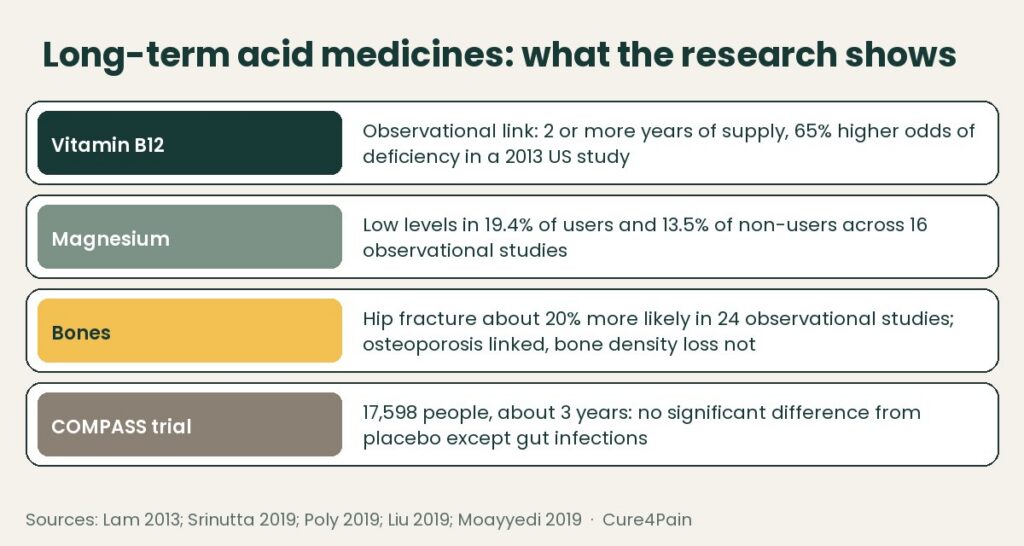
- The best evidence: COMPASS gave 17,598 people with stable heart and artery disease pantoprazole 40 mg daily or placebo for a median of 3.01 years. There was no significant difference in fractures, kidney disease, dementia, cancer, deaths and other safety events, except gut infections (1.4% against 1.0%) [7].
- Limits of COMPASS: the trial studied one PPI, pantoprazole, in people with heart and artery disease, and its listed safety events do not include vitamin B12 or magnesium levels [7]. The ACG adds that follow-up of at most 5 years may be too short for some events, such as stomach cancer, to develop [1].
- Observational studies: most concerns about long-term PPIs come from these; the ACG notes that they have flaws and do not establish cause and effect [1].
Do acid-reducing medicines lower vitamin B12 or magnesium?
Long-term acid-reducing medicines are linked with low vitamin B12 and low blood magnesium in observational studies, but the evidence on B12 is inconsistent. In a 2013 US study of 25,956 people with B12 deficiency and 184,199 without, a 2 or more years’ supply of PPIs was linked with 65% higher odds of deficiency [4]; a 2023 review of 25 studies found smaller odds (odds ratio 1.42), most of its studies found no difference in blood B12 between PPI users and non-users, and its authors judged the odds too low to imply a clear link [21]. A 2019 meta-analysis of 16 observational studies (131,507 people) found low blood magnesium in 19.4% of PPI users and 13.5% of non-users, with higher odds at higher doses [5].
- Official view: the NHS lists a very low vitamin B12 level among possible serious side effects of omeprazole, with a higher chance after a year or more [22].
- B12 testing: the ACG does not recommend routine monitoring for people on PPIs with no other risk factors [1]. The US National Institutes of Health lists vegetarian diets and prolonged metformin use among the risks for low B12 [23]; see our article on vitamin B12 deficiency.
- Magnesium testing: the ACG (2022) reports that the AGA advises against routine magnesium checks and that the US FDA suggests considering them before and during treatment; the ACG itself sees too little data to make a recommendation [1].
Do acid-reducing medicines weaken bones?
Observational studies link long-term PPIs with a modest rise in fractures, but the COMPASS randomised trial did not find a significant difference from placebo [7]. A 2019 meta-analysis of 24 observational studies with about 2.1 million people found hip fracture about 20% more likely with PPIs (risk ratio 1.20) [6]. A second 2019 meta-analysis found higher fracture risk (hazard ratio 1.30 at any site, 1.22 at the hip, 1.49 in the spine) and a link with osteoporosis (hazard ratio 1.23), but no clear link with loss of bone density [24].
- Guideline view: the ACG does not recommend routine bone density tests or extra calcium or vitamin D for people on PPIs who have no other risk factors for bone disease [1].
- NHS: it lists weakened bones among possible serious side effects of omeprazole, and says it may not suit people with osteoporosis [22]. If you have osteoporosis or a past fracture, tell your doctor; see our osteoporosis page.
Should you stop long-term acid medicines?
Do not stop long-term acid medicines without a review with your doctor, because many people still need them. The American Gastroenterological Association (AGA, 2022) advises a regular review of why each person takes a PPI, and a trial of reducing or stopping if there is no definite reason to continue; it says the decision should rest on that, not on concern about side effects [20].
- Usually stay on them, according to the AGA: people with severe erosive oesophagitis, an oesophageal ulcer or narrowing, Barrett’s oesophagus, or a high risk of stomach bleeding [20]. If a PPI protects your stomach during painkiller treatment, see our article on long-term painkillers.
- Rebound: the AGA says patients should be warned that symptoms can return for a while after stopping, and that tapering or abrupt stopping can both be considered [20]. Our Acidity & Hyperacidity page covers the rebound trial and the ACG and Canadian guidance.
When is acidity not safe to manage with diet?
Acidity in pregnancy, or with warning signs such as chest pain, vomiting blood, black stools or trouble swallowing, needs a doctor, not a diet chart. Indigestion is very common from 27 weeks of pregnancy, according to the NHS [25]; we refer pregnant women to their obstetrician or doctor.
- Call emergency services (112 in India, 911 in the US, 999 in the UK): sudden chest pain or discomfort that does not go away, which can feel like burning or indigestion, or chest pain that spreads to the arms, neck, jaw, stomach or back, or comes with sweating, feeling sick, light-headedness or breathlessness [26]; vomiting bright red blood or vomit that looks like ground coffee; black, sticky stools; severe stomach or chest pain that started suddenly [27].
- See a doctor soon: food getting stuck in your throat, painful swallowing, being sick often, feeling full after a very small meal, or losing weight without trying [2] [27].
How we plan your diet and review acid medicines at Cure4Pain
At Cure4Pain, your diet plan is one part of an integrative plan built around your tests, used alongside the medicines you need.
- Tests first: we read a panel of about 100 markers, adding tests for your condition when clinically indicated: an H. pylori breath or stool antigen test, as NICE names for dyspepsia [28], and vitamin B12 and other checks if you take long-term acid medicines; the ACG does not recommend routine B12 monitoring for people on PPIs with no other risk factors [1]. The panel is our clinic practice, not a guideline requirement.
- Your food plan: the food advice in the table above, with home-set curd where it suits you, ghee allowed and meal timing decided case by case. We consider time-restricted eating for suitable patients under supervision: in 25 people with suspected reflux, 2 days of a 16-hour fast eased heartburn and regurgitation scores, with weak evidence on acid exposure [29], while a 2026 cohort linked Ramadan fasting with more indigestion, particularly in women and older adults [30]. We do not advise fasting without supervision for people with diabetes on medicines, pregnant or breastfeeding women, or anyone with a history of eating disorders.
- Gut support and vitamin D: digestive enzymes, bile support, probiotics, magnesium and zinc, chosen for each person; low vitamin D corrected with standard supplement doses. Given by mouth first, with injections only when specifically needed or advised; magnesium mainly as bisglycinate, with L-threonate or citrate as advised, counted as elemental.
- Medicines: Dr Krushal Pabari reviews acid-reducing medicines regularly, as the AGA advises [20], and reduces them gradually where there is no definite reason to continue and symptoms have stayed settled, under clinical guidance from Team Cure4Pain, in coordination with your existing consulting physician and gastroenterologist; never stop or change them on your own.
- Time: case by case; in our clinic observation, many people notice meaningful relief within 8 to 12 weeks, depending on the cause; with a hiatus hernia, a long-term condition or an autoimmune condition, acidity is managed over the long term.
This is our clinic practice; individual results vary, and further studies are needed. Read more on our Acidity & Hyperacidity and Gut Dysbiosis & Gut Health pages.
If you would like a food plan and medicine review built around your own tests, you can book a consultation, online from anywhere or at our Mumbai clinic.
Frequently asked questions
What is the best diet chart for acidity?
We found no trial of a complete acidity diet chart. The ACG (2022) and the NHS favour earlier dinners, avoiding your own triggers and losing weight if you are overweight, and the NHS adds smaller, more frequent meals. The chart in this article is a sample that follows our clinic practice, not a prescription. [1] [2]
What foods should I avoid with acidity?
The NHS names coffee, tomatoes, alcohol, chocolate and fatty or spicy foods as common triggers. At Cure4Pain we also remove milk and most dairy, sugar, processed foods, nightshades and raw foods, generally replace wheat with jowar, bajra or other millets, and suggest limiting cruciferous vegetables; this is clinic practice, and the full list has not been tested in trials. [2]
Is milk good for acidity?
Research does not show that it helps or harms: milk was not linked with symptoms in the Nurses’ Health Study, and extra dairy did not change heartburn in an exploratory analysis of a small trial. At Cure4Pain we remove milk as clinic practice. [1] [14]
Is curd good for acidity?
We found no trial of curd alone for heartburn or reflux; in an exploratory analysis of a small trial, extra dairy including yogurt did not change heartburn. At Cure4Pain home-set curd is included where it suits the person. [14]
Which fruits are good for acidity?
We found no trial of fresh fruit for heartburn or reflux. Citrus is often reported as a trigger, though hard evidence is lacking. At Cure4Pain we cut down citrus and advise cooked rather than raw foods, with whole raw fruit once in a while. [13]
Can I drink tea or coffee with acidity?
At Cure4Pain we advise limiting tea and coffee. In the Nurses’ Health Study of women without known reflux, as the ACG reports, six servings a day of coffee, tea and soda were linked with more symptoms, and swapping two servings for water was linked with fewer. [1]
Is it safe to take pantoprazole or omeprazole every day?
For people who need them, the ACG (2022) says the benefits of PPIs far outweigh the theoretical risks. COMPASS, a 3-year trial of pantoprazole, found no significant difference from placebo except gut infections; it did not test omeprazole. The AGA (2022) says the reason for taking a PPI should be reviewed regularly. [1] [7] [20]
Do long-term PPIs cause cancer?
Research has not established that they do. The ACG (2022) says observational links do not establish cause and effect, and in the COMPASS trial cancer did not differ significantly from placebo over about 3 years. The ACG adds that this follow-up may be too short for some events such as stomach cancer, and that a small risk cannot be excluded. [1] [7]
This article is for education and does not replace medical advice. Do not start, stop or change any medicine or supplement without medical guidance.
References
1. Katz PO, et al. ACG Clinical Guideline for the Diagnosis and Management of Gastroesophageal Reflux Disease. Am J Gastroenterol 2022;117(1):27-56. doi:10.14309/ajg.0000000000001538
2. NHS (UK National Health Service). Heartburn and acid reflux. nhs.uk/conditions/heartburn-and-acid-reflux
3. Lakananurak N, et al. The Efficacy of Dietary Interventions in Patients with Gastroesophageal Reflux Disease: A Systematic Review and Meta-Analysis of Intervention Studies. Nutrients 2024;16(3). doi:10.3390/nu16030464
4. Lam JR, et al. Proton pump inhibitor and histamine 2 receptor antagonist use and vitamin B12 deficiency. JAMA 2013;310(22):2435-42. doi:10.1001/jama.2013.280490
5. Srinutta T, et al. Proton pump inhibitors and hypomagnesemia: A meta-analysis of observational studies. Medicine (Baltimore) 2019;98(44):e17788. doi:10.1097/MD.0000000000017788
6. Poly TN, et al. Proton pump inhibitors and risk of hip fracture: a meta-analysis of observational studies. Osteoporos Int 2019;30(1):103-114. doi:10.1007/s00198-018-4788-y
7. Moayyedi P, et al. Safety of Proton Pump Inhibitors Based on a Large, Multi-Year, Randomized Trial of Patients Receiving Rivaroxaban or Aspirin. Gastroenterology 2019;157(3):682-691.e2. doi:10.1053/j.gastro.2019.05.056
8. Gu C, et al. The Effects of Modifying Amount and Type of Dietary Carbohydrate on Esophageal Acid Exposure Time and Esophageal Reflux Symptoms: A Randomized Controlled Trial. Am J Gastroenterol 2022;117(10):1655-1667. doi:10.14309/ajg.0000000000001889
9. Fujiwara Y, et al. Association between dinner-to-bed time and gastro-esophageal reflux disease. Am J Gastroenterol 2005;100(12):2633-6. doi:10.1111/j.1572-0241.2005.00354.x
10. Zhang M, et al. Dietary and Lifestyle Factors Related to Gastroesophageal Reflux Disease: A Systematic Review. Ther Clin Risk Manag 2021;17:305-323. doi:10.2147/TCRM.S296680
11. Surdea-Blaga T, et al. Food and Gastroesophageal Reflux Disease. Curr Med Chem 2019;26(19):3497-3511. doi:10.2174/0929867324666170515123807
12. Bhatia SJ, et al. Indian consensus on gastroesophageal reflux disease in adults: A position statement of the Indian Society of Gastroenterology. Indian J Gastroenterol 2019;38(5):411-440. doi:10.1007/s12664-019-00979-y
13. Fox M, Gyawali CP. Dietary factors involved in GERD management. Best Pract Res Clin Gastroenterol 2023;62-63:101826. doi:10.1016/j.bpg.2023.101826
14. Fernando I, et al. The impact of low-fat and full-fat dairy foods on symptoms of gastroesophageal reflux disease: an exploratory analysis based on a randomized controlled trial. Eur J Nutr 2022;61(5):2815-2823. doi:10.1007/s00394-022-02855-6
15. Shahbazkhani B, et al. Prevalence of Non-Celiac Gluten Sensitivity in Patients with Refractory Functional Dyspepsia: a Randomized Double-blind Placebo Controlled Trial. Sci Rep 2020;10(1):2401. doi:10.1038/s41598-020-59532-z
16. Rubio-Tapia A, et al. American College of Gastroenterology Guidelines Update: Diagnosis and Management of Celiac Disease. Am J Gastroenterol 2023;118(1):59-76. doi:10.14309/ajg.0000000000002075
17. Galanty A, et al. Do Brassica Vegetables Affect Thyroid Function?-A Comprehensive Systematic Review. Int J Mol Sci 2024;25(7). doi:10.3390/ijms25073988
18. Ness-Jensen E, et al. Lifestyle Intervention in Gastroesophageal Reflux Disease. Clin Gastroenterol Hepatol 2016;14(2):175-82.e1-3. doi:10.1016/j.cgh.2015.04.176
19. Valentini DF Jr, et al. Dietary weight loss intervention provides improvement of gastroesophageal reflux disease symptoms-A randomized clinical trial. Clin Obes 2023;13(1):e12556. doi:10.1111/cob.12556
20. Targownik LE, et al. AGA Clinical Practice Update on De-Prescribing of Proton Pump Inhibitors: Expert Review. Gastroenterology 2022;162(4):1334-1342. doi:10.1053/j.gastro.2021.12.247
21. Choudhury A, et al. Vitamin B12 deficiency and use of proton pump inhibitors: a systematic review and meta-analysis. Expert Rev Gastroenterol Hepatol 2023;17(5):479-487. doi:10.1080/17474124.2023.2204229
22. NHS (UK National Health Service). Common questions about omeprazole. nhs.uk/medicines/omeprazole/common-questions-about-omeprazole
23. Office of Dietary Supplements, US National Institutes of Health. Vitamin B12: Fact Sheet for Health Professionals. ods.od.nih.gov/factsheets/VitaminB12-HealthProfessional
24. Liu J, et al. Proton pump inhibitors therapy and risk of bone diseases: An update meta-analysis. Life Sci 2019;218:213-223. doi:10.1016/j.lfs.2018.12.058
25. NHS (UK National Health Service). Indigestion. nhs.uk/conditions/indigestion
26. NHS (UK National Health Service). Chest pain. nhs.uk/symptoms/chest-pain
27. NHS (UK National Health Service). Gastritis. nhs.uk/conditions/gastritis
28. National Institute for Health and Care Excellence (NICE). Gastro-oesophageal reflux disease and dyspepsia in adults: investigation and management (CG184), published 2014. nice.org.uk/guidance/cg184
29. Jiang Y, et al. The Impact of Intermittent Fasting on Patients With Suspected Gastroesophageal Reflux Disease. J Clin Gastroenterol 2023;57(10):1001-1006. doi:10.1097/MCG.0000000000001788
30. Zekey FS, Başak F. The Impact of Ramadan Fasting on Dyspeptic Complaints. J Clin Gastroenterol 2026;60(2):151-155. doi:10.1097/MCG.0000000000002141