Written by AT. Chintan Dalal, N.D. · Reviewed by Dr Krushal Pabari, Clinical Team, Cure4Pain · Updated 30 October 2026
Key facts
We found no guideline that sets a specific Hashimoto’s diet: the US National Institute of Diabetes and Digestive and Kidney Diseases (NIDDK) says “no specific guidance is currently available” on diet and supplements [1]. In practice: eat a balanced home-cooked diet, limit seaweed, take no iodine supplements without medical advice, and get tested before cutting gluten. NICE (UK, 2015) advises a coeliac blood test when autoimmune thyroid disease is diagnosed [2], and about 1 in 62 people with autoimmune thyroid disease have biopsy-confirmed coeliac disease [3]. NIDDK warns that seaweed and iodine supplements can cause or worsen an underactive thyroid [1], and the American Thyroid Association (ATA, 2014) recommends against supplements in people with normal thyroid function or as a treatment for hypothyroidism [4]. In a 2024 review of 35 trials in Hashimoto’s, selenium lowered TPO antibodies [5]. Trials of a gluten-free diet without coeliac disease are small and disagree [6] [7]. As of October 2026 our PubMed searches found no trial of the Coimbra Protocol in Hashimoto’s.

Scientific explainer videos in our Resources section
In our Resources section, our clinical team discusses vitamin D, its cofactors and how autoimmune, lifestyle and pain conditions develop.
What do guidelines say about diet for Hashimoto’s?
No guideline we could find sets a Hashimoto’s diet; official advice covers coeliac testing (NICE, UK, 2015) [2], iodine-rich foods and iodine supplements (NIDDK, US) [1], and supplements in general (American Thyroid Association, 2014) [4]. According to NIDDK, researchers are studying diet and supplements such as vitamin D and selenium, but “no specific guidance is currently available” [1].
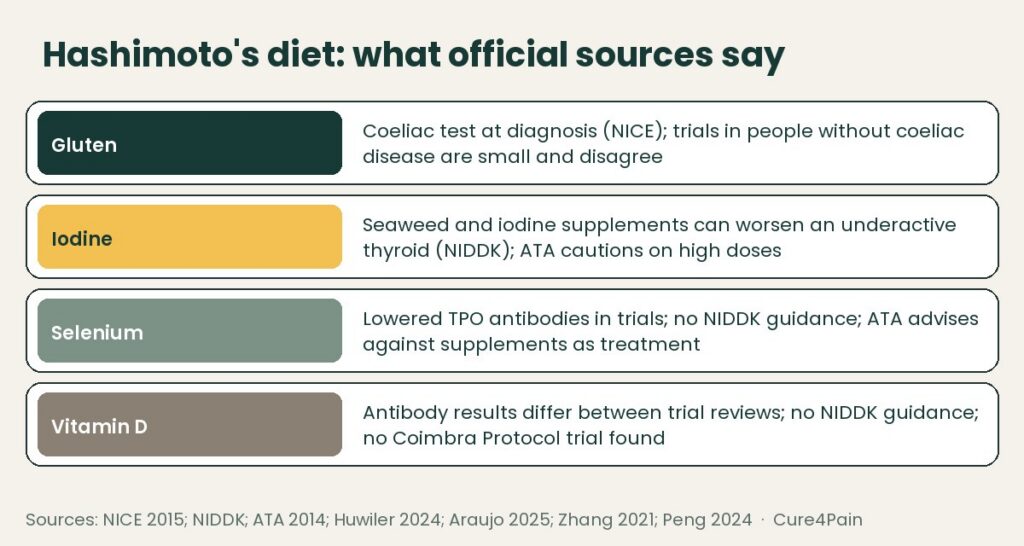
- American Thyroid Association 2014: recommends against dietary supplements in people with normal thyroid function or as a means of treating hypothyroidism, and particularly cautions against high doses of iodine; it is a strong recommendation based on low-quality evidence [4].
- Research reviews: a 2023 systematic review of 9 varied diet studies reported improvements in TPO antibodies, TSH and FT4 during energy restriction and after removing foods such as gluten, lactose or goitrogens, and said further experiments are needed to determine whether any diet helps [8]. A 2026 narrative review linked a Mediterranean diet with better thyroid outcomes and said gluten-free or lactose-free diets do not appear to give significant benefits [9].
Our Hashimoto’s thyroiditis page covers symptoms, tests and treatment; this article stays with food.
What is the best diet for Hashimoto’s?
No diet has been shown to be the best for Hashimoto’s. A balanced, home-cooked diet is a reasonable base. The two patterns below were tested in 45 and 17 people for 10 to 12 weeks [10] [11].
| Diet | Who was studied | What changed |
|---|---|---|
| Mediterranean | 45 adults with normal thyroid tests, 12 weeks, against gluten-free and free diets [10] | Oxidative stress markers improved; TSH, FT4 and antibodies did not change |
| Autoimmune protocol (AIP) | 17 women, 10-week online programme, no comparison group [11] | Quality of life and symptoms improved; thyroid hormones and antibodies did not change. One author co-founded the programme |
At Cure4Pain the plan is balanced and home-cooked, and we consider an anti-inflammatory, autoimmune-protocol or ketogenic pattern for suitable patients under supervision. This is clinic practice, not a trial result. A 2026 review in Annals of Medicine lists advanced kidney or liver disease as a relative contraindication to a ketogenic diet and advises particular caution with some glucose-lowering medicines, in pregnancy or breastfeeding, and when underweight [12]; Cleveland Clinic warns that an elimination diet such as AIP risks vitamin and mineral deficiencies and advises a dietitian [13].
What foods should you eat with Hashimoto’s?
With Hashimoto’s, choose whole, home-cooked foods from every food group, planned around your tests and whether you eat meat. No food has been shown to treat Hashimoto’s, and we found no trial of an Indian diet in Hashimoto’s; the table gives examples, not a prescription.
| Food group | Indian examples |
|---|---|
| Grains and millets | Rice, jowar, bajra, ragi (nachni), foxtail millet (kangni) |
| Pulses | Moong, masoor and toor dal |
| Vegetables | Bottle gourd (lauki), ridge gourd (turai), pumpkin (kaddu), spinach (palak), fenugreek (methi), carrot (gajar), okra (bhindi), beetroot, French beans |
| Fruit | Guava (amrood), apple, pomegranate (anaar), orange |
| Protein | Eggs, chicken, fish; paneer and curd (dahi) if dairy suits you |
| Nuts, seeds, fats | Walnuts (akhrot), almonds (badam), flaxseed (alsi), pumpkin seeds; cold-pressed oils |
At Cure4Pain, omega-3 is part of each plan unless there is a reason not to: from fish for people who eat it, and from algal oil for vegetarians and vegans. Our article on omega-3 and autoimmune disease explains the research.
What foods should you avoid with Hashimoto’s?
Seaweed such as kelp and dulse is the one food group the US agency NIDDK names as a risk to the thyroid in Hashimoto’s, because of its iodine [1]. For other foods, the research is shown beside Cure4Pain’s clinic practice.
| Food | What research shows | Cure4Pain clinic practice |
|---|---|---|
| Seaweed and kelp | Can cause or worsen an underactive thyroid, according to NIDDK [1]; even small amounts of brown seaweed may act against the thyroid, and labels may be inadequate, according to a 2021 review [14] | We do not use iodine for people with Hashimoto’s; we advise limiting iodine-rich foods |
| Processed foods and breads | No Hashimoto’s trial of these alone that we could find; Western-style diets may harm thyroid health, according to a 2026 review [9] | Avoided; home-made roti from processed wheat is switched to jowar, bajra or other millets |
| Gluten | Trials without coeliac disease are small and disagree [6] [7] | Avoided only with coeliac disease, not by everyone |
| Dairy and lactose | TSH fell after 8 weeks of lactose restriction in 38 patients with lactose intolerance on levothyroxine, without a randomised comparison [15]; another study found no change in TSH or medicine dose [16] | Reduced where it does not suit you; ghee is allowed |
| Cruciferous vegetables (cabbage, cauliflower, broccoli, mustard greens) | A 2024 review of 123 laboratory, animal and human studies found daily intake, particularly with enough iodine, had no adverse effect on thyroid function [17]; the US National Institutes of Health says reasonable amounts are not a concern for most people with enough iodine, speaking of people in general [18] | As an observational clinic practice, we generally suggest limiting them; this is not a research finding |
| Soy | A 2019 meta-analysis of 18 trials, not specific to Hashimoto’s, found no change in thyroid hormones and a very modest rise in TSH [19]; NIDDK says soy can affect absorption of thyroid medicine [1] | Normal amounts, taken well apart from thyroid medicine |
| Millets | A 2024 review found the evidence linking pearl millet with goitre not strong enough to apply to a balanced diet; most studies were of pearl millet [20] | Normal amounts as part of a varied diet |
Should you go gluten-free with Hashimoto’s?
Go gluten-free with Hashimoto’s only if a specialist confirms coeliac disease. Without coeliac disease, trials are small and disagree. NICE (UK) advises a coeliac blood test when autoimmune thyroid disease is diagnosed [2].
- Test before you change your diet: NICE says a coeliac test is accurate only if you are eating gluten, advises eating some gluten in more than 1 meal every day for at least 6 weeks before testing, and advises not starting a gluten-free diet until a specialist confirms the diagnosis, even if a blood test is positive [2].
- Trials without coeliac disease: a 2025 meta-analysis of 3 trials with 110 people found no significant change in TSH or thyroid hormones; thyroglobulin antibodies fell, TPO antibodies rose, and the evidence was very uncertain [6].
- A different result: a 2023 meta-analysis of 4 studies with 87 people without coeliac symptoms or histology found lower TSH and higher FT4, yet its authors said the evidence is not enough to recommend the diet to all patients [7].
- A 12-month trial: in a randomised trial of 62 women with chronic autoimmune thyroiditis, TSH was lower on a gluten-free diet than without it, with no difference in antibodies, FT3 or FT4 [21].
Should you avoid iodine with Hashimoto’s?
With Hashimoto’s, the caution is iodine supplements and seaweed, not ordinary food: the US agency NIDDK warns that both can cause or worsen an underactive thyroid [1]. According to the US National Institutes of Health, people with autoimmune thyroid disease may have adverse effects at iodine intakes considered safe for others [18].
- Cutting iodine: in a 2003 Korean trial of 45 people with an underactive thyroid from Hashimoto’s, not on thyroid medicine, 78.3% of those limited to under 100 mcg a day returned to normal thyroid function at 3 months, against 45.5% without the limit [22]. The trial was small and short, and it was done in a region with excessive iodine intake; a 2023 systematic review says different populations are likely to respond differently [8]. It is not a reason to change your medicine.
- Hidden iodine: kelp supplements and many multivitamins contain iodine, with multivitamins often at 150 mcg, according to the US National Institutes of Health [18]; NIDDK also names some cough syrups [1]. Read the label and tell your doctor.
- At Cure4Pain: we do not use iodine for people with Hashimoto’s and we advise limiting iodine-rich foods; ordinary iodised salt in normal amounts is enough for most people.
- Pregnancy is different: the baby depends on iodine from your diet, so NIDDK advises asking your doctor how much you need [1]. This is decided by your obstetrician and endocrinologist.
Does selenium help Hashimoto’s, and which foods have it?
Selenium supplements lowered TPO antibodies in trials in Hashimoto’s, but the US agency NIDDK gives no specific guidance [1], and the American Thyroid Association (2014) recommends against supplements as a treatment for hypothyroidism [4]. A 2024 review in Thyroid of 35 trials found lower TPO antibodies, and lower TSH in people not on thyroid medicine, with moderate certainty; thyroid hormones, thyroglobulin antibodies and thyroid size did not change [5]. The US National Institutes of Health notes that other trials found no effect on thyroid function or quality of life [23]. Lower antibodies have not been shown to restore a damaged thyroid.
- Food sources: seafood, meat and poultry are rich sources, and Brazil nuts contain particularly high amounts; plant foods vary with the soil, and people on vegetarian or vegan diets may have lower intakes, according to the US National Institutes of Health [23].
- Limits: the US National Institutes of Health gives a recommended selenium intake of 55 to 70 mcg a day for adults and an upper limit of 400 mcg a day; too much most often causes hair loss and brittle nails [23].
- Pregnancy: the American Thyroid Association recommends against selenium supplements in pregnant women with thyroid autoimmunity, as reported by the US National Institutes of Health [23]. Your obstetrician and endocrinologist decide this.
- At Cure4Pain: selenium is part of the plan, set from your tests and diet, alongside magnesium and B vitamins.
Does vitamin D help Hashimoto’s, and can food provide it?
Reviews of vitamin D trials in Hashimoto’s disagree on thyroid antibodies, and the US agency NIDDK gives no specific guidance [1]. According to the US National Institutes of Health, vitamin D is found naturally in only a few foods, such as fatty fish, fish liver oils, egg yolks and cheese [24].
- What reviews found: a 2021 meta-analysis of 8 trials found lower thyroid antibodies in courses longer than 3 months [25]; a 2024 network meta-analysis found vitamin D alone did not clearly lower antibodies over 6 months [26].
- Who may gain: in a 2025 meta-analysis of 577 people with autoimmune thyroid disease, TPO antibodies fell only in those whose vitamin D was low at the start [27].
- Safety: the upper limit for adults is 4,000 IU a day, and too much can raise blood calcium, according to the US National Institutes of Health [24]; higher doses are given only under medical supervision, with calcium checked regularly.
- At Cure4Pain: we use supervised vitamin D therapy (Coimbra Protocol), with cofactors and selenium, at the dose set for each person from blood tests. Vitamin D is used here as an immune modulator, and doses differ by condition. Our methods are derived from the work of Dr Coimbra. As of October 2026 our PubMed searches found no trial of the Coimbra Protocol in Hashimoto’s, so further studies are needed.
- Diet on this therapy: at high doses, the Coimbra Protocol, as described in a 2022 safety study of 319 people from one German centre without a comparison group, includes a strict low-calcium diet and regular fluids [28]. For Hashimoto’s our dose is often well below the highest protocol doses, so follow your own plan; see our Coimbra Protocol page. In pregnancy we do not use high doses.
Is coffee bad for Hashimoto’s? Food and thyroid medicine
We found no guideline against coffee in Hashimoto’s; the known issue is absorption of thyroid medicine. According to the US agency NIDDK, grapefruit juice, espresso coffee, soy, and multivitamins with iron or calcium can affect how well the body absorbs levothyroxine, and your doctor may ask you to take it in the morning, 30 to 60 minutes before your first meal [1].
- The evidence: a 2021 systematic review of 63 studies found limited evidence that coffee, soy, fibre, and calcium or iron supplements all reduce levothyroxine absorption, and that a proper time gap avoids this. It found morning and bedtime levothyroxine doses equally effective [29]. Change your timing only with your doctor.
- At Cure4Pain: we advise limiting coffee and tea, and supplements are timed so they do not interfere with your thyroid medicine.
Is a vegetarian diet good for Hashimoto’s?
We found no trial of a vegetarian diet in Hashimoto’s (PubMed search, 30 October 2026), and a large UK study of an underactive thyroid in general was not conclusive. On a vegetarian diet, iodine and selenium need attention.
- UK Biobank: among 466,362 adults, 8,057 of them vegetarian, followed for about 12.7 years, vegetarians had no significantly different risk of hypothyroidism, and a 23% higher risk only after adjusting for body mass index, which the authors flag as a possible source of bias; they call for studies that measure iodine [30].
- Nutrients to watch: people who eat few or no dairy foods, seafood and eggs might not get enough iodine [18], and vegetarians may have lower selenium intakes [23]. Reducing dairy removes one of these iodine sources.
What does a one-day Hashimoto’s diet plan look like?
This sample Indian day uses home-cooked meals, takes thyroid medicine apart from food, and leaves out seaweed and cruciferous vegetables. It is a sample, not a prescription: your plan depends on your tests, weight and medicines.
| Meal | Vegetarian | Non-vegetarian |
|---|---|---|
| On waking | Thyroid medicine with water, if prescribed; wait as advised | Same |
| Breakfast | Moong dal chilla with mint chutney; guava | Vegetable omelette; ragi porridge without sugar |
| Lunch | Rice, toor dal, okra sabzi, carrot salad, curd if it suits you | Rice, chicken curry, bottle gourd sabzi, carrot salad |
| Evening | Apple, walnuts | Orange, almonds |
| Dinner | Jowar bhakri, palak dal, pumpkin sabzi | Fish curry, rice, French beans sabzi |
How we plan your diet for Hashimoto’s at Cure4Pain
At Cure4Pain, your diet is one part of a long-term integrative plan used alongside guideline treatment, never instead of it.
- Tests first: we read a panel of about 100 markers, adding tests for your condition when clinically indicated: TSH, FT3, FT4, TPO and thyroglobulin antibodies, coeliac screening, which NICE advises when autoimmune thyroid disease is diagnosed [2], and a thyroid ultrasound when needed.
- Food: balanced home-cooked meals, vegetarian or non-vegetarian; no processed foods or breads, with home-made roti from processed wheat switched to jowar, bajra or other millets; gluten avoided only with coeliac disease, not by everyone; dairy reduced where it does not suit you, with ghee allowed; as an observational clinic practice, we generally suggest limiting cruciferous (Brassica) vegetables such as cabbage and cauliflower; gut support.
- Nutrients: supervised vitamin D therapy (Coimbra Protocol) with cofactors and selenium; magnesium and B vitamins as needed; no iodine. Supplements are by mouth first, with injections only when specifically needed or advised; magnesium is mainly bisglycinate, with L-threonate or citrate as advised, counted as elemental magnesium.
- Lifestyle: sleep, stress management and resistance training are discussed at consultations and follow-ups, and management is lifelong.
- Guideline treatment: levothyroxine is the standard treatment once the thyroid is underactive, according to the American Thyroid Association 2014 and the European Thyroid Association 2025 guidelines [4] [31]. With antibodies and normal thyroid tests, your doctor may simply monitor you [1]; for a mild (subclinical) underactive thyroid, treatment depends on TSH, age and symptoms, as set out by the European Thyroid Association in 2013 [32]. Treatment replaces the missing hormone; immune-suppressing medicines are not part of standard treatment [4] [33].
- Medicines stay: at Cure4Pain, Dr Krushal Pabari prescribes and adjusts these medicines as per guidelines, under clinical guidance from Team Cure4Pain, in coordination with your existing consulting physician and your endocrinologist; never stop or change them on your own.
This is our clinic practice; individual results vary, and further studies are needed. Read more on our Hashimoto’s thyroiditis, hypothyroidism and gut health pages.
If you would like a diet plan built around your blood tests and thyroid treatment, you can book a consultation, online from anywhere or at our Mumbai clinic.
Frequently asked questions
Is gluten bad for Hashimoto’s if I do not have coeliac disease?
Gluten has not been shown to be harmful in Hashimoto’s without coeliac disease. Small trials disagree, and a 2025 meta-analysis of 3 trials rated the evidence very uncertain. Have a coeliac test before cutting gluten: according to NICE (UK), the test is accurate only if you are eating gluten. [6] [2]
Do I need a low-iodine diet for Hashimoto’s?
No guideline we found asks for one. The caution is iodine supplements and seaweed. In one small Korean trial, more people returned to normal thyroid function on an iodine limit, but the region had excessive iodine intake, so the result may not apply elsewhere. At Cure4Pain we consider ordinary iodised salt in normal amounts enough for most people. [1] [22] [8]
Are Brazil nuts good for Hashimoto’s?
They contain particularly high amounts of selenium, according to the US National Institutes of Health, so they count toward the adult upper limit of 400 mcg a day. We did not find guidance that recommends them for Hashimoto’s. [23]
Can I eat eggs with Hashimoto’s?
We found no guideline or trial against eggs in Hashimoto’s. A large boiled egg contains about 31 mcg of iodine, against a recommended 150 mcg a day for adults, according to the US National Institutes of Health. [18]
Are soy and goitrogens bad for Hashimoto’s?
Reasonable amounts of soy and cruciferous vegetables are not a concern for most people with enough iodine, according to the US National Institutes of Health, speaking of people in general. A 2019 meta-analysis of 18 soy trials, also not specific to Hashimoto’s, found no change in thyroid hormones and a very modest rise in TSH. Keep soy away from your thyroid medicine. As an observational clinic practice, we generally suggest limiting cruciferous vegetables. [18] [19]
Is a keto or low-carbohydrate diet good for Hashimoto’s?
We found no guideline that recommends it, and no trial evidence strong enough to recommend it to everyone. At Cure4Pain we consider it for suitable patients under supervision; this is clinic practice, not a trial result. A 2026 review lists advanced kidney or liver disease as a relative contraindication and advises particular caution in pregnancy or breastfeeding. [1] [12]
Does losing weight help Hashimoto’s?
A 2023 systematic review reported improvements in TPO antibodies, TSH and FT4 during energy restriction, with or without removing selected foods, but this rests on 2 studies and the authors called for more research. Correct thyroid treatment comes first. [8]
Can diet alone make Hashimoto’s go away?
No diet has been shown to make Hashimoto’s go away. Hashimoto’s is a long-term condition, and the American Thyroid Association names levothyroxine as the standard of care once the thyroid is underactive. Diet works alongside that treatment, not instead of it. [4]
This article is for education and does not replace medical advice. Do not start, stop or change any medicine or supplement without medical guidance.
References
1. National Institute of Diabetes and Digestive and Kidney Diseases (NIDDK), US National Institutes of Health. Hashimoto’s disease. niddk.nih.gov
2. National Institute for Health and Care Excellence (NICE). Coeliac disease: recognition, assessment and management. NICE guideline NG20, 2015. nice.org.uk/guidance/ng20
3. Roy A, et al. Prevalence of Celiac Disease in Patients with Autoimmune Thyroid Disease: A Meta-Analysis. Thyroid 2016;26(7):880-90. doi:10.1089/thy.2016.0108
4. Jonklaas J, et al. Guidelines for the treatment of hypothyroidism: prepared by the american thyroid association task force on thyroid hormone replacement. Thyroid 2014;24(12):1670-751. doi:10.1089/thy.2014.0028
5. Huwiler VV, et al. Selenium Supplementation in Patients with Hashimoto Thyroiditis: A Systematic Review and Meta-Analysis of Randomized Clinical Trials. Thyroid 2024;34(3):295-313. doi:10.1089/thy.2023.0556
6. Araújo EMQ, et al. Effects of Gluten-Free Diet in Non-Celiac Hashimoto’s Thyroiditis: A Systematic Review and Meta-Analysis. Nutrients 2025;17(21). doi:10.3390/nu17213437
7. Piticchio T, et al. Effect of gluten-free diet on autoimmune thyroiditis progression in patients with no symptoms or histology of celiac disease: a meta-analysis. Front Endocrinol (Lausanne) 2023;14:1200372. doi:10.3389/fendo.2023.1200372
8. Osowiecka K, Myszkowska-Ryciak J. The Influence of Nutritional Intervention in the Treatment of Hashimoto’s Thyroiditis-A Systematic Review. Nutrients 2023;15(4). doi:10.3390/nu15041041
9. Ruggeri RM, et al. The role of nutrition on thyroid health and disease: myths and facts. J Endocrinol Invest 2026;49(8):1759-1779. doi:10.1007/s40618-026-02852-0
10. Laganà M, et al. Effects of Dietary Habits on Markers of Oxidative Stress in Subjects with Hashimoto’s Thyroiditis: Comparison Between the Mediterranean Diet and a Gluten-Free Diet. Nutrients 2025;17(2). doi:10.3390/nu17020363
11. Abbott RD, et al. Efficacy of the Autoimmune Protocol Diet as Part of a Multi-disciplinary, Supported Lifestyle Intervention for Hashimoto’s Thyroiditis. Cureus 2019;11(4):e4556. doi:10.7759/cureus.4556
12. Dyńka D, et al. The ketogenic diet is not for everyone: contraindications, side effects, and drug interactions. Ann Med 2026;58(1):2603016. doi:10.1080/07853890.2025.2603016
13. Cleveland Clinic. What Is the AIP (Autoimmune Protocol) Diet? health.clevelandclinic.org/aip-diet-autoimmune-protocol-diet
14. Smyth PPA. Iodine, Seaweed, and the Thyroid. Eur Thyroid J 2021;10(2):101-108. doi:10.1159/000512971
15. Asik M, et al. Decrease in TSH levels after lactose restriction in Hashimoto’s thyroiditis patients with lactose intolerance. Endocrine 2014;46(2):279-84. doi:10.1007/s12020-013-0065-1
16. Marabotto E, et al. Prevalence of Lactose Intolerance in Patients with Hashimoto Thyroiditis and Impact on LT4 Replacement Dose. Nutrients 2022;14(15). doi:10.3390/nu14153017
17. Galanty A, et al. Do Brassica Vegetables Affect Thyroid Function?-A Comprehensive Systematic Review. Int J Mol Sci 2024;25(7). doi:10.3390/ijms25073988
18. Office of Dietary Supplements, US National Institutes of Health. Iodine: Fact Sheet for Health Professionals. ods.od.nih.gov/factsheets/Iodine-HealthProfessional
19. Otun J, et al. Systematic Review and Meta-analysis on the Effect of Soy on Thyroid Function. Sci Rep 2019;9(1):3964. doi:10.1038/s41598-019-40647-x
20. Anitha S, et al. Does consumption of pearl millet cause goiter? A systematic review of existing evidence. Front Nutr 2024;11:1323336. doi:10.3389/fnut.2024.1323336
21. Pobłocki J, et al. Whether a Gluten-Free Diet Should Be Recommended in Chronic Autoimmune Thyroiditis or Not?-A 12-Month Follow-Up. J Clin Med 2021;10(15). doi:10.3390/jcm10153240
22. Yoon SJ, et al. The effect of iodine restriction on thyroid function in patients with hypothyroidism due to Hashimoto’s thyroiditis. Yonsei Med J 2003;44(2):227-35. doi:10.3349/ymj.2003.44.2.227
23. Office of Dietary Supplements, US National Institutes of Health. Selenium: Fact Sheet for Health Professionals. ods.od.nih.gov/factsheets/Selenium-HealthProfessional
24. Office of Dietary Supplements, US National Institutes of Health. Vitamin D: Fact Sheet for Health Professionals. ods.od.nih.gov/factsheets/VitaminD-HealthProfessional
25. Zhang J, et al. Effects of vitamin D on thyroid autoimmunity markers in Hashimoto’s thyroiditis: systematic review and meta-analysis. J Int Med Res 2021;49(12):3000605211060675. doi:10.1177/03000605211060675
26. Peng B, et al. Effects of different supplements on Hashimoto’s thyroiditis: a systematic review and network meta-analysis. Front Endocrinol (Lausanne) 2024;15:1445878. doi:10.3389/fendo.2024.1445878
27. Luo D, et al. The impacts of vitamin D supplementation on serum levels of thyroid autoantibodies in patients with autoimmune thyroid disease: a meta-analysis. PeerJ 2025;13:e19541. doi:10.7717/peerj.19541
28. Amon U, et al. Safety Data in Patients with Autoimmune Diseases during Treatment with High Doses of Vitamin D3 According to the “Coimbra Protocol”. Nutrients 2022;14(8). doi:10.3390/nu14081575
29. Wiesner A, et al. Levothyroxine Interactions with Food and Dietary Supplements-A Systematic Review. Pharmaceuticals (Basel) 2021;14(3). doi:10.3390/ph14030206
30. Candussi CJ, et al. Risk of hypothyroidism in meat-eaters, fish-eaters, and vegetarians: a population-based prospective study. BMC Med 2025;23(1):269. doi:10.1186/s12916-025-04045-7
31. Centanni M, et al. ETA guidelines for the use of levothyroxine sodium preparations in monotherapy to optimize the treatment of hypothyroidism. Eur Thyroid J 2025;14(4). doi:10.1530/ETJ-25-0123
32. Pearce SH, et al. 2013 ETA Guideline: Management of Subclinical Hypothyroidism. Eur Thyroid J 2013;2(4):215-28. doi:10.1159/000356507
33. Ralli M, et al. Hashimoto’s thyroiditis: An update on pathogenic mechanisms, diagnostic protocols, therapeutic strategies, and potential malignant transformation. Autoimmun Rev 2020;19(10):102649. doi:10.1016/j.autrev.2020.102649