
Written by AT. Chintan Dalal, N.D. · Reviewed by Dr Krushal Pabari, Clinical Team, Cure4Pain · Updated 30 October 2026
Key facts
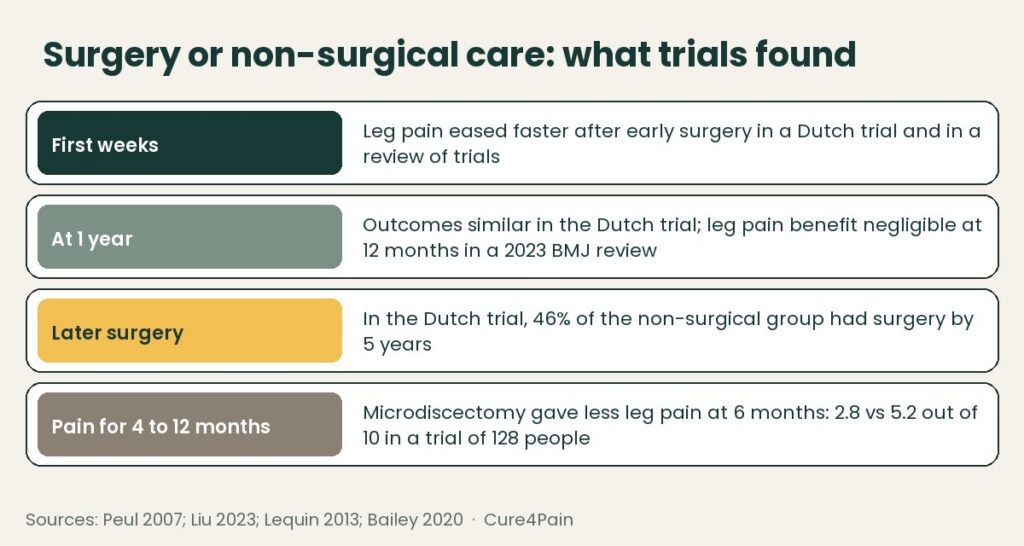
Recovery from sciatica without surgery is common: according to the NHS, it usually gets better in a few weeks to a few months, although it can last longer and can return [1]. In the Dutch Peul trial of 283 people with severe sciatica for 6 to 12 weeks, early surgery relieved leg pain faster, but outcomes were similar by one year, and 44% of those assigned to non-surgical care had surgery by two years [2] [3]. A 2023 BMJ review of 24 trials, 12 of them on discectomy (removing the pressing disc material), found that the leg pain benefit of discectomy was negligible at 12 months, on very low to low certainty evidence [4]. For sciatica lasting 4 to 12 months, a 2020 New England Journal of Medicine trial of 128 people found leg pain at 6 months of 2.8 out of 10 after surgery and 5.2 with non-surgical care [5]. Sciatica in both legs, numbness around the genitals or bottom, or new bladder or bowel problems can mean cauda equina syndrome, a surgical emergency [1] [6]. In a PubMed search in October 2026 we found no trial comparing Ayurveda with placebo or standard care for sciatica, and the one placebo trial of homeopathy we found was inconclusive [7].

Scientific explainer videos in our Resources section
In our Resources section, our clinical team discusses vitamin D, its cofactors and how autoimmune, lifestyle and pain conditions develop.
Can sciatica heal without surgery?
Yes, sciatica improves without an operation for many people, but not for everyone and not always fully. According to the NHS, sciatica usually gets better in a few weeks to a few months and can return [1]. India’s ICMR Standard Treatment Workflow for lower back pain (July 2024) asks doctors to “keep a high threshold for invasive procedures” [8]. The NHS advises seeing a doctor if pain has not improved after a few weeks, is getting worse or stops your normal activities [1]. Figures below vary because studies measure improvement differently.
- In the first weeks: in a 1999 New England Journal of Medicine trial of 183 people with sciatica severe enough for bed rest, 87% reported improvement at 12 weeks, whether they rested or simply waited; surgery rates were similar in the two groups [9].
- Over a year: in a UK primary care study of 609 people with back-related leg pain, 55% had improved by 12 months, meaning at least a 30% fall in disability scores [10].
- Over five years: in the Dutch Peul trial of people with severe sciatica, 21% of the 231 followed up, in both groups together and including those who had surgery, reported an unsatisfactory recovery at 5 years. The authors concluded that 8% never showed any recovery and at least 23% had ongoing complaints that came and went, irrespective of treatment [11].
- The cause matters: a slipped disc is the most common cause, and spinal narrowing and a slipped vertebra are others, according to the NHS [1]. Similar symptoms can have other roots: the NHS lists pins and needles and muscle weakness among the symptoms of vitamin B12 deficiency [12]. See also our neuropathy and piriformis syndrome pages.
Does a slipped disc shrink on its own?
Often, yes: many slipped discs shrink without surgery. A 2024 meta-analysis of 31 studies with 2,233 people treated without surgery found that about 70% of slipped discs shrank, mainly within 6 months, from 13% of bulges to 88% of sequestrations [13]:
| MRI wording | How often the disc shrank |
|---|---|
| Bulge | 13% |
| Protrusion | 38% |
| Extrusion (disc material pushed further out) | 67% |
| Sequestration (a free fragment) | 88% |
Complete disappearance is less common: a 2015 systematic review put it at 43% for sequestrated discs and 15% for extruded discs [14]. A disc still visible on a scan does not by itself mean a poor outcome. In the Dutch Peul trial, where people had surgery or non-surgical care, one year later a disc herniation was still visible in 35% of people with a good outcome and 33% of those with a poor one [15]. Our slipped disc page explains MRI wording in more detail.
What do trials of surgery versus non-surgical care show?
Surgery usually relieves sciatica leg pain sooner than non-surgical care, and the gap narrows with time. Four sets of trials shaped this view.
| Trial | Who took part | What it found |
|---|---|---|
| Weber, Norway, 1983 [16] | 126 people with an uncertain need for surgery | Better after surgery at 1 year. Still better at 4 years, but no longer statistically significant. Little change over the last 6 years |
| Peul, Netherlands, 2007 to 2013 [2] [3] [11] | 283 people with severe sciatica for 6 to 12 weeks | Faster leg pain relief with early surgery. Perceived recovery at 1 year was 95% in both groups, with no significant difference at 5 years. 46% of the non-surgical group had surgery by 5 years |
| SPORT, USA, 2006 and 2014 [17] [18] | 501 surgical candidates with symptoms for at least 6 weeks | Both groups improved substantially. Main differences were small and not statistically significant, but many people did not follow their assigned group: by 8 years, 60% of the surgery group and 49% of the non-surgical group had surgery, and the authors said this comparison could not settle which is better. Analysis by treatment actually received, which is not a randomised comparison, favoured surgery |
| Bailey, Canada, 2020 and 2021 [5] [19] | 128 people at one centre with sciatica for 4 to 12 months from an L4-L5 or L5-S1 disc | Leg pain at 6 months was 2.8 after microdiscectomy and 5.2 with non-surgical care, out of 10. At 2 years it was 2.8 and 4.2, a gap below the size considered clinically important, and 38% of the non-surgical group had surgery by then |
- Pooled trials: a 2023 BMJ systematic review of 24 trials, 12 of them on discectomy (1,711 participants), found a moderate leg pain benefit from discectomy in the first 3 months, a small one from 3 to 12 months and a negligible one at 12 months, with small, negligible or no effects on disability. The risk of any adverse event was similar. The certainty of this evidence was very low to low [4].
- After surgery: in a 2016 review of 39 cohort studies with 13,883 people, mean leg pain fell from 75 to 15 out of 100 by 3 months, and was 21 at 5 years, so some symptoms can remain; these studies followed only people who had surgery [20]. In the Canadian Bailey trial of 128 people, nine had adverse events linked to surgery and one needed repeat surgery for a recurrent disc [5].
- What these trials do not show: they studied sciatica from a slipped disc, so they do not settle the question for spinal narrowing, where a 2016 Cochrane review of five trials with 643 people had “very little confidence” about whether surgery or conservative care is better [21]. The non-surgical groups received usual or standardised conservative care. The results do not show that any one non-surgical therapy, including those we use at Cure4Pain, matches surgery.
When should sciatica be treated with surgery?
Emergency signs of cauda equina syndrome need urgent surgical assessment [6]. Otherwise surgery for sciatica is generally kept for intolerable pain, or for symptoms that persist after non-surgical care when the scan matches them. Whether weakness alone calls for early surgery is debated, so severe or worsening weakness needs a spine surgeon’s assessment promptly [22]. The UK’s NICE guideline NG59 (2016, last reviewed July 2026) advises considering spinal decompression “when non-surgical treatment has not improved pain or function” and the scan findings are consistent with the symptoms [23]. India’s ICMR Standard Treatment Workflow for lower back pain (July 2024) reserves surgery for “carefully selected patients after expert opinion” and refers unresolving nerve root symptoms to an orthopaedic surgeon [8].
- Your own priorities count: the authors of the 2023 BMJ review describe discectomy as an option for people who feel that rapid relief outweighs the risks and costs of surgery [4].
- Long-standing symptoms: in the US SPORT study, people with symptoms for more than 6 months did worse after both surgery and non-surgical care, while the added benefit of surgery did not depend on symptom length [24].
A spine surgeon is the right person to weigh these points with you.
Can weakness or nerve damage from sciatica recover without surgery?
Moderate leg weakness from sciatica often recovers, but severe or worsening weakness needs a spine surgeon promptly. In the Dutch Peul trial, 150 of the 283 people had leg weakness at the start, moderate in 84%. It recovered faster after early surgery, but at 1 year complete recovery was similar: 81% with early surgery and 80% with non-surgical care, where 40% had surgery for intolerable pain. Severe weakness carried 5.4 times the odds of weakness remaining at 1 year [22].
For foot drop, the evidence comes from people who had surgery, with no non-surgical comparison: in a 2025 analysis of 66 patient records, surgery within 6 weeks of onset was linked with greater motor recovery [25].
When is sciatica an emergency?
Sciatica is an emergency when it comes with signs of cauda equina syndrome (compression of the bundle of nerves at the base of the spine), such as sciatica on both sides, numbness around the genitals or bottom, or trouble passing urine or controlling stools [1]. Go to a hospital emergency department straight away if you have any of the signs below. Cauda equina syndrome is rare, found in 0.27% of people with low back pain seen in hospital, but it is a surgical emergency [6].
- According to the NHS: sciatica on both sides; severe or worsening weakness or numbness in both legs; numbness around or under the genitals or around the bottom; difficulty starting to pass urine, or being unable to pass or control it; not noticing the need to pass stools, or being unable to control them [1].
- Why speed matters: in a 2026 meta-analysis of 15 cohort studies (not trials) with 26,627 adults who had decompression, surgery within 48 hours of symptom onset was linked with better urinary and nerve recovery than later surgery, mainly in the short term and most clearly in people who could still pass urine voluntarily. This is not time to spare: go straight away [26].
- Other warning signs in the ICMR workflow: severe worsening pain, especially at night or when lying down; significant injury; weight loss, a history of cancer or fever; prolonged steroid or intravenous drug use; and a first episode of severe pain after age 50 [8].
In India, call 112 for emergencies (108 for an ambulance in most states). Do not wait for a clinic appointment.
Which non-surgical treatments have evidence?
Several non-surgical treatments for sciatica have some evidence, but none clearly stands above the others. A 2025 network meta-analysis of 50 trials with 4,920 people with chronic sciatica called the evidence very uncertain and concluded that “no high-quality evidence confirms the superior effectiveness of any non-surgical intervention” [27].
| Treatment | What research shows | Guideline view |
|---|---|---|
| Staying active, exercise | Bed rest no better than staying active [28]; exercise a small short-term benefit over advice, none long term [29] | NHS advises carrying on with normal activities [1]; NICE: consider group exercise programmes [23] |
| Epidural steroid injection | Less leg pain than placebo at 6 weeks and 3 months, but below the size patients usually notice [30] | NICE: consider in acute and severe sciatica [23]; ICMR: short-term relief [8] |
| Pregabalin | No better than placebo in 209 people, with more side effects [31] | NICE: do not offer gabapentinoids [23] |
| Acupuncture | One trial: in 216 people in China with chronic sciatica from a slipped disc, 10 sessions over 4 weeks gave less leg pain and disability than sham at 4 and 52 weeks [32] | NICE: do not offer for low back pain with or without sciatica [23] |
Guidelines and newer trials do not always agree: NICE says not to offer acupuncture for low back pain with or without sciatica, while a 2024 JAMA Internal Medicine trial of 216 people found less leg pain and disability than with sham [23] [32]. Our article on long-term painkillers covers the risks of regular use.
Does Ayurveda help sciatica?
Whether Ayurveda helps sciatica is not yet known. In our PubMed search (October 2026), we found no published trial comparing an Ayurvedic treatment for sciatica with placebo or with standard care.
- What exists: small studies comparing one Ayurvedic method with another, such as agnikarma (therapeutic cautery) against katibasti (warm oil held on the lower back) in 40 people [33], and a herbal tablet with or without matra basti (oil enema) in 102 people [34]. They report improvement, but without a placebo or standard care group they cannot separate treatment effect from natural recovery.
- Trials under way: an Indian trial of 80 people is comparing an Ayurvedic protocol with conventional care including physiotherapy, with results expected by December 2026 [35]. Another is comparing marma therapy with physiotherapy [36].
- Safety: in a 2008 JAMA study of 193 Ayurvedic products bought online in 2005, 20.7% contained detectable lead, mercury or arsenic [37]. The US National Center for Complementary and Integrative Health advises against using Ayurvedic medicine to postpone seeing a doctor [38], and the NHS advises against buying unlicensed herbal medicines online [39].
Does homeopathy help sciatica?
Trials have not shown that homeopathy helps sciatica. In the only placebo-controlled trial in sciatica we found, published in 2024, 60 people in West Bengal received individualised homeopathic medicines or placebo for 3 months. The main outcomes did not reach the trial’s threshold for statistical significance, some secondary scores did, and the authors called the trial inconclusive [7].
According to the US National Center for Complementary and Integrative Health, “there’s little evidence to support homeopathy as an effective treatment for any specific health condition” [40].
Can sciatica come back after it settles?
Yes, sciatica can return after it settles, according to the NHS, and staying active, lifting safely, good posture, keeping a healthy weight and not smoking lower the chance [1]. Among 199 people in the US SPORT study whose leg pain had settled with usual non-surgical care, recurrence reached 23% at 1 year and 51% at 3 years, with recurrence defined broadly to include any leg pain, an injection or surgery. Smoking predicted a higher risk [41].
How we approach sciatica at Cure4Pain
At Cure4Pain, sciatica care is non-surgical, with referral to a spine surgeon whenever it is needed. We found no trial comparing our method with surgery, and we do not suggest that it is better than surgery. An integrative plan may add options alongside standard care.
- Who we see: mainly L5-S1 and L4-L5 pinched nerves, spinal narrowing (mostly after 60) and sciatica after spine surgery, whether the sciatica is recent or long-standing. We do not treat sudden or severe pain.
- Reports first: we take patients on only after their reports and an assessment: muscle testing, straight-leg raise and reflex checks, and MRI review.
- Tests: we read a panel of about 100 markers, including B12 and HbA1c, adding tests for your condition when clinically indicated: for example, methylmalonic acid when symptoms suggest low B12 and the first result is uncertain (NICE NG239, 2024) [42], and HLA-B27 when long-lasting low back pain that began before age 45 has some of the features of spondyloarthritis (NICE NG65) [43].
- Referral: severe or worsening weakness, foot drop, a suspected fracture, cyst or tumour, and the emergency signs go first to a spine surgeon or hospital. We take patients on afterwards under the surgeon’s guidance.
- Needling and hands-on care: nutritional supplementation with twitch-response deep fascial acupuncture, with electroacupuncture, dry needling, myofascial release and cupping where needed, and stimulation of the piriformis and gluteal muscles for L5-S1. This is usually twice a week for 6 weeks, within 4 to 12 weeks of care, which differs from person to person. We found no randomised trial of dry needling for lumbar sciatica, and no controlled trial of this combination.
- Nutrition: vitamin B12, vitamin B1, magnesium (by mouth, and on the skin for comfort during exercises), omega-3 and protein, set after blood tests. Supplements are given by mouth first, with injections only when specifically needed or advised. Magnesium is mainly given as magnesium bisglycinate, with L-threonate or citrate as advised, always counted as elemental magnesium; absorption varies by form [44]. Vitamin D is at standard doses in most people, and supervised vitamin D therapy (Coimbra Protocol-based methods) where needed. Our methods are derived from the work of Dr Coimbra. We found no trial of the Coimbra Protocol in sciatica.
- Comfort and movement: hot and cold applications and fomentation in the painful phase. The NHS advises carrying on with normal activities, and NICE advises considering group exercise programmes [1] [23]; daily activity and gentle walking continue as comfort allows. As a clinic precaution against re-injury, we ask patients to pause other exercise programmes for the first 4 weeks until strength improves in sessions. A home programme, with nerve glides where suitable, follows.
- Medicines and injections: Dr Krushal Pabari reviews and manages pregabalin, gabapentin, painkillers and muscle relaxants, reducing them where appropriate, under clinical guidance from Team Cure4Pain, in coordination with your existing consulting physician and spine surgeon; never stop or change them on your own. Epidural injections are a guideline option that we do not give at the clinic.
In our clinic, many people report less pain within about 4 weeks; this is a clinic observation, not a comparison with surgery. Because sciatica often improves with time, part of any improvement during care may be natural recovery. This is our clinic practice; individual results vary, and further studies are needed. Read more on our sciatica and lower back pain pages.
If you would like your reports and options reviewed, you can book a consultation, online from anywhere or at our Mumbai clinic. Hands-on treatments are given only in Mumbai.
Frequently asked questions
Can sciatica go away on its own?
It often improves with time. The NHS says sciatica usually gets better in a few weeks to a few months, and in a 1999 trial of people with sciatica severe enough for bed rest, 87% reported improvement at 12 weeks, although that does not mean symptoms had gone. It can last longer in some people. [1] [9]
How long does sciatica take to heal without surgery?
Usually a few weeks to a few months, according to the NHS. In a UK primary care study, 55% had improved by 12 months. In one Dutch trial, about a fifth of those followed up, with or without surgery, reported an unsatisfactory recovery at 5 years. [1] [10] [11]
Can sciatica go away for good?
For some people sciatica does not return, but no treatment rules out a recurrence. The NHS says it can come back, and in one study leg pain recurred in 51% within 3 years after usual non-surgical care, on a broad definition. [1] [41]
Is surgery better than non-surgical care for sciatica?
Surgery usually relieves leg pain faster than non-surgical care. In a 2023 BMJ review, where 12 of 24 trials studied discectomy, the difference became negligible at 12 months, on very low to low certainty evidence. In one trial, people with sciatica for 4 to 12 months had less leg pain after surgery at 6 months. [4] [5]
When is surgery necessary for sciatica?
Emergency signs of cauda equina syndrome need urgent surgical assessment. Severe or worsening weakness also needs a spine surgeon promptly. NICE advises considering surgery when non-surgical treatment has not improved pain or function and the scan matches the symptoms. [1] [23]
Can nerve damage from sciatica heal?
Often, when weakness is moderate. In a Dutch trial, complete recovery of weakness at 1 year was 81% with early surgery and 80% in the group assigned to non-surgical care, where 40% had surgery for intolerable pain. Severe weakness was more likely to remain. [22]
Is Ayurvedic treatment for sciatica proven?
Not yet. We found no published trial comparing it with placebo or standard care; a trial in India is due to report by December 2026. Some products bought online have contained lead, mercury or arsenic. [35] [37]
Does homeopathy work for sciatica?
Trials have not shown that it does. The one placebo-controlled trial we found, in 60 people in India, was inconclusive. Do not delay assessment of warning signs or weakness while trying it. [7]
This article is for education and does not replace medical advice. Do not start, stop or change any medicine or supplement without medical guidance.
References
1. NHS (UK National Health Service). Sciatica. nhs.uk/conditions/sciatica
2. Peul WC, et al. Surgery versus prolonged conservative treatment for sciatica. N Engl J Med 2007;356(22):2245-56. doi:10.1056/NEJMoa064039
3. Peul WC, et al. Prolonged conservative care versus early surgery in patients with sciatica caused by lumbar disc herniation: two year results of a randomised controlled trial. BMJ 2008;336(7657):1355-8. doi:10.1136/bmj.a143
4. Liu C, et al. Surgical versus non-surgical treatment for sciatica: systematic review and meta-analysis of randomised controlled trials. BMJ 2023;381:e070730. doi:10.1136/bmj-2022-070730
5. Bailey CS, et al. Surgery versus Conservative Care for Persistent Sciatica Lasting 4 to 12 Months. N Engl J Med 2020;382(12):1093-1102. doi:10.1056/NEJMoa1912658
6. Hoeritzauer I, et al. What is the incidence of cauda equina syndrome? A systematic review. J Neurosurg Spine 2020;32(6):832-841. doi:10.3171/2019.12.SPINE19839
7. Das SK, et al. Efficacy of Individualized Homeopathic Medicines in the Treatment of Sciatica Pain: Double-Blind, Randomized, Placebo-Controlled Trial. J Integr Complement Med 2024;30(7):671-681. doi:10.1089/jicm.2023.0260
8. Indian Council of Medical Research, Department of Health Research, Ministry of Health and Family Welfare, Government of India. Standard Treatment Workflow: Lower Back Pain, July 2024. icmr.gov.in (PDF)
9. Vroomen PC, et al. Lack of effectiveness of bed rest for sciatica. N Engl J Med 1999;340(6):418-23. doi:10.1056/NEJM199902113400602
10. Konstantinou K, et al. Prognosis of sciatica and back-related leg pain in primary care: the ATLAS cohort. Spine J 2018;18(6):1030-1040. doi:10.1016/j.spinee.2017.10.071
11. Lequin MB, et al. Surgery versus prolonged conservative treatment for sciatica: 5-year results of a randomised controlled trial. BMJ Open 2013;3(5). doi:10.1136/bmjopen-2012-002534
12. NHS (UK National Health Service). Vitamin B12 or folate deficiency anaemia. nhs.uk/conditions/vitamin-b12-or-folate-deficiency-anaemia
13. Zou T, et al. Incidence of Spontaneous Resorption of Lumbar Disc Herniation: A Meta-analysis. Clin Spine Surg 2024;37(6):256-269. doi:10.1097/BSD.0000000000001490
14. Chiu CC, et al. The probability of spontaneous regression of lumbar herniated disc: a systematic review. Clin Rehabil 2015;29(2):184-95. doi:10.1177/0269215514540919
15. el Barzouhi A, et al. Magnetic resonance imaging in follow-up assessment of sciatica. N Engl J Med 2013;368(11):999-1007. doi:10.1056/NEJMoa1209250
16. Weber H. Lumbar disc herniation. A controlled, prospective study with ten years of observation. Spine (Phila Pa 1976) 1983;8(2):131-40. PubMed 6857385
17. Weinstein JN, et al. Surgical vs nonoperative treatment for lumbar disk herniation: the Spine Patient Outcomes Research Trial (SPORT): a randomized trial. JAMA 2006;296(20):2441-50. doi:10.1001/jama.296.20.2441
18. Lurie JD, et al. Surgical versus nonoperative treatment for lumbar disc herniation: eight-year results for the spine patient outcomes research trial. Spine (Phila Pa 1976) 2014;39(1):3-16. doi:10.1097/BRS.0000000000000088
19. Bailey CS, et al. Discectomy Compared with Standardized Nonoperative Care for Chronic Sciatica Due to a Lumbar Disc Herniation: A Secondary Analysis of a Randomized Controlled Trial with 2-Year Follow-up. J Bone Joint Surg Am 2021;103(23):2161-2169. doi:10.2106/JBJS.21.00448
20. Machado GC, et al. Patients with sciatica still experience pain and disability 5 years after surgery: A systematic review with meta-analysis of cohort studies. Eur J Pain 2016;20(10):1700-1709. doi:10.1002/ejp.893
21. Zaina F, et al. Surgical versus non-surgical treatment for lumbar spinal stenosis. Cochrane Database Syst Rev 2016;2016(1):CD010264. doi:10.1002/14651858.CD010264.pub2
22. Overdevest GM, et al. Recovery of motor deficit accompanying sciatica–subgroup analysis of a randomized controlled trial. Spine J 2014;14(9):1817-24. doi:10.1016/j.spinee.2013.07.456
23. National Institute for Health and Care Excellence (NICE). Low back pain and sciatica in over 16s: assessment and management. NG59, 2016, last reviewed July 2026. nice.org.uk/guidance/ng59
24. Rihn JA, et al. Duration of symptoms resulting from lumbar disc herniation: effect on treatment outcomes: analysis of the Spine Patient Outcomes Research Trial (SPORT). J Bone Joint Surg Am 2011;93(20):1906-14. doi:10.2106/JBJS.J.00878
25. Baig Mirza A, et al. Prognostic factors and surgical outcomes of foot drop secondary to lumbar degenerative disease: A systematic review and Individual patient data meta-analysis. Eur Spine J 2025;34(4):1386-1397. doi:10.1007/s00586-025-08711-5
26. Najjar E, et al. Reassessing the clock in cauda equina syndrome: a systematic review and meta-analysis of surgical timing and outcomes. Spine J 2026;26(9):1653-1670. doi:10.1016/j.spinee.2026.04.013
27. Zhu Z, et al. Effectiveness of non-surgical interventions for patients with chronic sciatica: A systematic review with network meta-analysis. J Pain 2025;33:105431. doi:10.1016/j.jpain.2025.105431
28. Dahm KT, et al. Advice to rest in bed versus advice to stay active for acute low-back pain and sciatica. Cochrane Database Syst Rev 2010;2010(6):CD007612. doi:10.1002/14651858.CD007612.pub2
29. Fernandez M, et al. Advice to Stay Active or Structured Exercise in the Management of Sciatica: A Systematic Review and Meta-analysis. Spine (Phila Pa 1976) 2015;40(18):1457-66. doi:10.1097/BRS.0000000000001036
30. Verheijen EJA, et al. Epidural steroid compared to placebo injection in sciatica: a systematic review and meta-analysis. Eur Spine J 2021;30(11):3255-3264. doi:10.1007/s00586-021-06854-9
31. Mathieson S, et al. Trial of Pregabalin for Acute and Chronic Sciatica. N Engl J Med 2017;376(12):1111-1120. doi:10.1056/NEJMoa1614292
32. Tu JF, et al. Acupuncture vs Sham Acupuncture for Chronic Sciatica From Herniated Disk: A Randomized Clinical Trial. JAMA Intern Med 2024;184(12):1417-1424. doi:10.1001/jamainternmed.2024.5463
33. Bali Y, et al. Efficacy of Agnikarma over the padakanistakam (little toe) and Katibasti in Gridhrasi: A comparative study. Int J Ayurveda Res 2010;1(4):223-30. doi:10.4103/0974-7788.76786
34. Ali M, et al. A clinical study of Nirgundi Ghana Vati and Matra Basti in the management of Gridhrasi with special reference to sciatica. Ayu 2010;31(4):456-60. doi:10.4103/0974-8520.82042
35. P S A, et al. Ayurvedic Treatment for Lumbar Disc Herniation With Radiculopathy: Protocol for a Randomized Controlled Trial. JMIR Res Protoc 2026;15:e82936. doi:10.2196/82936
36. Mundada P, et al. Evaluating the Efficacy of Marma Therapy for Pain in Lumbar Disc Herniation With Radiculopathy: Protocol for a Randomized Controlled Trial. JMIR Res Protoc 2026;15:e85720. doi:10.2196/85720
37. Saper RB, et al. Lead, mercury, and arsenic in US- and Indian-manufactured Ayurvedic medicines sold via the Internet. JAMA 2008;300(8):915-23. doi:10.1001/jama.300.8.915
38. National Center for Complementary and Integrative Health, US National Institutes of Health. Ayurvedic Medicine: In Depth. nccih.nih.gov/health/ayurvedic-medicine-in-depth
39. NHS (UK National Health Service). Herbal medicines and complementary therapies. nhs.uk/conditions/homeopathy
40. National Center for Complementary and Integrative Health, US National Institutes of Health. Homeopathy. nccih.nih.gov/health/homeopathy
41. Suri P, et al. Recurrence of Pain After Usual Nonoperative Care for Symptomatic Lumbar Disk Herniation: Analysis of Data From the Spine Patient Outcomes Research Trial. PM R 2016;8(5):405-14. doi:10.1016/j.pmrj.2015.10.016
42. National Institute for Health and Care Excellence (NICE). Vitamin B12 deficiency in over 16s: diagnosis and management. NG239, 2024. nice.org.uk/guidance/ng239
43. National Institute for Health and Care Excellence (NICE). Spondyloarthritis in over 16s: diagnosis and management. NG65, 2017. nice.org.uk/guidance/ng65
44. National Institutes of Health, Office of Dietary Supplements. Magnesium: Fact Sheet for Health Professionals. ods.od.nih.gov

