
Written by AT. Chintan Dalal, N.D. · Reviewed by Dr Krushal Pabari, Clinical Team, Cure4Pain · Updated 30 October 2026
Key facts
Calcium carbonate and calcium citrate are the two most common supplement forms, according to the US National Institutes of Health (NIH) [1]. Taken with a light meal, carbonate was absorbed as well as citrate in 37 healthy adults in a 1999 study [2], although a 1999 meta-analysis favoured citrate by about 22% with meals [3]; on an empty stomach, people with no stomach acid absorbed it poorly in a 1985 study [4]. Our PubMed search in October 2026 found no large trial showing that plant or algal calcium protects bones better than carbonate, and no published human study of calcium bisglycinate. Adults need 1,000 mg of calcium a day according to ICMR-NIN in India [5], and 1,000 to 1,200 mg according to the NIH, with an upper limit of 2,000 to 2,500 mg a day [1]. At Cure4Pain we use plant-based calcium and calcium bisglycinate rather than carbonate; this is clinic practice, and research does not clearly show that carbonate is absorbed less well when taken with food.

Scientific explainer videos in our Resources section
In our Resources section, our clinical team discusses vitamin D, its cofactors and how autoimmune, lifestyle and pain conditions develop.
Why do so many people run short of calcium?
Many diets provide too little calcium, and low vitamin D can limit how much is absorbed. Across 74 countries, a 2017 systematic review by Balk and colleagues found average dietary calcium ranging from 175 to 1,233 mg a day, with many countries in Asia under 500 mg [6]. In India, dietary calcium intake has declined over half a century and the main source is non-dairy food, according to Harinarayan and colleagues (2021) [7].
- Vitamin D: the NIH says vitamin D is required for calcium to be absorbed in the gut by active transport [1]. See our article on low vitamin D in India.
- Higher-risk groups: the NIH names postmenopausal women and people who avoid dairy [1].
- Testing: the NIH says total blood calcium is not a good reflection of calcium status; a DEXA bone density scan shows the cumulative picture [1].
Is calcium carbonate or plant calcium better?
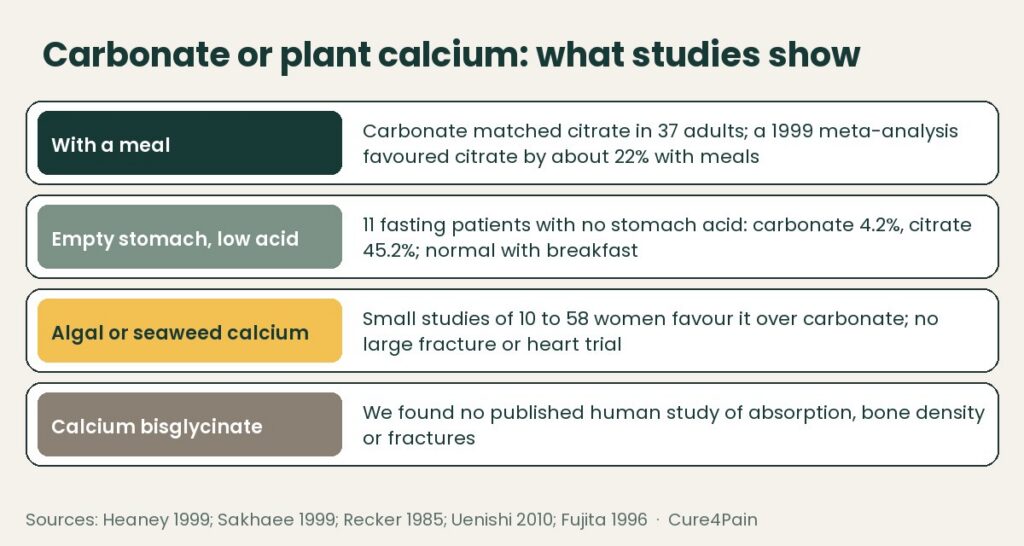
Research does not show that either calcium carbonate or plant calcium is clearly better. Calcium carbonate depends on stomach acid but is generally well absorbed with a meal, small studies favour some algal calcium products, and our search found no large trial comparing fractures or heart events between these forms.
- In carbonate’s favour: it is 40% calcium by weight, so tablets carry more calcium, according to the NIH [1], and a 2007 review calls it the most cost-effective form [8].
- Our clinic practice: at Cure4Pain we use plant-based calcium and calcium bisglycinate, never carbonate, because in our view carbonate is less well absorbed. This is clinic practice. Research does not clearly show this when carbonate is taken with food: it was absorbed as well as citrate in 37 healthy adults [2], while a 1999 meta-analysis favoured citrate by about 22% with meals [3]. We found no published human study of calcium bisglycinate.
What are the main forms of calcium in supplements?
The two most common forms of calcium in supplements are calcium carbonate and calcium citrate, according to the US National Institutes of Health (NIH) [1]. Algal or seaweed calcium, often labelled “plant-sourced”, and calcium bisglycinate, which is calcium bound to the amino acid glycine, are sold as alternatives.
| Form | What it is | What research shows |
|---|---|---|
| Calcium carbonate | 40% calcium by weight [1] | Absorbs best with food; low stomach acid can reduce absorption [1] |
| Calcium citrate | 21% calcium by weight [1] | Less dependent on stomach acid; can be taken without food [1] |
| Algal or seaweed calcium, often labelled “plant-sourced” | Minerals from red seaweed, about 32.6% calcium in one product [9]; another tested product is heated oyster shell with a seaweed ingredient [10] | Small studies only, described below |
| Calcium bisglycinate | Calcium bound to the amino acid glycine | We found no published human study |
Compare products by elemental calcium, the actual calcium in each tablet, not the tablet’s weight. The NIH says absorption is highest with 500 mg or less at one time: the body absorbs about 36% of a 300 mg dose and 28% of a 1,000 mg dose [1].
Does calcium carbonate need stomach acid?
Calcium carbonate is poorly absorbed on an empty stomach in people with no stomach acid, and taking it with a meal largely solves this. The NIH says low stomach acid could reduce absorption from carbonate “unless they are taken with a meal”, and that absorption of calcium supplements generally is greater with food [1].
- Without acid: in a 1985 study, 11 fasting patients with no stomach acid absorbed 4.2% from carbonate and 45.2% from citrate; absorption from carbonate became normal when taken with breakfast. In 9 fasting people with normal acid, the two did not differ significantly (22.5% from carbonate, 24.3% from citrate) [4].
- Studies finding no difference: with a light breakfast, calcium carbonate was “fully as absorbable” as citrate in 37 healthy adults in a 1999 study [2]; in a 2001 crossover trial of 24 postmenopausal women, the two gave identical blood calcium curves [11].
- The study that disagrees: a 1999 meta-analysis found citrate absorbed better than carbonate, by about 22% with meals (6 studies, 65 people) and 27% on an empty stomach (5 studies, 71 people) [3].
- Acid-lowering medicines: a 2007 review prefers citrate for people with very low stomach acid or on H2 blockers or proton pump inhibitors [8]. See our acidity page.
Does plant calcium absorb better than calcium carbonate?
Some small studies suggest that specific algal calcium products absorb better than calcium carbonate, but no large trial confirms it, and these results cannot be assumed to apply to other plant forms.
- Algal calcium, absorption: in 10 Japanese women aged 59 to 77, absorption was 23.1% from a heated oyster shell and seaweed product and 14.7% from carbonate [10].
- Algal calcium, bone density: in a 24-month randomised trial of 58 hospitalised women averaging 80 years, a heated oyster shell and seaweed product kept spine density above placebo, while carbonate did not [12]. A re-analysis of this small trial also reported fewer new spine fractures [13].
- Red seaweed calcium: a double-blind pilot in 12 fasting premenopausal women found parathyroid hormone stayed lower for longer after one dose than with placebo, with carbonate in between; it measured markers, not bone [14].
- Calcium bisglycinate: our PubMed search in October 2026 found no published human study of its absorption, bone density or fracture effects. Further studies are needed.
Which foods are high in calcium?
Dairy, sesame seeds, some leafy greens and ragi are among the richest sources in Indian food. Values below are per 100 g from the Indian Food Composition Tables 2017, and normal portions differ widely [15].
| Food | Calcium per 100 g | Absorption research |
|---|---|---|
| Sesame seeds (til) | 1,174 to 1,664 mg | Sesame paste under 10% in a lab digestion model [16] |
| Curry leaves (kadi patta) | 659 mg | Not found |
| Paneer | 476 mg | Not found for paneer |
| Ragi (nachni) | 364 mg | Among the top plant sources in a lab digestion model [16] |
| Green amaranth leaves (chaulai) | 330 mg | Not found in people |
| Drumstick leaves (moringa) | 314 mg | Rat studies only: lower than milk, because of oxalates [17] |
| Cow’s milk | 118 mg | About 30% for dairy, according to the NIH [1] |
| Spinach (palak) | 82 mg | 5.1%, against 27.6% from milk, in 13 adults [18] |
- Why plants differ: oxalic and phytic acid bind calcium, but the NIH says that in a varied diet this probably matters little [1]. The NHS names curly kale and okra as sources, “but not spinach” [19].
- Kale: absorption was 40.9%, against 32.1% from milk, in 11 women [20].
- Ragi in people: in a Pune study of 61 girls aged 15 to 18, the increase in blood ionised calcium over 9 hours (area under the curve) was 1.4% after a fermented ragi pancake, 3.1% after a rice-flake snack with carbonate and 9.1% after the ragi pancake fortified with prebiotic fibre; the abstract gives a significant result only for fortified against plain ragi [21]. In an Indian trial of 150 women aged 30 to 40 with low bone density, ragi laddu plus exercise raised bone density, but the design cannot separate the two [22].
How much calcium do you need a day?
Adults need about 1,000 mg of calcium a day according to both ICMR-NIN in India and the US NIH, rising to 1,200 mg for women over 50 and everyone over 70 in the NIH figures, while the UK NHS advises 700 mg [5] [1] [19]. ICMR-NIN’s 2020 note gives 1,000 mg as the recommended allowance for Indian adults and 800 mg as the average requirement [5]. The NIH figures are below [1]; the upper limit covers food and supplements together [23].
| Group (NIH) | Recommended per day | Upper limit per day |
|---|---|---|
| Adults 19 to 50, including pregnancy | 1,000 mg | 2,500 mg |
| Men 51 to 70 | 1,000 mg | 2,000 mg |
| Women 51 to 70 | 1,200 mg | 2,000 mg |
| Everyone over 70 | 1,200 mg | 2,000 mg |
Official figures differ between countries. The NHS advises 700 mg a day for adults and says that 1,500 mg or less a day from supplements is unlikely to cause harm [19]. An antacid tablet with calcium carbonate adds about 270 to 400 mg each, according to the NIH [1].
Do you need a calcium supplement at all?
A calcium supplement is often unnecessary if food provides enough calcium. The UK National Osteoporosis Guideline Group (NOGG, 2022) recommends at least 700 mg a day, preferably from diet and otherwise by supplement, for people with osteoporosis or at risk of fragility fracture [24].
- Studies supporting supplements: a 2019 meta-analysis in JAMA Network Open found that daily vitamin D with calcium lowered hip fractures by 16% in 6 trials with 49,282 people [25].
- Studies that disagree: a 2018 review for the US Preventive Services Task Force found no fewer fractures in adults without known deficiency, osteoporosis or prior fracture [26]. A 2015 BMJ review called the evidence that calcium supplements prevent fractures “weak and inconsistent” [27], and a 2023 Indian meta-analysis of 18 trials in people over 60 found no clear reduction in fractures [28].
- Bone density: calcium from food or supplements raised bone density by about 0.6 to 1.8% in a 2015 BMJ meta-analysis of 59 trials in people over 50, which the authors consider too small to reduce fractures meaningfully [29].
Do calcium supplements cause kidney stones?
Calcium supplements may raise the risk of kidney stones modestly, while calcium in food does not appear to. In the Women’s Health Initiative, 449 of 18,176 women on calcium carbonate with vitamin D reported a stone over 7 years, against 381 of 18,106 on placebo, a 17% increase [30].
- Reviews differ: a 2018 review for the US Preventive Services Task Force found more stones with vitamin D plus calcium, an absolute difference of 0.33%, but no increase with calcium alone [26]. A 2012 review of more than 8,000 people with osteoporosis found no significant increase [31].
- Food calcium: in an observational study of 91,731 US nurses, those with the highest dietary calcium had 35% fewer stones, while supplement users had 20% more [32].
- Do not cut food calcium on your own: in a 5-year trial of 120 men with recurrent stones and high urine calcium, a normal-calcium diet low in salt and animal protein halved relapses compared with a low-calcium diet [33]. The NHS also advises enough calcium in the diet [34].
- Form: the Women’s Health Initiative used calcium carbonate, so it cannot show whether another form would differ [30].
Do calcium supplements raise heart risk?
The evidence on calcium supplements and heart risk is divided: some meta-analyses found more heart attacks or cardiovascular disease, others found no link, and the US National Institutes of Health says more research is needed [1].
Studies raising concern:
- A 2010 BMJ meta-analysis linked calcium without vitamin D to about 27 to 31% more heart attacks [35].
- A 2021 meta-analysis of 13 double-blind trials found about 15% more cardiovascular disease in healthy postmenopausal women [36].
- In Women’s Health Initiative follow-up over 22 years, cardiovascular deaths were 6% higher and cancer deaths 7% lower with calcium and vitamin D, with no change in total deaths [37].
Studies finding no link:
- The US National Osteoporosis Foundation and American Society for Preventive Cardiology (2016) found moderate-quality evidence of no relationship in generally healthy adults, and consider intake within the upper limit safe for the heart [23].
- A 2015 meta-analysis of 18 trials with 63,563 older women found no rise in coronary events, reported by 5 of those trials [38], and a 2023 meta-analysis of 12 trials found no link with heart attack or stroke [39].
- The UK National Osteoporosis Guideline Group (NOGG, 2022) concludes that calcium and vitamin D supplements may increase kidney stones but not cardiovascular disease [24].
What this means for choosing a form: calcium in food does not appear to be a cardiac risk factor, according to a 2025 review [40]. Citrate and carbonate raised blood calcium alike in a trial that randomised 100 women across several supplement groups and placebo [41]. We found no heart-outcome trial of plant, algal or bisglycinate calcium, so it is not known whether these forms differ for the heart.
What are the side effects of calcium carbonate?
The main side effects of calcium carbonate are gas, bloating and constipation. The NIH says carbonate appears to cause more of these than citrate, especially in older adults with low stomach acid, and that switching form, taking smaller doses more often or taking it with meals can help [1]. Across all forms, a 2025 review reports these complaints 43% more often with calcium than placebo [40].
Which medicines interact with calcium?
The main medicines that interact with calcium are thyroid medicine (levothyroxine), quinolone antibiotics such as ciprofloxacin, the HIV medicine dolutegravir, lithium and bisphosphonates such as alendronate. Spacing below is official advice as reported by the NIH or NHS, not a clinic rule.
| Medicine | What happens | Advice |
|---|---|---|
| Levothyroxine | Carbonate, citrate and acetate each cut absorption by about 20 to 25% in 8 healthy adults [42] | Keep carbonate and levothyroxine 4 hours apart (US label, NIH) [1] |
| Ciprofloxacin and other quinolones | Carbonate antacid lowered ciprofloxacin to about 60% [43] | Take the antibiotic 2 hours before or after calcium (NIH) [1] |
| Dolutegravir | Blood levels fall substantially [1] | 2 hours before or 6 hours after calcium (US label, NIH) [1] |
| Lithium | Long-term use can raise blood calcium; supplements could add to this [1] | Discuss with your doctor |
| Alendronate | Food and drinks reduce absorption sharply [44] | Take on an empty stomach, before other medicines (NHS) [45] |
Never stop or change a medicine on your own because of a supplement.
Who should be careful with calcium supplements?
People with past kidney stones, kidney disease or high blood calcium, people taking large amounts of calcium including antacids, people with low stomach acid or on acid-lowering medicines, and people on supervised vitamin D therapy (Coimbra Protocol) should check with their doctor before taking calcium supplements.
- Past kidney stones: a 2025 review says calcium supplements are contraindicated in people with a history of stones [40]; the NHS still advises enough calcium from food [34].
- Kidney disease: a 2013 review says supplements worsen vascular calcification and increase mortality in dialysis and pre-dialysis patients [46].
- High blood calcium: this usually results from cancer, primary hyperparathyroidism or other conditions, according to the NIH, and can cause kidney problems and heart rhythm changes [1].
- Large amounts, including antacids: calcium-alkali syndrome means high blood calcium, metabolic alkalosis and kidney impairment. A 2013 review says most cases involve calcium carbonate supplements and older adults are more susceptible [46].
- Low stomach acid or acid-lowering medicines: calcium carbonate absorbs less well without a meal in people with low stomach acid, according to the NIH [1], and a 2007 review prefers citrate for people on H2 blockers or proton pump inhibitors [8].
- Vitamin D therapy: during supervised vitamin D therapy (Coimbra Protocol) for autoimmune conditions, our Coimbra Protocol page lists no dairy and no calcium supplements; ghee is allowed. Our osteoporosis plan, described below, uses Coimbra Protocol-based methods and does include calcium. Follow the plan set for you, and do not take high doses of vitamin D without medical supervision. Our methods are derived from the work of Dr Coimbra.
How we choose calcium at Cure4Pain
At Cure4Pain, calcium is one part of an osteoporosis and osteopenia plan built on your tests, used alongside guideline medicines where they are needed.
- Tests first: a yearly DEXA scan arranged by you, a FRAX fracture-risk score, and our panel of about 100 markers, adding tests for your condition when clinically indicated, such as calcium, PTH, phosphorus, alkaline phosphatase, thyroid tests, a coeliac screen and hormones, which the UK’s NOGG 2022 lists among investigations to consider [24].
- Calcium: plant-based calcium from foods such as moringa and ragi, and calcium bisglycinate supplements, never calcium carbonate. This is clinic practice, based on our view that carbonate is less well absorbed. Research does not clearly show this when carbonate is taken with food [2] [3], we found no published human study of calcium bisglycinate, and for moringa calcium we found rat studies only [17]. Beyond one small trial [13], research has not shown that another form lowers fractures, and we found no trial showing this for stones or heart events.
- Food: leafy cruciferous greens such as kale and broccoli are allowed in this plan; raw milk is removed and other milk products are allowed; we advise limiting salt, caffeine, alcohol and soft drinks.
- Other vegetables and wheat: as an observational clinic practice, we generally suggest limiting cruciferous (Brassica) vegetables such as cabbage and cauliflower; a 2024 review found that eating them, particularly with enough iodine, had no adverse effect on thyroid function [47]. Also, as clinic practice, we generally advise most patients to replace wheat with jowar, bajra or other millets as a general health measure, including home-made roti from processed wheat; a gluten-free diet is supported for coeliac disease and positive tests, and the NHS says people with coeliac disease must stop all gluten for life [48], and our PubMed search (October 2026) found no trial of removing wheat for bone health outside coeliac disease.
- Other nutrients: vitamin K2 as MK-7, magnesium, collagen, protein and omega-3, chosen for each person within official limits where one exists, with supplements by mouth first and injections only when specifically needed or advised. In this plan, magnesium is mainly bisglycinate, with L-threonate or citrate as advised, counted as elemental magnesium. Our article on vitamin D3 with K2 and magnesium sets out the trials.
- Vitamin D: supervised vitamin D therapy (Coimbra Protocol-based methods), taken daily, with blood tests every 3 months including ionized calcium. Doses can be above the standard upper limit and too much vitamin D can raise blood calcium, so they are used only under supervision. We found no trial of these methods for bone density or fractures; our osteoporosis page, linked below, sets out high-dose trials that raised falls and fractures or led to more bone loss.
- Medicines: Dr Krushal Pabari prescribes and manages osteoporosis medicines such as bisphosphonates, denosumab and teriparatide, under clinical guidance from Team Cure4Pain, in coordination with your existing consulting physician; never stop or change them on your own.
- Who we see: adults and young people aged 16 and over; we refer pregnant women to their obstetrician.
This is our clinic practice; individual results vary, and further studies are needed. Read more on our osteoporosis and osteopenia page.
If you would like your calcium and bone plan reviewed against your tests and medicines, you can book a consultation, online from anywhere or at our Mumbai clinic.
Frequently asked questions
Is calcium carbonate bad for you?
Not as a rule. It can cause gas, bloating and constipation, more often than citrate in older adults, and calcium supplements in general may modestly raise kidney stone risk. At Cure4Pain we avoid it because in our view it is less well absorbed; this is clinic practice, and research does not clearly show this when it is taken with food. [1] [2] [3] [30]
Is calcium carbonate the best form of calcium?
No single form is proven best. Carbonate has the most calcium by weight and matched citrate with a meal in 37 healthy adults, though a 1999 meta-analysis favoured citrate with meals; citrate is less dependent on stomach acid. [1] [2] [3]
Is calcium carbonate the same as calcium?
No. It is a compound that is 40% calcium by weight, so check the elemental calcium on the label. [1]
Is plant-based calcium better than calcium carbonate?
Small studies favour some algal products over carbonate, but we found no large trial on fractures or heart events. Absorption from plant foods varies widely, from 5.1% for spinach to 40.9% for kale in two small studies. [10] [12] [18] [20]
Is calcium bisglycinate better than calcium carbonate?
This is not known. Our PubMed search in October 2026 found no published human study of calcium bisglycinate; at Cure4Pain we prefer it as clinic practice, and further studies are needed.
Should calcium be taken with food?
Generally yes. The NIH says absorption from calcium supplements is greater with food, and that citrate can also be taken without food. [1]
Can I take calcium and thyroid medicine together?
No. The US levothyroxine label, reported by the NIH, says to keep it 4 hours from calcium carbonate, and a small study found citrate and acetate interfered similarly. [1] [42]
Are calcium supplements bad for the heart?
The evidence is divided. One meta-analysis linked calcium without vitamin D to more heart attacks and another found more cardiovascular disease in healthy postmenopausal women, while a 2016 US guideline found no relationship in generally healthy adults and other reviews found no link. [35] [36] [23] [38] [39]
This article is for education and does not replace medical advice. Do not start, stop or change any medicine or supplement without medical guidance.
References
1. National Institutes of Health, Office of Dietary Supplements. Calcium: Fact Sheet for Health Professionals. Updated 22 June 2026. ods.od.nih.gov
2. Heaney RP, et al. Absorption of calcium as the carbonate and citrate salts, with some observations on method. Osteoporos Int 1999;9(1):19-23. doi:10.1007/s001980050111
3. Sakhaee K, et al. Meta-analysis of calcium bioavailability: a comparison of calcium citrate with calcium carbonate. Am J Ther 1999;6(6):313-21. doi:10.1097/00045391-199911000-00005
4. Recker RR. Calcium absorption and achlorhydria. N Engl J Med 1985;313(2):70-3. doi:10.1056/NEJM198507113130202
5. ICMR-National Institute of Nutrition. A Brief Note on Nutrient Requirements for Indians, the Recommended Dietary Allowances (RDA) and the Estimated Average Requirements (EAR), 2020. nin.res.in
6. Balk EM, et al. Global dietary calcium intake among adults: a systematic review. Osteoporos Int 2017;28(12):3315-3324. doi:10.1007/s00198-017-4230-x
7. Harinarayan CV, et al. Modern India and Dietary Calcium Deficiency-Half a Century Nutrition Data-Retrospect-Introspect and the Road Ahead. Front Endocrinol (Lausanne) 2021;12:583654. doi:10.3389/fendo.2021.583654
8. Straub DA. Calcium supplementation in clinical practice: a review of forms, doses, and indications. Nutr Clin Pract 2007;22(3):286-96. doi:10.1177/0115426507022003286
9. Kozior M, et al. The Temporal Change in Ionised Calcium, Parathyroid Hormone and Bone Metabolism Following Ingestion of a Plant-Sourced Marine Mineral + Protein Isolate in Healthy Young Adults. Nutrients 2024;16(18). doi:10.3390/nu16183110
10. Uenishi K, et al. Fractional absorption of active absorbable algal calcium (AAACa) and calcium carbonate measured by a dual stable-isotope method. Nutrients 2010;2(7):752-61. doi:10.3390/nu2070752
11. Heaney RP, et al. Absorbability and cost effectiveness in calcium supplementation. J Am Coll Nutr 2001;20(3):239-46. doi:10.1080/07315724.2001.10719038
12. Fujita T, et al. Heated oyster shell-seaweed calcium (AAA Ca) on osteoporosis. Calcif Tissue Int 1996;58(4):226-30. doi:10.1007/BF02508640
13. Fujita T, et al. Reappraisal of Katsuragi calcium study, a prospective, double-blind, placebo-controlled study of the effect of active absorbable algal calcium (AAACa) on vertebral deformity and fracture. J Bone Miner Metab 2004;22(1):32-8. doi:10.1007/s00774-003-0445-3
14. Zenk JL, et al. Effect of Calcium Derived from Lithothamnion sp. on Markers of Calcium Metabolism in Premenopausal Women. J Med Food 2018;21(2):154-158. doi:10.1089/jmf.2017.0023
15. Longvah T, et al. Indian Food Composition Tables 2017. National Institute of Nutrition, Indian Council of Medical Research ([nin.res.in/ebooks/IFCT2017.pdf](https://www.nin.res.in/ebooks/IFCT2017.pdf)). The values in this article come from a digitised copy of IFCT 2017, not from the book itself (npm package ifct2017/compositions, github.com/nodef/ifct2017
16. Muleya M, et al. A comparison of the bioaccessible calcium supplies of various plant-based products relative to bovine milk. Food Res Int 2024;175:113795. doi:10.1016/j.foodres.2023.113795
17. Pankaja N, Prakash J. Availability of calcium from kilkeerai (Amaranthus tricolor) and drumstick (Moringa oleifera) greens in weanling rats. Nahrung 1994;38(2):199-203. doi:10.1002/food.19940380212
18. Heaney RP, et al. Calcium absorbability from spinach. Am J Clin Nutr 1988;47(4):707-9. doi:10.1093/ajcn/47.4.707
19. NHS (UK National Health Service). Calcium: vitamins and minerals. nhs.uk/conditions/vitamins-and-minerals/calcium
20. Heaney RP, Weaver CM. Calcium absorption from kale. Am J Clin Nutr 1990;51(4):656-7. doi:10.1093/ajcn/51.4.656
21. Sanwalka NJ, et al. Galacto-fructo-oligosaccharide fortification of fermented non-dairy snack enhances calcium absorption in healthy adolescent girls. Int J Food Sci Nutr 2012;63(3):343-52. doi:10.3109/09637486.2011.627848
22. Sahaya Rani G, et al. Effectiveness of Physical Activity and Finger Millet-Based Food Supplement on Biochemical Parameters and Bone Mineral Density among Premenopausal Women. Evid Based Complement Alternat Med 2021;2021:4757991. doi:10.1155/2021/4757991
23. Kopecky SL, et al. Lack of Evidence Linking Calcium With or Without Vitamin D Supplementation to Cardiovascular Disease in Generally Healthy Adults: A Clinical Guideline From the National Osteoporosis Foundation and the American Society for Preventive Cardiology. Ann Intern Med 2016;165(12):867-868. doi:10.7326/M16-1743
24. Gregson CL, et al. UK clinical guideline for the prevention and treatment of osteoporosis. Arch Osteoporos 2022;17(1):58. doi:10.1007/s11657-022-01061-5
25. Yao P, et al. Vitamin D and Calcium for the Prevention of Fracture: A Systematic Review and Meta-analysis. JAMA Netw Open 2019;2(12):e1917789. doi:10.1001/jamanetworkopen.2019.17789
26. Kahwati LC, et al. Vitamin D, Calcium, or Combined Supplementation for the Primary Prevention of Fractures in Community-Dwelling Adults: Evidence Report and Systematic Review for the US Preventive Services Task Force. JAMA 2018;319(15):1600-1612. doi:10.1001/jama.2017.21640
27. Bolland MJ, et al. Calcium intake and risk of fracture: systematic review. BMJ 2015;351:h4580. doi:10.1136/bmj.h4580
28. Khatri K, et al. Role of calcium &/or vitamin D supplementation in preventing osteoporotic fracture in the elderly: A systematic review & meta-analysis. Indian J Med Res 2023;158(1):5-16. doi:10.4103/ijmr.ijmr_1946_21
29. Tai V, et al. Calcium intake and bone mineral density: systematic review and meta-analysis. BMJ 2015;351:h4183. doi:10.1136/bmj.h4183
30. Wallace RB, et al. Urinary tract stone occurrence in the Women’s Health Initiative (WHI) randomized clinical trial of calcium and vitamin D supplements. Am J Clin Nutr 2011;94(1):270-7. doi:10.3945/ajcn.110.003350
31. Candelas G, et al. Calcium supplementation and kidney stone risk in osteoporosis: a systematic literature review. Clin Exp Rheumatol 2012;30(6):954-61. PubMed 23137489
32. Curhan GC, et al. Comparison of dietary calcium with supplemental calcium and other nutrients as factors affecting the risk for kidney stones in women. Ann Intern Med 1997;126(7):497-504. doi:10.7326/0003-4819-126-7-199704010-00001
33. Borghi L, et al. Comparison of two diets for the prevention of recurrent stones in idiopathic hypercalciuria. N Engl J Med 2002;346(2):77-84. doi:10.1056/NEJMoa010369
34. NHS (UK National Health Service). Kidney stones. nhs.uk/conditions/kidney-stones
35. Bolland MJ, et al. Effect of calcium supplements on risk of myocardial infarction and cardiovascular events: meta-analysis. BMJ 2010;341:c3691. doi:10.1136/bmj.c3691
36. Myung SK, et al. Calcium Supplements and Risk of Cardiovascular Disease: A Meta-Analysis of Clinical Trials. Nutrients 2021;13(2). doi:10.3390/nu13020368
37. Thomson CA, et al. Long-Term Effect of Randomization to Calcium and Vitamin D Supplementation on Health in Older Women : Postintervention Follow-up of a Randomized Clinical Trial. Ann Intern Med 2024;177(4):428-438. doi:10.7326/M23-2598
38. Lewis JR, et al. The effects of calcium supplementation on verified coronary heart disease hospitalization and death in postmenopausal women: a collaborative meta-analysis of randomized controlled trials. J Bone Miner Res 2015;30(1):165-75. doi:10.1002/jbmr.2311
39. Sim MG, et al. Association Between Calcium Supplementation and the Risk of Cardiovascular Disease and Stroke: A Systematic Review and Meta-Analysis. Heart Lung Circ 2023;32(10):1230-1239. doi:10.1016/j.hlc.2023.07.008
40. Reid IR. Calcium Supplementation- Efficacy and Safety. Curr Osteoporos Rep 2025;23(1):8. doi:10.1007/s11914-025-00904-7
41. Bristow SM, et al. Acute and 3-month effects of microcrystalline hydroxyapatite, calcium citrate and calcium carbonate on serum calcium and markers of bone turnover: a randomised controlled trial in postmenopausal women. Br J Nutr 2014;112(10):1611-20. doi:10.1017/S0007114514002785
42. Zamfirescu I, Carlson HE. Absorption of levothyroxine when coadministered with various calcium formulations. Thyroid 2011;21(5):483-6. doi:10.1089/thy.2010.0296
43. Frost RW, et al. Effects of aluminum hydroxide and calcium carbonate antacids on the bioavailability of ciprofloxacin. Antimicrob Agents Chemother 1992;36(4):830-2. doi:10.1128/AAC.36.4.830
44. Gertz BJ, et al. Studies of the oral bioavailability of alendronate. Clin Pharmacol Ther 1995;58(3):288-98. doi:10.1016/0009-9236(95)90245-7
45. NHS (UK National Health Service). How and when to take alendronic acid. nhs.uk/medicines/alendronic-acid
46. Patel AM, et al. Calcium-alkali syndrome in the modern era. Nutrients 2013;5(12):4880-93. doi:10.3390/nu5124880
47. Galanty A, et al. Do Brassica Vegetables Affect Thyroid Function?-A Comprehensive Systematic Review. Int J Mol Sci 2024;25(7). doi:10.3390/ijms25073988
48. NHS (UK National Health Service). Coeliac disease: treatment. nhs.uk/conditions/coeliac-disease/treatment

