Written by AT. Chintan Dalal, N.D. · Reviewed by Dr Krushal Pabari, Clinical Team, Cure4Pain · Updated 30 October 2026
Key facts
Fatty liver grades 1, 2 and 3 describe how much fat an ultrasound appears to show (mild, moderate, severe), according to the 2023 guidance of the Indian National Association for the Study of the Liver (INASL) [1]. The grade does not measure scarring (fibrosis), the main driver of long-term liver risk: in a prospective study, ultrasound, CT and MRI did not detect fibrosis [2] [3]. The American Association for the Study of Liver Diseases (AASLD, 2023) and the joint European guideline (EASL-EASD-EASO, 2024) assess scarring with a blood score (FIB-4), then imaging such as elastography [3] [4]. AASLD states that losing 3% to 5% of body weight improves liver fat, while more than 10% is generally required to improve steatohepatitis and fibrosis [3].

Scientific explainer videos in our Resources section
In our Resources section, our clinical team discusses vitamin D, its cofactors and how autoimmune, lifestyle and pain conditions develop.
What do fatty liver grades 1, 2 and 3 mean?
Fatty liver grades 1, 2 and 3 are a radiologist’s visual estimate of liver fat on an ultrasound, from mild to severe. INASL’s 2023 guidance describes them like this [1]:
| Grade | What the radiologist sees | In plain words |
|---|---|---|
| Grade 1 (mild) | The liver is more echogenic than the spleen and right kidney | The liver looks brighter than it should |
| Grade 2 (moderate) | Blurring of the blood vessels inside the liver | Fat blurs the view of the vessels |
| Grade 3 (severe) | Deep weakening of the sound signal; the diaphragm cannot be readily told apart from the back of the liver | The sound beam fades before it reaches the deeper liver |
A higher grade means more fat was seen. It does not show whether the liver is inflamed or scarred [2].
How accurate is an ultrasound grade?
Ultrasound is good at finding moderate to severe fat and less reliable for mild fat and for exact grading.
- Moderate to severe fat: in a 2011 meta-analysis (49 studies, 4,720 people), ultrasound had 84.8% sensitivity and 93.6% specificity compared with biopsy [5].
- Mild fat: AASLD says ultrasound lacks sensitivity for lesser degrees of fat, particularly with obesity, and gives only a subjective assessment of severity [3].
- Different readers: when three experienced radiologists graded the same images from 168 adults, pairs agreed on severity 47% to 59% of the time at first reading [6]. So a change from grade 2 to grade 1 between reports may partly reflect who read the scan.
Does the fatty liver grade show liver damage or scarring?
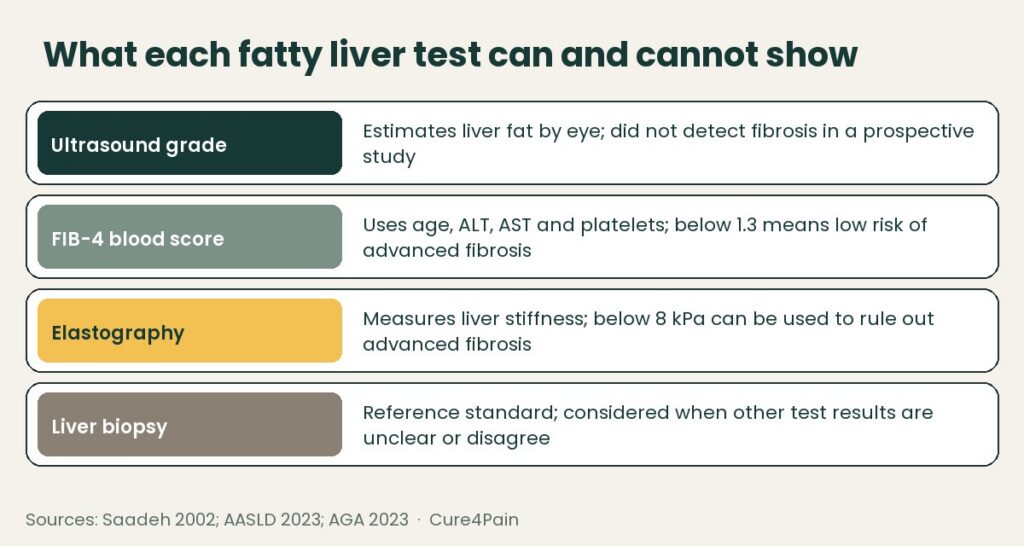
No. In a prospective study of people with biopsy-proven fatty liver, ultrasound, CT and MRI reflected only the amount of fat; none detected fibrosis or separated simple fat from steatohepatitis (fat with inflammation and liver cell injury) [2]. AASLD adds that a scan showing no fat does not exclude steatohepatitis or fibrosis [3].
- Why scarring matters: across 13 studies (4,428 people), liver-related death was 11 times more likely at fibrosis stage 4 than at stage 0 (relative risk 11.13), before adjustment [7].
- Fat still matters: AASLD notes more liver-related illness and death, and more cancers outside the liver, even in people with no fibrosis at first biopsy [3].
Which tests show liver scarring?
Liver scarring is checked with a blood score first, then a stiffness scan if needed, according to AASLD, EASL-EASD-EASO and INASL [3] [4] [1].
1. FIB-4: a score from age, ALT, AST and platelets. Below 1.3 means low risk; people with 2 or more metabolic risk factors, particularly prediabetes or type 2 diabetes, repeat it every 1 to 2 years [3].
2. Elastography (liver stiffness scan): according to AASLD, below 8 kPa can be used to rule out advanced fibrosis, and above 12 kPa makes it highly likely, although false positives are common [3].
3. Liver specialist: AASLD advises referral if risk stays intermediate or high after the second step [3].
4. Biopsy: considered when results are unclear or disagree, or another liver disease is suspected, according to the American Gastroenterological Association’s 2023 review [8].
Normal liver enzymes do not settle the question: AST can be normal in advanced fibrosis [3].
What is MASLD, and why does fat build up in the liver?
MASLD (metabolic dysfunction-associated steatotic liver disease) is the current name for what was called non-alcoholic fatty liver disease. It means liver fat plus at least 1 of 5 cardiometabolic risk factors, according to a 2023 international consensus [9]; INASL has adopted the name [10].
- Root cause: “Insulin resistance contributes to the development of NAFLD and promotes disease progression,” according to AASLD, which also links excess calories, particularly saturated fats, refined carbohydrates and sugar-sweetened drinks with fatty liver [3]. See our Metabolic Syndrome page.
- In India: a 2022 meta-analysis estimated fatty liver in about 38.6% of adults; 28.2% in community-based data [11].
Is grade 1, 2 or 3 fatty liver dangerous?
A fatty liver grade alone cannot show how risky it is, because, according to AASLD, risk depends mainly on scarring, which it does not measure [3] [2].
- Any grade: AASLD advises a risk assessment for anyone with fatty liver found on imaging, including people whose scan was done for another reason [3].
- NHS stages are different: the NHS lists four stages (fat, steatohepatitis, fibrosis, cirrhosis) and says most people only have the first, which does not usually cause problems [12]. An ultrasound grade does not tell you your stage.
- Symptoms: usually none. Some people feel very tired or unwell, or have discomfort under the right ribs [12].
- Higher risk: type 2 diabetes, obesity with metabolic complications, a family history of cirrhosis, or significant alcohol use [3].
What improves fatty liver?
Fatty liver improves with weight loss if you are overweight, a better diet and regular exercise. AASLD, EASL-EASD-EASO and INASL all put these first [3] [4] [1]. More weight loss went with more improvement:
| Weight lost | What was found |
|---|---|
| 3% to 5% | Improves liver fat, according to AASLD [3] |
| 5% or more | Steatohepatitis resolved on repeat biopsy in 58% (51 of 88), in a one-year study of 293 people in Cuba [13] |
| 7% to 10% | INASL’s target if overweight [1]; in a US trial of 31 people, those who lost 9.3% had better biopsy scores than a group who lost 0.2% [14] |
| 10% or more | In the Cuban study, 90% had resolution of steatohepatitis and 45% had regression of fibrosis [13] |
The Cuban study had no comparison group, and only 30% reached 5% weight loss [13]. In 22 randomised trials (2,588 people), weight-loss programmes lowered liver fat and ALT, with no significant change in fibrosis over a median of 6 months [15].
- Which diet: AASLD says low-carbohydrate, unsaturated-fat, Mediterranean and intermittent fasting patterns appear comparable [3]. INASL advises Indian patients to cut down on both carbohydrates and fats in their staple diet [1].
- Intermittent fasting: a 2023 meta-analysis (840 people) found better liver enzymes, liver fat and stiffness, on limited evidence [16]. A 12-month Chinese trial of 88 adults with obesity found eating within 8 hours added no benefit over calorie restriction alone [17].
- Exercise: INASL recommends 30 to 45 minutes of moderate aerobic or resistance exercise at least 5 days a week, whatever your weight [1]. In 10 trials (316 people), aerobic and combined training lowered liver fat without significant weight loss; resistance training alone improved cholesterol and triglycerides [18].
A 7-day Indian vegetarian diet chart for fatty liver
A fatty liver diet chart for Indian vegetarians can be built on millets, pulses, paneer and cooked vegetables, with little oil and no sugar or processed food, as in the week below. It follows our clinic rules and INASL’s advice to cut down on both carbohydrates and fats in the staple diet [1]. It is a sample, not a prescription, and it has not been tested in a trial; your own plan depends on your tests, weight, medicines and other conditions. It has no wheat roti, cabbage or cauliflower, and whole raw fruit appears only once in a while. Our usual plan is three meals a day, so take the evening snack only if it is advised for you.
- Monday: Breakfast: Moong dal cheela with grated bottle gourd (lauki). Lunch: Sorghum roti (jowar roti), pigeon pea dal (toor dal), okra (bhindi) sabzi, buttermilk (chaas). Evening snack: Roasted chickpeas (bhuna chana). Dinner: Pearl millet roti (bajra roti), paneer bhurji, ridge gourd (turai) sabzi.
- Tuesday: Breakfast: Foxtail millet (kangni) upma with carrot (gajar) and French beans. Lunch: Little millet (kutki) rice, red lentil dal (masoor dal), bitter gourd (karela) sabzi. Evening snack: Roasted fox nuts (makhana). Dinner: Finger millet roti (ragi roti), spinach (palak) sabzi, moong dal soup.
- Wednesday: Breakfast: Gram flour cheela (besan cheela) with fenugreek leaves (methi). Lunch: Pearl millet roti, black chickpea (kala chana) curry, pumpkin (kaddu) sabzi, curd (dahi). Evening snack: Guava (amrood). Dinner: Barnyard millet (sanwa) khichdi with moong dal and bottle gourd.
- Thursday: Breakfast: Steamed sprouted moong (ankurit moong) with tomato and lemon. Lunch: Sorghum roti, moong dal, fenugreek (methi) sabzi, buttermilk. Evening snack: Walnuts (akhrot). Dinner: Tofu and capsicum (shimla mirch) sabzi, finger millet roti, tomato soup.
- Friday: Breakfast: Finger millet dosa (ragi dosa) with tomato chutney. Lunch: Foxtail millet rice, kidney beans (rajma), apple gourd (tinda) sabzi. Evening snack: Roasted pumpkin seeds (kaddu ke beej). Dinner: Pearl millet roti, spinach with paneer (palak paneer), French beans sabzi.
- Saturday: Breakfast: Sorghum upma (jowar upma) with vegetables. Lunch: Little millet khichdi with moong dal, ridge gourd sabzi, curd. Evening snack: Papaya (papita). Dinner: Finger millet roti, mixed dal, drumstick (sahjan) sabzi.
- Sunday: Breakfast: Moong dal idli with sambar. Lunch: Sorghum roti, cowpea (lobia) curry, bottle gourd sabzi, buttermilk. Evening snack: Roasted chickpeas. Dinner: Barnyard millet pulao with vegetables, red lentil dal.
Notes for the week:
- If you eat eggs, fish or chicken: these can replace paneer or dal at a meal.
- If intermittent fasting is advised for you: the same meals are fitted into the eating window set with your doctor.
- If you take diabetes medicines: do not change meal timing or size without your doctor.
Can fatty liver go away, and how long does it take?
The amount of liver fat can go down, and trials have measured this within months. We found no trial that reports recovery time by ultrasound grade, so no one can give a reliable number of weeks for grade 1, 2 or 3.
- What was measured: liver fat on MRI fell by 8.3% and 8.1% at 6 months in the two arms of the Chinese trial [17]; biopsy improvement was measured at 48 and 52 weeks [14] [13].
- Keeping it down: AASLD reports that fewer than half of those who achieve effective weight loss keep it off at 5 years [3], so diet, exercise and monitoring need to continue.
Should you stop alcohol if you have fatty liver?
AASLD says alcohol intake should be assessed regularly, heavy drinking avoided, and alcohol stopped completely if you have significant scarring (stage 2 or higher) [3]. The European guideline advises discouraging alcohol [4].
Studies disagree on small amounts. In a 2023 meta-analysis, moderate drinking went with higher odds of advanced fibrosis in cohort studies (odds ratio 1.56) [19]. A 2026 meta-analysis found no significant link with fibrosis progression, yet its authors still support abstinence, particularly with established fibrosis [20]. These are observational studies, not a reason to start drinking.
Which medicines are used for fatty liver?
Medicines are for people with liver damage, not for an ultrasound grade alone: the NHS says you will not need treatment beyond lifestyle changes unless the condition has progressed [12]. These trials enrolled people with biopsy-proven steatohepatitis:
| Medicine | Guideline position | Trial finding |
|---|---|---|
| Vitamin E | INASL 2023: for adults and children without diabetes, with or without fibrosis stage 1 to 3 [1] | In 247 adults without diabetes: improved in 43% vs 19% on placebo; fibrosis scores did not improve significantly [21] |
| Pioglitazone | INASL 2023: for adults with or without diabetes, with or without fibrosis stage 1 to 3 [1] | 34% vs 19%, not significant for the main outcome; liver fat fell; more weight gain [21] |
| Resmetirom | EASL-EASD-EASO 2024: no cirrhosis, fibrosis stage 2 or higher, if locally approved [4] | Steatohepatitis resolved in 25.9% and 29.9% vs 9.7%; fibrosis improved in 24.2% and 25.9% vs 14.2% [22] |
| Semaglutide (GLP-1 medicine) | EASL-EASD-EASO 2024: incretin medicines for type 2 diabetes or obesity, if indicated [4] | Interim, 800 people with fibrosis stage 2 or 3: steatohepatitis resolved in 62.9% vs 34.3%; fibrosis improved in 36.8% vs 22.4%; more stomach side effects [23] |
- Also: INASL gives saroglitazar a weaker recommendation [1]. AASLD says risks of long-term high-dose vitamin E should be discussed first [3].
- Statins: AASLD says they are safe and recommended for heart risk across fatty liver, including compensated cirrhosis [3].
- Omega-3: in 20 trials (1,615 people), fat on ultrasound improved, but not fat on MRI, stiffness or biopsy; overall side effects were more likely [24].
- Berberine: in 10 trials (811 people), liver enzymes, blood fats and insulin resistance improved [25]. Goldenseal, a herb containing berberine, can change how the body handles many medicines and should not be used in pregnancy or breastfeeding, according to the US National Center for Complementary and Integrative Health [26].
When should you see a hepatologist? Red flags
See a liver specialist (hepatologist) if your FIB-4 or stiffness scan suggests scarring [3] [1] or if an ultrasound shows signs of cirrhosis [3]. AASLD advises liver cancer screening twice a year for people with cirrhosis [3].
According to the NHS, people with cirrhosis should get help as follows [27]:
- Emergency: vomiting blood, very dark or black stools, sudden confusion or slurred speech. Call 112 in India, 911 in the US or 999 in the UK.
- Urgent appointment: yellow skin or eyes, a swollen tummy, legs, ankles or feet, or more breathlessness than usual.
How we manage fatty liver at Cure4Pain
At Cure4Pain we manage fatty liver in-house with the same base plan as our Metabolic Syndrome and Type 2 Diabetes pages, under clinical guidance from Team Cure4Pain and in coordination with your existing consulting physician.
- Who we see: adults and young people aged 16 and over. We refer children to a paediatrician and pregnant women to their obstetrician.
- Tests first: we read a panel of about 100 markers, adding tests for your condition when clinically indicated. For fatty liver these include a FIB-4 score and a liver ultrasound or liver stiffness scan (elastography), as AASLD 2023 describes [3], with uric acid, waist, body composition, thyroid tests and cortisol.
- Diet: low carbohydrate, home cooked and no processed foods; fruit and raw foods limited, with whole raw fruit once in a while; and three meals a day. We consider intermittent fasting for suitable patients under supervision. Also, as clinic practice, we generally advise most patients to replace wheat with jowar, bajra or other millets as a general health measure, including home-made roti from processed wheat, and as an observational clinic practice, we generally suggest limiting cruciferous (Brassica) vegetables such as cabbage and cauliflower.
- Exercise: resistance training for lean muscle, 5,000 to 7,000 steps a day, walking after meals, yoga and Buteyko breathing. We measure your waist.
- Nutrients: vitamin D corrected with standard supplement doses in most cases, magnesium (mainly bisglycinate, with L-threonate or citrate as advised, counted as elemental magnesium; absorption varies by form), and omega-3 or berberine where needed, within official limits. Supplements are given by mouth first, with injections only when specifically needed or advised. Please do not start berberine on your own if you take other medicines.
- Medicines: Dr Krushal Pabari reviews statins, blood-pressure medicines and metformin and, depending on the case, may reduce them gradually after blood markers have improved for a sustained period; never stop or change them on your own. After a heart attack or stroke, statin decisions are made with your cardiologist. Further supplements or medicines are added where needed, and Dr Krushal Pabari prescribes cholesterol medicines beyond statins.
- GLP-1 medicines: we do not usually prescribe GLP-1 weight-loss medicines and consider them only where clearly needed, in coordination with your physician. If you already take one, we work alongside it.
- Alcohol: we advise limiting it. AASLD’s advice to avoid heavy drinking, and to stop completely with significant scarring, stands [3].
- Scarring: where tests suggest liver scarring, Dr Krushal Pabari involves a hepatologist.
- Follow-up: blood tests every 3 months, with monitoring continued for life. Many people notice changes in waist size, triglycerides and blood sugar markers within about 3 months; this is a clinic observation, and individual results vary. How long care lasts differs from person to person.
How research compares with these rules:
- Wheat: in a 2025 study of 243 people (randomisation not stated), a wheat flour-free diet lowered BMI, triglycerides and fat severity more than calorie restriction [28]. In a randomised trial of 60 people, a gluten-free diet lowered only fasting sugar and triglycerides more than the comparison [29]. We found no human trial of millets, or of Buteyko breathing, in fatty liver. Separately, a gluten-free diet is supported for coeliac disease and positive tests, and the NHS says people with coeliac disease must stop all gluten for life [30].
- Fruit and raw foods: limiting fruit is our clinic practice; we found no reliable trial on this. We found no trial of limiting raw foods.
- Cruciferous vegetables: a 2024 review found normal intake with enough iodine did not harm thyroid function [31]. We found no food-based trial in fatty liver; limiting them is our observational clinic practice.
- Intermittent fasting: see the research on it above. ADA 2026 advises medical monitoring during fasting for people with diabetes on insulin or secretagogue medicines, and says rigid meal plans can be contraindicated for people at increased risk of maladaptive eating behaviours [32]. We also do not advise fasting in pregnancy or breastfeeding.
An integrative plan may add options alongside standard care. This is our clinic practice; individual results vary, and further studies are needed.
If you would like your report reviewed with your blood tests, you can book a consultation, online from anywhere or at our Mumbai clinic.
Frequently asked questions
Is grade 1 fatty liver serious?
It usually causes no symptoms, but the grade does not show scarring, so AASLD advises a risk assessment such as FIB-4. [12] [3]
Is grade 2 fatty liver dangerous?
Grade 2 means more fat was seen. Risk depends mainly on scarring, checked with FIB-4 and, if needed, elastography. [1] [3]
Is grade 3 fatty liver dangerous?
Grade 3 means a large amount of fat appears on the scan, but it does not measure scarring, so it needs the same checks. Liver-related risk rises with fibrosis stage. [2] [7]
Can grade 1 fatty liver go back to normal?
The amount of liver fat can go down: AASLD says losing 3% to 5% of body weight improves it. Diet, exercise and monitoring need to continue. [3]
How long does it take for fatty liver to improve?
We found no trial reporting a time by ultrasound grade. Liver fat on MRI had fallen at 6 months in one trial, and biopsy improvement was measured at about one year in others. [17] [14]
What are the symptoms of fatty liver?
Usually none. The NHS says some people feel very tired or unwell, or have discomfort under the right ribs. [12]
Is there a tablet for fatty liver?
Medicines are studied in people with steatohepatitis and fibrosis, not for an ultrasound grade alone. Lifestyle change comes first, according to AASLD, EASL-EASD-EASO and INASL. [3] [4] [1]
Can thin people get fatty liver?
Yes. In 17 Indian studies, about 17% of people with fatty liver were lean. AASLD says weight loss may not be appropriate for them, but diet and exercise may help. [1] [3]
Is there a diet chart for fatty liver?
No chart has been tested in a trial. Our 7-day Indian vegetarian chart above is a sample, not a prescription, and INASL advises cutting down on both carbohydrates and fats in the staple diet. [1]
This article is for education and does not replace medical advice. Do not start, stop or change any medicine or supplement without medical guidance.
References
1. Duseja A, et al. Indian National Association for Study of the Liver (INASL) Guidance Paper on Nomenclature, Diagnosis and Treatment of Nonalcoholic Fatty Liver Disease (NAFLD). J Clin Exp Hepatol 2023;13(2):273-302. doi:10.1016/j.jceh.2022.11.014
2. Saadeh S, et al. The utility of radiological imaging in nonalcoholic fatty liver disease. Gastroenterology 2002;123(3):745-50. doi:10.1053/gast.2002.35354
3. Rinella ME, et al. AASLD Practice Guidance on the clinical assessment and management of nonalcoholic fatty liver disease. Hepatology 2023;77(5):1797-1835. doi:10.1097/HEP.0000000000000323
4. European Association for the Study of the Liver (EASL). EASL-EASD-EASO Clinical Practice Guidelines on the management of metabolic dysfunction-associated steatotic liver disease (MASLD). J Hepatol 2024;81(3):492-542. doi:10.1016/j.jhep.2024.04.031
5. Hernaez R, et al. Diagnostic accuracy and reliability of ultrasonography for the detection of fatty liver: a meta-analysis. Hepatology 2011;54(3):1082-1090. doi:10.1002/hep.24452
6. Strauss S, et al. Interobserver and intraobserver variability in the sonographic assessment of fatty liver. AJR Am J Roentgenol 2007;189(6):W320-3. doi:10.2214/AJR.07.2123
7. Taylor RS, et al. Association Between Fibrosis Stage and Outcomes of Patients With Nonalcoholic Fatty Liver Disease: A Systematic Review and Meta-Analysis. Gastroenterology 2020;158(6):1611-1625.e12. doi:10.1053/j.gastro.2020.01.043
8. Wattacheril JJ, et al. AGA Clinical Practice Update on the Role of Noninvasive Biomarkers in the Evaluation and Management of Nonalcoholic Fatty Liver Disease: Expert Review. Gastroenterology 2023;165(4):1080-1088. doi:10.1053/j.gastro.2023.06.013
9. Rinella ME, et al. A multisociety Delphi consensus statement on new fatty liver disease nomenclature. Hepatology 2023;78(6):1966-1986. doi:10.1097/HEP.0000000000000520
10. Duseja A, et al. Adoption of the New Nomenclature of Metabolic Dysfunction-Associated Steatotic Liver Disease (MASLD) by the Indian National Association for Study of the Liver (INASL): Implications for the INASL Guidance Paper on NAFLD. J Clin Exp Hepatol 2025;15(5):102590. doi:10.1016/j.jceh.2025.102590
11. Shalimar, et al. Prevalence of Non-alcoholic Fatty Liver Disease in India: A Systematic Review and Meta-analysis. J Clin Exp Hepatol 2022;12(3):818-829. doi:10.1016/j.jceh.2021.11.010
12. NHS (UK National Health Service). Non-alcoholic fatty liver disease (NAFLD). nhs.uk/conditions/non-alcoholic-fatty-liver-disease
13. Vilar-Gomez E, et al. Weight Loss Through Lifestyle Modification Significantly Reduces Features of Nonalcoholic Steatohepatitis. Gastroenterology 2015;149(2):367-78.e5; quiz e14-5. doi:10.1053/j.gastro.2015.04.005
14. Promrat K, et al. Randomized controlled trial testing the effects of weight loss on nonalcoholic steatohepatitis. Hepatology 2010;51(1):121-9. doi:10.1002/hep.23276
15. Koutoukidis DA, et al. Association of Weight Loss Interventions With Changes in Biomarkers of Nonalcoholic Fatty Liver Disease: A Systematic Review and Meta-analysis. JAMA Intern Med 2019;179(9):1262-1271. doi:10.1001/jamainternmed.2019.2248
16. Lange M, et al. Intermittent fasting improves hepatic end points in nonalcoholic fatty liver disease: A systematic review and meta-analysis. Hepatol Commun 2023;7(8). doi:10.1097/HC9.0000000000000212
17. Wei X, et al. Effects of Time-Restricted Eating on Nonalcoholic Fatty Liver Disease: The TREATY-FLD Randomized Clinical Trial. JAMA Netw Open 2023;6(3):e233513. doi:10.1001/jamanetworkopen.2023.3513
18. Babu AF, et al. Positive Effects of Exercise Intervention without Weight Loss and Dietary Changes in NAFLD-Related Clinical Parameters: A Systematic Review and Meta-Analysis. Nutrients 2021;13(9). doi:10.3390/nu13093135
19. Magherman L, et al. Meta-analysis: The impact of light-to-moderate alcohol consumption on progressive non-alcoholic fatty liver disease. Aliment Pharmacol Ther 2023;57(8):820-836. doi:10.1111/apt.17388
20. de Souza NS, et al. Moderate alcohol consumption and clinical outcomes in MASLD: a systematic review and meta-analysis of longitudinal cohorts. BMC Gastroenterol 2026;26(1). doi:10.1186/s12876-026-04814-5
21. Sanyal AJ, et al. Pioglitazone, vitamin E, or placebo for nonalcoholic steatohepatitis. N Engl J Med 2010;362(18):1675-85. doi:10.1056/NEJMoa0907929
22. Harrison SA, et al. A Phase 3, Randomized, Controlled Trial of Resmetirom in NASH with Liver Fibrosis. N Engl J Med 2024;390(6):497-509. doi:10.1056/NEJMoa2309000
23. Sanyal AJ, et al. Phase 3 Trial of Semaglutide in Metabolic Dysfunction-Associated Steatohepatitis. N Engl J Med 2025;392(21):2089-2099. doi:10.1056/NEJMoa2413258
24. Kim SJ, et al. Omega-3 polyunsaturated fatty acids and nonalcoholic fatty liver disease in adults: A meta-analysis of randomized controlled trials. Clin Nutr 2025;50:164-174. doi:10.1016/j.clnu.2025.05.013
25. Nie Q, et al. The clinical efficacy and safety of berberine in the treatment of non-alcoholic fatty liver disease: a meta-analysis and systematic review. J Transl Med 2024;22(1):225. doi:10.1186/s12967-024-05011-2
26. National Center for Complementary and Integrative Health (NCCIH), US National Institutes of Health. Goldenseal: Usefulness and Safety. nccih.nih.gov/health/goldenseal
27. NHS (UK National Health Service). Cirrhosis. nhs.uk/conditions/cirrhosis
28. Ciftel E, et al. Assessing the impact of a wheat flour and baker’s yeast restricted diet vs. calorie restriction in non-alcoholic fatty liver disease patients. Arch Med Sci 2025;21(3):719-728. doi:10.5114/aoms/193393
29. Jazayeri M, et al. Effects of gluten-free diet on metabolic syndrome components and anthropometric indices in patients with nonalcoholic fatty liver disease: An open-label randomized clinical trial. Arab J Gastroenterol 2026;27(1):84-90. doi:10.1016/j.ajg.2025.10.001
30. NHS (UK National Health Service). Coeliac disease: treatment. nhs.uk/conditions/coeliac-disease/treatment
31. Galanty A, et al. Do Brassica Vegetables Affect Thyroid Function?-A Comprehensive Systematic Review. Int J Mol Sci 2024;25(7). doi:10.3390/ijms25073988
32. American Diabetes Association Professional Practice Committee for Diabetes. 5. Facilitating Positive Health Behaviors and Well-being to Improve Health Outcomes: Standards of Care in Diabetes-2026. Diabetes Care 2026;49(Supplement_1):S89-S131. doi:10.2337/dc26-S005