
Written by AT. Chintan Dalal, N.D. · Reviewed by Dr Krushal Pabari, Clinical Team, Cure4Pain · Updated 30 October 2026
Key facts
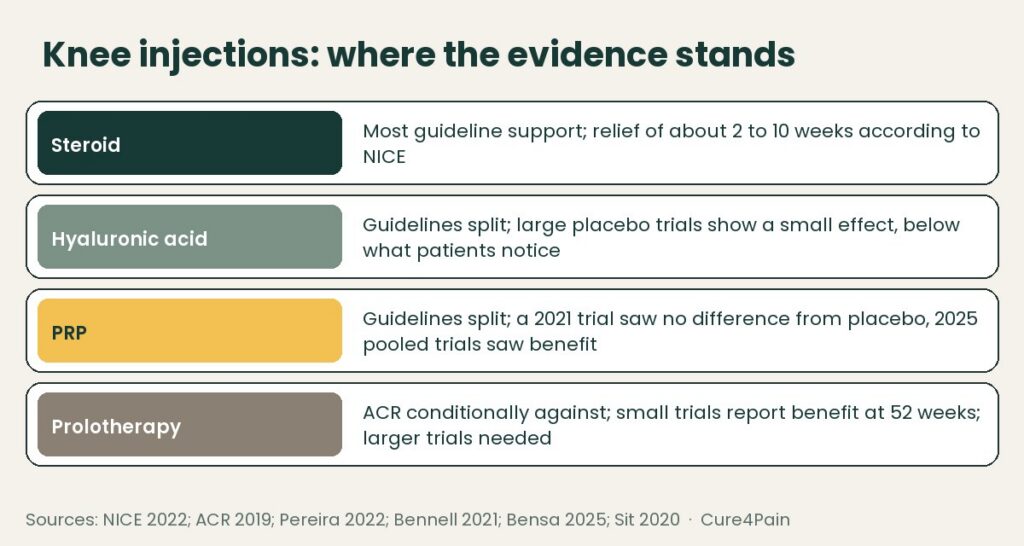
Guidelines agree most on steroid knee injections and differ on hyaluronic acid and PRP. The American College of Rheumatology (ACR) 2019 strongly recommends steroid injections for knee osteoarthritis [1], and the UK’s NICE 2022 advises considering them, for relief lasting 2 to 10 weeks [2]. NICE says not to offer hyaluronic acid [2] and the American Academy of Orthopaedic Surgeons (AAOS) 2021 does not recommend it for routine use [3], while OARSI 2019 lists it as an option for the knee [4]. For platelet-rich plasma (PRP), ACR strongly recommends against it [1] and AAOS says it may reduce pain, on limited evidence [3]; a 2021 trial of 288 people found no difference from placebo at 12 months [5], while a 2025 analysis of 18 trials found a benefit [6]. ACR conditionally recommends against prolotherapy [1], although small trials report benefit [7]. Cure4Pain does not give knee injections; we refer patients who need them.

Scientific explainer videos in our Resources section
In our Resources section, our clinical team discusses vitamin D, its cofactors and how autoimmune, lifestyle and pain conditions develop.
Do knee injections work for osteoarthritis?
Some knee injections work, for a limited time, and the size of the benefit is still debated. An overview of 29 systematic reviews, prepared for the European (EULAR) recommendations, concluded that most injections used in knee osteoarthritis have small effects and are well tolerated, and that many of the underlying trials carried a high risk of bias [8]. This article summarises the evidence so that you can discuss the options with your doctor. It covers osteoarthritis only; rheumatoid arthritis is a different condition.
- Trials at lower risk of bias show smaller effects. A 2025 analysis of 57 large trials (22,795 people with knee or hip osteoarthritis) found larger effects in trials at high risk of bias. In the lower-risk trials, the effects of 16 injected treatments were smaller than the minimal clinically important difference (the smallest change patients notice), and most were consistent with placebo effects [9].
- Placebo injections help many people. Across 50 trial reports (4,076 people), salt-water injections improved pain and function up to 6 months, and 52% of people responded [10]. So feeling better after an injection does not show what caused the improvement; only placebo-controlled trials can show that.
- Osteoarthritis involves the whole joint. According to a review in JAMA, it changes the cartilage, bone, joint lining, ligaments, muscle and fat around the joint, with risk linked to age, sex, weight, genes and past injury [11]. Trials have not clearly shown that injections protect or rebuild the joint: a Cochrane review found no effect of steroid injections on joint space narrowing [12], and a large PRP trial found no difference in cartilage volume [5]. Guidelines place education, exercise and weight management at the core of care [4] [13], and use injections alongside them.
What do guidelines say about knee injections?
Knee osteoarthritis guidelines agree that education, exercise and weight management come first, and most support steroid injections as an add-on; they disagree about hyaluronic acid and PRP. A 2023 review of 25 guidelines found that the seven of higher quality consistently favoured steroid injections for the knee and consistently advised against stem cell injections, while their advice on hyaluronic acid for the knee was inconsistent [13].
- ACR/Arthritis Foundation 2019 (US): strongly recommends steroid injections for knee osteoarthritis. It conditionally recommends against hyaluronic acid in the knee, but accepts its use through shared decision-making when other options have failed. It conditionally recommends against prolotherapy, and strongly recommends against PRP and stem cell injections, partly because preparations are not standardised [1].
- NICE NG226, 2022 (UK): do not offer hyaluronic acid injections. Consider steroid injections when other medicines are ineffective or unsuitable, or to support therapeutic exercise, and explain that relief lasts 2 to 10 weeks. The recommendations do not mention PRP or prolotherapy [2].
- OARSI 2019 (international): core care is education and structured exercise, with or without weight management. Steroid and hyaluronic acid injections are Level 1B or Level 2 options for the knee, depending on a person’s other health conditions [4].
- AAOS 2021 (US): steroid injections could provide short-term relief, hyaluronic acid is not recommended for routine use, and PRP may reduce pain and improve function (a limited-strength statement) [3]. Its work group called for better research on all three [14].
- Singapore ACE 2026: consider steroid injections for short-term relief alongside mainstay care if symptoms persist despite anti-inflammatory medicines or allied health support (a conditional recommendation) [15].
- India: we did not find a national guideline from an Indian government body or specialty society. A 2019 consensus of 78 Indian orthopaedic surgeons supports hyaluronic acid, especially in mild to moderate disease, and notes the absence of standard Indian guidance; it was funded by a pharmaceutical company [16].
Which knee injection is best?
No injection has been shown to be best for everyone. Some analyses that rank injections place PRP at or near the top [17] [18], while an analysis of large trials at lower risk of bias gives a steroid the clearest short-term effect, based on one trial [9]. The answer depends on which studies are given most weight.
| Injection | Guideline position | What studies show, and for how long |
|---|---|---|
| Steroid (cortisone, glucocorticoid) | ACR strongly for [1]; NICE: consider [2]; AAOS: short-term relief [3] | About 1 point better on a 10-point pain scale; no evidence of effect at 26 weeks [12] |
| Hyaluronic acid (gel injection, viscosupplementation) | NICE: do not offer [2]; ACR conditionally against [1]; AAOS: not routine [3]; OARSI: an option [4] | A small pain reduction against placebo, below the level patients notice [19] |
| PRP (from your own blood) | ACR strongly against [1]; AAOS: may help, limited evidence [3] | Studies disagree: no difference from placebo at 12 months in one large trial [5]; benefit to 6 to 12 months in pooled trials [6] |
| Prolotherapy (usually dextrose) | ACR conditionally against [1] | Benefit to 52 weeks in small trials [7] [20]; most studies at high risk of bias [21] |
| Stem cell | ACR strongly against [1]; higher-quality guidelines consistently against [13] | May slightly improve pain and function up to 6 months; low-certainty evidence [22] |
Studies of different injections also differ in their populations and preparations, so direct comparisons between rows are limited.
How long does a steroid (cortisone) knee injection last?
Steroid knee injection relief usually lasts weeks. NICE advises telling patients to expect 2 to 10 weeks of relief [2], and the NHS says steroid injections work quickly and can ease pain for several weeks or months [23].
- Size of effect: a Cochrane review of 27 trials (1,767 people) found about 1 point less pain on a 10-point scale, with effects fading over time and no evidence of an effect at 26 weeks. The authors rated the evidence as low quality [12].
- Recent analyses: in 11 placebo-controlled trials (842 people), the benefit was noticeable to patients only up to 6 weeks [24]. In large lower-risk trials, triamcinolone, a steroid, had the highest probability of a noticeable effect at 2 and 6 weeks, based on one trial [9].
- Compared with physical therapy: in a US military primary care trial of 156 people, those assigned to physical therapy had less pain and disability at 1 year than those assigned to steroid injections [25]. This trial did not test our clinic’s methods, and guidelines still include injections as an add-on [2] [13].
Are repeated steroid injections bad for the knee?
They may be: a 2-year trial found more cartilage loss with injections every 3 months, while observational studies disagree on whether injections speed up osteoarthritis.
- Repeated injections: in a 2-year trial of 140 people with knee osteoarthritis and signs of joint lining inflammation, injections every 3 months caused more cartilage loss than salt water (0.21 mm against 0.10 mm), with no difference in pain [26]. A 2022 analysis found no benefit of repeated steroid injections over placebo at 12 to 24 months [27].
- Studies disagree on progression: in one US cohort, people starting steroid injections had about three times the rate of X-ray worsening compared with matched non-users [28]. A later analysis of two US cohorts (791 people) compared steroid with hyaluronic acid injections and found similar progression [29]. Cohort studies cannot prove cause, because people with worse knees may be more likely to have injections.
Do hyaluronic acid (gel) knee injections work?
Studies of hyaluronic acid knee injections disagree, but large trials at lower risk of bias show little or no effect on pain. Hyaluronic acid is a natural component of joint fluid; the injections are also called viscosupplementation or gel injections.
- Against placebo: a 2022 BMJ analysis of 169 trials (21,163 people) focused on 24 large placebo-controlled trials. Pain was 2 mm lower on a 100 mm scale, which was below the level patients notice, and serious adverse events were more common (relative risk 1.49) [19]. A 2025 analysis of large trials found no effect on pain [9].
- The other view: a 2025 umbrella review concluded that hyaluronic acid gives moderate relief, especially in early to moderate osteoarthritis, while noting mixed study results and guidelines that vary [30]. A 2019 Indian expert consensus also supports its use in selected patients [16].
Does PRP work for knee osteoarthritis?
Knee PRP evidence conflicts: ACR strongly recommends against it [1], while AAOS says it may reduce pain, on limited evidence [3]. PRP is made by concentrating platelets from your own blood, and preparations vary widely [1].
- A large placebo-controlled trial: the 2021 RESTORE trial in Australia gave 288 people aged 50 or over with mild to moderate knee osteoarthritis three PRP or salt-water injections. At 12 months, pain improved by 2.1 points with PRP and 1.8 with placebo, a difference that was not statistically significant, and cartilage volume did not differ [5].
- Pooled trials: a 2025 analysis of 18 placebo-controlled trials (1,995 people) found noticeable pain relief at 3 and 6 months and better function up to 12 months, with larger effects from higher platelet concentrations [6].
- Comparisons with other injections: a 2025 analysis of 111 studies (14,695 people) found consistently larger estimates for PRP than for prolotherapy, steroid and hyaluronic acid, but statistical significance was lost in some checks, and there was generally no significant difference between the nine therapies compared [17]. An analysis of 37 trials (5,089 people) ranked PRP plus hyaluronic acid ahead of PRP alone, for mid- to long-term pain and function [18]. A 2026 analysis of 24 trials found that differences between PRP or cell treatments and hyaluronic acid did not reach the level patients notice [31].
Does prolotherapy work for the knee?
Small trials report benefit from knee prolotherapy, but larger trials are needed. Prolotherapy means injecting a solution, usually dextrose (a sugar), into or around the joint.
- Trials: in Hong Kong, 76 people given dextrose or salt-water injections were followed for 52 weeks; WOMAC pain scores improved by about 10 points more with dextrose [7]. A US trial of 90 adults found greater improvement with dextrose than with salt water or home exercise at 52 weeks [20].
- Reviews: a 2021 review of 11 studies (837 people) found potential pain benefits, but most studies were at high risk of bias [21]. A 2022 analysis of 6 studies (395 people) found effects similar to hyaluronic acid in the short term and asked for better trials [32].
What about stem cell injections?
Stem cell knee injections remain unsettled. A 2025 Cochrane review of 25 trials (1,341 people) found they may slightly improve pain and function up to 6 months compared with placebo, on low-certainty evidence. X-ray progression was not measured, and harms remain uncertain [22].
What are the risks of knee injections?
Serious problems are uncommon, but no injection is free of risk. All joint procedures carry a small risk of joint infection (septic arthritis) [22].
- Infection: in a Danish register, 11 people developed a joint infection after about 14,000 steroid injections into joints (0.08%), with higher risk in older people and those with existing joint disease [33].
- Steroid: reported adverse events include a rise in blood sugar, which matters if you have diabetes, adrenal suppression, effects on cartilage and lower bone density, according to a 2026 US multi-society guideline [34].
- Hyaluronic acid: a higher rate of serious adverse events than placebo in large trials [19] [9].
- PRP: in 24 trials, complications were more common than with comparators (18.7% against 9.1%), similar to hyaluronic acid and steroid but higher than placebo; nearly all were mild or moderate [35]. A larger review of 559 clinical studies, a lower level of evidence, found the lowest adverse event rate with PRP [36], so these findings differ.
- Before knee replacement: an analysis of 12 studies linked injections in the 3 months before surgery with a higher risk of joint replacement infection, with no difference at longer intervals; the authors suggest waiting at least 3 months [37]. Tell your surgeon about any recent injection.
Go to a hospital straight away if your knee becomes hot, red and swollen with fever, or if you cannot put weight on the leg.
What should you ask your doctor before a knee injection?
These questions support shared decision-making, which ACR 2019 advises [1]. The EULAR 2021 recommendations also cover patient information, sterile technique and repeated injections [38].
- What is causing my knee pain, and is it osteoarthritis?
- Which injection do you suggest, and what do the guidelines say about it?
- How much benefit should I expect, compared with a placebo injection, and for how long?
- How many injections are planned, and how many are safe over time?
- What are the risks for me, given my diabetes, blood thinners or other conditions?
- Exactly what will be injected, and how is it prepared?
- Might I need knee replacement soon, and would this injection affect the timing?
- What exercise and weight plan should go with the injection?
- What is the total cost, including repeat injections?
How we approach knee injections at Cure4Pain
We do not give knee injections at Cure4Pain; when one is needed, we refer you, and your care with us continues.
- Assessment first: your history, an examination of the knee, hip, back and feet, and a review of your X-rays, MRI and blood tests.
- Referral: if, after a detailed investigation and consultation, Dr Krushal Pabari and AT. Chintan Dalal find that an injection or surgery is the right next step, we refer you to the right specialist, such as a knee surgeon.
- Primary care continues: we continue your mobility and strengthening work and your nutritional supplementation plan, and we send systematic feedback on your progress to the knee surgeon.
- Our plan: exercise rehabilitation, myofascial dry needling and release, acupuncture and electroacupuncture, naturopathy and functional nutrition. Guideline bodies weigh acupuncture and dry needling differently: ACR conditionally recommends acupuncture [1], and NICE says do not offer either [2]. We know of no trial comparing this combined plan with injections, and we do not claim that it works better.
- Medicines: painkillers and other medicines for your knees are adjusted under clinical guidance from Team Cure4Pain, in coordination with your existing consulting physician and orthopaedic surgeon; never stop or change them on your own.
This is our clinic practice; individual results vary, and further studies are needed. Read more on our knee pain and knee arthritis and osteoarthritis pages.
If you would like your X-rays and tests reviewed as you weigh these options, you can book a consultation, online from anywhere or at our Mumbai clinic.
Frequently asked questions
Do knee injections work?
Some give short-term relief. Most injections used in knee osteoarthritis have small effects, and large lower-risk trials found most effects consistent with placebo; steroid injections had the clearest effect, at 2 and 6 weeks, in one trial. [8] [9]
Which is better, PRP or hyaluronic acid?
Studies disagree. Some analyses rank PRP above hyaluronic acid, but a 2026 analysis of 24 trials found that the difference did not reach the level patients notice. [18] [31]
How long do knee injections last?
Steroid relief lasts about 2 to 10 weeks according to NICE. Studies report PRP benefit up to 6 to 12 months in some pooled trials but no difference from placebo at 12 months in a large trial. [2] [6] [5]
Are cortisone injections bad for your knee?
They can be used under guidelines for short-term relief. In a 2-year trial, injections every 3 months caused more cartilage loss than salt water, while observational studies disagree on whether injections speed up progression. [26] [28] [29]
What are the side effects of a knee injection?
In PRP trials, nearly all complications were mild or moderate, and joint infection is uncommon. Steroid injections can raise blood sugar, and hyaluronic acid had more serious adverse events than placebo in large trials. [35] [22] [34] [19]
Can knee injections regrow cartilage?
This has not been shown. A large PRP trial found no difference in cartilage volume from placebo, and a 2026 analysis called imaging findings on cartilage inconsistent. [5] [31]
Do knee injections help bone on bone arthritis?
Evidence is limited, because major trials such as those of PRP and repeated steroid injections enrolled people with mild to moderate changes (grade 2 or 3). A JAMA review notes that people with advanced symptoms and structural damage are candidates for joint replacement. [5] [26] [11]
Can I have a knee injection before knee replacement surgery?
Discuss the timing with your surgeon. An analysis of 12 studies linked injections in the 3 months before surgery with a higher risk of joint replacement infection. [37]
Are knee injections worth the cost?
It depends on your situation and local prices. A 2025 review found hyaluronic acid cost-effective compared with placebo, usual care and paracetamol but not compared with steroid injections or anti-inflammatory medicines; 95% of the studies came from high-income countries. [39]
Does Cure4Pain give knee injections?
No. If an injection or surgery is the right next step after assessment, we refer you to the right specialist and continue your mobility work, nutrition plan and progress feedback.
This article is for education and does not replace medical advice. Do not start, stop or change any medicine or supplement without medical guidance.
References
1. Kolasinski SL, et al. 2019 American College of Rheumatology/Arthritis Foundation Guideline for the Management of Osteoarthritis of the Hand, Hip, and Knee. Arthritis Rheumatol 2020;72(2):220-233. doi:10.1002/art.41142
2. National Institute for Health and Care Excellence (NICE). Osteoarthritis in over 16s: diagnosis and management (NG226), 2022. nice.org.uk/guidance/ng226
3. American Academy of Orthopaedic Surgeons. Management of Osteoarthritis of the Knee (Non-Arthroplasty): Evidence-Based Clinical Practice Guideline, 2021. aaos.org/oak3cpg
4. Bannuru RR, et al. OARSI guidelines for the non-surgical management of knee, hip, and polyarticular osteoarthritis. Osteoarthritis Cartilage 2019;27(11):1578-1589. doi:10.1016/j.joca.2019.06.011
5. Bennell KL, et al. Effect of Intra-articular Platelet-Rich Plasma vs Placebo Injection on Pain and Medial Tibial Cartilage Volume in Patients With Knee Osteoarthritis: The RESTORE Randomized Clinical Trial. JAMA 2021;326(20):2021-2030. doi:10.1001/jama.2021.19415
6. Bensa A, et al. PRP Injections for the Treatment of Knee Osteoarthritis: The Improvement Is Clinically Significant and Influenced by Platelet Concentration: A Meta-analysis of Randomized Controlled Trials. Am J Sports Med 2025;53(3):745-754. doi:10.1177/03635465241246524
7. Sit RWS, et al. Efficacy of Intra-Articular Hypertonic Dextrose (Prolotherapy) for Knee Osteoarthritis: A Randomized Controlled Trial. Ann Fam Med 2020;18(3):235-242. doi:10.1370/afm.2520
8. Rodriguez-García SC, et al. Efficacy and safety of intra-articular therapies in rheumatic and musculoskeletal diseases: an overview of systematic reviews. RMD Open 2021;7(2). doi:10.1136/rmdopen-2021-001658
9. Pereira TV, et al. Effectiveness and safety of intra-articular interventions for knee and hip osteoarthritis based on large randomized trials: A systematic review and network meta-analysis. Osteoarthritis Cartilage 2025;33(2):207-217. doi:10.1016/j.joca.2024.08.014
10. Previtali D, et al. The Long-Lasting Effects of “Placebo Injections” in Knee Osteoarthritis: A Meta-Analysis. Cartilage 2021;13(1_suppl):185S-196S. doi:10.1177/1947603520906597
11. Katz JN, et al. Diagnosis and Treatment of Hip and Knee Osteoarthritis: A Review. JAMA 2021;325(6):568-578. doi:10.1001/jama.2020.22171
12. Jüni P, et al. Intra-articular corticosteroid for knee osteoarthritis. Cochrane Database Syst Rev 2015;2015(10):CD005328. doi:10.1002/14651858.CD005328.pub3
13. Gibbs AJ, et al. Recommendations for the management of hip and knee osteoarthritis: A systematic review of clinical practice guidelines. Osteoarthritis Cartilage 2023;31(10):1280-1292. doi:10.1016/j.joca.2023.05.015
14. Brophy RH, Fillingham YA. AAOS Clinical Practice Guideline Summary: Management of Osteoarthritis of the Knee (Nonarthroplasty), Third Edition. J Am Acad Orthop Surg 2022;30(9):e721-e729. doi:10.5435/JAAOS-D-21-01233
15. Chan JL, et al. Evidence-to-Recommendation Framework for 2026 ACE Clinical Guideline on the management of knee osteoarthritis – a joint effort with patients. Singapore Med J 2026;67(6):336-344. doi:10.4103/SINGAPOREMEDJ.SMJ-2026-139
16. Tapasvi S, et al. Viscosupplementation for Management of Knee Osteoarthritis from an Indian Perspective: An Expert Consensus Report. Pain Ther 2019;8(2):217-231. doi:10.1007/s40122-019-0131-3
17. Goh SL, et al. Semi-invasive therapies for pain in knee osteoarthritis: A systematic review and network meta-analysis. Pain Pract 2025;25(1):e13404. doi:10.1111/papr.13404
18. Gupta N, et al. Long-term effectiveness of intra-articular injectables in patients with knee osteoarthritis: a systematic review and Bayesian network meta-analysis. J Orthop Surg Res 2025;20(1):227. doi:10.1186/s13018-025-05574-w
19. Pereira TV, et al. Viscosupplementation for knee osteoarthritis: systematic review and meta-analysis. BMJ 2022;378:e069722. doi:10.1136/bmj-2022-069722
20. Rabago D, et al. Dextrose prolotherapy for knee osteoarthritis: a randomized controlled trial. Ann Fam Med 2013;11(3):229-37. doi:10.1370/afm.1504
21. Wee TC, et al. Dextrose prolotherapy in knee osteoarthritis: A systematic review and meta-analysis. J Clin Orthop Trauma 2021;19:108-117. doi:10.1016/j.jcot.2021.05.015
22. Whittle SL, et al. Stem cell injections for osteoarthritis of the knee. Cochrane Database Syst Rev 2025;4(4):CD013342. doi:10.1002/14651858.CD013342.pub2
23. NHS (UK National Health Service). Osteoarthritis: treatment. nhs.uk/conditions/osteoarthritis/treatment
24. Bensa A, et al. Intra-articular corticosteroid injections provide a clinically relevant benefit compared to placebo only at short-term follow-up in patients with knee osteoarthritis: A systematic review and meta-analysis. Knee Surg Sports Traumatol Arthrosc 2024;32(2):311-322. doi:10.1002/ksa.12057
25. Deyle GD, et al. Physical Therapy versus Glucocorticoid Injection for Osteoarthritis of the Knee. N Engl J Med 2020;382(15):1420-1429. doi:10.1056/NEJMoa1905877
26. McAlindon TE, et al. Effect of Intra-articular Triamcinolone vs Saline on Knee Cartilage Volume and Pain in Patients With Knee Osteoarthritis: A Randomized Clinical Trial. JAMA 2017;317(19):1967-1975. doi:10.1001/jama.2017.5283
27. Donovan RL, et al. Effects of recurrent intra-articular corticosteroid injections for osteoarthritis at 3 months and beyond: a systematic review and meta-analysis in comparison to other injectables. Osteoarthritis Cartilage 2022;30(12):1658-1669. doi:10.1016/j.joca.2022.07.011
28. Zeng C, et al. Intra-articular corticosteroids and the risk of knee osteoarthritis progression: results from the Osteoarthritis Initiative. Osteoarthritis Cartilage 2019;27(6):855-862. doi:10.1016/j.joca.2019.01.007
29. Bucci J, et al. Progression of Knee Osteoarthritis With Use of Intraarticular Glucocorticoids Versus Hyaluronic Acid. Arthritis Rheumatol 2022;74(2):223-226. doi:10.1002/art.42031
30. Glinkowski WM, Tomaszewski W. Intra-Articular Hyaluronic Acid for Knee Osteoarthritis: A Systematic Umbrella Review. J Clin Med 2025;14(4). doi:10.3390/jcm14041272
31. Han JH, et al. Intra-articular Orthobiologics Show Statistically but Not Clinically Meaningful Improvements Compared With Viscosupplementation in Knee Osteoarthritis: A Network Meta-analysis of Randomized Controlled Trials. Arthroscopy 2026;42(10):2291-2308. doi:10.1002/arj.70411
32. Arias-Vázquez PI, et al. Hypertonic Dextrose Prolotherapy, an Alternative to Intra-Articular Injections With Hyaluronic Acid in the Treatment of Knee Osteoarthritis: Systematic Review and Meta-analysis. Am J Phys Med Rehabil 2022;101(9):816-825. doi:10.1097/PHM.0000000000001918
33. Petersen SK, et al. Low frequency of septic arthritis after arthrocentesis and intra-articular glucocorticoid injection. Scand J Rheumatol 2019;48(5):393-397. doi:10.1080/03009742.2019.1584329
34. Benzon HT, et al. Use and safety of corticosteroid injections in joints and musculoskeletal soft tissue: guidelines from the American Society of Regional Anesthesia and Pain Medicine, the American Academy of Pain Medicine, the American Society of Interventional Pain Physicians, and the International Pain and Spine Intervention Society. Reg Anesth Pain Med 2026;51(7):746-773. doi:10.1136/rapm-2024-105656
35. Fucaloro SP, et al. Complications of Platelet-Rich Plasma Injection for Knee Osteoarthritis Are Similar to Those of Corticosteroids and Hyaluronic Acid but Are Significantly Greater Than Those of Placebo Injections: A Meta-analysis of Randomized Controlled Trials. Arthroscopy 2025;41(11):4789-4803. doi:10.1016/j.arthro.2025.05.018
36. Bensa A, et al. Safety profile comparison of intra-articular corticosteroids, hyaluronic acid, platelet-rich plasma, and cell-based injections for knee osteoarthritis: A systematic review and meta-analysis by the ESSKA Orthobiologics Initiative. Knee Surg Sports Traumatol Arthrosc 2025. doi:10.1002/ksa.70230
37. Avila A, et al. Intra-articular injection receipt within 3 months prior to primary total knee arthroplasty is associated with increased periprosthetic joint infection risk. Knee Surg Sports Traumatol Arthrosc 2022;30(12):4088-4097. doi:10.1007/s00167-022-06942-3
38. Uson J, et al. EULAR recommendations for intra-articular therapies. Ann Rheum Dis 2021;80(10):1299-1305. doi:10.1136/annrheumdis-2021-220266
39. Mathieson S, et al. The cost-effectiveness of guideline-recommended treatments for osteoarthritis: A systematic review. Osteoarthritis Cartilage 2025;33(11):1274-1292. doi:10.1016/j.joca.2025.04.003

