Written by AT. Chintan Dalal, N.D. · Reviewed by Dr Krushal Pabari, Clinical Team, Cure4Pain · Updated 20 October 2026
Key facts
Vitamin C is an important antioxidant that supports the normal work of immune cells [1] [2]. Oxidative stress is raised in rheumatoid arthritis, lupus and multiple sclerosis [3] [4] [5], but no trial has shown that vitamin C supplements treat an autoimmune disease; small trials show changes in blood markers only [6] [7]. According to the US National Institutes of Health (NIH), adult men need 90 mg and women 75 mg of vitamin C a day, with an upper limit of 2,000 mg [8]. A 2012 Cochrane review of 78 trials found that vitamin E and beta-carotene pills seemed to slightly increase deaths [9]. One small 2012 trial of NAC in 36 people with lupus lowered disease-activity scores [10], and a 2024 review of 35 studies found that selenium lowers thyroid antibodies in Hashimoto’s thyroiditis [11]; both are used only under clinical guidance from Team Cure4Pain, and selenium only after testing.

Scientific explainer videos in our Resources section
In our Resources section, our clinical team discusses vitamin D, its cofactors and how autoimmune, lifestyle and pain conditions develop.
What is oxidative stress, in plain words?
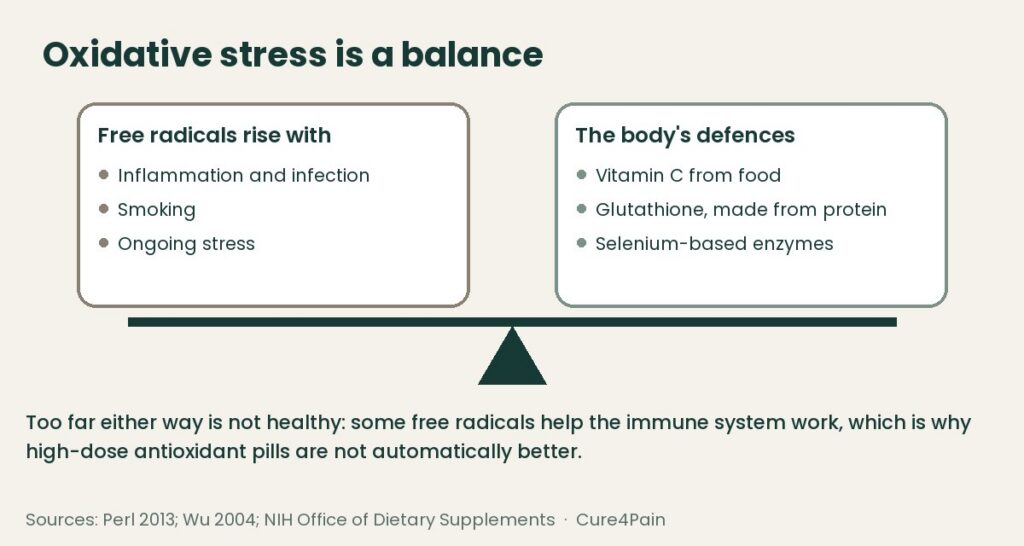
Oxidative stress is an imbalance in which the body makes more free radicals than its antioxidant defences can handle. Free radicals are reactive molecules made in normal energy use and, in larger amounts, by inflammation, infection and smoking. The body keeps them in check with antioxidants it makes itself, such as glutathione, and antioxidants from food, such as vitamin C [1] [12].
Research has found more oxidative damage in several autoimmune diseases:
- Rheumatoid arthritis: a 2016 study from India found that 120 people with rheumatoid arthritis had more free-radical damage to fats, proteins and DNA than 53 healthy people, and lower antioxidant defences, including vitamin C and glutathione [3]. It shows a link, not a cause.
- Lupus: oxidative stress is increased in lupus, and glutathione, the main antioxidant inside cells, is depleted in the T cells (a type of white blood cell) of people with the disease [4]. In a small study of 44 people with lupus, blood glutathione was lower in moderate and severe disease than in healthy people [13].
- Multiple sclerosis: in brain tissue from 30 people with multiple sclerosis, oxidative damage was concentrated in areas of active inflammation and linked with injury to the cells that make myelin, the protective coating of nerves [5].
This does not mean that more antioxidants are always better. The immune system uses free radicals to kill germs and, in some cells, to keep itself in check. A review of lupus research warns that blocking these signals too much could be harmful [4].
Is vitamin C good for autoimmune disease?
Vitamin C is good for anyone who is low in it, including people with an autoimmune disease, but no trial has shown that vitamin C supplements treat an autoimmune disease itself.
Vitamin C collects in immune cells such as neutrophils, supports the skin as a barrier, helps kill germs and helps clear away spent immune cells. A lack of vitamin C weakens immunity, and infections use vitamin C up [1].
In a US national survey of 7,277 people, 7.1% were deficient, and smokers had levels about one-third lower than non-smokers [2]. Smokers, people with limited diets, and people with poor absorption or certain chronic diseases are also more likely to run low [8].
Studies of vitamin C and the risk of developing autoimmune arthritis disagree:
- UK, 2004: in the EPIC-Norfolk study of middle-aged and older adults, 73 people who went on to develop inflammatory arthritis were compared with matched people who did not. Those with the lowest vitamin C intake had more than three times the risk [14]. The authors said similar studies are needed to confirm this.
- US, 2010: 184,643 women in the Nurses’ Health Studies were followed for up to 24 years. Their intake of antioxidants, including vitamin C, was not linked with the risk of developing rheumatoid arthritis or lupus [15].
Treatment trials are small and measured blood markers only:
- Lupus: 39 people with lupus took vitamins C and E together or a placebo (a dummy pill) for 12 weeks. One blood marker of fat damage fell; other markers and blood vessel function did not change [6].
- Autoimmune thyroiditis: 102 people took vitamin C, selenium or a placebo for 3 months. Thyroid antibodies fell within the vitamin C and selenium groups but not with placebo, yet the difference between the groups was not statistically significant, and thyroid-stimulating hormone (TSH) did not change [7].
In plain words: correcting low vitamin C makes sense, and food is the best place to start. A vitamin C supplement is not a treatment for lupus, rheumatoid arthritis or any other autoimmune disease.
Is vitamin C bad for autoimmune disease?
Vitamin C is not known to be bad for autoimmune disease at normal intakes: we found no study showing that it makes an autoimmune disease worse, but high doses have side effects worth knowing.
Many people worry that vitamin C “boosts” the immune system and so might feed an overactive one. But vitamin C supports the normal work of immune cells, including the clean-up of spent ones, rather than simply turning immunity up [1]. The research in autoimmune disease is small [6] [7], so staying within official limits is wise.
Vitamin C has low toxicity, but high doses can cause diarrhoea, nausea and stomach cramps [8]. The NIH fact sheet also notes that high intakes could add to kidney stones, especially in people with kidney problems, although studies disagree, and that in hereditary haemochromatosis, an inherited iron overload, high doses could make the overload worse [8]. People having chemotherapy or radiation therapy, or taking statins, should check before taking vitamin C supplements, because they may interact [8]. High-dose vitamin C drips go far beyond these limits; they need medical supervision and have not been studied as a treatment for autoimmune disease in the research reviewed here.
How much vitamin C is safe?
According to the US National Institutes of Health, adult men need 90 mg of vitamin C a day and adult women 75 mg (85 mg in pregnancy and 120 mg when breastfeeding), and the upper limit for adults is 2,000 mg a day [8].
Food first. The best sources are fruits and vegetables, especially citrus fruits, red and green peppers (capsicum), kiwifruit, broccoli, strawberries and Brussels sprouts [8]. Everyday citrus fruits such as oranges, lemons and sweet lime count. Vitamin C is damaged by heat, so cooking lowers the amount in food; raw or lightly cooked fruit and vegetables keep the most [8].
Official daily amounts for adults aged 19 and over (US National Institutes of Health [8]):
| Group | Vitamin C a day |
|---|---|
| Men | 90 mg |
| Women | 75 mg |
| Pregnancy | 85 mg |
| Breastfeeding | 120 mg |
| People who smoke | 35 mg more than non-smokers |
| Upper limit for adults | 2,000 mg |
Your own amount, and whether you need a supplement at all, is set after testing. Do not start a high-dose supplement without medical guidance, especially if you have kidney problems, past kidney stones or hereditary haemochromatosis, or take chemotherapy or statins.
Vitamin C, selenium and Hashimoto’s thyroiditis
Selenium has the most research of any antioxidant nutrient in Hashimoto’s thyroiditis, where it lowers thyroid antibodies, but it has not yet been shown to change how people feel.
- Selenium, 2024 review: a 2024 review of 35 studies in people with Hashimoto’s thyroiditis found that selenium lowered thyroid antibodies (TPO) and, in people not taking thyroid tablets, slightly lowered TSH. Thyroid hormone levels did not change, and side effects were similar to placebo. The certainty of the evidence was moderate [11].
- Selenium, 2016 review: an earlier review of 16 trials also found lower antibodies, but said that whether this brings real benefits to patients “remains to be demonstrated”. More side effects were reported with selenium, and the evidence was of low quality [16].
- Vitamin C: in the 3-month trial above, thyroid antibodies fell with vitamin C as well as with selenium [7].
- Thyroid tablets: in a small study of 31 people with an underactive thyroid and stomach problems, most of whom had autoimmune thyroiditis, taking the thyroid tablet with vitamin C improved thyroid hormone levels, and TSH became normal in 17 of them. The study was not blinded [17]. Any change in how or when you take thyroid tablets is made under clinical guidance from Team Cure4Pain, because hormone levels need checking afterwards.
Selenium has a narrow safe range. The NIH sets the adult selenium amount at 55 mcg a day (60 mcg in pregnancy and 70 mcg when breastfeeding), with an upper limit of 400 mcg a day [18]. Too much causes hair and nail loss, a garlic smell on the breath, a metallic taste, rash, nausea and tiredness; Brazil nuts contain particularly high amounts [18]. In a trial of 1,202 US adults seen in skin clinics in low-selenium areas of the eastern US, followed for about 7.7 years, selenium supplements did not prevent type 2 diabetes, and the disease was more common in the selenium group, most of all in people whose selenium was already high [19]. This is why selenium is tested before it is suggested.
Glutathione and NAC: the body’s own antioxidant
Glutathione is the main antioxidant made inside the body’s cells; NAC, which helps the body make it, has one small encouraging trial in lupus, while glutathione drips and injections lack trials in autoimmune disease.
- How the body makes it: glutathione is built from three amino acids (glutamate, cysteine and glycine), so eating enough protein matters. NAC (N-acetylcysteine) supplies cysteine, the building block in shortest supply [12].
- Lower in lupus: glutathione is depleted in lupus T cells [4], and in the small study above, lower blood glutathione went with more active lupus [13].
- NAC in lupus: in a 2012 randomized trial of 36 people with lupus in the US, NAC at the higher doses lowered disease-activity and fatigue scores over 3 months; the lowest dose and placebo did not. A third of those on the highest dose had nausea. The authors called it a pilot study, and larger trials are needed [10].
- Glutathione by mouth: in a 6-month trial of 54 healthy non-smoking adults, glutathione supplements raised the body’s glutathione stores, by 30 to 35% in blood cells at the higher dose, and levels fell back within a month of stopping [20]. It has not been tested in this way in people with autoimmune disease.
- Drips, injections and liposomal forms: we found no trials of these in autoimmune disease.
Supporting the body’s own glutathione, through enough protein and, where suitable, NAC used under clinical guidance from Team Cure4Pain, has early evidence in lupus but is not yet a proven treatment.
When antioxidant supplements can do harm
High-dose antioxidant pills are not automatically safe: large trials have linked some of them with more deaths, cancer or diabetes.
- Deaths: a 2012 Cochrane review of 78 randomized trials with 296,707 adults (average age 63), both healthy people and people with various diseases in a stable phase, found that antioxidant supplements did not prevent deaths. In the most reliable trials, beta-carotene and vitamin E seemed to slightly increase deaths; vitamin C and selenium had no significant effect either way [9].
- Cancer: in the SELECT trial of 35,533 healthy men, vitamin E supplements raised the risk of prostate cancer by 17% [21].
- Diabetes: selenium supplements were linked with more type 2 diabetes in the trial described above [19].
For these reasons we do not suggest vitamin E or alpha-lipoic acid supplements for autoimmune disease, and we test before suggesting any antioxidant.
Where vitamin D and magnesium fit
Vitamin D is not an antioxidant, but in a large prevention trial it lowered the number of new autoimmune diseases.
In the VITAL trial, 25,871 US adults (men aged 50 and over, women aged 55 and over) were followed for about 5 years. Those taking vitamin D had 22% fewer confirmed new autoimmune diseases, such as rheumatoid arthritis, psoriasis and autoimmune thyroid disease, than those taking a placebo; omega-3 fish oil gave 15% fewer, which was not statistically significant [22]. These were mostly healthy older adults, so the trial tells us about prevention, not treatment. VITAL did not test higher-dose programmes such as the Coimbra Protocol, which we use as one of several therapies under clinical guidance from Team Cure4Pain.
The body needs magnesium to activate vitamin D [23]; read more in our article on magnesium and autoimmune disease. Thiamine and gut health are covered in our article on gut health and thiamine in autoimmune disease.
How we use antioxidants at Cure4Pain
Antioxidant nutrients are one small part of a functional nutrition and integrative rheumatology plan, never a treatment on their own. We look at your diet, blood tests, medicines and symptoms, correct what is low, such as vitamin C or selenium, and recheck, alongside vitamin D and its co-factors (nutrients such as magnesium that vitamin D needs to work [23]), gut health and lifestyle care where suitable. All of this happens under clinical guidance from Team Cure4Pain, who review your medicines and supplements together, including how they interact, in coordination with your existing consulting physician.
See all our autoimmune care, and our pages on lupus and rheumatoid arthritis.
If you would like your vitamin C, selenium and the rest of your nutrition checked as part of an autoimmune plan, you can book a consultation, online from anywhere or at our Mumbai clinic.
Frequently asked questions
Is vitamin C good for autoimmune disease?
Vitamin C supports the normal work of immune cells, and people who are low in it should correct that [1]. But no trial has shown that vitamin C supplements treat an autoimmune disease; small trials in lupus and autoimmune thyroiditis found changes in blood markers or antibodies only [6] [7]. Food comes first, with a supplement only if testing shows you need one.
Is vitamin C bad for autoimmune disease?
Vitamin C at normal intakes has not been shown to worsen an autoimmune disease. High doses can cause diarrhoea, nausea and stomach cramps [8]. The official upper limit for adults is 2,000 mg a day, and people with kidney problems or past kidney stones, or with hereditary haemochromatosis (inherited iron overload), need particular care with high doses [8].
How much vitamin C should I take if I have an autoimmune disease?
There is no separate official amount of vitamin C for people with autoimmune disease; the US National Institutes of Health gives the same amounts as for all adults: 90 mg a day for men and 75 mg for women, 35 mg more for people who smoke, and an upper limit of 2,000 mg a day [8]. Fruit and vegetables usually cover this. Your own amount is set after testing.
Can people with lupus take vitamin C?
Most people with lupus can get vitamin C from food in the usual way. In a small 2005 trial of 39 people with lupus, vitamins C and E together for 12 weeks lowered one blood marker of oxidative damage but did not change blood vessel function [6]. Any supplement should be reviewed alongside your other medicines under clinical guidance from Team Cure4Pain.
Does vitamin C help Hashimoto’s?
The evidence is limited. In a 3-month trial of 102 people with autoimmune thyroiditis, thyroid antibodies fell with both vitamin C and selenium but not with placebo, though the groups did not differ significantly [7]. A small study in people with an underactive thyroid and stomach problems found that vitamin C helped them absorb their thyroid tablets [17]. Any change in thyroid medicine is made under clinical guidance from Team Cure4Pain.
Is glutathione good for autoimmune disease?
Glutathione is the main antioxidant inside cells and is lower in people with more active lupus [13]. A small 2012 trial in 36 people with lupus found that NAC, which helps the body make glutathione, lowered disease-activity scores at higher doses [10]. Oral glutathione has only been tested in healthy adults [20], and we found no trials of drips or injections in autoimmune disease.
What are the best antioxidants for autoimmune disease?
There is no single best antioxidant pill. A 2012 Cochrane review of 78 trials found that antioxidant supplements did not prevent deaths in healthy people or people with various diseases, and that vitamin E and beta-carotene seemed to slightly increase them [9]. The safest approach is food first, then testing, then correcting only what is actually low, such as vitamin C or selenium, under clinical guidance.
Can antioxidants make autoimmune disease go away?
No study has shown that antioxidants make an autoimmune disease go away. Oxidative stress is one part of these conditions [3] [4], and correcting a shortfall may help as part of a wider plan that can include diet, vitamin D and co-factors, and your existing medicines. How much each person improves varies, and further studies are needed.
This article is for education and does not replace medical advice. Do not start, stop or change any medicine or supplement without medical guidance.
References
1. Carr AC, Maggini S. Vitamin C and immune function. Nutrients 2017;9(11):1211. doi:10.3390/nu9111211
2. Schleicher RL, Carroll MD, Ford ES, Lacher DA. Serum vitamin C and the prevalence of vitamin C deficiency in the United States: 2003-2004 National Health and Nutrition Examination Survey (NHANES). Am J Clin Nutr 2009;90(5):1252-1263. doi:10.3945/ajcn.2008.27016
3. Mateen S, Moin S, Khan AQ, Zafar A, Fatima N. Increased reactive oxygen species formation and oxidative stress in rheumatoid arthritis. PLoS One 2016;11(4):e0152925. doi:10.1371/journal.pone.0152925
4. Perl A. Oxidative stress in the pathology and treatment of systemic lupus erythematosus. Nat Rev Rheumatol 2013;9(11):674-686. doi:10.1038/nrrheum.2013.147
5. Haider L, Fischer MT, Frischer JM, et al. Oxidative damage in multiple sclerosis lesions. Brain 2011;134(Pt 7):1914-1924. doi:10.1093/brain/awr128
6. Tam LS, Li EK, Leung VY, et al. Effects of vitamins C and E on oxidative stress markers and endothelial function in patients with systemic lupus erythematosus: a double blind, placebo controlled pilot study. J Rheumatol 2005;32(2):275-282. PubMed 15693087
7. Karimi F, Omrani GR. Effects of selenium and vitamin C on the serum level of antithyroid peroxidase antibody in patients with autoimmune thyroiditis. J Endocrinol Invest 2019;42(4):481-487. doi:10.1007/s40618-018-0944-7
8. National Institutes of Health, Office of Dietary Supplements. Vitamin C: Fact Sheet for Health Professionals. ods.od.nih.gov/factsheets/VitaminC-HealthProfessional
9. Bjelakovic G, Nikolova D, Gluud LL, Simonetti RG, Gluud C. Antioxidant supplements for prevention of mortality in healthy participants and patients with various diseases. Cochrane Database Syst Rev 2012;(3):CD007176. doi:10.1002/14651858.CD007176.pub2
10. Lai ZW, Hanczko R, Bonilla E, et al. N-acetylcysteine reduces disease activity by blocking mammalian target of rapamycin in T cells from systemic lupus erythematosus patients: a randomized, double-blind, placebo-controlled trial. Arthritis Rheum 2012;64(9):2937-2946. doi:10.1002/art.34502
11. Huwiler VV, Maissen-Abgottspon S, Stanga Z, et al. Selenium supplementation in patients with Hashimoto thyroiditis: a systematic review and meta-analysis of randomized clinical trials. Thyroid 2024;34(3):295-313. doi:10.1089/thy.2023.0556
12. Wu G, Fang YZ, Yang S, Lupton JR, Turner ND. Glutathione metabolism and its implications for health. J Nutr 2004;134(3):489-492. doi:10.1093/jn/134.3.489
13. Tewthanom K, Janwityanuchit S, Totemchockchyakarn K, Panomvana D. Correlation of lipid peroxidation and glutathione levels with severity of systemic lupus erythematosus: a pilot study from single center. J Pharm Pharm Sci 2008;11(3):30-34. doi:10.18433/j3c885
14. Pattison DJ, Silman AJ, Goodson NJ, et al. Vitamin C and the risk of developing inflammatory polyarthritis: prospective nested case-control study. Ann Rheum Dis 2004;63(7):843-847. doi:10.1136/ard.2003.016097
15. Costenbader KH, Kang JH, Karlson EW. Antioxidant intake and risks of rheumatoid arthritis and systemic lupus erythematosus in women. Am J Epidemiol 2010;172(2):205-216. doi:10.1093/aje/kwq089
16. Wichman J, Winther KH, Bonnema SJ, Hegedüs L. Selenium supplementation significantly reduces thyroid autoantibody levels in patients with chronic autoimmune thyroiditis: a systematic review and meta-analysis. Thyroid 2016;26(12):1681-1692. doi:10.1089/thy.2016.0256
17. Jubiz W, Ramirez M. Effect of vitamin C on the absorption of levothyroxine in patients with hypothyroidism and gastritis. J Clin Endocrinol Metab 2014;99(6):E1031-E1034. doi:10.1210/jc.2013-4360
18. National Institutes of Health, Office of Dietary Supplements. Selenium: Fact Sheet for Health Professionals. ods.od.nih.gov/factsheets/Selenium-HealthProfessional
19. Stranges S, Marshall JR, Natarajan R, et al. Effects of long-term selenium supplementation on the incidence of type 2 diabetes: a randomized trial. Ann Intern Med 2007;147(4):217-223. doi:10.7326/0003-4819-147-4-200708210-00175
20. Richie JP, Nichenametla S, Neidig W, et al. Randomized controlled trial of oral glutathione supplementation on body stores of glutathione. Eur J Nutr 2015;54(2):251-263. doi:10.1007/s00394-014-0706-z
21. Klein EA, Thompson IM, Tangen CM, et al. Vitamin E and the risk of prostate cancer: the Selenium and Vitamin E Cancer Prevention Trial (SELECT). JAMA 2011;306(14):1549-1556. doi:10.1001/jama.2011.1437
22. Hahn J, Cook NR, Alexander EK, et al. Vitamin D and marine omega 3 fatty acid supplementation and incident autoimmune disease: VITAL randomized controlled trial. BMJ 2022;376:e066452. doi:10.1136/bmj-2021-066452
23. Uwitonze AM, Razzaque MS. Role of magnesium in vitamin D activation and function. J Am Osteopath Assoc 2018;118(3):181-189. doi:10.7556/jaoa.2018.037