Written by AT. Chintan Dalal, N.D. · Reviewed by Dr Krushal Pabari, Clinical Team, Cure4Pain · Updated 29 October 2026
Key facts
Psoriasis during pregnancy often improves, then often flares after delivery: in a 2005 US prospective study of 47 pregnant women, 55% improved during pregnancy, while 65% worsened after delivery [1]. Two reviews found modestly higher odds of caesarean delivery, pre-eclampsia, gestational diabetes and preterm birth in women with psoriasis, but they disagree on whether the baby is affected [2] [3]. Moisturisers, mild to moderate steroid creams and narrowband UVB light therapy are first-line treatments in pregnancy [4] [5]. The 2020 guideline of the American Academy of Dermatology and the US National Psoriasis Foundation advises stopping methotrexate at least 3 months, and acitretin at least 3 years, before conception [6].

Scientific explainer videos in our Resources section
In our Resources section, our clinical team discusses vitamin D, its cofactors and how autoimmune, lifestyle and pain conditions develop.
Does pregnancy make psoriasis better or worse?
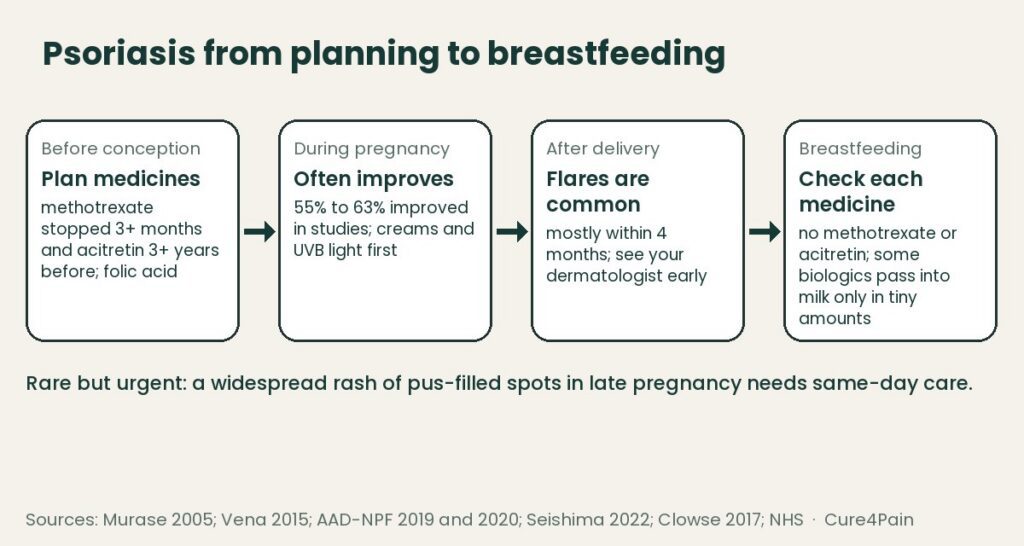
Psoriasis improves during pregnancy in about half or more of women, but it commonly flares in the weeks and months after delivery. A 2015 review summarised three studies in which 55% to 63% of women improved during pregnancy; in one survey of 90 women, 87.7% had a flare after delivery, mostly within 4 months [4]. In a prospective US study that followed 47 pregnant women with psoriasis, 55% reported improvement during pregnancy, 21% no change and 23% worsening; after delivery only 9% reported improvement and 65% reported worsening [1].
- When it improves: the area of skin affected fell significantly between 10 and 20 weeks of pregnancy, compared with women who were not pregnant [1].
- Why it may improve: improvement went with higher levels of the hormone estradiol and a higher ratio of oestrogen to progesterone; progesterone alone showed no link [1].
- After delivery: the affected area rose significantly by 6 weeks after delivery [1].
- Psoriatic arthritis: a review of 13 studies with 2,332 pregnancies also found joint symptoms tend to worsen after delivery [7].
A 2015 review reached the same overall picture, that a change in pregnancy “is more likely to be reported as an improvement”, with one important exception, generalized pustular psoriasis [4].
What does psoriasis look like in pregnancy, and when is it urgent?
Most women see their usual psoriasis: raised, scaly patches, often on the scalp, elbows, knees and lower back, which may ease or spread [8]. One rare form needs urgent care. Generalized pustular psoriasis of pregnancy, also called impetigo herpetiformis, is a sudden widespread rash of red skin and small pus-filled bumps, with or without fever and feeling unwell, usually in the last three months of pregnancy [9].
- Why it is urgent: it can be life-threatening for the mother in severe cases, and it has been linked with placental problems, stillbirth and early newborn death, so mother and baby need close monitoring and prompt specialist treatment [9].
- After delivery: it usually settles after delivery, but it tends to return earlier and more severely in later pregnancies [9].
If a rash with pus-filled spots spreads quickly in pregnancy, contact your obstetrician or go to hospital the same day.
Does psoriasis affect the pregnancy or the baby?
Psoriasis is linked with a modestly higher chance of some pregnancy complications for the mother; whether it affects the baby is less clear, because two large analyses disagree.
- For the mother: a 2021 analysis of 16 studies in the journal Rheumatology found higher odds of caesarean delivery, preterm birth, pre-eclampsia, gestational diabetes and high blood pressure in pregnancy, about 1.2 to 1.3 times the odds of women without psoriasis [2]. A 2023 analysis in BMC Pregnancy and Childbirth found similar results for the mother [3].
- For the baby, no increase in one analysis: the 2021 analysis found no higher risk of small babies, low birth weight, birth defects, stillbirth or newborn death [2].
- For the baby, small increases in another: the 2023 analysis in BMC Pregnancy and Childbirth found small increases in low birth weight and stillbirth [3].
- Psoriatic arthritis: a review of 13 studies found signals for higher pre-eclampsia, planned caesarean and preterm birth, but not for gestational diabetes or small babies, after adjustment [7].
These studies show links, not proof that psoriasis itself causes the complications. A 2015 review noted that the links were mainly with moderate to severe psoriasis, and that women with psoriasis were more likely to be overweight, to smoke or to have depression before pregnancy, which may also play a part [4]. Because the complications include high blood pressure and gestational diabetes, the usual pregnancy checks of blood pressure and blood sugar are especially worth keeping up [2].
How is psoriasis treated during pregnancy?
In pregnancy, the first choices are moisturisers, mild to moderate steroid creams and narrowband UVB light therapy, and some medicines must be avoided [4] [5] [6]. Every choice is made with your obstetrician and dermatologist.
| Treatment | In pregnancy | Source |
|---|---|---|
| Moisturisers and emollients | First-line | [4] |
| Mild to moderate steroid creams | First-line; no link with birth defects or preterm birth in a Cochrane review | [4] [10] |
| Potent or very potent steroid creams | Only if needed, on limited areas; probable link with low birth weight when very large amounts are used | [4] [10] |
| Calcipotriol (vitamin D cream), coal tar, salicylic acid, dithranol | Not recommended in pregnancy in a 2015 review; calcipotriol on small areas only when there is no alternative | [4] |
| Narrowband UVB light therapy | “Considered safe in pregnancy” in the US guideline; folic acid advised during treatment | [5] |
| PUVA (psoralen tablets with UVA light) | Not used in pregnancy or breastfeeding | [5] |
| Biologic medicines | Used when needed, with specialist advice; rates of miscarriage and birth defects similar to the general population | [11] |
| Ciclosporin | Considered for severe cases after a careful risk and benefit review; pregnancy data come mainly from transplant patients | [4] [6] |
| Methotrexate | Not used in pregnancy or breastfeeding | [6] |
| Acitretin | Not used in pregnancy or breastfeeding; stop at least 3 years before trying to conceive | [6] |
| Tazarotene gel | Not used in pregnancy | [4] |
- Steroid creams: a 2015 Cochrane review of 14 observational studies with about 1.6 million people found no link between steroid creams of any strength and birth defects, preterm birth or stillbirth; it found a probable link between low birth weight and potent or very potent creams, “especially when the cumulative dosage … is very large” [10]. This is why milder creams are preferred in pregnancy, without large amounts over wide areas or under airtight dressings [4].
- Biologic medicines: in a 2023 review of 51 studies with 739 pregnancies exposed to biologic medicines for psoriasis, mostly in the first three months, miscarriage occurred in 15.3% and birth defects in about 3.0% of live births, similar to the general population [11]. Biologics cross the placenta to different degrees: according to a 2015 review, infliximab and adalimumab have been found in newborns at higher levels than in their mothers, while etanercept crosses much less [4]. In a small study of 16 women taking certolizumab late in pregnancy, 13 of 14 babies had no measurable medicine at birth; the study was sponsored by the manufacturer [12].
Light therapy can lower folate levels, so the 2019 phototherapy guideline of the American Academy of Dermatology and the US National Psoriasis Foundation advises all women who could become pregnant to take folic acid during phototherapy [5].
How should I plan a pregnancy if I have psoriasis?
The best time to plan is before conception, so that medicines can be changed safely and the skin is as settled as possible. A Spanish expert consensus of dermatologists, a rheumatologist and gynaecologists set out 23 recommendations covering fertility, contraception, planning, medicines in pregnancy and breastfeeding [13].
- Methotrexate: according to the 2020 guideline of the American Academy of Dermatology and the US National Psoriasis Foundation, methotrexate is not used in pregnancy, and a woman should wait “at least 3 months after discontinuation” before trying to conceive [6].
- Acitretin: the 2020 guideline also states that women “should wait at least 3 years after completion of treatment” before becoming pregnant, and that acitretin is avoided in women who could become pregnant [6].
- Biologic medicines: whether to continue, pause or switch is decided with your dermatologist, weighing disease control against the available pregnancy data [11].
- Folic acid: the UK NHS advises 400 micrograms a day while trying to conceive and for the first 12 weeks of pregnancy; a GP may prescribe a higher dose for some women, for example those with diabetes [14].
Can I breastfeed if I have psoriasis?
Yes. Psoriasis itself does not stop breastfeeding, but some medicines do. The 2020 US guideline of the American Academy of Dermatology and the National Psoriasis Foundation lists methotrexate as not to be used while nursing and states that “mothers receiving acitretin should not breast-feed” [6]; PUVA light treatment is also not used in nursing mothers [5].
- Biologic medicines: some pass into breast milk only in tiny amounts. In a study of 17 mothers taking certolizumab, the baby’s estimated dose was 0.15% of the mother’s, and infant safety was similar to babies who were not exposed; the study was sponsored by the manufacturer [15].
- Vaccines for the baby: if you took a biologic medicine late in pregnancy, tell your baby’s doctor before any live vaccine, including BCG given at birth in many countries. A 2015 review advised postponing live vaccines in newborns exposed to biologics in the second half of pregnancy, after a reported fatal BCG infection in one exposed infant [4]. Some guidance advises avoiding live vaccines in the first 6 to 12 months of life, although a Canadian study of 191 exposed infants found the live rotavirus vaccine generally safe [16].
Why does psoriasis flare after delivery, and what helps?
Flares after delivery are common: in a 2005 US prospective study of 47 women, 65% worsened after delivery, and the affected skin area had risen significantly by 6 weeks [1]. The study linked improvement in pregnancy to high oestrogen levels, which fall after birth [1]. Psoriatic arthritis also tends to worsen after delivery [7].
- Plan before the birth: agree with your dermatologist which creams and treatments you will use after delivery, including while breastfeeding.
- Get help early: new or worse psoriasis after pregnancy, or new joint pain or swelling, is worth reviewing with your dermatologist rather than waiting.
- Mood matters too: depression is more common in women with psoriasis [4], so tell your doctor if low mood or anxiety builds after the birth.
Which vitamins should I take in pregnancy if I have psoriasis?
In pregnancy, vitamins are taken at the standard amounts advised for all pregnant women, and some supplements are avoided. The UK NHS advises:
| Nutrient | Advice in pregnancy | Source |
|---|---|---|
| Folic acid | 400 micrograms a day while trying to conceive and for the first 12 weeks | NHS [14] |
| Vitamin D | 10 micrograms (400 IU) a day, at least from October to March, and all year for women with little sun exposure or darker skin; not more than 100 micrograms a day | NHS [14] |
| Vitamin A (retinol) | Avoid supplements containing vitamin A and cod liver oil | NHS [14] |
Low vitamin D is common in psoriasis, but vitamin D tablets did not improve psoriasis in trials [17]; the research is explained in our article on vitamin deficiencies linked to psoriasis. We found no published study of high-dose vitamin D protocols, such as the Coimbra Protocol, in pregnancy.
How Cure4Pain supports women with psoriasis before, during and after pregnancy
At Cure4Pain, care around pregnancy is planned together with your obstetrician and dermatologist, and integrative care is used alongside guideline treatment, never instead of it.
- Before conception: we review your medicines against the guideline rules above, and check a blood panel that includes vitamin D, vitamin B12 and homocysteine, iron and ferritin, thyroid function and HbA1c, so that what is low is corrected before pregnancy. Women taking methotrexate plan conception with us in advance.
- Supervised vitamin D therapy (Coimbra Protocol): not used during pregnancy or breastfeeding. Women on it plan conception with us so that it is stopped under supervision before trying to conceive; in pregnancy and breastfeeding, only the standard vitamin D amounts advised for pregnancy are used. Our methods are derived from the work of Dr Coimbra.
- During pregnancy and breastfeeding: psoriasis medicines are chosen together with your obstetrician and dermatologist; Dr Krushal Pabari coordinates them with nutrition and treatments that guidelines list as suitable in pregnancy, under clinical guidance from Team Cure4Pain, in coordination with your existing consulting physician. The plan stays gentle: diet, skin care and standard vitamin D. Never stop or change any medicine on your own.
- After delivery: we watch for the common flare after delivery and involve your dermatologist when it needs more treatment. The wider integrative plan restarts after breastfeeding ends.
This is our clinic practice; individual results vary, and further studies are needed. Read more on our psoriasis and psoriatic arthritis pages, and about the method on our Coimbra Protocol page.
If you are planning a pregnancy, or are pregnant or breastfeeding with psoriasis, you can book a consultation, online from anywhere or at our Mumbai clinic.
Frequently asked questions
How do you treat psoriasis while pregnant?
First-line treatments in pregnancy are moisturisers, mild to moderate steroid creams and narrowband UVB light therapy. Biologic medicines are used when needed with specialist advice, while methotrexate, acitretin, tazarotene and PUVA are not used. [4] [5] [6]
Does having psoriasis affect pregnancy?
Studies link psoriasis with modestly higher odds of caesarean delivery, pre-eclampsia, gestational diabetes and preterm birth. One large analysis found no effect on the baby, while another found small increases in low birth weight and stillbirth. [2] [3]
Can psoriasis go away during pregnancy?
It often improves: 55% of women improved in a 2005 US prospective study. After delivery, however, 65% of the same women worsened. [1]
I developed psoriasis or a flare after pregnancy. What should I do?
See your GP or dermatologist, whether the psoriasis is new or a flare of existing psoriasis. Flares are common in the weeks after delivery, and treatment can be chosen to suit breastfeeding. New joint pain or swelling should also be checked, as psoriatic arthritis tends to worsen after delivery. [1] [7]
Can I use steroid cream for psoriasis while pregnant?
Mild to moderate steroid creams are first-line in pregnancy. A Cochrane review found no link with birth defects or preterm birth, but a probable link between low birth weight and very large amounts of potent or very potent creams. [4] [10]
Are biologics safe in pregnancy?
In a review of 739 exposed pregnancies, rates of miscarriage and birth defects were similar to the general population. The decision to continue, pause or switch is made with your dermatologist. [11]
How long after methotrexate can I get pregnant?
The 2020 US guideline advises waiting at least 3 months after stopping methotrexate. For acitretin, the wait is at least 3 years. [6]
Is scalp psoriasis treatment safe in pregnancy?
The same rules apply to the scalp: moisturising treatments and mild to moderate steroid lotions are first-line, while coal tar and salicylic acid products are not recommended in pregnancy in a 2015 review. Check any medicated shampoo or herbal product with your doctor first. [4]
This article is for education and does not replace medical advice. Do not start, stop or change any medicine or supplement without medical guidance.
References
1. Murase JE, et al. Hormonal effect on psoriasis in pregnancy and post partum. Arch Dermatol 2005;141(5):601-6. doi:10.1001/archderm.141.5.601
2. Xie W, et al. Maternal and neonatal outcomes in pregnant women with psoriasis and psoriatic arthritis: a systematic review and meta-analysis. Rheumatology (Oxford) 2021;60(9):4018-4028. doi:10.1093/rheumatology/keab357
3. Rahmati S, et al. Impact of maternal psoriasis on adverse maternal and neonatal outcomes: a systematic review and meta-analysis. BMC Pregnancy Childbirth 2023;23(1):703. doi:10.1186/s12884-023-06006-5
4. Vena GA, et al. Psoriasis in pregnancy: challenges and solutions. Psoriasis (Auckl) 2015;5:83-95. doi:10.2147/PTT.S82975
5. Elmets CA, et al. Joint American Academy of Dermatology-National Psoriasis Foundation guidelines of care for the management and treatment of psoriasis with phototherapy. J Am Acad Dermatol 2019;81(3):775-804. doi:10.1016/j.jaad.2019.04.042
6. Menter A, et al. Joint American Academy of Dermatology-National Psoriasis Foundation guidelines of care for the management of psoriasis with systemic nonbiologic therapies. J Am Acad Dermatol 2020;82(6):1445-1486. doi:10.1016/j.jaad.2020.02.044
7. Meissner Y, et al. Pregnancy in women with psoriatic arthritis: A systematic literature review of disease activity and adverse pregnancy outcomes. Semin Arthritis Rheum 2021;51(3):530-538. doi:10.1016/j.semarthrit.2021.04.003
8. Griffiths CEM, et al. Psoriasis. Lancet 2021;397(10281):1301-1315. doi:10.1016/S0140-6736(20)32549-6
9. Seishima M, et al. Generalized Pustular Psoriasis in Pregnancy: Current and Future Treatments. Am J Clin Dermatol 2022;23(5):661-671. doi:10.1007/s40257-022-00698-9
10. Chi CC, et al. Safety of topical corticosteroids in pregnancy. Cochrane Database Syst Rev 2015;2015(10):CD007346. doi:10.1002/14651858.CD007346.pub3
11. Sánchez-García V, et al. Exposure to biologic therapy before and during pregnancy in patients with psoriasis: Systematic review and meta-analysis. J Eur Acad Dermatol Venereol 2023;37(10):1971-1990. doi:10.1111/jdv.19238
12. Mariette X, et al. Lack of placental transfer of certolizumab pegol during pregnancy: results from CRIB, a prospective, postmarketing, pharmacokinetic study. Ann Rheum Dis 2018;77(2):228-233. doi:10.1136/annrheumdis-2017-212196
13. Belinchón I, et al. Management of Psoriasis During Preconception, Pregnancy, Postpartum, and Breastfeeding: A Consensus Statement. Actas Dermosifiliogr (Engl Ed) 2021;112(3):225-241. doi:10.1016/j.ad.2020.10.002
14. NHS (UK National Health Service). Pregnancy vitamins and supplements. nhs.uk/pregnancy/keeping-well/pregnancy-vitamins-and-supplements
15. Clowse ME, et al. Minimal to no transfer of certolizumab pegol into breast milk: results from CRADLE, a prospective, postmarketing, multicentre, pharmacokinetic study. Ann Rheum Dis 2017;76(11):1890-1896. doi:10.1136/annrheumdis-2017-211384
16. Fitzpatrick T, et al. Immunological effects and safety of live rotavirus vaccination after antenatal exposure to immunomodulatory biologic agents: a prospective cohort study from the Canadian Immunization Research Network. Lancet Child Adolesc Health 2023;7(9):648-656. doi:10.1016/S2352-4642(23)00136-0
17. Formisano E, et al. Psoriasis and Vitamin D: A Systematic Review and Meta-Analysis. Nutrients 2023;15(15). doi:10.3390/nu15153387