Written by AT. Chintan Dalal, N.D. · Reviewed by Dr Krushal Pabari, Clinical Team, Cure4Pain · Updated 30 October 2026
Key facts
The US National Institutes of Health (NIH) and European Food Safety Authority (EFSA) documents we read do not recommend vitamin D3, K2 and magnesium as a routine combination, and our PubMed search (October 2026) found no randomised trial of these three alone; some trials used multi-nutrient products containing vitamin K, vitamin D and magnesium [1] [2]. Magnesium has the firmest biological reason: according to a 2018 review, the enzymes that process vitamin D appear to need it [3]. For K2, the NIH says it is “not clear” whether vitamin K supplements affect osteoporosis risk and calls artery calcification trials “inconclusive” [4]. In a 2-year Danish trial of 365 older men with calcified heart valves, K2 with vitamin D did not slow the calcification [5]. Vitamin K supplements can interfere with warfarin, so the UK NHS advises people on warfarin not to take them [6].

Scientific explainer videos in our Resources section
In our Resources section, our clinical team discusses vitamin D, its cofactors and how autoimmune, lifestyle and pain conditions develop.
Should vitamin D3 be taken with K2 and magnesium?
Not as a rule for everyone. There is a sound biological reason to keep magnesium intake adequate when you take vitamin D, K2 has mixed trial results, and no randomised trial we could find has tested these three alone; some used multi-nutrient products containing vitamin K, vitamin D and magnesium [1] [2].
The reason for pairing them is that vitamin D does not act alone. All the enzymes that metabolise vitamin D seem to need magnesium [3], and low intake is common: national survey figures quoted in a 2018 trial show that 79% of US adults do not meet the recommended amount [7]. Vitamin K is a coenzyme for proteins involved in bone metabolism and for matrix Gla protein, which “might help reduce abnormal calcification” [4]. The evidence differs for each: magnesium’s case rests on biochemistry and small trials, K2’s on mixed trials, and the idea that vitamin D needs K2 to be safe on a hypothesis and animal studies.
For vitamin D itself, see our articles on vitamin D deficiency in India and vitamin D in autoimmune disease.
What happens if you take vitamin D3 without K2?
At ordinary doses, a large trial found no substantial differences in adverse events between vitamin D3 and placebo, although we found no trial that compared safety with and without K2. In the US VITAL trial, 25,871 midlife and older adults took vitamin D3 at 2,000 IU a day or placebo for a median of 5.3 years, with no K2 in the study treatment. Fractures did not fall, in people not selected for deficiency or low bone mass [8].
- The K2 safety idea: a 2007 hypothesis paper proposed that vitamin D toxicity comes from using up vitamin K, based on animal studies [9]. We found no human trial of this idea.
- High doses are a separate matter: according to the NIH, very high blood levels can cause nausea, vomiting, muscle weakness, confusion, dehydration and kidney stones, almost always from excessive supplements [10]. K2 has not been shown to prevent this, so it should not be treated as protection against high doses.
Does vitamin D3 with K2 help bones?
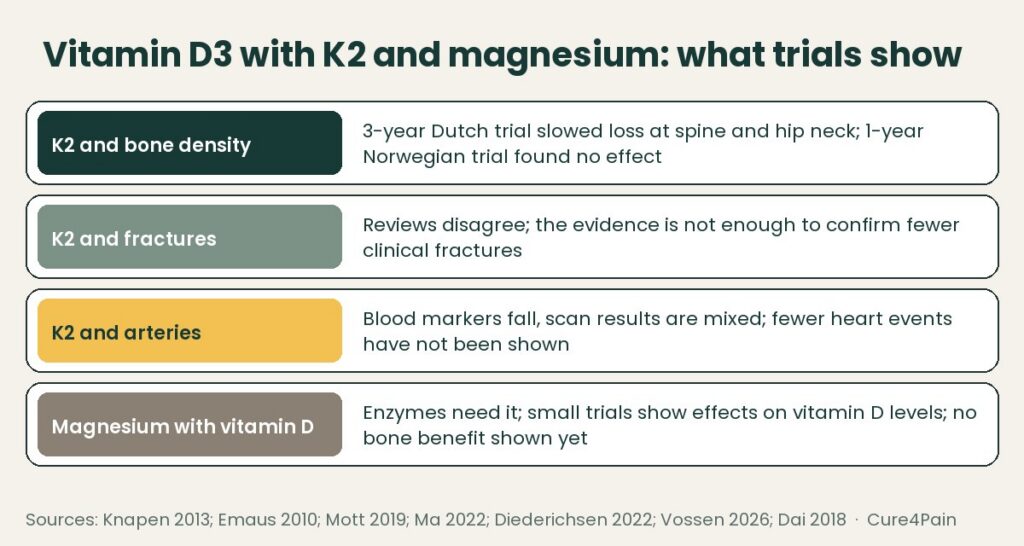
Vitamin K2 may slow bone loss in some postmenopausal women, but fewer fractures have not been confirmed.
- D3 with K, pooled trials: a 2020 meta-analysis of 8 randomised trials with 971 people found higher total bone density and lower undercarboxylated osteocalcin, a marker of low vitamin K status [11].
- What D3 adds: in a 1-year Chinese trial of 311 men and postmenopausal women aged 50 to 75, K2 at 90 micrograms a day slowed bone loss at the hip neck in women, not in men. Adding calcium and vitamin D3 brought no additional effect [12].
- Multi-nutrient products: in a 3-year trial of 181 healthy postmenopausal women aged 50 to 60, adding vitamin K1 (not K2) to calcium, magnesium, zinc and vitamin D reduced bone loss at the hip neck, not the lower spine [1]. A 42-day trial of a yogurt with MK-7, vitamin D3, magnesium and other nutrients measured blood markers, not bone [2].
- K2 as MK-7, trials that disagree: in a 3-year trial of 244 healthy postmenopausal Dutch women, MK-7 slowed loss at the lower spine and hip neck, but not the whole hip [13]. In a 1-year trial of 334 Norwegian women, 1 to 5 years after menopause, it had no effect on bone loss [14].
- Fractures: a 2022 meta-analysis of 16 trials in postmenopausal women found no overall difference in fractures in the 6 that reported them. A reduction appeared only after one study was removed, and the authors themselves urge caution about that step [15]. A York review of 36 studies found no evidence of an effect on bone density or vertebral fractures in postmenopausal or osteoporotic patients, and not enough evidence to confirm fewer clinical fractures [16]. Its authors later adjusted their estimates because of integrity concerns about a Japanese osteoporosis trial [17].
- Official view: EFSA set its 2017 intake value for vitamin K1 only, because the evidence on menaquinones (K2) was insufficient [18].
Reviews also differ on side effects: one found no difference from controls [15], another found more adverse reactions with K2, none serious [19]. Our osteoporosis page sets these nutrients within the full bone plan.
Does K2 keep calcium out of the arteries?
K2 has not been shown to keep calcium out of the arteries; the NIH calls the vitamin K trials “inconclusive” [4]. K2 improves blood markers of vitamin K status, but scan results are mixed and no reduction in heart events has been demonstrated.
- K2 with vitamin D: in the Danish trial of 365 men, mean age 71, MK-7 with vitamin D for 2 years did not slow calcification of the aortic valve, aorta or coronary arteries, although the marker dp-ucMGP fell [5].
- K2 alone: in a 2026 Dutch trial, 180 people with symptomatic coronary disease were randomised to MK-7 or placebo. Coronary calcium scores rose less with MK-7 over 2 years, and the authors say the clinical importance is still undetermined [20].
- Reviews disagree: a 2023 meta-analysis of 14 trials found slower coronary calcification and asked for more rigorous trials [21]. A 2026 review, mainly in kidney disease, found that K2 has not produced reproducible benefits on scans, and that neither vitamin K1 nor K2 has reduced major heart events or deaths [22].
Why is magnesium taken with vitamin D?
Magnesium is taken with vitamin D because, according to a 2018 review, the enzymes that process vitamin D appear to need it [3]. The evidence is biochemical plus small short trials; we found no trial showing fewer fractures from adding magnesium to vitamin D.
- Vitamin D levels depend on the starting point: in a US trial of 180 adults aged 40 to 85, magnesium raised vitamin D levels (25-hydroxyvitamin D) in people with lower starting levels and lowered them in people with higher ones. The authors suggest that magnesium status may matter for optimising vitamin D status [7].
- Combined against vitamin D alone: in a 12-week US trial of 95 overweight or obese adults, the combination raised vitamin D levels most, with no significant effect on parathyroid hormone or inflammation markers [23]. Bone turnover markers and blood sugar measures did not differ between groups [24].
- Bones: a 2022 review of observational studies in adults aged 60 and over linked higher magnesium intake with higher hip bone density, found no link with fractures, and called for randomised trials [25].
Supplement amounts are counted as elemental magnesium, and absorption varies by form. According to the NIH, the aspartate, citrate, lactate and chloride forms tend to be better absorbed than oxide and sulfate [26]. Our article on magnesium and neck pain compares the forms.
Can a blood test show whether you need magnesium or K2?
A blood test alone cannot show this. According to the NIH, less than 1% of the body’s magnesium is in blood serum, and serum levels do not accurately reflect total body magnesium or levels in specific tissues, so a full evaluation may need both laboratory tests and a clinical assessment [26]. For vitamin K, the NIH says status is not routinely assessed, and that altered prothrombin time (a clotting test) is the only clinically significant indicator [4].
Are K2 and magnesium safe? Warfarin and other medicines
K2 should not be added on your own if you take warfarin. In postmenopausal women with osteoporosis, one review reported no serious events related to K2 [19], but medicines and kidney health still matter.
- Warfarin: warfarin works against vitamin K, so people taking it “need to maintain consistent vitamin K intakes”, according to the NIH [4]. The NHS advises against vitamin K supplements while on warfarin [6]. In a study of 15 healthy volunteers on acenocoumarol, a similar medicine, MK-7 at doses as low as 10 micrograms a day affected anticoagulation in some people, and the authors advise avoiding it during this treatment [27].
- Newer blood thinners: the NIH names “warfarin and other anticoagulants” [4]. The NHS says apixaban users can eat and drink as normal and should tell a doctor or pharmacist about any supplements [28]. We found no trial of K2 with these medicines.
- Magnesium and medicines: magnesium may interact with oral bisphosphonates (bone medicines), tetracyclines and quinolone antibiotics; diuretics and proton pump inhibitors can affect magnesium status [26].
- Too much magnesium: high supplement doses can cause diarrhoea, nausea and cramps, and very high doses can be dangerous. The kidneys largely control magnesium levels [26], so people with kidney disease should ask first.
Official intakes and upper limits for adults differ between agencies. They are general limits, not personal doses:
| Nutrient | Official daily intake | Official upper limit |
|---|---|---|
| Vitamin D | NIH: 15 to 20 mcg (600 to 800 IU) by age [10] | NIH: 100 mcg (4,000 IU) [10]; EFSA: 100 mcg [29] |
| Vitamin K | NIH: 90 to 120 mcg [4]; EFSA: 70 mcg, K1 only [18] | None set: NIH cites low toxicity [4]; EFSA, no adequate data [30] |
| Magnesium (elemental) | NIH: 310 to 420 mg [26] | From supplements: NIH 350 mg [26]; EFSA 250 mg [30] |
The bone trials above used K2 at 50 to 360 micrograms a day [12] [13] [14]; these are study amounts, not recommendations.
When should you take them, and with food?
Take vitamin D with a meal that contains some fat; we found no trial that sets a best time of day for all three. The NIH says vitamin D “is best absorbed when taken with a meal or snack that includes some fat” [10]. In a single-dose study of 50 healthy older adults, peak blood vitamin D3 was 32% higher when the dose came with a fat-containing meal than with a fat-free one [31]. Vitamin K is also absorbed along with dietary fats [4]. We found no trial comparing morning with evening, or taking these nutrients together with taking them apart. If you take a bone medicine or an antibiotic named above, ask about spacing.
How we use vitamin D, K2 and magnesium at Cure4Pain
At Cure4Pain these nutrients are chosen for each person as part of a wider plan, not given as a fixed combination.
- Vitamin D depends on the condition: standard supplement doses to correct a deficiency; supervised vitamin D therapy (Coimbra Protocol-based methods) for some conditions; and the full supervised Coimbra Protocol for a few, such as multiple sclerosis. In immune-related conditions, vitamin D in these therapies is used as an immune modulator, not as a standard bone supplement. Our methods are derived from the work of Dr Coimbra. We found no trial of K2 or magnesium within the Coimbra Protocol.
- Cofactors: with supervised therapy, the cofactors you need, especially magnesium and often vitamin B2 and K2. For a deficiency on its own, related nutrients are reviewed and those that are low are corrected. We use supplements by mouth first, with injections only when specifically needed or advised.
- Osteoporosis: supervised-dose vitamin D therapy (Coimbra Protocol-based methods) with vitamin K2 as MK-7, magnesium and other nutrients chosen for each person within official limits where one exists; plant-based calcium rather than calcium carbonate; blood tests every 3 months including ionized calcium, and a DEXA scan every year.
- Magnesium: mainly as bisglycinate, with L-threonate or citrate as advised, counted as elemental magnesium. We found no trial comparing forms for vitamin D metabolism, so this is clinic practice. Status is assessed from the overall clinical picture, not from a serum result alone.
- Medicines: your supplements are reviewed together with your medicines, including blood thinners and bone medicines, under clinical guidance from Team Cure4Pain, in coordination with your existing consulting physician; never stop or change them on your own.
- Tests and doses: we read a panel of about 100 markers, adding tests for your condition when clinically indicated, and set doses after your tests. We do not publish clinic doses, and we advise against taking high doses on your own.
This is our clinic practice; individual results vary, and further studies are needed.
If you would like your vitamin D, cofactors and medicines reviewed together, you can book a consultation, online from anywhere or at our Mumbai clinic.
Frequently asked questions
Should vitamin D3 and K2 be taken together?
There is no official recommendation to do so in the NIH and EFSA documents we read. Vitamin K with vitamin D raised bone density in pooled trials, but it did not slow heart valve calcification in a 2-year trial. [11] [5]
Can I take vitamin D3 without K2?
Yes, at ordinary doses. The VITAL trial of 25,871 midlife and older adults gave vitamin D3 without K2 and found no substantial differences in adverse events. [8]
Can I take vitamin D3, K2 and magnesium together?
No randomised trial we could find has tested these three alone; some used multi-nutrient products containing vitamin K, vitamin D and magnesium. We found no evidence that they must be separated. Ask first if you take warfarin, a bone medicine or an antibiotic. [1] [2] [4] [26]
What are the benefits of D3 and K2 MK-7?
MK-7 improves blood markers of vitamin K status and slowed bone loss in a 3-year trial of postmenopausal women, but a 1-year trial found no effect. Fewer fractures and fewer heart events have not been confirmed. [13] [14] [16]
Does K2 work the same in men and women?
Many bone trials enrolled only postmenopausal women. In a Chinese trial that included both, K2 slowed bone loss in postmenopausal women but not in men. [12]
Which magnesium should I take with vitamin D?
We found no trial comparing forms for vitamin D metabolism. According to the NIH, forms that dissolve well, such as citrate and chloride, tend to be better absorbed than oxide; amounts are counted as elemental magnesium. At Cure4Pain we mainly use bisglycinate, with L-threonate or citrate as advised, as clinic practice. [26]
Can I take K2 if I am on warfarin?
Not on your own. The NHS advises against vitamin K supplements on warfarin, and MK-7 at very low doses affected a similar medicine in volunteers. [6] [27]
Can I take vitamin D3, K2 and calcium together?
In one trial, adding calcium and vitamin D3 to K2 gave no extra effect on bone loss. Whether you need calcium depends on your diet, tests and any therapy you are on, so ask first. [12]
This article is for education and does not replace medical advice. Do not start, stop or change any medicine or supplement without medical guidance.
References
1. Braam LA, et al. Vitamin K1 supplementation retards bone loss in postmenopausal women between 50 and 60 years of age. Calcif Tissue Int 2003;73(1):21-6. doi:10.1007/s00223-002-2084-4
2. Knapen MH, et al. Steady-state vitamin K2 (menaquinone-7) plasma concentrations after intake of dairy products and soft gel capsules. Eur J Clin Nutr 2016;70(7):831-6. doi:10.1038/ejcn.2016.3
3. Uwitonze AM, Razzaque MS. Role of Magnesium in Vitamin D Activation and Function. J Am Osteopath Assoc 2018;118(3):181-189. doi:10.7556/jaoa.2018.037
4. National Institutes of Health, Office of Dietary Supplements. Vitamin K: Fact Sheet for Health Professionals. Updated 22 October 2026. ods.od.nih.gov
5. Diederichsen ACP, et al. Vitamin K2 and D in Patients With Aortic Valve Calcification: A Randomized Double-Blinded Clinical Trial. Circulation 2022;145(18):1387-1397. doi:10.1161/CIRCULATIONAHA.121.057008
6. NHS (UK National Health Service). Warfarin. nhs.uk/medicines/warfarin
7. Dai Q, et al. Magnesium status and supplementation influence vitamin D status and metabolism: results from a randomized trial. Am J Clin Nutr 2018;108(6):1249-1258. doi:10.1093/ajcn/nqy274
8. LeBoff MS, et al. Supplemental Vitamin D and Incident Fractures in Midlife and Older Adults. N Engl J Med 2022;387(4):299-309. doi:10.1056/NEJMoa2202106
9. Masterjohn C. Vitamin D toxicity redefined: vitamin K and the molecular mechanism. Med Hypotheses 2007;68(5):1026-34. doi:10.1016/j.mehy.2006.09.051
10. National Institutes of Health, Office of Dietary Supplements. Vitamin D: Fact Sheet for Consumers. ods.od.nih.gov
11. Kuang X, et al. The combination effect of vitamin K and vitamin D on human bone quality: a meta-analysis of randomized controlled trials. Food Funct 2020;11(4):3280-3297. doi:10.1039/c9fo03063h
12. Zhang Y, et al. Effect of Low-Dose Vitamin K2 Supplementation on Bone Mineral Density in Middle-Aged and Elderly Chinese: A Randomized Controlled Study. Calcif Tissue Int 2020;106(5):476-485. doi:10.1007/s00223-020-00669-4
13. Knapen MH, et al. Three-year low-dose menaquinone-7 supplementation helps decrease bone loss in healthy postmenopausal women. Osteoporos Int 2013;24(9):2499-507. doi:10.1007/s00198-013-2325-6
14. Emaus N, et al. Vitamin K2 supplementation does not influence bone loss in early menopausal women: a randomised double-blind placebo-controlled trial. Osteoporos Int 2010;21(10):1731-40. doi:10.1007/s00198-009-1126-4
15. Ma ML, et al. Efficacy of vitamin K2 in the prevention and treatment of postmenopausal osteoporosis: A systematic review and meta-analysis of randomized controlled trials. Front Public Health 2022;10:979649. doi:10.3389/fpubh.2022.979649
16. Mott A, et al. Effect of vitamin K on bone mineral density and fractures in adults: an updated systematic review and meta-analysis of randomised controlled trials. Osteoporos Int 2019;30(8):1543-1559. doi:10.1007/s00198-019-04949-0
17. Mott A, et al. Correction to Effect of vitamin K on bone mineral density and fractures in adults: an updated systematic review and meta-analysis of randomised controlled trials. Osteoporos Int 2020;31(11):2269-2270. doi:10.1007/s00198-020-05586-8
18. Turck D, et al. Dietary reference values for vitamin K. EFSA J 2017;15(5):e04780. doi:10.2903/j.efsa.2017.4780
19. Zhou M, et al. Efficacy and safety of vitamin K2 for postmenopausal women with osteoporosis at a long-term follow-up: meta-analysis and systematic review. J Bone Miner Metab 2022;40(5):763-772. doi:10.1007/s00774-022-01342-6
20. Vossen LM, et al. Two Years of Menaquinone-7 Supplementation and Coronary Artery Calcification: A Randomized Clinical Trial. JAMA Cardiol 2026;11(8):719-726. doi:10.1001/jamacardio.2026.1279
21. Li T, et al. Vitamin K supplementation and vascular calcification: a systematic review and meta-analysis of randomized controlled trials. Front Nutr 2023;10:1115069. doi:10.3389/fnut.2023.1115069
22. Brandenburg V, et al. Vitamin K and vascular calcification: from biological plausibility to clinical realism. Clin Kidney J 2026;19(10):sfag249. doi:10.1093/ckj/sfag249
23. Cheung MM, et al. The effect of combined magnesium and vitamin D supplementation on vitamin D status, systemic inflammation, and blood pressure: A randomized double-blinded controlled trial. Nutrition 2022;99-100:111674. doi:10.1016/j.nut.2022.111674
24. Dall RD, et al. Combined vitamin D and magnesium supplementation does not influence markers of bone turnover or glycemic control: A randomized controlled clinical trial. Nutr Res 2023;110:33-43. doi:10.1016/j.nutres.2022.12.005
25. Groenendijk I, et al. Impact of magnesium on bone health in older adults: A systematic review and meta-analysis. Bone 2022;154:116233. doi:10.1016/j.bone.2021.116233
26. National Institutes of Health, Office of Dietary Supplements. Magnesium: Fact Sheet for Health Professionals. Updated 6 January 2026. ods.od.nih.gov
27. Theuwissen E, et al. Effect of low-dose supplements of menaquinone-7 (vitamin K2 ) on the stability of oral anticoagulant treatment: dose-response relationship in healthy volunteers. J Thromb Haemost 2013;11(6):1085-92. doi:10.1111/jth.12203
28. NHS (UK National Health Service). Common questions about apixaban. nhs.uk/medicines/apixaban/common-questions-about-apixaban
29. Turck D, et al. Scientific opinion on the tolerable upper intake level for vitamin D, including the derivation of a conversion factor for calcidiol monohydrate. EFSA J 2023;21(8):e08145. doi:10.2903/j.efsa.2023.8145
30. European Food Safety Authority. Overview on Tolerable Upper Intake Levels. Version 1, August 2025. efsa.europa.eu (PDF)
31. Dawson-Hughes B, et al. Dietary fat increases vitamin D-3 absorption. J Acad Nutr Diet 2015;115(2):225-230. doi:10.1016/j.jand.2014.09.014