Written by AT. Chintan Dalal, N.D. · Reviewed by Dr Krushal Pabari, Clinical Team, Cure4Pain · Updated 30 October 2026
Key facts
A cholesterol report (lipid profile) shows total cholesterol, LDL, HDL, non-HDL, triglycerides and often VLDL and a ratio. There is no single normal LDL: according to the Cardiological Society of India (CSI) 2024 guideline, the goal is below 100 mg/dL at low or moderate risk, below 70 at high risk and below 55 at very high risk [1]. In the ICMR-INDIAB national survey of 23,665 Indian adults, 87.3% had at least one abnormal value by Lipid Association of India cut-offs, mostly low HDL (66.8%) [2]. CSI lists hypothyroidism and poorly controlled diabetes among the common endocrine causes of abnormal lipids, and the US National Institutes of Health advises a thyroid test for anyone with high cholesterol [1] [3]. CSI and the 2026 American guideline, as summarised by the American College of Cardiology, advise testing lipoprotein(a) at least once in adult life [1] [4]. Never stop a statin on your own [5].

Scientific explainer videos in our Resources section
In our Resources section, our clinical team discusses vitamin D, its cofactors and how autoimmune, lifestyle and pain conditions develop.
How do you read a cholesterol report?
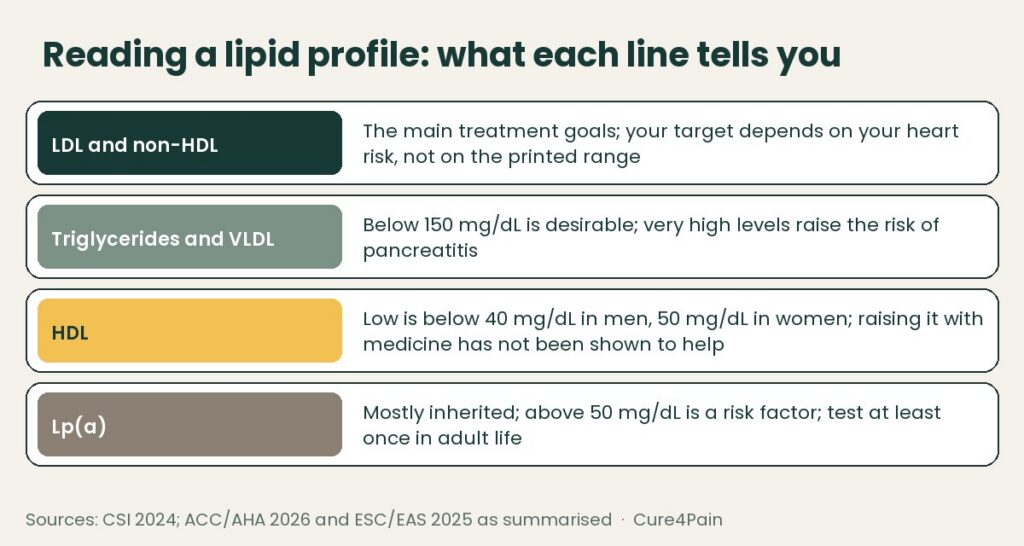
Read each line of a cholesterol report (lipid profile) against your own heart risk, not only against the range printed by the laboratory. According to the Cardiological Society of India (CSI) 2024 guideline, the desirable values at low risk are LDL below 100 mg/dL, non-HDL below 130 mg/dL, triglycerides below 150 mg/dL, and HDL above 40 mg/dL in men and 50 mg/dL in women; LDL and non-HDL goals are lower at higher risk [1]. The table gives the source for each line.
| Line on the report | What it means | Desirable value at low risk |
|---|---|---|
| Total cholesterol | All the cholesterol in the blood | Below 200 mg/dL for adults, according to MedlinePlus [6] |
| LDL | Mainly carries cholesterol [6]; the main treatment target, with non-HDL (CSI 2024) [1] | Below 100 mg/dL (CSI 2024) [1] |
| HDL | Carries cholesterol back to the liver | Above 40 mg/dL in men, above 50 mg/dL in women (CSI 2024) [1] |
| Non-HDL | Total cholesterol minus HDL | Below 130 mg/dL (CSI 2024) [1] |
| Triglycerides | A type of fat in the blood | Below 150 mg/dL (CSI 2024) [1] |
| VLDL | Mainly carries triglycerides; estimated as about one-fifth of triglycerides | No separate goal in the CSI tables; it falls as triglycerides fall [7] |
| Total cholesterol to HDL ratio | Total cholesterol divided by HDL | Below 5:1, in a US university health encyclopedia; not a guideline goal [8] |
Reports from the UK use mmol/L. The NHS gives these guide levels for healthy adults: total cholesterol below 5 mmol/L, HDL above 1.0 mmol/L in men and 1.2 mmol/L in women, and non-HDL below 4 mmol/L [9]. As a guide, 5 mmol/L of cholesterol is about 190 mg/dL, and 1.7 mmol/L of triglycerides is 150 mg/dL [10].
Could a thyroid or sugar problem be behind a high cholesterol report?
Yes, a thyroid or sugar problem can be behind abnormal lipids, so both are worth checking early. The Cardiological Society of India (CSI) 2024 guideline lists hypothyroidism, poorly controlled diabetes and Cushing’s syndrome as common endocrine causes of abnormal lipids, and the UK NICE guideline (NG238) adds excess alcohol, liver disease and nephrotic syndrome to the causes to exclude [1] [11].
- Thyroid: the US National Institute of Diabetes and Digestive and Kidney Diseases says “If you have high cholesterol, you should get tested for hypothyroidism” [3]. CSI notes that LDL and Lp(a) may be raised in hypothyroidism and that thyroid levels should be normal before a statin is started [1]. NICE advises a TSH test before a statin in people with symptoms of an underactive or overactive thyroid [11].
- What thyroid treatment does: in a 2020 meta-analysis, levothyroxine in overt hypothyroidism lowered total cholesterol by about 58 mg/dL and LDL by about 41 mg/dL, with smaller changes in subclinical hypothyroidism [12]. In 12 randomised trials of subclinical hypothyroidism (940 people), it lowered total and LDL cholesterol, but not HDL or triglycerides significantly [13].
- Diabetes: the Lipid Association of India (LAI) estimates that more than 90% of Indians with diabetes have abnormal lipids [14]. CSI notes that nearly half of people with diabetes have high triglycerides, and that obesity, polycystic ovary syndrome and type 2 diabetes go with high triglycerides and low HDL [1].
See our pages on hypothyroidism and type 2 diabetes.
What does a high LDL mean?
A high LDL means more cholesterol is being carried in the particles that build up in artery walls. What counts as high depends on your risk: the Cardiological Society of India (CSI) 2024 goal is below 100 mg/dL at low or moderate risk, below 70 at high risk and below 55 at very high risk [1]. The European Society of Cardiology 2025 update describes LDL and other apolipoprotein B-containing particles as a direct cause of atherosclerotic heart and artery disease [15] [16].
- The evidence: in a 2010 Cholesterol Treatment Trialists’ meta-analysis in The Lancet, covering 26 randomised trials and about 170,000 people, each 1.0 mmol/L (about 39 mg/dL) fall in LDL with statins lowered the yearly rate of heart attacks, ischaemic strokes and bypass or stent procedures by just over a fifth [17].
- Very high LDL: a 2016 European Atherosclerosis Society consensus flags LDL above 190 mg/dL for possible familial hypercholesterolaemia, an inherited condition that needs separate assessment [10].
- Calculated or direct: CSI accepts LDL either measured directly or calculated [1]. The usual calculations are less accurate when LDL is low or triglycerides are 400 mg/dL or more, according to a US National Institutes of Health study [18].
What is non-HDL cholesterol, and what does a high level mean?
Non-HDL cholesterol is total cholesterol minus HDL, so it counts the cholesterol in every particle that can build up in arteries, and a high level means more of that cholesterol is being carried. The Cardiological Society of India (CSI) 2024 goal is below 130 mg/dL at low or moderate risk, below 100 at high risk and below 85 at very high risk [1]. CSI calls non-HDL simpler, more convenient and more predictive of heart and artery disease than LDL, and uses it as a co-primary goal; the Lipid Association of India (LAI) does the same [1] [19].
- Long-term risk: in the Multinational Cardiovascular Risk Consortium (The Lancet, 2019), with almost 399,000 people without heart or artery disease at the start, from 19 countries in Europe, Australia and North America, the 30-year rate of heart and stroke events was 7.7% in women with non-HDL below 2.6 mmol/L (about 100 mg/dL) and 33.7% in women with 5.7 mmol/L (about 220 mg/dL) or more; in men it was 12.8% and 43.6% [20].
- When it helps most: according to a 2026 review of the American guideline in the journal Life, non-HDL is particularly useful with high triglycerides, type 2 diabetes, obesity or metabolic syndrome, where LDL may understate the risk [21].
What do high triglycerides and VLDL mean?
High triglycerides often point to something else to correct, such as sugar control, alcohol, weight, thyroid or kidney function, and a high VLDL usually repeats the same result, because laboratories estimate VLDL from triglycerides [7]. A 2026 review of the American guideline in the journal Life lists poor sugar control, excess alcohol, obesity, hypothyroidism, kidney disease, refined carbohydrates and some medicines as causes to correct first [21].
- Levels: the Cardiological Society of India (CSI) 2024 guideline gives below 150 mg/dL as desirable and calls raised triglycerides an important and unique feature of abnormal lipids in India [1].
- Pancreatitis: the Endocrine Society treats levels above 1,000 mg/dL as a risk for pancreatitis [22], and a 2016 European Atherosclerosis Society consensus advises separate referral above 880 mg/dL [10]. According to a 2026 review of the American guideline, from 500 mg/dL, and especially above 1,000 mg/dL, treatment should also aim to prevent pancreatitis [21].
- Medicines: according to CSI, fenofibrate lowers triglycerides by 30% to 50% but has not been shown to lower heart events without a statin, fenofibrate alone is mainly for triglycerides above 500 mg/dL, and of the omega-3 products only icosapent ethyl has been shown to lower heart events [1].
- VLDL: it cannot be measured directly in routine tests; laboratories estimate it from triglycerides, so a high VLDL line usually repeats what the triglyceride line says [7].
Is low HDL bad, and can HDL be too high?
Low HDL, below 40 mg/dL in men and 50 mg/dL in women in the Cardiological Society of India (CSI) 2024 guideline, is a risk marker, but raising the number with medicine has not been shown to help [1]. Very high HDL may also be a concern: an observational study in Copenhagen linked it to higher all-cause mortality, a finding that needs confirmation [23]. CSI states that treatments aimed at increasing HDL have not improved heart outcomes and are not recommended, while weight loss, brisk walking, stopping smoking and eating fewer carbohydrates are still encouraged [1].
- Genetic evidence: in a 2012 Mendelian randomisation study in The Lancet, with about 116,000 people, a gene variant that raises HDL did not lower heart attack risk. In the same report, a genetic score for higher HDL also showed no link, while a score for higher LDL raised the risk [24].
- Very high HDL: in an observational study of 116,508 people in Copenhagen, men with HDL of 116 mg/dL or more and women with 135 mg/dL or more had higher all-cause mortality than those at the lowest-risk levels, about 73 mg/dL in men and 93 mg/dL in women. The authors say this needs confirmation [23].
What is a good total cholesterol to HDL ratio?
According to the University of Rochester Medical Center health encyclopedia, most doctors want the total cholesterol to HDL ratio below 5:1, and below 3.5:1 is considered very good [8]. To work it out, divide total cholesterol by HDL: a total cholesterol of 200 mg/dL and an HDL of 50 mg/dL give a ratio of 4:1.
- What it predicts: in a 2007 Lancet meta-analysis of 61 long-term studies, mostly in Western Europe and North America, the total cholesterol to HDL ratio was the strongest simple predictor of death from coronary heart disease among measures using HDL [25]. The UK NICE guideline advises measuring both total and HDL cholesterol for the best estimate of risk [11].
- Its limit: the CSI 2024 goal tables and the 2026 American guideline, as summarised, set goals for LDL and non-HDL, not for this ratio [1] [21]. A good ratio does not replace checking your LDL against your goal.
What are ApoB and Lp(a), and do you need them?
ApoB and Lp(a) are extra tests, often not part of a basic lipid profile, and guidance on them differs. ApoB counts the particles that can build up in arteries, and the 2026 American guideline does not advise it for everyone, as summarised in a 2026 review in the journal Life [21]. Lp(a) is mostly inherited, and the Cardiological Society of India (CSI) 2024 guideline advises measuring it at least once in a lifetime [1].
- ApoB (apolipoprotein B): each particle that can build up in arteries carries one ApoB molecule, so the test counts particles rather than the cholesterol inside them [1] [26]. According to a 2026 review in the journal Life, the American guideline does not advise it for everyone; it is most useful when LDL may not show the full burden, which is more relevant with high triglycerides, type 2 diabetes or obesity, or when risk remains after reaching lipid goals [21]. CSI lists ApoB goals of below 100 mg/dL at moderate risk, below 80 at high risk and below 65 at very high risk, and the Lipid Association of India uses it as a secondary target [1] [19].
- Lp(a) (lipoprotein a): this is mostly inherited and stays stable over time. CSI says diet and exercise do not change it, levels above 50 mg/dL or 125 nmol/L count as raised, and about 1 in 4 South Asians have this, compared with 1 in 5 people worldwide [1].
- Who should test Lp(a): the 2022 European Atherosclerosis Society consensus and CSI advise testing at least once in adult life [27] [1]; so does the 2026 American guideline, as summarised [4], and the 2025 European update advises considering it [16].
- What a high Lp(a) changes: according to the CSI 2024 guideline, no approved medicine is aimed at it yet, so the plan is stricter control of LDL and other risk factors [1] [27]. A 2026 review reports that the large outcome trials of Lp(a)-lowering medicines were still running in August 2026 [21].
What LDL target do Indian and international guidelines use?
Your LDL goal depends on your risk group. The Cardiological Society of India (CSI) 2024 guideline sets below 100 mg/dL at low or moderate risk, below 70 at high risk and below 55 at very high risk [1]. The 2026 American guideline, as summarised, uses the same three numbers for its own risk groups [4] [21], and the Lipid Association of India (LAI) goes lower, with below 50 mg/dL for heart or artery disease or very high risk, and 30 or lower at extreme risk [28].
CSI 2024 groups people this way: low risk means no risk factor; moderate risk means one of smoking or tobacco use, high blood pressure, diabetes or early heart disease in the family; high risk means two or more risk factors, chronic kidney disease, diabetes for more than 10 years or inherited high cholesterol; very high risk means established heart or artery disease or diabetes for more than 20 years [1].
| Guideline | Who it applies to | LDL goal (non-HDL), mg/dL |
|---|---|---|
| CSI 2024 | Low or moderate risk | Below 100 (below 130) [1] |
| CSI 2024 | High risk | Below 70 (below 100) [1] |
| CSI 2024 | Very high risk | Below 55 (below 85) [1] |
| LAI 2020 | Heart or artery disease, or very high risk without it | Below 50 [28] |
| LAI 2020 | Extreme risk, for example coronary disease with diabetes and disease in other arteries (recommended) or with inherited high cholesterol (optional) | 30 or lower [28] |
| ACC/AHA 2026, as summarised | Borderline or intermediate 10-year risk | Below 100 (below 130) [4] [21] |
| ACC/AHA 2026, as summarised | High 10-year risk | Below 70 (below 100) [4] [21] |
| ACC/AHA 2026, as summarised | Very high risk with established disease | Below 55 (below 85) [21] |
| ESC/EAS 2025, as summarised | High risk; very high risk | Below 70; below 55 [21] |
- Why LAI goes lower: it cites the younger age of onset and the more aggressive course of heart disease in Indians, and it favours lifetime risk over 10-year risk [29]. Its goals rest largely on expert opinion, because outcome data from India are scarce [28]. Its 2024 update revised its risk assessment and added a goal of 10 to 15 mg/dL for the small group who keep having heart or artery events despite LDL of 30 mg/dL or lower [19].
- Elsewhere: the 2026 American guideline replaces the 2018 one [30], and the European society states that its LDL goals are unchanged from 2019 [16]. The UK NICE guideline sets 2.0 mmol/L or less for people with heart or artery disease, a level it says is based on cost effectiveness [11].
These are guideline statements for groups of people. Your own goal is set with your physician.
Do you need to fast before a lipid profile?
You usually do not need to fast before a lipid profile, but ask your laboratory. A 2016 consensus from the European Atherosclerosis Society and the European Federation of Clinical Chemistry and Laboratory Medicine recommends non-fasting samples for routine use, because after usual meals triglycerides rise by only about 26 mg/dL and LDL and total cholesterol fall by about 8 mg/dL, while HDL, ApoB and Lp(a) do not change [10]. The Cardiological Society of India (CSI) also accepts non-fasting samples, and the NHS says eating beforehand does not make much difference [1] [9].
- When fasting is still used: the same consensus suggests a fasting sample when non-fasting triglycerides are above 440 mg/dL [10], and the Endocrine Society bases a diagnosis of high triglycerides on fasting levels [22]. MedlinePlus says you may need to fast for 9 to 12 hours [6].
Do you need a statin if your LDL is high?
Whether you need a statin depends mainly on your overall heart risk, not only on one LDL number, and it is decided with your physician. The Cardiological Society of India (CSI) 2024 guideline names statins as the first choice of medicine for abnormal lipids [1]; lifestyle changes come alongside them.
- Benefit: in the 2010 Cholesterol Treatment Trialists’ meta-analysis of 26 trials, the proportional benefit was similar in all types of patient studied, including people with LDL below about 77 mg/dL (2 mmol/L) [17].
- Muscle symptoms: in a 2022 Cholesterol Treatment Trialists’ analysis of 19 blinded trials with 123,940 people, 27.1% on a statin and 26.6% on placebo reported muscle pain or weakness. More than 90% of these reports in people on a statin were not due to the statin, but statins did cause a small excess of mostly mild muscle pain [31].
- Other effects: in Cholesterol Treatment Trialists’ analyses of blinded trials, new diabetes diagnoses rose from 1.2% to 1.3% a year with low or moderate intensity statins and from 3.5% to 4.8% a year with high intensity, mostly in people already close to the diabetes threshold [32], and abnormal liver tests rose by about 0.13 percentage points a year [33].
- CSI also notes: observational studies suggest South Asians may respond to lower doses and may be more prone to side effects; statins are not used in pregnancy or breastfeeding; and ezetimibe, bempedoic acid, PCSK9 inhibitors (evolocumab, alirocumab) and inclisiran can be combined with statins [1].
- Stopping: the NHS says statins are usually taken long term and advises talking to a doctor or pharmacist before stopping [5]. In a Danish cohort of 67,418 long-term statin users aged 75 or older, those who stopped had more major heart and stroke events; this was an observational study [34]. If you have side effects, speak to your doctor, who may change the dose or the statin [1].
How we read your cholesterol report at Cure4Pain
At Cure4Pain, we read the lipid profile together with your thyroid, blood sugar, liver and kidney results, as part of a plan that starts with tests.
- Tests with it: we read a panel of about 100 markers, adding tests for your condition when clinically indicated, such as Lp(a) at least once in a lifetime and ApoB, both in the CSI 2024 guideline [1]. For metabolic syndrome, this means a lipid profile with HbA1c, fasting glucose, fasting insulin, liver and kidney function, uric acid, thyroid tests, cortisol, waist measurement, body composition and a liver scan. For hypothyroidism, a lipid profile with TSH, FT3, FT4 and thyroid antibodies.
- Thyroid medicine: if you need levothyroxine, Dr Krushal Pabari manages it, under clinical guidance from Team Cure4Pain, in coordination with your existing consulting physician; we refer you or involve a specialist when needed.
- Diet and exercise for metabolic syndrome: a low-carbohydrate, home-cooked diet and resistance training for lean muscle. Also, as clinic practice, we generally advise most patients to replace wheat with jowar, bajra or other millets as a general health measure, including home-made roti from processed wheat; a gluten-free diet is supported for coeliac disease and positive tests, and the NHS says people with coeliac disease must stop all gluten for life [35]. And as an observational clinic practice, we generally suggest limiting cruciferous (Brassica) vegetables such as cabbage and cauliflower; a 2024 review found that eating them, particularly with enough iodine, had no adverse effect on thyroid function [36]. The full plan, including our limit on fruit and the research that differs from it, is on our metabolic syndrome page.
- High triglycerides: the same plan. Omega-3 is part of each nutrition plan unless there is a reason against it, from fish for people who eat it and from algal oil for vegetarians and vegans; where triglycerides stay high, we may add omega-3 or berberine under supervision. The research on both, and its limits, is on that page. Supplements are given by mouth first, with injections only when specifically needed or advised. Please do not start berberine on your own if you take diabetes or other medicines.
- Statins and other medicines: for patients under our metabolic syndrome plan only, Dr Krushal Pabari reviews statins, blood-pressure medicines and metformin and, depending on the case, may reduce them gradually after blood markers have improved for a sustained period, under clinical guidance from Team Cure4Pain, in coordination with your existing consulting physician. Dr Krushal Pabari also prescribes cholesterol medicines beyond statins where they are needed. The NHS says statins are usually taken long term [5]. For people who have had a heart attack or stroke, statin decisions are made together with their cardiologist. Never stop or change them on your own.
- Follow-up: in both the metabolic syndrome and the hypothyroidism plans, blood tests every 3 months, with monitoring continued for life.
An integrative plan may add options alongside standard care. This is our clinic practice; individual results vary, and further studies are needed.
If you would like your report read together with your thyroid, sugar and liver results, you can book a consultation, online from anywhere or at our Mumbai clinic.
Frequently asked questions
What is a normal cholesterol level?
According to MedlinePlus, total cholesterol below 200 mg/dL is healthy for adults. The Cardiological Society of India (CSI) 2024 guideline gives LDL below 100 mg/dL at low or moderate risk, HDL above 40 mg/dL in men and 50 mg/dL in women, and triglycerides below 150 mg/dL; LDL goals are lower at higher risk. [6] [1]
Is a total cholesterol of 200 high?
At 200 mg/dL it is at the usual upper limit: the ICMR-INDIAB survey, using Lipid Association of India cut-offs, counts 200 mg/dL or more as high. What it means for you depends on your LDL, non-HDL and overall risk. [2]
What does high non-HDL cholesterol mean?
High non-HDL cholesterol means more cholesterol is carried in the particles that can build up in arteries. The Cardiological Society of India (CSI) 2024 guideline gives a goal below 130 mg/dL at low or moderate risk, below 100 at high risk and below 85 at very high risk. [1]
What does high VLDL mean?
High VLDL usually means your triglycerides are high, because VLDL is estimated as about one-fifth of the triglyceride level, and it falls as triglycerides fall, according to MedlinePlus. [7]
What causes high triglycerides?
Common causes of high triglycerides are poor blood sugar control, excess alcohol, obesity, hypothyroidism, kidney disease, refined carbohydrates and some medicines, according to a 2026 review of the American guideline in the journal Life. [21]
Can hypothyroidism cause high cholesterol?
Yes. The US National Institute of Diabetes and Digestive and Kidney Diseases says hypothyroidism can contribute to high cholesterol and advises a thyroid test for people with high cholesterol; in a 2020 meta-analysis, levothyroxine lowered LDL by about 41 mg/dL in overt hypothyroidism. [3] [12]
How often should cholesterol be checked?
The University of Rochester Medical Center, citing the American Heart Association, says adults should have cholesterol checked at least every 5 years from age 19, and more often with heart or stroke risk factors; ask your doctor what fits you. [8]
Is fasting needed for a lipid profile?
A lipid profile usually does not need fasting: a 2016 European Atherosclerosis Society consensus and the Cardiological Society of India (CSI) accept non-fasting samples, though a fasting sample may be used when triglycerides are very high. Follow what your laboratory asks. [10] [1]
Can I stop my statin if my report is now normal?
You should not stop a statin on your own, even if your report is now normal. A normal report on a statin may reflect the medicine, and the NHS advises talking to a doctor or pharmacist before stopping because cholesterol levels may be affected. [5]
This article is for education and does not replace medical advice. Do not start, stop or change any medicine or supplement without medical guidance.
References
1. Sawhney JP, et al. CSI clinical practice guidelines for dyslipidemia management: Executive summary. Indian Heart J 2024;76 Suppl 1(Suppl 1):S6-S19. doi:10.1016/j.ihj.2023.11.271
2. Deepa M, et al. Prevalence of dyslipidemia in India: The ICMR-INDIAB National Study (ICMR-INDIAB-25). J Clin Lipidol 2026. doi:10.1016/j.jacl.2026.07.011
3. National Institute of Diabetes and Digestive and Kidney Diseases (NIDDK), US National Institutes of Health. Hypothyroidism (Underactive Thyroid). niddk.nih.gov
4. American College of Cardiology. Prioritizing Health | Lower Sooner: How the 2026 Dyslipidemia Guideline Changes Practice. 2026. acc.org
5. NHS (UK National Health Service). Statins. nhs.uk/medicines/statins
6. MedlinePlus, US National Library of Medicine. Cholesterol Levels. medlineplus.gov/lab-tests/cholesterol-levels
7. MedlinePlus, US National Library of Medicine. VLDL Cholesterol. medlineplus.gov/vldlcholesterol.html
8. University of Rochester Medical Center Health Encyclopedia. Lipid Panel With Total Cholesterol: HDL Ratio. urmc.rochester.edu
9. NHS (UK National Health Service). What is high cholesterol? Cholesterol levels. nhs.uk/conditions/high-cholesterol/cholesterol-levels
10. Nordestgaard BG, et al. Fasting is not routinely required for determination of a lipid profile: clinical and laboratory implications including flagging at desirable concentration cut-points-a joint consensus statement from the European Atherosclerosis Society and European Federation of Clinical Chemistry and Laboratory Medicine. Eur Heart J 2016;37(25):1944-58. doi:10.1093/eurheartj/ehw152
11. National Institute for Health and Care Excellence (NICE). Cardiovascular disease: risk assessment and reduction, including lipid modification. NICE guideline NG238, 2023. nice.org.uk/guidance/ng238
12. Kotwal A, et al. Treatment of Thyroid Dysfunction and Serum Lipids: A Systematic Review and Meta-analysis. J Clin Endocrinol Metab 2020;105(12). doi:10.1210/clinem/dgaa672
13. Li X, et al. The lipid-lowering effect of levothyroxine in patients with subclinical hypothyroidism: A systematic review and meta-analysis of randomized controlled trials. Clin Endocrinol (Oxf) 2017;87(1):1-9. doi:10.1111/cen.13338
14. Puri R, et al. Management of diabetic dyslipidemia in Indians: Expert consensus statement from the Lipid Association of India. J Clin Lipidol 2023;17(2):e1-e14. doi:10.1016/j.jacl.2022.11.002
15. Mach F, et al. 2025 Focused Update of the 2019 ESC/EAS Guidelines for the management of dyslipidaemias. Eur Heart J 2025;46(42):4359-4378. doi:10.1093/eurheartj/ehaf190
16. European Society of Cardiology, Council for Cardiology Practice. What is new in the 2025 Focused Update of the 2019 ESC/EAS Guidelines for the management of dyslipidaemias. escardio.org
17. Baigent C, et al. Efficacy and safety of more intensive lowering of LDL cholesterol: a meta-analysis of data from 170,000 participants in 26 randomised trials. Lancet 2010;376(9753):1670-81. doi:10.1016/S0140-6736(10)61350-5
18. Sampson M, et al. A New Equation for Calculation of Low-Density Lipoprotein Cholesterol in Patients With Normolipidemia and/or Hypertriglyceridemia. JAMA Cardiol 2020;5(5):540-548. doi:10.1001/jamacardio.2020.0013
19. Puri R, et al. Navigating Cardiovascular Risk and Lipid Management in Indian Patients: Key Messages from the Lipid Association of India 2024 Consensus Statement IV. J Assoc Physicians India 2024;72(8):80-82. doi:10.59556/japi.72.0614
20. Brunner FJ, et al. Application of non-HDL cholesterol for population-based cardiovascular risk stratification: results from the Multinational Cardiovascular Risk Consortium. Lancet 2019;394(10215):2173-2183. doi:10.1016/S0140-6736(19)32519-X
21. Sabouret P, et al. The 2026 ACC/AHA Dyslipidemia Guideline: A Critical and Transatlantic Perspective on Personalized Lipid Management. Life (Basel) 2026;16(9). doi:10.3390/life16091470
22. Berglund L, et al. Evaluation and treatment of hypertriglyceridemia: an Endocrine Society clinical practice guideline. J Clin Endocrinol Metab 2012;97(9):2969-89. doi:10.1210/jc.2011-3213
23. Madsen CM, et al. Extreme high high-density lipoprotein cholesterol is paradoxically associated with high mortality in men and women: two prospective cohort studies. Eur Heart J 2017;38(32):2478-2486. doi:10.1093/eurheartj/ehx163
24. Voight BF, et al. Plasma HDL cholesterol and risk of myocardial infarction: a mendelian randomisation study. Lancet 2012;380(9841):572-80. doi:10.1016/S0140-6736(12)60312-2
25. Lewington S, et al. Blood cholesterol and vascular mortality by age, sex, and blood pressure: a meta-analysis of individual data from 61 prospective studies with 55,000 vascular deaths. Lancet 2007;370(9602):1829-39. doi:10.1016/S0140-6736(07)61778-4
26. Sniderman AD, et al. Apolipoprotein B Particles and Cardiovascular Disease: A Narrative Review. JAMA Cardiol 2019;4(12):1287-1295. doi:10.1001/jamacardio.2019.3780
27. Kronenberg F, et al. Lipoprotein(a) in atherosclerotic cardiovascular disease and aortic stenosis: a European Atherosclerosis Society consensus statement. Eur Heart J 2022;43(39):3925-3946. doi:10.1093/eurheartj/ehac361
28. Puri R, et al. Proposed low-density lipoprotein cholesterol goals for secondary prevention and familial hypercholesterolemia in India with focus on PCSK9 inhibitor monoclonal antibodies: Expert consensus statement from Lipid Association of India. J Clin Lipidol 2020;14(2):e1-e13. doi:10.1016/j.jacl.2020.01.006
29. Puri R, et al. Lipid Association of India 2023 update on cardiovascular risk assessment and lipid management in Indian patients: Consensus statement IV. J Clin Lipidol 2024;18(3):e351-e373. doi:10.1016/j.jacl.2024.01.006
30. Blumenthal RS, et al. 2026 ACC/AHA/AACVPR/ABC/ACPM/ADA/AGS/APhA/ASPC/NLA/PCNA Guideline on the Management of Dyslipidemia: A Report of the American College of Cardiology/American Heart Association Joint Committee on Clinical Practice Guidelines. Circulation 2026;153(17):e1154-e1276. doi:10.1161/CIR.0000000000001423
31. Cholesterol Treatment Trialists’ Collaboration. Effect of statin therapy on muscle symptoms: an individual participant data meta-analysis of large-scale, randomised, double-blind trials. Lancet 2022;400(10355):832-845. doi:10.1016/S0140-6736(22)01545-8
32. Cholesterol Treatment Trialists’ (CTT) Collaboration. Effects of statin therapy on diagnoses of new-onset diabetes and worsening glycaemia in large-scale randomised blinded statin trials: an individual participant data meta-analysis. Lancet Diabetes Endocrinol 2024;12(5):306-319. doi:10.1016/S2213-8587(24)00040-8
33. Cholesterol Treatment Trialists’ (CTT) Collaboration. Assessment of adverse effects attributed to statin therapy in product labels: a meta-analysis of double-blind randomised controlled trials. Lancet 2026;407(10529):689-703. doi:10.1016/S0140-6736(25)01578-8
34. Thompson W, et al. Statin Discontinuation and Cardiovascular Events Among Older People in Denmark. JAMA Netw Open 2021;4(12):e2136802. doi:10.1001/jamanetworkopen.2021.36802
35. NHS (UK National Health Service). Coeliac disease: treatment. nhs.uk/conditions/coeliac-disease/treatment
36. Galanty A, et al. Do Brassica Vegetables Affect Thyroid Function?-A Comprehensive Systematic Review. Int J Mol Sci 2024;25(7). doi:10.3390/ijms25073988