Written by AT. Chintan Dalal, N.D. · Reviewed by Dr Krushal Pabari, Clinical Team, Cure4Pain · Updated 30 October 2026
Key facts
Insulin resistance usually causes no symptoms, and the US National Institute of Diabetes and Digestive and Kidney Diseases (NIDDK) says its formal test is used primarily in research [1]. HOMA-IR estimates it from one fasting blood sample [2], but there is no universal cut-off: thresholds in three published studies run from 1.85 in Spanish men without diabetes to 5.9 in white adults in the USA [3] [4] [5], and laboratory insulin tests differed by up to 1.8-fold in one comparison [6]. The American Diabetes Association (ADA) diagnoses prediabetes and diabetes from glucose and HbA1c, not insulin [7]. In India’s ICMR-INDIAB survey of 113,043 people, 15.3% of adults had prediabetes and 39.5% had abdominal obesity [8].

Scientific explainer videos in our Resources section
In our Resources section, our clinical team discusses vitamin D, its cofactors and how autoimmune, lifestyle and pain conditions develop.
What is insulin resistance?
Insulin resistance is a condition in which the body does not respond to insulin the way it should, which can raise blood sugar and contribute to weight gain, according to NIDDK. Over time the pancreas may not make enough insulin, and blood sugar rises [1].
According to NIDDK, researchers do not fully understand what causes it, but people with certain risk factors are more likely to develop it [1]:
- Weight, activity and background: NIDDK lists overweight, obesity or a large waist, physical inactivity, smoking, age 35 or older, a family history of diabetes and Asian American ancestry among the risk factors [1].
- Medicines and conditions: NIDDK names long-term glucocorticoid steroids, some antipsychotics and some HIV medicines, along with polycystic ovary syndrome (PCOS) and sleep apnoea [1].
- Low muscle: in a one-time survey of 13,644 US adults, each 10% higher muscle relative to body weight went with 11% lower HOMA-IR; this is an association, not proof of cause [9].
What are the early signs of insulin resistance?
Insulin resistance usually has no early signs: NIDDK says people with insulin resistance and prediabetes usually have no symptoms [1]. The signs people search for can be reasons to ask a doctor about blood sugar testing, and none of them confirms the condition.
| Possible sign | What research shows | Its limit |
|---|---|---|
| Large waist | NIDDK lists it as a risk factor [1] | Insulin resistance also occurs at normal weight [10] |
| Dark, velvety skin on the neck or armpits (acanthosis nigricans) | The ADA lists it among conditions associated with insulin resistance [7] | Also occurs in otherwise healthy people, and with some medicines and cancers [11] |
| Skin tags | In 70 Varanasi hospital cases with skin tags or acanthosis nigricans, 41.4% had insulin resistance against 17.1% of controls [12] | Small study; most cases did not have it |
| High triglycerides, low HDL, high blood pressure | Parts of metabolic syndrome [13] | Risk markers, not a measure of insulin action |
| PCOS, fatty liver, sleep apnoea | Linked with insulin resistance by NIDDK [1] | Each has other causes too |
| Tiredness | Chronic fatigue went with higher estimated insulin resistance in 8,183 Danish adults [14] | One-time survey, so it cannot show cause |
We found no study that validates sugar cravings or “brain fog” as early signs of insulin resistance.
How much does acanthosis nigricans tell you? Studies disagree:
- Bengaluru: of 87 adults with acanthosis nigricans and no diabetes, 63.2% had high insulin resistance on QUICKI, but it did not track with severity, and the authors concluded the sign does not qualify as a screening tool [15].
- Young people in India: in a Mysuru study of 60 people aged 2 to 24 with acanthosis nigricans and 30 controls, the link with insulin resistance held even at normal weight [16].
MedlinePlus advises contacting a provider about thick, dark, velvety skin, and says that if it develops rapidly and widely, a link with cancer should be considered [11].
Can you have insulin resistance with normal blood sugar or HbA1c?
Yes. Fasting insulin can run high while glucose is normal. In a Boston study of 23 healthy South Asians and 18 white adults matched for age and BMI, fasting glucose was similar, yet fasting insulin was almost double in South Asians (41 against 21 pmol/L) and insulin sensitivity on the clamp test was lower [17]. A smaller US study found the same pattern [18].
HbA1c can miss it too. In a clamp study, 18 normal-weight Asians with more abdominal and liver fat had 20% to 30% lower insulin sensitivity than 18 matched controls, although fasting glucose and HbA1c did not differ [10]. Among 62 Danish adults with normal or impaired glucose regulation, HbA1c was not associated with clamp-measured insulin sensitivity [19].
Insulin resistance is not the same as prediabetes or diabetes, which are defined by glucose. According to the ADA’s 2026 Standards of Care, prediabetes means an HbA1c of 5.7% to 6.4% or a fasting glucose of 100 to 125 mg/dL, and diabetes an HbA1c of 6.5% or above or a fasting glucose of 126 mg/dL or above. A 2-hour glucose tolerance test can also be used, and without unequivocal high blood sugar a diabetes diagnosis needs two abnormal results. Fasting insulin and HOMA-IR are not among these criteria [7].
How is insulin resistance tested?
There is no routine diagnostic blood test for insulin resistance: NIDDK says health care professionals may not test for it and that the test is used primarily for research [1]. According to a 2008 review, the reference standard is the glucose clamp, which directly measures how the body uses glucose under insulin but is labour and time intensive [20]. Tests used in everyday practice either estimate insulin resistance or measure blood sugar instead.
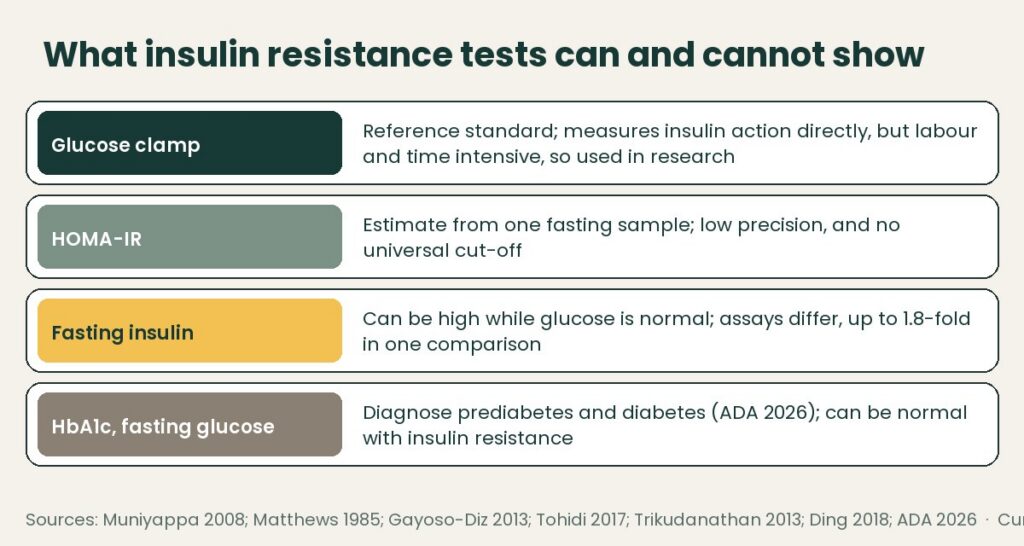
- What doctors usually order: HbA1c and fasting glucose, which show whether blood sugar has already risen [1] [7].
- Estimates from a fasting sample: fasting insulin, HOMA-IR and a related index, QUICKI [20].
- How well the estimates track the clamp: in a Boston study of 23 South Asians and 18 white adults, HOMA-IR, QUICKI and the triglyceride-to-HDL ratio correlated with the clamp in South Asians but not in white adults [17].
What is a normal fasting insulin level?
No guideline we found sets a universal normal fasting insulin level, and the ADA does not use fasting insulin for diagnosis [7]. Use the range printed on your own report, because results depend on the laboratory method:
- Eight assays (2017): on 165 samples, results differed by up to 1.8-fold, and the authors noted there is no reference method for insulin assays [6].
- Twelve immunoassays (2025): on 40 samples, each was repeatable, but only one fully agreed with isotope dilution mass spectrometry, even though all claimed the same WHO standard [21].
The same blood could therefore look “normal” at one laboratory and “high” at another. Where you can, compare results from the same laboratory method, and read them alongside glucose, waist and blood fats.
What is HOMA-IR, and what is a normal HOMA-IR?
HOMA-IR (homeostasis model assessment of insulin resistance) is a calculated estimate from fasting glucose and fasting insulin, first described in 1985 [2]. No universal normal value exists: thresholds in three published studies run from 1.85 to 5.9, depending on the population, the method and what the index was tested against [3] [4] [5].
The calculation: HOMA-IR equals fasting glucose in mg/dL multiplied by fasting insulin in µU/mL, divided by 405 [4]; with glucose in mmol/L, divide by 22.5 [3]. With made-up values of 90 mg/dL and 10 µU/mL, HOMA-IR is about 2.2. Check the units, since some laboratories report insulin in pmol/L.
| Study and people | Threshold, and what it was set against |
|---|---|
| USA, 167 white adults [4] | Above 5.9, or 2.8 to 5.9 with low HDL (glucose clamp) |
| Spain, 2,459 adults [3] | 3.46 (population 90th percentile); 2.05 (metabolic syndrome); 1.85 in men without diabetes |
| Brazil, 1,203 adults without diabetes [5] | Above 2.7 (90th percentile of a healthy group); above 2.3 (metabolic syndrome) |
We found no Indian national cut-off. A newer version, HOMA2-IR, gives different numbers: in the Brazilian study its insulin resistance threshold was 1.8 rather than 2.7 [5]. Do not compare one with the other.
What HOMA-IR can show:
- Agreement with the clamp: in the original 1985 work it correlated well with the clamp (Rs 0.88) [2].
- Future risk in groups: in a 2022 systematic review of 38 cohort studies with 215,878 people, higher HOMA-IR went with more type 2 diabetes (hazard ratio 1.87), non-fatal heart events and high blood pressure, though not with cardiovascular or cancer deaths [22].
What it cannot show:
- A precise figure for one person: the 1985 authors reported a coefficient of variation of 31% and said this low precision limits its use [2]. A 2004 review from the same group names cohort and epidemiological studies as appropriate uses and stresses careful interpretation [23].
- A diagnosis or treatment trigger: the ADA’s 2026 diagnostic criteria do not use HOMA-IR [7].
- How well the pancreas is coping: HOMA-IR estimates resistance only; the same model’s separate estimate of insulin production also has low precision [2], and the 2004 review lists measuring it in isolation as inappropriate use [23].
Why is insulin resistance common in Indians?
The reasons are not fully understood, but studies point to differences in insulin action and body composition. In the USA, Asian Indian men had lower glucose disposal on the clamp than white men even after adjusting for body fat [24], and the MASALA study of South Asians found higher liver fat and less lean muscle than in four other US groups [25].
A 2013 systematic review noted that type 2 diabetes comes at a younger age and lower BMI in South Asians, and concluded that insulin resistance seems to be the main mechanism rather than poor insulin production [26]. This is not fully settled: MASALA also found lower insulin secretion [25].
- Related conditions in India: the ICMR-INDIAB-17 survey found diabetes in 11.4% of adults; it counted diabetes, prediabetes and obesity, not insulin resistance itself [8].
- Lower thresholds: the ADA advises considering diabetes testing from a BMI of 23, rather than 25, in people of Asian ancestry with a further risk factor [7], and an Indian consensus sets lower limits of normal BMI [27].
How is insulin resistance treated?
Insulin resistance is managed mainly with lifestyle change. We found no guideline that sets treatment by a HOMA-IR number, so this follows the ADA’s 2026 Standards of Care for prediabetes and people at high risk of type 2 diabetes:
- Weight and activity: the ADA advises prevention programmes for high-risk adults with overweight or obesity, aiming for at least 5% to 7% weight loss with a reduced-calorie eating pattern and at least 150 minutes of moderate activity a week [28].
- Eating pattern: the ADA advises an evidence-based pattern, such as Mediterranean or low carbohydrate, for people with prediabetes [28].
- Metformin: the ADA says to consider it in adults at high risk, especially those aged 25 to 59 with a BMI of 35 or above, higher fasting glucose and higher HbA1c, and in people with past gestational diabetes [28].
- GLP-1 medicines: the ADA notes that semaglutide and tirzepatide lowered new type 2 diabetes in prediabetes, but that long-term data for diabetes prevention alone support only metformin; it adds that using them for weight management in overweight or obesity brings high benefit and should be considered [28].
The research behind this includes a randomised trial from India:
- Indian Diabetes Prevention Programme: in 531 Asian Indians with impaired glucose tolerance, mean BMI 25.8, three-year diabetes incidence was 55.0% in controls, 39.3% with lifestyle advice and 40.5% with metformin, with no added benefit from combining them [29].
- US Diabetes Prevention Program: in a randomised trial of 3,234 people with a mean BMI of 34, lifestyle change lowered new diabetes by 58% and metformin by 31% against placebo [30].
- Exercise: in a 2021 network meta-analysis of 13 studies in prediabetes, aerobic, resistance and combined training all helped; aerobic ranked highest for HbA1c and HOMA-IR [31].
- Meal timing: a proof-of-concept feeding trial in men with prediabetes found that eating early in the day within 6 hours, with dinner before 3 p.m., improved insulin sensitivity without weight loss [32]; larger trials are needed.
Can insulin resistance improve?
Insulin resistance can improve, though not always back to normal. Writing about type 2 diabetes, the ADA says it may improve with weight reduction, physical activity or medicines for high blood sugar, but is seldom restored to normal [7]. In prediabetes, a network meta-analysis found that exercise improved it [31]. If you also have fatty liver, our article on fatty liver grades explains what the scan means.
How we assess and manage insulin resistance at Cure4Pain
At Cure4Pain, insulin resistance with normal blood sugar is managed with almost the same plan as type 2 diabetes.
- Who we see: adults and young people aged 16 and over. We refer children to a paediatrician and pregnant women to their obstetrician.
- Tests first: we read a panel of about 100 markers, adding tests for your condition when clinically indicated, such as a 2-hour glucose tolerance test, which the ADA’s 2026 criteria include [7]. It covers HbA1c, fasting glucose and fasting insulin, with HOMA-IR when needed, lipids, kidney and liver function; the panel is our clinic protocol, not a guideline requirement. We use HOMA-IR to follow one person over time, not as a diagnosis, and its low precision applies here too.
- Added where relevant: uric acid, a liver ultrasound or liver stiffness scan, waist measurement, body composition, thyroid tests and cortisol.
- Diet: low carbohydrate, home cooked and no processed foods; fruit and raw foods limited, with whole raw fruit once in a while; and three meals a day. We consider intermittent fasting for suitable patients under supervision. Also, as clinic practice, we generally advise most patients to replace wheat with jowar, bajra or other millets as a general health measure, including home-made roti from processed wheat.
- Research beside the diet: millets had a lower glycaemic index than refined wheat or milled rice in a 2021 meta-analysis [33], but we found no study showing that wheat itself harms people without coeliac disease; a gluten-free diet is supported for coeliac disease and positive tests, and the NHS says people with coeliac disease must stop all gluten for life [34]. Large US cohorts linked whole fruit with slightly lower diabetes risk and fruit juice with higher risk [35]. ADA 2026 advises medical monitoring during fasting for people with diabetes on insulin or secretagogue medicines, and says rigid meal plans can be contraindicated for people at increased risk of maladaptive eating behaviours [36]. We also do not advise fasting in pregnancy or breastfeeding.
- Cruciferous vegetables: as an observational clinic practice, we generally suggest limiting cruciferous (Brassica) vegetables such as cabbage and cauliflower. Research beside this: broccoli sprout powder lowered HOMA-IR in a small trial in type 2 diabetes [37], a sprout extract in prediabetes missed its main target with a small fall in fasting glucose [38], and a 2024 review found no harm to thyroid function with adequate iodine [39].
- Exercise: resistance training for lean muscle, 5,000 to 7,000 steps a day, walking after meals, yoga and Buteyko breathing, with waist measured rather than a target weight. We found no trial of Buteyko breathing in insulin resistance.
- Nutrients: vitamin D corrected with standard supplement doses in most cases, plus magnesium (mainly bisglycinate, with L-threonate or citrate as advised, counted as elemental magnesium; absorption varies by form) and vitamin B12 as needed, within official limits, with support for digestion and bile flow. Supplements are given by mouth first, with injections only when specifically needed or advised. Omega-3 is part of each patient’s nutrition plan, food first with a supplement where food falls short, unless contraindicated. In the D2d trial of 2,423 adults with prediabetes, vitamin D did not significantly lower diabetes risk [40], so we use it to correct a deficiency.
- Berberine and inositol: used where needed. Berberine lowered triglycerides, fasting glucose and waist in a 2025 meta-analysis, whose authors asked for better trials [41]; inositol evidence in PCOS is limited and inconclusive [42]. Please do not start berberine on your own if you take diabetes or other medicines.
- Medicines: Dr Krushal Pabari prescribes metformin in prediabetes where it is indicated, and reviews and adjusts metformin, statins and blood-pressure medicines case by case, under clinical guidance from Team Cure4Pain, in coordination with your existing consulting physician; medicines are reduced only gradually, and never stop or change them on your own. We do not usually prescribe GLP-1 weight-loss medicines and consider them only where clearly needed; if you already take one, we work alongside it.
- Follow-up: blood tests every 3 months, with monitoring continued for life. Many people notice changes in waist size, triglycerides and blood sugar markers within about 3 months; this is an observation, not a trial result, and individual results vary. How long care lasts differs from person to person.
An integrative plan may add options alongside standard care. This is our clinic practice; individual results vary, and further studies are needed. Read more on our metabolic syndrome and type 2 diabetes pages.
If you would like your results reviewed together with your diet, activity and medicines, you can book a consultation, online from anywhere or at our Mumbai clinic.
Frequently asked questions
What are the first signs of insulin resistance?
Usually there are none, according to NIDDK. A large waist, dark velvety skin on the neck or armpits, high triglycerides or PCOS are reasons to ask about blood sugar testing, but none confirms it. [1] [7]
Can you have insulin resistance with a normal HbA1c?
Yes. Fasting insulin can be high while glucose is normal in small clamp studies of South Asians, and in a clamp study of normal-weight Asians insulin sensitivity was 20% to 30% lower although HbA1c did not differ from controls. [17] [18] [10]
What is a normal HOMA-IR?
There is no universal value. Thresholds in three published studies range from 1.85 to 5.9, depending on the population and method, and we found no Indian national cut-off. [3] [4] [5]
What is a normal fasting insulin level?
We found no guideline that sets a universal range. Use the range on your own report, because laboratory methods differed by up to 1.8-fold in one comparison. [6]
Is insulin resistance the same as prediabetes?
No. Prediabetes is defined by glucose or HbA1c. Insulin resistance describes how the body responds to insulin, and fasting insulin can be high while glucose is still normal. [7] [17]
Can insulin resistance go away?
It can improve with weight reduction and physical activity. In type 2 diabetes, the ADA says it is seldom restored to normal, so monitoring continues. [7]
Can thin people have insulin resistance?
Yes. In a clamp study, normal-weight Asians with more abdominal and liver fat had 20% to 30% lower insulin sensitivity than matched controls, and South Asians develop type 2 diabetes at a lower BMI. [10] [26]
Is metformin needed for insulin resistance?
Not automatically. The ADA advises considering it for adults at high risk of type 2 diabetes, especially those aged 25 to 59 with a BMI of 35 or above and higher glucose and HbA1c, and after gestational diabetes. Do not start or stop it on your own. [28]
This article is for education and does not replace medical advice. Do not start, stop or change any medicine or supplement without medical guidance.
References
1. National Institute of Diabetes and Digestive and Kidney Diseases (NIDDK), US National Institutes of Health. Insulin Resistance & Prediabetes. niddk.nih.gov
2. Matthews DR, et al. Homeostasis model assessment: insulin resistance and beta-cell function from fasting plasma glucose and insulin concentrations in man. Diabetologia 1985;28(7):412-9. doi:10.1007/BF00280883
3. Gayoso-Diz P, et al. Insulin resistance (HOMA-IR) cut-off values and the metabolic syndrome in a general adult population: effect of gender and age: EPIRCE cross-sectional study. BMC Endocr Disord 2013;13:47. doi:10.1186/1472-6823-13-47
4. Tam CS, et al. Defining insulin resistance from hyperinsulinemic-euglycemic clamps. Diabetes Care 2012;35(7):1605-10. doi:10.2337/dc11-2339
5. Geloneze B, et al. HOMA1-IR and HOMA2-IR indexes in identifying insulin resistance and metabolic syndrome: Brazilian Metabolic Syndrome Study (BRAMS). Arq Bras Endocrinol Metabol 2009;53(2):281-7. doi:10.1590/s0004-27302009000200020
6. Tohidi M, et al. Assay-dependent variability of serum insulin concentrations: a comparison of eight assays. Scand J Clin Lab Invest 2017;77(2):122-129. doi:10.1080/00365513.2016.1278260
7. American Diabetes Association Professional Practice Committee for Diabetes. 2. Diagnosis and Classification of Diabetes: Standards of Care in Diabetes-2026. Diabetes Care 2026;49(Supplement_1):S27-S49. doi:10.2337/dc26-S002
8. Anjana RM, et al. Metabolic non-communicable disease health report of India: the ICMR-INDIAB national cross-sectional study (ICMR-INDIAB-17). Lancet Diabetes Endocrinol 2023;11(7):474-489. doi:10.1016/S2213-8587(23)00119-5
9. Srikanthan P, Karlamangla AS. Relative muscle mass is inversely associated with insulin resistance and prediabetes. Findings from the third National Health and Nutrition Examination Survey. J Clin Endocrinol Metab 2011;96(9):2898-903. doi:10.1210/jc.2011-0435
10. Ding C, et al. Regulation of glucose metabolism in nondiabetic, metabolically obese normal-weight Asians. Am J Physiol Endocrinol Metab 2018;314(5):E494-E502. doi:10.1152/ajpendo.00382.2017
11. MedlinePlus, US National Library of Medicine. Acanthosis nigricans. medlineplus.gov/ency/article/000852.htm
12. Singh SK, et al. Association of Acanthosis Nigricans and Acrochordon with Insulin Resistance: A Cross-Sectional Hospital-Based Study from North India. Indian J Dermatol 2020;65(2):112-117. doi:10.4103/ijd.IJD_646_18
13. Alberti KG, et al. Harmonizing the metabolic syndrome: a joint interim statement of the International Diabetes Federation Task Force on Epidemiology and Prevention; National Heart, Lung, and Blood Institute; American Heart Association; World Heart Federation; International Atherosclerosis Society; and International Association for the Study of Obesity. Circulation 2009;120(16):1640-5. doi:10.1161/CIRCULATIONAHA.109.192644
14. Dantoft TM, et al. Unfavourable glucose metabolism is associated with functional somatic disorders. A cross-sectional general population-based study: The DanFunD study. Psychoneuroendocrinology 2025;172:107258. doi:10.1016/j.psyneuen.2024.107258
15. Banti S, et al. Insulin resistance in various grades of acanthosis nigricans. Acta Dermatovenerol Alp Pannonica Adriat 2022;31(3):101-104. PubMed 36149039
16. Nithun TM, et al. Association of Acanthosis Nigricans and Insulin Resistance in Indian Children and Youth – A HOMA2-IR Based Cross-Sectional Study. Indian Dermatol Online J 2019;10(3):272-278. doi:10.4103/idoj.IDOJ_303_18
17. Trikudanathan S, et al. Comparison of insulin sensitivity measures in South Asians. Metabolism 2013;62(10):1448-54. doi:10.1016/j.metabol.2013.05.016
18. Raji A, et al. Body fat distribution and insulin resistance in healthy Asian Indians and Caucasians. J Clin Endocrinol Metab 2001;86(11):5366-71. doi:10.1210/jcem.86.11.7992
19. Bruhn L, et al. Physiological factors contributing to HbA(1c) in the normal and pre-diabetic range: a cross-sectional analysis. Endocrine 2020;68(2):306-311. doi:10.1007/s12020-020-02234-3
20. Muniyappa R, et al. Current approaches for assessing insulin sensitivity and resistance in vivo: advantages, limitations, and appropriate usage. Am J Physiol Endocrinol Metab 2008;294(1):E15-26. doi:10.1152/ajpendo.00645.2007
21. Rohlfing C, et al. The current status of serum insulin measurements and the need for standardization. Clin Chem Lab Med 2025;63(12):2442-2446. doi:10.1515/cclm-2025-0552
22. González-González JG, et al. HOMA-IR as a predictor of Health Outcomes in Patients with Metabolic Risk Factors: A Systematic Review and Meta-analysis. High Blood Press Cardiovasc Prev 2022;29(6):547-564. doi:10.1007/s40292-022-00542-5
23. Wallace TM, et al. Use and abuse of HOMA modeling. Diabetes Care 2004;27(6):1487-95. doi:10.2337/diacare.27.6.1487
24. Chandalia M, et al. Relationship between generalized and upper body obesity to insulin resistance in Asian Indian men. J Clin Endocrinol Metab 1999;84(7):2329-35. doi:10.1210/jcem.84.7.5817
25. Kanaya AM. Diabetes in South Asians: Uncovering Novel Risk Factors With Longitudinal Epidemiologic Data: Kelly West Award Lecture 2023. Diabetes Care 2024;47(1):7-16. doi:10.2337/dci23-0068
26. Bakker LE, et al. Pathogenesis of type 2 diabetes in South Asians. Eur J Endocrinol 2013;169(5):R99-R114. doi:10.1530/EJE-13-0307
27. Misra A, et al. Consensus statement for diagnosis of obesity, abdominal obesity and the metabolic syndrome for Asian Indians and recommendations for physical activity, medical and surgical management. J Assoc Physicians India 2009;57:163-70. PubMed 19582986
28. American Diabetes Association Professional Practice Committee for Diabetes. 3. Prevention or Delay of Diabetes and Associated Comorbidities: Standards of Care in Diabetes-2026. Diabetes Care 2026;49(Supplement_1):S50-S60. doi:10.2337/dc26-S003
29. Ramachandran A, et al. The Indian Diabetes Prevention Programme shows that lifestyle modification and metformin prevent type 2 diabetes in Asian Indian subjects with impaired glucose tolerance (IDPP-1). Diabetologia 2006;49(2):289-97. doi:10.1007/s00125-005-0097-z
30. Knowler WC, et al. Reduction in the incidence of type 2 diabetes with lifestyle intervention or metformin. N Engl J Med 2002;346(6):393-403. doi:10.1056/NEJMoa012512
31. Huang L, et al. Comparisons of different exercise interventions on glycemic control and insulin resistance in prediabetes: a network meta-analysis. BMC Endocr Disord 2021;21(1):181. doi:10.1186/s12902-021-00846-y
32. Sutton EF, et al. Early Time-Restricted Feeding Improves Insulin Sensitivity, Blood Pressure, and Oxidative Stress Even without Weight Loss in Men with Prediabetes. Cell Metab 2018;27(6):1212-1221.e3. doi:10.1016/j.cmet.2018.04.010
33. Anitha S, et al. A Systematic Review and Meta-Analysis of the Potential of Millets for Managing and Reducing the Risk of Developing Diabetes Mellitus. Front Nutr 2021;8:687428. doi:10.3389/fnut.2021.687428
34. NHS (UK National Health Service). Coeliac disease: treatment. nhs.uk/conditions/coeliac-disease/treatment
35. Muraki I, et al. Fruit consumption and risk of type 2 diabetes: results from three prospective longitudinal cohort studies. BMJ 2013;347:f5001. doi:10.1136/bmj.f5001
36. American Diabetes Association Professional Practice Committee for Diabetes. 5. Facilitating Positive Health Behaviors and Well-being to Improve Health Outcomes: Standards of Care in Diabetes-2026. Diabetes Care 2026;49(Supplement_1):S89-S131. doi:10.2337/dc26-S005
37. Bahadoran Z, et al. Effect of broccoli sprouts on insulin resistance in type 2 diabetic patients: a randomized double-blind clinical trial. Int J Food Sci Nutr 2012;63(7):767-71. doi:10.3109/09637486.2012.665043
38. Dwibedi C, et al. Effect of broccoli sprout extract and baseline gut microbiota on fasting blood glucose in prediabetes: a randomized, placebo-controlled trial. Nat Microbiol 2025;10(3):681-693. doi:10.1038/s41564-025-01932-w
39. Galanty A, et al. Do Brassica Vegetables Affect Thyroid Function?-A Comprehensive Systematic Review. Int J Mol Sci 2024;25(7). doi:10.3390/ijms25073988
40. Pittas AG, et al. Vitamin D Supplementation and Prevention of Type 2 Diabetes. N Engl J Med 2019;381(6):520-530. doi:10.1056/NEJMoa1900906
41. Liu D, et al. Efficacy and safety of berberine on the components of metabolic syndrome: a systematic review and meta-analysis of randomized placebo-controlled trials. Front Pharmacol 2025;16:1572197. doi:10.3389/fphar.2025.1572197
42. Fitz V, et al. Inositol for Polycystic Ovary Syndrome: A Systematic Review and Meta-analysis to Inform the 2023 Update of the International Evidence-based PCOS Guidelines. J Clin Endocrinol Metab 2024;109(6):1630-1655. doi:10.1210/clinem/dgad762