Written by AT. Chintan Dalal, N.D. · Reviewed by Dr Krushal Pabari, Clinical Team, Cure4Pain · Updated 30 October 2026
Key facts
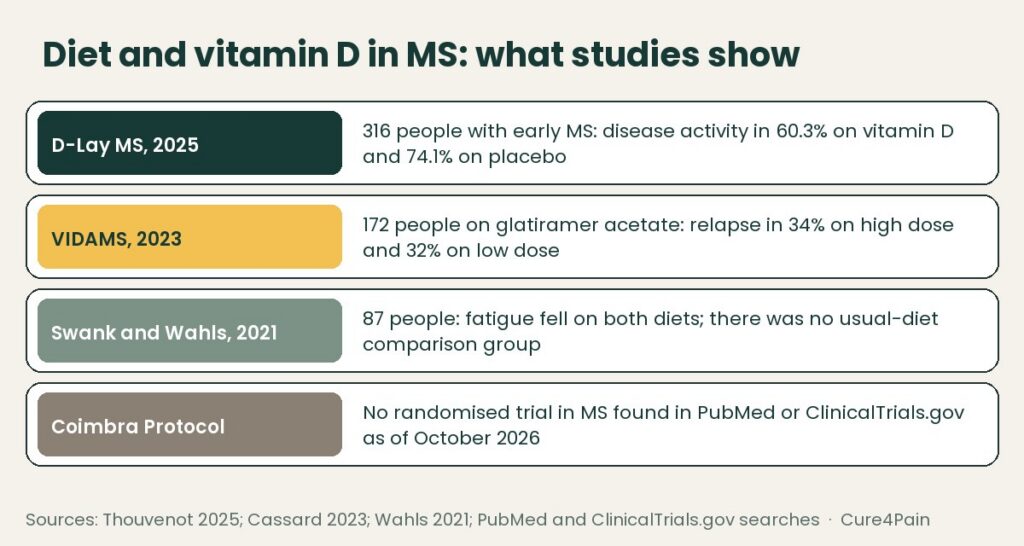
No diet has been shown in a large trial to change relapses or MRI activity in multiple sclerosis (MS). A 2023 analysis of 12 trials in Neurology found that several diets may ease fatigue, but rated the evidence very low [1]. On vitamin D, low levels are a well-supported risk factor for developing MS: in a 2015 genetic study in PLoS Medicine, each standard deviation of genetically lower vitamin D about doubled the odds of MS [2]. Treatment trials disagree: the 2025 D-Lay MS trial in JAMA found less disease activity in early MS [3], while the 2023 VIDAMS trial and a 2018 Cochrane review found no clear benefit in established MS [4] [5]. The UK’s NICE guideline advises: “Do not offer vitamin D solely for the purpose of treating MS” [6]. We found no randomised trial of the Coimbra Protocol in MS as of 30 October 2026.

Scientific explainer videos in our Resources section
In our Resources section, our clinical team discusses vitamin D, its cofactors and how autoimmune, lifestyle and pain conditions develop.
Is there a special diet for multiple sclerosis?
No specific diet is proven for multiple sclerosis (MS). The UK’s NICE guideline (NG220, 2022) explains that no evidence shows a specific diet improves MS fatigue, and that a healthy diet benefits general health [6].
- Cochrane review, 2020: across 30 trials, all with unknown or high risk of bias, there was not enough evidence to say whether antioxidants or other dietary interventions affect MS outcomes [7].
- Network analysis in Neurology, 2023: in 12 trials with 608 people, Paleolithic, low-fat and Mediterranean diets reduced fatigue more than a usual diet, but the credibility of the evidence was very low [1].
- Large survey, 2018: among 6,989 people in a North American registry, those with the healthiest diets had less disability and lower depression scores. This was a cross-sectional survey, so it cannot show cause [8].
Swank or Wahls: which diet is better for MS?
Neither the Swank nor the Wahls diet has been clearly shown to be better for MS. The one trial that compared them directly, WAVES (2021), randomised 87 people with relapsing MS and fatigue. Fatigue fell on both diets, with no difference in the size of the change on its main fatigue score. Quality of life scores, and a second fatigue score at 24 weeks, improved more on Wahls, but the trial had no usual-diet comparison group and its lead author has financial interests in the Wahls diet [9].
- Swank diet: the Swank diet for MS restricts saturated fat and allows set amounts of unsaturated fat, grains, fruit and vegetables [9].
- Wahls diet: the Wahls diet for MS is a modified Paleolithic plan with plenty of vegetables and fruit and with meat. It excludes grains, legumes, eggs and dairy, and in the WAVES trial it also excluded nightshades for the first 12 weeks [9].
| Study | What it found | Limits |
|---|---|---|
| WAVES, 2021: 87 people with relapsing MS and fatigue randomised to Swank or Wahls [9] | Fatigue and quality of life improved on both; quality of life at 12 and 24 weeks and a second fatigue score at 24 weeks improved more on Wahls; walking distance did not change at 12 weeks, and by 24 weeks had risen only on Wahls | Short, self-reported outcomes, no usual-diet group; the lead author created the Wahls diet and declared financial interests in it |
| Swank, 1990: 144 people followed for 34 years [10] | Those keeping to the fat limit had less deterioration and lower death rates | People were compared by how closely they kept to the diet, not by random assignment |
| Very-low-fat plant-based diet, 2016: 61 people, 1 year [11] | Fatigue, weight and cholesterol improved; no difference in MRI, relapses or disability | Only very large MRI effects could be detected; control group was a waiting list |
The evidence on Swank and Wahls points in different directions. The 34-year Swank follow-up and the fatigue changes on Wahls look encouraging, but a 2020 Cochrane review found insufficient evidence for dietary interventions, and the UK’s NICE guideline finds no evidence that a specific diet improves fatigue [7] [6]. Nutrients also need attention: in the WAVES trial, with dietitian support, both diets reduced inadequate intake overall compared with people’s usual diet, but it rose for calcium, thiamin and vitamin B12 on Wahls and for vitamin A on Swank, and with supplements, excessive vitamin D intake rose on both [12].
Does a Mediterranean diet help MS?
A Mediterranean diet may ease fatigue in MS, but small trials disagree on whether it changes disability.
- Pilot trial, 2019: 36 women with MS in the US on a modified Mediterranean diet, without meat and dairy, for 6 months had less fatigue and lower disability scores than the comparison group, but these were exploratory results in a study built to test feasibility [13].
- Larger trial, 2022: among 180 people with MS randomised in Iran, of whom 147 were analysed, a modified Mediterranean diet reduced fatigue after 6 months, with no considerable change in disability [14].
- Prevention, not treatment: in a 2026 cohort of 41,428 Swedish adults followed for a mean of 17.6 years, each one-point rise in a Mediterranean diet score went with a 14% lower risk of developing MS, based on 89 cases [15].
Do ketogenic diets or fasting help MS?
Ketogenic diets and fasting are not proven to help MS, and early results are mixed. In a 2025 German randomised trial of 105 people followed for 18 months, new MRI lesions, the main outcome, did not change on either diet [16].
- German trial, 2025: 105 people with relapsing MS followed a standard healthy diet, a fasting diet or a ketogenic diet for 18 months, and 81 completed it. New MRI lesions did not change in any group. In exploratory results against each group’s own baseline, neurofilament light chain, a blood marker, was lower at 9 months on fasting, and a cognition score was better at 18 months on the ketogenic diet; heart and metabolic markers improved in all three groups [16].
- Ketogenic diet, 2022: in a 6-month study of 65 people with relapsing MS and no comparison group, self-reported fatigue and depression scores fell by nearly half [17].
- Ramadan fasting: a 2026 review of four small reports with 481 people, all from the Eastern Mediterranean region, found no link with more relapses overall, but higher disability and longer disease raised the risk of MS activity during Ramadan [18].
These diets can be demanding, so discuss them with your neurologist first, especially if you take medicines or have other conditions. Given this early evidence, at Cure4Pain we consider a ketogenic or fasting plan only for suitable patients under supervision. A 2026 review in Annals of Medicine lists pregnancy, breastfeeding, diabetes on some glucose-lowering medicines and advanced liver or kidney disease among the situations needing caution or medical supervision on keto [19]. We do not advise fasting without supervision for people with diabetes on medicines, pregnant or breastfeeding women, or anyone with a history of eating disorders.
Should you avoid gluten, dairy or sugar with MS?
No single food, including gluten, dairy or sugar, has been shown to change the course of MS. The table sets what research shows beside what we advise at Cure4Pain during supervised vitamin D therapy.
| Food | What research shows | Our clinic practice |
|---|---|---|
| Wheat and gluten | A 2026 review found six small studies; none isolated gluten in a randomised comparison, and certainty was very low [20]. A gluten-free diet is required in coeliac disease, according to the American College of Gastroenterology (2023) [21] | As clinic practice, we generally advise most patients to replace wheat with jowar, bajra or other millets as a general health measure |
| Dairy | Dairy intake, estimated retrospectively, was not linked with disease activity in 186 people [22]; pooled studies on developing MS are inconclusive [23] | Removed to limit calcium; small amounts of yogurt or kefir may be allowed within your calcium limit; ghee is allowed |
| Sugar | Part of a diet score linked with less disability in a survey [8]; we found no trial of sugar alone | Removed |
| Nightshades | Excluded for 12 weeks in the Wahls diet [9]; we found no human study of nightshades alone in MS | Removed |
| Cold foods and drinks | We found no study in MS | Removed |
| Cruciferous vegetables | We found no study in MS; a 2024 review found that normal intake with enough iodine did not harm thyroid function [24] | As an observational clinic practice, we generally suggest limiting these |
Rules that are clinic practice are not research findings; we state them so that you know exactly what we advise and where the evidence is thinner. On salt, we report research only: a 2019 systematic review of 12 human, animal and cellular studies described emerging evidence linking sodium intake with MS progression and called for more studies [25].
Omega-3: The UK’s NICE guideline advises against omega-3 or omega-6 compounds to treat MS, explaining that there is no evidence they affect relapses or progression [6], and a 2020 Cochrane review found little to no difference in relapses and disability between omega-3 and omega-6 [7]. At Cure4Pain, omega-3 is a general nutrient in each plan unless there is a reason not to use it, from fish or from algal oil for vegetarians and vegans. It is not used as an MS treatment.
Does vitamin D help multiple sclerosis?
Low vitamin D is linked with a higher risk of developing multiple sclerosis (MS), but whether vitamin D supplements change the course of the disease is unsettled. People with MS have lower levels than healthy controls, according to a 2026 meta-analysis [26], and a 2015 genetic study in PLoS Medicine supports a causal link with developing MS [2]. Treatment trials point in different directions, and none tested the Coimbra Protocol.
| Trial | Who | What it found |
|---|---|---|
| D-Lay MS, JAMA 2025 [3] | 316 untreated people in France with a first MS-like episode; vitamin D alone or placebo | Disease activity over 24 months in 60.3% on vitamin D against 74.1% on placebo; fewer MRI lesions; relapses alone did not differ significantly (17.9% against 21.8%) |
| PrevANZ, Brain 2024 [27] | 204 people in Australia and New Zealand after a first episode; three daily doses or placebo | No reduction in conversion to MS at 48 weeks |
| SOLAR, Neurology 2019 [28] | 229 people with relapsing MS on interferon | No difference in freedom from disease activity (36.3% on vitamin D against 35.3% on placebo); fewer active MRI lesions, an exploratory result |
| CHOLINE, 2019 [29] | 181 people on interferon with low vitamin D | Main outcome not met; better results on vitamin D among the 90 who completed 2 years |
| EVIDIMS, 2020 [30] | 53 people on interferon, high against low dose | No difference; authors say the trial was too small to decide |
| VIDAMS, 2023 [4] | 172 people on glatiramer acetate, high against low dose | Relapse at 96 weeks in 34% on high dose against 32% on low dose, not a significant difference |
- Cochrane review, 2018: 12 trials with 933 people; very low-quality evidence suggested no benefit on relapses, disability or MRI lesions. It predates D-Lay MS [5].
- Meta-analysis in Frontiers in Immunology, 2026: across 22 supplementation studies, vitamin D supplements overall did not significantly lower relapses or disability. A high-dose subgroup had fewer relapses, but comparing doses directly showed no significant difference in relapse rates [26].
- Why vitamin D trial results may differ: D-Lay MS studied untreated early disease for 24 months, while SOLAR, CHOLINE, EVIDIMS and VIDAMS added vitamin D to interferon or glatiramer acetate. PrevANZ also studied early disease, for 48 weeks, and did not show a reduction in conversion to MS, so timing alone does not settle it [3] [27] [28] [29] [30] [4].
The UK’s NICE guideline has advised against vitamin D solely as MS treatment since 2014, and that advice stands in the guideline as updated in August 2026 [6]. Our article on vitamin D in autoimmune disease gives the wider picture.
Is high-dose vitamin D safe in MS?
High-dose vitamin D was generally well tolerated in MS trials lasting up to about 2 years, but long-term safety is not established and self-dosing has caused harm.
- In trials: in D-Lay MS no serious side effect was related to vitamin D [3]. VIDAMS reported no high calcium, though 3 people developed kidney or ureter stones, and 2 of these were possibly related to the study drug [4].
- Long-term gap: a 2020 review in Nutrients describes a knowledge gap for long-term high doses, with possible kidney failure, heart rhythm problems and seizures. It adds that toxicity can look like progressive MS, with fatigue, weakness and bladder problems [31].
- Self-dosing: a 2019 report in the Irish Medical Journal describes a 45-year-old man with MS treated for symptomatic high calcium after taking vitamin D3 bought online, and a 2025 report in a Swiss journal describes a woman with MS hospitalised with severe high calcium after starting high-dose vitamin D herself [32] [33].
- Laboratory signal: in a 2019 study in Brain, in mice with an MS-like disease, moderate vitamin D helped, while high doses that raised calcium made the disease worse [34]. This has not been shown in people.
- Official limit: the NHS advises adults not to take more than 100 micrograms (4,000 IU) a day [35]. See our article on vitamin D toxicity.
Please never copy vitamin D doses from forums or videos. Personal reports cannot separate a treatment’s effect from the natural course of MS, in which symptoms may come and go, according to the NHS [36].
Has the Coimbra Protocol been tested in MS?
No randomised trial has tested the Coimbra Protocol in multiple sclerosis (MS), as far as we can find. The Coimbra Protocol is a method of high-dose vitamin D therapy developed by Dr Cicero Coimbra in Brazil, with a strict low-calcium diet and at least 2.5 litres of fluid a day [37]. Our methods are derived from the work of Dr Coimbra, so please read this section with that in mind. Our search of PubMed and ClinicalTrials.gov on 30 October 2026 returned no randomised trial of it.
- Other vitamin D trials: MS trials such as D-Lay MS and VIDAMS gave fixed vitamin D schedules, while the Coimbra Protocol adjusts doses to blood tests [38], so their results do not test it directly in either direction.
- Safety study in Nutrients, 2022: in 319 people with various autoimmune diseases treated under the Coimbra Protocol, average calcium and kidney results stayed in the normal range for up to 3.5 years. It did not test whether the protocol helps MS, and it came from one centre with no comparison group [37].
- Hypothesis paper, 2021: doctors who use the protocol argue from their experience with MS that acquired vitamin D resistance explains the need for high doses. This is not a trial [38].
How we approach diet and vitamin D in MS at Cure4Pain
At Cure4Pain, Dr Krushal Pabari leads MS care, online worldwide, as lifelong management that adds supervised vitamin D therapy and a nutritional layer to guideline MS treatment and never replaces it.
- Assessment first: your MRI reports, neurologist letters and medicines. We read a panel of about 100 markers with ANA by the IFA method, at a laboratory near you, adding tests for your condition when clinically indicated, such as MRI and cerebrospinal fluid oligoclonal bands, which the 2017 McDonald diagnostic criteria use [39].
- Supervised vitamin D therapy (Coimbra Protocol): doses are set for each person and adjusted to blood tests. Our methods are derived from the work of Dr Coimbra, and we give the Coimbra Protocol full credit. The UK’s NICE guideline advises against vitamin D solely to treat MS, and we found no randomised trial of the protocol in MS; an integrative plan may add this option alongside standard care, never in place of it.
- Monitoring: the full panel every 6 to 8 weeks is mandatory during therapy, and we coordinate with your local physician where needed before treatment starts.
- Diet: dairy (ghee is allowed), sugar, nightshades and cold foods and drinks removed, wheat replaced with jowar, bajra or other millets, and cruciferous vegetables limited as an observational practice (see the table above), at least 2.5 litres of fluid a day, and replacement foods so that protein and fibre stay adequate.
- Cofactors: magnesium, vitamin K2, vitamin B12, folate and vitamin B2 when tests or diet show a need, and omega-3 as described above, within official upper limits where these exist; see vitamin D3, K2 and magnesium. Supplements are given by mouth first, with injections only when specifically needed or advised; magnesium is mainly bisglycinate, with L-threonate or citrate as advised, counted as elemental magnesium.
- Other care: gut health, metabolic health, thyroid and sleep in the same plan, and an exercise protocol delivered by a local physiotherapist who reports back every 3 months. We do not use acupuncture or needling in MS.
- Pregnancy: vitamin D stays at standard supplement doses, with your neurologist and obstetrician.
Guideline medicines. According to NICE NG220 (2022, updated 2026) [6], and with the ECTRIMS/EAN guideline (2018) [40] and American Academy of Neurology guideline (2018) [41] guiding starting, switching and stopping, standard treatment includes the following. Availability differs by country.
| Situation | Medicines (generic names) |
|---|---|
| Relapse affecting daily tasks | Methylprednisolone by mouth, or into a vein in selected cases |
| Active relapsing MS | Interferon beta, peginterferon beta-1a, glatiramer acetate, teriflunomide, dimethyl fumarate, diroximel fumarate, ponesimod, ofatumumab, ocrelizumab, ublituximab, cladribine |
| Highly active or rapidly evolving severe relapsing MS | Natalizumab, alemtuzumab, cladribine, ocrelizumab, ofatumumab, ublituximab; ponesimod and fingolimod in selected cases |
| Secondary progressive MS with active disease | Siponimod, interferon beta-1b |
| Early primary progressive MS with inflammatory changes on imaging | Ocrelizumab |
At Cure4Pain, Dr Krushal Pabari prescribes and adjusts these medicines as per guidelines, under clinical guidance from Team Cure4Pain, in coordination with your neurologist, who is kept in the loop, and your existing consulting physician; never stop or change them on your own.
This is our clinic practice; individual results vary, and further studies are needed. Read more on our multiple sclerosis, Coimbra Protocol and gut health pages.
If you would like a plan built around your reports and your MS treatment, you can book a consultation, online from anywhere or at our Mumbai clinic.
Frequently asked questions
What is the best diet for multiple sclerosis?
No diet is proven best for multiple sclerosis. Paleolithic, low-fat and Mediterranean diets each reduced fatigue compared with a usual diet in a 2023 analysis of 12 trials in Neurology, but the evidence was very low in credibility. The UK’s NICE guideline advises a healthy diet for general health. [1] [6]
What foods should you avoid with MS?
No food has been proven to worsen MS. During supervised vitamin D therapy at Cure4Pain we remove dairy (ghee is allowed), sugar, cold foods and drinks and nightshades, advise replacing wheat with millets, and suggest limiting cruciferous vegetables; this is clinic practice, and most of it is untested in trials. [7]
Is the Swank or Wahls diet better for MS?
Neither diet has been clearly shown to be better for MS. In the 2021 WAVES trial of 87 people, fatigue fell on both, with no difference in the size of the change on its main fatigue score, while quality of life improved more on Wahls. It had no usual-diet comparison group. Each diet raised inadequate intake of some nutrients. [9] [12]
Is dairy bad for MS?
It is not proven that dairy is bad for MS. Dairy intake, estimated retrospectively, was not linked with disease activity in a 2023 study of 186 people. At Cure4Pain dairy is removed during vitamin D therapy to limit calcium, not because it is shown to worsen MS; ghee is allowed. [22]
Does gluten affect MS?
Current evidence does not show that removing gluten itself helps MS. A 2026 review found six small studies, none isolating gluten in a randomised comparison. As clinic practice, we generally advise most patients to replace wheat with jowar, bajra or other millets as a general health measure; a gluten-free diet is required in coeliac disease. [20] [21]
Is intermittent fasting good for MS?
Whether intermittent fasting helps MS is not yet known. An 18-month German trial found that new MRI lesions did not change on a fasting diet, and a 2026 review of small Ramadan fasting studies found no link with more relapses overall. Discuss fasting with your neurologist first. [16] [18]
How much vitamin D should I take for MS?
No vitamin D dose has been established as treatment for MS. The UK’s NHS advises adults not to take more than 100 micrograms (4,000 IU) a day. Higher doses should be used only under medical supervision with regular blood tests. [35] [31]
Does high-dose vitamin D help MS?
Trials disagree on whether high-dose vitamin D helps MS. The 2025 D-Lay MS trial found less disease activity in early MS, while the VIDAMS and PrevANZ trials and a 2018 Cochrane review found no clear benefit. The UK’s NICE guideline advises against vitamin D solely to treat MS. [3] [4] [27] [5] [6]
Has the Coimbra Protocol been studied in MS?
We found no randomised trial of the Coimbra Protocol in MS. A 2022 safety study covered 319 people with various autoimmune diseases, but it did not test whether the protocol helps MS. [37]
Should I stop my MS medicines if I change my diet or take vitamin D?
No. Diet and vitamin D are not replacements for MS medicines. Never stop or change them on your own; any change is made under clinical guidance, in coordination with your neurologist.
This article is for education and does not replace medical advice. Do not start, stop or change any medicine or supplement without medical guidance.
References
1. Snetselaar LG, et al. Efficacy of Diet on Fatigue and Quality of Life in Multiple Sclerosis: A Systematic Review and Network Meta-analysis of Randomized Trials. Neurology 2023;100(4):e357-e366. doi:10.1212/WNL.0000000000201371
2. Mokry LE, et al. Vitamin D and Risk of Multiple Sclerosis: A Mendelian Randomization Study. PLoS Med 2015;12(8):e1001866. doi:10.1371/journal.pmed.1001866
3. Thouvenot E, et al. High-Dose Vitamin D in Clinically Isolated Syndrome Typical of Multiple Sclerosis: The D-Lay MS Randomized Clinical Trial. JAMA 2025;333(16):1413-1422. doi:10.1001/jama.2025.1604
4. Cassard SD, et al. High-dose vitamin D(3) supplementation in relapsing-remitting multiple sclerosis: a randomised clinical trial. EClinicalMedicine 2023;59:101957. doi:10.1016/j.eclinm.2023.101957
5. Jagannath VA, et al. Vitamin D for the management of multiple sclerosis. Cochrane Database Syst Rev 2018;9(9):CD008422. doi:10.1002/14651858.CD008422.pub3
6. National Institute for Health and Care Excellence (NICE). Multiple sclerosis in adults: management (NG220), published 2022, last updated 26 August 2026. nice.org.uk/guidance/ng220
7. Parks NE, et al. Dietary interventions for multiple sclerosis-related outcomes. Cochrane Database Syst Rev 2020;5(5):CD004192. doi:10.1002/14651858.CD004192.pub4
8. Fitzgerald KC, et al. Diet quality is associated with disability and symptom severity in multiple sclerosis. Neurology 2018;90(1):e1-e11. doi:10.1212/WNL.0000000000004768
9. Wahls TL, et al. Impact of the Swank and Wahls elimination dietary interventions on fatigue and quality of life in relapsing-remitting multiple sclerosis: The WAVES randomized parallel-arm clinical trial. Mult Scler J Exp Transl Clin 2021;7(3):20552173211035399. doi:10.1177/20552173211035399
10. Swank RL, Dugan BB. Effect of low saturated fat diet in early and late cases of multiple sclerosis. Lancet 1990;336(8706):37-9. doi:10.1016/0140-6736(90)91533-g
11. Yadav V, et al. Low-fat, plant-based diet in multiple sclerosis: A randomized controlled trial. Mult Scler Relat Disord 2016;9:80-90. doi:10.1016/j.msard.2016.07.001
12. Titcomb TJ, et al. Change in Micronutrient Intake among People with Relapsing-Remitting Multiple Sclerosis Adapting the Swank and Wahls Diets: An Analysis of Weighed Food Records. Nutrients 2021;13(10). doi:10.3390/nu13103507
13. Katz Sand I, et al. Randomized-controlled trial of a modified Mediterranean dietary program for multiple sclerosis: A pilot study. Mult Scler Relat Disord 2019;36:101403. doi:10.1016/j.msard.2019.101403
14. Bohlouli J, et al. Modified Mediterranean diet v. traditional Iranian diet: efficacy of dietary interventions on dietary inflammatory index score, fatigue severity and disability in multiple sclerosis patients. Br J Nutr 2022;128(7):1274-1284. doi:10.1017/S000711452100307X
15. Ratti S, et al. Mediterranean diet and risk of multiple sclerosis: A prospective cohort study. Mult Scler 2026;32(1):61-68. doi:10.1177/13524585251396408
16. Bahr LS, et al. Fasting, ketogenic, and anti-inflammatory diets in multiple sclerosis: a randomized controlled trial with 18-month follow-up. BMC Nutr 2025;11(1):167. doi:10.1186/s40795-025-01156-5
17. Brenton JN, et al. Phase II study of ketogenic diets in relapsing multiple sclerosis: safety, tolerability and potential clinical benefits. J Neurol Neurosurg Psychiatry 2022;93(6):637-644. doi:10.1136/jnnp-2022-329074
18. Nourmohammad A, et al. Ramadan fasting in multiple sclerosis: A systematic review. Mult Scler Relat Disord 2026;106:106920. doi:10.1016/j.msard.2025.106920
19. Dyńka D, et al. The ketogenic diet is not for everyone: contraindications, side effects, and drug interactions. Ann Med 2026;58(1):2603016. doi:10.1080/07853890.2025.2603016
20. Alromayan R, et al. Gluten-Free and Gluten-Restricted Diets in Multiple Sclerosis: A Systematic Review of Disease Activity and Patient-Reported Outcomes. Nutrients 2026;18(19). doi:10.3390/nu18193190
21. Rubio-Tapia A, et al. American College of Gastroenterology Guidelines Update: Diagnosis and Management of Celiac Disease. Am J Gastroenterol 2023;118(1):59-76. doi:10.14309/ajg.0000000000002075
22. Temperley IA, et al. Dairy and gluten in disease activity in multiple sclerosis. Mult Scler J Exp Transl Clin 2023;9(4):20552173231218107. doi:10.1177/20552173231218107
23. Sedighi B, et al. The Association between Dairy Consumption and the Risk of Developing Multiple Sclerosis: A Systematic Review and Meta-Analysis. Iran J Public Health 2025;54(11):2408-2420. doi:10.18502/ijph.v54i11.20386
24. Galanty A, et al. Do Brassica Vegetables Affect Thyroid Function?-A Comprehensive Systematic Review. Int J Mol Sci 2024;25(7). doi:10.3390/ijms25073988
25. Probst Y, et al. A Systematic Review of the Impact of Dietary Sodium on Autoimmunity and Inflammation Related to Multiple Sclerosis. Adv Nutr 2019;10(5):902-910. doi:10.1093/advances/nmz032
26. Li Y, et al. Vitamin D status, supplementation, and multiple sclerosis: a systematic review and meta-analysis. Front Immunol 2026;17:1775270. doi:10.3389/fimmu.2026.1775270
27. Butzkueven H, et al. Vitamin D did not reduce multiple sclerosis disease activity after a clinically isolated syndrome. Brain 2024;147(4):1206-1215. doi:10.1093/brain/awad409
28. Hupperts R, et al. Randomized trial of daily high-dose vitamin D(3) in patients with RRMS receiving subcutaneous interferon β-1a. Neurology 2019;93(20):e1906-e1916. doi:10.1212/WNL.0000000000008445
29. Camu W, et al. Cholecalciferol in relapsing-remitting MS: A randomized clinical trial (CHOLINE). Neurol Neuroimmunol Neuroinflamm 2019;6(5). doi:10.1212/NXI.0000000000000597
30. Dörr J, et al. High-dose vitamin D supplementation in multiple sclerosis – results from the randomized EVIDIMS (efficacy of vitamin D supplementation in multiple sclerosis) trial. Mult Scler J Exp Transl Clin 2020;6(1):2055217320903474. doi:10.1177/2055217320903474
31. Feige J, et al. Vitamin D Supplementation in Multiple Sclerosis: A Critical Analysis of Potentials and Threats. Nutrients 2020;12(3). doi:10.3390/nu12030783
32. Duffy E, Brassill MJ. Hypercalcaemia due to Hypervitaminosis D in a Self-Supplementing Multiple Sclerosis Patient: A Case Report. Ir Med J 2019;112(6):953. PubMed 31538442
33. Meier D, et al. [What happens if you deliberately overdose on vitamin D?]. Praxis (Bern 1994) 2025;114(5):199-204. doi:10.23785/PRAXIS.2025.05.007
34. Häusler D, et al. High dose vitamin D exacerbates central nervous system autoimmunity by raising T-cell excitatory calcium. Brain 2019;142(9):2737-2755. doi:10.1093/brain/awz190
35. NHS (UK National Health Service). Vitamin D. nhs.uk/conditions/vitamins-and-minerals/vitamin-d
36. NHS (UK National Health Service). Multiple sclerosis. nhs.uk/conditions/multiple-sclerosis
37. Amon U, et al. Safety Data in Patients with Autoimmune Diseases during Treatment with High Doses of Vitamin D3 According to the “Coimbra Protocol”. Nutrients 2022;14(8). doi:10.3390/nu14081575
38. Lemke D, et al. Vitamin D Resistance as a Possible Cause of Autoimmune Diseases: A Hypothesis Confirmed by a Therapeutic High-Dose Vitamin D Protocol. Front Immunol 2021;12:655739. doi:10.3389/fimmu.2021.655739
39. Thompson AJ, et al. Diagnosis of multiple sclerosis: 2017 revisions of the McDonald criteria. Lancet Neurol 2018;17(2):162-173. doi:10.1016/S1474-4422(17)30470-2
40. Montalban X, et al. ECTRIMS/EAN Guideline on the pharmacological treatment of people with multiple sclerosis. Mult Scler 2018;24(2):96-120. doi:10.1177/1352458517751049
41. Rae-Grant A, et al. Practice guideline recommendations summary: Disease-modifying therapies for adults with multiple sclerosis: Report of the Guideline Development, Dissemination, and Implementation Subcommittee of the American Academy of Neurology. Neurology 2018;90(17):777-788. doi:10.1212/WNL.0000000000005347