Written by AT. Chintan Dalal, N.D. · Reviewed by Dr Krushal Pabari, Clinical Team, Cure4Pain · Updated 30 October 2026
Key facts
Waking up tired has many causes, including too little or broken sleep, depression, anaemia and an underactive thyroid, and obstructive sleep apnoea is one to check. The UK NICE guideline (NG202, 2021) advises assessing for sleep apnoea when a person has 2 or more features such as snoring, witnessed pauses in breathing, unrefreshing sleep, waking headaches or unexplained tiredness [1]. In India, reviews estimate sleep apnoea in 11% to 14.6% of the general adult population, and a 2025 sleep-study cohort of 958 hospital attendants in Bhopal found moderate to severe disease in 30.5% [2] [3] [4]. STOP-BANG is a screening questionnaire, and the American Academy of Sleep Medicine (AASM, 2017) recommends that questionnaires not be used to diagnose sleep apnoea without a sleep study [5]. NICE offers CPAP for moderate or severe sleep apnoea, and the AASM (2019) recommends positive airway pressure for sleep apnoea with excessive sleepiness [1] [6]. Among people who saw a primary care doctor for tiredness, a 2016 review of 26 studies found depression in 18.5% and serious physical disease in 4.3% [7].

Scientific explainer videos in our Resources section
In our Resources section, our clinical team discusses vitamin D, its cofactors and how autoimmune, lifestyle and pain conditions develop.
Why do I wake up tired even after 8 hours of sleep?
You can wake up tired after 8 hours of sleep because hours in bed do not show how unbroken that sleep was. One well-described root cause is a narrowed airway: according to the UK NICE guideline (NG202, 2021), the upper airway narrows or closes when muscles relax in sleep, and the person wakes or lightens sleep to end each episode, which disrupts sleep and can lead to sleepiness [1].
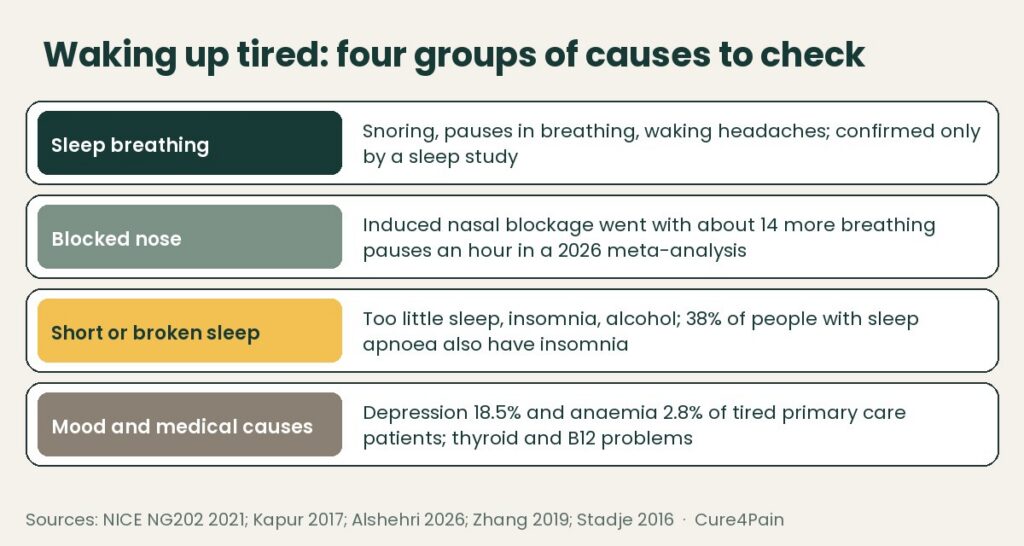
The four groups of causes are sleep breathing, a blocked nose, short or broken sleep, and mood or medical causes, and more than one can apply. Sleep apnoea is confirmed only by a sleep study [5]; the figures below come from separate studies and cannot be compared directly.
Is waking up tired a sign of sleep apnoea?
Waking up tired can be a sign of obstructive sleep apnoea, especially with snoring or pauses in breathing, but tiredness alone does not settle it. The UK NICE guideline (NG202, 2021) advises assessment when a person has 2 or more of these features: snoring, witnessed pauses, unrefreshing sleep, waking headaches, unexplained sleepiness, tiredness or fatigue, waking to urinate, choking in sleep, broken sleep or insomnia, and memory or thinking problems [1].
- Tired rather than sleepy: in a 2000 US sleep laboratory study of 190 people with sleep apnoea (Chervin), 62% reported lack of energy and 47% sleepiness; asked for the one main problem, about 40% chose lack of energy and about 22% sleepiness [8]. NICE also warns that not all people with sleep apnoea have excessive sleepiness [1].
- Women and men: in a 2024 Lung India study (Goyal) of 514 Indian patients with sleep apnoea at one sleep laboratory, fatigability, morning headache, waking to urinate and depression were more common in women, who were also older and more obese, and excess sleepiness in men [9].
- Morning headaches: a 2024 review of 23 studies found morning headaches in 33% of people with sleep apnoea, but the overall risk of headache was not clearly higher than in people without it [10]. See our migraine and headache page.
- Not everyone sleepy has sleep apnoea: in the Sleep Heart Health Study of 1,824 community adults with an average age of 65, excess sleepiness rose from 21% in those with fewer than 5 breathing pauses an hour to 35% in those with 30 or more [11]. So about 1 in 5 people with few pauses were sleepy anyway, which points to other causes.
Does snoring make you tired, and does every snorer have sleep apnoea?
Snoring is linked with daytime sleepiness, but that link does not show it is the cause, and not every snorer has sleep apnoea [12]. The UK NHS advises seeing a GP if you feel sleepy during the day, or if your breathing stops and starts or you gasp or choke in sleep [13].
- South Delhi study: in a 2009 study (Reddy), 18% of 2,505 adults snored habitually, and sleep studies found sleep apnoea in 32.4% of habitual snorers tested and 4% of non-habitual snorers tested [14].
- Snoring without sleep apnoea: in 307 people referred for sleep studies who snored but did not have sleep apnoea, louder snoring went with more daytime sleepiness [12]. This cannot show that snoring is the cause.
Our snoring and mouth breathing page explains the causes in detail.
How common is sleep apnoea in India?
Obstructive sleep apnoea affects an estimated 11% of Indian adults in the general population according to a 2023 meta-analysis (Suri) and 14.6% according to a 2025 meta-analysis (Datta), while the 2025 BLESS sleep-study cohort in Bhopal found moderate to severe disease in 30.5% of hospital attendants [2] [3] [4]. Estimates vary widely, and the table shows the main studies.
| Study | Who was studied | Result |
|---|---|---|
| Suri 2023, 8 studies [2] | 11,009 adults in the general population | 11% overall (13% men, 5% women); 5% moderate to severe |
| Datta 2025, 100 studies [3] | General population subgroup | 14.6%; 48.1% in patient groups |
| Goyal 2025, BLESS cohort [4] | 958 hospital attendants in Bhopal, full sleep study | 30.5% moderate to severe; 10.1% severe |
| Udwadia 2004 [15] | 250 men aged 35 to 65 in Mumbai, home sleep study | 19.5% had 5 or more pauses an hour; 7.5% also had daytime sleepiness |
The studies differ in methods, scoring rules and the people tested, and the reviews report high variation [2] [3]. The BLESS cohort (Goyal 2025) used current scoring rules but tested attendants at one hospital; the median BMI (body mass index) of everyone tested was 23.5 [4].
Does mouth breathing make you tired?
Mouth breathing may contribute to tiredness, but we found no trial that tested mouth breathing itself as a cause of morning tiredness in adults (PubMed search, October 2026). The evidence is about how the breathing route changes the airway in sleep.
- Breathing route: in a small 2003 crossover study (Fitzpatrick) of 12 healthy adults, breathing pauses were far more frequent during mouth breathing (43 an hour) than nose breathing (1.5 an hour) [16].
- Blocked nose: a 2026 meta-analysis in OTO Open of studies that induced nasal blockage, experimentally, after treatment for a nosebleed or after nasal surgery, linked it with about 14 more breathing pauses an hour, and the authors say variation between studies limits how far this applies [17]. In 1,459 Japanese day workers, nasal blockage went with more snoring and daytime sleepiness, while allergy without blockage did not [18].
- Allergic rhinitis: a 2020 review of observational studies linked it with difficulty waking up and daytime sleepiness, with low to very low quality of evidence [19], although the Japanese study above found no link with daytime sleepiness when the nose was not blocked [18]. See our allergic rhinitis page.
- Mouth taping: a 2025 review of 10 studies (213 people) found limited benefit and warned of a potentially serious risk of harm, including with a blocked nose [20]. At Cure4Pain we may suggest it only once the nose breathes freely and sleep apnoea has been checked, with guidance.
What is the STOP-BANG questionnaire?
STOP-BANG is an 8-item yes or no screening questionnaire that estimates the risk of obstructive sleep apnoea [21]. Each “yes” scores 1 point. It is not a diagnosis. These are the items as used in research, in plain words [22]:
| Letter | What it asks |
|---|---|
| S: Snoring | Loud snoring that others can hear |
| T: Tired | Often tired, fatigued or sleepy in the daytime |
| O: Observed | Someone has seen you stop breathing or choke in sleep |
| P: Pressure | High blood pressure, or treatment for it |
| B: BMI | Body mass index over 35 |
| A: Age | Over 50 |
| N: Neck | Neck size over 40 cm |
| G: Gender | Male |
What the score means, and its limits:
- Scores: according to a 2016 review in Chest (Chung), a STOP-BANG score of 0 to 2 is classed as low risk of moderate to severe sleep apnoea and 5 to 8 as high risk; 3 or 4 needs further criteria [21]. The chance of moderate to severe disease rises from 18% at 0 to 2 points to 60% at 7 to 8 [21].
- Accuracy: in a 2021 JAMA Network Open meta-analysis (Pivetta) of 47 sleep clinic studies (26,547 people), a STOP-BANG score of 3 or more detected over 90% of people with moderate to severe sleep apnoea, but specificity was only 28%, and 45% in South or Southeast Asia [23]. So many people who score 3 or more do not have moderate to severe sleep apnoea, and the authors say the results apply only to sleep clinics [23].
- Indian patients: a 2021 study (Waseem) of surgical patients with cardiovascular risk factors, including 161 Indian patients, recommends a STOP-BANG BMI cut-off of 27.5 rather than 35 for Indian and Chinese patients, and a score of 4 or more in all four ethnic groups studied [22]. Because the standard form counts BMI only above 35, a low score should be read with caution in an Indian adult with symptoms.
- What guidelines say: NICE suggests considering STOP-BANG together with the Epworth Sleepiness Scale when sleep apnoea is suspected [1]. The US Preventive Services Task Force (2022) found the evidence insufficient to assess screening in adults without symptoms or with unrecognised symptoms [24]; this does not cover people seeking help for symptoms.
Which test confirms sleep apnoea?
A sleep study confirms obstructive sleep apnoea; the American Academy of Sleep Medicine (AASM, 2017) recommends that questionnaires not be used to diagnose it without one [5]. According to the UK NHS, you usually wear devices overnight at home, and the result is an AHI score (apnoea-hypopnoea index, breathing pauses an hour): 5 to 14 is mild, 15 to 30 moderate and over 30 severe [25]. The AASM advises a full sleep study (polysomnography) for people with significant heart or lung disease, a past stroke or severe insomnia, or after a negative or inconclusive home test [5].
What else can make you wake up tired?
Besides sleep apnoea, you can wake up tired because of too little sleep, sleep inertia, insomnia, depression or stress, anaemia, low B12 or folate, an underactive thyroid, diabetes, restless legs, alcohol, illness, hormones or medicines. A 2016 review of 26 primary care studies (Stadje) found that serious physical disease was uncommon in people complaining of tiredness (4.3%) and about as common in people without tiredness, and it advises looking at depression and psychosocial problems first, with wider tests when the history or examination points to them [7].
| Cause | What points to it | What sources report |
|---|---|---|
| Too little sleep | Fewer hours than you need | The NHS suggests aiming for 6 to 9 hours [26] |
| Sleep inertia | Slow, groggy first period after waking | A normal state, strongest when waking in the biological night or after sleep loss [27] |
| Insomnia | Trouble falling or staying asleep | 38% of people with sleep apnoea also have it [28] |
| Depression or stress | Low mood, hard to get up | Depression in 18.5% of tired primary care patients [7]; hard waking is common in mood disorders [27] |
| Anaemia, low B12 or folate | Lack of energy, extreme tiredness | Anaemia in 2.8% of tired primary care patients [7]; symptoms listed by the NHS [29] |
| Underactive thyroid | Extreme tiredness, feeling cold, weight gain | NHS symptom list [30]; sleep apnoea is also more common with it [1] |
| Diabetes | Very tired, very thirsty, passing urine more often, weight loss | NHS symptom list [26] |
| Restless legs | Leg symptoms at rest at night that affect sleep | NHS [31]; 6.6% of India’s general population in a review [3] |
| Alcohol | Waking in the second half of the night | More broken sleep later in the night [32]; about 4 more breathing pauses an hour [33] |
| Illness, hormones, medicines | Recent illness, pregnancy, menopause, new medicine | NHS list of causes [26] |
In our clinic, light or unrefreshing sleep and pain waking people at night are the sleep problems we see most often. This is a clinic observation, and further studies are needed. Our insomnia and sleep problems page covers these in detail, our article on vitamin D, magnesium and melatonin for insomnia sets out the supplement trials, and our hypothyroidism page covers the thyroid.
Does CPAP help morning tiredness?
CPAP (continuous positive airway pressure) can lower fatigue and sleepiness in people with confirmed sleep apnoea, although trials used fatigue and sleepiness scales rather than measuring morning tiredness itself. CPAP gently pumps air through a mask to keep the airway open in sleep [25]. In a double-blind trial of 59 adults (Tomfohr 2011), 3 weeks of therapeutic CPAP lowered fatigue and raised energy compared with placebo CPAP, while sleepiness fell only in those who were excessively sleepy at the start [34], and a 2019 American Academy of Sleep Medicine review of 336 studies found clinically significant reductions in sleepiness and better sleep-related quality of life [35]. Guidelines differ in detail:
| Guideline | Diagnosis | Treatment |
|---|---|---|
| NICE NG202, UK, 2021 [1] | Home respiratory polygraphy first; polysomnography if negative and symptoms continue | CPAP with lifestyle advice for moderate or severe disease; for mild disease that affects daily life, CPAP if lifestyle advice is not enough or priority factors apply; a mandibular advancement splint if CPAP is not tolerated or is declined |
| AASM, US, 2017 and 2019 [5] [6] | Polysomnography or an adequate home test | Positive airway pressure recommended with excessive sleepiness; suggested with poor sleep-related quality of life or high blood pressure |
| INOSA, India, 2014 [36] | Supervised overnight polysomnography as the “gold standard” | Positive airway pressure as the mainstay; oral appliances for mild to moderate disease in those who prefer them or do not respond to it; surgery if it fails or is not tolerated |
Other points on treatment:
- Mild without symptoms: for mild sleep apnoea without symptoms that affect daytime activities, NICE says treatment is not usually needed [1].
- Use in India: in 79 patients with moderate to severe disease in Bhopal, 30.3% used CPAP regularly overall, against 82.7% of those who bought a machine; among those who did not buy one, 60% named cost as the main reason [37].
- Oral appliances: in a 2025 network meta-analysis of 197 trials, oral appliances gave smaller improvements than positive airway pressure [38].
- Myofunctional therapy (mouth and throat exercises): in a 2026 network meta-analysis of 55 trials, CPAP lowered breathing pauses most, while myofunctional exercises improved daytime sleepiness [39]. A 2026 umbrella review rated the overall evidence on active conservative treatments as very low certainty, and low certainty for myofunctional therapy against sham [40].
What can I do to wake up less tired?
To wake up less tired, the UK NHS advises the same sleep times each night, 6 to 9 hours, a room that is not too bright, noisy or warm, no food, caffeine or exercise in the couple of hours before sleep, and no screens in the last hour [26]. For snoring, the NHS advises losing weight if needed, sleeping on your side, not smoking and avoiding heavy drinking [13], and not taking sleeping pills unless a doctor recommends them, as they can make sleep apnoea worse [25].
When should morning tiredness be checked?
See a doctor if you have felt tired for a few weeks without knowing why, if it affects daily life, or if you have other symptoms such as weight loss, mood changes, or gasping, snorting or choking noises in sleep, according to the NHS [26]. Bringing someone who has seen your sleep can help [25].
- Driving: people with sleep apnoea have more crashes than comparable people without it; a 2009 meta-analysis of case-control and cohort studies puts the crash rate at about 1.2 to 4.9 times higher [41]. Do not drive when sleepy.
- Children: a child who snores heavily, or stops breathing or gasps in sleep, needs a paediatric ENT or sleep specialist first.
How we look at waking up tired at Cure4Pain
At Cure4Pain, we look for what disturbs each person’s sleep and breathing, and work alongside your sleep specialist, dentist, ENT surgeon and existing consulting physician. An integrative plan may add options alongside standard care such as CPAP.
- Assessment first: nose, jaw, tongue-tie, tongue posture and body posture; a panel of about 100 markers that we read, adding tests for your condition when clinically indicated, such as vitamin D, B12, iron, thyroid, blood sugar and cortisol; and a sleep study when sleep apnoea is suspected, as NICE (NG202, 2021) and the AASM (2017) advise [1] [5]. The panel is our clinic protocol, not a guideline requirement.
- Myofunctional therapy and appliances: tongue posture, swallowing, lip seal and throat exercises, in person or online, usually over 6 to 8 weeks, though this differs from person to person, given by AT. Chintan Dalal, N.D., Dr Krushal Pabari and Dr Kedar Bakshi, airway dentist and orthodontist (B.D.S, PGD Orthodontics), who is associated with Cure4Pain. Dr Bakshi fits custom, adjustable oral appliances where suitable, in coordination with your sleep specialist.
- Supervised-dose vitamin D therapy (Coimbra Protocol-based methods): doses set per person and monitored with blood tests, with Dr Stasha Gominak’s approach to sleep. Our methods are derived from the work of Dr Coimbra. Vitamin D is lower on average in moderate or severe sleep apnoea in observational studies [42], but a trial in 19 adults showed no change in quality of life [43], and Dr Gominak’s paper reports an uncontrolled study and a hypothesis [44]. We found no controlled trial of this approach in snoring or sleep apnoea.
- Food, nutrients and habits: for a blocked nose, sugar, cold foods and nightshades are removed, and dairy is removed with ghee allowed; we advise limiting alcohol and restrict late dinners; magnesium, mainly as bisglycinate, with L-threonate or citrate as advised, counted as elemental magnesium, a B-vitamin complex and omega-3 are added, with supplements by mouth first, with injections only when specifically needed or advised; and we support weight loss and sleeping on your side. We found no trial of these food and nutrient changes for morning tiredness.
- Wheat and cruciferous vegetables: we generally advise most patients to replace wheat with jowar, bajra or other millets as a general health measure, including home-made roti from processed wheat; a gluten-free diet is supported for coeliac disease and positive tests [45]. Also, as an observational clinic practice, we generally suggest limiting cruciferous (Brassica) vegetables such as cabbage and cauliflower; a 2024 review found no harm to the thyroid with daily intake, particularly with adequate iodine [46].
- Hands-on care: at times, needling, myofascial release or acupuncture for tight jaw, neck or throat muscles; evidence for acupuncture in sleep apnoea is weak [38].
- Insomnia and other causes: a sleep routine, morning light, fewer screens, less caffeine and excess sugar, and attention to night pain, gut symptoms and menopause.
- Medicines and CPAP: Dr Krushal Pabari manages sleeping pills and blood pressure medicines, under clinical guidance from Team Cure4Pain, in coordination with your existing consulting physician and the doctor who prescribed them; never stop or change them on your own. CPAP is the most effective treatment for sleep apnoea [38]. Whether CPAP continues depends on the case and severity and is decided with your sleep specialist; never stop it without medical guidance.
- Referred first: we refer people to a specialist first if they choke or gasp at night, fall asleep while driving, have heart rhythm problems or are pregnant, and children who snore heavily.
This is our clinic practice; individual results vary, and further studies are needed.
If you would like your tired mornings, snoring or sleep reviewed, you can book a consultation, online from anywhere or at our Mumbai clinic.
Frequently asked questions
Why do I wake up tired even after 8 hours of sleep?
Broken sleep is a common reason. Sleep apnoea, insomnia, alcohol, low mood, an underactive thyroid and anaemia can all leave you tired despite enough hours in bed. [1] [7] [30]
Is waking up tired a sign of sleep apnoea?
It can be, especially with snoring, pauses in breathing or waking headaches. NICE advises assessment when a person has 2 or more such features, and a sleep study confirms it. [1]
Why do I wake myself up snoring?
Waking with a snort or gasp can be a sign of sleep apnoea. According to NICE, the person wakes or lightens sleep to end each episode of blocked breathing, and the NHS lists snorting and choking noises as symptoms. [1] [25]
Can you have sleep apnoea without snoring?
Yes, though it is less common. In a South Delhi study, sleep apnoea was found in 4% of people who did not snore habitually (3 of 75 tested, who may still snore at times) and in 32.4% of habitual snorers. [14]
What is a high STOP-BANG score?
A score of 5 to 8 is classed as high risk of moderate to severe sleep apnoea, and 0 to 2 as low risk. A score of 3 or 4 needs further criteria. It does not diagnose sleep apnoea. [21] [5]
Can I test for sleep apnoea at home?
Often, yes. The NHS says the overnight monitoring can usually be done at home, and NICE offers home respiratory polygraphy first. The AASM advises a full sleep study for some people, such as those with significant heart or lung disease. [25] [1] [5]
Does CPAP help with tiredness?
In a double-blind trial of 59 adults with sleep apnoea, 3 weeks of therapeutic CPAP lowered fatigue and raised energy compared with placebo CPAP. A 2019 American Academy of Sleep Medicine review of 336 studies reports less sleepiness. Do not stop CPAP without medical guidance. [34] [35]
When should I see a doctor about waking up tired?
The NHS advises seeing a GP if you have felt tired for a few weeks without knowing why, if it affects daily life, or if you have other symptoms such as weight loss, mood changes or choking noises in sleep. [26]
This article is for education and does not replace medical advice. Do not start, stop or change any medicine or supplement without medical guidance.
References
1. National Institute for Health and Care Excellence (NICE). Obstructive sleep apnoea/hypopnoea syndrome and obesity hypoventilation syndrome in over 16s (NG202), 2021. nice.org.uk/guidance/ng202
2. Suri TM, et al. Systematic review and meta-analysis of the prevalence of obstructive sleep apnea in Indian adults. Sleep Med Rev 2023;71:101829. doi:10.1016/j.smrv.2023.101829
3. Datta K, et al. Wake-up Call for India on Sleep Health: Systematic Review Findings. Indian J Public Health 2025;69(4):614-621. doi:10.4103/ijph.ijph_504_24
4. Goyal A, et al. Prevalence and association analysis of obstructive sleep apnea in India: Results from BLESS cohort. Sleep Med 2025;125:128-135. doi:10.1016/j.sleep.2024.11.029
5. Kapur VK, et al. Clinical Practice Guideline for Diagnostic Testing for Adult Obstructive Sleep Apnea: An American Academy of Sleep Medicine Clinical Practice Guideline. J Clin Sleep Med 2017;13(3):479-504. doi:10.5664/jcsm.6506
6. Patil SP, et al. Treatment of Adult Obstructive Sleep Apnea with Positive Airway Pressure: An American Academy of Sleep Medicine Clinical Practice Guideline. J Clin Sleep Med 2019;15(2):335-343. doi:10.5664/jcsm.7640
7. Stadje R, et al. The differential diagnosis of tiredness: a systematic review. BMC Fam Pract 2016;17(1):147. doi:10.1186/s12875-016-0545-5
8. Chervin RD. Sleepiness, fatigue, tiredness, and lack of energy in obstructive sleep apnea. Chest 2000;118(2):372-9. doi:10.1378/chest.118.2.372
9. Goyal A, et al. Sex-specific differences in presenting symptoms of obstructive sleep apnea. Lung India 2024;41(2):115-120. doi:10.4103/lungindia.lungindia_235_22
10. Błaszczyk B, et al. Prevalence of headaches and their relationship with obstructive sleep apnea (OSA) – Systematic review and meta-analysis. Sleep Med Rev 2024;73:101889. doi:10.1016/j.smrv.2023.101889
11. Gottlieb DJ, et al. Relation of sleepiness to respiratory disturbance index: the Sleep Heart Health Study. Am J Respir Crit Care Med 1999;159(2):502-7. doi:10.1164/ajrccm.159.2.9804051
12. Kalchiem-Dekel O, et al. Snoring intensity and excessive daytime sleepiness in subjects without obstructive sleep apnea. Laryngoscope 2016;126(7):1696-701. doi:10.1002/lary.25876
13. NHS (UK National Health Service). Snoring. nhs.uk/conditions/snoring
14. Reddy EV, et al. Prevalence and risk factors of obstructive sleep apnea among middle-aged urban Indians: a community-based study. Sleep Med 2009;10(8):913-8. doi:10.1016/j.sleep.2008.08.011
15. Udwadia ZF, et al. Prevalence of sleep-disordered breathing and sleep apnea in middle-aged urban Indian men. Am J Respir Crit Care Med 2004;169(2):168-73. doi:10.1164/rccm.200302-265OC
16. Fitzpatrick MF, et al. Effect of nasal or oral breathing route on upper airway resistance during sleep. Eur Respir J 2003;22(5):827-32. doi:10.1183/09031936.03.00047903
17. Alshehri NA, et al. Impact of Nasal Obstruction and Mouth Taping on Sleep Apnea Indicators: Systematic Review and Meta-Analysis. OTO Open 2026;10(3):e70294. doi:10.1002/oto2.70294
18. Hiraki N, et al. Snoring, daytime sleepiness, and nasal obstruction with or without allergic rhinitis. Arch Otolaryngol Head Neck Surg 2008;134(12):1254-7. doi:10.1001/archotol.134.12.1254
19. Liu J, et al. The association between allergic rhinitis and sleep: A systematic review and meta-analysis of observational studies. PLoS One 2020;15(2):e0228533. doi:10.1371/journal.pone.0228533
20. Rhee J, et al. Breaking social media fads and uncovering the safety and efficacy of mouth taping in patients with mouth breathing, sleep disordered breathing, or obstructive sleep apnea: A systematic review. PLoS One 2025;20(5):e0323643. doi:10.1371/journal.pone.0323643
21. Chung F, et al. STOP-Bang Questionnaire: A Practical Approach to Screen for Obstructive Sleep Apnea. Chest 2016;149(3):631-8. doi:10.1378/chest.15-0903
22. Waseem R, et al. Diagnostic performance of the STOP-Bang questionnaire as a screening tool for obstructive sleep apnea in different ethnic groups. J Clin Sleep Med 2021;17(3):521-532. doi:10.5664/jcsm.8940
23. Pivetta B, et al. Use and Performance of the STOP-Bang Questionnaire for Obstructive Sleep Apnea Screening Across Geographic Regions: A Systematic Review and Meta-Analysis. JAMA Netw Open 2021;4(3):e211009. doi:10.1001/jamanetworkopen.2021.1009
24. Mangione CM, et al. Screening for Obstructive Sleep Apnea in Adults: US Preventive Services Task Force Recommendation Statement. JAMA 2022;328(19):1945-1950. doi:10.1001/jama.2022.20304
25. NHS (UK National Health Service). Sleep apnoea. nhs.uk/conditions/sleep-apnoea
26. NHS (UK National Health Service). Tiredness and fatigue. nhs.uk/symptoms/tiredness-and-fatigue
27. Trotti LM. Waking up is the hardest thing I do all day: Sleep inertia and sleep drunkenness. Sleep Med Rev 2017;35:76-84. doi:10.1016/j.smrv.2016.08.005
28. Zhang Y, et al. Worldwide and regional prevalence rates of co-occurrence of insomnia and insomnia symptoms with obstructive sleep apnea: A systematic review and meta-analysis. Sleep Med Rev 2019;45:1-17. doi:10.1016/j.smrv.2019.01.004
29. NHS (UK National Health Service). Vitamin B12 or folate deficiency anaemia. nhs.uk/conditions/vitamin-b12-or-folate-deficiency-anaemia
30. NHS (UK National Health Service). Underactive thyroid (hypothyroidism). nhs.uk/conditions/underactive-thyroid-hypothyroidism
31. NHS (UK National Health Service). Restless legs syndrome. nhs.uk/conditions/restless-legs-syndrome
32. Ebrahim IO, et al. Alcohol and sleep I: effects on normal sleep. Alcohol Clin Exp Res 2013;37(4):539-49. doi:10.1111/acer.12006
33. Burgos-Sanchez C, et al. Impact of Alcohol Consumption on Snoring and Sleep Apnea: A Systematic Review and Meta-analysis. Otolaryngol Head Neck Surg 2020;163(6):1078-1086. doi:10.1177/0194599820931087
34. Tomfohr LM, et al. Effects of continuous positive airway pressure on fatigue and sleepiness in patients with obstructive sleep apnea: data from a randomized controlled trial. Sleep 2011;34(1):121-6. doi:10.1093/sleep/34.1.121
35. Patil SP, et al. Treatment of Adult Obstructive Sleep Apnea With Positive Airway Pressure: An American Academy of Sleep Medicine Systematic Review, Meta-Analysis, and GRADE Assessment. J Clin Sleep Med 2019;15(2):301-334. doi:10.5664/jcsm.7638
36. Sharma SK, et al. Consensus & evidence-based INOSA Guidelines 2014 (first edition). Indian J Med Res 2014;140(3):451-68. PubMed 25366217
37. Goyal A, et al. Barriers to CPAP Use in India: An Exploratory Study. J Clin Sleep Med 2017;13(12):1385-1394. doi:10.5664/jcsm.6830
38. Papageorgiou SN, et al. Comparative efficacy of non-pharmacological interventions for adults with sleep apnea: A systematic review and network meta-analysis. Sleep Med 2025;128:130-138. doi:10.1016/j.sleep.2025.02.008
39. Castellanos MFI, et al. Comparative effectiveness of CPAP and isolated or combined non-invasive therapies for obstructive sleep apnea: A network meta-analysis. Sleep Med 2026;141:108795. doi:10.1016/j.sleep.2026.108795
40. Justribó-Manion C, et al. Active conservative interventions for obstructive sleep apnea: An umbrella review and meta-meta-analysis of systematic reviews. Sleep Med 2026;138:108665. doi:10.1016/j.sleep.2025.108665
41. Tregear S, et al. Obstructive sleep apnea and risk of motor vehicle crash: systematic review and meta-analysis. J Clin Sleep Med 2009;5(6):573-81. PubMed 20465027
42. Loh HH, et al. Obstructive sleep apnea and vitamin D: an updated systematic review and meta-analysis. Hormones (Athens) 2023;22(4):563-580. doi:10.1007/s42000-023-00481-3
43. Kerley CP, et al. Vitamin D Improves Selected Metabolic Parameters but Not Neuropsychological or Quality of Life Indices in OSA: A Pilot Study. J Clin Sleep Med 2017;13(1):19-26. doi:10.5664/jcsm.6378
44. Gominak SC, Stumpf WE. The world epidemic of sleep disorders is linked to vitamin D deficiency. Med Hypotheses 2012;79(2):132-5. doi:10.1016/j.mehy.2012.03.031
45. NHS (UK National Health Service). Coeliac disease: treatment. nhs.uk/conditions/coeliac-disease/treatment
46. Galanty A, et al. Do Brassica Vegetables Affect Thyroid Function?-A Comprehensive Systematic Review. Int J Mol Sci 2024;25(7). doi:10.3390/ijms25073988