Written by AT. Chintan Dalal, N.D. · Reviewed by Dr Krushal Pabari, Clinical Team, Cure4Pain · Updated 30 October 2026
Key facts
We found no randomised trial showing that a whole diet treats allergic rhinitis (PubMed search, October 2026); the evidence on food comes mostly from surveys, and they disagree [1] [2], so the food rules and 7-day chart below are clinic practice, not a proven treatment. Lower vitamin D goes with allergic rhinitis in children, according to a 2016 meta-analysis of 19 observational studies [3], but two genetic studies found no evidence of a causal link [4] [5], and 2025 reviews of supplement trials disagree [6] [7]. Allergic rhinitis often lasts: in a Swedish cohort, about 75% of children with pollen allergic rhinitis at 4 or 8 years still had it at 24 [8]. Trials that followed people after treatment stopped show lasting benefit from allergen immunotherapy given for at least 3 years [9] [10], and the 2018 European Academy of Allergy and Clinical Immunology (EAACI) guideline calls it the only available treatment that targets the underlying disease process [11].

Scientific explainer videos in our Resources section
In our Resources section, our clinical team discusses vitamin D, its cofactors and how autoimmune, lifestyle and pain conditions develop.
Does diet help allergic rhinitis?
Diet may support allergic rhinitis care, but our PubMed search (October 2026) found no randomised trial showing that a whole diet treats it. Allergic rhinitis is an allergic reaction to things you breathe in, such as pollen, house dust mites, mould and animal dander, according to the NHS [12], so food can influence only part of it. Allergic rhinitis affects 9.8% of adults and 23.5% of 13 to 14 year olds in India, according to the 2022 Global Asthma Network Phase I study [13].
- Mediterranean-style eating, where studies disagree: in a 2022 survey of 1,934 Greek adolescents, good adherence went with 41% lower odds of allergic rhinitis symptoms [1]. Surveys of 12,080 Korean adults (2025) [2] and 9,875 Turkish children aged 6 to 7 (2014) [14] found no significant link. A 2017 review found that most studies showed no significant effect on preventing rhinitis in children, and called for randomised trials [15].
- Vegetables: in a 2020 study of 435 Korean 7 year olds, a vegetable-rich eating pattern went with lower odds of allergic rhinitis, but only in children at lower genetic risk [16].
- Fast food: a 2018 review of 16 observational studies on fast food and allergic disease reported 43% higher odds of doctor-diagnosed allergic rhinitis; studies of this kind cannot show cause [17].
- Sugar and ultra-processed food: a 2024 European Academy of Allergy and Clinical Immunology (EAACI) task force linked sugar, soft drinks and ultra-processed foods with allergic rhinitis in children “in many, but not all studies” [18].
- Removing foods: the only elimination diet data we found is an uncontrolled 1980 report in 322 infants with respiratory allergy and negative skin tests to inhaled allergens. On a 6-week restricted diet 91% improved, symptoms returned on food challenge in 51%, and milk was the food most often involved [19].
Food allergy alone is rarely the cause of allergic rhinitis. A 2007 review calls rhinitis caused by food allergy alone extremely rare [20], and the US Rhinitis 2020 practice parameter does not recommend food allergy testing in the routine evaluation of rhinitis [21].
What foods should you avoid with allergic rhinitis?
We found no trial showing that any food worsens allergic rhinitis (PubMed search, October 2026). Observational studies link sugar and soft drinks in children [18], and fast food [17], with it. At Cure4Pain we remove dairy (ghee is allowed), sugar, cold foods and drinks, and nightshades, as clinic practice rather than a research finding. We also generally advise most patients to replace wheat with jowar, bajra or other millets as a general health measure, and, as an observational clinic practice, we generally suggest limiting cruciferous (Brassica) vegetables such as cabbage and cauliflower. The table shows what research says and what we advise, side by side.
| Food | What research shows | Our clinic practice |
|---|---|---|
| Dairy | Studies disagree. A 2005 review concluded that milk does not increase mucus [22], and in a 2020 randomised trial in 96 children with and without asthma, one milk drink did not change symptoms or lung tests [23]. In a blinded 6-day 2019 trial in 108 people with persistent mucus complaints, not specifically allergic rhinitis, a dairy-free diet went with less self-reported mucus [24] | Removed, with replacement foods; ghee allowed |
| Wheat | We found no trial of removing wheat in allergic rhinitis; research supports a gluten-free diet for coeliac disease confirmed by testing [25] | We generally advise most patients to replace it with jowar, bajra or other millets as a general health measure |
| Sugar | Linked with allergic rhinitis in children in observational studies [18]; we found no trial of removing it | Removed |
| Cold foods and drinks | We found no trial of avoiding them | Removed; meals and drinks taken warm or at room temperature |
| Nightshades (tomato, potato, brinjal, peppers) | We found no study of avoiding them. In a 2007 survey of 690 children in Crete, eating fresh tomatoes, with other local produce, went with less rhinitis [26]. In a small 2007 trial of 33 people, a tomato extract supplement eased symptoms; that is not the same as eating tomato [27] | Removed |
| Cruciferous vegetables (cabbage, cauliflower, broccoli) | We found no study of avoiding them. In a 2021 trial of 47 people over 3 weeks, broccoli sprout extract with a steroid spray gave the best measured airflow [28] | Limited, as an observational clinic practice |
The Cure4Pain food rules are clinic practice, not research findings; we state both so that you know exactly what we advise and where the evidence is thin. An integrative plan may add options like these alongside standard care. Removing dairy and replacing wheat can lower calcium, protein and fibre intake, so the plan includes replacement foods, with extra care for children and in pregnancy.
Alcohol has limited data: in a 2008 cohort study of 5,870 young Danish women, more than 14 drinks a week went with higher odds of developing year-round allergic rhinitis, but not seasonal allergic rhinitis [29]. At Cure4Pain we advise limiting alcohol.
Can food trigger allergic rhinitis symptoms?
Food can trigger symptoms in some people with pollen allergy, usually a mouth reaction rather than a runny nose. This is called pollen food syndrome: proteins in raw plant foods resemble pollen proteins, according to the 2022 British Society for Allergy and Clinical Immunology (BSACI) guideline [30].
- Symptoms: pollen food syndrome is usually limited to the mouth, according to a 2025 review, though rhinitis, skin and breathing symptoms can occur [31].
- How common: in a 2023 study in Turkey, 14% of 222 adults with seasonal allergic rhinitis reported pollen food syndrome; brinjal, walnut, kiwi, peach and melon were the commonest foods there, and triggers vary by region [32] [31].
- What to do: tell your doctor, because the BSACI guideline bases management on leaving out your known trigger foods [30].
- Emergency: severe reactions can occur [30]. Swelling of the throat and tongue or difficulty breathing needs an ambulance at once, according to the NHS [33].
What foods are good for allergic rhinitis?
We found no strong evidence that any food reduces allergic rhinitis. Single small trials report benefit from high-dose honey added to an antihistamine (40 people) [34] and from a Japanese green tea variety during cedar pollen season (51 people) [35]. Mediterranean-style and vegetable-rich eating went with fewer symptoms in some surveys [1] [16]; the foods below lean that way and fit our clinic rules.
| Food group | Indian examples |
|---|---|
| Millets and grains | Jowar, bajra, ragi (nachni), foxtail millet (kangni), rice |
| Pulses | Moong, masoor and toor dal, besan |
| Vegetables | Bottle gourd (lauki), ridge gourd (turai), pumpkin (kaddu), spinach (palak), fenugreek (methi), carrot (gajar), okra (bhindi), beetroot, French beans, tinda, drumstick (sahjan), sweet potato |
| Fruit | Papaya, guava (amrood), apple, pomegranate (anaar), banana, orange |
| Nuts and seeds | Walnuts (akhrot), almonds (badam), flaxseed (alsi), pumpkin seeds, fox nuts (makhana) |
| Fats and spices | Cold-pressed oils, ghee; turmeric (haldi), ginger (adrak), cumin (jeera), black pepper |
What research shows about specific foods and supplements:
- Fish and omega-3: in a 2025 case-control study of 411 people with allergic rhinitis, oily fish other than tuna went with lower odds and white fish with higher odds [36]. A 2025 trial of omega-3 capsules in 22 people found no difference from placebo [37].
- Turmeric: in a 2016 trial of 241 people over 2 months, oral curcumin (a compound in turmeric, given as a supplement) eased nasal symptoms; the authors call it a pilot study [38].
- Polyphenols: a 2025 meta-analysis of 13 trials found fewer nasal symptoms with compounds such as quercetin, with low to very low certainty [39].
- Probiotics: two 2022 reviews point to a small effect at most. A review of 28 studies found a small benefit and urged caution because results varied [40]; a review of 13 trials found only slight improvement, with no significant effect on nasal scores for the 2 types it could pool [41].
At Cure4Pain, omega-3 is part of each plan unless there is a reason not to: from fish for people who eat it, and from algal oil for vegetarians and vegans. Our article on omega-3 explains the wider evidence.
A 7-day Indian diet chart for allergic rhinitis
This 7-day Indian diet chart for allergic rhinitis is a sample week built from Cure4Pain clinic food advice: no dairy except ghee, no wheat, sugar, cold foods or nightshades, and no cruciferous vegetables in this sample. It is a sample, not a prescription, and it has not been tested in a trial: your plan depends on your tests, weight, medicines and any food triggers. Take meals warm, drink tea or coffee without milk or sugar, cook with cold-pressed oil or ghee, and cook without tomato, potato, brinjal, capsicum or chillies; use ginger, black pepper, cumin and tamarind instead.
- Monday: Breakfast: Jowar upma with carrot and beans; papaya. Lunch: Bajra roti (bajri bhakri), moong dal, bottle gourd (lauki) sabzi. Evening snack: Roasted fox nuts (makhana), warm ginger water. Dinner: Ragi dosa with coconut chutney, spinach dal (palak dal).
- Tuesday: Breakfast: Moong dal chilla with mint and ginger chutney; guava. Lunch: Rice, toor dal, okra (bhindi) sabzi. Evening snack: Apple, walnuts (akhrot). Dinner: Jowar roti, masoor dal, ridge gourd (turai) sabzi.
- Wednesday: Breakfast: Idli with sambar (pumpkin and drumstick). Lunch: Ragi roti (nachni bhakri), masoor dal, fenugreek (methi) sabzi. Evening snack: Banana, roasted pumpkin seeds. Dinner: Moong dal and rice khichdi, French beans sabzi.
- Thursday: Breakfast: Poha with carrot and peas; pomegranate (anaar). Lunch: Foxtail millet (kangni) rice, tamarind rasam with black pepper, pumpkin (kaddu) sabzi. Evening snack: Coconut water at room temperature, almonds (badam). Dinner: Bajra roti, tinda sabzi, moong dal.
- Friday: Breakfast: Besan chilla with grated carrot; papaya. Lunch: Jowar roti (jowar bhakri), cooked moong usal, bottle gourd sabzi. Evening snack: Orange, flaxseed (alsi) mixed into warm porridge. Dinner: Millet pulao with carrot, beans and peas, masoor dal.
- Saturday: Breakfast: Ragi porridge (ragi malt) made with water or coconut milk, with banana. Lunch: Rice, sambar with drumstick and pumpkin, beans and coconut stir-fry (poriyal). Evening snack: Guava, roasted makhana. Dinner: Jowar roti, methi dal, sweet potato sabzi.
- Sunday: Breakfast: Green moong dosa (pesarattu) with coconut chutney. Lunch: Bajra khichdi with vegetables. Evening snack: Pomegranate, walnuts. Dinner: Moong dal soup, ragi roti, spinach (palak) sabzi.
Swaps and notes for the week:
- If you eat eggs, fish or chicken: these are not on our removal list and can replace dal at any meal.
- If a food makes your mouth itch: leave it out and tell your doctor, as pollen food syndrome varies from person to person.
- Vitamin B12: this week has no meat, fish, eggs or dairy, and vitamin B12 is not found naturally in fruit, vegetables and grains, according to the NHS [42], so please do not follow it long term without medical guidance. We check B12 in your tests.
- Children and pregnancy: plans are adjusted, so please do not copy this chart without medical guidance.
Does vitamin D help allergic rhinitis?
Vitamin D may help allergic rhinitis as an add-on to standard treatment, but the evidence is unsettled. Lower vitamin D levels go with allergic rhinitis in some studies, genetic studies do not support a causal link, and reviews of supplement trials disagree.
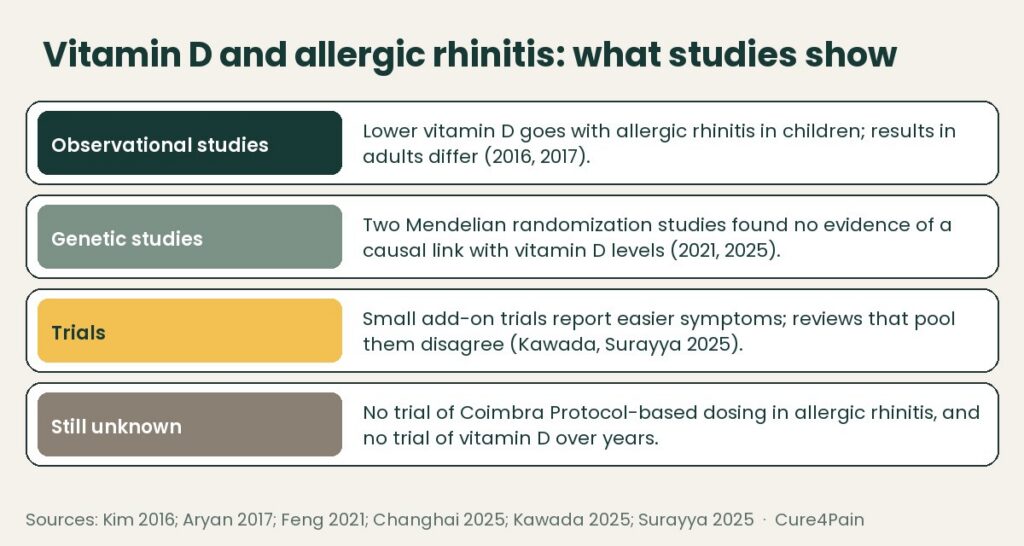
- Levels: in a 2016 meta-analysis of 19 studies, lower vitamin D went with more allergic rhinitis only in children, and earlier levels did not predict who developed it; the authors advise considering a vitamin D check during management, especially in children [3]. In a 2017 meta-analysis of 21 studies, people at 75 nmol/L or more had lower odds than those below 50 nmol/L, mainly adult men [43].
- Genetic studies: two Mendelian randomization studies (2021 and 2025), which use genes to test cause and effect, found no evidence of a causal link between vitamin D levels and the risk of allergic rhinitis, the first of them in people of European ancestry [4] [5]. They look at developing the condition, not at treating it.
- Reviews that disagree: A 2025 meta-analysis by Kawada and colleagues pooled 5 trials and found no significant overall effect, with results varying widely; symptoms did ease in the subgroup not using steroid sprays [6]. A 2025 meta-analysis by Surayya and colleagues pooled 11 trials and 5 cohort studies and found significantly lower symptom scores, IgE and eosinophils, also with very wide variation [7]. A 2026 umbrella review reported symptom benefit from vitamin D supplements, graded it class IV, below its “suggestive” grade, and asked for “greater standardization and precision” in research [44].
Three examples of trials that added vitamin D to standard treatment:
| Trial | Who and what | Result |
|---|---|---|
| Bakhshaee 2019, Iran [45] | 80 people with vitamin D deficiency, 68 finished; cetirizine with vitamin D or placebo | The authors report “relative” symptom improvement at 8 weeks |
| Guo 2023, China [46] | 140 people with moderate to severe disease; steroid spray with or without vitamin D for 4 weeks | Greater improvement, except for sneezing and eye symptoms |
| Jerzynska 2016, Poland [47] | 50 children on grass immunotherapy tablets; vitamin D or placebo for 5 months | Fewer nasal symptoms with vitamin D; medicine use and eye scores no different |
We found no trial of vitamin D over years, and no trial of Coimbra Protocol-based dosing in allergic rhinitis. Do not self-treat with high-dose vitamin D: the NHS says adults and children aged 11 to 17 should not take more than 100 micrograms (4,000 IU) a day, children aged 1 to 10 not more than 50 micrograms (2,000 IU), and infants under 12 months not more than 25 micrograms (1,000 IU), as more could be harmful; long-term overuse can raise blood calcium and damage the kidneys and heart [48]. Vitamin D doses above these limits are used only under medical supervision with regular blood tests. See our articles on vitamin D deficiency in India and vitamin D toxicity.
Does allergic rhinitis go away on its own?
Allergic rhinitis sometimes goes away on its own, but for many people it lasts for years, and long-term studies give different pictures.
- Children into adulthood: in a 2024 report from a Swedish birth cohort of 1,137 people, about 75% of children with pollen allergic rhinitis at 4 or 8 years still had it at 24 [8].
- Adults in Northern Europe: in a 2022 report from a survey over about 20 years, 31.8% of 3,379 people who had reported allergic rhinitis no longer reported it at the last survey [49].
- Former US students: in a 23-year follow-up published in 1998, of 306 people who had hay fever by then, 54.9% had improved and 22.9% had no symptoms; people whose symptoms began earlier improved more often [50].
- A less favourable result: in a 1997 study of 82 Swedish hospital patients followed for about 12 years without immunotherapy, 1 was free of symptoms, 39% were better, 39% unchanged and 21% worse [51].
Is there a lasting treatment for allergic rhinitis?
No treatment has been shown to end allergic rhinitis for everyone. Trials that followed people after treatment stopped show lasting benefit from allergen immunotherapy [9], though a 2017 review calls this evidence more modest than the evidence during treatment [52]; other options aim at control.
- Allergen immunotherapy: the 2018 EAACI guideline calls it the only available treatment that targets the underlying disease process, and recommends at least 3 years for long-term benefit, with the strongest long-term evidence for grass pollen and evidence gaps elsewhere, including in children [11]. The 2024 US AAO-HNSF (American Academy of Otolaryngology-Head and Neck Surgery Foundation) guideline says to offer it, or refer, when symptoms stay uncontrolled on medicines or allergen avoidance, or when a person prefers this approach, and not to start it in pregnancy or uncontrolled asthma [10].
- Surgery: the 2015 AAO-HNSF guideline lists reducing the inferior turbinates (structures inside the nose) as an option for a blocked nose with enlarged turbinates after medicines have not helped [53]. A 2023 meta-analysis of 18 studies found benefits lasting beyond a year [54]; a 2010 Cochrane review found no randomised trial that met its criteria [55].
- Homeopathy: a 2017 systematic review of 11 trials rated the evidence as low or uncertain quality, and advised caution in drawing firm conclusions, while saying that one remedy and one nasal spray may have small effects [56].
- Ayurveda and herbs: one open-label Indian trial of 250 people, published in 2023, compared a herbal and mineral formula with medicines for 28 days and favoured the formula; the authors say it needs further scientific development [57]. A trial against a steroid spray was planned to finish analysis by February 2025; we found no published result [58]. The US Rhinitis 2020 practice parameter says herbal products lack adequate studies [21].
What does long-term control of allergic rhinitis involve?
Long-term control of allergic rhinitis means medicine matched to your symptoms, stepped up or down as they change, along with trigger control at home. The 2020 ARIA (Allergic Rhinitis and its Impact on Asthma) guideline describes stepping treatment up or down, with control of the disease as the aim of medicine choice [59].
- Medicines: the ARIA-EAACI 2024-2025 guideline suggests steroid nasal sprays over antihistamine sprays, and a combined spray over either alone [60].
- Saline rinses: a 2018 Cochrane review of 14 trials found they may reduce symptoms for up to 3 months compared with no rinsing, with low quality evidence and no data beyond that; it was uncertain whether they add to medicines [61]. For a homemade rinse, the NHS says to boil the water and let it cool first [12].
- Triggers at home: the NHS advises washing bedding at 60°C or above, damp dusting and a vacuum with a HEPA filter [12]. Our allergic rhinitis page covers the evidence on mite covers and air purifiers.
How we manage allergic rhinitis at Cure4Pain
At Cure4Pain, allergic rhinitis is managed as a long-term condition, and diet and vitamin D are two parts of a wider plan used alongside guideline care.
- Tests first: we read a panel of about 100 markers, adding tests for your condition when clinically indicated: total IgE, eosinophil count and an allergy panel (dust mite, pollen, mould, pets). The 2015 AAO-HNSF guideline supports specific IgE allergy testing when treatment has not helped, the diagnosis is uncertain or the allergen needs to be known [53]. The panel is our clinic protocol, not a guideline requirement.
- Supervised-dose vitamin D therapy (Coimbra Protocol-based methods): vitamin D used as an immune modulator, at a dose above standard supplement doses but below high-dose protocols, set for you and monitored with blood tests. Our methods are derived from the work of Dr Coimbra.
- Gut support: probiotics and support for digestion and bile flow.
- Food advice: dairy (except ghee), sugar, cold foods and drinks, and nightshades removed; wheat generally replaced with jowar, bajra or other millets as a general health measure; cruciferous vegetables generally limited, as an observational clinic practice; alcohol limited, with balanced replacements.
- Nutrients: vitamin C, omega-3, zinc, magnesium and quercetin, within official upper limits where these exist. Given by mouth first, with injections only when specifically needed or advised; magnesium mainly as bisglycinate, with L-threonate or citrate as advised, counted as elemental.
- Nose and breathing: saline rinses or jal neti, and Buteyko breathing with nose breathing; we found no trial of Buteyko breathing in allergic rhinitis.
- Triggers at home: we ask you to check and correct dust mites, bedding, pets, mould and air quality.
- Medicines stay: Dr Krushal Pabari manages antihistamines and steroid nasal sprays under clinical guidance from Team Cure4Pain, in coordination with your existing consulting physician; never stop or change them on your own.
- Immunotherapy: we discuss it with you and refer you to an allergy specialist when it may suit you, for example if symptoms stay uncontrolled despite medicines and trigger control. In our practice such referrals have been uncommon, which is an observation, not a comparison of treatments. If you are already on immunotherapy, please continue it with your allergy specialist.
- Children: the plan is almost the same; Dr Pabari adapts tests, vitamin D, nutrients and diet to age and weight, in coordination with your child’s paediatrician.
- Over the long term: allergic rhinitis has no agreed medical definition of remission, and at Cure4Pain “remission management” means keeping symptoms controlled over the long term. In our clinic, many people who follow the plan report a meaningful improvement within about 12 to 18 weeks, with fewer and milder episodes, and many reach long periods with few or no symptoms; this is an observation from our practice, not a trial result, and allergy symptoms vary with season and exposure. Allergic rhinitis needs lifelong management, and symptoms can return if the plan stops.
This is our clinic practice; individual results vary, and further studies are needed. Read more on our allergic rhinitis, asthma, snoring and Coimbra Protocol pages.
If you would like a plan built around your allergy tests, blood results and current medicines, you can book a consultation, online from anywhere or at our Mumbai clinic.
Frequently asked questions
Which foods reduce allergic rhinitis?
We found no strong evidence that any food reduces allergic rhinitis. A Mediterranean-style diet went with fewer symptoms in Greek adolescents but not in Korean adults. Single small trials of honey and one green tea variety, a pilot trial of curcumin and low-certainty trials of polyphenol supplements report benefit. [1] [2] [34] [35] [38] [39]
Does milk make allergic rhinitis worse?
Studies disagree on milk and mucus. A 2005 review and a trial of one milk drink in children found no effect, while a blinded 6-day 2019 trial in people with persistent mucus complaints found less self-reported mucus on a dairy-free diet. None selected people for allergic rhinitis, and we found no trial of removing dairy to treat it. At Cure4Pain we remove dairy as clinic practice, with replacement foods; ghee is allowed. [22] [23] [24]
Does vitamin D help allergic rhinitis?
Vitamin D may help allergic rhinitis as an add-on, but reviews of trials disagree and genetic studies found no evidence of a causal link. Have your level checked, and correct a low level under supervision. [6] [7] [4] [3]
Is vitamin C good for allergic rhinitis?
There is little evidence that vitamin C helps allergic rhinitis. In a 2018 trial of 27 people, exercise eased symptoms, and the study could not show that adding vitamin C helped. [62]
Is there a treatment that ends allergic rhinitis for good?
No treatment has been shown to end allergic rhinitis for everyone. Trials show benefits that last after allergen immunotherapy stops, when it is given for at least 3 years, and the 2018 EAACI guideline calls it the only available treatment that targets the underlying disease process. [9] [11]
Can allergic rhinitis go away completely?
Allergic rhinitis can go away completely for some people. At a 23-year follow-up, 22.9% of former US students with hay fever had no symptoms, but in a Swedish birth cohort about 75% of children with pollen allergic rhinitis still had it at 24. [50] [8]
Can homeopathy or Ayurveda treat allergic rhinitis?
The evidence for homeopathy and Ayurveda in allergic rhinitis is limited. A 2017 review of 11 homeopathy trials rated the evidence as low or uncertain quality, and one open-label Ayurveda trial lasted 28 days. Do not stop prescribed treatment without medical guidance. [56] [57]
Does surgery help allergic rhinitis?
The 2015 US AAO-HNSF guideline lists turbinate reduction as an option for a blocked nose with enlarged turbinates when medicines have not helped. Studies report benefits beyond a year, but a 2010 Cochrane review found no qualifying randomised trial. [53] [54] [55]
This article is for education and does not replace medical advice. Do not start, stop or change any medicine or supplement without medical guidance.
References
1. Antonogeorgos G, et al. Hierarchical analysis of Mediterranean Dietary pattern on atopic diseases’ prevalence in adolescence: The Greek Global Asthma Network study. Allergol Immunopathol (Madr) 2022;50(5):114-120. doi:10.15586/aei.v50i5.665
2. Tan K, et al. Adherence to the Mediterranean diet and allergic diseases in Korean adults: KNHANES 2013-2016. Front Nutr 2025;12:1563251. doi:10.3389/fnut.2025.1563251
3. Kim YH, et al. Vitamin D levels in allergic rhinitis: a systematic review and meta-analysis. Pediatr Allergy Immunol 2016;27(6):580-90. doi:10.1111/pai.12599
4. Feng Q, et al. Null association between serum 25-hydroxyvitamin D levels with allergic rhinitis, allergic sensitization and non-allergic rhinitis: A Mendelian randomization study. Clin Exp Allergy 2021;51(1):78-86. doi:10.1111/cea.13739
5. Changhai L, et al. Micronutrients and Allergic Diseases: A Mendelian Randomization Study. Int Arch Allergy Immunol 2025;186(1):41-51. doi:10.1159/000540376
6. Kawada K, et al. Vitamin D Supplementation and Allergic Rhinitis: A Systematic Review and Meta-Analysis. Medicina (Kaunas) 2025;61(2). doi:10.3390/medicina61020355
7. Surayya R, et al. Effect of Adjuvant Vitamin D Therapy on Total Nasal Symptoms Score, IgE, and Eosinophil Levels in Allergic Rhinitis: A systematic review and meta-analysis. Sultan Qaboos Univ Med J 2025;25(1):867-875. doi:10.18295/2075-0528.2910
8. Lindqvist M, et al. Natural course of pollen-induced allergic rhinitis from childhood to adulthood: A 20-year follow up. Allergy 2024;79(4):884-893. doi:10.1111/all.15927
9. Penagos M, Durham SR. Allergen immunotherapy for long-term tolerance and prevention. J Allergy Clin Immunol 2022;149(3):802-811. doi:10.1016/j.jaci.2022.01.007
10. Gurgel RK, et al. Clinical Practice Guideline: Immunotherapy for Inhalant Allergy. Otolaryngol Head Neck Surg 2024;170 Suppl 1(Suppl 1):S1-S42. doi:10.1002/ohn.648
11. Roberts G, et al. EAACI Guidelines on Allergen Immunotherapy: Allergic rhinoconjunctivitis. Allergy 2018;73(4):765-798. doi:10.1111/all.13317
12. NHS (UK National Health Service). Allergic rhinitis (page reviewed 8 January 2026). nhs.uk/conditions/allergic-rhinitis
13. Barne M, et al. Global Asthma Network Phase I, India: Results for allergic rhinitis and eczema in 127,309 children and adults. J Allergy Clin Immunol Glob 2022;1(2):51-60. doi:10.1016/j.jacig.2022.01.004
14. Tamay Z, et al. Dietary habits and prevalence of allergic rhinitis in 6 to 7-year-old schoolchildren in Turkey. Allergol Int 2014;63(4):553-62. doi:10.2332/allergolint.13-OA-0661
15. Castro-Rodriguez JA, Garcia-Marcos L. What Are the Effects of a Mediterranean Diet on Allergies and Asthma in Children? Front Pediatr 2017;5:72. doi:10.3389/fped.2017.00072
16. Oh HY, et al. Vegetable dietary pattern may protect mild and persistent allergic rhinitis phenotype depending on genetic risk in school children. Pediatr Allergy Immunol 2020;31(8):920-929. doi:10.1111/pai.13308
17. Wang CS, et al. Is the consumption of fast foods associated with asthma or other allergic diseases? Respirology 2018;23(10):901-913. doi:10.1111/resp.13339
18. Berni Canani R, et al. Ultra-processed foods, allergy outcomes and underlying mechanisms in children: An EAACI task force report. Pediatr Allergy Immunol 2024;35(9):e14231. doi:10.1111/pai.14231
19. Ogle KA, Bullock JD. Children with allergic rhinitis and/or bronchial asthma treated with elimination diet: a five-year follow-up. Ann Allergy 1980;44(5):273. PubMed 7189650
20. Malik V, et al. Rhinitis due to food allergies: fact or fiction? J Laryngol Otol 2007;121(6):526-9. doi:10.1017/S0022215106005147
21. Dykewicz MS, et al. Rhinitis 2020: A practice parameter update. J Allergy Clin Immunol 2020;146(4):721-767. doi:10.1016/j.jaci.2020.07.007
22. Wüthrich B, et al. Milk consumption does not lead to mucus production or occurrence of asthma. J Am Coll Nutr 2005;24(6 Suppl):547S-55S. doi:10.1080/07315724.2005.10719503
23. Koren Y, et al. Respiratory effects of acute milk consumption among asthmatic and non-asthmatic children: a randomized controlled study. BMC Pediatr 2020;20(1):433. doi:10.1186/s12887-020-02319-y
24. Frosh A, et al. Effect of a dairy diet on nasopharyngeal mucus secretion. Laryngoscope 2019;129(1):13-17. doi:10.1002/lary.27287
25. Rubio-Tapia A, et al. American College of Gastroenterology Guidelines Update: Diagnosis and Management of Celiac Disease. Am J Gastroenterol 2023;118(1):59-76. doi:10.14309/ajg.0000000000002075
26. Chatzi L, et al. Protective effect of fruits, vegetables and the Mediterranean diet on asthma and allergies among children in Crete. Thorax 2007;62(8):677-83. doi:10.1136/thx.2006.069419
27. Yoshimura M, et al. An evaluation of the clinical efficacy of tomato extract for perennial allergic rhinitis. Allergol Int 2007;56(3):225-30. doi:10.2332/allergolint.O-06-443
28. Yusin J, et al. The Effect of Broccoli Sprout Extract on Seasonal Grass Pollen-Induced Allergic Rhinitis. Nutrients 2021;13(4). doi:10.3390/nu13041337
29. Bendtsen P, et al. Alcohol consumption and the risk of self-reported perennial and seasonal allergic rhinitis in young adult women in a population-based cohort study. Clin Exp Allergy 2008;38(7):1179-85. doi:10.1111/j.1365-2222.2008.02945.x
30. Skypala IJ, et al. BSACI guideline for the diagnosis and management of pollen food syndrome in the UK. Clin Exp Allergy 2022;52(9):1018-1034. doi:10.1111/cea.14208
31. Kato Y, et al. Comprehensive review of pollen-food allergy syndrome: Pathogenesis, epidemiology, and treatment approaches. Allergol Int 2025;74(1):42-50. doi:10.1016/j.alit.2024.08.007
32. Özdemir E, et al. Prevalence and clinical features of pollen-food allergy syndrome in adults with seasonal allergic rhinitis. Eur Rev Med Pharmacol Sci 2023;27(1):103-109. doi:10.26355/eurrev_202301_30858
33. NHS (UK National Health Service). Anaphylaxis (page reviewed 21 June 2023). nhs.uk/conditions/anaphylaxis
34. Asha’ari ZA, et al. Ingestion of honey improves the symptoms of allergic rhinitis: evidence from a randomized placebo-controlled trial in the East coast of Peninsular Malaysia. Ann Saudi Med 2013;33(5):469-75. doi:10.5144/0256-4947.2013.469
35. Masuda S, et al. ‘Benifuuki’ green tea containing o-methylated catechin reduces symptoms of Japanese cedar pollinosis: a randomized, double-blind, placebo-controlled trial. Allergol Int 2014;63(2):211-7. doi:10.2332/allergolint.13-OA-0620
36. Regueira C, et al. Fish and sea products consumption and allergic rhinitis: A multicenter case-control study. Clin Nutr 2025;49:42-49. doi:10.1016/j.clnu.2025.04.005
37. Armenta-Morales J, et al. [High-dose omega-3 fatty acid supplementation in patients with persistent allergic rhinitis sensitized to perennial allergens: a randomized, placebo-controlled clinical trial]. Rev Alerg Mex 2025;72(4):312-317. doi:10.29262/ram.v72i4.1552
38. Wu S, Xiao D. Effect of curcumin on nasal symptoms and airflow in patients with perennial allergic rhinitis. Ann Allergy Asthma Immunol 2016;117(6):697-702.e1. doi:10.1016/j.anai.2016.09.427
39. Lai YR, et al. Clinical Effects of Polyphenolic Compounds on Allergic Rhinitis: A Systematic Review and Meta-Analysis. J Allergy Clin Immunol Pract 2025;13(9):2475-2491.e16. doi:10.1016/j.jaip.2025.06.032
40. Luo C, et al. The Efficacy and Safety of Probiotics for Allergic Rhinitis: A Systematic Review and Meta-Analysis. Front Immunol 2022;13:848279. doi:10.3389/fimmu.2022.848279
41. Farahmandi K, et al. Effects of Probiotics on Allergic Rhinitis: A Systematic Review and Meta-Analysis of Randomized Clinical Trials. Am J Rhinol Allergy 2022;36(4):440-450. doi:10.1177/19458924211073550
42. NHS (UK National Health Service). B vitamins and folic acid (page reviewed 3 August 2020). nhs.uk/conditions/vitamins-and-minerals/vitamin-b
43. Aryan Z, et al. Vitamin D status, aeroallergen sensitization, and allergic rhinitis: A systematic review and meta-analysis. Int Rev Immunol 2017;36(1):41-53. doi:10.1080/08830185.2016.1272600
44. Hou Y, et al. Effects of vitamin D levels and vitamin D supplementation on allergic diseases: an umbrella review. Front Allergy 2026;7:1841244. doi:10.3389/falgy.2026.1841244
45. Bakhshaee M, et al. Therapeutic effect of vitamin D supplementation on allergic rhinitis. Eur Arch Otorhinolaryngol 2019;276(10):2797-2801. doi:10.1007/s00405-019-05546-x
46. Guo M. Vitamin D supplementation improves the therapeutic effect of mometasone on allergic rhinitis. Acta Biochim Pol 2023;70(3):583-589. doi:10.18388/abp.2020_6637
47. Jerzynska J, et al. The clinical effect of vitamin D supplementation combined with grass-specific sublingual immunotherapy in children with allergic rhinitis. Allergy Asthma Proc 2016;37(2):105-14. doi:10.2500/aap.2016.37.3921
48. NHS (UK National Health Service). Vitamin D (page reviewed 3 August 2020). nhs.uk/conditions/vitamins-and-minerals/vitamin-d
49. Heldin J, et al. Clinical Remission of Asthma and Allergic Rhinitis – in a Longitudinal Population Study. J Asthma Allergy 2022;15:1569-1578. doi:10.2147/JAA.S378584
50. Greisner WA 3rd, et al. Natural history of hay fever: a 23-year follow-up of college students. Allergy Asthma Proc 1998;19(5):271-5. doi:10.2500/108854198778557728
51. Danielsson J, Jessen M. The natural course of allergic rhinitis during 12 years of follow-up. Allergy 1997;52(3):331-4. doi:10.1111/j.1398-9995.1997.tb00999.x
52. Dhami S, et al. Allergen immunotherapy for allergic rhinoconjunctivitis: A systematic review and meta-analysis. Allergy 2017;72(11):1597-1631. doi:10.1111/all.13201
53. Seidman MD, et al. Clinical practice guideline: Allergic rhinitis. Otolaryngol Head Neck Surg 2015;152(1 Suppl):S1-43. doi:10.1177/0194599814561600
54. Park SC, et al. Long-term Outcomes of Turbinate Surgery in Patients With Allergic Rhinitis: A Systematic Review and Meta-analysis. JAMA Otolaryngol Head Neck Surg 2023;149(1):15-23. doi:10.1001/jamaoto.2022.3567
55. Jose J, Coatesworth AP. Inferior turbinate surgery for nasal obstruction in allergic rhinitis after failed medical treatment. Cochrane Database Syst Rev 2010;2010(12):CD005235. doi:10.1002/14651858.CD005235.pub2
56. Banerjee K, et al. Homeopathy for Allergic Rhinitis: A Systematic Review. J Altern Complement Med 2017;23(6):426-444. doi:10.1089/acm.2016.0310
57. Prakash VB, et al. Proof of Efficacy Study to Evaluate an Ayurvedic Formulation in the Treatment of Allergic Rhinitis: An Open Label Randomized Controlled Clinical Trial. Cureus 2023;15(10):e46663. doi:10.7759/cureus.46663
58. Mata S, et al. Ayurveda Management of Allergic Rhinitis: Protocol for a Randomized Controlled Trial. JMIR Res Protoc 2024;13:e56063. doi:10.2196/56063
59. Bousquet J, et al. Next-generation Allergic Rhinitis and Its Impact on Asthma (ARIA) guidelines for allergic rhinitis based on Grading of Recommendations Assessment, Development and Evaluation (GRADE) and real-world evidence. J Allergy Clin Immunol 2020;145(1):70-80.e3. doi:10.1016/j.jaci.2019.06.049
60. Sousa-Pinto B, et al. Allergic Rhinitis and Its Impact on Asthma (ARIA)-EAACI Guidelines-2024-2025 Revision: Part I-Guidelines on Intranasal Treatments. Allergy 2026;81(4):954-976. doi:10.1111/all.70131
61. Head K, et al. Saline irrigation for allergic rhinitis. Cochrane Database Syst Rev 2018;6(6):CD012597. doi:10.1002/14651858.CD012597.pub2
62. Tongtako W, et al. Effects of aerobic exercise and vitamin C supplementation on rhinitis symptoms in allergic rhinitis patients. Asian Pac J Allergy Immunol 2018;36(4):222-231. doi:10.12932/AP-040417-0066