
Written by AT. Chintan Dalal, N.D. · Reviewed by Dr Krushal Pabari, Clinical Team, Cure4Pain · Updated 30 October 2026
Key facts
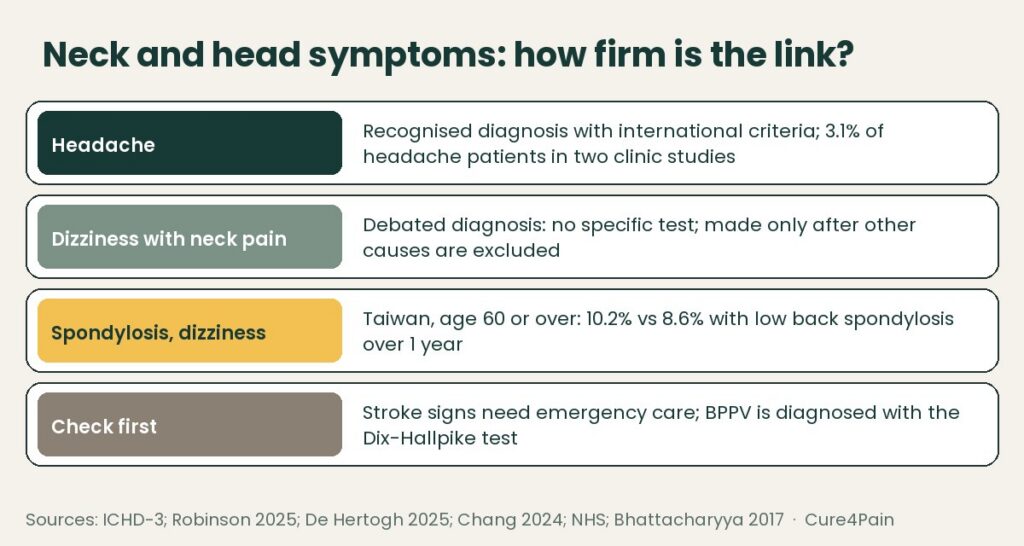
Neck problems can cause headaches: the International Headache Society recognises cervicogenic headache and sets criteria for it [1], although a 2025 review found it made up only 3.1% of 3,165 outpatients assessed for headache in two clinic-based studies [2]. Neck-related dizziness is a debated diagnosis with no specific test, made only after other causes are excluded [3] [4]. In a Taiwanese study of 7,276 people aged 60 or over, dizziness was diagnosed within a year in 10.2% of those with neck spondylosis and 8.6% of those with low back spondylosis, and the authors call dizziness from neck spondylosis uncommon [5]. A better-established root cause of spinning vertigo is benign paroxysmal positional vertigo (BPPV), an inner-ear problem linked with low vitamin D: in a 2020 Korean trial of 1,050 people after successful repositioning, giving vitamin D and calcium to those with low levels meant 0.83 recurrences a year across the group, against 1.10 with observation only [6]. According to the NHS, dizziness can be a stroke symptom, and a drooping face, arm weakness or slurred speech means calling emergency services at once [7].

Scientific explainer videos in our Resources section
In our Resources section, our clinical team discusses vitamin D, its cofactors and how autoimmune, lifestyle and pain conditions develop.
Can neck problems cause dizziness, vertigo or headaches?
Neck problems can cause headaches and possibly dizziness, but the neck should not be the first explanation accepted for spinning vertigo. According to the NHS, inner-ear problems are the most common causes of vertigo [8], and doctors look for those, and for stroke, before attributing symptoms to the neck [4].
| Symptom | What the evidence supports | How firm is it? |
|---|---|---|
| Headache | Pain from upper neck joints and muscles can be referred to the head [9] | A recognised ICHD-3 diagnosis, although a 2009 Lancet Neurology review says some clinicians remain sceptical [1] [9] |
| Dizziness or unsteadiness with neck pain | Altered signals from neck sensors may clash with signals from the inner ear and eyes [3] | Debated; no specific test [3] |
| Spinning vertigo | A 1996 review argued that any neck-related problem would be unsteadiness, not clear spinning [10] | Weak; inner-ear problems are the most common causes [8] |
| Reduced blood flow when the head turns | A vertebral artery can be narrowed by head rotation [11] | Real but rare: 193 reported cases in a 2021 review [11] |
When are dizziness, vertigo or neck pain an emergency?
Treat dizziness, vertigo or headache as an emergency when it comes with signs of stroke. According to the NHS, stroke signs are a drooping face, weakness or numbness in one arm, and slurred or confused speech; dizziness or falling over, blurred or lost vision and a severe headache can also occur [7]. Call 112 in India, 911 in the US or 999 in the UK, even if the signs have stopped, and do not drive yourself [7].
- Vertigo with other signs: the NHS advises emergency care for vertigo with double or lost vision, hearing loss, trouble speaking, or weakness, numbness or tingling in an arm or leg [8].
- Sudden or unusual headache: the NHS advises emergency care for a headache that starts suddenly with extreme pain, or comes with a very high temperature, a stiff neck, a seizure, a head injury in the last 3 months, or confusion [12].
- New neck pain with headache: a 2009 Lancet Neurology review says a tear in a neck artery (cervical artery dissection) can cause headache and neck pain, and that most people with such a tear have a stroke or a transient ischaemic attack [13]. It is a rare cause of stroke overall, but a major one in young adults [14] [13].
- After neck treatment: a 2025 review of 334 reported serious events found most followed spinal manipulation, and some followed vestibular testing, gentle mobilisation, exercise, acupuncture or massage; it collects reported cases, so it cannot show how often they happen. First symptoms included a sharp rise in headache or neck pain, nausea, dizziness or altered sensation, during treatment or within 48 hours; seek urgent assessment if this happens [15].
- Spinal cord signs: according to a 2018 BMJ review, clumsy hands, unsteady walking, falls, or bladder or bowel problems can mean pressure on the spinal cord in the neck (myelopathy), which needs prompt specialist assessment [16].
What is a cervicogenic headache?
A cervicogenic headache is a headache caused by a disorder of the neck bones, discs or soft tissues, usually with neck pain. The International Classification of Headache Disorders (ICHD-3) requires evidence of a neck disorder, and evidence of cause from at least two of these four findings [1]:
- The headache began around the time the neck problem began.
- The headache improved or settled as the neck problem improved.
- Neck movement is reduced, and pressing or moving the neck clearly worsens the headache.
- A diagnostic numbing injection of a neck structure or its nerve stops the headache.
Another headache diagnosis must not explain it better [1]. Three notes in the criteria matter for anyone holding a scan report:
- Scans are not proof: ICHD-3 says upper neck changes on imaging are common in people without headache [1].
- Spondylosis: ICHD-3 says it may or may not be a valid cause, depending on the individual case [1].
- Neck muscles: when neck muscle pain (myofascial pain) is the cause, ICHD-3 says the headache should probably be coded as tension-type headache [1].
According to ICHD-3, pain that stays on one side, is brought on by pressing neck muscles or moving the head, and spreads from back to front points towards cervicogenic headache, but these features are not unique to it [1]. Estimates of how common cervicogenic headache is vary: 0.17% of Norwegians aged 30 to 44 in a 2010 survey of chronic headache [17], and 3.9% in the only population study that met the criteria of a 2025 review, which calls the data limited [2].
Can neck pain cause migraines?
Neck pain and migraine occur together very often, but that does not show that the neck causes migraine. In a 2022 meta-analysis of clinic studies, 77.0% of people with migraine had neck pain, against 23.2% of people without headache [18]. These are observational data, and the authors say more research is needed on what drives the neck pain [18].
Cervicogenic headache and migraine can also coexist: in the 2010 Norwegian survey, 42% of people with cervicogenic headache also had migraine [17]. Migraine can bring its own dizziness too: a 2020 meta-analysis found dizziness in 35.7% and vertigo in 33.9% of people with migraine during the headache phase, from studies of mostly modest quality [19]. Our migraine and headache page explains the types and how each is managed.
Is cervicogenic dizziness a real diagnosis?
Cervicogenic dizziness, also called cervical dizziness or cervical vertigo, means dizziness associated with neck pain or neck dysfunction [20] [3]. It is a possible diagnosis, but it is debated. A 2025 paper by European and Australian researchers calls it “a debated clinical entity” because it depends on excluding other causes and has no specific criteria or gold-standard test [3].
- The case for it: according to a 2016 Handbook of Clinical Neurology review, signals from the neck matter for balance, and treating the neck may relieve dizziness in some patients [20].
- The case against it: the same 2016 review says neck pain and dizziness are both common and may simply coincide [20].
- The research so far: a 2019 systematic review found only eight comparison studies with 225 patients, and concluded that current criteria are likely to have low specificity, because they rest on excluding other causes rather than on positive features [21].
- A careful working rule: the 2016 review looks for neck pain that comes before or close in time to the dizziness, other causes made unlikely, and treating the neck also reducing the dizziness, and it advises using the diagnosis with care [20].
Can cervical spondylosis cause vertigo?
Cervical spondylosis may cause vertigo in some people, but it is an uncommon explanation. In a 2024 Taiwanese study of 7,276 people aged 60 or over, neck spondylosis carried a 1.20 relative risk of a dizziness diagnosis within a year, compared with low back spondylosis. The absolute difference was 1.6 percentage points, and the authors warn clinicians against diagnosing a neck cause from a history of spondylosis alone [5]. The study counted outpatient diagnoses of dizziness in insurance claims, not vertigo specifically [5].
Studies of blood flow in spondylosis and vertigo disagree. A 2023 study of 100 patients in Maharashtra, India, and a 2011 study from Egypt found lower vertebral artery flow on head turning in people with advanced spondylosis and vertigo [22] [23]. A 2009 Turkish study of 91 patients found no significant Doppler finding in those with vertigo [24]. None of these can prove that changes in flow cause the vertigo.
According to a 2021 review, rotational vertebral artery occlusion (bow hunter syndrome) is a clearly documented mechanism, but it is rare, seen mostly in adults aged 50 to 70, and most often linked with degenerative neck changes [11]. For the wider picture of spondylosis, see our neck pain and cervical spondylosis page and our article on the cervical spondylosis diet.
What else causes dizziness and vertigo?
Dizziness has many causes, and in a 2018 review of 31 primary care studies the most common were inner-ear, cardiovascular, neurological and psychological; the review’s summary of common causes does not name the neck [25].
| Cause | Typical pattern | Source |
|---|---|---|
| BPPV | Attacks of spinning lasting under a minute, brought on by typical changes in head position | German population study, 2007 [26] |
| Stroke or mini-stroke | Sudden, often with face, arm, speech or vision signs | NHS [7] |
| Vestibular migraine | Repeated episodes of 5 minutes to 72 hours in someone with a history of migraine | Bárány Society and International Headache Society criteria, 2022 [27] |
| Labyrinthitis | Off balance or spinning, feeling or being sick, sometimes after a cold or flu | NHS [28] |
| Fall in blood pressure | On standing or sitting up suddenly | NHS [28] |
| Medicines | After starting a new prescription medicine | NHS [28] |
| Neck-related dizziness | Neck pain with unsteadiness, once the causes above are excluded | Narrative review, 2017 [4] |
Benign paroxysmal positional vertigo (BPPV) matters most here because a repositioning manoeuvre treats it. In a 2007 German population study, lifetime prevalence of BPPV was 2.4%, yet only 8% of those affected received effective treatment [26]. In a 2014 Cochrane review, vertigo resolved completely in 56% with the Epley manoeuvre against 21% with sham or control, although BPPV came back in 36%; some patients could not tolerate it because of neck problems, so tell your doctor about yours [29]. The 2017 American Academy of Otolaryngology-Head and Neck Surgery Foundation guideline recommends repositioning, and advises against routine scans and routine vestibular suppressant medicines when BPPV is confirmed [30].
Can low vitamin D or vitamin B12 cause dizziness?
Low vitamin D is linked with BPPV and, in one observational study, with worse neck-related dizziness, and low vitamin B12 can affect balance. People with BPPV had lower vitamin D levels than controls in a 2024 meta-analysis, although the link with recurrence stayed uncertain [31].
Trials of correcting low vitamin D to prevent BPPV coming back are more encouraging:
- Korea, 2020, 1,050 people with BPPV: after successful repositioning, those in the intervention group with low levels took vitamin D and calcium. Across that whole group, recurrences were 0.83 a year against 1.10 with observation only, without a placebo [6].
- Singapore, 2025, placebo-controlled: older adults with BPPV and low vitamin D had 0.75 fewer episodes a year on vitamin D than on placebo [32].
According to the NHS, vitamin B12 deficiency can cause problems with balance and coordination, numbness and pins and needles [33]. Ask your doctor to check your vitamin D and vitamin B12 levels rather than supplementing on your own.
For neck-related dizziness itself, we found one observational study. In a 2026 study of 210 patients in Turkey on a neck rehabilitation programme, lower vitamin D went with more severe symptoms and longer recovery; those with low levels also received vitamin D, and there was no control group, so it cannot show that vitamin D helped [34]. Our PubMed search (October 2026) found no controlled trial testing vitamin D or vitamin B12 on its own in cervicogenic dizziness.
How do doctors tell neck-related dizziness from other causes?
Doctors rule out the dangerous and the common causes of dizziness first, then look for positive signs in the neck, because no single test confirms a neck cause [4] [3].
- Timing and triggers: the 2023 GRACE-3 emergency guideline from the Society for Academic Emergency Medicine sorts acute dizziness by its timing and triggers, which decide which tests are used [35].
- Eye examination: the HINTS bedside examination (head impulse, nystagmus, test of skew) helps separate central causes, such as stroke, from inner-ear causes in acute vestibular syndrome (acute severe vertigo or unsteadiness), with 94.0% sensitivity and 86.9% specificity in a 2023 Cochrane review (low-certainty evidence, trained clinicians) [36]. GRACE-3 recommends it only for clinicians trained in its use, calls it inaccurate in routine use without that training, and advises against brain CT for this purpose [35].
- Positional test: the Dix-Hallpike test diagnoses posterior canal BPPV, according to the 2017 American Academy of Otolaryngology-Head and Neck Surgery Foundation guideline [30]. It bends the neck back, so a clinician should do it.
- Neck examination: the flexion-rotation test, which measures how far the head turns with the neck bent forward, had 83% sensitivity and specificity for cervicogenic headache in a 2022 meta-analysis, but probably has only a small to moderate effect on the likelihood of the diagnosis [37]. A 2021 systematic review found that it may help separate cervicogenic headache from migraine [38].
- Scans: a report of spondylosis does not settle the question, because ICHD-3 says upper neck changes on imaging are common in people without headache [1].
Before your appointment, note when the symptoms began, what brings them on, how long each episode lasts, whether neck pain came first, and every medicine you take.
What treatment helps neck-related headaches and dizziness?
For neck-related headaches and dizziness, exercise and hands-on treatment have the most evidence, more for headache than for dizziness, and most results are short term or of limited certainty.
For cervicogenic headache:
- Exercise and manual therapy: in a 2002 trial of 200 people with cervicogenic headache, manipulative therapy and specific neck exercise each reduced headache frequency and intensity at 12 months compared with a control group [39]. A 2023 meta-analysis supports manual therapy in the short term and neck exercise in the long term; at 12 months manual therapy was no better than sham [40].
- Combined programmes: a 2026 network meta-analysis of 41 trials found combined non-drug programmes better in the short term than single treatments or medicines, with manual therapy plus dry needling ranked highest; massage alone, pregabalin and botulinum toxin showed limited effect [41].
- Dry needling: in a 2022 trial of 69 patients with cervicogenic headache in Iran, adding it to physiotherapy lowered headache intensity and disability more than sham needling, but the clinical gain was small and headache frequency did not differ significantly [42].
For cervicogenic dizziness:
- Manual therapy: a 2022 review of 13 trials (898 patients) with cervicogenic dizziness found moderate-quality evidence of benefit, and very low-quality evidence that adding exercise helps more [43]. In a 2015 trial of 86 people, dizziness was less frequent and less disabling at 12 months than with placebo, but no less intense [44].
- Dry needling: in a 2019 trial of 61 women with neck trigger points and dizziness, needling plus exercise did better than exercise alone over four months, with no sham comparison [45].
- Acupuncture: a 2026 network meta-analysis of 66 trials in cervical vertigo suggests possible benefit, with results reported mainly against Tuina, a Chinese manual therapy, and with mostly low or very low certainty [46].
- The cautious view: a 2026 review of physiotherapy in people with neck pain and cervicogenic dizziness or tinnitus found 10 of 13 studies at high risk of bias, limited or no evidence for most dizziness outcomes against placebo or wait-list, and conflicting evidence on disability from dizziness; more research is needed for firm conclusions [47].
At home, the NHS suggests a low, firm pillow and heat or cold packs for neck pain with headaches [48]. For vertigo, it advises moving your head carefully and sitting down straight away when dizzy [8].
How we assess and treat neck-related headaches at Cure4Pain
At Cure4Pain we look for the source of each person’s headaches and treat the neck, jaw and muscles alongside exercise, in coordination with your existing consulting physician.
- First visit: a full history, an examination of posture and muscles, a review of your scans and tests, and a plan.
- Tests: we read a panel of about 100 markers, which for headaches includes ANA by the IFA method, the lipid profile and inflammatory markers, adding tests for your condition when clinically indicated. One example a named guideline supports: vitamin B12, with methylmalonic acid if the first result is uncertain, when balance problems, an unsteady walk, pins and needles or numbness come with a risk factor for low B12 (NICE NG239, 2024) [49].
- Hands-on treatment: myofascial dry needling and release for tight muscles and trigger points in the neck, shoulders and upper back, and acupuncture. For headaches, we use needling only for myofascial and myofunctional tension headaches.
- Jaw and tongue: where headaches come with clenching, a jaw or bite problem or tongue thrusting, we correct tongue posture alongside needling.
- Exercise and posture: strengthening of the neck, shoulder-blade and upper-back muscles, a home programme, and advice on desk set-up, pillow and sleep position.
- Naturopathy: hot and cold applications, fomentation, therapeutic diet, relaxation and yoga-based breathing, for comfort and recovery.
- Nutrition: we test vitamin D and vitamin B12 and correct what is low; magnesium is assessed from diet, symptoms and history. Supplements are given by mouth first, with injections only when specifically needed or advised. Magnesium is mainly given as magnesium bisglycinate, with L-threonate or citrate as advised, always counted as elemental magnesium; absorption varies by form [50].
- Dizziness or vertigo: other causes such as BPPV, migraine and stroke need assessing first. Your plan is agreed in coordination with your existing consulting physician, who decides on scans and specialist referral.
- Medicines and specialists: many people with headaches come to us referred by their neurologist, and we work alongside them. Any change to your medicines is made under clinical guidance from Team Cure4Pain, in coordination with your existing consulting physician and your neurologist; never stop or change them on your own.
- Timeline: this differs from person to person. When headaches come from jaw, neck or muscle tension, many people in our clinic notice relief within 6 to 8 weeks, as a clinic observation; lasting change in the neck usually needs a few weeks of treatment plus exercise at home. We see adults and young people aged 16 and over for headaches.
This is our clinic practice; individual results vary, and further studies are needed. Read more on our neck pain and cervical spondylosis, migraine and headache and pinched nerve pages.
If you would like your neck and headaches assessed together, you can book a consultation, online from anywhere or at our Mumbai clinic. Dry needling and acupuncture need an in-person visit.
Frequently asked questions
Can neck problems cause dizziness?
Neck problems may cause dizziness, but this is debated. Cervicogenic dizziness has no specific test and is diagnosed only after other causes are excluded, so inner-ear problems, migraine and stroke need considering first. [3] [4]
Can neck problems cause headaches?
Yes, neck problems can cause headaches. The International Headache Society recognises cervicogenic headache, caused by a disorder of the neck and usually accompanied by neck pain. A 2025 review found it made up 3.1% of outpatients assessed for headache in two clinic-based studies. [1] [2]
Can cervical spondylosis cause vertigo?
Cervical spondylosis may cause vertigo in some people, but this is uncommon. In a 2024 Taiwanese study of people aged 60 or over, dizziness was diagnosed in 10.2% with neck spondylosis and 8.6% with low back spondylosis over a year. [5]
Can tight neck muscles cause dizziness?
Tight neck muscles may contribute to dizziness, but the evidence is limited. In a 2019 trial of 61 women with neck trigger points and dizziness, dry needling plus exercise did better than exercise alone, without a sham comparison. [45]
How can I tell if my dizziness is coming from my neck?
You cannot tell on your own whether dizziness comes from your neck. Neck pain and dizziness are both common and may simply coincide, so a doctor needs to exclude other causes and examine the neck. [20] [4]
Why do I feel dizzy when I turn my head or roll over in bed?
A well-established reason for dizziness on turning the head or rolling over in bed is benign paroxysmal positional vertigo (BPPV), an inner-ear problem in which specific head movements bring on vertigo. Turning the head moves the inner ear as well as the neck, so this does not point to the neck by itself. The Dix-Hallpike test checks for it. [8] [30]
Can neck pain cause migraines?
Neck pain has not been shown to cause migraines. In a 2022 meta-analysis of clinic studies, neck pain was present in 77.0% of people with migraine, against 23.2% of people without headache, which shows that they occur together, not that one causes the other. [18]
Where is a cervicogenic headache felt?
According to ICHD-3, a cervicogenic headache is often felt on one side, spreading from the back of the head towards the front, and brought on by pressing neck muscles or moving the head. These features are not unique to it. [1]
Does cervical vertigo go away?
Long-term data on cervical vertigo, also called cervicogenic dizziness, are few. In a 2015 trial of 86 people with chronic cervicogenic dizziness, manual therapy left dizziness less frequent and less disabling than placebo at 12 months, but no less intense. [44]
When should I worry about dizziness and neck pain?
According to the NHS, get emergency care for a drooping face, arm weakness, slurred speech, double or lost vision, or a sudden severe headache. See a doctor urgently for clumsy hands, unsteady walking, or new bladder or bowel problems. [7] [8] [12] [16]
This article is for education and does not replace medical advice. Do not start, stop or change any medicine or supplement without medical guidance.
References
1. Headache Classification Committee of the International Headache Society. International Classification of Headache Disorders, 3rd edition (ICHD-3): 11.2.1 Cervicogenic headache. ichd-3.org
2. Robinson CL, et al. Prevalence and relative frequency of cervicogenic headache in population- and clinic-based studies: A systematic review and meta-analysis. Cephalalgia 2025;45(3):3331024251322446. doi:10.1177/03331024251322446
3. De Hertogh W, et al. Dizziness and neck pain: a perspective on cervicogenic dizziness exploring pathophysiology, diagnostic challenges, and therapeutic implications. Front Neurol 2025;16:1545241. doi:10.3389/fneur.2025.1545241
4. Reiley AS, et al. How to diagnose cervicogenic dizziness. Arch Physiother 2017;7:12. doi:10.1186/s40945-017-0040-x
5. Chang TP, et al. Risk of Cervical Dizziness in Patients With Cervical Spondylosis. JAMA Otolaryngol Head Neck Surg 2024;150(2):93-98. doi:10.1001/jamaoto.2023.3810
6. Jeong SH, et al. Prevention of benign paroxysmal positional vertigo with vitamin D supplementation: A randomized trial. Neurology 2020;95(9):e1117-e1125. doi:10.1212/WNL.0000000000010343
7. NHS (UK National Health Service). Symptoms of a stroke. nhs.uk/conditions/stroke/symptoms
8. NHS (UK National Health Service). Vertigo. nhs.uk/conditions/vertigo
9. Bogduk N, Govind J. Cervicogenic headache: an assessment of the evidence on clinical diagnosis, invasive tests, and treatment. Lancet Neurol 2009;8(10):959-68. doi:10.1016/S1474-4422(09)70209-1
10. Brandt T. Cervical vertigo–reality or fiction? Audiol Neurootol 1996;1(4):187-96. doi:10.1159/000259201
11. Schulz R, et al. Rotational vertebral artery occlusion (“bow hunter syndrome”). Eur Spine J 2021;30(6):1440-1450. doi:10.1007/s00586-020-06680-5
12. NHS (UK National Health Service). Headaches. nhs.uk/conditions/headaches
13. Debette S, Leys D. Cervical-artery dissections: predisposing factors, diagnosis, and outcome. Lancet Neurol 2009;8(7):668-78. doi:10.1016/S1474-4422(09)70084-5
14. Jacobs W, et al. Risk factors for cervical artery dissection: a systematic review with meta-analysis. Stroke Vasc Neurol 2026;11(3):275-285. doi:10.1136/svn-2025-004186
15. Leung B, et al. Serious adverse events associated with conservative physical procedures directed towards the cervical spine: A systematic review. J Bodyw Mov Ther 2025;41:56-77. doi:10.1016/j.jbmt.2024.10.018
16. Davies BM, et al. Degenerative cervical myelopathy. BMJ 2018;360:k186. doi:10.1136/bmj.k186
17. Knackstedt H, et al. Cervicogenic headache in the general population: the Akershus study of chronic headache. Cephalalgia 2010;30(12):1468-76. doi:10.1177/0333102410368442
18. Al-Khazali HM, et al. Prevalence of neck pain in migraine: A systematic review and meta-analysis. Cephalalgia 2022;42(7):663-673. doi:10.1177/03331024211068073
19. Iljazi A, et al. Dizziness and vertigo during the prodromal phase and headache phase of migraine: A systematic review and meta-analysis. Cephalalgia 2020;40(10):1095-1103. doi:10.1177/0333102420921855
20. Magnusson M, Malmström EM. The conundrum of cervicogenic dizziness. Handb Clin Neurol 2016;137:365-9. doi:10.1016/B978-0-444-63437-5.00026-1
21. Knapstad MK, et al. Clinical characteristics in patients with cervicogenic dizziness: A systematic review. Health Sci Rep 2019;2(9):e134. doi:10.1002/hsr2.134
22. Shende C, et al. Degenerative Cervical Spondylosis: A Cause of Vertigo? Global Spine J 2023;13(5):1273-1279. doi:10.1177/21925682211027840
23. Machaly SA, et al. Vertigo is associated with advanced degenerative changes in patients with cervical spondylosis. Clin Rheumatol 2011;30(12):1527-34. doi:10.1007/s10067-011-1770-x
24. Bayrak IK, et al. Effect of cervical spondylosis on vertebral arterial flow and its association with vertigo. Clin Rheumatol 2009;28(1):59-64. doi:10.1007/s10067-008-0983-0
25. Bösner S, et al. Prevalence, aetiologies and prognosis of the symptom dizziness in primary care – a systematic review. BMC Fam Pract 2018;19(1):33. doi:10.1186/s12875-017-0695-0
26. von Brevern M, et al. Epidemiology of benign paroxysmal positional vertigo: a population based study. J Neurol Neurosurg Psychiatry 2007;78(7):710-5. doi:10.1136/jnnp.2006.100420
27. Lempert T, et al. Vestibular migraine: Diagnostic criteria1. J Vestib Res 2022;32(1):1-6. doi:10.3233/VES-201644
28. NHS (UK National Health Service). Dizziness. nhs.uk/conditions/dizziness
29. Hilton MP, Pinder DK. The Epley (canalith repositioning) manoeuvre for benign paroxysmal positional vertigo. Cochrane Database Syst Rev 2014;2014(12):CD003162. doi:10.1002/14651858.CD003162.pub3
30. Bhattacharyya N, et al. Clinical Practice Guideline: Benign Paroxysmal Positional Vertigo (Update). Otolaryngol Head Neck Surg 2017;156(3_suppl):S1-S47. doi:10.1177/0194599816689667
31. Wood H, et al. Association between vitamin D deficiency and benign paroxysmal positional vertigo (BPPV) incidence and recurrence: a systematic review and meta-analysis. BMJ Open 2024;14(4):e077986. doi:10.1136/bmjopen-2023-077986
32. Chua KW, et al. Randomized Controlled Trial Assessing Vitamin D’s Role in Reducing BPPV Recurrence in Older Adults. Otolaryngol Head Neck Surg 2025;172(1):127-136. doi:10.1002/ohn.954
33. NHS (UK National Health Service). Symptoms of vitamin B12 or folate deficiency anaemia. nhs.uk/conditions/vitamin-b12-or-folate-deficiency-anaemia/symptoms
34. Cetin YS, Agirbas S. Association of serum vitamin D levels with clinical severity and recovery duration in cervical dizziness. BMC Musculoskelet Disord 2026;27(1). doi:10.1186/s12891-026-10119-1
35. Edlow JA, et al. Guidelines for reasonable and appropriate care in the emergency department 3 (GRACE-3): Acute dizziness and vertigo in the emergency department. Acad Emerg Med 2023;30(5):442-486. doi:10.1111/acem.14728
36. Gottlieb M, et al. Head impulse, nystagmus, and test of skew examination for diagnosing central causes of acute vestibular syndrome. Cochrane Database Syst Rev 2023;11(11):CD015089. doi:10.1002/14651858.CD015089.pub2
37. Demont A, et al. Cervicogenic headache, an easy diagnosis? A systematic review and meta-analysis of diagnostic studies. Musculoskelet Sci Pract 2022;62:102640. doi:10.1016/j.msksp.2022.102640
38. Anarte-Lazo E, et al. Differentiating migraine, cervicogenic headache and asymptomatic individuals based on physical examination findings: a systematic review and meta-analysis. BMC Musculoskelet Disord 2021;22(1):755. doi:10.1186/s12891-021-04595-w
39. Jull G, et al. A randomized controlled trial of exercise and manipulative therapy for cervicogenic headache. Spine (Phila Pa 1976) 2002;27(17):1835-43; discussion 1843. doi:10.1097/00007632-200209010-00004
40. Demont A, et al. Efficacy of physiotherapy interventions for the management of adults with cervicogenic headache: A systematic review and meta-analyses. PM R 2023;15(5):613-628. doi:10.1002/pmrj.12856
41. Koonalinthip N, et al. The Comparative Efficacy of Treatments for Cervicogenic Headache: A Systematic Review and Network Meta-Analysis of Randomised Controlled Trials. Eur J Pain 2026;30(2):e70219. doi:10.1002/ejp.70219
42. Mousavi-Khatir SR, et al. The Effect of Adding Dry Needling to Physical Therapy in the Treatment of Cervicogenic Headache: A Randomized Controlled Trial. Pain Med 2022;23(3):579-589. doi:10.1093/pm/pnab312
43. De Vestel C, et al. Systematic review and meta-analysis of the therapeutic management of patients with cervicogenic dizziness. J Man Manip Ther 2022;30(5):273-283. doi:10.1080/10669817.2022.2033044
44. Reid SA, et al. Manual therapy for cervicogenic dizziness: Long-term outcomes of a randomised trial. Man Ther 2015;20(1):148-56. doi:10.1016/j.math.2014.08.003
45. Aydin T, et al. The Effectiveness of Dry Needling and Exercise Therapy in Patients with Dizziness Caused By Cervical Myofascial Pain Syndrome; Prospective Randomized Clinical Study. Pain Med 2019;20(1):153-160. doi:10.1093/pm/pny072
46. Yang Z, et al. Comparative effectiveness of acupuncture and Tuina for cervical vertigo: a systematic review and network meta-analysis of randomized controlled trials. Front Neurol 2026;17:1691312. doi:10.3389/fneur.2026.1691312
47. Canlı K, et al. The effects of physiotherapy on neck pain with associated symptoms, ıncludıng cervicogenic dizziness and tinnitus: a systematic review. BMC Musculoskelet Disord 2026;27(1). doi:10.1186/s12891-026-09664-6
48. NHS (UK National Health Service). Tension headaches. nhs.uk/conditions/tension-headaches
49. National Institute for Health and Care Excellence (NICE). Vitamin B12 deficiency in over 16s: diagnosis and management. NG239, 2024. nice.org.uk/guidance/ng239
50. National Institutes of Health, Office of Dietary Supplements. Magnesium: Fact Sheet for Health Professionals. ods.od.nih.gov

