Written by AT. Chintan Dalal, N.D. · Reviewed by Dr Krushal Pabari, Clinical Team, Cure4Pain · Updated 30 October 2026
Key facts
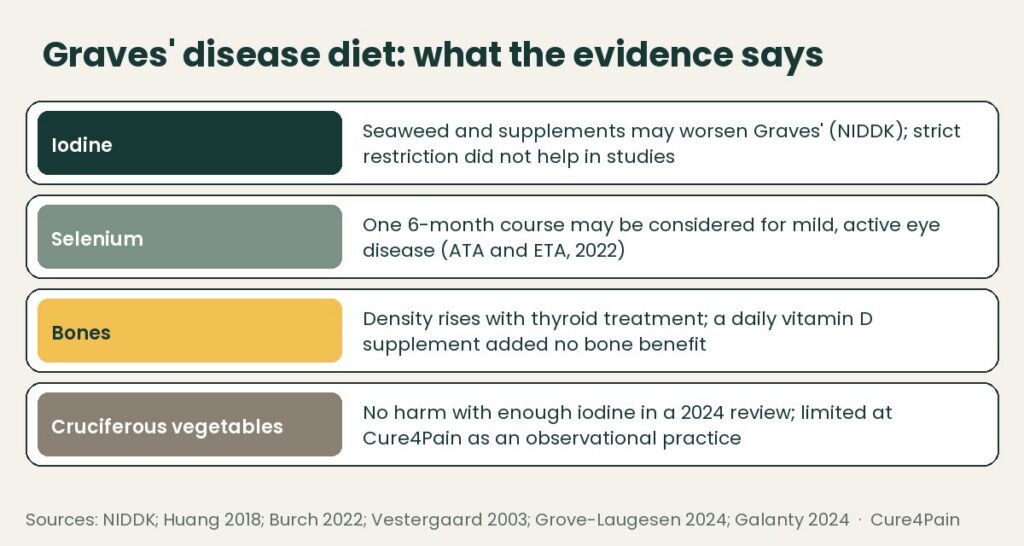
We found no guideline that sets a Graves’ disease diet. The clearest advice comes from the US National Institute of Diabetes and Digestive and Kidney Diseases (NIDDK): foods with large amounts of iodine, such as kelp and other seaweed, and iodine supplements may cause or worsen an overactive thyroid [1]. Strict restriction is a different matter: in a 2018 randomised trial in China, with 459 people randomised and 405 completing the study, relapse within 12 months of stopping antithyroid medicine was 45.5% on a low-iodine diet and 35.5% with iodised salt [2]. The 2022 American Thyroid Association (ATA) and European Thyroid Association (ETA) consensus says a single 6-month course of selenium, 100 mcg twice a day, may be considered for mild, active thyroid eye disease [3]; the ATA 2016, ETA 2018 and NICE 2019 guidelines do not recommend it for the overactive thyroid itself [4] [5] [6]. Bone density falls with an untreated overactive thyroid and rises with treatment, according to a 2003 meta-analysis [7]. A 2024 review of 123 studies found that cruciferous vegetables, with enough iodine, did not harm thyroid function [8]; as an observational clinic practice, we generally suggest limiting them.

Scientific explainer videos in our Resources section
In our Resources section, our clinical team discusses vitamin D, its cofactors and how autoimmune, lifestyle and pain conditions develop.
Is there a special diet for Graves’ disease?
No. We found no special diet for Graves’ disease in the American Thyroid Association (ATA) 2016, European Thyroid Association (ETA) 2018 or UK NICE 2019 guidelines; the main food advice, from the US National Institute of Diabetes and Digestive and Kidney Diseases (NIDDK), is about excess iodine [4] [5] [6] [1]. Graves’ disease is an autoimmune disease that makes the thyroid overactive, according to NIDDK [1]. Two facts shape what you eat: the thyroid uses iodine to make its hormones [1], and an untreated overactive thyroid lowers bone density and usually body weight [7] [9].
- The one whole-diet trial we found in Graves’: in a 2025 Italian trial, 40 people with mild, active eye disease and stable thyroid function followed either a Mediterranean diet enriched with selenium from food or a free diet. Compared with the free diet, the Mediterranean diet group had more improvement in eye disease activity at 12 weeks and in soft tissue signs at 12 and 24 weeks. Thyroid function and TSH receptor antibodies did not differ between the groups [10]. It was small and from one centre.
Our Graves’ disease page covers symptoms, tests and treatment; this article stays with food.
What foods should you avoid with Graves’ disease?
With Graves’ disease, avoid kelp and other seaweed, and iodine supplements: the US National Institute of Diabetes and Digestive and Kidney Diseases (NIDDK) says these may cause or worsen an overactive thyroid [1]. As clinic practice, Cure4Pain also advises avoiding processed foods, breads and ashwagandha, and, as an observational practice, generally suggests limiting cruciferous (Brassica) vegetables such as cabbage and cauliflower. The table shows the research beside our clinic practice.
| Food or product | What research shows | Cure4Pain clinic practice |
|---|---|---|
| Kelp, dulse, nori and other seaweed | May cause or worsen an overactive thyroid, according to NIDDK [1]; commercial seaweed ranged from 16 to 2,984 mcg of iodine per gram, according to the US National Institutes of Health (NIH) [11] | Avoided |
| Iodine supplements and drops, kelp tablets | May cause or worsen an overactive thyroid, according to NIDDK, which also warns that some cough syrups and multivitamins may contain iodine [1] | No iodine supplements |
| Processed foods and breads | We found no Graves’ study of these | Avoided |
| Cruciferous vegetables | No harm with enough iodine in a 2024 review [8] | As an observational clinic practice, we generally suggest limiting them (see below) |
| Gluten | Coeliac disease was found in 2.6% of people with an overactive autoimmune thyroid in a 2016 meta-analysis [12]; avoiding gluten helps only with a matching sensitivity [13] | We generally advise most patients to replace wheat with jowar, bajra or other millets as a general health measure, including home-made roti from processed wheat; gluten-free only with coeliac disease or gluten sensitivity |
| Dairy | Avoiding it helps only with a matching sensitivity [13]; we found no Graves’ study | Reduced where it does not suit you; ghee is allowed |
| Ashwagandha | Not recommended with thyroid or autoimmune disorders, according to the US National Center for Complementary and Integrative Health [14] | Avoided |
NICE (UK, 2015) advises offering a coeliac blood test to people with autoimmune thyroid disease, so test before you cut gluten [15].
What foods can you eat with Graves’ disease?
People with Graves’ disease can eat a balanced, home-cooked diet from every food group, though no food has been shown to treat the condition. This is the base at Cure4Pain, planned differently for vegetarians and non-vegetarians. The table gives Indian examples, not a prescription.
| What you need | Indian food examples | Why |
|---|---|---|
| Protein and energy | Moong, masoor and toor dal; paneer and curd if dairy suits you; eggs, chicken, fish | Most people lose weight while the thyroid is overactive [9] |
| Calcium | Milk, curd, paneer; ragi (nachni), sesame seeds (til) | Dairy is high in calcium, and absorption from plants varies, according to the NIH [16] |
| Selenium | Fish, chicken, meat | Fish, chicken and meat are rich sources; selenium in plant foods varies with the soil, according to the NIH [17] |
| Vitamin D | Fatty fish, egg yolks, cheese | Found naturally in only a few foods, according to the NIH [18] |
| Everyday base | Rice, ragi, jowar; bottle gourd (lauki), ridge gourd (turai), pumpkin, carrot, okra, spinach; guava, apple, pomegranate | Most fruit and vegetables are poor sources of iodine, according to the NIH [11] |
At Cure4Pain, omega-3 is part of each plan unless there is a reason not to: from fish for people who eat it, and from algal oil for vegetarians and vegans. Our article on omega-3 and autoimmune disease explains the research.
Should you avoid iodine with Graves’ disease?
With Graves’ disease, avoid excess iodine from sources such as seaweed and supplements, not ordinary food. According to the NIH, people with autoimmune thyroid disease may have adverse effects at intakes considered safe for the general population [11]. A prospective study from Japan and a randomised trial from China do not support strict restriction during antithyroid medicine.
- Japan, 2006: in a prospective study of 81 people newly diagnosed with Graves’ disease in an area of excessive iodine intake, restricting iodine for the first 8 weeks of medicine made no difference to the fall in thyroid hormones or antibodies [19].
- China, 2018: in a randomised trial of people newly diagnosed with Graves’ disease and on antithyroid medicine (459 randomised, 405 completing the study), with the diets kept up for 24 months, relapse within 12 months of stopping medicine was 35.5% with iodised salt, with urine iodine in the recommended range, and 45.5% with non-iodised salt and a low-iodine diet. The authors say strict restriction might be an adverse factor [2].
- Official figures: the NIH gives 150 mcg of iodine a day as the adult recommended intake and 1,100 mcg as the upper limit for the general population [11].
Fish, eggs and dairy are good sources of iodine, according to the NIH [11], but NIDDK’s warning names seaweed, not these foods [1]. As clinic practice, we advise limiting iodine-rich foods, and normal iodised salt in cooking stays fine. These US values, from the NIH iodine fact sheet, are per serving and vary with the source [11]:
| Food | Iodine per serving (NIH) |
|---|---|
| Cod, baked, 3 ounces | 146 mcg |
| Nori seaweed, dried, 5 g | 116 mcg |
| Milk, nonfat, 1 cup | 84 mcg |
| Iodised table salt, a quarter teaspoon | 78 mcg |
| Egg, 1 large | 31 mcg |
| Rice, banana, broccoli | 0 mcg |
Is iodised salt safe with Graves’ disease?
At Cure4Pain, normal iodised salt in cooking is fine for people with Graves’ disease, and in a 2018 randomised trial in China, relapse was lower with iodised salt than with non-iodised salt and a low-iodine diet [2]. India requires salt to be iodised: the 2018-19 India Iodine Survey of 21,406 households found adequately iodised salt in 76.3% of them, and urine iodine levels in women of reproductive age within the WHO’s adequate range [20].
- Other salts: sea salt and Himalayan salt are not usually iodised, according to the NIH [11]. We found no study showing that switching to these salts helps Graves’ disease.
- Too much iodine is still possible: a 2025 review lists iodised salt among potential sources of excess iodine, with seaweed, supplements, drinking water, contrast media and amiodarone [21]. Cure4Pain’s advice covers normal amounts of iodised salt in cooking.
Can you have iodine contrast, or medicines containing iodine, with Graves’ disease?
Iodine contrast is not recommended during overt hyperthyroidism, according to the 2021 European Thyroid Association (ETA) guideline, which advises considering ultrasound, MRI or a non-contrast CT instead [22]. Tell every doctor and radiology team that you have Graves’ disease before a contrast scan.
- Risk: according to the 2021 ETA guideline, contrast-related thyroid problems are mostly mild and short-lived, and an overactive thyroid after contrast is mainly seen with iodine deficiency, nodular goitre or latent Graves’ disease [22]. In general patients, not only Graves’, a 2021 meta-analysis found overt hyperthyroidism in 0.1% after contrast [23].
- Before a scan: the 2021 ETA guideline suggests a TSH test in people at high risk of contrast-related thyroid problems, and does not recommend preventive medicine for all of them. If an emergency scan cannot wait in overt hyperthyroidism, antithyroid medicine is started first [22]. This is decided by your treating team, so do not refuse or delay an urgent scan on your own.
- Medicines: amiodarone, a heart medicine, is a known iodine source [4] [21]. Some cough syrups and multivitamins contain iodine [1], and multivitamins often contain 150 mcg [11]. High-dose iodine taken with antithyroid medicine can add to the medicine’s effect, according to the NIH [11]. Never stop a prescribed medicine on your own.
- Before radioactive iodine: the 2016 ATA guideline says no special diet is required, but iodine supplements and seaweed are avoided for at least 7 days, a low-iodine diet may be useful when uptake is relatively low, and contrast in the previous 1 to 2 months lowers uptake [4]. In a 2015 study of 67 people with Graves’ disease in Brazil, a 1 to 2 week low-iodine diet before radioactive iodine did not change treatment results at 6 months [24].
- Iodine as a medicine: specialists sometimes use inorganic iodine to treat Graves’ hyperthyroidism and thyroid storm, and before surgery [21]. This is not a reason to take it yourself.
- Pregnancy: the 2026 ATA guideline advises 150 mcg of iodine a day for all women before conception, in pregnancy and while breastfeeding [25]; with Graves’ disease, your endocrinologist and obstetrician decide this.
Does selenium help Graves’ disease, and which foods have it?
In Graves’ disease, selenium’s clearest evidence is in mild thyroid eye disease. For the overactive thyroid itself, the effect in a 2018 meta-analysis of trials was short-lived [26], and the ATA 2016, ETA 2018 and NICE 2019 guidelines do not recommend it [4] [5] [6]. Seafood, meat and poultry are rich food sources, according to the NIH [17]. The 2022 ATA and ETA consensus says a single course of 100 mcg twice a day for 6 months may be considered for mild, active thyroid eye disease, particularly where selenium intake is low, and that evidence does not support going past 6 months [3].
- Eyes: in a 2011 trial of 159 people with mild eye disease, 6 months of selenium improved quality of life and reduced eye involvement against placebo [27]. A 2026 meta-analysis of 5 trials and 303 people found lower activity scores, with no consistent benefit for quality of life or vision [28].
- Thyroid levels: a 2018 meta-analysis of 10 trials with 796 people on antithyroid medicine found better thyroid function at 6 months that was gone by 9 months; whether this matters clinically is unproven [26].
- Where intake is adequate: whether selenium works where intake is already sufficient is an open question, according to the 2022 consensus [3]. A 2001 study estimated selenium intake in Mumbai adults at about 62 mcg a day [29]; we found no recent Indian national figure.
- Food: Brazil nuts contain particularly high amounts, and people on vegetarian or vegan diets may have lower intakes, according to the NIH [17].
- Too much: long-term high selenium intake can cause hair loss, brittle nails, a garlic smell on the breath and a metallic taste, according to the NIH [17].
- Pregnancy: the ATA recommends against selenium supplements in pregnant women with thyroid autoimmunity, as reported by the NIH [17]. Your endocrinologist and obstetrician decide this.
- At Cure4Pain: as clinic practice, selenium is given to everyone with Graves’ disease, and the dose and duration for each person are decided by Dr Krushal Pabari and Team Cure4Pain. This is wider than the guideline’s use, so please do not add selenium on your own.
Graves’ disease and bones: what about calcium and vitamin D?
In Graves’ disease, controlling the overactive thyroid is the main step for bones; in a 2024 randomised trial, bone density improved during antithyroid treatment and adding vitamin D made no further difference [30]. A 2003 meta-analysis found that bone density falls and fracture risk rises in an untreated overactive thyroid, and that density returns to normal with treatment, without other bone medicines [7]. Studies do not all agree on how complete this recovery is.
- Recovery: in a 2012 study of 80 people with Graves’ disease at AIIMS, New Delhi, of whom 27 completed 2 years, density improved, but after adjusting for age and BMI the loss was not made up, and vitamin D was low in patients and comparison adults alike [31].
- Vitamin D: vitamin D levels are lower on average in Graves’ disease, according to a 2015 meta-analysis of 26 studies [32], but in a 2024 report from the DAGMAR randomised trial, on 86 people, a daily vitamin D supplement did not improve bone density or structure compared with placebo; both improved during antithyroid treatment [30]. The 2016 ATA and 2018 ETA guidelines advise correcting low vitamin D before thyroid surgery [4] [5]. The NIH upper limit for unsupervised vitamin D use is 1,000 to 4,000 IU a day, depending on age [18].
- Blood calcium can run higher before treatment: blood calcium was higher on average in Graves’ disease than in controls in a 2026 meta-analysis [33], and it fell for a while once treatment started in a 2023 Swedish study [34]. At Cure4Pain, calcium is based on your tests, so please do not start a calcium supplement on your own.
- Calcium intake: the NIH gives 1,000 to 1,200 mg a day as the adult recommended intake and 2,000 to 2,500 mg as the upper limit, and notes that calcium supplements can interact with levothyroxine [16]. Our article on calcium supplements lists Indian food sources.
- After thyroid surgery: low calcium was found in 48% of 56 people with Graves’ having total thyroidectomy in a 2014 Swedish study, and it was also common in people with multinodular goitre [35]. A 2021 systematic review of total thyroidectomy for any reason favoured calcium, vitamin D or both beforehand, with 7 of 9 trials positive [36], though one large dose of vitamin D did not lower the overall rate of low calcium in a 2019 randomised trial of 150 people, 31% of them with Graves’ [37]. Your surgeon decides this.
At Cure4Pain, calcium, vitamin K2 and other cofactors are based on your tests. We also use supervised vitamin D therapy (Coimbra Protocol-based methods) as an immune modulator, not as a bone supplement, with no fixed dose for every person and calcium intake managed within a limit set for you. Our methods are derived from the work of Dr Coimbra. Supervised vitamin D therapy is not a guideline treatment: in the DAGMAR randomised trial (2023) of 278 adults with Graves’ disease, a daily vitamin D supplement did not help more people reach remission (normal TSH, free T4 and T3 for 1 year after stopping medicine, as the 2016 ATA guideline defines it), and the authors concluded that this supplement cannot be recommended for Graves’ disease [38] [4]. Our October 2026 PubMed search found no study of the Coimbra Protocol in Graves’ disease. Read about vitamin D toxicity and our osteoporosis page.
Are cruciferous vegetables bad for Graves’ disease?
Research does not show thyroid harm from normal amounts of cruciferous vegetables; as an observational clinic practice, we generally suggest limiting them. A 2024 systematic review of 123 laboratory, animal and human studies found that daily intake, particularly with enough iodine, had no adverse effect on thyroid function [8]. The review was not specific to Graves’ disease.
- Official view: the NIH says reasonable amounts of these foods are not a concern for most people with adequate iodine, speaking of people in general [11].
- Thyroid review: a 2022 review found little proven benefit in avoiding cruciferous vegetables or soy in thyroid disorders [13].
- At Cure4Pain: as an observational clinic practice, we generally suggest limiting cruciferous (Brassica) vegetables such as cabbage and cauliflower. This is not a research finding.
How should you eat when weight changes with Graves’ disease?
Eat enough protein and energy while the thyroid is overactive, then adjust, because weight usually returns with treatment. Most people with an overactive thyroid lose weight, and treatment usually brings weight gain, sometimes more than was lost, according to a 2019 review [9].
- How much: in a 2025 study of 110 people with an overactive thyroid, average gain after treatment was 7.4 kg against 5.3 kg lost, and 52.7% gained 10% or more at peak; more severe disease predicted more gain [39].
- Diet: limited data suggest diet plans lessen the gain, and controlled trials are needed [9].
How we plan your diet for Graves’ disease at Cure4Pain
At Cure4Pain, your diet is one part of a lifelong integrative plan used alongside guideline treatment, never instead of it.
- Tests first: we read a panel of about 100 markers, adding tests for your condition when clinically indicated, such as TSH receptor antibodies (TRAb), which NICE uses to confirm Graves’ disease [6] and the 2018 ETA guideline advises measuring before stopping antithyroid medicine [5], with TSH, free T4 and free T3. Stop biotin before thyroid tests as your doctor advises, because high doses can make results look like Graves’ [4] [40].
- Food: balanced home-cooked meals, vegetarian or non-vegetarian; no processed foods or breads; we generally advise most patients to replace wheat with jowar, bajra or other millets as a general health measure; dairy reduced where it does not suit you, with ghee allowed; as an observational clinic practice, we generally suggest limiting cruciferous (Brassica) vegetables such as cabbage and cauliflower; no seaweed or iodine supplements, and we advise limiting iodine-rich foods, coffee and tea; normal iodised salt in cooking.
- Nutrients: selenium, supervised vitamin D therapy (Coimbra Protocol-based methods), and magnesium, zinc, B vitamins, vitamin K2 and calcium based on your tests and clinical picture, by mouth first, with injections only when specifically needed or advised; magnesium is mainly bisglycinate, with L-threonate or citrate as advised, counted as elemental magnesium.
- Weight: enough protein and calories at first, adjusted as thyroid levels settle.
- Guideline medicines: according to the 2016 ATA and 2018 ETA guidelines, most people start with methimazole or carbimazole for about 12 to 18 months, with a beta blocker such as propranolol for a fast heartbeat and tremor; propylthiouracil is used in early pregnancy and thyroid storm; radioactive iodine or total thyroidectomy are the other options, including after a relapse, and long-term low-dose methimazole is a further choice; and most people need levothyroxine after radioactive iodine or surgery [4] [5]. The 2019 NICE guideline (updated 2023) offers radioactive iodine first for many adults [6]. Details are on our Graves’ disease page.
- Medicines stay: at Cure4Pain, Dr Krushal Pabari prescribes and adjusts these medicines as per guidelines, under clinical guidance from Team Cure4Pain, in coordination with your existing consulting physician and endocrinologist; radioactive iodine and surgery are decided with your endocrinologist and thyroid surgeon, and eye treatment with an eye specialist; never stop or change them on your own, except that a high temperature or sore throat on antithyroid medicine means stopping it and contacting your doctor for a blood count the same day [4].
This is our clinic practice; individual results vary, and further studies are needed. Read more in our articles on the Hashimoto’s diet and hypothyroidism diet, which differ because those conditions usually make the thyroid underactive.
If you would like a diet plan built around your blood tests and thyroid treatment, you can book a consultation, online from anywhere or at our Mumbai clinic.
Frequently asked questions
What foods should I not eat with Graves’ disease?
With Graves’ disease, avoid kelp, other seaweed and iodine supplements, which the US National Institute of Diabetes and Digestive and Kidney Diseases (NIDDK) says may cause or worsen an overactive thyroid. As clinic practice, Cure4Pain also advises avoiding processed foods, breads and ashwagandha, and generally suggests limiting cruciferous vegetables as an observational practice; research has not shown that cruciferous vegetables harm the thyroid when iodine intake is adequate. [1] [8] [14]
What foods are good for Graves’ disease?
No food treats Graves’ disease. A balanced home-cooked diet with enough protein and energy is the base. In a small 2025 Italian trial of 40 people with mild, active eye disease, a selenium-rich Mediterranean diet improved eye disease activity but not thyroid function. [10]
Do I need a low-iodine diet for Graves’ disease?
No guideline we read asks for a low-iodine diet during antithyroid medicine. A 2006 Japanese study of 81 people found no early benefit, and in a 2018 randomised trial in China, relapse within 12 months of stopping medicine was 45.5% on strict restriction and 35.5% with iodised salt. Avoid seaweed and iodine supplements instead. [19] [2] [1]
Can I have a CT scan with iodine contrast if I have Graves’ disease?
Tell your doctor you have Graves’ disease before a scan with iodine contrast. The 2021 European Thyroid Association guideline does not recommend iodine contrast during overt hyperthyroidism and advises considering other imaging; in an emergency, antithyroid medicine is started before the scan. [22]
Should I take selenium for Graves’ disease?
Take selenium for Graves’ disease only under medical guidance. The 2022 American Thyroid Association and European Thyroid Association consensus says a single 6-month course of 100 mcg twice a day may be considered for mild, active thyroid eye disease. At Cure4Pain, selenium is given as clinic practice, with the dose and duration decided by Dr Krushal Pabari and Team Cure4Pain. [3]
Can I eat cabbage, cauliflower or broccoli with Graves’ disease?
A 2024 systematic review of 123 studies found no harm to thyroid function from cruciferous vegetables such as these, particularly with enough iodine. As an observational clinic practice, we generally suggest limiting them; this is not a research finding. [8]
Can I drink milk or eat curd with an overactive thyroid?
We found no study showing that dairy worsens Graves’ disease, and a 2022 review found that avoiding dairy helps only people with a matching sensitivity. At Cure4Pain, dairy is reduced only where it does not suit you, with ghee allowed, and during vitamin D therapy calcium is managed within a limit set for you. [13]
Can I drink coffee or tea with Graves’ disease?
We found no guideline rule or clinical trial on coffee or tea in Graves’ disease. A 2023 US survey and genetic study did not link coffee with the risk of developing hyperthyroidism, which does not answer what it does once you have Graves’ disease. As clinic practice, we advise limiting coffee and tea; if you have a fast heartbeat, ask your doctor. [41]
Is a vegetarian diet good for Graves’ disease?
No trial has tested a vegetarian diet in Graves’ disease. In a 2015 survey of 65,981 North American church members, vegans reported about half as much hyperthyroidism as non-vegetarians, but this was self-reported and not specific to Graves’ disease. Vegetarians may need to watch selenium intake. [42] [17]
This article is for education and does not replace medical advice. Do not start, stop or change any medicine or supplement without medical guidance.
References
1. National Institute of Diabetes and Digestive and Kidney Diseases (NIDDK), US National Institutes of Health. Graves’ disease. niddk.nih.gov
2. Huang H, et al. Optimal iodine supplementation during antithyroid drug therapy for Graves’ disease is associated with lower recurrence rates than iodine restriction. Clin Endocrinol (Oxf) 2018;88(3):473-478. doi:10.1111/cen.13543
3. Burch HB, et al. Management of Thyroid Eye Disease: A Consensus Statement by the American Thyroid Association and the European Thyroid Association. Thyroid 2022;32(12):1439-1470. doi:10.1089/thy.2022.0251
4. Ross DS, et al. 2016 American Thyroid Association Guidelines for Diagnosis and Management of Hyperthyroidism and Other Causes of Thyrotoxicosis. Thyroid 2016;26(10):1343-1421. doi:10.1089/thy.2016.0229
5. Kahaly GJ, et al. 2018 European Thyroid Association Guideline for the Management of Graves’ Hyperthyroidism. Eur Thyroid J 2018;7(4):167-186. doi:10.1159/000490384
6. National Institute for Health and Care Excellence (NICE). Thyroid disease: assessment and management. NICE guideline NG145, 2019, updated 2023. nice.org.uk/guidance/ng145
7. Vestergaard P, Mosekilde L. Hyperthyroidism, bone mineral, and fracture risk–a meta-analysis. Thyroid 2003;13(6):585-93. doi:10.1089/105072503322238854
8. Galanty A, et al. Do Brassica Vegetables Affect Thyroid Function?-A Comprehensive Systematic Review. Int J Mol Sci 2024;25(7). doi:10.3390/ijms25073988
9. Kyriacou A, et al. Weight gain following treatment of hyperthyroidism-A forgotten tale. Clin Obes 2019;9(5):e12328. doi:10.1111/cob.12328
10. Le Moli R, et al. Mediterranean diet, selenium and Graves’ ophthalmopathy: a prospective, randomized, single-center study. Endocrine 2025;90(2):709-718. doi:10.1007/s12020-025-04360-2
11. Office of Dietary Supplements, US National Institutes of Health. Iodine: Fact Sheet for Health Professionals. ods.od.nih.gov/factsheets/Iodine-HealthProfessional
12. Roy A, et al. Prevalence of Celiac Disease in Patients with Autoimmune Thyroid Disease: A Meta-Analysis. Thyroid 2016;26(7):880-90. doi:10.1089/thy.2016.0108
13. Larsen D, et al. Thyroid, Diet, and Alternative Approaches. J Clin Endocrinol Metab 2022;107(11):2973-2981. doi:10.1210/clinem/dgac473
14. National Center for Complementary and Integrative Health, US National Institutes of Health. Ashwagandha. nccih.nih.gov/health/ashwagandha
15. National Institute for Health and Care Excellence (NICE). Coeliac disease: recognition, assessment and management. NICE guideline NG20, 2015. nice.org.uk/guidance/ng20
16. Office of Dietary Supplements, US National Institutes of Health. Calcium: Fact Sheet for Health Professionals. ods.od.nih.gov/factsheets/Calcium-HealthProfessional
17. Office of Dietary Supplements, US National Institutes of Health. Selenium: Fact Sheet for Health Professionals. ods.od.nih.gov/factsheets/Selenium-HealthProfessional
18. Office of Dietary Supplements, US National Institutes of Health. Vitamin D: Fact Sheet for Health Professionals. ods.od.nih.gov/factsheets/VitaminD-HealthProfessional
19. Hiraiwa T, et al. Restriction of dietary Iodine does not ameliorate the early effect of anti-thyroid drug therapy for Graves’ disease in an area of excessive iodine intake. J Endocrinol Invest 2006;29(4):380-4. doi:10.1007/BF03344113
20. Jha RK, et al. National and Sub-National Estimates of Household Coverage of Iodized Salt and Urinary Iodine Status among Women of Reproductive Age in India: Insights from the India Iodine Survey, 2018-19. J Nutr 2023;153(9):2717-2725. doi:10.1016/j.tjnut.2023.06.037
21. Braverman KD, Pearce EN. Iodine and Hyperthyroidism: A Double-Edged Sword. Endocr Pract 2025;31(3):390-395. doi:10.1016/j.eprac.2024.10.014
22. Bednarczuk T, et al. 2021 European Thyroid Association Guidelines for the Management of Iodine-Based Contrast Media-Induced Thyroid Dysfunction. Eur Thyroid J 2021;10(4):269-284. doi:10.1159/000517175
23. Bervini S, et al. Prevalence of Iodine-Induced Hyperthyroidism After Administration of Iodinated Contrast During Radiographic Procedures: A Systematic Review and Meta-Analysis of the Literature. Thyroid 2021;31(7):1020-1029. doi:10.1089/thy.2020.0459
24. Santarosa VA, et al. Low iodine diet does not improve the efficacy of radioiodine for the treatment of Graves’ disease. Arch Endocrinol Metab 2015;59(6):501-6. doi:10.1590/2359-3997000000082
25. Korevaar TIM, et al. American Thyroid Association 2026 Guidelines for Thyroid Disease in Preconception, Pregnancy, and Postpartum. Thyroid 2026;36(5):481-544. doi:10.1177/10507256261445624
26. Zheng H, et al. Effects of Selenium Supplementation on Graves’ Disease: A Systematic Review and Meta-Analysis. Evid Based Complement Alternat Med 2018;2018:3763565. doi:10.1155/2018/3763565
27. Marcocci C, et al. Selenium and the course of mild Graves’ orbitopathy. N Engl J Med 2011;364(20):1920-31. doi:10.1056/NEJMoa1012985
28. Kostadinov N, et al. Efficacy of Selenium Supplementation in Graves’ Orbitopathy: A Systematic Review and Meta-Analysis of Randomized Controlled Trials with Trial Sequential Analysis. J Clin Med 2026;15(12). doi:10.3390/jcm15124710
29. Mahapatra S, et al. Daily intake of Se by adult population of Mumbai, India. Sci Total Environ 2001;277(1-3):217-23. doi:10.1016/s0048-9697(00)00879-2
30. Grove-Laugesen D, et al. Changes in bone density and microarchitecture following treatment of Graves’ disease and the effects of vitamin D supplementation. A randomized clinical trial. Osteoporos Int 2024;35(12):2153-2164. doi:10.1007/s00198-024-07241-y
31. Jyotsna VP, et al. Bone mineral density in patients of Graves disease pre- & post-treatment in a predominantly vitamin D deficient population. Indian J Med Res 2012;135(1):36-41. doi:10.4103/0971-5916.93422
32. Xu MY, et al. Vitamin D and Graves’ disease: a meta-analysis update. Nutrients 2015;7(5):3813-27. doi:10.3390/nu7053813
33. Wu M, et al. Graves’ disease and bone mineral density: a meta-analysis and UK Biobank. Front Endocrinol (Lausanne) 2026;17:1794055. doi:10.3389/fendo.2026.1794055
34. Khamisi S, et al. Vitamin D and bone metabolism in Graves’ disease: a prospective study. J Endocrinol Invest 2023;46(2):425-433. doi:10.1007/s40618-022-01927-y
35. Annerbo M, et al. Left-shifted relation between calcium and parathyroid hormone in Graves’ disease. J Clin Endocrinol Metab 2014;99(2):545-51. doi:10.1210/jc.2013-2500
36. Khatiwada AS, Harris AS. Use of pre-operative calcium and vitamin D supplementation to prevent post-operative hypocalcaemia in patients undergoing thyroidectomy: a systematic review. J Laryngol Otol 2021;135(7):568-573. doi:10.1017/S0022215121001523
37. Rowe CW, et al. High-dose preoperative cholecalciferol to prevent post-thyroidectomy hypocalcaemia: A randomized, double-blinded placebo-controlled trial. Clin Endocrinol (Oxf) 2019;90(2):343-350. doi:10.1111/cen.13897
38. Grove-Laugesen D, et al. Effect of Vitamin D Supplementation on Graves’ Disease: The DAGMAR Trial. Thyroid 2023;33(9):1110-1118. doi:10.1089/thy.2023.0111
39. Kyriacou A, et al. Severity of thyrotoxicosis is a risk factor for excessive weight gain in treated hyperthyroidism. Eur Thyroid J 2025;14(3). doi:10.1530/ETJ-24-0373
40. Campi I, et al. 2026 ETA guideline on interference in immunoassay measurements used in assessment of thyroid function. Eur Thyroid J 2026;15(4). doi:10.1530/ETJ-26-0011
41. Zhao G, et al. Effect of coffee consumption on thyroid function: NHANES 2007-2012 and Mendelian randomization. Front Endocrinol (Lausanne) 2023;14:1188547. doi:10.3389/fendo.2023.1188547
42. Tonstad S, et al. Prevalence of hyperthyroidism according to type of vegetarian diet. Public Health Nutr 2015;18(8):1482-7. doi:10.1017/S1368980014002183