Written by AT. Chintan Dalal, N.D. · Reviewed by Dr Krushal Pabari, Clinical Team, Cure4Pain · Updated 30 October 2026
Key facts
No diet has been shown to replace thyroid medicine: the American Thyroid Association’s 2014 guideline recommends against supplements as a treatment for hypothyroidism [1], and a 2022 review in the Journal of Clinical Endocrinology and Metabolism found that many popular thyroid diets have no proven benefit or are not well studied [2]. In a 2019 meta-analysis of 18 trials, only 2 of them in subclinical hypothyroidism, soy did not change thyroid hormones and raised TSH very slightly, though more in those 2 trials [3]. A 2024 systematic review of 123 laboratory, animal and human studies found that cruciferous vegetables, eaten daily with adequate iodine, did not harm thyroid function [4]. A 2021 global review rates India iodine sufficient on average [5], and the US National Institutes of Health warns that kelp, seaweed and iodine supplements can cause or worsen hypothyroidism [6]. A 2021 systematic review of 63 studies found limited evidence that coffee, fibre, and calcium or iron supplements can reduce levothyroxine absorption [7].

Scientific explainer videos in our Resources section
In our Resources section, our clinical team discusses vitamin D, its cofactors and how autoimmune, lifestyle and pain conditions develop.
What is the best diet for hypothyroidism?
There is no single proven hypothyroidism diet, and few trials have tested one. A 2022 review in the Journal of Clinical Endocrinology and Metabolism found that avoiding gluten and dairy helped only people sensitive to them, and that avoiding cruciferous vegetables and soy had little proven benefit [2]. At Cure4Pain we advise a balanced diet of home-cooked meals, planned differently for vegetarians and non-vegetarians, avoiding processed foods and breads.
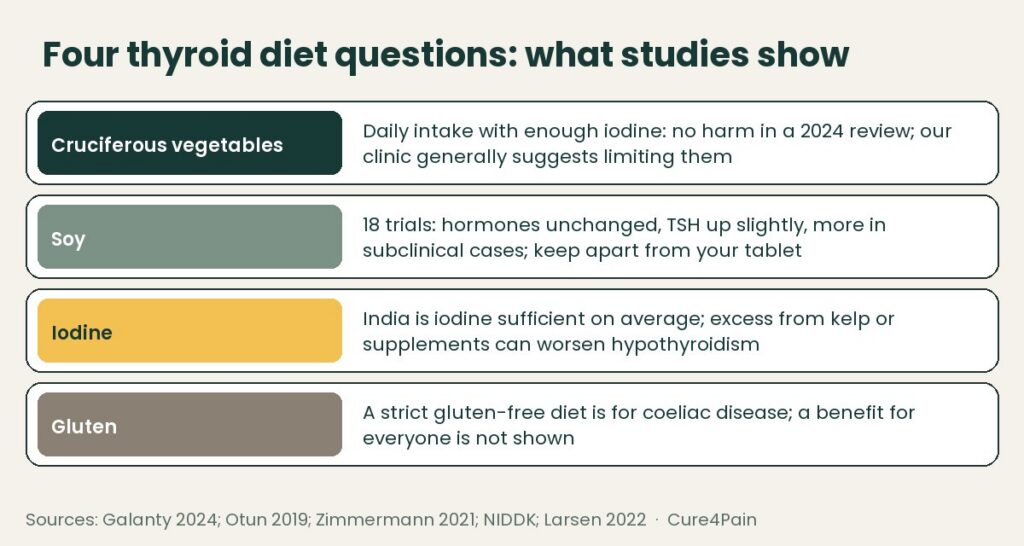
Clinic practice is not a research finding: we state both so that you know exactly what we advise and where the evidence is thinner.
| Food | What research shows | Our clinic practice |
|---|---|---|
| Cruciferous vegetables (cabbage, cauliflower, broccoli, kale, radish, mustard greens) | Daily intake with adequate iodine: no adverse effect on thyroid function [4] | As an observational clinic practice, we generally suggest limiting them |
| Soy (tofu, soya milk, soya chunks) | Thyroid hormones unchanged, TSH up very slightly in 18 trials, more in subclinical hypothyroidism [3] | Normal amounts, taken well apart from thyroid medicine |
| Millets | Evidence that pearl millet in a balanced diet causes goitre is not strong; more research is needed [8] | Normal amounts, as part of a varied diet |
| Kelp, seaweed, iodine supplements | Can cause or worsen hypothyroidism [6] | We advise limiting seaweed and other iodine-rich foods; iodine used very cautiously and rarely |
| Wheat and gluten | Avoiding gluten helps only people sensitive to it [2] | We generally advise most patients to replace wheat with jowar, bajra or other millets as a general health measure, including home-made roti from processed wheat; not gluten-free for everyone |
| Milk and dairy | Avoiding dairy helps only people sensitive to it [2] | Reduced where it does not suit you; ghee is allowed |
| Processed foods | Observational studies of ultra-processed food are mixed: a higher risk of autoimmune hypothyroidism in 123,812 UK adults [9]; no link with mild hypothyroidism in 8,732 Chinese adults [10] | Avoided |
Which nutrient deficiencies are linked with hypothyroidism?
According to meta-analyses, low vitamin B12 is common in hypothyroidism and iron deficiency is linked with lower thyroid hormone levels, so both are worth testing before you change your diet. These are associations, and they do not show that supplements can replace thyroid medicine.
- Vitamin B12: 27% of people with hypothyroidism had low vitamin B12 in a 2023 meta-analysis of 64 studies [11].
- Iron: a 2023 meta-analysis of 10 snapshot studies found lower FT4, FT3 and TSH levels in people with iron deficiency than in people without it [12].
Which foods are good for hypothyroidism?
No food treats hypothyroidism. The balanced, home-cooked diet we advise at Cure4Pain can draw on rice and millets, dals, vegetables (limiting cruciferous ones), fruit, nuts and seeds, and protein foods such as paneer, curd, eggs, chicken or fish.
| Food group | Indian examples |
|---|---|
| Grains and millets | Rice, jowar, bajra, ragi (nachni), foxtail millet (kangni), in rotation |
| Pulses | Moong, masoor, toor and chana dal |
| Vegetables | Bottle gourd (lauki), ridge gourd (turai), pumpkin (kaddu), spinach (palak), fenugreek (methi), carrot, okra (bhindi), beetroot, cucumber, French beans, tinda, drumstick, tomato |
| Fruit | Papaya, guava (amrood), apple, pomegranate (anaar), banana, orange |
| Nuts and seeds | Walnuts (akhrot), almonds (badam), flaxseed (alsi), pumpkin seeds, fox nuts (makhana) |
| Protein | Dal, paneer and curd where dairy suits you; eggs, chicken and fish for non-vegetarians |
A 7-day Indian vegetarian diet chart for hypothyroidism
This 7-day Indian vegetarian chart for hypothyroidism is a sample week built from Cure4Pain’s clinic rules, not a prescription: your own plan depends on your tests, weight, medicines and other conditions. It leaves out cruciferous vegetables and processed foods, and uses rice and millets as its grains. Have breakfast, tea or coffee 30 to 60 minutes after your tablet, as the NHS advises [13].
- Monday: Breakfast: Moong dal chilla with mint chutney; papaya. Lunch: Rice, toor dal, bottle gourd (lauki) sabzi, cucumber salad, curd. Evening snack: Roasted fox nuts (makhana). Dinner: Jowar roti (jowar bhakri), spinach dal (palak dal), pumpkin sabzi.
- Tuesday: Breakfast: Idli with sambar (drumstick and pumpkin). Lunch: Bajra roti (bajri bhakri), masoor dal, okra (bhindi) sabzi, carrot salad. Evening snack: Guava (amrood), walnuts. Dinner: Moong dal and rice khichdi with ghee, kadhi.
- Wednesday: Breakfast: Poha with carrot and peas; pomegranate. Lunch: Rice, chana dal, ridge gourd (turai) sabzi, buttermilk. Evening snack: Apple, roasted pumpkin seeds. Dinner: Ragi roti (nachni bhakri), paneer bhurji with tomato, French beans sabzi.
- Thursday: Breakfast: Ragi porridge with banana. Lunch: Foxtail millet (kangni) rice, tomato dal, fenugreek (methi) sabzi, curd. Evening snack: Orange, almonds. Dinner: Rice, sambar, beans and coconut stir-fry (poriyal).
- Friday: Breakfast: Besan chilla with grated carrot; curd. Lunch: Jowar roti, moong dal, tinda sabzi, beetroot salad. Evening snack: Papaya, flaxseed on curd. Dinner: Vegetable pulao with carrot, beans and peas, cucumber raita.
- Saturday: Breakfast: Green moong dosa (pesarattu) with coconut chutney. Lunch: Rice, toor dal, pumpkin (kaddu) sabzi, buttermilk. Evening snack: Banana, walnuts. Dinner: Bajra khichdi with vegetables, curd.
- Sunday: Breakfast: Jowar upma with carrot and beans. Lunch: Rice, masoor dal, spinach (palak) sabzi, cucumber raita. Evening snack: Pomegranate, almonds. Dinner: Moong dal soup, ragi roti, bottle gourd sabzi.
Swaps for the week:
- If you eat eggs or meat: eggs, chicken or fish can replace paneer or dal at any meal.
- If dairy does not suit you: leave out milk, curd, paneer and buttermilk, and add dal or nuts; ghee is allowed.
- If you eat soy: tofu can replace paneer in normal amounts, well apart from your tablet.
Can I eat cabbage, cauliflower and broccoli with hypothyroidism?
Research has not shown that cabbage, cauliflower or broccoli harm the thyroid: a 2024 systematic review of 123 laboratory, animal and human studies found no adverse effect from daily intake with adequate iodine [4]. As an observational clinic practice, Cure4Pain generally suggests limiting cruciferous (Brassica) vegetables such as cabbage and cauliflower; this is not a research finding.
- Why the concern exists: according to the US National Institutes of Health, cruciferous vegetables contain goitrogens, substances that interfere with iodine uptake by the thyroid, but reasonable amounts are not a concern for most people with adequate iodine [14].
- The main review: the 2024 systematic review, in the International Journal of Molecular Sciences, says the advice to avoid cruciferous vegetables often rests on old animal studies using seeds [4].
Is soy bad for hypothyroidism?
A 2019 meta-analysis of 18 trials found that soy did not change thyroid hormones and only very modestly raised TSH [3], so for most people soy in normal amounts does not appear to harm the thyroid. People with subclinical (mild) hypothyroidism may be more sensitive, and soy should be kept well apart from your levothyroxine tablet.
- Thyroid function: the 2019 meta-analysis, in Scientific Reports, found no change in FT3 or FT4 and a rise in TSH of 0.248 mIU/L; its authors call the clinical significance, if any, unclear. In the 2 trials in subclinical hypothyroidism TSH rose more (0.69 mIU/L, against 0.20 in the others), and the authors say soy could matter more when thyroid function is already reduced [3].
- Trials that disagree: both tested soy protein supplements, not food, in people with subclinical (mild) hypothyroidism. In a 2011 UK trial of 60 people, six women progressed to overt hypothyroidism after the supplement with more phytoestrogens, an amount the authors described as representative of a vegetarian diet [15]. In a 2018 trial of 44 people by the same group, a much higher phytoestrogen amount did not raise that rate (two people progressed), and thyroid tests did not differ [16].
- Soy and your tablet: the US National Institutes of Health lists soy among foods that can affect levothyroxine absorption [17]. The evidence is thin: a 2023 narrative review in Endocrine Practice found mainly case reports and judged the effect, if present, to have little clinical impact [18].
- Our practice: at Cure4Pain we advise normal amounts of soy, taken well apart from thyroid medicine.
Should you take iodine or use iodised salt with hypothyroidism?
Do not take iodine supplements without medical guidance: they, along with seaweed such as kelp, may cause or worsen hypothyroidism, according to the US National Institutes of Health [6]. Iodised salt is a different matter: that warning does not name it, salt iodisation is mandatory in India [19], and a 2021 global review rates India iodine sufficient, with 93% population coverage of iodised salt [5]. The American Thyroid Association’s 2014 guideline particularly cautions against high doses in people with underlying thyroid disease [1].
- Official amounts: adults need 150 mcg a day, and the adult upper limit is 1,100 mcg a day, according to the US National Institutes of Health [14].
- India: in the 2018-19 India Iodine Survey of 21,406 households, 76.3% had adequately iodised salt, and coverage varied by state [19].
- Rock, sea and pink salt: sea salt, Himalayan salt and other specialty salts are not usually iodised, according to the US National Institutes of Health, so read the label [14]. In India, unrefined and loose salt were less often adequately iodised [20].
- Hidden iodine: according to the US National Institutes of Health, some cough syrups contain iodine [6], and many multivitamins do too, often 150 mcg [14].
- Our practice: at Cure4Pain we use iodine very cautiously and rarely, only at the recommended daily amount, and only when your diet and history point to low intake and thyroid antibodies are negative, and we advise limiting iodine-rich foods such as seaweed. We do not use iodine for people with Hashimoto’s.
- Pregnancy is different: the American Thyroid Association’s 2026 guidelines advise a daily 150 mcg iodine supplement for all women before conception, in pregnancy and while breastfeeding, unless traditional diets already give high intake [21]. Your obstetrician and endocrinologist decide this.
Should you go gluten-free or dairy-free for hypothyroidism?
A gluten-free or dairy-free diet is worth considering only if you have coeliac disease [22] or a clear sensitivity: a 2022 review in the Journal of Clinical Endocrinology and Metabolism found that avoiding gluten and dairy helped only people sensitive to them [2], and at Cure4Pain we do not advise a gluten-free diet for everyone, though we generally advise most patients to replace wheat with jowar, bajra or other millets as a general health measure. The gluten studies are mostly in Hashimoto’s, and we found no randomised trial in hypothyroidism in general.
- Coeliac disease: it can reduce levothyroxine absorption, and a gluten-free diet often improves this [22]. Ask your doctor about testing if you have digestive symptoms or need an unusually high dose.
- Without coeliac disease: a 2025 meta-analysis of 3 small trials in Hashimoto’s (110 people) found no significant change in TSH or thyroid hormones, with very uncertain evidence [23]. Our Hashimoto’s diet article and Hashimoto’s thyroiditis page cover this in more detail.
- Dairy: dairy is a source of iodine [14], and avoiding it helped only people sensitive to it [2]. Milk and the tablet are covered in the timing table below.
How should you time food, tea and coffee with levothyroxine?
Take levothyroxine on an empty stomach, 30 to 60 minutes before your first meal and before any drink with caffeine, according to the NHS [13].
| Item | What is known | What to do |
|---|---|---|
| Breakfast | Some foods can affect how levothyroxine works, according to the NHS [13] | Take your tablet 30 to 60 minutes before breakfast, at the same time each day |
| Tea and coffee | Coffee reduces absorption, on limited evidence [7]; tea did too in a small before-and-after study of 37 patients [24] | Drink 30 to 60 minutes or more after your tablet; we advise limiting them |
| Calcium and iron supplements | Reduce absorption [7]; a 4-hour gap is traditional but untested [1] | Separate them; we plan the timing with you |
| Soy, fibre, grapefruit juice, espresso | Can affect absorption [7] [17] | Keep away from the tablet |
| Milk, juices, papaya | Possible effect; larger studies are needed [7] | Have them well after your tablet |
Change your timing only with medical guidance, and never stop or change your thyroid medicine on your own [17] [13].
Will diet help you lose weight with hypothyroidism?
Thyroid medicine alone may not bring much weight loss, and we found no randomised trial of a weight-loss diet in overt hypothyroidism, so the evidence for a specific diet plan here is thin. In a retrospective Boston study of 101 adults starting levothyroxine, median weight change was only -0.1 kg once TSH was in range, and the 52% who lost weight lost a mean of 3.8 kg [25]. At Cure4Pain, counselling on weight, sleep, stress and exercise is part of every plan; individual results vary.
How we plan your diet at Cure4Pain
At Cure4Pain, your diet plan is one part of long-term integrative care, used alongside thyroid medicine where it is needed, never instead of it.
- Tests first: we read a panel of about 100 markers, adding tests for your condition when clinically indicated: TSH, FT3, FT4, thyroid antibodies, vitamin D, vitamin B12, iron and ferritin. Examples a named guideline supports: TPO antibodies, which NICE says to consider when TSH is above the reference range [26], and a coeliac blood test when autoimmune thyroid disease is diagnosed [27].
- Your food plan: balanced home-cooked meals, planned differently for vegetarians and non-vegetarians; no processed foods or breads; wheat replaced with jowar, bajra or other millets for most patients as a general health measure; as an observational clinic practice, we generally suggest limiting cruciferous (Brassica) vegetables such as cabbage and cauliflower; soy and millets in normal amounts; dairy reduced where it does not suit you, with ghee allowed; we advise limiting coffee, tea and iodine-rich foods.
- Nutrients: vitamin D at standard supplement doses; iron and vitamin B12 where tests show they are low; selenium, zinc and magnesium where your diet and history suggest a shortfall (most selenium trials are in Hashimoto’s); iodine very cautiously and rarely; omega-3 in every plan unless contraindicated, from fish for people who eat it and algal oil for vegetarians and vegans. Supplements are by mouth first, with injections only when specifically needed or advised; magnesium is mainly bisglycinate, with L-threonate or citrate as advised, counted as elemental magnesium.
- Medicines stay: Dr Krushal Pabari manages thyroid medicine, under clinical guidance from Team Cure4Pain, in coordination with your existing consulting physician, and we refer you to a specialist such as an endocrinologist when needed; never stop or change it on your own.
- Lifestyle and follow-up: counselling on weight, sleep, stress and exercise for every patient, and lifelong reviews with blood tests every 3 months.
This is our clinic practice; individual results vary, and further studies are needed. Read more on our hypothyroidism and Hashimoto’s thyroiditis pages.
If you would like a diet plan built around your blood tests and thyroid medicine, you can book a consultation, online from anywhere or at our Mumbai clinic.
Frequently asked questions
What foods should I avoid with hypothyroidism?
According to the US National Institutes of Health, kelp, seaweed and iodine supplements can cause or worsen hypothyroidism. At Cure4Pain we also advise avoiding processed foods and breads and, as an observational practice, generally suggest limiting cruciferous vegetables; these are clinic practices, and research has not shown that cruciferous vegetables harm thyroid function when iodine intake is adequate. [6] [4]
Is soy milk safe with hypothyroidism?
In a 2019 meta-analysis of 18 trials, soy did not change thyroid hormones and raised TSH very slightly, more in people with subclinical hypothyroidism. Whether soy milk affects levothyroxine absorption is unresolved, according to a 2023 review, so keep it well apart from your tablet. [3] [18]
Is milk bad for hypothyroidism?
A 2022 review in the Journal of Clinical Endocrinology and Metabolism found that avoiding dairy helped only people sensitive to it, and dairy also provides iodine. Milk may affect levothyroxine absorption, so drink it well after your tablet, not with it. [2] [14] [7]
Should thyroid patients use iodised salt?
In the 2018-19 India Iodine Survey of 21,406 households, 76.3% had adequately iodised salt, and median urinary iodine in women was in the adequate range. Specialty salts are not usually iodised, according to the US National Institutes of Health. Iodine supplements are a different matter: take them only with medical guidance. [19] [14] [6]
Should I stop gluten for hypothyroidism?
Yes if you have coeliac disease. Without it, a 2025 meta-analysis of 3 small trials in Hashimoto’s found no significant change in TSH or thyroid hormones, with very uncertain evidence. At Cure4Pain we do not advise a gluten-free diet for everyone, though we generally advise most patients to replace wheat with jowar, bajra or other millets as a general health measure. [22] [23]
Is a vegetarian diet good for hypothyroidism?
A vegetarian diet can fit well if planned, particularly for iodine: vegetarians, mainly vegans, can get too little, or too much from seaweed and supplements. In the Adventist Health Study-2 of 65,981 people in North America, a vegan diet was not linked with higher risk, and a lacto-ovo vegetarian diet was linked with slightly higher odds; this was observational. [28] [29]
Can I drink tea or coffee with levothyroxine?
Do not drink tea or coffee at the same time as levothyroxine. The NHS advises taking it 30 to 60 minutes before any drink with caffeine, because coffee and possibly tea reduce its absorption. At Cure4Pain we advise limiting them. [13] [7] [24]
Can diet replace thyroid medicine?
No diet has been shown to replace thyroid medicine. Levothyroxine replaces the hormone your thyroid no longer makes, and the American Thyroid Association’s 2014 guideline recommends against supplements as a treatment for hypothyroidism. Never stop or change it on your own. [17] [1]
This article is for education and does not replace medical advice. Do not start, stop or change any medicine or supplement without medical guidance.
References
1. Jonklaas J, et al. Guidelines for the treatment of hypothyroidism: prepared by the american thyroid association task force on thyroid hormone replacement. Thyroid 2014;24(12):1670-751. doi:10.1089/thy.2014.0028
2. Larsen D, et al. Thyroid, Diet, and Alternative Approaches. J Clin Endocrinol Metab 2022;107(11):2973-2981. doi:10.1210/clinem/dgac473
3. Otun J, et al. Systematic Review and Meta-analysis on the Effect of Soy on Thyroid Function. Sci Rep 2019;9(1):3964. doi:10.1038/s41598-019-40647-x
4. Galanty A, et al. Do Brassica Vegetables Affect Thyroid Function?-A Comprehensive Systematic Review. Int J Mol Sci 2024;25(7). doi:10.3390/ijms25073988
5. Zimmermann MB, Andersson M. GLOBAL ENDOCRINOLOGY: Global perspectives in endocrinology: coverage of iodized salt programs and iodine status in 2020. Eur J Endocrinol 2021;185(1):R13-R21. doi:10.1530/EJE-21-0171
6. National Institute of Diabetes and Digestive and Kidney Diseases (NIDDK), US National Institutes of Health. Hypothyroidism (Underactive Thyroid). niddk.nih.gov
7. Wiesner A, et al. Levothyroxine Interactions with Food and Dietary Supplements-A Systematic Review. Pharmaceuticals (Basel) 2021;14(3). doi:10.3390/ph14030206
8. Anitha S, et al. Does consumption of pearl millet cause goiter? A systematic review of existing evidence. Front Nutr 2024;11:1323336. doi:10.3389/fnut.2024.1323336
9. Liu D, et al. Ultra-processed food consumption and incident autoimmune-related hypothyroidism: a sex-stratified prospective analysis from the UK Biobank. Am J Clin Nutr 2026;123(2):101142. doi:10.1016/j.ajcnut.2025.101142
10. Zhang J, et al. Ultra-processed food consumption and the risk of subclinical thyroid dysfunction: a prospective cohort study. Food Funct 2022;13(6):3431-3440. doi:10.1039/d1fo03279h
11. Benites-Zapata VA, et al. Vitamin B12 levels in thyroid disorders: A systematic review and meta-analysis. Front Endocrinol (Lausanne) 2023;14:1070592. doi:10.3389/fendo.2023.1070592
12. Garofalo V, et al. Relationship between Iron Deficiency and Thyroid Function: A Systematic Review and Meta-Analysis. Nutrients 2023;15(22). doi:10.3390/nu15224790
13. NHS (UK National Health Service). Levothyroxine. nhs.uk/medicines/levothyroxine
14. Office of Dietary Supplements, US National Institutes of Health. Iodine: Fact Sheet for Health Professionals. ods.od.nih.gov/factsheets/Iodine-HealthProfessional
15. Sathyapalan T, et al. The effect of soy phytoestrogen supplementation on thyroid status and cardiovascular risk markers in patients with subclinical hypothyroidism: a randomized, double-blind, crossover study. J Clin Endocrinol Metab 2011;96(5):1442-9. doi:10.1210/jc.2010-2255
16. Sathyapalan T, et al. The Effect of Phytoestrogen on Thyroid in Subclinical Hypothyroidism: Randomized, Double Blind, Crossover Study. Front Endocrinol (Lausanne) 2018;9:531. doi:10.3389/fendo.2018.00531
17. National Institute of Diabetes and Digestive and Kidney Diseases (NIDDK), US National Institutes of Health. Hashimoto’s disease. niddk.nih.gov
18. Gatta E, et al. Interference or Noninterference Between Soy and Levothyroxine: That Is the Question. A Narrative Review of Literature. Endocr Pract 2023;29(11):897-901. doi:10.1016/j.eprac.2023.08.009
19. Jha RK, et al. National and Sub-National Estimates of Household Coverage of Iodized Salt and Urinary Iodine Status among Women of Reproductive Age in India: Insights from the India Iodine Survey, 2018-19. J Nutr 2023;153(9):2717-2725. doi:10.1016/j.tjnut.2023.06.037
20. Pandav CS, et al. High national and sub-national coverage of iodised salt in India: evidence from the first National Iodine and Salt Intake Survey (NISI) 2014-2015. Public Health Nutr 2018;21(16):3027-3036. doi:10.1017/S1368980018002306
21. Korevaar TIM, et al. American Thyroid Association 2026 Guidelines for Thyroid Disease in Preconception, Pregnancy, and Postpartum. Thyroid 2026;36(5):481-544. doi:10.1177/10507256261445624
22. Saad M, Maisch NM. Levothyroxine Absorption in Patients With Celiac Disease: Challenges and Therapeutic Strategies. Ann Pharmacother 2026;60(3):303-305. doi:10.1177/10600280251361914
23. Araújo EMQ, et al. Effects of Gluten-Free Diet in Non-Celiac Hashimoto’s Thyroiditis: A Systematic Review and Meta-Analysis. Nutrients 2025;17(21). doi:10.3390/nu17213437
24. Lai YW, Huang SM. Tea consumption affects the absorption of levothyroxine. Front Endocrinol (Lausanne) 2022;13:943775. doi:10.3389/fendo.2022.943775
25. Lee SY, et al. Changes in body weight after treatment of primary hypothyroidism with levothyroxine. Endocr Pract 2014;20(11):1122-8. doi:10.4158/EP14072.OR
26. National Institute for Health and Care Excellence (NICE). Thyroid disease: assessment and management. NICE guideline NG145, 2019, updated 2023. nice.org.uk/guidance/ng145
27. National Institute for Health and Care Excellence (NICE). Coeliac disease: recognition, assessment and management. NICE guideline NG20, 2015. nice.org.uk/guidance/ng20
28. Croce L, et al. Modern challenges of iodine nutrition: vegan and vegetarian diets. Front Endocrinol (Lausanne) 2025;16:1537208. doi:10.3389/fendo.2025.1537208
29. Tonstad S, et al. Vegan diets and hypothyroidism. Nutrients 2013;5(11):4642-52. doi:10.3390/nu5114642