Written by AT. Chintan Dalal, N.D. · Reviewed by Dr Krushal Pabari, Clinical Team, Cure4Pain · Updated 30 October 2026
Key facts
No single diet suits everyone with IBS. The British Society of Gastroenterology (BSG 2021) offers first-line dietary advice to all patients and a low FODMAP diet second-line, supervised by a trained dietitian [1]; the American College of Gastroenterology (ACG 2021) recommends a limited trial of a low FODMAP diet [2]. A 2025 network meta-analysis of 28 trials and 2,338 patients found the most evidence for low FODMAP, though it ranked fourth for overall symptoms [3]. In an Indian trial of 101 adults with diarrhoea-type IBS, 62.7% responded to a low FODMAP diet at 4 weeks against 40.8% on traditional advice [4]. In an analysis of 295 Indian recipes by SNDT Women’s University, Mumbai, and Monash University, onion, lentils and wheat products were the main sources of FODMAPs [5]. Exclusion diets are linked with lower intake of vitamins B1 and B2, calcium, iron and zinc [6], so strict diets need supervision.

Scientific explainer videos in our Resources section
In our Resources section, our clinical team discusses vitamin D, its cofactors and how autoimmune, lifestyle and pain conditions develop.
What is the best diet for IBS in India?
There is no single best diet for IBS in India. The British Society of Gastroenterology (BSG 2021) and NICE start with regular meals and simple food changes, and offer a low FODMAP diet if symptoms continue, while the Indian consensus of 2023 says more Indian studies are needed [1] [7] [8]. In Indian cooking, onion, garlic, most pulses, wheat and milk are the main high FODMAP foods, while rice, jowar and ragi are low [5] [9]; food tables and a 7-day sample chart are below. For diagnosis, warning signs and treatment, see our IBS page.
| Guideline | First step | Low FODMAP diet |
|---|---|---|
| BSG 2021 | First-line dietary advice for all patients [1] | Second-line; supervised by a trained dietitian and reintroduced according to tolerance (weak recommendation, very low quality evidence) [1] |
| ACG 2021 | Soluble, not insoluble, fibre suggested [2] | Recommends a limited trial to improve overall symptoms [2] |
| NICE CG61 (updated 2017) | Regular meals and general advice [7] | If symptoms persist; “only be given by a healthcare professional with expertise in dietary management” [7] |
| Indian consensus 2023 | Lifestyle change, patient education and counselling [8] | “Useful in a proportion of IBS patients”; more Indian studies needed [8] |
According to NICE, the general advice is: [7]
- Meals: regular meals, time to eat, and no missed meals or long gaps.
- Drinks: at least 8 cups of fluid a day, no more than 3 cups of tea or coffee, and less alcohol and fizzy drinks.
- Fruit: no more than 3 portions of fresh fruit a day, each about 80 g.
- For wind and bloating: oats, and up to 1 tablespoon of linseeds (alsi) a day, may help.
- For diarrhoea: avoid sorbitol, a sweetener in sugar-free sweets and drinks.
The NHS adds spicy or fatty food as possible triggers [10], and the BSG does not recommend food elimination diets based on IgG antibody tests (strong recommendation) [1].
Can a strict IBS diet cause nutrient deficiencies?
A strict IBS diet may lower nutrient intake. A 2022 systematic review of 26 studies linked exclusion diets with lower intake of vitamins B1 and B2, calcium, iron and zinc, and found that people with IBS generally already had lower vitamin D, vitamin B2, calcium and iron than people without IBS [6].
The BSG warns of nutritional deficiencies and overly restrictive eating, and advises screening people at high risk before recommending such diets [1]. The NHS advises seeing a GP if you need to avoid lots of different foods to control symptoms [11].
What is the low FODMAP diet, and what are its phases?
The low FODMAP diet limits FODMAPs, short-chain carbohydrates that are poorly absorbed in the small intestine and rapidly fermented by gut bacteria, which can cause gas, pain, bloating and altered bowel habits [5]. According to Monash University and the American College of Gastroenterology, it has three phases: swap, reintroduce and personalise. It is not meant to stay strict for life [12] [2].
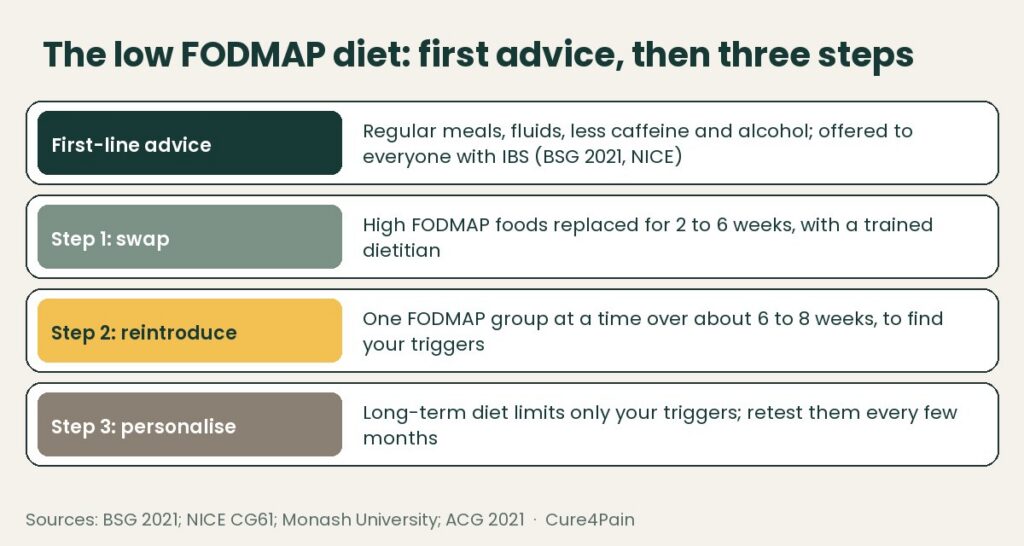
- Phase 1, swap: high FODMAP foods are replaced with low FODMAP choices. Monash University advises 2 to 6 weeks under a dietitian [12].
- Phase 2, reintroduce: FODMAP groups are tested one at a time, usually over 6 to 8 weeks, according to Monash University [12]. In a blinded Belgian hospital study that recruited 117 patients, the commonest triggers among diet responders were fructans (56%) and mannitol (54%), with an average of 2.5 triggers per person [13].
- Phase 3, personalise: you avoid only your confirmed triggers and retest them every few months [12].
Which Indian foods are high or low in FODMAPs?
According to Monash University sources and South Asian diet reviews, onion, garlic, most pulses, wheat products and milk are the main high FODMAP foods in Indian cooking; rice, jowar, ragi and plain eggs or fish are low [5] [14] [9]. Most tested foods came from Australia, so data on Indian foods are limited [5], and portion size changes the rating.
| Food group | Higher in FODMAPs | Lower in FODMAPs |
|---|---|---|
| Grains | Wheat atta, maida, rava (sooji), sevai, barley [5] [14] | Rice, jowar, ragi (nachni), bajra, foxtail millet (kangni), barnyard millet (bhagar), oats [5] [14] |
| Pulses | Most pulses, including moong, toor and chana; soaking and draining lowers one FODMAP group [14] [5] | Sprouted whole moong [5] |
| Vegetables | Onion (pyaz, kanda), garlic (lehsun, lasun), green peas, mushrooms, cauliflower, pumpkin, red capsicum [14] [5] | Bottle gourd (lauki, dudhi), carrot, cucumber, French beans, potato, brinjal, green capsicum [14] [5] |
| Fruit | Apple, mango, pear, peach, plum, watermelon, dried fruit [14] | Orange, kiwi, pineapple, cantaloupe, banana [14] [5] |
| Dairy | Milk, ice cream, custard, condensed milk, yoghurt [14] [5] | Hard cheese, lactose-free milk, curd in a small serve under 1/4 cup [14] [5] |
| Protein | Some marinated or processed meats [14] | Eggs; plain cooked chicken, fish or meat; firm tofu [14] |
| Nuts and seeds | Cashews, pistachios [14] | Peanuts, almonds, walnuts, pumpkin seeds [14] [5] |
According to a 2018 review of South Asian diets by the Monash group, spices and condiments are mostly low in FODMAPs [9]. A UK laboratory study of 20 foods eaten by ethnic minority groups found chana dal, fenugreek seeds, guava, karela and tamarind to be significant sources of at least one FODMAP [15]. Sources differ on coconut, which the 2018 review lists as high [9] and a 2025 review uses as a swap [5]. We give no gram values, because the Monash list is a sample without serving sizes [14], and we could not confirm a rating for paneer, okra (bhindi), tinda, drumstick or fenugreek leaves (methi).
Dishes matter as much as ingredients. Researchers at SNDT Women’s University, Mumbai, and Monash University rated these selected Indian recipes with the Monash FODMAP Calculator, at a set serving, so they are calculated estimates and your recipe may differ [5]. Of those shown, only jowar rotla and sago khichadi, both from the West, were rated low.
| Region | Rated high |
|---|---|
| West | Misal, khaman dhokla, sheera, Goan fish curry; Gujarati kadhi (lactose) |
| North | Chole, aloo paratha, kulcha; butter chicken, dahi bhalla (lactose) |
| South | Sambar, dal wada, rawa dosa, bisi bele bhaat, akki roti; avial (lactose) |
| East | Ghugni, aloo chop, niramish khichuri; rasgulla (lactose) |
How can you lower FODMAPs in Indian cooking?
You can lower FODMAPs in Indian cooking by swapping a few ingredients rather than giving up Indian food, according to a 2025 review by researchers at SNDT Women’s University, Mumbai, and Monash University [5]. These are research suggestions, not our clinic rules.
- Onion: use the green tops of spring onions or hing (asafoetida).
- Garlic: use garlic-infused oil, or ginger and hing.
- Dal and chana: soak overnight, keep soaking in the fridge, drain, then cook separately from onion and garlic, with ginger and hing.
- Roti: use jowar, ragi or rice flour; blending flours helps, because millet flatbreads can be crumbly.
- Rava: use rice rava or barnyard millet.
- Milk: the review advises small amounts through the day rather than removing dairy, because people with lactose intolerance can generally tolerate under 12 g of lactose a day.
Your own triggers matter more than any list, and the NHS advises keeping a diary of what you eat and any symptoms [11]. In a survey at P D Hinduja Hospital, Mumbai, of 204 people with IBS and 400 healthy people, 72.1% of those with IBS reported some food intolerance, but it varied widely by food, and milk intolerance was similar in the two groups (29.9% and 23%); the authors advise individual choices rather than decisions based on FODMAP content alone [16].
Does the low FODMAP diet work?
The low FODMAP diet helps many people with IBS, but it is not clearly better than simpler advice in every trial, and Indian data are few. A 2025 network meta-analysis of 28 trials and 2,338 patients ranked it fourth for overall symptoms [3].
- 2025 analysis: in this network meta-analysis, a diet lower in starch and sugar ranked first (2 trials), low FODMAP fourth (24 trials) and British Dietetic Association and NICE advice tenth (8 trials) for overall symptoms. Among diets tested more than once, only low FODMAP beat a habitual diet for bloating. Most comparisons were low or very low confidence; low FODMAP and the starch and sugar diet against a habitual diet were moderate [3].
- India: in a Ludhiana trial of 101 adults with diarrhoea-type IBS, 62.7% responded to low FODMAP at 4 weeks against 40.8% on traditional advice. With foods reintroduced from week 4, 52.9% responded at 16 weeks against 30.6%. Adherence fell from 93% to 64%; energy and fibre intake dropped at 4 weeks, then improved by 16 weeks [4].
- Sham-controlled trial: in 104 UK patients, 57% had adequate relief on low FODMAP against 38% on a sham diet, just short of statistical significance by intention to treat; Bifidobacterium counts were lower on the diet, with long-term consequences unknown [17] [1].
- Studies that found no clear difference: in Sweden, 50% improved on low FODMAP and 46% on traditional advice among 75 patients [18]. In the UK, 55% improved on low FODMAP, 58% on gluten-free and 42% on traditional advice among 99 patients, and traditional advice was cheaper and easier [19].
Which foods do we ask IBS patients to remove at Cure4Pain?
At Cure4Pain, we ask IBS patients to remove milk and most dairy, sugar and processed foods, and nightshades, and to eat cooked rather than raw foods during gut care, with whole raw fruit once in a while. After coeliac testing, we generally advise most patients to replace wheat with jowar, bajra or other millets as a general health measure. As an observational clinic practice, we generally suggest limiting cruciferous (Brassica) vegetables such as cabbage and cauliflower. The rest is tailored to each person. These are the same food rules we use for gut dysbiosis. Low FODMAP is stated here as research; it is not our clinic protocol.
| Food | What research shows | Our clinic practice |
|---|---|---|
| Milk and most dairy | Milk is high in FODMAPs [8]; the 2025 review advises not removing dairy [5] | Removed; home-set curd where it suits the person; ghee allowed |
| Wheat or gluten | BSG does not recommend gluten-free for IBS (weak, very low quality evidence) [1]; in 59 people with self-reported gluten sensitivity, fructans raised symptoms and gluten did not [20]; research supports a gluten-free diet for coeliac disease confirmed by testing [21] | We generally advise most patients to replace it with jowar, bajra or other millets as a general health measure, after coeliac testing, because cutting gluten first can make the test inaccurate [22] |
| Sugar and processed foods | NHS advises against lots of processed foods [11]; a diet lower in both starch and sugar ranked first, in only 2 trials [3] | Removed |
| Nightshades (tomato, potato, brinjal, peppers, chillies) | No IBS trial found; a 2023 review calls the literature limited [23]; potato and brinjal are low FODMAP [14] | Removed |
| Cruciferous vegetables (cabbage, cauliflower, broccoli) | NHS lists them as hard to digest for bloating [11]; normal intake with enough iodine did not harm thyroid function in a 2024 review [24] | Limited, as an observational clinic practice |
| Raw foods | No trial of raw against cooked food in IBS found | Cooked rather than raw during gut care; whole raw fruit once in a while |
Research has not tested this combination of exclusions in IBS. An integrative plan may add options like these alongside standard care. We check nutrients during the diet because exclusion diets can lower vitamin and mineral intake [6].
Should IBS-C and IBS-D eat differently?
Constipation-type IBS (IBS-C) and diarrhoea-type IBS (IBS-D) call for partly different food choices. For diarrhoea, the NHS advises cutting down high-fibre foods such as wholegrains, nuts and seeds, and avoiding sorbitol; for constipation, it advises more soluble fibre from oats, pulses, carrots and linseeds [11]. Whichever type you have, BSG and NICE advise against insoluble fibre such as wheat bran [1] [7].
- Isabgol (psyllium): BSG calls soluble fibre such as ispaghula an effective treatment (strong recommendation, moderate quality evidence) [1], and ACG suggests soluble fibre [2].
- At Cure4Pain: we do not routinely use isabgol. If it already helps you, please tell us before stopping it. For constipation we use magnesium by mouth, mainly bisglycinate, with citrate as advised, rather than magnesium oxide as a laxative, set for each person. This is a clinic choice, not a finding that one form works better.
- Magnesium safety: the upper limit from supplements is 350 mg of elemental magnesium a day for adults, and absorption varies by form, according to the US National Institutes of Health; high doses can cause diarrhoea and cramps [25]. Read more about magnesium.
A 7-day sample Indian IBS diet chart
This 7-day sample Indian IBS diet chart follows the Cure4Pain clinic food advice: no milk, wheat, sugar, processed food or nightshades, no cruciferous vegetables in this sample, and everything cooked. It is a sample, not a prescription, and it is not a low FODMAP chart, since it contains dal, curd and tamarind. Your own plan depends on your tests, IBS type, medicines and other conditions.
Cook with a small amount of oil or ghee, and flavour with hing, ginger, cumin (jeera), coriander (dhania), turmeric (haldi), curry leaves and black pepper instead of chillies. Make sambar with tamarind instead of tomato. Tea or coffee stay without milk or sugar, and within the NICE limit of 3 cups a day [7].
- Monday: Breakfast: Jowar upma with carrot and French beans. Lunch: Rice, moong dal, bottle gourd (lauki, dudhi) sabzi, home-set curd if it suits you. Evening snack: Roasted fox nuts (makhana). Dinner: Jowar roti (jowar bhakri), ridge gourd (turai, dodka) sabzi, masoor dal.
- Tuesday: Breakfast: Moong dal chilla with cooked ridge gourd chutney. Lunch: Bajra roti (bajri bhakri), toor dal, okra (bhindi) sabzi. Evening snack: Roasted pumpkin seeds. Dinner: Moong dal and rice khichdi with carrot.
- Wednesday: Breakfast: Idli with drumstick sambar. Lunch: Ragi roti (nachni bhakri), spinach dal (palak dal), tinda sabzi. Evening snack: Roasted almonds (badam). Dinner: Rice, moong dal, carrot and French beans stir-fry.
- Thursday: Breakfast: Poha with carrot and French beans. Lunch: Foxtail millet (kangni) rice, toor dal, bottle gourd sabzi, home-set curd if it suits you. Evening snack: Ragi porridge (ragi malt) made with water. Dinner: Jowar roti, fenugreek (methi) sabzi, moong dal.
- Friday: Breakfast: Steamed sprouted moong with cumin and ginger. Lunch: Rice, drumstick sambar, okra sabzi. Evening snack: Roasted fox nuts. Dinner: Barnyard millet (bhagar) khichdi with moong dal and carrot.
- Saturday: Breakfast: Ragi dosa with cooked ridge gourd chutney. Lunch: Bajra roti, masoor dal, spinach sabzi. Evening snack: Roasted almonds. Dinner: Rice, toor dal, ash gourd (petha, kohala) sabzi.
- Sunday: Breakfast: Green moong dosa (pesarattu) with cooked ridge gourd chutney. Lunch: Jowar roti, moong dal, bottle gourd sabzi, home-set curd if it suits you. Evening snack: Roasted pumpkin seeds. Dinner: Moong dal soup, soft rice, cooked spinach.
Notes for the week:
- Fresh fruit: left out of this sample, because we advise cooked rather than raw foods during gut care; whole raw fruit once in a while is allowed.
- Onion and garlic: not listed. Add them only if they suit you; the NHS lists onions among foods that can worsen bloating [11].
- If dal gives you gas: the soaking method above is a research suggestion you can try [5].
- If you eat eggs, fish or chicken: plain-cooked portions can replace dal at a meal.
- At every meal: chew each mouthful slowly, and drink water between meals rather than with them. This is our clinic practice.
When is stomach pain not a diet problem?
Stomach pain that starts suddenly and is severe needs emergency care, not a diet change, according to the NHS [26]. Cure4Pain does not treat sudden or severe stomach pain or other acute conditions.
- Go to an emergency department: pain that started suddenly and is severe, vomiting blood, a lot of blood from your bottom, black and sticky stools, or being unable to pass stools or wind [26]. Emergency numbers are 112 in India, 911 in the US and 999 in the UK.
- See a doctor urgently: weight loss without a reason, bleeding from your bottom or bloody diarrhoea, or a hard lump in your stomach [10].
How we plan your IBS diet at Cure4Pain
At Cure4Pain, your diet is one part of an integrative plan for all types of IBS, for adults and young people aged 16 and over, with tests first.
- Tests first: we read a panel of about 100 markers, adding tests for your condition when clinically indicated: full blood count, ESR or plasma viscosity, CRP and coeliac antibodies, which NICE advises to exclude other diagnoses [7]; faecal calprotectin, which NICE supports to help tell inflammatory bowel disease from IBS in adults with recent symptoms when cancer is not suspected [27]; and stool, breath and H. pylori tests. The panel is our clinic protocol, not a guideline requirement, and NICE does not consider stool parasite or breath tests necessary to confirm IBS [7]. We do not add food intolerance or lactose tests.
- Gut support: probiotics and other supplements, chosen for each person, given by mouth first, with injections only when specifically needed or advised. Guidelines differ on probiotics: BSG allows a trial of up to 12 weeks [1], while ACG suggests against them for overall symptoms [2].
- Supervised-dose vitamin D therapy (Coimbra Protocol-based methods): for most of our IBS patients, with the dose set by condition and severity. Our methods are derived from the work of Dr Coimbra. We found no trial of this protocol in IBS, and trials of standard vitamin D supplements give mixed results [28] [29]. See our Coimbra Protocol page.
- Omega-3: part of every plan unless there is a reason not to, from fish or fish oil, or from algal oil for vegetarians and vegans.
- Medicines: NICE lists antispasmodics, laxatives and loperamide first, then low-dose tricyclic antidepressants [7]. At Cure4Pain, Dr Krushal Pabari prescribes and adjusts these medicines as per guidelines, under clinical guidance from Team Cure4Pain, in coordination with your existing consulting physician; never stop or change them on your own. He recommends endoscopy or colonoscopy if something more serious is suspected.
- Timeline: case by case. As a clinic observation, most people notice meaningful improvement within 12 to 18 weeks, followed by a full review with blood tests every 6 months, or every 3 months with an autoimmune condition.
This is our clinic practice; individual results vary, and further studies are needed. Stress care and moxibustion are on our IBS page; see also gut health.
If you would like a diet plan built around your tests and IBS type, you can book a consultation, online from anywhere or at our Mumbai clinic.
Frequently asked questions
IBS me kya khana chahiye (what should I eat with IBS)?
NICE advises regular meals and enough fluids first. As clinic practice at Cure4Pain, we remove milk, sugar, processed foods, nightshades and raw foods, generally replace wheat with jowar, bajra or other millets, suggest limiting cruciferous vegetables, then tailor the plan to each person; our sample chart uses rice, millets, dal and cooked vegetables. [7]
Is there a low FODMAP Indian diet chart?
This article does not give one: the British Society of Gastroenterology (BSG 2021) advises that a low FODMAP diet be supervised by a trained dietitian, and the plan depends on your region, portions and nutrient needs. Our 7-day sample chart follows clinic rules and is not a low FODMAP chart. [1] [5]
Is curd good for IBS?
It depends on the person. Monash University lists yoghurt as high in FODMAPs, while a 2025 review suggests a small serve of curd under 1/4 cup for a low FODMAP diet, and we found no trial of home-set curd in IBS. At Cure4Pain we keep home-set curd where it suits the person. [14] [5]
Is dal good for IBS?
The evidence on dal is limited. Monash University lists most pulses as high in FODMAPs, and 88% of lentil-based dishes were rated high in an analysis of Indian recipes by SNDT Women’s University, Mumbai, and Monash University, but soaking and draining lowers one FODMAP group, galacto-oligosaccharides. We found no trial of cooked dal itself in IBS; in a small Thai study of 20 patients, mung bean noodles produced less gut gas than wheat noodles. [14] [5] [30]
Is rice good for IBS?
Rice is low in FODMAPs and can replace wheat at meals, although rice dishes become high when cooked with onion, garlic or lentils. People with diabetes or obesity may be advised brown rice or millets instead, according to a 2025 review. [5]
Is roti bad for IBS?
Wheat is high in fructans, so wheat roti is restricted in the first phase of a low FODMAP diet, while BSG does not recommend a gluten-free diet for IBS. At Cure4Pain, after coeliac testing, we generally advise most patients to replace wheat with jowar, bajra or other millets as a general health measure, including home-made roti from processed wheat, and our sample chart uses jowar, bajra or ragi roti. [5] [1]
Are onion and garlic bad for IBS?
They are major high FODMAP foods in Indian cooking, and the NHS lists onions among foods that can worsen bloating, but food intolerance varies widely between people. [9] [11] [16]
Can vegetarians follow a low FODMAP diet?
Yes, but it is harder, because milk, wheat and pulses are major vegetarian protein sources in India. A 2025 review advises ruling out iron, vitamin B12 and calcium deficiency first and considering a less strict approach, with eggs, nuts, seeds and low-lactose dairy as protein. [5]
This article is for education and does not replace medical advice. Do not start, stop or change any medicine or supplement without medical guidance.
References
1. Vasant DH, et al. British Society of Gastroenterology guidelines on the management of irritable bowel syndrome. Gut 2021;70(7):1214-1240. doi:10.1136/gutjnl-2021-324598
2. Lacy BE, et al. ACG Clinical Guideline: Management of Irritable Bowel Syndrome. Am J Gastroenterol 2021;116(1):17-44. doi:10.14309/ajg.0000000000001036
3. Cuffe MS, et al. Efficacy of dietary interventions in irritable bowel syndrome: a systematic review and network meta-analysis. Lancet Gastroenterol Hepatol 2025;10(6):520-536. doi:10.1016/S2468-1253(25)00054-8
4. Goyal O, et al. Low fermentable oligosaccharide, disaccharide, monosaccharide, and polyol diet in patients with diarrhea-predominant irritable bowel syndrome: A prospective, randomized trial. J Gastroenterol Hepatol 2021;36(8):2107-2115. doi:10.1111/jgh.15410
5. Varney JE, et al. Implementing a Fermentable Oligosaccharides, Disaccharides, Monosaccharides, and Polyols Diet in Asia: Addressing Cultural, Clinical and Practical Challenges. J Neurogastroenterol Motil 2025;31(4):422-437. doi:10.5056/jnm25090
6. Bek S, et al. Association between irritable bowel syndrome and micronutrients: A systematic review. J Gastroenterol Hepatol 2022;37(8):1485-1497. doi:10.1111/jgh.15891
7. National Institute for Health and Care Excellence (NICE). Irritable bowel syndrome in adults: diagnosis and management (CG61), published 2008, last updated 2017. nice.org.uk/guidance/cg61
8. Ghoshal UC, et al. Indian consensus statements on irritable bowel syndrome in adults: A guideline by the Indian Neurogastroenterology and Motility Association and jointly supported by the Indian Society of Gastroenterology. Indian J Gastroenterol 2023;42(2):249-273. doi:10.1007/s12664-022-01333-5
9. Hewawasam SP, et al. Dietary practices and FODMAPs in South Asia: Applicability of the low FODMAP diet to patients with irritable bowel syndrome. J Gastroenterol Hepatol 2018;33(2):365-374. doi:10.1111/jgh.13885
10. NHS (UK National Health Service). Symptoms of IBS (irritable bowel syndrome). nhs.uk
11. NHS (UK National Health Service). Diet, lifestyle and medicines for IBS (irritable bowel syndrome). nhs.uk
12. Monash University. The 3 steps of the FODMAP diet. monashfodmap.com
13. Van den Houte K, et al. Efficacy and Findings of a Blinded Randomized Reintroduction Phase for the Low FODMAP Diet in Irritable Bowel Syndrome. Gastroenterology 2024;167(2):333-342. doi:10.1053/j.gastro.2024.02.008
14. Monash University. High and low FODMAP foods (sample list). monashfodmap.com
15. Prichard R, et al. Fermentable oligosaccharide, disaccharide, monosaccharide and polyol content of foods commonly consumed by ethnic minority groups in the United Kingdom. Int J Food Sci Nutr 2016;67(4):383-90. doi:10.3109/09637486.2016.1163328
16. Abraham P, et al. Self-reported food intolerances in an Indian population: Need for individualization rather than a universal low-FODMAP diet. JGH Open 2023;7(11):772-776. doi:10.1002/jgh3.12981
17. Staudacher HM, et al. A Diet Low in FODMAPs Reduces Symptoms in Patients With Irritable Bowel Syndrome and A Probiotic Restores Bifidobacterium Species: A Randomized Controlled Trial. Gastroenterology 2017;153(4):936-947. doi:10.1053/j.gastro.2017.06.010
18. Böhn L, et al. Diet low in FODMAPs reduces symptoms of irritable bowel syndrome as well as traditional dietary advice: a randomized controlled trial. Gastroenterology 2015;149(6):1399-1407.e2. doi:10.1053/j.gastro.2015.07.054
19. Rej A, et al. Efficacy and Acceptability of Dietary Therapies in Non-Constipated Irritable Bowel Syndrome: A Randomized Trial of Traditional Dietary Advice, the Low FODMAP Diet, and the Gluten-Free Diet. Clin Gastroenterol Hepatol 2022;20(12):2876-2887.e15. doi:10.1016/j.cgh.2022.02.045
20. Skodje GI, et al. Fructan, Rather Than Gluten, Induces Symptoms in Patients With Self-Reported Non-Celiac Gluten Sensitivity. Gastroenterology 2018;154(3):529-539.e2. doi:10.1053/j.gastro.2017.10.040
21. Rubio-Tapia A, et al. American College of Gastroenterology Guidelines Update: Diagnosis and Management of Celiac Disease. Am J Gastroenterol 2023;118(1):59-76. doi:10.14309/ajg.0000000000002075
22. NHS (UK National Health Service). Coeliac disease: diagnosis. nhs.uk
23. Kuang R, et al. Nightshade Vegetables: A Dietary Trigger for Worsening Inflammatory Bowel Disease and Irritable Bowel Syndrome? Dig Dis Sci 2023;68(7):2853-2860. doi:10.1007/s10620-023-07955-9
24. Galanty A, et al. Do Brassica Vegetables Affect Thyroid Function?-A Comprehensive Systematic Review. Int J Mol Sci 2024;25(7). doi:10.3390/ijms25073988
25. National Institutes of Health, Office of Dietary Supplements. Magnesium: Fact Sheet for Health Professionals. ods.od.nih.gov
26. NHS (UK National Health Service). Stomach ache. nhs.uk/symptoms/stomach-ache
27. National Institute for Health and Care Excellence (NICE). Faecal calprotectin diagnostic tests for inflammatory diseases of the bowel (HTG320, formerly DG11). nice.org.uk/guidance/htg320
28. Chong RIH, et al. Vitamin D supplementation for irritable bowel syndrome: A systematic review and meta-analysis. J Gastroenterol Hepatol 2022;37(6):993-1003. doi:10.1111/jgh.15852
29. Bin Y, et al. Vitamin D status in irritable bowel syndrome and the impact of supplementation on symptoms: a systematic review and meta-analysis. Nutr Hosp 2022;39(5):1144-1152. doi:10.20960/nh.04044
30. Linlawan S, et al. Effect of Rice, Wheat, and Mung Bean Ingestion on Intestinal Gas Production and Postprandial Gastrointestinal Symptoms in Non-Constipation Irritable Bowel Syndrome Patients. Nutrients 2019;11(9). doi:10.3390/nu11092061