Written by AT. Chintan Dalal, N.D. · Reviewed by Dr Krushal Pabari, Clinical Team, Cure4Pain · Updated 30 October 2026
Key facts
No single migraine diet is proven to prevent attacks: a 2020 systematic review of 43 studies in the journal Headache rated the overall evidence as low quality [1]. The UK’s NHS names skipping meals and too much caffeine as triggers, and advises regular meals, good hydration and limits on caffeine and alcohol [2]. A 2025 systematic review of 8 trial reports in Nutrition Reviews concluded that DASH and ketogenic diets may help, and asks for more high-quality studies [3]. A 2012 guideline from the American Academy of Neurology and the American Headache Society rated magnesium and riboflavin “probably effective” and coenzyme Q10 “possibly effective” for prevention; the Academy retired it in 2015 [4] [5]. According to the US National Institutes of Health, the adult upper limit from supplements is 350 mg of elemental magnesium a day [6].

Scientific explainer videos in our Resources section
In our Resources section, our clinical team discusses vitamin D, its cofactors and how autoimmune, lifestyle and pain conditions develop.
Is there a diet that prevents migraine?
No single diet is proven to prevent migraine, although regular meals and a few specific changes may help some people. In a 2020 systematic review of 43 studies in the journal Headache, 68% of the diet pattern and trigger studies were cross-sectional or surveys, and the few small randomised trials gave no strong results [1]. A 2025 review of 8 trial reports in Nutrition Reviews concluded that DASH and ketogenic diets may reduce migraine frequency and severity, but that more high-quality studies are needed [3].
The NHS advises eating at regular times, staying hydrated, limiting caffeine and alcohol, keeping to a healthy weight and avoiding the triggers you know. To prevent attacks it also lists medicines such as beta blockers, antidepressants and epilepsy medicines [2]; diet is used alongside these, not in place of them. Food is one factor among several: headache types, medicines, sleep and jaw or neck causes are explained on our Migraine and Headache page.
Are low magnesium and riboflavin linked with migraine?
Low magnesium appears to be associated with migraine, according to the US National Institutes of Health (NIH); for riboflavin, the proposed link is energy production in cells. Neither link proves cause [6] [7].
- Magnesium in food: in a 2021 analysis of a US national survey (NHANES 2001-2004) of 3,626 adults aged 20 to 50, people in the highest quarter of dietary magnesium intake had lower odds of migraine or severe headache than those in the lowest (odds ratio 0.76). The survey was cross-sectional, so it cannot show cause [8].
- Riboflavin: the NIH says faulty energy production in mitochondria is thought to play a causal role in some types of migraine, and riboflavin is required for mitochondrial function [7].
- Magnesium testing: less than 1% of the body’s magnesium is in blood serum, and serum levels do not accurately reflect total body magnesium, according to the NIH [6]. At Cure4Pain we assess magnesium status from the overall clinical picture.
Which foods trigger migraine?
Few food triggers have controlled evidence: a 2016 review in Headache found the strongest provocation evidence for caffeine withdrawal and for monosodium glutamate (MSG) dissolved in liquid [9], and most other food triggers rest on what patients report. In a 2007 study of 1,207 people with migraine, 57.3% named not eating as a trigger, 37.8% alcohol and 26.9% food [10].
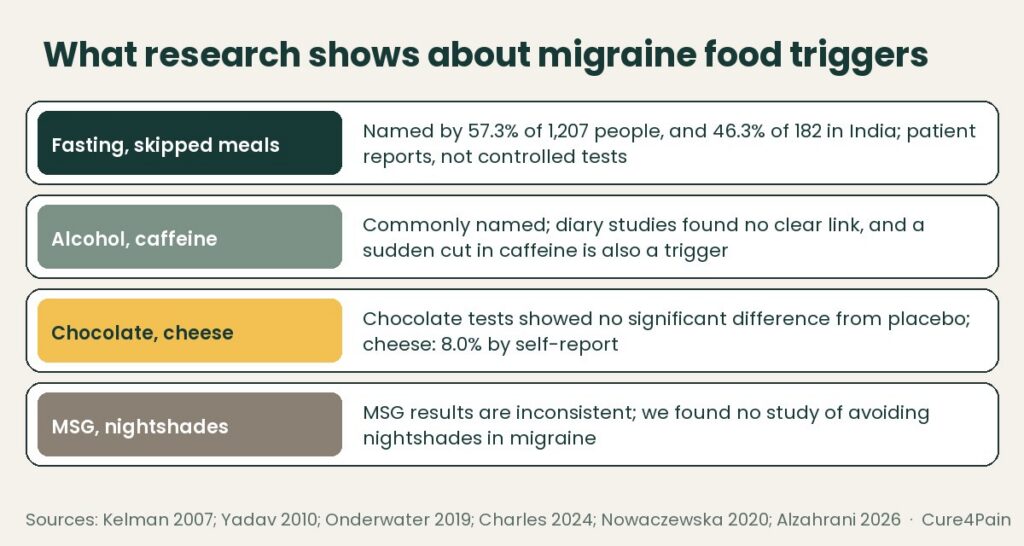
Research and our clinic practice, side by side:
| Food or drink | What research shows | Our clinic practice |
|---|---|---|
| Caffeine | Too much is a trigger, according to the NHS [2], and a sudden cut is also a trigger, according to a 2024 review [11]. Habitual intake was not linked with headache frequency in a 2024 study of 97 adults [12] | We advise limiting it, reducing gradually |
| Alcohol | Named as a trigger by 35.6% of 2,197 people in a 2019 web survey, but red wine consistently led to an attack in only 8.8% [13]. In a 2022 diary study of 487 mostly low-dose drinkers, which excluded non-drinkers, there was no significant effect within 24 hours [14] | We advise limiting it |
| MSG | In human studies of headache, not limited to migraine, a 2016 systematic review found no consistent effect with food; effects came mainly with concentrated solutions without food, in poorly blinded studies [15] | Removed |
| Nightshades (tomato, potato, brinjal, peppers) | We found no study of avoiding them in migraine | Removed |
| Wheat | A gluten-free diet is supported for coeliac disease and positive tests; the NHS says people with coeliac disease must stop all gluten for life [16]. In a 2024 six-week trial of 46 people with digestive disorders, migraine and atopic dermatitis, migraines improved in the placebo group [17] | We generally advise most patients to replace wheat with jowar, bajra or other millets as a general health measure, including home-made roti from processed wheat |
| Cruciferous vegetables | We found no study of them as a migraine factor. On the usual thyroid concern, a 2024 review found no harm with daily intake, particularly with adequate iodine [18] | As an observational clinic practice, we generally suggest limiting them (cabbage, cauliflower) at times |
Clinic rules are not research findings; we state them so that you know what we advise and how thin the evidence is. Other foods people ask about:
- Chocolate: a 2020 review found 3 provocation studies, none showing a significant difference from placebo, and judged the evidence insufficient to call it a trigger [19].
- Cheese: in a 2026 pooled analysis of patient reports, 8.0% named cheese, 13.9% chocolate and 12.0% caffeine as triggers. The authors concluded that routine avoidance cannot be recommended for everyone, and that a diary should guide choices [20].
- A trigger or an early sign? In a 2021 study of 53 people, reported food and skipped-meal triggers matched food cravings before attacks, which suggests that some “triggers” are early signs of an attack already starting [21].
Does skipping meals or fasting trigger migraine?
Skipping meals and fasting are commonly reported migraine triggers, which makes regular meals the simplest food advice to follow. The NHS lists skipping meals or not eating regularly among triggers [2].
- In India: in a 2010 hospital study of 182 people with migraine aged 14 to 58, fasting was reported as a trigger by 46.3% [22].
- Religious fasting: in a 2021 Egyptian diary study of 292 people, median attacks were 4 during Ramadan against 3 in the month before, and fell in the second and third 10 days [23]. Cutting caffeine suddenly during a fast can add to the problem, according to a 2024 review [11].
Does a ketogenic diet help migraine?
A ketogenic diet may help adults with migraine who are overweight, but the evidence is limited. A 2022 systematic review of 10 studies in Nutrition Reviews found fewer and milder attacks with few reported adverse effects, but rated the evidence low, so the effect remains inconclusive [24].
- Crossover trial: in a 2019 trial of 35 overweight adults with episodic migraine, one month of a very low-calorie ketogenic diet gave 3.73 fewer migraine days than a very low-calorie non-ketogenic diet [25].
- EMIKETO trial (2023): in 57 people with frequent episodic migraine and a body mass index above 27, a programme with 8 ketogenic weeks lowered migraine days more than a balanced low-calorie diet at 8, 12 and 24 weeks. Participants had regular blood and urine checks, and it was a single-centre trial [26].
- The limits: the 2019 crossover trial and the EMIKETO trial were both very low-calorie programmes in people with excess weight, so their results may not apply to people of normal weight.
- Who should not try it: a 2026 review lists rare inherited metabolic disorders and porphyria as contraindications, and acute pancreatitis, advanced liver or kidney disease and familial high cholesterol as relative contraindications. It advises particular caution in diabetes on certain medicines, pregnancy or breastfeeding, and underweight, and names fatigue, headache and nausea among transient side effects [27].
- At Cure4Pain: we consider a ketogenic diet for suitable patients under supervision; this is clinic practice, not a trial result.
Do elimination, DASH, low-fat or omega-3 diets help migraine?
Elimination, DASH, low-fat and omega-3-rich diets each have a positive migraine trial, but the evidence is thin: the elimination trials disagree, the others are single trials, and quality of life did not clearly improve in the DASH and omega-3 trials. DASH (Dietary Approaches to Stop Hypertension) is a US eating plan of vegetables, fruit, whole grains, low-fat dairy, fish, poultry, beans and nuts, lower in sodium [28].
| Diet | Who was studied | Result |
|---|---|---|
| Elimination, foods chosen by an IgG antibody blood test | 2011 UK trial: 167 volunteers with migraine-like headaches. 2025 sham-controlled trial: 98 adults | 2011: better than a sham diet at 4 weeks but not at 12, with no difference in disability [29]. 2025: larger falls in most migraine questionnaire scores at 12 weeks [30] |
| DASH | 2022 trial: 102 women aged 20 to 50, 12 weeks | Attacks fell by 3.00 against 1.40 with usual advice; severity also improved; quality of life did not differ [31] |
| Low-fat | 2015 crossover trial: 83 adults aged 18 to 57 on preventive medicines | 2.9 attacks against 6.8 on a normal-fat diet [32] |
| More omega-3, less omega-6, from food | 2021 BMJ trial: 182 adults, 16 weeks, with most food supplied | 4.0 fewer headache days a month than the control diet; the headache impact score did not change significantly [33] |
Omega-3 from food and from capsules gave different results: a 2025 meta-analysis of 22 supplement trials found no significant effect of omega-3 supplements on migraine [34].
Does magnesium help migraine, and how much is safe?
Magnesium may help prevent migraine in some people, although studies disagree: a 2012 American Academy of Neurology and American Headache Society guideline, retired by the Academy in 2015, rated it “probably effective” [4] [5]. The US National Institutes of Health gives the adult upper limit from supplements as 350 mg of elemental magnesium a day; food does not count towards it, and absorption varies by form [6]. Our article on magnesium forms compares them.
- For: a 2016 meta-analysis of 10 oral trials (789 people) found lower frequency and intensity, though some of its trials were not adequately randomised [35], and a 2025 meta-analysis of supplement trials found about 2.5 fewer attacks, and 1.7 fewer migraine days a month, with magnesium [34].
- Uncertain: a 2019 Canadian meta-analysis called the evidence insufficient [36], and a 2018 review graded magnesium “possibly effective” [37].
- Two trials that disagree: in a 1996 trial of 81 adults, with 600 mg (24 mmol) of elemental magnesium as dicitrate a day, attacks fell 41.6% against 15.8% with placebo, and 18.6% had diarrhoea [38]. A second 1996 trial, with 20 mmol a day (about 490 mg of elemental magnesium, our calculation), stopped early at 69 people with equal responders (28.6% and 29.4%), and 45.7% had mild side effects such as soft stools, against 23.5% with placebo [39].
- Above the limit: the magnesium amounts people take for migraine exceed the upper limit of 350 mg of elemental magnesium, so the US National Center for Complementary and Integrative Health advises taking them only under a health care provider’s supervision [40]. Very high doses of magnesium can cause low blood pressure, difficulty breathing and irregular heartbeat, and people with kidney disease need medical advice first, because the kidneys largely control magnesium balance, according to the NIH [6].
- Medicines: according to the NIH, magnesium can interact with some antibiotics and osteoporosis medicines, and proton pump inhibitors for acidity can affect magnesium status [6].
Does riboflavin (vitamin B2) help migraine?
Riboflavin has the most consistent guideline support among the supplements covered here, although two trials of combination products showed no benefit. The UK’s National Institute for Health and Care Excellence (NICE) advises that 400 mg once a day may reduce migraine frequency and intensity for some people [41], and the NHS lists vitamin B2 among preventive options [2].
- Main trial: in a 1998 trial of 55 people, 400 mg of riboflavin a day for 3 months gave at least a 50% fall in headache days in 59% against 15% with placebo [42].
- Pooled results: a 2022 meta-analysis of 9 trials (673 people) found fewer migraine days and attacks at 400 mg a day for 3 months, with wide variation between studies [43].
- Combinations: a 2017 review of 11 riboflavin trials found benefit in 5 adult trials but not in 2 combination trials [44].
- Safety: no official upper limit exists, because adverse effects at 400 mg a day for at least 3 months have not been reported, according to the NIH, which notes that the US Food and Nutrition Board urges caution with excessive amounts and that side effects such as discoloured urine are minimal [7]. The main trial recorded two minor events on riboflavin, diarrhoea and frequent urination [42].
Does coenzyme Q10 help migraine?
Coenzyme Q10 may reduce how often and how long migraine attacks occur; reviews disagree on severity, and the evidence is small. A 2021 meta-analysis of 6 trials (371 people) in BMJ Open found about 1.5 fewer attacks and shorter attacks, with no change in severity [45]; a 2025 meta-analysis of 22 supplement trials found fewer and shorter attacks and lower severity [34]; and a 2019 Canadian meta-analysis found no significant effect in 2 trials (97 people) [36].
No serious side effects of coenzyme Q10 have been reported, but it may interact with warfarin and insulin, according to the US National Center for Complementary and Integrative Health [40].
What do guidelines say about magnesium, riboflavin and CoQ10?
Migraine guidelines differ on these supplements: the American Academy of Neurology and the American Headache Society rated magnesium and riboflavin “probably effective” and coenzyme Q10 “possibly effective” in a 2012 guideline that the Academy retired in 2015 [4] [5], the Canadian Headache Society (2012) strongly recommends riboflavin, coenzyme Q10 and magnesium citrate [46], and the UK’s NICE names riboflavin only [41].
| Guideline | Position | Note |
|---|---|---|
| American Academy of Neurology and American Headache Society, 2012 | Magnesium and riboflavin “probably effective” (Level B); coenzyme Q10 “possibly effective” (Level C) [4] | Studies to May 2009. Retired by the Academy on 16 September 2015 [5]; that year it stopped recommending butterbur, from the same guideline, over liver concerns [40] |
| Canadian Headache Society, 2012 | Strong recommendation for riboflavin, coenzyme Q10 and magnesium citrate [46] | The evidence for riboflavin was low quality, according to the NIH [7] |
| NICE CG150, UK (recommendation from 2012; guideline updated 2025) | Riboflavin may help some people [41] | Its recommendations do not mention magnesium or coenzyme Q10 |
Newer guidelines focus on medicines. The published summaries of the 2024 Canadian update [47] and the 2026 American drug guideline [48] do not mention these supplements; we could read only the summaries.
Which foods contain magnesium and riboflavin?
Food can meet daily needs for these nutrients, but not the amounts tested in migraine trials. Adults need 1.3 mg (men) or 1.1 mg (women) of riboflavin a day, and a cup of milk gives about 0.5 mg, according to the NIH [7].
- Magnesium: green leafy vegetables, legumes, nuts, seeds and whole grains [6]; in Indian food, palak, methi, dals, almonds, pumpkin seeds, jowar or bajra.
- Riboflavin: eggs, milk, curd, lean meats and almonds [7]. Vegans and people who drink little milk have a higher risk of low intake [7].
A 7-day Indian vegetarian migraine diet chart
This 7-day Indian vegetarian migraine diet chart is a sample, not a prescription, and it has not been tested in a trial. It keeps to regular meals, as the NHS advises [2], and to our clinic rules: no MSG or nightshades (tomato, potato, brinjal, peppers), no wheat roti, and no cruciferous vegetables in this sample. It includes foods that supply magnesium and riboflavin [6] [7]. Your own plan depends on your tests, headache type, weight, medicines and other conditions.
- Monday: Breakfast: Finger millet porridge (ragi ki kanji), almonds (badam). Lunch: Sorghum flatbread (jowar roti), spinach and lentil curry (palak dal), bottle gourd (lauki) sabzi, curd (dahi). Evening snack: Roasted fox nuts (makhana), apple (seb). Dinner: Moong dal and rice (moong dal khichdi) with ghee, pumpkin (kaddu) sabzi.
- Tuesday: Breakfast: Moong dal pancake (moong dal chilla) with mint chutney (pudina chutney), papaya (papita). Lunch: Rice (chawal), pigeon pea dal (arhar dal), ridge gourd (turai) sabzi, buttermilk (chaas). Evening snack: Banana (kela), roasted pumpkin seeds (kaddu ke beej). Dinner: Pearl millet flatbread (bajra roti), fenugreek (methi) sabzi, moong dal.
- Wednesday: Breakfast: Flattened rice (poha) with peas (matar) and carrot (gajar), curd (dahi). Lunch: Foxtail millet (kangni) rice, red lentils (masoor dal), okra (bhindi) sabzi, cucumber (kheera). Evening snack: Guava (amrood), almonds (badam). Dinner: Finger millet flatbread (ragi roti), spinach with paneer (palak paneer), round gourd (tinda) sabzi.
- Thursday: Breakfast: Sorghum upma (jowar upma) with carrot and beans, milk (doodh). Lunch: Rice (chawal), split chickpea dal (chana dal), spinach (palak) sabzi, curd (dahi). Evening snack: Pear (nashpati), walnuts (akhrot). Dinner: Pearl millet and vegetables (bajra khichdi), bottle gourd raita (lauki raita).
- Friday: Breakfast: Gram flour pancake (besan chilla) with grated carrot, buttermilk (chaas). Lunch: Sorghum flatbread (jowar roti), moong dal, pumpkin (kaddu) sabzi, beetroot (chukandar). Evening snack: Papaya (papita), roasted chickpeas (bhuna chana). Dinner: Rice (chawal), pigeon pea dal (arhar dal), fenugreek (methi) sabzi.
- Saturday: Breakfast: Steamed rice cakes (idli) with coconut chutney (nariyal chutney). Lunch: Pearl millet flatbread (bajra roti), black-eyed beans (lobia), ridge gourd (turai) sabzi, curd (dahi). Evening snack: Apple (seb), roasted pumpkin seeds (kaddu ke beej). Dinner: Moong dal soup, finger millet flatbread (ragi roti), round gourd (tinda) sabzi.
- Sunday: Breakfast: Moong dal crepe (moong dosa) with coconut chutney (nariyal chutney). Lunch: Rice (chawal), red lentils (masoor dal), spinach (palak) sabzi, cucumber raita (kheera raita). Evening snack: Pomegranate (anar), almonds (badam). Dinner: Sorghum flatbread (jowar roti), scrambled paneer (paneer bhurji), French beans (fansi) sabzi.
Notes for the week:
- Flavour: cook without tomato or chilli; ginger, cumin, coriander and curry leaves give flavour.
- Tea or coffee: we advise limiting them and reducing them gradually, because a sudden cut in caffeine is also a trigger [11].
- Your own triggers: leave out any food your diary links with attacks. A chart does not replace that record [20].
- If you eat eggs or fish: these can replace paneer or dal at any meal.
How do you find your own food triggers?
To find your own migraine food triggers, keep a diary, because triggers differ between people. NICE guideline CG150 suggests recording headaches, symptoms, medicines and possible triggers for at least 8 weeks [41], and a 2026 pooled analysis also concluded that a diary should guide food choices [20].
Record meals and their times, water, caffeine, alcohol, sleep, and when each attack started. Change one thing at a time, and look for a pattern rather than one event.
When is a headache an emergency?
Call emergency services or go to an emergency department if a headache starts suddenly and is extremely painful, or comes with a seizure, numbness or weakness in the body or face, difficulty speaking, balancing, walking or remembering, drowsiness or confusion, loss of vision, a head injury within the last 3 months, a rash that does not fade under a glass, a very high temperature, a stiff neck, or bright lights bothering you, according to the NHS [49]. Call 112 in India, 911 in the US or 999 in the UK, and do not drive yourself.
- Get an urgent doctor’s appointment: headache with vomiting or vision problems, jaw pain when eating or a sore scalp, or one triggered or made worse by coughing, sneezing, bending or exercise, according to the NHS [49].
- Other warning features: a substantial change in your usual headache, according to NICE [41], or a new headache after age 65, in pregnancy or with a weak immune system, according to the 2019 SNNOOP10 list [50].
A diet does not treat any of these.
How we plan your migraine diet at Cure4Pain
At Cure4Pain, diet is one part of a plan matched to the source of each person’s headaches: jaw and neck muscles, sleep and breathing, or metabolic, deficiency or autoimmune factors. An integrative plan may add options alongside standard care.
- Tests first: we read a panel of about 100 markers, adding tests for your condition when clinically indicated, such as ANA by the IFA method, the lipid profile and markers of inflammation. The panel is our clinic protocol, not a guideline requirement.
- Diet: we advise limiting caffeine, reduced gradually, and alcohol; MSG and nightshades are removed; we generally advise most patients to replace wheat with jowar, bajra or other millets as a general health measure; and as an observational clinic practice, we generally suggest limiting cruciferous (Brassica) vegetables such as cabbage and cauliflower at times. The research on each is stated above.
- Nutrients: magnesium, mainly as bisglycinate, with L-threonate or citrate as advised, counted as elemental magnesium; riboflavin, coenzyme Q10, omega-3 and vitamin B12, within official limits where these exist, with supplements by mouth first, with injections only when specifically needed or advised. Severe deficiency states are treated with nutrition as therapy. We found no migraine trial of bisglycinate or threonate, so the choice of form is clinic practice.
- Beyond food: medicines and nutritional support for acidity, raised triglycerides and histamine responses; probiotics and digestive and bile support; sleep and breathing care; and dry needling, acupuncture and tongue-posture work only for myofascial and myofunctional tension headaches.
- Vitamin D: supervised-dose vitamin D therapy (Coimbra Protocol-based methods), mainly for autoimmune and metabolic types. Our methods are derived from the work of Dr Coimbra. We found no trial of this approach in migraine.
- Medicines: many people come to us referred by their neurologist, and we work alongside them. Painkillers and preventive medicines are reviewed under clinical guidance from Team Cure4Pain, in coordination with your neurologist and existing consulting physician; never stop or change them on your own.
- Who and how long: we see adults and young people aged 16 and over. In our clinic, many people with jaw, neck or muscle-related headaches notice relief within 6 to 8 weeks, while autoimmune or metabolic types need lifelong management; these are clinic observations, care differs from person to person, and individual results vary.
This is our clinic practice; individual results vary, and further studies are needed.
If you would like your diet and nutrients reviewed alongside your headache pattern, you can book a consultation, online from anywhere or at our Mumbai clinic.
Frequently asked questions
What foods should you avoid with a migraine?
No list applies to everyone. The NHS advises limiting caffeine and alcohol and not skipping meals. As clinic practice, Cure4Pain also removes MSG and nightshades, generally replaces wheat with jowar, bajra or other millets, and suggests limiting cruciferous vegetables at times; research does not establish these foods as triggers. [2] [15]
What foods help migraine?
No food is proven to stop migraine. Regular meals and good hydration are the NHS advice, and foods rich in magnesium and riboflavin support daily needs, though not the doses tested in trials. [2] [6] [7]
Is chocolate a migraine trigger?
Chocolate is probably not a migraine trigger for most people. A 2020 review found that provocation studies showed no significant difference from placebo, and craving certain foods can be a symptom at the start of an attack, according to the NHS. [19] [2]
Does caffeine trigger or help migraine?
Caffeine can do both. Too much is a trigger, according to the NHS; a 2024 review adds that a sudden cut is also a trigger, that caffeine has some short-term benefit in milder attacks, and that moderate amounts at consistent times before noon are suggested. At Cure4Pain we advise limiting it and reducing it gradually. [11] [2]
How much magnesium should I take for migraine?
The upper limit from supplements is 350 mg of elemental magnesium a day for adults, according to the US National Institutes of Health. The main positive trial used 600 mg of elemental magnesium, so higher amounts are for medical supervision only. [6] [38] [40]
Which magnesium is best for migraine?
No form of magnesium has been shown to be best for migraine. Citrate forms have a positive trial and the 2012 Canadian Headache Society recommendation, and they tend to be absorbed better than oxide, according to the NIH. We found no migraine trial of glycinate; at Cure4Pain we mainly use bisglycinate, with L-threonate or citrate as advised, as clinic practice. [38] [46] [6]
How much riboflavin should I take for migraine?
NICE and the main trials refer to 400 mg once a day, with results measured at about 3 months. No official upper limit exists, but this is far above daily needs, so ask your clinician first. [41] [42] [7]
Can a ketogenic diet help chronic migraine?
Most trial evidence on the ketogenic diet is in overweight adults with episodic migraine, not chronic migraine, and a 2022 review rated the evidence as low. At Cure4Pain we consider it for suitable patients under supervision. [24]
This article is for education and does not replace medical advice. Do not start, stop or change any medicine or supplement without medical guidance.
References
1. Hindiyeh NA, et al. The Role of Diet and Nutrition in Migraine Triggers and Treatment: A Systematic Literature Review. Headache 2020;60(7):1300-1316. doi:10.1111/head.13836
2. NHS. Migraine. nhs.uk/conditions/migraine
3. Roldán-Ruiz A, et al. Effects of Dietary Interventions in Patients With Migraine: A Systematic Review. Nutr Rev 2025;83(7):e1815-e1827. doi:10.1093/nutrit/nuae188
4. Holland S, et al. Evidence-based guideline update: NSAIDs and other complementary treatments for episodic migraine prevention in adults: report of the Quality Standards Subcommittee of the American Academy of Neurology and the American Headache Society. Neurology 2012;78(17):1346-53. doi:10.1212/WNL.0b013e3182535d0c
5. American Academy of Neurology. Update: NSAIDs and Other Complementary Treatments for Episodic Migraine Prevention in Adults (guideline page, retired 16 September 2015). aan.com
6. Office of Dietary Supplements, US National Institutes of Health. Magnesium: Fact Sheet for Health Professionals. ods.od.nih.gov
7. Office of Dietary Supplements, US National Institutes of Health. Riboflavin: Fact Sheet for Health Professionals. ods.od.nih.gov
8. Slavin M, et al. Dietary magnesium and migraine in adults: A cross-sectional analysis of the National Health and Nutrition Examination Survey 2001-2004. Headache 2021;61(2):276-286. doi:10.1111/head.14065
9. Martin VT, Vij B. Diet and Headache: Part 1. Headache 2016;56(9):1543-1552. doi:10.1111/head.12953
10. Kelman L. The triggers or precipitants of the acute migraine attack. Cephalalgia 2007;27(5):394-402. doi:10.1111/j.1468-2982.2007.01303.x
11. Charles A. The role of caffeine in headache disorders. Curr Opin Neurol 2024;37(3):289-294. doi:10.1097/WCO.0000000000001249
12. Mittleman MR, et al. Habitual caffeinated beverage consumption and headaches among adults with episodic migraine: A prospective cohort study. Headache 2024;64(3):299-305. doi:10.1111/head.14673
13. Onderwater GLJ, et al. Alcoholic beverages as trigger factor and the effect on alcohol consumption behavior in patients with migraine. Eur J Neurol 2019;26(4):588-595. doi:10.1111/ene.13861
14. Vives-Mestres M, et al. Alcohol as a trigger of migraine attacks in people with migraine. Results from a large prospective cohort study in English-speaking countries. Headache 2022;62(10):1329-1338. doi:10.1111/head.14428
15. Obayashi Y, Nagamura Y. Does monosodium glutamate really cause headache? : a systematic review of human studies. J Headache Pain 2016;17:54. doi:10.1186/s10194-016-0639-4
16. NHS (UK National Health Service). Coeliac disease: treatment. nhs.uk/conditions/coeliac-disease/treatment
17. San Mauro Martín I, et al. Effects of Gluten on Gut Microbiota in Patients with Gastrointestinal Disorders, Migraine, and Dermatitis. Nutrients 2024;16(8). doi:10.3390/nu16081228
18. Galanty A, et al. Do Brassica Vegetables Affect Thyroid Function?-A Comprehensive Systematic Review. Int J Mol Sci 2024;25(7). doi:10.3390/ijms25073988
19. Nowaczewska M, et al. To Eat or Not to Eat: A Review of the Relationship between Chocolate and Migraines. Nutrients 2020;12(3). doi:10.3390/nu12030608
20. Alzahrani H. Assessment of Chocolate, Cheese, and Caffeine as Migraine Triggers: A Systematic Review and Meta-Analysis of Patient-Reported Trigger Rates. J Nutr Metab 2026;2026:4693275. doi:10.1155/jnme/4693275
21. Karsan N, et al. Are some patient-perceived migraine triggers simply early manifestations of the attack? J Neurol 2021;268(5):1885-1893. doi:10.1007/s00415-020-10344-1
22. Yadav RK, et al. A study of triggers of migraine in India. Pain Med 2010;11(1):44-7. doi:10.1111/j.1526-4637.2009.00725.x
23. Ragab AH, et al. Changes in migraine characteristics over 30 days of Ramadan fasting: A prospective study. Headache 2021;61(10):1493-1498. doi:10.1111/head.14231
24. Caminha MC, et al. Efficacy and tolerability of the ketogenic diet and its variations for preventing migraine in adolescents and adults: a systematic review. Nutr Rev 2022;80(6):1634-1647. doi:10.1093/nutrit/nuab080
25. Di Lorenzo C, et al. A Randomized Double-Blind, Cross-Over Trial of very Low-Calorie Diet in Overweight Migraine Patients: A Possible Role for Ketones? Nutrients 2019;11(8). doi:10.3390/nu11081742
26. Caprio M, et al. Very-low-calorie ketogenic diet vs hypocaloric balanced diet in the prevention of high-frequency episodic migraine: the EMIKETO randomized, controlled trial. J Transl Med 2023;21(1):692. doi:10.1186/s12967-023-04561-1
27. Dyńka D, et al. The ketogenic diet is not for everyone: contraindications, side effects, and drug interactions. Ann Med 2026;58(1):2603016. doi:10.1080/07853890.2025.2603016
28. National Heart, Lung, and Blood Institute, US National Institutes of Health. DASH Eating Plan. nhlbi.nih.gov
29. Mitchell N, et al. Randomised controlled trial of food elimination diet based on IgG antibodies for the prevention of migraine like headaches. Nutr J 2011;10:85. doi:10.1186/1475-2891-10-85
30. Zhao Z, et al. Food-specific IgG-based elimination diet decreased IL-6, TNF-α, and CGRP and improved symptoms in adults with migraine. Front Nutr 2025;12:1720389. doi:10.3389/fnut.2025.1720389
31. Arab A, et al. Effects of the Dietary Approaches to Stop Hypertension (DASH) diet on clinical, quality of life and mental health outcomes in women with migraine: a randomised controlled trial. Br J Nutr 2022;128(8):1535-1544. doi:10.1017/S000711452100444X
32. Ferrara LA, et al. Low-lipid diet reduces frequency and severity of acute migraine attacks. Nutr Metab Cardiovasc Dis 2015;25(4):370-5. doi:10.1016/j.numecd.2014.12.006
33. Ramsden CE, et al. Dietary alteration of n-3 and n-6 fatty acids for headache reduction in adults with migraine: randomized controlled trial. BMJ 2021;374:n1448. doi:10.1136/bmj.n1448
34. Talandashti MK, et al. Effects of selected dietary supplements on migraine prophylaxis: A systematic review and dose-response meta-analysis of randomized controlled trials. Neurol Sci 2025;46(2):651-670. doi:10.1007/s10072-024-07794-0
35. Chiu HY, et al. Effects of Intravenous and Oral Magnesium on Reducing Migraine: A Meta-analysis of Randomized Controlled Trials. Pain Physician 2016;19(1):E97-112. PubMed 26752497
36. Okoli GN, et al. Vitamins and Minerals for Migraine Prophylaxis: A Systematic Review and Meta-analysis. Can J Neurol Sci 2019;46(2):224-233. doi:10.1017/cjn.2018.394
37. von Luckner A, Riederer F. Magnesium in Migraine Prophylaxis-Is There an Evidence-Based Rationale? A Systematic Review. Headache 2018;58(2):199-209. doi:10.1111/head.13217
38. Peikert A, et al. Prophylaxis of migraine with oral magnesium: results from a prospective, multi-center, placebo-controlled and double-blind randomized study. Cephalalgia 1996;16(4):257-63. doi:10.1046/j.1468-2982.1996.1604257.x
39. Pfaffenrath V, et al. Magnesium in the prophylaxis of migraine–a double-blind placebo-controlled study. Cephalalgia 1996;16(6):436-40. doi:10.1046/j.1468-2982.1996.1606436.x
40. National Center for Complementary and Integrative Health, US National Institutes of Health. Headaches: What You Need To Know. nccih.nih.gov
41. National Institute for Health and Care Excellence (NICE). Headaches in over 12s: diagnosis and management (CG150). nice.org.uk/guidance/cg150
42. Schoenen J, et al. Effectiveness of high-dose riboflavin in migraine prophylaxis. A randomized controlled trial. Neurology 1998;50(2):466-70. doi:10.1212/wnl.50.2.466
43. Chen YS, et al. Effect of Vitamin B2 supplementation on migraine prophylaxis: a systematic review and meta-analysis. Nutr Neurosci 2022;25(9):1801-1812. doi:10.1080/1028415X.2021.1904542
44. Thompson DF, Saluja HS. Prophylaxis of migraine headaches with riboflavin: A systematic review. J Clin Pharm Ther 2017;42(4):394-403. doi:10.1111/jcpt.12548
45. Sazali S, et al. Coenzyme Q10 supplementation for prophylaxis in adult patients with migraine-a meta-analysis. BMJ Open 2021;11(1):e039358. doi:10.1136/bmjopen-2020-039358
46. Pringsheim T, et al. Canadian Headache Society guideline for migraine prophylaxis. Can J Neurol Sci 2012;39(2 Suppl 2):S1-59. PubMed 22683887
47. Medrea I, et al. Updated Canadian Headache Society Migraine Prevention Guideline with Systematic Review and Meta-analysis. Can J Neurol Sci 2024:1-23. doi:10.1017/cjn.2024.285
48. Potrebic S, et al. Pharmacologic Treatment for Migraine Prevention in Adults Practice Guideline Recommendations: Report of the AAN Guidelines Subcommittee and the American Headache Society. Neurology 2026;107(7):e214881. doi:10.1212/WNL.0000000000214881
49. NHS. Headaches. nhs.uk/conditions/headaches
50. Do TP, et al. Red and orange flags for secondary headaches in clinical practice: SNNOOP10 list. Neurology 2019;92(3):134-144. doi:10.1212/WNL.0000000000006697