
Written by AT. Chintan Dalal, N.D. · Reviewed by Dr Krushal Pabari, Clinical Team, Cure4Pain · Updated 30 October 2026
Key facts
Many frozen shoulders (adhesive capsulitis) improve with time, but not all recover fully. A 2017 systematic review in the journal Physiotherapy found that shoulders given no treatment gained some, but not complete, movement over 1 to 4 years, on low-quality evidence [1]. In a 2008 long-term study of 223 people, 59% had normal or near-normal shoulders after an average of 4.4 years, and 41% still had some symptoms, mostly mild [2]. People with diabetes are about 5 times more likely to have frozen shoulder, according to a 2016 meta-analysis of 18 studies [3], and may recover less well [4]. An underactive thyroid is linked with roughly double the odds, according to a 2023 meta-analysis [5]. A link with menopause is plausible but unproven: the one study of hormone therapy we found was a pilot with no statistically significant result [6].

Scientific explainer videos in our Resources section
In our Resources section, our clinical team discusses vitamin D, its cofactors and how autoimmune, lifestyle and pain conditions develop.
Does frozen shoulder heal on its own?
Frozen shoulder (adhesive capsulitis) often improves a good deal with time, but full recovery is not certain. The NHS says that “the pain and stiffness will usually go away eventually”, and that this can take months or years [7]. A 2025 Korean clinical practice guideline agrees that frozen shoulder often settles by itself, and adds that some people are left with long-term disability [8].
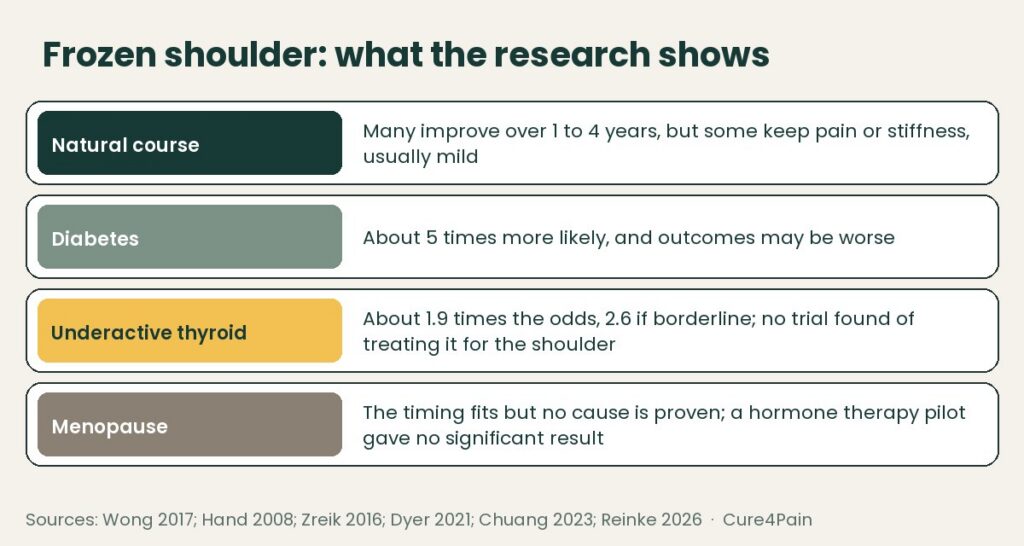
- The closest evidence to “no treatment”: a 2017 systematic review in Physiotherapy included seven studies with no-treatment comparison groups. Movement improved somewhat over 1 to 4 years, but not completely, and the evidence was low quality [1].
- The old idea of full recovery: the same review found nothing to support the belief, dating from the 1940s, that frozen shoulder always passes through recovery phases to full resolution without treatment [1].
- Linked conditions: a 2025 Korean guideline says diabetes, thyroid disease and raised blood fats increase the risk of frozen shoulder [8]. We found no randomised trial of whether treating diabetes or thyroid disease changes recovery.
Long-term follow-up studies give more detail. Two of these three followed people treated without surgery, so they do not show the course with no care at all.
| Study | Who was followed | What was found |
|---|---|---|
| Hand 2008 [2] | 223 people with primary frozen shoulder, average 4.4 years from onset | 59% normal or near normal; 41% with some symptoms, of whom 94% mild and 6% severe |
| Kim 2020 [9] | 215 people treated without surgery, average about 3.5 years | 72.3% satisfied or very satisfied; 15.8% of shoulders rated fair; 11.9% unsatisfied or very unsatisfied |
| Shaffer 1992 [10] | 62 people treated without surgery, average 7 years | 50% had mild pain or stiffness; 60% had some loss of movement against study control values, but 30% of the 37 with one shoulder affected when compared with their other shoulder; 11% reported mild functional limits |
Read together, these three long-term studies suggest that most people with frozen shoulder end up with a shoulder they can use well, but many keep some symptoms, usually mild: 41% in one study and 50% in another [2] [10]. The studies measured recovery differently, so the percentages cannot be compared directly.
How long does frozen shoulder last without treatment?
There is no reliable single figure for how long frozen shoulder lasts without treatment. The NHS says it can take months or years to get better [7], and studies that follow people for an average of 3.5 to 7 years still find some with symptoms [2] [9] [10].
- Early rather than late: a 2017 systematic review reported moderate-quality evidence from three randomised trials that most improvement came early, not late, which does not fit the idea of a long wait followed by a thaw [1].
- Watchful waiting: in a 2025 randomised trial of 61 people, watchful waiting and physical therapy gave similar pain and function scores at every point up to 12 months. However, 47 patients, reported as 96%, had at least one steroid injection, and all were offered one, so this was not a test of no treatment [11].
Who is less likely to recover fully?
Follow-up studies of frozen shoulder point to three factors linked with a poorer recovery: severe symptoms at the start, a long duration of symptoms, and diabetes.
- Severity at the start: in a 2008 long-term study of 223 people, those with the most severe symptoms at onset had the worst long-term outlook [2].
- Long duration: in a 2020 study of 215 people treated without surgery, duration of symptoms was an independent predictor of an unsuccessful outcome [9].
- Diabetes: a 2021 review of 28 follow-up studies found worse outcomes with diabetes, and called the evidence preliminary [4].
- Thyroid and other factors: in a 2022 BMJ Open study of 121 people followed for 9 months, diabetes and thyroid disorders were among the predictors, but together the factors studied explained only 2.5% to 6.3% of the outcome [12]. In a 2023 study of 56 people, raised blood fats and anxiety went with less improvement and hypothyroidism with more, so the thyroid findings do not agree [13].
Can frozen shoulder come back or affect the other shoulder?
Frozen shoulder can affect the other shoulder, and return in the same shoulder looks less common, although the evidence is thin.
- The other shoulder: in a 2008 long-term study of 223 people, 20% reported symptoms in both shoulders [2].
- The same shoulder: the same 2008 study of 223 people found no recurrent cases [2]. This is one study, so it does not rule out recurrence.
- Links with both shoulders: in a 2017 case-control study, thyroid stimulating hormone (TSH) was higher in people with both shoulders affected [14].
How is diabetes linked to frozen shoulder?
Diabetes is the best-documented link with frozen shoulder. A 2016 meta-analysis of 18 studies found that people with diabetes were 5 times more likely than controls to have frozen shoulder, that 13.4% of people with diabetes had it, and that 30% of people with frozen shoulder had diabetes [3]. A 2018 study of 235 people found a lower figure, with 14% already diagnosed with diabetes [15].
- Risk of developing frozen shoulder: a 2023 BMJ Open review of six case-control studies (5,388 people) put the odds at 3.69 times those of people without diabetes, and two cohort studies also showed higher risk. The authors name unmeasured confounding as the main limit [16].
- Genetic evidence: in 379,708 UK Biobank participants of European ancestry, higher genetically predicted HbA1c (average blood sugar) was linked with frozen shoulder, while body mass index was not. The authors conclude that long-term high blood sugar plays a causal role [17].
- Sugar control: studies disagree. Among 201,513 people with diabetes, HbA1c was not related to frozen shoulder, but longer diabetes was [18]; in 24,417 patients, a new measure of long-term HbA1c, not previously validated, went with more frozen shoulder [19].
- Undiagnosed diabetes: the evidence is limited. In a 2018 study of 235 people, none of the 122 tested had undiagnosed diabetes [15]. The 18-study meta-analysis advises that screening be considered [3].
- Recovery: a review of 28 follow-up studies, 21 of them at high risk of bias, found worse overall shoulder scores with diabetes (moderate certainty), worse pain (low certainty) and worse movement (very low certainty), and called this preliminary [4]. In 235 people followed for two years, both groups improved, but those with diabetes had poorer shoulder scores at 24 months [20].
In a PubMed search in October 2026, we found no randomised trial testing whether better blood sugar control changes the course of frozen shoulder. Read more on our type 2 diabetes and type 1 diabetes pages.
Is frozen shoulder linked to thyroid problems?
Frozen shoulder is linked to thyroid problems, mainly an underactive thyroid (hypothyroidism), although most of the evidence comes from studies that cannot prove cause.
- Meta-analysis: a 2023 meta-analysis of ten case-control studies with 127,967 people found 1.92 times the odds of frozen shoulder with hypothyroidism and 2.56 times with subclinical (borderline) hypothyroidism. For an overactive thyroid the result was 1.42 times and not statistically significant, possibly because few studies exist [5].
- Case-control study: in a 2017 study, hypothyroidism was diagnosed in 27.2% of 93 people with frozen shoulder and 10.7% of 151 controls, and TSH was higher in severe cases [14].
- Genetic evidence: two studies in people of European ancestry suggest that hypothyroidism may be a cause, with small effects (odds of about 1.06 and 1.07) [21] [22].
In a PubMed search in October 2026, we found no randomised trial testing whether treating an underactive thyroid changes the course of frozen shoulder. Read more on our hypothyroidism and Hashimoto’s thyroiditis pages.
Is frozen shoulder linked to menopause?
Frozen shoulder may be linked to menopause, but no study we found has shown that menopause causes it. The timing fits, because frozen shoulder typically affects women aged 40 to 60 [6].
- Who gets it: in UK general practice records of about 2.2 million adults aged 40 to 79, the yearly rate was 3.38 per 1,000 women and 2.36 per 1,000 men [23]. Average age at onset was 53.4 years in one long-term study, with women affected 1.6 times as often as men [2].
- Around menopause: in a 2018 study in the journal Menopause, among women with shoulder pain, frozen shoulder was the most common diagnosis both in 197 who were perimenopausal (35.4%) and 113 who were premenopausal (31.8%), with no significant difference. Inflammation of the joint lining (synovitis) was more common around menopause (25.1% against 6.2%), so not all shoulder pain at this age is frozen shoulder [24].
- Hormone therapy: in a 2026 pilot using the medical records of 1,952 postmenopausal women aged 40 to 60, frozen shoulder was recorded in 3.95% of those on hormone therapy and 7.65% of those not on it. The difference was not statistically significant, only 152 women were on hormone therapy, and the authors call for larger studies. It did not test hormone therapy as a treatment for the shoulder [6].
- Laboratory work: estradiol, a form of estrogen, reduced scar-like changes in a rat model and in patients’ cells [25], and a 2025 narrative review proposes low estrogen as a central factor [26]. Neither shows what happens in women treated for the shoulder.
In a PubMed search in October 2026, we found no study following whether frozen shoulder settles after menopause, and no randomised trial of hormone therapy or supplements for frozen shoulder. Diabetes and an underactive thyroid can both appear in midlife, so at Cure4Pain we check them first.
Do injections and exercise change the course?
Steroid injections can ease frozen shoulder symptoms sooner, at up to 12 weeks [27]; evidence that injections or exercise change the long-term result is weaker. A 2022 review in Nature Reviews Disease Primers describes the effectiveness of the main treatments as still unclear [28].
| Treatment | What trials show | Limits |
|---|---|---|
| Steroid injection into the joint | In a 2020 JAMA Network Open review of 65 studies (4,097 people), the only treatment clearly better at up to 12 weeks for pain and function; home exercise may add benefit [27]. Recommended in the 2025 Korean guideline [8] | Better outcomes reported when used within the first year [27] |
| Exercise and manual therapy | In a 2022 review of 33 studies, preliminary evidence that movement, function and pain improve [29]. Combined, they helped less than an injection at 7 weeks in one trial, according to a 2014 Cochrane review [30] | No long-term conclusion possible [29]; differences at 6 and 12 months not clinically important; no trial of the combination against placebo or no treatment [30] |
| Hydrodilatation | At least short-term gains over steroid injection alone [31] | Clinical relevance still unclear [31] |
| Manipulation under anaesthesia or keyhole release | UK FROST (503 people): neither was clinically superior to physiotherapy with a steroid injection at 12 months [32] | Keyhole release carried higher risks [32] |
| Acupuncture-related therapies | In 84 trials (7,125 people), some forms did better than physical therapy or medicines on overall response and function, with no significant difference in pain; generally safe [33] | Low to moderate certainty [33] |
For people with diabetes and frozen shoulder, the evidence is thinner. In a 2019 systematic review of eight trials, joint mobilisation with exercise showed the largest effects, on low-quality evidence [34]. In a 2016 review, seven small studies (72 people with diabetes) all showed a rise in blood sugar after a steroid injection into a joint, often within 24 to 72 hours, and the authors advise monitoring for up to a week [35]; another study of 18 people with diabetes found no significant change after a shoulder injection [36].
No exercise trial we found was specific to menopause. Exercises and what to go carefully with are on our frozen shoulder page.
When should you have your shoulder checked?
See a doctor if shoulder pain is getting worse, has not improved after 2 weeks, or makes it very hard to move your arm, according to the NHS [37].
- Urgent check: the NHS advises an urgent check for sudden or very bad shoulder pain, not being able to move the arm, a shoulder that has changed shape or is badly swollen, pins and needles that do not go away, no feeling in the arm or shoulder, a hot or cold shoulder, pain after an injury, severe pain in both shoulders, or feeling feverish or unwell [37].
- Emergency: the NHS says to call emergency services (your local emergency number) for chest pain that feels tight or squeezing, chest pain spreading to the arms, neck or jaw, or severe difficulty breathing [38].
How we care for frozen shoulder at Cure4Pain
At Cure4Pain we care for frozen shoulder by addressing the body first and then the shoulder, in coordination with your existing consulting physician.
- Tests: we read a panel of about 100 markers, adding tests for your condition when clinically indicated. For frozen shoulder these include blood sugar, thyroid tests and blood fats, because the 2025 Korean guideline says diabetes, thyroid disease and raised blood fats increase the risk [8].
- Blood sugar and thyroid first: we check these at the start of care and address them first, with your diabetologist or endocrinologist.
- Nutrition: a steady-sugar eating plan and correction of nutrient shortfalls, with supplements by mouth first and injections only when specifically needed or advised.
- Food: as clinic practice, we generally advise most patients to replace wheat with jowar, bajra or other millets as a general health measure, including home-made roti from processed wheat; a gluten-free diet is supported for coeliac disease and positive tests, and the NHS says people with coeliac disease must stop all gluten for life [39], and our PubMed search (October 2026) found no study of wheat in frozen shoulder. Also, as an observational clinic practice, we generally suggest limiting cruciferous (Brassica) vegetables such as cabbage and cauliflower; a 2024 review found that eating them, particularly with enough iodine, had no adverse effect on thyroid function [40].
- Topical magnesium: magnesium applied to the skin is used to support comfort during mobility exercises, so that stiff muscles can move without further strain; it is not a pain treatment on its own. A 2017 review judged the claims for absorption through the skin to be scientifically unsupported [41]. In a neck pain trial of 60 people, magnesium sulfate applied with a mild electric current (iontophoresis) had positive effects, although dry needling did better [42].
- Muscle testing and release: we test the muscles around the shoulder, shoulder blade, neck and upper back, find connected fascial and muscle groups that are tight or weak, and release them with myofascial release and electroacupuncture.
- Needling: electroacupuncture at the shoulder and the muscles that move it, and dry needling of tight knots (trigger points).
- Gentle exercises: within pain, step by step, with a daily home plan.
- Injections and surgery: we do not give pain or joint injections at Cure4Pain. If Dr Krushal Pabari and AT. Chintan Dalal find that a steroid injection or surgery is the right next step, we refer you to the right specialist, and you stay under our primary care for your shoulder treatment, exercise plan, blood sugar, thyroid and nutrition, with systematic feedback to the specialist.
- Medicines: any change to painkillers or to diabetes or thyroid medicines is made under clinical guidance from Team Cure4Pain, in coordination with your existing consulting physician; never stop or change them on your own.
This is our clinic practice; individual results vary, and further studies are needed. Our frozen shoulder page explains the method and research in full, and our article on magnesium for neck and shoulder pain covers magnesium.
If you would like your shoulder and your blood tests looked at together, you can book a consultation at our Mumbai clinic or online from anywhere; hands-on treatment and needling need a visit to Mumbai. We plan in blocks of a few weeks with regular reviews; how long care takes differs from person to person, and the NHS says frozen shoulder can take months or years to get better [7].
Frequently asked questions
Does frozen shoulder go away on its own?
Frozen shoulder often improves a good deal, but not always fully. A 2017 systematic review found some, but not complete, improvement in movement over 1 to 4 years without treatment, on low-quality evidence. [1]
How long does frozen shoulder last without treatment?
There is no reliable single figure. The NHS says months or years, and most improvement in trials came early rather than late. [7] [1]
Does frozen shoulder go away completely?
Not for everyone. In one long-term study 59% had normal or near-normal shoulders after an average of 4.4 years, and 41% had some symptoms, mostly mild. [2]
Can frozen shoulder come back?
Evidence is limited. One long-term study found no recurrent cases, although 20% of people had symptoms in both shoulders. [2]
Is frozen shoulder a sign of diabetes?
Frozen shoulder can be a sign of diabetes, but not always. About 30% of people with frozen shoulder have diabetes, according to a 2016 meta-analysis of 18 studies, and evidence on how often undiagnosed diabetes is found is limited. A blood test settles the question. [3] [15]
Why do people with diabetes get frozen shoulder?
The NHS says it is unclear why diabetes is linked to frozen shoulder. A 2024 genetic study of 379,708 UK Biobank participants suggests that long-term high blood sugar plays a causal role, and the same study found no link with genetically predicted body mass index. [7] [17]
Is frozen shoulder linked to thyroid problems?
Frozen shoulder is linked to thyroid problems, mainly an underactive thyroid: a 2023 meta-analysis of ten studies found 1.92 times the odds, and 2.56 times with borderline hypothyroidism. We found no randomised trial testing whether treating the thyroid changes the shoulder. [5]
Is frozen shoulder caused by menopause?
Menopause has not been shown to cause frozen shoulder. Frozen shoulder typically affects women aged 40 to 60, and laboratory work suggests a role for estrogen, but studies in women have not established menopause as a cause. [6] [25] [24]
Does hormone therapy help frozen shoulder?
Hormone therapy for frozen shoulder is unproven. A 2026 pilot using the records of 1,952 postmenopausal women found no statistically significant difference in how often frozen shoulder was recorded with and without hormone therapy. It did not test treatment of the shoulder, and we found no randomised trial. [6]
This article is for education and does not replace medical advice. Do not start, stop or change any medicine or supplement without medical guidance.
References
1. Wong CK, et al. Natural history of frozen shoulder: fact or fiction? A systematic review. Physiotherapy 2017;103(1):40-47. doi:10.1016/j.physio.2016.05.009
2. Hand C, et al. Long-term outcome of frozen shoulder. J Shoulder Elbow Surg 2008;17(2):231-6. doi:10.1016/j.jse.2007.05.009
3. Zreik NH, et al. Adhesive capsulitis of the shoulder and diabetes: a meta-analysis of prevalence. Muscles Ligaments Tendons J 2016;6(1):26-34. doi:10.11138/mltj/2016.6.1.026
4. Dyer BP, et al. Diabetes as a Prognostic Factor in Frozen Shoulder: A Systematic Review. Arch Rehabil Res Clin Transl 2021;3(3):100141. doi:10.1016/j.arrct.2021.100141
5. Chuang SH, et al. Association between adhesive capsulitis and thyroid disease: a meta-analysis. J Shoulder Elbow Surg 2023;32(6):1314-1322. doi:10.1016/j.jse.2023.01.033
6. Reinke EK, et al. A preliminary pilot study to address design issues related to research on potential association of hormone therapy and adhesive capsulitis. Climacteric 2026;29(3):478-483. doi:10.1080/13697137.2026.2615391
7. NHS (UK National Health Service). Frozen shoulder. nhs.uk/conditions/frozen-shoulder
8. Lee BC, et al. Clinical Practice Guidelines for Diagnosis and Non-Surgical Treatment of Primary Frozen Shoulder. Ann Rehabil Med 2025;49(3):113-138. doi:10.5535/arm.250057
9. Kim DH, et al. Is frozen shoulder completely resolved at 2 years after the onset of disease? J Orthop Sci 2020;25(2):224-228. doi:10.1016/j.jos.2019.03.011
10. Shaffer B, et al. Frozen shoulder. A long-term follow-up. J Bone Joint Surg Am 1992;74(5):738-46. PubMed 1624489
11. Martin SD, et al. AAOS 2024 best paper in the shoulder and elbow classification: watchful waiting provides higher value with similar functional outcomes to physical therapy for frozen shoulder: a prospective randomized controlled trial. J Shoulder Elbow Surg 2025;34(6):e455-e467. doi:10.1016/j.jse.2024.09.017
12. Mertens MG, et al. Understanding the clinical profile of patients with frozen shoulder: a longitudinal multicentre observational study. BMJ Open 2022;12(11):e056563. doi:10.1136/bmjopen-2021-056563
13. Romeo PV, et al. Prognostic factors associated with improvements in patient-reported outcomes in idiopathic adhesive capsulitis. JSES Int 2023;7(2):336-341. doi:10.1016/j.jseint.2022.12.007
14. Schiefer M, et al. Prevalence of hypothyroidism in patients with frozen shoulder. J Shoulder Elbow Surg 2017;26(1):49-55. doi:10.1016/j.jse.2016.04.026
15. Gundtoft PH, et al. Prevalence and Impact of Diabetes Mellitus on the Frozen Shoulder. South Med J 2018;111(11):654-659. doi:10.14423/SMJ.0000000000000886
16. Dyer BP, et al. Diabetes as a risk factor for the onset of frozen shoulder: a systematic review and meta-analysis. BMJ Open 2023;13(1):e062377. doi:10.1136/bmjopen-2022-062377
17. Green HD, et al. Hyperglycaemia is a causal risk factor for upper limb pathologies. Int J Epidemiol 2024;53(1). doi:10.1093/ije/dyad187
18. Yian EH, et al. Effects of glycemic control on prevalence of diabetic frozen shoulder. J Bone Joint Surg Am 2012;94(10):919-23. doi:10.2106/JBJS.J.01930
19. Chan JH, et al. The relationship between the incidence of adhesive capsulitis and hemoglobin A(1c). J Shoulder Elbow Surg 2017;26(10):1834-1837. doi:10.1016/j.jse.2017.03.015
20. Gundtoft PH, et al. Diabetes mellitus affects the prognosis of frozen shoulder. Dan Med J 2020;67(10). PubMed 33046203
21. Deng G, Wei Y. The causal relationship between hypothyroidism and frozen shoulder: A two-sample Mendelian randomization. Medicine (Baltimore) 2023;102(43):e35650. doi:10.1097/MD.0000000000035650
22. Chen B, et al. Causal associations of hypothyroidism with frozen shoulder: a two-sample bidirectional Mendelian randomization study. BMC Musculoskelet Disord 2024;25(1):693. doi:10.1186/s12891-024-07826-y
23. White D, et al. Secular trend of adhesive capsulitis. Arthritis Care Res (Hoboken) 2011;63(11):1571-5. doi:10.1002/acr.20590
24. Yoon S, et al. Perimenopausal arthralgia in the shoulder. Menopause 2018;25(1):98-101. doi:10.1097/GME.0000000000000944
25. Wang Z, et al. Mechanistic insights into the anti-fibrotic effects of estrogen via the PI3K-Akt pathway in frozen shoulder. J Steroid Biochem Mol Biol 2025;249:106701. doi:10.1016/j.jsbmb.2025.106701
26. Navarro-Ledesma S. Frozen Shoulder as a Systemic Immunometabolic Disorder: The Roles of Estrogen, Thyroid Dysfunction, Endothelial Health, Lifestyle, and Clinical Implications. J Clin Med 2025;14(20). doi:10.3390/jcm14207315
27. Challoumas D, et al. Comparison of Treatments for Frozen Shoulder: A Systematic Review and Meta-analysis. JAMA Netw Open 2020;3(12):e2029581. doi:10.1001/jamanetworkopen.2020.29581
28. Millar NL, et al. Frozen shoulder. Nat Rev Dis Primers 2022;8(1):59. doi:10.1038/s41572-022-00386-2
29. Mertens MG, et al. Exercise Therapy Is Effective for Improvement in Range of Motion, Function, and Pain in Patients With Frozen Shoulder: A Systematic Review and Meta-analysis. Arch Phys Med Rehabil 2022;103(5):998-1012.e14. doi:10.1016/j.apmr.2021.07.806
30. Page MJ, et al. Manual therapy and exercise for adhesive capsulitis (frozen shoulder). Cochrane Database Syst Rev 2014;2014(8):CD011275. doi:10.1002/14651858.CD011275
31. Poku D, et al. Efficacy of hydrodilatation in frozen shoulder: a systematic review and meta-analysis. Br Med Bull 2023;147(1):121-147. doi:10.1093/bmb/ldad018
32. Rangan A, et al. Management of adults with primary frozen shoulder in secondary care (UK FROST): a multicentre, pragmatic, three-arm, superiority randomised clinical trial. Lancet 2020;396(10256):977-989. doi:10.1016/S0140-6736(20)31965-6
33. Ji R, et al. Comparative effectiveness of acupuncture-related therapies for frozen shoulder: a systematic review and network meta-analysis. Front Med (Lausanne) 2025;12:1673193. doi:10.3389/fmed.2025.1673193
34. Alsubheen SA, et al. Effectiveness of Nonsurgical Interventions for Managing Adhesive Capsulitis in Patients With Diabetes: A Systematic Review. Arch Phys Med Rehabil 2019;100(2):350-365. doi:10.1016/j.apmr.2018.08.181
35. Choudhry MN, et al. Blood Glucose Levels Following Intra-Articular Steroid Injections in Patients with Diabetes: A Systematic Review. JBJS Rev 2016;4(3). doi:10.2106/JBJS.RVW.O.00029
36. Habib GS, Abu-Ahmad R. Lack of effect of corticosteroid injection at the shoulder joint on blood glucose levels in diabetic patients. Clin Rheumatol 2007;26(4):566-8. doi:10.1007/s10067-006-0353-8
37. NHS (UK National Health Service). Shoulder pain. nhs.uk/conditions/shoulder-pain
38. NHS (UK National Health Service). Heart attack. nhs.uk/conditions/heart-attack
39. NHS (UK National Health Service). Coeliac disease: treatment. nhs.uk/conditions/coeliac-disease/treatment
40. Galanty A, et al. Do Brassica Vegetables Affect Thyroid Function?-A Comprehensive Systematic Review. Int J Mol Sci 2024;25(7). doi:10.3390/ijms25073988
41. Gröber U, et al. Myth or Reality-Transdermal Magnesium? Nutrients 2017;9(8). doi:10.3390/nu9080813
42. Abu El Kasem ST, et al. Dry needling versus magnesium sulfate iontophoresis of active trigger points of the axioscapular muscle in neck pain: a single blind randomized controlled trial. Acupunct Med 2026;44(1):3-13. doi:10.1177/09645284251410579

