

Written by AT. Chintan Dalal, N.D. · Reviewed by Dr Krushal Pabari, Clinical Team, Cure4Pain · Updated 30 October 2026
Key facts
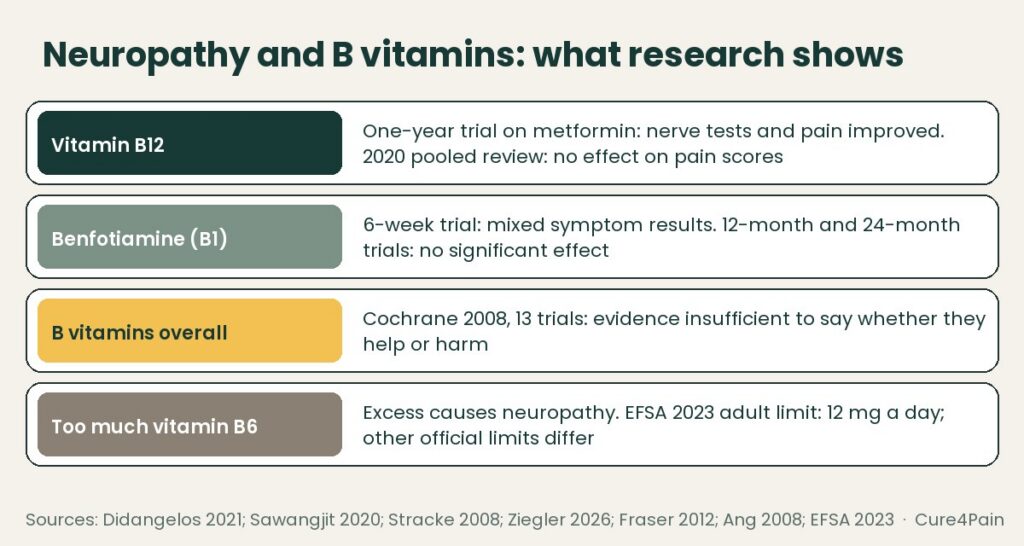
B vitamins for neuropathy have the clearest case when they correct a real shortage; beyond that, trials disagree. In a one-year double-blind trial of 90 people with type 2 diabetes on metformin, all with vitamin B12 below 400 pmol/L, oral B12 improved nerve conduction, pain and quality of life against placebo [1]. A 2020 meta-analysis of 15 trials found no effect of methylcobalamin, a form of B12, on pain scores, and most of those trials had a high risk of bias [2]. Benfotiamine, a form of vitamin B1, gave mixed symptom results in a 6-week trial [3], and double-blind trials of 12 months (57 people) [4] and 24 months (67 people with type 1 diabetes) [5] found no significant effect. A 2008 Cochrane review called the evidence insufficient to say whether vitamin B helps or harms [6]. Too much vitamin B6 can itself cause neuropathy, according to the European Food Safety Authority (EFSA), which set an adult upper limit of 12 mg a day in 2023 [7].

Scientific explainer videos in our Resources section
In our Resources section, our clinical team discusses vitamin D, its cofactors and how autoimmune, lifestyle and pain conditions develop.
Do vitamins B12 and B1 help neuropathy?
Vitamins B12 and B1 can help neuropathy when a shortage is part of the cause, but trials of giving them to people with neuropathy disagree. A 2021 meta-analysis in the European Journal of Neurology linked neuropathy with lower B12 and with higher levels of two B12 markers, methylmalonic acid and homocysteine, but said the trials have limitations and generally did not check vitamin levels before treatment [8].
- Vitamin B12 in the 2021 meta-analysis: across 4 trials, the link with better symptoms was not statistically significant [8].
- Vitamin B1 in the 2021 meta-analysis: across 3 trials, treatment was linked with better symptoms, with a very wide margin of uncertainty [8].
- Cochrane review (2008): 13 studies with 741 people with alcohol-related or diabetic neuropathy left the evidence insufficient to say whether vitamin B helps or harms; searches ended in 2005. Vitamin B was generally well tolerated, but in small short trials it did less well than alpha-lipoic acid, cilostazol or cytidine triphosphate [6].
Why do B12 and B1 run low in people with neuropathy?
Metformin, a diabetes medicine, is linked with low vitamin B12 [9], diabetes itself with low plasma thiamine (vitamin B1) [10], and weight-loss surgery was the commonest background in a 2025 review of nutritional neuropathy [11]. Low levels of B12 or other vitamins are a recognised cause of neuropathy, according to the NHS [12].
- Metformin and B12: in a 2019 meta-analysis of 31 studies, people with diabetes on metformin had about twice the risk of B12 deficiency, depending on dose and duration, but metformin use itself had no significant link with neuropathy [9]. In the US Diabetes Prevention Program, whose adults had raised glucose and overweight at entry, neuropathy was more common in metformin users with low B12 [13]. The first compared users with non-users and the second looked at low B12 among users, so neither settles whether low B12 from metformin causes neuropathy.
- Diabetes and B1: in a UK study of 74 people with diabetes and 20 healthy volunteers, plasma thiamine was about 75% lower in diabetes, and the kidneys cleared it 16 to 24 times faster [10].
- Surgery and poor intake: in a 2025 review of 83 people from high-income countries in hospital with sudden nutritional neuropathy not due to alcohol, 54% had low thiamine and 72% had had weight-loss surgery; it can look like Guillain-Barré syndrome [11].
Our articles on vitamin B12 deficiency and thiamine deficiency cover the symptoms, tests and foods.
Does vitamin B12 help neuropathy?
Vitamin B12 improved nerve tests and pain in a one-year double-blind trial of 90 people with type 2 diabetes on metformin, all with B12 below 400 pmol/L [1], but a 2020 meta-analysis of 15 trials in a wider group found no effect of methylcobalamin on pain scores [2].
- One-year trial: in this 2021 double-blind trial in people with type 2 diabetes on metformin, B12 levels rose and nerve conduction, vibration sense, pain and quality of life improved, while several of these worsened on placebo. Heart-related nerve tests and the examination score did not improve significantly. The trial dose was 1 mg of oral methylcobalamin a day [1]; this is a study fact, not a recommendation.
- Pooled trials: in a 2020 meta-analysis of 1,707 people with diabetic or herpetic neuropathy, methylcobalamin alone did better than active comparators on an overall rating of response, but not on pain or symptom scores, and 11 of 15 trials had a high risk of bias [2].
- Metformin users: a 2022 review of 7 trials with 506 people found B12 levels rose, but the effect on nerve symptoms was unclear: 2 studies showed improvement and 1 did not [14].
- Against a nerve pain medicine: in a 2009 single-blind trial of 100 people with painful diabetic neuropathy, injected B12 lowered pain scores more than nortriptyline (3.66 against 0.84 points), with no difference in nerve tests [15]. The trial had no placebo group.
Is methylcobalamin better than other forms of B12?
Trials do not settle this for neuropathy. A PubMed search in October 2026 found almost no trials comparing forms of B12 directly, and none that names cyanocobalamin as the comparison, so neither form is shown to be better. The one-year metformin trial used methylcobalamin [1].
How long does B12 take to help neuropathy, and does the damage recover?
No trial we read sets a timetable for how long vitamin B12 takes to help neuropathy, and recovery is not certain. Studies differ in what they measured and when: a trial of L-methylfolate, methylcobalamin and pyridoxal phosphate improved symptom scores at 16 and 24 weeks in 214 people with type 2 diabetes, but not vibration sense [16], and a one-year metformin trial of methylcobalamin reported its results at 12 months [1].
According to the NHS, nerve problems from B12 deficiency can sometimes last [17], which is why testing early matters. In the UK, the NHS refers people with numbness or tingling from low B12 to a blood specialist (haematologist), and they may need regular injections [18].
Does benfotiamine help diabetic neuropathy?
Benfotiamine, a form of vitamin B1, gave mixed symptom results in a 6-week trial of diabetic neuropathy [3], and double-blind, placebo-controlled trials of 12 months in type 2 diabetes [4] and 24 months in type 1 diabetes [5] found no significant effect. It was absorbed better than two other thiamine forms in a small study of 7 volunteers [19].
| Trial | Who and how long | Result |
|---|---|---|
| BENDIP 2008 [3] | 165 randomised, 133 analysed, 6 weeks | Symptom score significant only among those who completed the protocol (p=0.033), just short in the full group (p=0.055); total symptom score no different |
| Fraser 2012 [5] | 67 people with type 1 diabetes, 59 completed, 24 months | No significant difference in peripheral nerve function or inflammatory markers |
| BOND 2026 [4] | 57 people with type 2 diabetes and mild to moderate neuropathy, 12 months | No difference in corneal nerve fibres, nerve conduction, symptoms or quality of life; well tolerated |
Expert reviews disagree on benfotiamine. A 2023 review by Ziegler, the lead author of BOND, published before BOND’s results, listed benfotiamine among treatments with trial support [20], while a 2026 review by Ciubotaru and colleagues concluded that, outside documented thiamine deficiency, routine use cannot be recommended on current evidence [21]. BOND was small, so it could miss a small benefit, and several of its authors declared ties to the pharmaceutical company that sponsored it, three as its employees [4].
Does thiamine (vitamin B1) help neuropathy?
Thiamine (vitamin B1) is needed when levels are low, but neuropathy trials of plain thiamine are few and old, and the two below gave it with vitamin B6.
- Diabetes: in a 1997 Tanzanian trial of 200 people, thiamine with pyridoxine (vitamin B6) at 25 mg and 50 mg a day improved symptoms over 4 weeks far more than 1 mg of each: among people whose worst symptom was pain, it eased in 88.9% against 11.1%. Lower blood thiamine went with worse symptoms [22]. B6 was part of the treatment, so this trial cannot show the effect of B1 alone.
- Alcohol-related neuropathy: in an 8-week placebo-controlled trial of 84 outpatients, benfotiamine improved vibration sense, motor function and overall score [23]. In a 21-day trial of 303 people, thiamine with B6, benfotiamine with B6, and a nucleotide medicine all improved, with no clinically relevant difference; there was no placebo group [24]. A 2019 review called the data sparse but in favour of B vitamin regimens that include thiamine [25].
Do B vitamins help neuropathy from chemotherapy?
The evidence on B vitamins for neuropathy from chemotherapy conflicts. A 2024 review of 22 chemotherapy studies could not recommend any supplement, and results for vitamin B12 were conflicting [26]. In a 2017 pilot trial, an oral B group vitamin did not prevent neuropathy from chemotherapy on the doctor’s score, although patients reported fewer symptoms [27].
Plan any supplement during cancer treatment with your oncologist.
Can too much vitamin B6 cause neuropathy?
Yes. The European Food Safety Authority (EFSA) calls the link between excess vitamin B6 and peripheral neuropathy well established [7]. Vitamin B6 neuropathy mainly affects feeling rather than strength, and it usually follows supplement use, according to a 2023 systematic review [28].
- First reports: in 1983, seven adults taking high daily amounts developed severe loss of sensation and unsteady walking. Four were severely disabled; all improved after stopping [29].
- Lower amounts: a 1985 report described 16 people on 0.2 to 5 g a day, with symptoms appearing sooner at higher doses [30]. In a 1987 clinic series of 172 women with raised B6 levels, 60% had nerve symptoms at a mean of 117 mg a day. Women with and without symptoms took similar doses, but those with symptoms had taken it for longer (2.9 against 1.6 years), and recovery was complete within 6 months of stopping [31].
- After stopping: in a study of five volunteers given very high doses, symptoms kept worsening for 2 to 3 weeks after the last dose [32]. The NHS says the problem usually improves after stopping, but that in a few people who took large amounts, particularly for more than a few months, it may not [33].
Official adult limits for vitamin B6 range from 10 mg a day (NHS advice on supplements) to 100 mg a day (US Institute of Medicine 1998; WHO/FAO 2004), mainly because different bodies based them on different studies, according to EFSA [33] [7].
| Source | Adult limit |
|---|---|
| NHS (UK) | No more than 10 mg a day from supplements unless a doctor advises; 200 mg or more can cause neuropathy; 10 to 200 mg is unclear [33] |
| EFSA 2023 (Europe) | 12 mg a day from all dietary sources, food and supplements together [7] |
| NHMRC 2006 (Australia and New Zealand) | 50 mg a day, as listed by EFSA [7] |
| Institute of Medicine 1998 (US); WHO/FAO 2004 | 100 mg a day, as listed by EFSA [7] |
Studies also disagree on where harm begins. In 261 people with neuropathy of unknown cause, moderately raised blood B6 levels were not linked with worse neuropathy, although the authors said this does not show whether stopping supplements would help [34]. A systematic review found supplements at permitted daily doses have not been proven harmful in people who already have neuropathy; it also found no proof that B6 helps, because it has been studied only in combinations [28].
Two practical points: read the label of any B-complex or “nerve” supplement for its B6 content, and tell your doctor if numbness or tingling starts or worsens while you take one. If B6 was prescribed with the tuberculosis medicine isoniazid, do not stop it on your own: it is used there to prevent neuropathy in people at higher risk [35].
Should you take a B complex for neuropathy?
Test first rather than starting a B complex by default. A 2008 Cochrane review found the evidence insufficient to say whether vitamin B helps or harms [6], a 2021 meta-analysis found that trials generally did not check vitamin levels before treatment [8], and excess vitamin B6 can itself cause neuropathy [7]. The American Academy of Neurology’s 2009 practice parameter says the tests most likely to find an abnormality in polyneuropathy are blood glucose, serum B12 with its markers, and a blood protein test called immunofixation electrophoresis [36]. The UK medicines regulator (MHRA) advises checking B12 in people on metformin with new neuropathy and continuing metformin as long as it is tolerated and not contraindicated, while any deficiency is corrected [37].
How we use vitamins B12 and B1 for neuropathy at Cure4Pain
At Cure4Pain, we find and correct nutrient deficiencies as an add-on to your existing treatment, never instead of it.
- Test first: we read a panel of about 100 markers, adding tests for your condition when clinically indicated, such as vitamin B12 (with its markers when needed), thiamine, vitamin D and the American Academy of Neurology tests named above [36], read with your sugar and lipid results. Magnesium is judged from your overall clinical picture.
- Replenish what is low: mainly vitamin B12, thiamine, magnesium and a moderate, normal-range vitamin D, with omega-3 fatty acids. This is by mouth first, with injections only when specifically needed or advised; magnesium is mainly bisglycinate, with L-threonate or citrate as advised, counted as elemental magnesium. Vitamin B6 is case by case, within official limits [7]. Amounts are set for you from your reports, re-checked over time and adjusted.
- Medicines stay: medicines for diabetes, cholesterol and blood pressure are never stopped abruptly. Any change is made under clinical guidance from Team Cure4Pain, in coordination with your existing consulting physician and your diabetologist or cardiologist; never stop or change them on your own.
- The rest of the plan: diet, weight, activity, sleep and stress, with daily foot checks and safe exercise.
- What we do not use: we avoid acupuncture and dry needling in diabetic neuropathy, because numb feet heal poorly. The supervised vitamin D therapy we use for some other conditions is not part of our neuropathy care.
- Long term: in people with diabetes or high blood fats (dyslipidaemia), neuropathy is a lifelong condition that needs lifelong management, so levels are checked and topped up over the years.
This is our clinic practice; individual results vary, and further studies are needed. Read more on our neuropathy and nerve pain page.
If you would like your reports read and any deficiency corrected alongside your medicines, you can book a consultation, online from anywhere or at our Mumbai clinic.
Frequently asked questions
Which vitamin is best for neuropathy?
No vitamin is best for everyone. A one-year trial supports oral B12 in people on metformin with B12 below 400 pmol/L. Other trials generally did not check vitamin levels first, and their results disagree. [1] [8]
How much B12 should I take for neuropathy?
The NHS refers people with nerve symptoms from low B12 to a haematologist, and they may need regular injections. A one-year trial in people with type 2 diabetes on metformin used 1 mg of oral methylcobalamin a day, as a study dose. In a 2026 trial of 35 people with type 2 diabetes, neuropathy and low B12, 2 mg a day did no better than 1 mg on symptoms over 16 weeks; it had no placebo group. Your own amount depends on the cause and your blood test, so ask your doctor. [18] [1] [38]
How long does B12 take to work for neuropathy?
No trial we read sets a timetable. Symptom scores improved at 16 weeks in a trial combining methylcobalamin with L-methylfolate and pyridoxal phosphate, and a one-year trial of methylcobalamin reported its results at 12 months. [16] [1]
Can nerve damage from low B12 recover?
Sometimes. In a one-year trial of people with diabetic neuropathy on metformin, all with B12 below 400 pmol/L, nerve tests improved on oral B12. The NHS says nerve problems from B12 deficiency can sometimes last, so early testing matters. [1] [17]
Is benfotiamine better than thiamine for neuropathy?
Benfotiamine was absorbed better than two other thiamine forms in a study of 7 volunteers, but plain thiamine was not one of them, and better results are not proven. In a 21-day trial of 303 people with alcohol-related neuropathy, benfotiamine and thiamine, each given with vitamin B6, showed no clinically relevant difference. [19] [24]
Does vitamin B6 help neuropathy?
That vitamin B6 helps neuropathy is not confirmed. A 2023 systematic review found B6 has been studied only in combinations, while high levels can damage nerves. [28]
How much vitamin B6 is too much?
Official limits differ. The NHS advises no more than 10 mg a day from supplements unless a doctor advises, EFSA set 12 mg a day for adults from all dietary sources, and older US and WHO limits are 100 mg. [33] [7]
Can vitamin B6 neuropathy go away?
Vitamin B6 neuropathy usually improves after stopping, according to the NHS, but not in every case. In a 1987 clinic series, women taking a mean of 117 mg a day recovered within 6 months of stopping, and in a study of five volunteers on very high doses, symptoms kept worsening for 2 to 3 weeks after stopping. [33] [31] [32]
Should I stop metformin if I have neuropathy?
No. The UK medicines regulator advises correcting any B12 deficiency and continuing metformin as long as it is tolerated and not contraindicated. Speak to the doctor managing your diabetes. [37]
Can I take B1, B6 and B12 together?
Many trials tested these vitamins together, and a 2008 Cochrane review found vitamin B generally well tolerated, but check the B6 content against official limits, such as the 12 mg a day that the European Food Safety Authority set for adults, and take advice first. [6] [7]
This article is for education and does not replace medical advice. Do not start, stop or change any medicine or supplement without medical guidance.
References
1. Didangelos T, et al. Vitamin B12 Supplementation in Diabetic Neuropathy: A 1-Year, Randomized, Double-Blind, Placebo-Controlled Trial. Nutrients 2021;13(2). doi:10.3390/nu13020395
2. Sawangjit R, et al. Efficacy and Safety of Mecobalamin on Peripheral Neuropathy: A Systematic Review and Meta-Analysis of Randomized Controlled Trials. J Altern Complement Med 2020;26(12):1117-1129. doi:10.1089/acm.2020.0068
3. Stracke H, et al. Benfotiamine in diabetic polyneuropathy (BENDIP): results of a randomised, double blind, placebo-controlled clinical study. Exp Clin Endocrinol Diabetes 2008;116(10):600-5. doi:10.1055/s-2008-1065351
4. Ziegler D, et al. Effects of benfotiamine treatment over 12 months on morphometric, neurophysiological and clinical measures in type 2 diabetes patients with symptomatic polyneuropathy: a randomized, placebo-controlled, double-blind clinical trial (BOND study). BMJ Open Diabetes Res Care 2026;14(1). doi:10.1136/bmjdrc-2025-005773
5. Fraser DA, et al. The effects of long-term oral benfotiamine supplementation on peripheral nerve function and inflammatory markers in patients with type 1 diabetes: a 24-month, double-blind, randomized, placebo-controlled trial. Diabetes Care 2012;35(5):1095-7. doi:10.2337/dc11-1895
6. Ang CD, et al. Vitamin B for treating peripheral neuropathy. Cochrane Database Syst Rev 2008;2008(3):CD004573. doi:10.1002/14651858.CD004573.pub3
7. Turck D, et al. Scientific opinion on the tolerable upper intake level for vitamin B6. EFSA J 2023;21(5):e08006. doi:10.2903/j.efsa.2023.8006
8. Stein J, et al. Association between neuropathy and B-vitamins: A systematic review and meta-analysis. Eur J Neurol 2021;28(6):2054-2064. doi:10.1111/ene.14786
9. Yang W, et al. Associations between metformin use and vitamin B(12) levels, anemia, and neuropathy in patients with diabetes: a meta-analysis. J Diabetes 2019;11(9):729-743. doi:10.1111/1753-0407.12900
10. Thornalley PJ, et al. High prevalence of low plasma thiamine concentration in diabetes linked to a marker of vascular disease. Diabetologia 2007;50(10):2164-70. doi:10.1007/s00125-007-0771-4
11. Hansen KIT, et al. Acute non-alcoholic nutritional neuropathies in high-income countries – a systematic review. Dan Med J 2025;72(11). doi:10.61409/A05250359
12. NHS (UK National Health Service). Peripheral neuropathy: causes. nhs.uk/conditions/peripheral-neuropathy/causes
13. Aroda VR, et al. Long-term Metformin Use and Vitamin B12 Deficiency in the Diabetes Prevention Program Outcomes Study. J Clin Endocrinol Metab 2016;101(4):1754-61. doi:10.1210/jc.2015-3754
14. Pratama S, et al. The efficacy of vitamin B(12) supplementation for treating vitamin B(12) deficiency and peripheral neuropathy in metformin-treated type 2 diabetes mellitus patients: A systematic review. Diabetes Metab Syndr 2022;16(10):102634. doi:10.1016/j.dsx.2022.102634
15. Talaei A, et al. Vitamin B12 may be more effective than nortriptyline in improving painful diabetic neuropathy. Int J Food Sci Nutr 2009;60 Suppl 5:71-6. doi:10.1080/09637480802406153
16. Fonseca VA, et al. Metanx in type 2 diabetes with peripheral neuropathy: a randomized trial. Am J Med 2013;126(2):141-9. doi:10.1016/j.amjmed.2012.06.022
17. NHS (UK National Health Service). Vitamin B12 or folate deficiency anaemia: complications. nhs.uk/conditions/vitamin-b12-or-folate-deficiency-anaemia/complications
18. NHS (UK National Health Service). Vitamin B12 or folate deficiency anaemia: treatment. nhs.uk/conditions/vitamin-b12-or-folate-deficiency-anaemia/treatment
19. Greb A, Bitsch R. Comparative bioavailability of various thiamine derivatives after oral administration. Int J Clin Pharmacol Ther 1998;36(4):216-21. PubMed 9587048
20. Ziegler D. Pathogenetic treatments for diabetic peripheral neuropathy. Diabetes Res Clin Pract 2023;206 Suppl 1:110764. doi:10.1016/j.diabres.2023.110764
21. Ciubotaru A, et al. Alpha-Lipoic Acid and Benfotiamine in Diabetic Peripheral Neuropathy: A Critical Review of Mechanistic Rationale and Clinical Evidence Within a Nutritional Therapeutic Framework. Nutrients 2026;18(10). doi:10.3390/nu18101538
22. Abbas ZG, Swai AB. Evaluation of the efficacy of thiamine and pyridoxine in the treatment of symptomatic diabetic peripheral neuropathy. East Afr Med J 1997;74(12):803-8. PubMed 9557427
23. Woelk H, et al. Benfotiamine in treatment of alcoholic polyneuropathy: an 8-week randomized controlled study (BAP I Study). Alcohol Alcohol 1998;33(6):631-8. doi:10.1093/alcalc/33.6.631
24. Kretschmar C, et al. [Medicamentous therapy of alcoholic polyneuropathy. Randomized double-blind study comparing 2 vitamin B preparations and a nucleotide preparation]. Fortschr Med 1996;114(32):439-43. PubMed 9064269
25. Julian T, et al. Alcohol-related peripheral neuropathy: a systematic review and meta-analysis. J Neurol 2019;266(12):2907-2919. doi:10.1007/s00415-018-9123-1
26. Frediani JK, et al. The role of diet and non-pharmacologic supplements in the treatment of chronic neuropathic pain: A systematic review. Pain Pract 2024;24(1):186-210. doi:10.1111/papr.13291
27. Schloss JM, et al. A randomised, placebo-controlled trial assessing the efficacy of an oral B group vitamin in preventing the development of chemotherapy-induced peripheral neuropathy (CIPN). Support Care Cancer 2017;25(1):195-204. doi:10.1007/s00520-016-3404-y
28. Muhamad R, et al. The Role of Vitamin B6 in Peripheral Neuropathy: A Systematic Review. Nutrients 2023;15(13). doi:10.3390/nu15132823
29. Schaumburg H, et al. Sensory neuropathy from pyridoxine abuse. A new megavitamin syndrome. N Engl J Med 1983;309(8):445-8. doi:10.1056/NEJM198308253090801
30. Parry GJ, Bredesen DE. Sensory neuropathy with low-dose pyridoxine. Neurology 1985;35(10):1466-8. doi:10.1212/wnl.35.10.1466
31. Dalton K, Dalton MJ. Characteristics of pyridoxine overdose neuropathy syndrome. Acta Neurol Scand 1987;76(1):8-11. doi:10.1111/j.1600-0404.1987.tb03536.x
32. Berger AR, et al. Dose response, coasting, and differential fiber vulnerability in human toxic neuropathy: a prospective study of pyridoxine neurotoxicity. Neurology 1992;42(7):1367-70. doi:10.1212/wnl.42.7.1367
33. NHS (UK National Health Service). B vitamins and folic acid. nhs.uk/conditions/vitamins-and-minerals/vitamin-b
34. Stewart SL, et al. Vitamin B6 levels do not correlate with severity of neuropathy in chronic idiopathic axonal polyneuropathy. J Peripher Nerv Syst 2022;27(1):31-37. doi:10.1111/jns.12480
35. Snider DE Jr. Pyridoxine supplementation during isoniazid therapy. Tubercle 1980;61(4):191-6. doi:10.1016/0041-3879(80)90038-0
36. England JD, et al. Practice Parameter: evaluation of distal symmetric polyneuropathy: role of laboratory and genetic testing (an evidence-based review). Report of the American Academy of Neurology, American Association of Neuromuscular and Electrodiagnostic Medicine, and American Academy of Physical Medicine and Rehabilitation. Neurology 2009;72(2):185-92. doi:10.1212/01.wnl.0000336370.51010.a1
37. Medicines and Healthcare products Regulatory Agency (MHRA). Metformin and reduced vitamin B12 levels: new advice for monitoring patients at risk. Drug Safety Update, 2022. gov.uk/drug-safety-update
38. Mansour A, et al. Efficacy of Oral Vitamin B-12 at 1000 μg Compared with 2000 μg on Neuropathic Outcomes in Patients with Diabetic Peripheral Neuropathy and Low Serum Vitamin B-12: a Randomized Clinical Trial. J Nutr 2026;156(3):101368. doi:10.1016/j.tjnut.2026.101368

