Written by AT. Chintan Dalal, N.D. · Reviewed by Dr Krushal Pabari, Clinical Team, Cure4Pain · Updated 20 October 2026
Key facts
Cervical spondylosis is age-related wear of the neck’s discs and joints, and most people improve without surgery, according to a 2020 review in the New England Journal of Medicine [1]. No supplement has been shown to treat the wear itself. Vitamin D and B12 are worth testing: low vitamin D was common in two small studies of people with neck problems [2] [3], the US National Institutes of Health notes that low B12 causes nerve changes [4], and a case report describes B12 deficiency that looked like spinal cord pressure [5]. Turmeric, omega-3 and collagen have been studied in knees or inflammatory arthritis, not the neck [6] [7] [8]; a 2010 BMJ analysis found glucosamine of little benefit even in knees [9]. The best-studied options for neck pain, mostly with low- to moderate-certainty evidence, are exercise, yoga, hands-on therapy, acupuncture and dry needling [10] [11] [12] [13] [14]. Poor sleep predicts worse chronic pain [15], and pillow studies, though limited, favour the right height and shape [16] [17]. Clumsy hands, unsteady walking or bladder changes need a doctor first [18].

Scientific explainer videos in our Resources section
In our Resources section, our clinical team discusses vitamin D, its cofactors and how autoimmune, lifestyle and pain conditions develop.
Cervical spondylosis or spondylitis?
Cervical spondylosis is wear in the neck, while spondylitis is inflammation of the spine, and the two need different care.
- Cervical spondylosis is age-related wear of the discs and small joints of the neck. It is very common from middle age onwards and often causes neck pain and stiffness. When worn discs or bone spurs press on a nerve, pain, tingling or weakness can spread into the shoulder and arm (cervical radiculopathy) [1].
- Spondylitis means inflammation of the spine. Its best-known form, ankylosing spondylitis, is an immune-mediated inflammatory condition that usually starts in younger adults and needs different care.
Many people, especially in India, search for “spondylitis” remedies when they mean spondylosis. This article is about spondylosis and long-standing neck pain.
See a doctor first if you notice these signs
Some symptoms mean the spinal cord itself may be under pressure, and these need a medical assessment before any home remedy.
Warning signs: see a doctor urgently if you notice clumsy hands (dropping things, trouble with buttons or writing), unsteady walking, electric-shock feelings down the spine or limbs, new weakness, or new bladder or bowel problems. These can mean pressure on the spinal cord, which needs prompt specialist assessment [18].
According to a 2018 review in the BMJ, this kind of spinal cord pressure (degenerative cervical myelopathy) is often missed. In one hospital series it took on average 2.2 years and about five consultations to reach the diagnosis, and 43% of patients were first treated for carpal tunnel syndrome. Treatment within six months of symptoms gives the best chance of recovery, and forceful neck manipulation must be avoided [18].
Low vitamin B12 can cause similar problems. Doctors in Kolkata described a 42-year-old man whose leg weakness, numbness and bladder retention looked like spinal cord pressure; the cause was B12 deficiency, and he improved with B12 injections [5]. This is one reason we test before treating.
Supplements for cervical spondylosis: what the research shows
No supplement has been shown to treat cervical spondylosis itself; testing for a shortfall, especially of vitamin D or B12, and correcting it is a sensible first step, though trials in neck pain are still lacking.
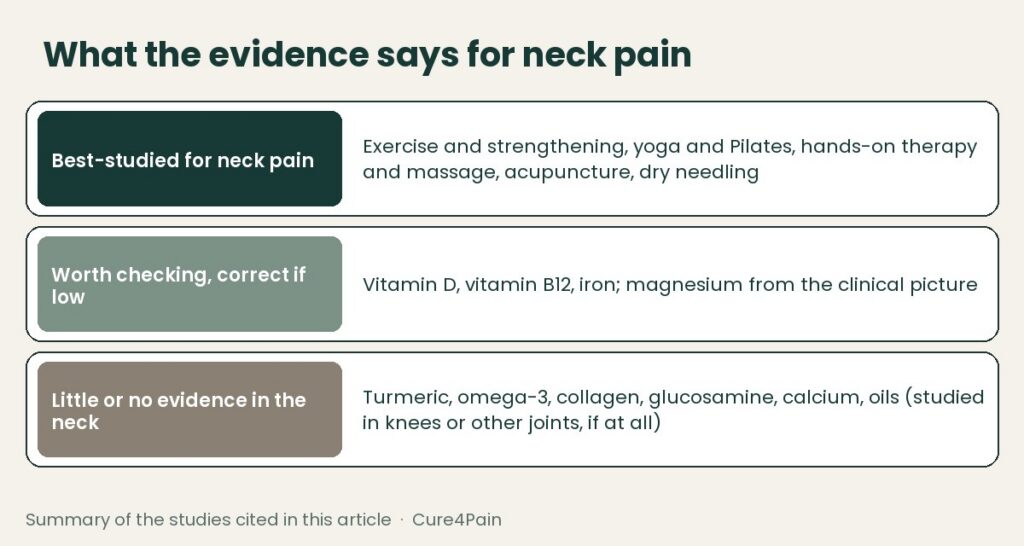
None of the supplements below has been tested in a trial of people with cervical spondylosis. Most of the research comes from knee and other joint arthritis, and the table shows where each piece of evidence comes from.
| Supplement | What studies show | Strength of evidence | Take care |
|---|---|---|---|
| Vitamin D | A 2016 review of 19 trials: in the 8 trials that measured change in pain, vitamin D lowered pain slightly more than placebo, more so in people who already had pain [19]. 54 people with chronic neck pain had lower vitamin D and ferritin (iron stores) than 54 without [2]; 71% of people having neck surgery for spinal cord pressure were low [3]. | Some, for chronic pain in general | More is not better: in 200 adults over 70, higher monthly doses did no better than the standard dose [20] |
| Vitamin B12 | Needed for healthy nerves; a shortfall causes tiredness and nerve changes [4], and in one case report it imitated spinal cord pressure [5]. | Clear for nerve health when levels are low | At risk: older adults, vegetarians, people with gut problems, and long-term use of acid-reducing medicines or metformin [4] |
| Magnesium | Needed for normal muscle and nerve function [21]. Covered in detail in our article on magnesium for neck pain. | Indirect, from other pain conditions | Kidney disease; amounts count elemental magnesium only [21] |
| Calcium | No study has tested calcium supplements in cervical spondylosis. Bone spurs are part of the wear process [1]; no study shows that extra calcium prevents or shrinks them. | None | Extra supplemental calcium might raise the risk of kidney stones [22] |
| Omega-3 (fish oil) | A 2007 analysis of 17 trials in rheumatoid arthritis, bowel-related joint pain and period pain: 3 to 4 months eased joint pain and stiffness and cut anti-inflammatory tablet use [7]. | Some, for inflammatory joint pain | High doses may lengthen bleeding time; take care with blood thinners [23] |
| Turmeric (curcumin) | A 2016 review of 8 small trials, mostly knee arthritis: less pain than placebo in 3, similar to pain medicine in 5; not enough for firm conclusions, said the authors [6]. | Low, mostly in knees | Rare but serious liver injury from turmeric supplements, some combined with black pepper extract [24] |
| Collagen | In 11 trials with 870 people with knee arthritis, collagen improved pain and function, but results varied widely between trials [8]. | Some, in knees | Discuss with your clinician before starting |
| Glucosamine and chondroitin | 10 large trials, 3,803 people with hip or knee arthritis: no clinically meaningful pain relief and no effect on joint narrowing; industry-funded trials showed bigger effects [9]. | Good evidence of little benefit, in hips and knees | The BMJ authors advised against new prescriptions [9] |
In plain words: test, then correct what is actually low. Supplements with no evidence in the neck are unlikely to change neck pain, and none of them rebuilds worn discs.
Test, do not guess: the shortfalls we look for
Testing shows what is actually low, so that only real shortfalls are corrected.
In our clinic, when we assess people with long-standing neck or back pain, we often find more than one shortfall: low vitamin D and magnesium, and at times low zinc or iron. Many of these people also have weak, poorly toned muscles around the neck and spine (low muscle tone), which gives the discs and joints less support. These are observations from our own practice, not a controlled study, and they do not show that these shortfalls cause spondylosis or spondylitis. They do match what published research has found:
- Vitamin D: across 30 randomized trials, vitamin D gave a small improvement in muscle strength, larger in people who started very low [25]. Across 19 trials, it lowered pain scores more than placebo in people with chronic pain [19].
- Zinc: people with chronic myofascial pain (painful muscle knots, common in the neck and shoulders) had lower zinc stores in their red blood cells than people without pain, and lower zinc went with a higher chance of pain [26].
- Iron: muscles need iron to make energy, and low iron reduces this capacity, shown mainly in laboratory work and in people with chronic illness [27]. In a randomized trial of 198 women with tiredness and low iron stores but no anaemia, iron supplements reduced fatigue [28].
Further studies are needed to know how much correcting these shortfalls helps neck pain itself. This is also why we assess before suggesting anything: more is not better, and too much zinc, for example, can lower copper and iron [29].
How much is safe? Official daily amounts
Official daily amounts are modest, and anything above them should only be taken after testing and under medical guidance.
According to the US National Institutes of Health, Office of Dietary Supplements, adults need the following [4] [21] [22] [30]:
| Nutrient | Adults need daily (from all sources) | Upper limit for adults |
|---|---|---|
| Vitamin D | 600 to 800 IU (15 to 20 mcg) | 4,000 IU (100 mcg) |
| Vitamin B12 | 2.4 to 2.8 mcg | None set |
| Calcium (elemental) | 1,000 to 1,200 mg | 2,000 to 2,500 mg |
| Magnesium (elemental) | 310 to 420 mg | 350 mg from supplements |
Calcium and magnesium amounts refer to the elemental mineral, not the weight of the whole compound printed on the label, and how much the body absorbs differs between forms [21] [22]. Your own amount, and whether you need a supplement at all, is set after a clinical assessment. According to the US National Institutes of Health, less than 1% of the body’s magnesium is in the blood, and blood (serum) levels do not accurately reflect total body magnesium [21], so we assess magnesium status from the overall clinical picture. Higher vitamin D amounts are used only under close medical supervision, as one therapy among several, for example in the Coimbra Protocol.
Take care if: your kidneys are not working fully (magnesium and calcium) [21] [22]; you take blood thinners (high-dose omega-3) [23]; you have liver problems (turmeric supplements) [24]; or you take acid-reducing medicines or metformin long term (check B12) [4].
Do not start, stop or change any medicine or supplement without medical guidance.
Diet for cervical spondylosis: what to eat
There is no special diet for cervical spondylosis, but a whole-food diet can help chronic pain in general.
A 2021 review of 43 studies in people with chronic pain found that whole-food diets reduced pain overall, with no single diet standing out; diet quality, nutrient density and weight loss may be what matter [31].
- Build meals on: vegetables and fruit, dals and beans, whole grains and millets such as ragi, nuts and seeds, curd, and fish or eggs if you eat them.
- Limit: highly processed, sugary and fried foods.
- Foods to avoid: no single food has been shown to worsen cervical spondylosis. Daily habits are a more useful target: in a 2023 review of 30 studies in 18,395 college students, neck pain was linked with wrong pillow use, poor sitting posture, long periods with the head bent forward, lack of exercise, staying up late, long screen time and stress. These studies show links, not causes, and were in young adults rather than people with spondylosis [32].
Oils, massage and heat: what helps
No oil has been shown to work better than another; the massage and warmth are what help.
A 2025 review of 101 trials (7,633 people with neck pain) found that manual therapy, soft-tissue work (massage and myofascial techniques) and mobilisation reduced neck pain compared with no treatment, with combinations working best; many trials had a high risk of bias, so certainty is moderate to very low [12]. A 2024 review of 18 trials found yoga combined with heat (hot sand packs) ranked best for chronic neck pain [11].
- Ayurvedic oils: the only randomized trial we found in cervical spondylosis was small, from one centre in Kerala: adding a medicated nasal-oil therapy (nasya) to herbal decoctions helped more than the decoctions alone [33]. No trial compares massage oils.
- Practical use: any oil you like suits a gentle massage; test it on a small patch of skin first.
- Heat or ice? For long-standing stiffness, warmth is the option with research behind it: yoga combined with heat ranked best in the 2024 review [11]. A warm pack or shower before exercise is a simple way to use it.
- Avoid forceful neck cracking, and avoid any manipulation if you have the warning signs above [18].
Home remedies with real evidence: exercise and posture
Regular strengthening and movement are the home remedies with the strongest evidence for long-standing neck pain.
A 2015 Cochrane review of 27 trials (2,485 people) found that strengthening exercises for the neck, shoulders and upper back reduced chronic neck pain, with moderate-certainty evidence, while stretching alone may not help [10]. A 2020 analysis of 40 trials found motor-control exercise, yoga, Pilates, tai chi, qigong and strengthening helped about equally, with very low-certainty evidence [34]. Most of the exercise and treatment reviews in this article studied long-standing neck pain in general (often called non-specific or mechanical neck pain), not cervical spondylosis specifically [10] [11] [34] [35].
- A simple start: gentle chin tucks, shoulder blade squeezes, slow neck turns within comfort, and rowing movements with a light resistance band, a few minutes once or twice a day.
- Desk and screen habits: screen at eye level, phone held up rather than looking down, and a short movement break every 30 to 45 minutes [32].
- Stop and get checked if arm pain, tingling or weakness gets worse during or after exercise.
Sleep and the right pillow
A pillow that keeps your neck level with your spine, and enough good sleep, both help neck pain.
A 2021 review of 9 good-quality studies (555 people) found that latex (rubber) and spring pillows reduced neck pain, waking pain and disability, and that the shape and height of the pillow mattered more than the material for neck alignment [16]. A newer 2025 review of 5 studies (239 people) found only limited evidence and no pillow type clearly better [17]. In practice, the right height keeps your head in line with your spine, which usually means a higher pillow for side sleeping and a lower one for back sleeping.
Sleep matters as much as the pillow: according to a 2013 review in the Journal of Pain, poor sleep reliably predicts new and worsening chronic pain and weakens the body’s own pain control [15].
Natural treatments in the clinic: dry needling, acupuncture and myofascial release
Dry needling, acupuncture and myofascial release are among the best-studied natural treatments for neck pain, although most of the evidence is of low to moderate certainty.
- Dry needling of tight muscle knots in the neck and upper back improves pain and disability in the short term, with low- to moderate-certainty evidence [14].
- Acupuncture, in an analysis of 39 trials and 20,827 patients with chronic pain (including non-specific musculoskeletal pain such as neck pain), did better than sham and no acupuncture, and most of the effect lasted at one year, with only about a 15% decrease [13].
- Myofascial release and other hands-on care reduced neck pain in the 2025 review of 101 trials [12].
- Combined care: a 2022 review of 119 trials (12,496 people with long-standing neck pain) found that combined non-drug care, such as exercise with manual therapy, reduced pain and disability for up to 3 to 6 months compared with inactive treatment, while anti-inflammatory tablets did not; the evidence was of low to very low certainty [35].
Read more on our Neck Pain & Cervical Spondylosis page.
Will cervical spondylosis go away with natural treatment?
The wear itself does not undo itself, but pain and stiffness often settle well with the right care.
Disc and joint wear is part of ageing for most people, and most people with cervical spondylosis improve without surgery [1]. In long-standing neck pain, combined exercise and hands-on care reduced pain and disability for up to 3 to 6 months, though the evidence was of low to very low certainty [35]. How much each person improves varies, and no remedy, natural or otherwise, can promise a fixed result.
How we approach cervical spondylosis at Cure4Pain
We start with testing and then treat the neck, the muscles and the nutrition together. We look at your symptoms, posture, sleep, diet and blood tests (including vitamin D, B12, iron stores, and kidney and liver function), assess magnesium from the overall clinical picture, correct what is low through functional nutrition, and recheck. The neck itself is treated with dry needling, myofascial release, acupuncture and naturopathy, with exercises you can continue at home. All of this happens under clinical guidance from Team Cure4Pain, who review your medicines and supplements together, including how they interact, in coordination with your existing consulting physician.
See all our care for musculoskeletal and pain conditions.
If you would like your supplements, diet and the rest of your plan checked properly, you can book a consultation, online from anywhere or at our Mumbai clinic.
Frequently asked questions
What supplements help cervical spondylosis?
No supplement has been shown to treat cervical spondylosis itself. Testing for vitamin D, vitamin B12 and iron, assessing magnesium from the overall clinical picture, and correcting only what is low, makes sense as one part of a wider plan. A 2015 Cochrane review and other large reviews show that exercise, acupuncture and dry needling have stronger evidence for neck pain than any supplement [10] [13] [14].
Which vitamin is best for cervical spondylosis?
Vitamin D and vitamin B12 matter most, but only when you are low. A 2016 review of 19 trials found that vitamin D lowered pain slightly more than placebo [19], and the US National Institutes of Health notes that low B12 causes nerve changes [4]. More is not better: in adults over 70, higher vitamin D doses did no better than the standard dose [20].
Is vitamin B12 good for cervical spondylosis?
Vitamin B12 is essential for healthy nerves. The US National Institutes of Health lists older adults, vegetarians and people taking acid-reducing medicines or metformin long term as more likely to be low [4]. A low level can even cause symptoms that look like spinal cord pressure [5]. No trial has tested B12 for neck pain in people whose levels are normal.
Do calcium or collagen supplements help cervical spondylosis?
No study has tested calcium supplements in cervical spondylosis, and the US National Institutes of Health notes that extra supplemental calcium might raise the risk of kidney stones [22]. Collagen improved pain in 11 trials in people with knee arthritis, though results varied widely between trials [8]. Neither has been studied in the neck, so neither is a proven neck treatment.
Does turmeric help neck pain, and is it safe?
A 2016 review of 8 small trials, mostly in knee arthritis, found that turmeric eased joint pain more than placebo, but the authors said the evidence was not enough for firm conclusions [6]. It has not been tested in neck pain. Turmeric supplements have caused rare but serious liver injury, so do not start them without medical guidance [24].
Is omega-3 or glucosamine good for cervical spondylosis?
Neither has been tested in cervical spondylosis. A 2007 analysis of 17 trials found that omega-3 eased joint pain and stiffness in inflammatory conditions such as rheumatoid arthritis [7], which differ from neck wear. A 2010 BMJ analysis of 10 large trials in 3,803 people found that glucosamine and chondroitin gave no meaningful pain relief even in hip and knee arthritis [9].
Which oil is best for cervical spondylosis?
No oil has been shown to work better than another for cervical spondylosis. A 2025 review of 101 trials found that massage and other hands-on treatments eased neck pain [12], so the massage and warmth seem to matter more than the oil. The only ayurvedic trial we found was small and used a nasal oil therapy alongside herbal medicines [33].
What foods should I eat or avoid with cervical spondylosis?
There is no special diet for cervical spondylosis. A 2021 review of 43 studies found that whole-food diets reduced chronic pain, with no single diet standing out [31]. Build meals on vegetables, fruit, dals, whole grains, nuts and seeds, and limit highly processed, sugary and fried foods. No single food has been shown to worsen the neck.
Will cervical spondylosis go away with natural treatment?
The wear in the discs and joints does not undo itself, but according to a 2020 review in the New England Journal of Medicine most people improve without surgery [1]. In long-standing neck pain, combined exercise and hands-on care reduced pain and disability for up to 3 to 6 months, though with low-certainty evidence [35]. How much each person improves varies, and warning signs always need a doctor.
This article is for education and does not replace medical advice. Do not start, stop or change any medicine or supplement without medical guidance.
References
1. Theodore N. Degenerative cervical spondylosis. N Engl J Med 2020;383(2):159-168. doi:10.1056/NEJMra2003558
2. Eloqayli H, Al-Yousef A, Jaradat R. Vitamin D and ferritin correlation with chronic neck pain using standard statistics and a novel artificial neural network prediction model. Br J Neurosurg 2018;32(2):172-176. doi:10.1080/02688697.2018.1436691
3. Ravindra VM, Guan J, Holland CM, et al. Vitamin D status in cervical spondylotic myelopathy: comparison of fusion rates and patient outcome measures. J Neurosurg Sci 2019;63(1):36-41. doi:10.23736/S0390-5616.16.03846-7
4. National Institutes of Health, Office of Dietary Supplements. Vitamin B12: Fact Sheet for Health Professionals. ods.od.nih.gov/factsheets/VitaminB12-HealthProfessional
5. Das S, Dubey S, Pandit A, Ray BK. Myeloradiculoneuropathy due to vitamin B12 deficiency: an unusual clinical and radiological presentation. BMJ Case Rep 2021;14(1):e239415. doi:10.1136/bcr-2020-239415
6. Daily JW, Yang M, Park S. Efficacy of turmeric extracts and curcumin for alleviating the symptoms of joint arthritis: a systematic review and meta-analysis of randomized clinical trials. J Med Food 2016;19(8):717-729. doi:10.1089/jmf.2016.3705
7. Goldberg RJ, Katz J. A meta-analysis of the analgesic effects of omega-3 polyunsaturated fatty acid supplementation for inflammatory joint pain. Pain 2007;129(1-2):210-223. doi:10.1016/j.pain.2007.01.020
8. Simental-Mendía M, Ortega-Mata D, Acosta-Olivo CA, et al. Effect of collagen supplementation on knee osteoarthritis: an updated systematic review and meta-analysis of randomised controlled trials. Clin Exp Rheumatol 2025;43(1):126-134. doi:10.55563/clinexprheumatol/kflfr5
9. Wandel S, Jüni P, Tendal B, et al. Effects of glucosamine, chondroitin, or placebo in patients with osteoarthritis of hip or knee: network meta-analysis. BMJ 2010;341:c4675. doi:10.1136/bmj.c4675
10. Gross A, Kay TM, Paquin JP, et al. Exercises for mechanical neck disorders. Cochrane Database Syst Rev 2015;1:CD004250. doi:10.1002/14651858.CD004250.pub5
11. Gao Q, Li X, Pan M, et al. Comparative efficacy of mind-body exercise for treating chronic non-specific neck pain: a systematic review and network meta-analysis. Curr Pain Headache Rep 2024;28(6):507-523. doi:10.1007/s11916-024-01218-6
12. Gong Z, Liu W, Gao Y, et al. Effectiveness of musculoskeletal manipulations in patients with neck pain: a systematic review and network meta-analysis. BMJ Open 2025;15(10):e098682. doi:10.1136/bmjopen-2024-098682
13. Vickers AJ, Vertosick EA, Lewith G, et al. Acupuncture for chronic pain: update of an individual patient data meta-analysis. J Pain 2018;19(5):455-474. doi:10.1016/j.jpain.2017.11.005
14. Navarro-Santana MJ, Sanchez-Infante J, Fernández-de-las-Peñas C, et al. Effectiveness of dry needling for myofascial trigger points associated with neck pain symptoms: an updated systematic review and meta-analysis. J Clin Med 2020;9(10):3300. doi:10.3390/jcm9103300
15. Finan PH, Goodin BR, Smith MT. The association of sleep and pain: an update and a path forward. J Pain 2013;14(12):1539-1552. doi:10.1016/j.jpain.2013.08.007
16. Chun-Yiu JP, Man-Ha ST, Chak-Lun AF. The effects of pillow designs on neck pain, waking symptoms, neck disability, sleep quality and spinal alignment in adults: a systematic review and meta-analysis. Clin Biomech 2021;85:105353. doi:10.1016/j.clinbiomech.2021.105353
17. Ghosh S, Goyal M, Goyal K. Effect of pillow on pain, disability and sleep quality in patients with chronic neck pain: a systematic review. Rehabilitacion (Madr) 2025;59(3):100922. doi:10.1016/j.rh.2025.100922
18. Davies BM, Mowforth OD, Smith EK, Kotter MR. Degenerative cervical myelopathy. BMJ 2018;360:k186. doi:10.1136/bmj.k186
19. Wu Z, Malihi Z, Stewart AW, et al. Effect of vitamin D supplementation on pain: a systematic review and meta-analysis. Pain Physician 2016;19(7):415-427. PubMed 27676659
20. Schlögl M, Chocano-Bedoya P, Dawson-Hughes B, et al. Effect of monthly vitamin D on chronic pain among community-dwelling seniors: a randomized, double-blind controlled trial. J Am Med Dir Assoc 2019;20(3):356-361. doi:10.1016/j.jamda.2018.09.004
21. National Institutes of Health, Office of Dietary Supplements. Magnesium: Fact Sheet for Health Professionals. ods.od.nih.gov/factsheets/Magnesium-HealthProfessional
22. National Institutes of Health, Office of Dietary Supplements. Calcium: Fact Sheet for Health Professionals. ods.od.nih.gov/factsheets/Calcium-HealthProfessional
23. National Institutes of Health, Office of Dietary Supplements. Omega-3 Fatty Acids: Fact Sheet for Health Professionals. ods.od.nih.gov/factsheets/Omega3FattyAcids-HealthProfessional
24. Halegoua-DeMarzio D, Navarro V, Ahmad J, et al. Liver injury associated with turmeric, a growing problem: ten cases from the Drug-Induced Liver Injury Network [DILIN]. Am J Med 2023;136(2):200-206. doi:10.1016/j.amjmed.2022.09.026
25. Beaudart C, Buckinx F, Rabenda V, et al. The effects of vitamin D on skeletal muscle strength, muscle mass, and muscle power: a systematic review and meta-analysis of randomized controlled trials. J Clin Endocrinol Metab 2014;99(11):4336-4345. doi:10.1210/jc.2014-1742
26. Barros-Neto JA, Souza-Machado A, Kraychete DC, et al. Selenium and zinc status in chronic myofascial pain: serum and erythrocyte concentrations and food intake. PLoS One 2016;11(10):e0164302. doi:10.1371/journal.pone.0164302
27. Dziegala M, Josiak K, Kasztura M, et al. Iron deficiency as energetic insult to skeletal muscle in chronic diseases. J Cachexia Sarcopenia Muscle 2018;9(5):802-815. doi:10.1002/jcsm.12314
28. Vaucher P, Druais PL, Waldvogel S, Favrat B. Effect of iron supplementation on fatigue in nonanemic menstruating women with low ferritin: a randomized controlled trial. CMAJ 2012;184(11):1247-1254. doi:10.1503/cmaj.110950
29. Stiles LI, Ferrao K, Mehta KJ. Role of zinc in health and disease. Clin Exp Med 2024;24(1):38. doi:10.1007/s10238-024-01302-6
30. National Institutes of Health, Office of Dietary Supplements. Vitamin D: Fact Sheet for Health Professionals. ods.od.nih.gov/factsheets/VitaminD-HealthProfessional
31. Field R, Pourkazemi F, Turton J, Rooney K. Dietary interventions are beneficial for patients with chronic pain: a systematic review with meta-analysis. Pain Med 2021;22(3):694-714. doi:10.1093/pm/pnaa378
32. Gao Y, Chen Z, Chen S, Wang S, Lin J. Risk factors for neck pain in college students: a systematic review and meta-analysis. BMC Public Health 2023;23(1):1502. doi:10.1186/s12889-023-16212-7
33. Radhika C, Kumar GV, Mihirjan K. A randomized controlled clinical trial to assess the efficacy of Nasya in reducing the signs and symptoms of cervical spondylosis. Ayu 2012;33(1):73-77. doi:10.4103/0974-8520.100316
34. de Zoete RMJ, Armfield NR, McAuley JH, Chen K, Sterling M. Comparative effectiveness of physical exercise interventions for chronic non-specific neck pain: a systematic review with network meta-analysis of 40 randomised controlled trials. Br J Sports Med 2020 (published online 2 November). doi:10.1136/bjsports-2020-102664
35. Castellini G, Pillastrini P, Vanti C, et al. Some conservative interventions are more effective than others for people with chronic non-specific neck pain: a systematic review and network meta-analysis. J Physiother 2022;68(4):244-254. doi:10.1016/j.jphys.2022.09.007