Written by AT. Chintan Dalal, N.D. · Reviewed by Dr Krushal Pabari, Clinical Team, Cure4Pain · Updated 30 October 2026
Key facts
Appropriately planned vegetarian and vegan diets can be nutritionally adequate and offer long-term health benefits for adults who are not pregnant or breastfeeding, according to a 2025 position paper of the Academy of Nutrition and Dietetics [1]. A 2021 review of 141 studies found that intake and status of vitamin B12, vitamin D, iron, zinc, iodine and calcium were generally lower than in meat-eaters, and that all diets, including meat-based ones, had gaps [2]. In the Indian Migration Study of 6,555 adults, a food questionnaire showed vegetarian diets meeting recommended dietary allowances overall, with vitamin B12 the main concern [3]. We found no guideline that sets a test list for these diets; a reasonable first step is to discuss vitamin B12, ferritin with a blood count, and vitamin D with your doctor. Some tests have firm limits: according to the US National Institutes of Health, spot urine iodine cannot diagnose one person [4] and serum magnesium does not accurately reflect the body’s magnesium [5].

Scientific explainer videos in our Resources section
In our Resources section, our clinical team discusses vitamin D, its cofactors and how autoimmune, lifestyle and pain conditions develop.
Which deficiencies do vegetarians and vegans commonly have?
Vegetarians and vegans generally have lower intake and status of vitamin B12, vitamin D, iron, zinc, iodine and calcium than meat-eaters, and take in less of the omega-3 fats EPA and DHA, according to a 2021 systematic review of 141 studies in Nutrients; both authors work for a company that markets fortified foods and supplements [2]. Its main patterns were:
- Lower in plant-based diets: intake and status of vitamin B12, vitamin D, iron, zinc, iodine and calcium, and intake of EPA and DHA.
- Lowest in vegans: vitamin B12, calcium and iodine intake, with lower iodine status and bone density.
- Higher in plant-based diets: fibre, folate, vitamins C and E, and magnesium intake.
- Meat-eaters have gaps too: a risk of inadequate fibre, folate, vitamin D, vitamin E, calcium and magnesium.
A lower average is not a deficiency in you, which is why testing is more useful than assuming. The NHS says that with good planning a vegan diet can provide all the nutrients the body needs [6].
What do Indian studies show about vegetarian deficiencies?
According to the Indian Migration Study of 6,555 adults, Indian vegetarian diets met recommended dietary allowances overall, with vitamin B12 the main concern [3]. Other Indian studies found no difference in ferritin deficiency between vegetarians and non-vegetarians [7] and low serum zinc in a mostly non-vegetarian group [8]. These studies are local and use different cut-offs.
| Study | Who | Finding |
|---|---|---|
| Indian Migration Study, 2014 [3] | 6,555 adults in four cities; 32.8% vegetarian; food questionnaire, not blood tests | Vegetarians took in less than non-vegetarians: 6.4 g a day less protein, 1.4 mcg less B12 and 0.6 mg less zinc; more vitamin C and folate |
| Blood donors, 2025 [7] | 1,722 healthy voluntary donors | B12 deficiency higher in vegetarians, folate deficiency higher in non-vegetarians, no difference in ferritin deficiency, in a group where regular donation is itself linked to low iron |
| Nagpur area, 2014 [8] | 109 rural and tribal women; 72% non-vegetarian | 52% had low serum zinc, attributed to low energy intake and poor zinc availability |
| Bengaluru, 2025 [9] | 1,023 pregnant women; 332 vegetarian | Vegetarians and omnivores had similar fatty acid profiles; omega-3 levels in both were less than half those of Australian women |
The diet label alone does not predict your results. We found no large Indian study that tested all of these nutrients together, and very little Indian data on vegans.
Which blood tests should vegetarians and vegans ask for?
Vitamin B12, a full blood count with ferritin, and vitamin D are reasonable first tests for vegetarians and vegans to discuss with a doctor, although we found no guideline that sets a test list for these diets. The UK’s NICE guideline (NG239, 2024) lists diets low in animal-source foods as a risk factor for low B12 [10], and the US National Institutes of Health reports a 1.8 times higher iron requirement on vegetarian diets [11] and more low vitamin D with ovo-vegetarian and vegan diets [12].
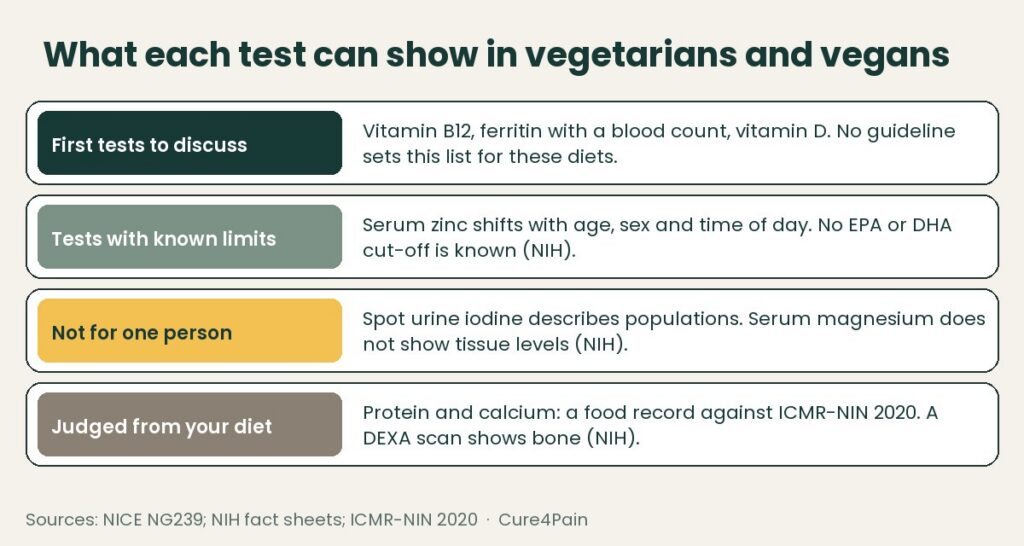
Add other tests according to your diet, symptoms and medicines, and ask what each result can and cannot show. For vitamin D, the Endocrine Society (2024) suggests against routine testing in the general population without an established reason, and the US Preventive Services Task Force (2021) finds the evidence insufficient for adults without symptoms [13] [14].
| Test | What it checks | Its limit |
|---|---|---|
| Vitamin B12 (total or active) | B12 in the blood; methylmalonic acid or homocysteine may be added if unclear | Supplements can raise the result without fully treating a deficiency, so test before starting them [10] |
| Blood count and ferritin | Anaemia and iron stores | Haemoglobin is neither sensitive nor specific for low iron, and ferritin can be affected by inflammation [11] |
| Vitamin D (25-hydroxy) | The main marker of vitamin D status | The level that defines deficiency has not been definitively identified [12] |
| Serum zinc | Zinc in the blood | Affected by age, sex, time of day and infection, and does not always match intake [15] |
| Omega-3 index | EPA and DHA in red blood cells, a stand-in for tissue levels | No known cut-off below which function is impaired [16] |
| Spot urine iodine | Recent iodine intake | Suitable for populations, not for diagnosing one person; repeated samples are more accurate [4] |
| DEXA bone scan | Long-term calcium status in bone | Shows cumulative status over a lifetime; a serum calcium test is not a good reflection of calcium status [17] |
| Serum magnesium | Magnesium in the blood only | Does not show total body or tissue levels [5] |
We found no guideline that sets a blood test for protein intake; it is judged from a food record and your weight. Our article on blood tests for chronic pain and fatigue explains how to discuss a wider list with your doctor.
Do vegetarians need a vitamin B12 test?
A vitamin B12 test is often useful for vegetarians, especially vegans and anyone who eats little dairy or few eggs [18], and more so with symptoms. According to the US National Institutes of Health, natural food sources of B12 are limited to animal foods, and fortified foods and supplements can substantially reduce the risk of deficiency [19]. The UK’s NICE guideline (NG239, 2024) advises offering a test to people with at least one common symptom and at least one risk factor. It lists diets low in animal-source foods, where B12 preparations are not used regularly, as a risk factor, and reminds doctors that a vegetarian or vegan diet may not be the cause, or the only cause, of a deficiency [10].
- In India: a 2020 review of 14 studies in healthy adults found deficiency reaching 78.5% on varying cut-offs, higher in vegetarians, and warned that mixed methods make clear conclusions difficult [20].
Symptoms, cut-offs and treatment are in our article on vitamin B12 deficiency. If tingling or numbness in the feet is your main concern, see our neuropathy page.
Are vegetarians low in iron?
Vegetarians tend to have lower iron stores, which does not always mean anaemia. A 2018 meta-analysis of 24 cross-sectional studies found ferritin about 30 µg/L lower in adult vegetarians than in non-vegetarians; its authors also note that high iron stores are a risk factor for conditions such as type 2 diabetes, and advise vegetarians and non-vegetarians alike to check their iron status [21]. According to the US National Institutes of Health, about 5% to 12% of iron is absorbed from vegetarian diets, and the requirement for vegetarians is 1.8 times higher [11]. The NHS advises eating foods with vitamin C at the same time and avoiding tea or coffee during or after main meals [6]. Cut-offs and tests are in our article on iron deficiency without anaemia.
Do vegetarians lack zinc?
Vegetarians usually have lower zinc intake and lower serum zinc levels, according to the US National Institutes of Health, which says phytates in beans, nuts and whole grains inhibit absorption [15]. A 2013 meta-analysis found vegetarians had lower zinc intake (by 0.88 mg a day) and lower serum zinc (by 0.93 µmol/L), with larger differences in women, vegans and people in developing countries [22].
- In India: the Comprehensive National Nutrition Survey (CNNS, 2016 to 2018) found low serum zinc in 31.1% of adolescents of all diets [23].
- Food preparation: the NIH says that soaking beans, grains and seeds for several hours before cooking, and fermented foods, may improve zinc absorption [15]. In Indian cooking this fits soaked dal, sprouts and fermented batters.
Are vegetarians low in omega-3?
Vegetarians and vegans take in less of the omega-3 fats EPA and DHA than meat-eaters [2], although blood levels differ less than intake suggests. In the UK’s EPIC-Norfolk study, omega-3 intake in non-fish-eaters was 57% to 80% of that in fish-eaters, but status differences were smaller than expected [24]. Plants provide ALA (alpha-linolenic acid), and according to the US National Institutes of Health its conversion to EPA and DHA is very limited, at less than 15% [16].
- In India: a 2016 review describes Indian diets as very low in omega-3 fats [25]. In Bengaluru, pregnant vegetarians and omnivores had similar levels [9].
- Algal oil: a 2017 systematic review of four randomised trials and two cohort studies found that algal DHA raised DHA levels in vegetarians and vegans [26]. We found no trial showing a health outcome from this in vegetarians, and the review’s authors call for such studies.
More detail is in our article on omega-3 fatty acids.
Do vegans in India need to worry about iodine?
Iodine matters most for vegans in India who do not use iodised salt. A 2023 meta-analysis of 11 studies with 4,421 adults found the lowest iodine intake in vegans, influenced by whether a country has a universal salt iodisation programme [27]. Universal salt iodisation is mandatory in India [28]. We found no Indian study of iodine status in vegans.
- Indian survey: the India Iodine Survey (2018 to 2019) found adequately iodised salt in 76.3% of 21,406 households, and a median urine iodine of 178 µg/L in non-pregnant, non-lactating women, within the WHO adequate range [28]. The National Iodine and Salt Intake Survey (2014 to 2015) found adequately iodised salt less often in homes using non-packaged and non-refined salt [29].
- Too much is also a problem: according to the NIH, high intakes can cause goitre, raised TSH and hypothyroidism, and the adult upper limit is 1,100 mcg a day [4]. If you have a thyroid condition, discuss iodine first; see our hypothyroidism page.
Do vegetarians get enough calcium?
In the UK, the NHS says most vegetarians who eat dairy usually get enough calcium [18]. Vegans have the lowest intake [2], and low intake is also reported in Indian adults. In a 2024 study of 291 healthy adults in Chandigarh, mean intake was 392.6 mg a day, and only 21.3% exceeded the older Indian allowance of 600 mg [30].
Bone results need careful reading. A 2019 meta-analysis found lower bone density in vegetarians and vegans than in omnivores, and concluded that these diets should be planned with bone health in mind [31]. In the UK EPIC-Oxford study, hip fractures over 10 years were higher than in meat eaters by 2.9 per 1,000 fish eaters, 2.9 per 1,000 vegetarians and 14.9 per 1,000 vegans, and the links looked stronger before allowing for body mass index [32]. A 2026 meta-analysis of 4 cohorts rated its pooled evidence low certainty for vegetarians and very low for vegans [33]. These are associations, and we found no such study in India. See our osteoporosis page.
Is low vitamin D caused by a vegetarian diet?
A vegetarian diet is only part of the picture for low vitamin D, because sunlight is the other main source. According to the US National Institutes of Health, low vitamin D is more common with ovo-vegetarian and vegan diets [12]. In the UK’s EPIC-Oxford study of 2,107 white adults, mean levels were 77.0 nmol/L in meat eaters and 55.8 nmol/L in vegans, and the gap was 20% in summer against 38% in winter [34].
Low vitamin D is common among Indian adults generally. In a 2007 study of 1,148 healthy South Indians, 62% to 75% of urban adults and 44% to 70% of rural adults were below 20 ng/mL [35]. We found no large Indian study comparing levels by diet.
Vegans should read supplement labels, because some vitamin D is of animal origin, according to the NHS [6]. Testing, sun and doses are in our article on vitamin D deficiency in India.
Do vegetarians get enough protein?
Most vegetarians usually have enough protein, according to the UK’s NHS [18], and pulses or dairy alongside cereals improve its quality [36]. A 2021 review of 141 studies found vegetarian and vegan intake lower than in meat-eaters but well within recommended levels [2]. The question in India is quality more than quantity:
- Cereals: Indian diets as a whole, not only vegetarian ones, derive almost 60% of protein from cereals, which have relatively low digestibility and quality [37]. National household data suggest 4% to 26% of people, depending on age and area, are at risk of inadequate quality protein [38].
- Official amount: India’s ICMR-NIN (2020) sets an allowance of 0.83 g per kg of body weight a day, and 1 g per kg on cereal-based diets with low-quality protein, with a cereal, legume and milk ratio of 3:1:2.5 for good protein quality [36].
How much of each nutrient do you need?
India’s ICMR-NIN (2020) sets adult allowances (RDA) of 2.2 mcg of vitamin B12, 1,000 mg of calcium and 600 IU of vitamin D a day, and 19 mg of iron for men and 29 mg for women; the table gives the rest [36]. The allowance covers nearly everyone, and ICMR-NIN advises the average requirement (EAR) for planning an individual’s diet. They are general amounts, not a treatment plan.
| Nutrient | RDA a day (men / women) | EAR a day (men / women) |
|---|---|---|
| Protein | 54 g / 45.7 g | 42.9 g / 36.3 g |
| Vitamin B12 | 2.2 mcg | 2 mcg |
| Iron | 19 mg / 29 mg | 11 mg / 15 mg |
| Zinc | 17 mg / 13 mg | 14 mg / 11 mg |
| Calcium | 1,000 mg | 800 mg |
| Iodine | 150 mcg | 95 mcg |
| Vitamin D | 600 IU | 400 IU |
| Magnesium (elemental) | 440 mg / 370 mg | 370 mg / 310 mg |
Protein figures assume 65 kg for men and 55 kg for women. Magnesium is stated as elemental, and absorption varies by form [5]; see our article on forms of magnesium. The same note gives 2.2 g a day of omega-3 fats [36].
Who should test sooner, and should you test before taking supplements?
Vegans, people who eat little dairy or few eggs, pregnant or breastfeeding women, women with periods, people on long-term metformin or acid-reducing medicines, and anyone with unexplained tiredness or pins and needles have more reason to test sooner. We found no guideline that sets a testing schedule for vegetarians or vegans, so the timing depends on your risk.
- Higher risk: vegans, and people who eat little dairy or few eggs [10] [18].
- Pregnancy and breastfeeding: the NHS asks vegetarian and vegan mothers to make sure they get enough vitamins and minerals [6], and the NIH notes a B12 risk in infants of vegan mothers [19].
- Women with periods: a 2018 review found iron deficiency anaemia more common in vegetarians, especially premenopausal women [39].
- Medicines: long-term metformin and acid-reducing medicines are listed risk factors for low B12 [10]. Do not stop them on your own.
- Symptoms: NICE advises offering a B12 test if you have a common symptom, such as unexplained tiredness or pins and needles, and a risk factor; without a risk factor, it leaves the decision to clinical judgement [10].
Test before taking supplements where you can. The UK’s NICE guideline (NG239, 2024) advises taking blood before starting B12, but says treatment should not wait for results when megaloblastic anaemia with nerve symptoms is suspected [10]. Excess of some nutrients causes harm: the NIH lists adult upper limits of 4,000 IU a day for vitamin D [12] and 40 mg a day for zinc [15]. The NHS advises fortified foods or supplements for the nutrients that are harder to get on a vegan diet, including vitamin D, B12, iodine, selenium and calcium [6].
How we read diet history and blood tests at Cure4Pain
At Cure4Pain, we read your diet history together with your blood work, and correct what is low alongside your existing treatment, never instead of it.
- Tests: we read a panel of about 100 markers, adding tests for your condition when clinically indicated, so that vitamin D is read together with calcium, kidney and liver function, thyroid, blood sugar and other nutrients. NICE NG239 (2024) supports adding methylmalonic acid or homocysteine when a B12 result is uncertain [10]. We found no guideline that sets serum zinc, spot urine iodine or the omega-3 index for these diets, so these are added only when clinically indicated, with the limits shown above.
- Vitamin B12: read with homocysteine. With nerve symptoms, we check B12 with its markers when needed, thiamine and vitamin D, as on our neuropathy page.
- Vitamin D: a deficiency on its own is corrected with standard doses as per guidelines, at regular daily or weekly intervals, then a repeat blood test.
- Gut and absorption: if your gut does not absorb fat well, vitamin D supplements work less well, so we look for the cause. See our gut health page.
- Omega-3: part of each nutrition plan, judged from your diet history, food first, with algal oil for vegetarians and vegans and fish for people who eat it, unless contraindicated, for example with bleeding risk, heart rhythm problems or before surgery.
- Magnesium: we assess magnesium status from the overall clinical picture. Where it is used, it is mainly bisglycinate, with L-threonate or citrate as advised, counted as elemental magnesium; absorption varies by form [5].
- How nutrients are given: supplements by mouth first, with injections only when specifically needed or advised.
- Food: as clinic practice, we generally advise most patients to replace wheat with jowar, bajra or other millets as a general health measure, including home-made roti from processed wheat; a gluten-free diet is supported for coeliac disease and positive tests, and the NHS says people with coeliac disease must stop all gluten for life [40]. Also, as an observational clinic practice, we generally suggest limiting cruciferous (Brassica) vegetables such as cabbage and cauliflower; a 2024 review found that eating them, particularly with enough iodine, had no adverse effect on thyroid function [41].
- Medicines: any change is made under clinical guidance from Team Cure4Pain, in coordination with your existing consulting physician; never stop or change them on your own.
We found no trial comparing this broader approach with testing single nutrients. This is our clinic practice; individual results vary, and further studies are needed.
If you would like your diet and blood reports read together, you can book a consultation, online from anywhere or at our Mumbai clinic.
Frequently asked questions
What deficiencies do vegetarians usually have?
A 2021 review of 141 studies found intake and status of vitamin B12, vitamin D, iron, zinc, iodine and calcium generally lower than in meat-eaters, and intake of EPA and DHA lower. A lower average does not mean every vegetarian is deficient. [2]
What blood tests should vegetarians get?
Vitamin B12, a full blood count with ferritin, and vitamin D are reasonable first tests to discuss with your doctor. We found no guideline that sets a list for these diets, and the Endocrine Society (2024) suggests against routine vitamin D testing without an established reason. Others depend on your diet, symptoms and medicines. [10] [11] [13]
What do vegans lack most?
Vegans had the lowest vitamin B12, calcium and iodine intake in a 2021 review, although a lower average does not mean every vegan is deficient. The NHS says that with good planning a vegan diet can provide all the nutrients the body needs, and advises fortified foods or supplements for those that are harder to get. [2] [6]
What symptoms should prompt a test on a vegetarian or vegan diet?
The UK’s NICE guideline (NG239, 2024) advises offering a B12 test to people with a common symptom, such as unexplained tiredness or pins and needles, and a common risk factor, and it lists diets low in animal-source foods as one. Without a risk factor, it leaves the decision to clinical judgement. [10]
Do Indian vegetarians get enough protein?
Usually yes. The Indian Migration Study found vegetarian diets met recommended allowances overall, and protein quality improves when cereals are eaten with pulses or dairy. ICMR-NIN (2020) sets an allowance of 0.83 g per kg of body weight a day. [3] [38] [36]
Does a vegetarian diet cause low vitamin D in India?
It is only part of the picture. British data show lower levels in vegans, but low levels are common among Indian adults generally, sunlight matters, and we found no large Indian study comparing levels by diet. [34] [35]
Do vegetarians need omega-3 supplements?
We found no trial showing a health benefit of omega-3 supplements in vegetarians or vegans, although a 2017 systematic review found that algal DHA raises their DHA levels. Plants provide ALA, and according to the NIH its conversion to EPA and DHA is very limited. Ask first if you have a bleeding risk or surgery planned. [16] [26]
Can a blood test show magnesium deficiency?
A serum test does not show tissue levels. The NIH says less than 1% of body magnesium is in serum, and that a full evaluation may need laboratory tests and a clinical assessment. [5]
Is a vegetarian diet unhealthy?
Not when it is appropriately planned. The Academy of Nutrition and Dietetics says, in a 2025 position paper on adults, that appropriately planned vegetarian and vegan diets can be nutritionally adequate and offer long-term health benefits. Testing helps you plan, whatever you eat. [1]
This article is for education and does not replace medical advice. Do not start, stop or change any medicine or supplement without medical guidance.
References
1. Raj S, et al. Vegetarian Dietary Patterns for Adults: A Position Paper of the Academy of Nutrition and Dietetics. J Acad Nutr Diet 2025;125(6):831-846.e2. doi:10.1016/j.jand.2025.02.002
2. Neufingerl N, Eilander A. Nutrient Intake and Status in Adults Consuming Plant-Based Diets Compared to Meat-Eaters: A Systematic Review. Nutrients 2021;14(1). doi:10.3390/nu14010029
3. Shridhar K, et al. Nutritional profile of Indian vegetarian diets–the Indian Migration Study (IMS). Nutr J 2014;13:55. doi:10.1186/1475-2891-13-55
4. National Institutes of Health, Office of Dietary Supplements. Iodine: Fact Sheet for Health Professionals (updated 5 November 2024). ods.od.nih.gov
5. National Institutes of Health, Office of Dietary Supplements. Magnesium: Fact Sheet for Health Professionals (updated 6 January 2026). ods.od.nih.gov
6. NHS (UK National Health Service). The vegan diet (page reviewed 5 June 2026). nhs.uk/live-well/eat-well/how-to-eat-a-balanced-diet/the-vegan-diet
7. Chavan P, et al. Prevalence of select micronutrient deficiencies in Indian voluntary blood donors. Asian J Transfus Sci 2025;19(2):261-266. doi:10.4103/ajts.ajts_152_22
8. Herbst CA, et al. Dietary and non-dietary factors associated with serum zinc in Indian women. Biol Trace Elem Res 2014;161(1):38-47. doi:10.1007/s12011-014-0090-9
9. Mugford M, et al. Associations between fatty acids providing support for n-3 and n-6 pathways are strongest in pregnant Indian vegetarians compared with pregnant Australian omnivores. Prostaglandins Leukot Essent Fatty Acids 2025;207:102714. doi:10.1016/j.plefa.2025.102714
10. National Institute for Health and Care Excellence (NICE). Vitamin B12 deficiency in over 16s: diagnosis and management. Guideline NG239, 2024. nice.org.uk/guidance/ng239
11. National Institutes of Health, Office of Dietary Supplements. Iron: Fact Sheet for Health Professionals (updated 4 September 2025). ods.od.nih.gov
12. National Institutes of Health, Office of Dietary Supplements. Vitamin D: Fact Sheet for Health Professionals (updated 27 June 2025). ods.od.nih.gov
13. Demay MB, et al. Vitamin D for the Prevention of Disease: An Endocrine Society Clinical Practice Guideline. J Clin Endocrinol Metab 2024;109(8):1907-1947. doi:10.1210/clinem/dgae290
14. Krist AH, et al. Screening for Vitamin D Deficiency in Adults: US Preventive Services Task Force Recommendation Statement. JAMA 2021;325(14):1436-1442. doi:10.1001/jama.2021.3069
15. National Institutes of Health, Office of Dietary Supplements. Zinc: Fact Sheet for Health Professionals (updated 6 January 2026). ods.od.nih.gov
16. National Institutes of Health, Office of Dietary Supplements. Omega-3 Fatty Acids: Fact Sheet for Health Professionals (updated 22 August 2025). ods.od.nih.gov
17. National Institutes of Health, Office of Dietary Supplements. Calcium: Fact Sheet for Health Professionals (updated 22 June 2026). ods.od.nih.gov
18. NHS (UK National Health Service). The vegetarian diet (page reviewed 10 March 2026). nhs.uk/live-well/eat-well/how-to-eat-a-balanced-diet/the-vegetarian-diet
19. National Institutes of Health, Office of Dietary Supplements. Vitamin B12: Fact Sheet for Health Professionals (updated 2 July 2025). ods.od.nih.gov
20. Malik A, Trilok-Kumar G. Status of Vitamin B(12) among Healthy Adult and Elderly Population in India: A Review. J Nutr Sci Vitaminol (Tokyo) 2020;66(Supplement):S361-S368. doi:10.3177/jnsv.66.S361
21. Haider LM, et al. The effect of vegetarian diets on iron status in adults: A systematic review and meta-analysis. Crit Rev Food Sci Nutr 2018;58(8):1359-1374. doi:10.1080/10408398.2016.1259210
22. Foster M, et al. Effect of vegetarian diets on zinc status: a systematic review and meta-analysis of studies in humans. J Sci Food Agric 2013;93(10):2362-71. doi:10.1002/jsfa.6179
23. Pullakhandam R, et al. Prevalence of low serum zinc concentrations in Indian children and adolescents: findings from the Comprehensive National Nutrition Survey 2016-18. Am J Clin Nutr 2021;114(2):638-648. doi:10.1093/ajcn/nqab066
24. Welch AA, et al. Dietary intake and status of n-3 polyunsaturated fatty acids in a population of fish-eating and non-fish-eating meat-eaters, vegetarians, and vegans and the product-precursor ratio [corrected] of α-linolenic acid to long-chain n-3 polyunsaturated fatty acids: results from the EPIC-Norfolk cohort. Am J Clin Nutr 2010;92(5):1040-51. doi:10.3945/ajcn.2010.29457
25. Mani I, Kurpad AV. Fats & fatty acids in Indian diets: Time for serious introspection. Indian J Med Res 2016;144(4):507-514. doi:10.4103/0971-5916.200904
26. Craddock JC, et al. Algal supplementation of vegetarian eating patterns improves plasma and serum docosahexaenoic acid concentrations and omega-3 indices: a systematic literature review. J Hum Nutr Diet 2017;30(6):693-699. doi:10.1111/jhn.12474
27. Eveleigh ER, et al. Systematic review and meta-analysis of iodine nutrition in modern vegan and vegetarian diets. Br J Nutr 2023;130(9):1580-1594. doi:10.1017/S000711452300051X
28. Jha RK, et al. National and Sub-National Estimates of Household Coverage of Iodized Salt and Urinary Iodine Status among Women of Reproductive Age in India: Insights from the India Iodine Survey, 2018-19. J Nutr 2023;153(9):2717-2725. doi:10.1016/j.tjnut.2023.06.037
29. Pandav CS, et al. High national and sub-national coverage of iodised salt in India: evidence from the first National Iodine and Salt Intake Survey (NISI) 2014-2015. Public Health Nutr 2018;21(16):3027-3036. doi:10.1017/S1368980018002306
30. Pal R, et al. Dietary Calcium Intake and Association with Serum Calcium in Healthy Urban North Indian Adults: The Calcium-Chandigarh Urban Bone Epidemiological Study. Indian J Endocrinol Metab 2024;28(6):596-600. doi:10.4103/ijem.ijem_184_24
31. Iguacel I, et al. Veganism, vegetarianism, bone mineral density, and fracture risk: a systematic review and meta-analysis. Nutr Rev 2019;77(1):1-18. doi:10.1093/nutrit/nuy045
32. Tong TYN, et al. Vegetarian and vegan diets and risks of total and site-specific fractures: results from the prospective EPIC-Oxford study. BMC Med 2020;18(1):353. doi:10.1186/s12916-020-01815-3
33. Ballarin RS, et al. Vegetarian and Vegan Diets and the Risk of Hip Fracture in Adults: A Systematic Review and Meta-analysis. Nutr Rev 2026;84(11):2232-2239. doi:10.1093/nutrit/nuaf241
34. Crowe FL, et al. Plasma concentrations of 25-hydroxyvitamin D in meat eaters, fish eaters, vegetarians and vegans: results from the EPIC-Oxford study. Public Health Nutr 2011;14(2):340-6. doi:10.1017/S1368980010002454
35. Harinarayan CV, et al. High prevalence of low dietary calcium, high phytate consumption, and vitamin D deficiency in healthy south Indians. Am J Clin Nutr 2007;85(4):1062-7. doi:10.1093/ajcn/85.4.1062
36. ICMR-National Institute of Nutrition. A Brief Note on Nutrient Requirements for Indians, the Recommended Dietary Allowances (RDA) and the Estimated Average Requirements (EAR), 2020. nin.res.in
37. Swaminathan S, et al. Protein intakes in India. Br J Nutr 2012;108 Suppl 2:S50-8. doi:10.1017/S0007114512002413
38. Minocha S, et al. Dietary Protein and the Health-Nutrition-Agriculture Connection in India. J Nutr 2017;147(7):1243-1250. doi:10.3945/jn.116.243980
39. Pawlak R, et al. Iron Status of Vegetarian Adults: A Review of Literature. Am J Lifestyle Med 2018;12(6):486-498. doi:10.1177/1559827616682933
40. NHS (UK National Health Service). Coeliac disease: treatment. nhs.uk/conditions/coeliac-disease/treatment
41. Galanty A, et al. Do Brassica Vegetables Affect Thyroid Function?-A Comprehensive Systematic Review. Int J Mol Sci 2024;25(7). doi:10.3390/ijms25073988