
Written by AT. Chintan Dalal, N.D. · Reviewed by Dr Krushal Pabari, Clinical Team, Cure4Pain · Updated 30 October 2026
Key facts
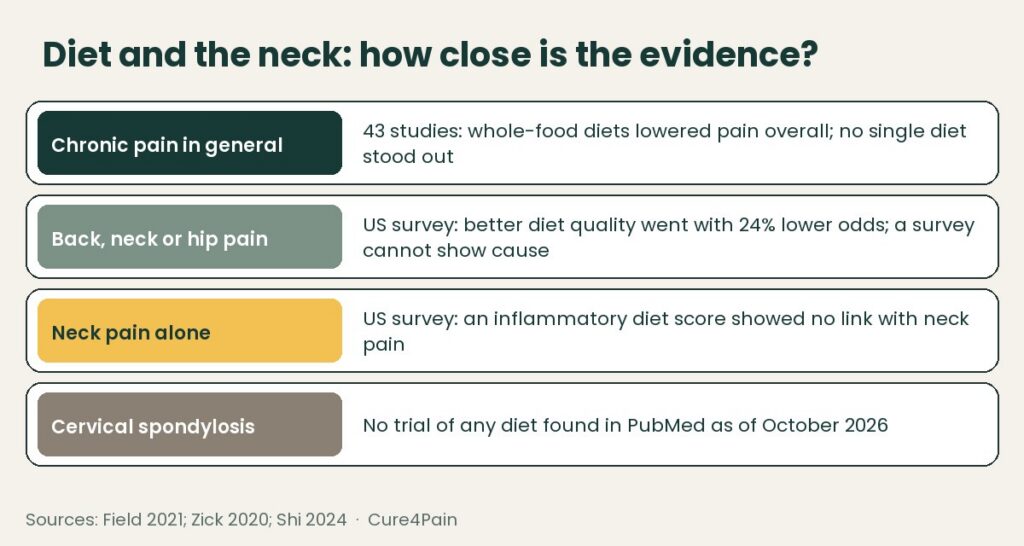
We found no trial in PubMed that has tested a diet in people with cervical spondylosis (October 2026). The closest evidence comes from other pain conditions: a 2021 review of 43 studies in chronic pain found that whole-food diets lowered pain overall, with no single diet standing out [1]. In a US survey of 4,123 adults, better diet quality went with 24% lower odds of chronic pain in the back, neck or hip, and added sugar with 49% higher odds, although a survey cannot show cause [2]. In another US survey, an inflammatory diet score showed no link with neck pain itself [3]. According to the US National Institutes of Health, vitamin B12 is not naturally present in plant foods [4], and in a study from Pune half of 119 young vegetarians were B12 deficient [5]. Clumsy hands, unsteady walking or bladder problems need a doctor first, not a change of diet [6].

Scientific explainer videos in our Resources section
In our Resources section, our clinical team discusses vitamin D, its cofactors and how autoimmune, lifestyle and pain conditions develop.
Is there a special diet for cervical spondylosis?
No. We searched PubMed in October 2026 and found no trial of any diet in people with cervical spondylosis, so no food plan is proven. The closest evidence favours whole, home-cooked foods, less added sugar and fewer ultra-processed foods.
Cervical spondylosis is wear on the discs, bones and joints of the neck, and according to MedlinePlus (US National Library of Medicine) its major risk factor is ageing [7]. Many people search for a “cervical spondylitis diet” when they mean spondylosis; ankylosing spondylitis is a different, immune-mediated condition that needs different care.
Because direct evidence is thin, it matters who each study looked at:
| Who was studied | What the study found | Type of study |
|---|---|---|
| Neck pain, US adults | An inflammatory diet score was linked with joint pain and headache, but not with neck pain or low back pain [3] | Survey |
| Chronic pain in several body sites, with similar results reported for back and neck pain, UK adults | Cheese, cereal and fruit went with lower pain scores; alcohol, salt, pork and poultry with higher scores [8] | Genetic study (Mendelian randomisation), mainly European ancestry |
| Back, neck or hip pain, 4,123 US adults | Better diet quality went with 24% lower odds of chronic pain [2] | Survey; cannot show cause |
| Musculoskeletal disorders including neck pain, 107,983 UK adults | Over a median of 11.6 years, a higher plant-based diet score went with a very slightly lower risk overall, with similar patterns for neck pain [9] | Long-term cohort |
| Chronic pain in general | Whole-food diets lowered pain overall; no single diet stood out [1] | Review of 43 studies |
| Chronic musculoskeletal pain | Pain fell on a whole-food diet without ultra-processed foods and on a ketogenic diet [10] | Pilot randomised trial; no group left on their usual diet |
| Spinal cord pressure in the neck (myelopathy) | Unbalanced diet, alcohol abuse and malnourishment went with poorer results after surgery; the authors rate the strength of this advice as low [11] | Review of 44 studies |
In plain words: a whole-food pattern is a sensible choice for general health and chronic pain, but its effect on the neck itself is not known.
Why can food matter for a neck problem?
Food cannot rebuild worn discs, but it may influence what surrounds them: nutrient shortfalls, muscle and body weight.
- Nutrient shortfalls: in a 2026 Polish study of 380 people having lower back surgery, over 90% did not meet the recommended vitamin D intake and over 80% had too little of the omega-3 fats EPA and DHA from food. These shortfalls were not independently linked with pain or disc grade, and the study was not in the neck [12].
- Muscle: strong neck and upper back muscles are central to care for neck pain, as our neck pain page explains. According to the PROT-AGE expert group (2013), older adults need more dietary protein than younger adults to support health, recovery and function, except for people with severe kidney disease, who may need to limit it [13]. No study has tested protein intake in cervical spondylosis.
In our clinic, when we assess people with long-standing neck or back pain, we often find more than one shortfall: low vitamin D and magnesium, and at times low zinc or iron. Many of these people also have weak, poorly toned muscles around the neck and spine, which gives the discs and joints less support. These are observations from our own practice, not a controlled study, and they do not show that these shortfalls cause spondylosis.
What foods are good for cervical spondylosis?
Whole, home-cooked foods are a sensible choice for cervical spondylosis. At Cure4Pain we advise vegetables, fruit, pulses, whole grains such as millets, nuts and seeds, omega-3 sources and good oils, with enough protein to support muscles. Trials have not tested this pattern in the neck; a 2021 review of 43 studies found that whole-food diets lowered chronic pain overall [1].
| Food group | Indian examples |
|---|---|
| Grains | Jowar, bajra, ragi (nachni), foxtail millet (kangni), rice |
| Pulses | Moong, masoor and toor dal |
| Vegetables | Bottle gourd (lauki), ridge gourd (turai), pumpkin (kaddu), spinach (palak), fenugreek (methi), okra (bhindi), carrot, beetroot, drumstick |
| Fruit | Papaya, guava (amrood), apple, pomegranate (anaar), banana, orange |
| Nuts and seeds | Walnuts (akhrot), almonds (badam), flaxseed (alsi), pumpkin seeds |
| Protein foods | Dal, curd (dahi), paneer, eggs, chicken, fish |
| Fats | Cold-pressed oils, a little ghee |
Omega-3 foods: at Cure4Pain, omega-3 is part of every patient’s nutrition plan unless there is a medical reason against it, judged from your diet history: fish for people who eat it, and algal sources for vegetarians and vegans. According to the US National Institutes of Health, flaxseed and walnuts contain the plant form ALA, but the body converts very little of it into EPA and DHA, the forms found in fish [14]. For neck pain, the only study we found was uncontrolled: of 250 patients in a neurosurgical practice with nonsurgical neck or back pain asked to take fish oil, 125 replied, and 60% of them reported less pain [15]. That was a supplement, not a food; our article on natural remedies for cervical spondylosis covers supplements.
Fruit: no study has tested a single fruit, including banana, in cervical spondylosis. Fruit as a group went with lower odds of chronic spinal pain in the US survey [2].
What foods should you avoid with cervical spondylosis?
No food has been shown to worsen cervical spondylosis. Added sugar, ultra-processed foods, alcohol and salt have been linked with chronic pain in general, and all of this evidence is indirect.
| Food | What research shows | Limits of the evidence |
|---|---|---|
| Added sugar, sweets, sweetened drinks | 49% higher odds of chronic pain in the back, neck or hip with higher intake [2] | Survey; cannot show cause |
| Ultra-processed foods | Pain fell in people with chronic musculoskeletal pain on a diet without ultra-processed foods [10] | Pilot trial; no group stayed on their usual diet |
| Alcohol | Linked with low back pain [16] and with higher multi-site pain scores [8] | Genetic studies; not specific to spondylosis |
| Salt | Linked with higher multi-site pain scores [8] | One genetic study, mainly European ancestry |
Single-food findings from genetic studies conflict and should not become food rules. One linked pork and poultry with higher pain scores [8], another found that processed meat went with less low back pain [16], and a third found that Danish pastry went with less disc degeneration [17]; neither is a reason to eat those foods.
At Cure4Pain we advise fewer ultra-processed foods and less sugar, and we advise limiting alcohol, tea and coffee. As an observational clinic practice, we generally suggest limiting cruciferous (Brassica) vegetables such as cabbage and cauliflower. This is clinic practice, not a research finding: no study has looked at them in neck pain, and a 2024 review found that eating them, particularly with enough iodine, had no adverse effect on thyroid function [18].
We also generally advise most patients to replace wheat with jowar, bajra or other millets as a general health measure, and if home-made roti is made from processed wheat, we ask you to switch to jowar, bajra or millets. This too is clinic practice: research supports a gluten-free diet for coeliac disease, diagnosed by testing, and the American College of Gastroenterology (2023) advises strict adherence to it in that condition [19]. We found no trial of removing wheat in cervical spondylosis.
Is milk good for cervical spondylosis? Does calcium help?
No study has tested milk in cervical spondylosis, and we found none showing that it does harm. In a US survey of 4,123 adults, higher dairy intake went with lower odds of chronic spinal pain, although a survey cannot show cause [2].
- Calcium in food: according to the US National Institutes of Health, milk, yogurt and cheese contain high amounts of calcium, and about 30% of it is absorbed; absorption from certain plants may be much lower [20].
- Ragi: finger millet has a naturally higher calcium content than other grains, although how much of it the body can use remains a challenge, according to a 2017 review [21].
- Bone spurs: we found no study showing that calcium from food prevents or shrinks them.
Calcium tablets are a separate question, covered in our supplements article.
Which vitamins and minerals matter for cervical spondylosis?
Vitamin B12, vitamin D and magnesium are the ones most worth looking at, because they are often short in the diet or linked with nerve and muscle function. No trial has shown that eating more of them changes cervical spondylosis.
| Nutrient | Why it matters | Where it comes from in food |
|---|---|---|
| Vitamin B12 | Needed to build the insulation around nerves. A deficiency in a young man was first diagnosed and treated as cervical radiculopathy [22] | Foods of animal origin such as milk, curd, eggs, fish and meat; not naturally present in plant foods, though some are fortified [4] |
| Vitamin D | 54 people with chronic neck pain had lower vitamin D and ferritin (iron stores) than 54 people without it, in a small study from Jordan [23] | Found naturally in few foods, such as fatty fish, fish liver oils, egg yolks and cheese; fortified foods [24] |
| Magnesium | Needed for muscle and nerve function [25] | Green leafy vegetables, legumes, nuts, seeds and whole grains [25]: for example palak, dals, almonds, pumpkin seeds and ragi |
- Vegetarians: the US National Institutes of Health lists people who follow vegetarian diets as more likely to be low in B12 [4], and half of 119 young, healthy vegetarians in the Pune study were deficient by the definition used, although none had clinical signs [5].
- Can low vitamin D cause cervical spondylosis? No study has shown this. The authors of the Jordan study say low vitamin D and iron cannot be isolated as the only risk factors for chronic neck pain [23], and ageing remains the major risk factor for spondylosis [7]. See also our article on vitamin D deficiency in India.
- Magnesium status: less than 1% of the body’s magnesium is in blood serum, and according to the US National Institutes of Health serum levels do not accurately reflect total body magnesium [25]. Our article on magnesium and neck pain has the details.
Official daily amounts and the evidence on tablets are in our supplements article.
Does losing weight help neck pain?
Losing weight may help neck pain, but the evidence is limited, and we found no weight-loss trial in cervical spondylosis. MedlinePlus lists being overweight and not exercising among the factors that make spondylosis more likely [7].
- Neck pain and weight: a 2022 review of 9 studies found very low certainty evidence of a modest link between overweight or obesity and nonspecific neck pain starting and persisting, in workers [26].
- Women and men: a 2022 review of 14 long-term studies found strong evidence linking high body mass index with chronic neck pain in women and conflicting evidence in men; the effects were small [27].
- Lifestyle trial: in a Finnish trial of 731 employees with high blood pressure, a 12-month lifestyle programme lowered weight and waist size, and reported disability from neck pain fell 7% against 2% with usual care. They were not people with spondylosis, and diet was not tested alone [28].
- Waist size: a 2026 genetic study linked a larger waist with disc degeneration, not specifically in the neck, while body mass index showed no clear link [17].
A sample Indian diet chart for cervical spondylosis
This sample Indian vegetarian diet chart for cervical spondylosis is built from the food list above. It is not a prescription, and no diet chart has been tested in cervical spondylosis. Your own plan depends on your tests, weight, medicines and other conditions. Drink tea or coffee without sugar.
- Day 1: Breakfast: Ragi porridge with milk and banana, no sugar; walnuts. Lunch: Jowar roti, moong dal, bottle gourd (lauki) sabzi, cucumber salad, curd. Evening snack: Guava, roasted pumpkin seeds. Dinner: Bajra roti, paneer bhurji with tomato, spinach (palak) sabzi.
- Day 2: Breakfast: Moong dal chilla with mint chutney; curd. Lunch: Rice, toor dal, okra (bhindi) sabzi, carrot salad, buttermilk (chaas). Evening snack: Apple, almonds (badam). Dinner: Vegetable and moong dal millet khichdi with a little ghee, cucumber raita.
- Day 3: Breakfast: Idli with sambar (pumpkin and drumstick); papaya. Lunch: Ragi roti (nachni bhakri), masoor dal, fenugreek (methi) sabzi, beetroot salad, curd. Evening snack: Pomegranate, flaxseed (alsi) sprinkled on curd. Dinner: Foxtail millet pulao with carrot and beans, paneer and tomato curry.
Swaps and notes:
- If you eat eggs, chicken or fish: they can replace paneer or dal at any meal.
- If you are vegan or avoid dairy: B12 needs a planned source, because plant foods do not naturally contain it [4].
- If you have kidney disease: ask before raising your protein intake [13].
When does neck pain need urgent care instead of a diet change?
See a doctor urgently if neck pain comes with clumsy hands, trouble with buttons or writing, weakness or numbness in the arms or legs, stiff legs, unsteady walking or falls, or new bladder or bowel problems. According to a 2018 review in the BMJ, these can mean pressure on the spinal cord (degenerative cervical myelopathy), and treatment within six months of symptoms offers the best chance of recovery [6].
No food treats spinal cord pressure. Low vitamin B12 can also cause nerve symptoms that look like a neck problem [22], so these symptoms need an examination and tests rather than home changes.
How we plan your diet at Cure4Pain
At Cure4Pain, diet is one part of functional nutrition, used alongside treatment for the neck itself and never instead of it.
- Assessment first: your diet history, symptoms, medicines and blood tests. We read a panel of about 100 markers, adding tests for your condition when clinically indicated; for example, vitamin B12, with methylmalonic acid if the first result is uncertain, when pins and needles, numbness or an unsteady walk come with a risk factor such as a diet low in animal-source foods (NICE NG239, 2024) [29]. We assess magnesium from the overall clinical picture.
- Your food plan: anti-inflammatory eating as described above, with fewer ultra-processed foods and less sugar, and enough protein to support muscles, tailored to your tests.
- Wheat: we generally advise most patients to replace wheat with jowar, bajra or other millets as a general health measure, with the research stated above.
- Cruciferous vegetables: as an observational clinic practice, we generally suggest limiting them, with the research stated above.
- Omega-3: part of your nutrition plan unless there is a medical reason against it; food first, from fish or algal sources.
- What is low gets corrected: we correct real shortfalls rather than giving the same tablets to everyone. Supplements are given by mouth first, with injections only when specifically needed or advised. Magnesium is mainly given as magnesium bisglycinate, with L-threonate or citrate as advised, always counted as elemental magnesium; absorption varies by form [25].
- The neck itself: dry needling, myofascial release, acupuncture, naturopathy, and posture and exercise rehabilitation.
- Medicines: any change is made under clinical guidance from Team Cure4Pain, in coordination with your existing consulting physician; never stop or change them on your own.
This is our clinic practice; individual results vary, and further studies are needed. Read more on our neck pain and cervical spondylosis, pinched nerve and musculoskeletal pain pages.
If you would like a food plan built around your tests and neck treatment, you can book a consultation, online from anywhere or at our Mumbai clinic.
Frequently asked questions
What foods should be avoided in cervical spondylosis?
No food has been shown to worsen cervical spondylosis. Added sugar, ultra-processed foods and alcohol have been linked with chronic pain in general, though not in trials of the neck. As clinic practices, we generally suggest limiting cruciferous vegetables and we generally advise most patients to replace wheat with millets. [2] [8] [10]
What is the best food for cervical spondylosis?
No single food has been shown to be best. A 2021 review of 43 studies found that whole-food diets lowered chronic pain overall, with no single diet standing out; none of this was tested specifically in cervical spondylosis. Vegetables, fruit, pulses, millets, nuts, seeds and enough protein fit that pattern. [1]
Which vitamin is best for cervical spondylosis?
No vitamin has been shown to treat cervical spondylosis. Vitamin B12 and vitamin D are the ones most worth checking, because low B12 can cause nerve symptoms and vitamin D levels were lower in a small study of chronic neck pain. Correct them when they are low. [22] [23]
Can vitamin D deficiency cause cervical spondylosis?
No study has shown that it does. According to MedlinePlus, ageing is the major risk factor for cervical spondylosis. A small study from Jordan found lower vitamin D in people with chronic neck pain, but its authors say it cannot be isolated as the only risk factor. [7] [23]
Is milk good for cervical spondylosis?
No study has tested milk in cervical spondylosis, and we found none showing harm. In a US survey of 4,123 adults, higher dairy intake went with lower odds of chronic spinal pain, but a survey cannot show cause. [2]
Is banana good for cervical spondylosis?
No study has tested banana or any other single fruit in cervical spondylosis, and we found none showing harm. Fruit as a group went with lower odds of chronic pain in the back, neck or hip in a US survey, which cannot show cause. [2]
Are cabbage and cauliflower bad for cervical spondylosis?
No study has looked at them in neck pain. As an observational clinic practice, we generally suggest limiting cruciferous (Brassica) vegetables such as cabbage and cauliflower. A 2024 review found that eating them, particularly with enough iodine, had no adverse effect on thyroid function. [18]
Is a vegetarian diet suitable for cervical spondylosis?
Yes, if it is well planned; no trial has compared diets in this condition. Plan for protein, omega-3 and vitamin B12, which is not naturally present in plant foods. In a Pune study, half of 119 young vegetarians were B12 deficient by the definition used. [4] [5]
Does being overweight make cervical spondylosis worse?
It may affect neck pain, but the evidence is limited. MedlinePlus lists being overweight among the factors that make spondylosis more likely, and a 2022 review found very low certainty evidence linking overweight with nonspecific neck pain. We found no weight-loss trial in cervical spondylosis. [7] [26]
Can diet alone treat cervical spondylosis?
No. Food cannot rebuild worn discs or joints, and no diet has been tested in this condition. Diet is one part of a plan that also treats the neck muscles and joints. Clumsy hands, unsteady walking or bladder problems need a doctor urgently. [6]
This article is for education and does not replace medical advice. Do not start, stop or change any medicine or supplement without medical guidance.
References
1. Field R, et al. Dietary Interventions Are Beneficial for Patients with Chronic Pain: A Systematic Review with Meta-Analysis. Pain Med 2021;22(3):694-714. doi:10.1093/pm/pnaa378
2. Zick SM, et al. Association of chronic spinal pain with diet quality. Pain Rep 2020;5(5):e837. doi:10.1097/PR9.0000000000000837
3. Shi Y, et al. Association between the dietary inflammatory index and pain in US adults from NHANES. Nutr Neurosci 2024;27(5):460-469. doi:10.1080/1028415X.2023.2218122
4. National Institutes of Health, Office of Dietary Supplements. Vitamin B12: Fact Sheet for Health Professionals. ods.od.nih.gov/factsheets/VitaminB12-HealthProfessional
5. Naik S, et al. Identification of vitamin B12 deficiency in vegetarian Indians. Br J Nutr 2018;119(6):629-635. doi:10.1017/S0007114518000090
6. Davies BM, et al. Degenerative cervical myelopathy. BMJ 2018;360:k186. doi:10.1136/bmj.k186
7. MedlinePlus, US National Library of Medicine. Cervical spondylosis. medlineplus.gov/ency/article/000436.htm
8. Zhou R, et al. Causal Associations between Dietary Habits and Chronic Pain: A Two-Sample Mendelian Randomization Study. Nutrients 2023;15(17). doi:10.3390/nu15173709
9. Zheng S, et al. Plant-based diet, metabolic signature, genetic susceptibility, and risk of musculoskeletal disorders: a large-scale population-based prospective cohort study. Front Public Health 2026;14:1803631. doi:10.3389/fpubh.2026.1803631
10. Field R, et al. Effects of a Low-Carbohydrate Ketogenic Diet on Reported Pain, Blood Biomarkers and Quality of Life in Patients with Chronic Pain: A Pilot Randomized Clinical Trial. Pain Med 2022;23(2):326-338. doi:10.1093/pm/pnab278
11. Partha Sarathi CI, et al. The Role of Nutrition in Degenerative Cervical Myelopathy: A Systematic Review. Nutr Metab Insights 2021;14:11786388211054664. doi:10.1177/11786388211054664
12. Strojny D, et al. Dietary inadequacies and their association with pain severity and disc degeneration in patients surgically treated for degenerative lumbosacral spine disorders. Front Nutr 2026;13:1910742. doi:10.3389/fnut.2026.1910742
13. Bauer J, et al. Evidence-based recommendations for optimal dietary protein intake in older people: a position paper from the PROT-AGE Study Group. J Am Med Dir Assoc 2013;14(8):542-59. doi:10.1016/j.jamda.2013.05.021
14. National Institutes of Health, Office of Dietary Supplements. Omega-3 Fatty Acids: Fact Sheet for Health Professionals. ods.od.nih.gov/factsheets/Omega3FattyAcids-HealthProfessional
15. Maroon JC, Bost JW. Omega-3 fatty acids (fish oil) as an anti-inflammatory: an alternative to nonsteroidal anti-inflammatory drugs for discogenic pain. Surg Neurol 2006;65(4):326-31. doi:10.1016/j.surneu.2005.10.023
16. Liu S, et al. Diet and risk of low back pain: a Mendelian randomization analysis. Eur Spine J 2024;33(2):496-504. doi:10.1007/s00586-023-07970-4
17. Wang Y, et al. Causal associations between abdominal obesity, dietary patterns, and intervertebral disc degeneration: a bidirectional two-sample Mendelian randomization study with clinical validation. Front Med (Lausanne) 2026;13:1763791. doi:10.3389/fmed.2026.1763791
18. Galanty A, et al. Do Brassica Vegetables Affect Thyroid Function?-A Comprehensive Systematic Review. Int J Mol Sci 2024;25(7). doi:10.3390/ijms25073988
19. Rubio-Tapia A, et al. American College of Gastroenterology Guidelines Update: Diagnosis and Management of Celiac Disease. Am J Gastroenterol 2023;118(1):59-76. doi:10.14309/ajg.0000000000002075
20. National Institutes of Health, Office of Dietary Supplements. Calcium: Fact Sheet for Health Professionals. ods.od.nih.gov/factsheets/Calcium-HealthProfessional
21. Puranik S, et al. Harnessing Finger Millet to Combat Calcium Deficiency in Humans: Challenges and Prospects. Front Plant Sci 2017;8:1311. doi:10.3389/fpls.2017.01311
22. Mehta A, et al. Vitamin B(12) deficiency presenting as neck pain and cervical radiculopathy. BMJ Case Rep 2024;17(4). doi:10.1136/bcr-2024-259696
23. Eloqayli H, et al. Vitamin D and ferritin correlation with chronic neck pain using standard statistics and a novel artificial neural network prediction model. Br J Neurosurg 2018;32(2):172-176. doi:10.1080/02688697.2018.1436691
24. National Institutes of Health, Office of Dietary Supplements. Vitamin D: Fact Sheet for Health Professionals. ods.od.nih.gov/factsheets/VitaminD-HealthProfessional
25. National Institutes of Health, Office of Dietary Supplements. Magnesium: Fact Sheet for Health Professionals. ods.od.nih.gov/factsheets/Magnesium-HealthProfessional
26. Luc A, et al. Relationship Between Leisure Time Physical Activity, Weight, and the Onset and Persistence of Nonspecific Neck Pain: A Systematic Review. J Orthop Sports Phys Ther 2022;52(12):777-791. doi:10.2519/jospt.2022.11137
27. Manderlier A, et al. Modifiable lifestyle-related prognostic factors for the onset of chronic spinal pain: A systematic review of longitudinal studies. Ann Phys Rehabil Med 2022;65(6):101660. doi:10.1016/j.rehab.2022.101660
28. Mattila R, et al. Effects of lifestyle intervention on neck, shoulder, elbow and wrist symptoms. Scand J Work Environ Health 2004;30(3):191-8. doi:10.5271/sjweh.779
29. National Institute for Health and Care Excellence (NICE). Vitamin B12 deficiency in over 16s: diagnosis and management. NG239, 2024. nice.org.uk/guidance/ng239

