Written by AT. Chintan Dalal, N.D. · Reviewed by Dr Krushal Pabari, Clinical Team, Cure4Pain · Updated 30 October 2026
Key facts
Thiamine deficiency (low vitamin B1) can cause nerve damage and wasting (beriberi), heart failure in rare cases, and Wernicke’s encephalopathy, a life-threatening brain condition, according to the US National Institutes of Health (NIH) [1]. Adults need 1.1 to 1.2 mg a day according to the NIH and 1.7 to 1.8 mg according to India’s ICMR-NIN (2020) [1] [2]. Risk is higher with heavy drinking, diabetes and weight-loss surgery according to the NIH [1] and with diets based on polished rice according to a 2018 global review [3]; long-term diuretics and prolonged vomiting have also been linked to it [1] [4] [5]. In a 2026 community study of 500 adults in Kashmir, where polished rice is the staple, 18.4% were deficient [6]. No single test settles the diagnosis, so a 2021 clinical review advises early treatment when suspicion is high [7]. Sudden confusion, unsteady walking or eye-movement problems need emergency care.

Scientific explainer videos in our Resources section
In our Resources section, our clinical team discusses vitamin D, its cofactors and how autoimmune, lifestyle and pain conditions develop.
What is thiamine deficiency?
Thiamine deficiency means the body has too little vitamin B1 to turn food into energy for its cells, because too little is eaten, too little is absorbed or too much is lost, according to the NIH [1]. The adult body holds only about 25 to 30 mg and the vitamin has a short half-life, so a continuous supply from the diet is needed [1].
- Often missed: thiamine deficiency disorders affect nerves, heart, breathing, the gut and muscles, and are frequently misdiagnosed, according to a 2021 clinical review [7].
- Still seen in India: reports come mainly from Kashmir and Northeast India [6] [8]. These are regional findings; we did not find a national Indian estimate.
What are the symptoms of thiamine deficiency?
Early symptoms of thiamine deficiency are poor appetite, weight loss, confusion, short-term memory loss and muscle weakness, according to the NIH [1]. Later forms depend on which organ is most affected:
| Form | Main symptoms and signs |
|---|---|
| Dry beriberi | Nerve damage on both sides of the body, wasting, weakness mainly in the legs [1] [9] [10] |
| Wet beriberi | High-output heart failure, with swelling of the legs [9] [1] |
| Gastric beriberi | Recurrent vomiting, nausea, loss of appetite, raised blood lactate, reported in 27 patients in Kashmir [11] |
| Wernicke’s encephalopathy | Confusion, unsteady walking, eye-movement problems [12] |
| Korsakoff syndrome | Severe short-term memory loss, disorientation, confusing real and imagined memories [1] |
| Infants | Irritability, hoarse voice, acidotic breathing, drooping eyelids, reported in 43 infants in Kashmir [13] |
- Numb or burning feet: many causes are possible; see our neuropathy page.
When is thiamine deficiency an emergency?
Thiamine deficiency is an emergency when Wernicke’s encephalopathy, a life-threatening brain condition, is suspected: go to an emergency department for new confusion, unsteady walking, double vision or abnormal eye movements, especially with heavy drinking, repeated vomiting, poor food intake or recent weight-loss surgery. Without treatment, up to 20% of people with Wernicke’s encephalopathy die, according to the NIH [1].
- The classic three signs are often absent: in a 1986 analysis of 131 cases of Wernicke-Korsakoff syndrome confirmed after death, only 16% had the classic triad of signs and 80% had not been diagnosed in life [14]. The European EFNS guideline (2010) needs only two of four signs in people who drink heavily: poor diet, eye signs, poor coordination, and altered mental state or mild memory loss [12].
- It also happens without alcohol: of 50 adults with non-alcohol-related Wernicke’s in Kashmir, 42 had recurrent vomiting, 35 had nystagmus (involuntary eye movements), and all ate polished rice as their staple [15].
- Treatment is in hospital: the UK’s NICE guideline advises thiamine by injection or drip for at least 5 days unless Wernicke’s encephalopathy is excluded [16]. EFNS advises giving thiamine before any carbohydrate [12].
- Recovery can be incomplete: in a 2008 systematic review of 84 cases of Wernicke’s after weight-loss surgery, 49% did not recover fully [4]. Tablets at home are not a substitute: the NIH notes that even high oral doses may not raise blood levels enough [1].
Which foods are high in vitamin B1?
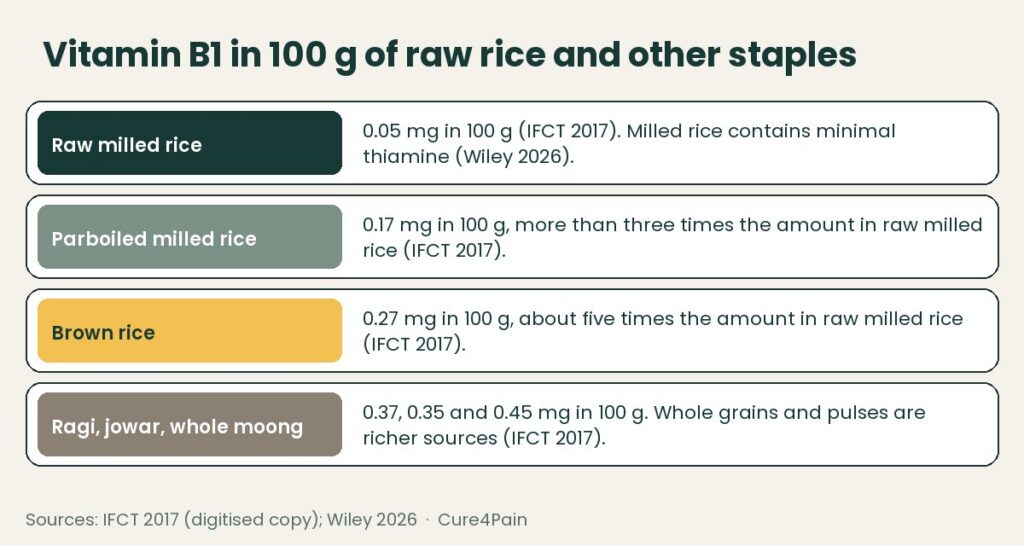
Foods high in vitamin B1 include pulses, whole grains, nuts and seeds, which are good everyday sources for vegetarians too. According to the Indian Food Composition Tables 2017, toor dal and whole moong have 0.45 mg per 100 g raw and whole wheat flour (atta) has 0.42 mg [17]. All the values below are raw; cooking lowers them, and the NIH says that dairy and most fruit contain little [1].
| Grains | Thiamine (mg per 100 g) |
|---|---|
| Whole wheat flour (atta) | 0.42 |
| Ragi | 0.37 |
| Jowar | 0.35 |
| Semolina (sooji) | 0.29 |
| Brown rice | 0.27 |
| Bajra | 0.25 |
| Parboiled milled rice | 0.17 |
| Refined flour (maida) | 0.15 |
| Rice flakes (poha) | 0.12 |
| Puffed rice (mamra) | 0.11 |
| Raw milled rice | 0.05 |
Pulses, seeds and other foods from the same tables [17]:
| Food | Thiamine (mg per 100 g) |
|---|---|
| Cashew | 0.61 |
| Soya bean | 0.59 to 0.61 |
| Sunflower seeds | 0.59 |
| Groundnuts | 0.57 |
| Dry peas | 0.56 |
| Whole moong, toor dal | 0.45 |
| Moong dal, chana dal, masoor dal | 0.34 to 0.35 |
| Pork chop | 0.30 |
| Sesame seeds, flaxseed | 0.27 to 0.36 |
| Urad dal | 0.21 |
| Whole egg | 0.06 |
| Milk, paneer | 0.02 to 0.05 |
How much vitamin B1 do you need a day?
Official amounts for adults differ by country: 1.1 to 1.2 mg a day according to the US NIH, 1.7 to 1.8 mg according to India’s ICMR-NIN and 0.8 to 1 mg according to the UK NHS [1] [2] [18].
| Source | Men | Women |
|---|---|---|
| US NIH [1] | 1.2 mg | 1.1 mg (1.4 mg in pregnancy and breastfeeding) |
| India ICMR-NIN 2020 RDA [2] | 1.8 mg | 1.7 mg |
| UK NHS, ages 19 to 64 [18] | 1 mg | 0.8 mg |
The NIH reports no upper limit, because no harm has been reported from high intakes, though it notes that excessive intakes could still have adverse effects and that absorption falls sharply above 5 mg [1]. The NHS says 100 mg or less a day from supplements is unlikely to cause harm [18]. Our article on thiamine and gut health compares the supplement forms; we do not recommend brands.
Does polished rice cause thiamine deficiency?
Polished rice can raise the risk of thiamine deficiency when it is the staple, because milling and washing remove the vitamin, according to a 2018 global review [3]. According to the NIH, unenriched white rice has one-tenth the thiamine of unenriched brown rice [1]; the Indian Food Composition Tables give about one-fifth, 0.05 mg for raw milled rice against 0.27 mg for brown rice per 100 g raw [17].
- Kashmir: in a 2026 community study of 500 adults, washing rice more than twice (adjusted odds ratio 1.82), tea (1.55), acid-reducing proton pump inhibitors (1.93) and being female (1.48) were independently linked with low thiamine [6]. These are associations, not proof of cause.
- Washing and cooking water: in a US laboratory study, rinsing washed thiamine out of enriched polished and parboiled rice, and cooking in excess water cut thiamine in that rice by 50% to 70%, with smaller losses in brown rice, which is not enriched [19]. Cooking in excess water also lowered inorganic arsenic by 40% in polished rice, while rinsing had little effect on arsenic, so the trade-off applies to the cooking water, not to rinsing [19]. The NIH confirms that thiamine is lost when cooking water is thrown out [1].
- Tea, betel nut and raw fish: tea, coffee, raw fish and shellfish are reported to contain anti-thiamine factors [9]. In a Thai field study, stopping betel nut and raw fermented fish improved thiamine status [20].
Who is at risk of thiamine deficiency?
The people most at risk of thiamine deficiency are those who drink heavily, eat mostly milled grains, absorb poorly or lose more in urine, according to the NIH and a 2018 global review [1] [3]. Alcohol, diuretics and surgery have their own sections below; other groups are:
| Group | What the evidence shows |
|---|---|
| Severe vomiting in pregnancy | In 177 reported cases of Wernicke’s with hyperemesis gravidarum, double vision was an early sign in 37% [5] |
| Pregnant women in Kashmir | 38.2% of 492 had low whole-blood thiamine [21] |
| Older adults | Up to 20% to 30% show some laboratory sign according to the NIH [1], but none of 238 German hospital patients, mean age 82, were deficient on whole-blood testing [22] |
| Bowel disease and coeliac disease | Covered in our article on thiamine and gut health |
| HIV, and fluorouracil chemotherapy | Named by the NIH [1] |
| Weight-loss medicines (GLP-1) | 15 reported cases of Wernicke’s, most with vomiting, weight loss or poor appetite; described as potentially rare but severe [23] |
- Diabetes: in a UK study of 74 people with diabetes and 20 healthy volunteers, plasma thiamine was about 75% lower, along with higher kidney clearance [24], but a 2026 methods review says plasma thiamine is not a useful marker of thiamine status [25] and the NIH says the relevance of these changes to clinical outcomes is not known [1]. The 12-month BOND randomised trial of benfotiamine, a man-made form, in 57 people with type 2 diabetes and nerve symptoms found no significant effect on nerve measures [26].
Why does alcohol cause thiamine deficiency?
Alcohol reduces thiamine absorption, liver stores and activation, and people drinking heavily often eat poorly, so up to 80% of people with long-term heavy drinking develop deficiency, according to the NIH [1].
- UK guidance: NICE advises preventive oral thiamine for harmful or dependent drinkers who are malnourished or at risk of it, have decompensated liver disease, are in acute withdrawal, or are about to undergo planned withdrawal [16].
Do diuretics lower thiamine?
The loop diuretic furosemide has been linked to thiamine loss through urine, according to the NIH, but whether supplements prevent deficiency in people taking it has not been established [1].
- Small study: in an Israeli pilot study, 21 of 23 people with heart failure on long-term furosemide had a raised TDP effect, a laboratory sign of low thiamine, against 2 of 16 controls [27].
- Heart failure: a 2024 meta-analysis of 7 trials (274 people) found no direct benefit from thiamine supplements beyond correcting a shortfall [28].
Do not stop a diuretic because of this; ask the doctor managing it about a thiamine check.
How common is thiamine deficiency after weight-loss surgery?
Thiamine deficiency after weight-loss surgery is most common in the first months. A 2024 meta-analysis of 41 studies found 7% of people low before surgery, 19% at 3 months (with very wide uncertainty), 9% at 6 months and 6% at one year [29].
- Warning sign: in a 2008 systematic review of 84 cases of Wernicke’s after weight-loss surgery, 94% were admitted to hospital within 6 months of surgery and 90% had frequent vomiting [4].
- Follow-up: EFNS recommends following thiamine status for at least 6 months after surgery [12].
Which tests check thiamine levels, and what are their limits?
The most reliable tests for thiamine deficiency are whole-blood thiamine diphosphate and the red blood cell transketolase test, according to a 2026 methods review by Jones and colleagues, but no test is a widely agreed standard [25] [3].
| Test | What it shows | Limit |
|---|---|---|
| Whole-blood thiamine diphosphate (TDP) | The main active form [1] [25] | Availability is limited in some settings [30] |
| Transketolase test (TDP effect) | Enzyme response: 0 to 15% is healthy, 15 to 25% marginal, over 25% deficient [1] | May mislead in diabetes [24] |
| Plasma or serum thiamine | Recent intake [25] | Not a useful guide to status [25] |
- Studies differ on blood tests: the NIH (2023) says blood levels of thiamine are not reliable [1], while a 2026 methods review separates plasma thiamine, which is not useful, from whole-blood TDP, which it rates highly [25].
- A result does not settle it alone: in a Lao study of 274 hospitalised children under 18 months (152 responded to thiamine, 122 did not), no marker reliably identified the individual children who responded [31].
- Timing: EFNS advises taking blood immediately before the first dose [12]. When suspicion is high, a 2021 review advises early treatment [7].
How is thiamine deficiency treated?
Thiamine deficiency is treated by replacing thiamine, with the route set by severity. For mild deficiency, the World Health Organization recommends, as quoted by the NIH, oral thiamine at 10 mg a day for a week, then 3 to 5 mg a day for at least 6 weeks; for severe deficiency, the NIH describes treatment that starts with injected thiamine [1]. Suspected Wernicke’s encephalopathy is treated by injection or drip, according to NICE [16]. These are guideline figures for a doctor to apply, not a self-treatment plan.
- Speed of response: with thiamine treatment, improvement can come within hours or days even in severe cases, while nerve involvement can take longer, according to a 2021 review [7].
- Lasting effects: at the Korsakoff stage, about a quarter of patients do not recover even with injected thiamine, according to the NIH [1].
- Without a deficiency: evidence for taking thiamine is limited. Trials for fatigue are covered in our gut health article, and fibromyalgia in our fibromyalgia nutrients article.
How we find and replenish low thiamine at Cure4Pain
At Cure4Pain, thiamine is one part of finding and replenishing nutrient shortfalls, as an add-on to your existing treatment, never instead of it.
- Neuropathy: we look for deficiencies linked to the condition and to its medicines, mostly in diabetic neuropathy and in people with high cholesterol or triglycerides. Thiamine, vitamin B12, magnesium and a moderate, normal-range vitamin D are the core nutrients we replenish, with omega-3 for overall deficiency management, as long-term management. See our neuropathy page.
- Gut conditions: thiamine is one of the gut-support nutrients in our gut dysbiosis and IBS plans.
- Fibromyalgia: we use thiamine only after assessment and with follow-up. See our fibromyalgia page.
- Tests: we read a panel of about 100 markers, adding tests for your condition when clinically indicated. When low thiamine is suspected, this can include a blood thiamine test, taken before the first dose as the European EFNS guideline (2010) advises [12].
- How nutrients are given: supplements by mouth first, with injections only when specifically needed or advised; suspected Wernicke’s encephalopathy needs hospital treatment, as above. Magnesium is mainly bisglycinate, with L-threonate or citrate as advised, counted as elemental magnesium; absorption varies by form.
- Food: as clinic practice, we generally advise most patients to replace wheat with jowar, bajra or other millets as a general health measure, including home-made roti from processed wheat; a gluten-free diet is supported for coeliac disease and positive tests, and the NHS says people with coeliac disease must stop all gluten for life [32]. The tables above are composition facts, and they list jowar, bajra and ragi as sources. Also, as an observational clinic practice, we generally suggest limiting cruciferous (Brassica) vegetables such as cabbage and cauliflower; a 2024 review found that eating them, particularly with enough iodine, had no adverse effect on thyroid function [33].
- Amounts: set for you after assessment and adjusted over time; we do not publish clinic doses.
- Medicines stay: your existing medicines are never stopped abruptly. Any change is made under clinical guidance from Team Cure4Pain, in coordination with your existing consulting physician; never stop or change them on your own.
This is our clinic practice; individual results vary, and further studies are needed.
If you would like your risk factors, diet and reports reviewed together, you can book a consultation, online from anywhere or at our Mumbai clinic. Urgent symptoms need an emergency department instead.
Frequently asked questions
Is thiamine the same as vitamin B1?
Yes. Thiamine, also spelled thiamin, is vitamin B1, one of the water-soluble B vitamins, according to the US National Institutes of Health. [1]
What are the first signs of thiamine deficiency?
According to the NIH, early signs include weight loss, poor appetite, confusion, short-term memory loss, muscle weakness and heart symptoms. None of these is specific, so risk factors matter. [1] [7]
Which disease is caused by lack of vitamin B1?
Lack of vitamin B1 causes beriberi and Wernicke-Korsakoff syndrome. Dry beriberi mainly affects the nerves, wet beriberi affects the heart, and Wernicke’s encephalopathy affects the brain and is an emergency. [1] [9]
Can thiamine deficiency affect the eyes?
Yes. Eye-movement problems and double vision are signs of Wernicke’s encephalopathy and need emergency care. In a 2019 systematic review of 177 cases of Wernicke’s with severe pregnancy vomiting, double vision (37%) and blurred vision (27%) were early signs. [12] [5]
What is the test for thiamine deficiency called?
Usually whole-blood thiamine or thiamine diphosphate (TDP), or the red blood cell transketolase test. A 2026 review calls these the most reliable, while plasma thiamine only reflects recent intake. [25]
Which vegetarian foods are high in vitamin B1?
Pulses such as toor dal and whole moong, whole grains such as atta and ragi, soya, groundnuts, sunflower seeds and cashews, according to the Indian Food Composition Tables. Dairy contains little. [17] [1]
Is it safe to take thiamine supplements?
The NIH reports no upper limit for thiamine, and the NHS says 100 mg or less a day is unlikely to cause harm. If you have symptoms, speak to a doctor first, because the European EFNS guideline on Wernicke’s encephalopathy advises taking blood before thiamine is started. [1] [18] [12]
This article is for education and does not replace medical advice. Do not start, stop or change any medicine or supplement without medical guidance.
References
1. National Institutes of Health, Office of Dietary Supplements. Thiamin: Fact Sheet for Health Professionals (updated 9 February 2023). ods.od.nih.gov
2. ICMR-National Institute of Nutrition. A Brief Note on Nutrient Requirements for Indians, the Recommended Dietary Allowances (RDA) and the Estimated Average Requirements (EAR), 2020. nin.res.in
3. Whitfield KC, et al. Thiamine deficiency disorders: diagnosis, prevalence, and a roadmap for global control programs. Ann N Y Acad Sci 2018;1430(1):3-43. doi:10.1111/nyas.13919
4. Aasheim ET. Wernicke encephalopathy after bariatric surgery: a systematic review. Ann Surg 2008;248(5):714-20. doi:10.1097/SLA.0b013e3181884308
5. Oudman E, et al. Wernicke’s encephalopathy in hyperemesis gravidarum: A systematic review. Eur J Obstet Gynecol Reprod Biol 2019;236:84-93. doi:10.1016/j.ejogrb.2019.03.006
6. Muzaffer U, et al. Public health implications of thiamin deficiency in an endemic population: lessons from a community-based study in Kashmir. Nutr Res 2026;147:42-50. doi:10.1016/j.nutres.2026.01.004
7. Smith TJ, et al. Thiamine deficiency disorders: a clinical perspective. Ann N Y Acad Sci 2021;1498(1):9-28. doi:10.1111/nyas.14536
8. Koshy RM, et al. The rediscovery of thiamine deficiency disorders at a secondary level mission hospital in Northeast India. Ann N Y Acad Sci 2021;1498(1):96-107. doi:10.1111/nyas.14552
9. Wiley KD, Singh J. Vitamin B1 (Thiamine) Deficiency. StatPearls, 2026. PubMed 30725889
10. Nisar S, et al. Thiamine deficiency-related neuropathy: A reversible entity from an endemic area. Eur J Neurol 2024;31(3):e16155. doi:10.1111/ene.16155
11. Nisar S, et al. Clinical profile of patients presenting with thiamine-responsive upper-gastrointestinal upset: A pointer toward gastric beriberi. Nutrition 2022;102:111730. doi:10.1016/j.nut.2022.111730
12. Galvin R, et al. EFNS guidelines for diagnosis, therapy and prevention of Wernicke encephalopathy. Eur J Neurol 2010;17(12):1408-18. doi:10.1111/j.1468-1331.2010.03153.x
13. Qureshi UA, et al. Infantile thiamine deficiency: Redefining the clinical patterns. Nutrition 2021;84:111097. doi:10.1016/j.nut.2020.111097
14. Harper CG, et al. Clinical signs in the Wernicke-Korsakoff complex: a retrospective analysis of 131 cases diagnosed at necropsy. J Neurol Neurosurg Psychiatry 1986;49(4):341-5. doi:10.1136/jnnp.49.4.341
15. Shah IA, et al. Nonalcoholic Wernicke’s Encephalopathy: A Retrospective Study from a Tertiary Care Center in Northern India. J Neurosci Rural Pract 2017;8(3):401-406. doi:10.4103/jnrp.jnrp_14_17
16. National Institute for Health and Care Excellence (NICE). Alcohol-use disorders: diagnosis and management of physical complications. Guideline CG100, 2010, updated 2017. nice.org.uk/guidance/cg100
17. Longvah T, et al. Indian Food Composition Tables 2017. National Institute of Nutrition, Indian Council of Medical Research ([nin.res.in/ebooks/IFCT2017.pdf](https://www.nin.res.in/ebooks/IFCT2017.pdf)). The values in this article come from a digitised copy of IFCT 2017, not from the book itself (npm package ifct2017/compositions, github.com/nodef/ifct2017
18. NHS (UK National Health Service). B vitamins and folic acid. nhs.uk/conditions/vitamins-and-minerals/vitamin-b
19. Gray PJ, et al. Cooking rice in excess water reduces both arsenic and enriched vitamins in the cooked grain. Food Addit Contam Part A Chem Anal Control Expo Risk Assess 2016;33(1):78-85. doi:10.1080/19440049.2015.1103906
20. Vimokesant SL, et al. Effects of betel nut and fermented fish on the thiamin status of northeastern Thais. Am J Clin Nutr 1975;28(12):1458-63. doi:10.1093/ajcn/28.12.1458
21. Kareem O, et al. Prevalence of Thiamine Deficiency in Pregnancy and its impact on fetal outcome in an area endemic for thiamine deficiency. PLoS Negl Trop Dis 2023;17(5):e0011324. doi:10.1371/journal.pntd.0011324
22. Pourhassan M, et al. Prevalence of thiamine deficiency in older hospitalized patients. Clin Interv Aging 2018;13:2247-2250. doi:10.2147/CIA.S183102
23. Lev D, et al. Glucagon-like peptide-1 receptor agonists and Wernicke encephalopathy: A pharmacovigilance study and literature review. Clin Nutr 2026;57:106571. doi:10.1016/j.clnu.2025.106571
24. Thornalley PJ, et al. High prevalence of low plasma thiamine concentration in diabetes linked to a marker of vascular disease. Diabetologia 2007;50(10):2164-70. doi:10.1007/s00125-007-0771-4
25. Jones KS, et al. Assessment of thiamine status in humans. Methods Enzymol 2026;735:189-216. doi:10.1016/bs.mie.2026.06.018
26. Ziegler D, et al. Effects of benfotiamine treatment over 12 months on morphometric, neurophysiological and clinical measures in type 2 diabetes patients with symptomatic polyneuropathy: a randomized, placebo-controlled, double-blind clinical trial (BOND study). BMJ Open Diabetes Res Care 2026;14(1). doi:10.1136/bmjdrc-2025-005773
27. Seligmann H, et al. Thiamine deficiency in patients with congestive heart failure receiving long-term furosemide therapy: a pilot study. Am J Med 1991;91(2):151-5. doi:10.1016/0002-9343(91)90007-k
28. He S, et al. Role of Thiamine Supplementation in the Treatment of Chronic Heart Failure: An Updated Meta-Analysis of Randomized Controlled Trials. Clin Cardiol 2024;47(7):e24309. doi:10.1002/clc.24309
29. Karimi Behnagh A, et al. Pre- and Post-surgical Prevalence of Thiamine Deficiency in Patients Undergoing Bariatric Surgery: a Systematic Review and Meta-analysis. Obes Surg 2024;34(2):653-665. doi:10.1007/s11695-023-06896-6
30. Nisar S, et al. Descriptive spectrum of thiamine deficiency in pregnancy: A potentially preventable condition. Int J Gynaecol Obstet 2024;164(1):157-165. doi:10.1002/ijgo.14989
31. Hess SY, et al. Assessment of Erythrocyte Transketolase, Whole Blood Thiamine Diphosphate, and Human Milk Thiamine Concentrations to Identify Infants and Young Children Responding Favorably to Therapeutic Thiamine Administration: Findings from the Lao Thiamine Study, a Prospective Cohort Study. Curr Dev Nutr 2024;8(6):103786. doi:10.1016/j.cdnut.2024.103786
32. NHS (UK National Health Service). Coeliac disease: treatment. nhs.uk/conditions/coeliac-disease/treatment
33. Galanty A, et al. Do Brassica Vegetables Affect Thyroid Function?-A Comprehensive Systematic Review. Int J Mol Sci 2024;25(7). doi:10.3390/ijms25073988