Written by AT. Chintan Dalal, N.D. · Reviewed by Dr Krushal Pabari, Clinical Team, Cure4Pain · Updated 30 October 2026
Key facts
No ankylosing spondylitis diet has been shown to treat the disease: a 2018 systematic review called the evidence extremely limited and inconclusive [1], and a 2026 review found it insufficient to recommend any one diet [2]. The French Society for Rheumatology advises a Mediterranean-type diet, omega-3 and weight loss for people who are overweight, as an addition to medicines. Among measures for inflammatory rheumatic diseases, it does not propose a gluten-free diet without coeliac disease, a vegetarian or vegan diet, removing dairy or fasting [3]. A 2022 meta-analysis found blood vitamin D 7.53 ng/mL lower than in controls [4], but a 2020 meta-analysis of randomised vitamin trials included no trial in spondyloarthritis [5]. For B12, the evidence is thin: deficiency was found in 13.2% of 220 outpatients with spondyloarthritis [6], and we found no trial. The low-starch diet rests on an unproven theory about the gut bacterium Klebsiella [7] [8].

Scientific explainer videos in our Resources section
In our Resources section, our clinical team discusses vitamin D, its cofactors and how autoimmune, lifestyle and pain conditions develop.
Does diet help ankylosing spondylitis?
No diet has been shown to treat ankylosing spondylitis, and diet does not replace medicines. The 2021 EULAR (European Alliance of Associations for Rheumatology) recommendations emphasise a healthy, balanced diet and a healthy weight for people with rheumatic diseases [9].
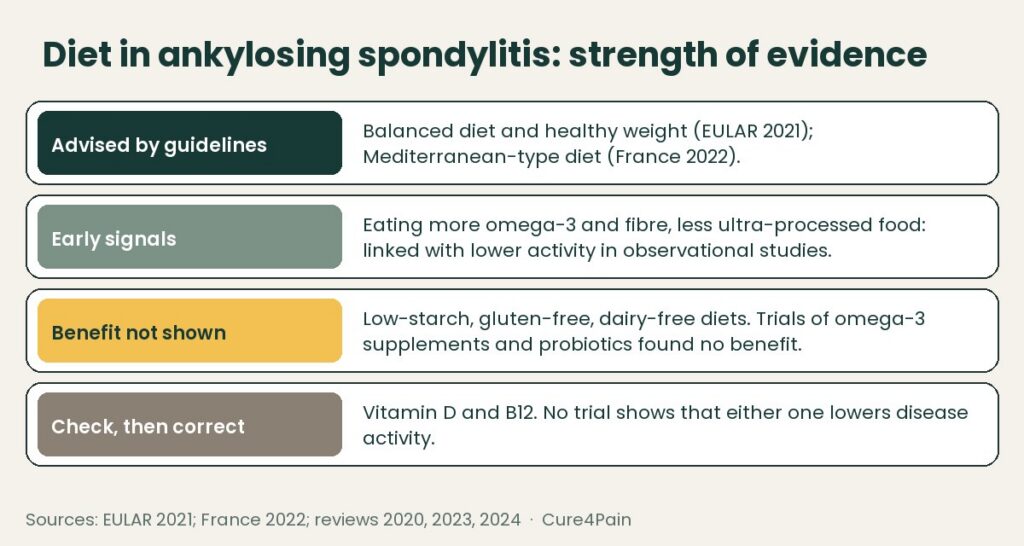
- Systematic reviews: a 2018 review of 16 studies found the evidence extremely limited and inconclusive [1]. A 2023 review of 15 studies in spondyloarthritis called the evidence on eating patterns scarce and heterogeneous [10]. A 2025 review of 49 randomised trials in three forms of arthritis found the evidence in axial spondyloarthritis limited [11].
- National advice: rheumatology societies in France (2022) and Morocco (2025) both say diet should add to medicines, not replace them, and both favour a Mediterranean-type diet and omega-3 [3] [12]. Their advice covers inflammatory rheumatic diseases as a group, not ankylosing spondylitis alone.
Which nutrients are low in ankylosing spondylitis?
Vitamin D is the best-documented low nutrient in ankylosing spondylitis, and a 2025 Swedish study also found lower intakes of fibre and marine omega-3 [4] [13]. B12 has not been shown to be low in ankylosing spondylitis specifically.
- Vitamin D: blood 25-hydroxyvitamin D averaged 7.53 ng/mL lower than in controls in a 2022 meta-analysis of 6 studies [4].
- Food intake: in a 2025 Swedish study, 155 people with radiographic axial spondyloarthritis ate less fibre per calorie, marine omega-3, calcium, folate, selenium and vitamins A, C and K than 604 matched controls [13].
- Link with activity: in 295 Swedish patients with radiographic axial spondyloarthritis, low marine omega-3 went with higher disease activity and low fibre with higher CRP, a blood marker of inflammation [13]. In a single-centre cohort of 278 patients with axial spondyloarthritis, high activity went with low omega-3 and fibre and high ultra-processed food intake [14].
- Where studies disagree: two earlier cross-sectional studies in ankylosing spondylitis, one of them Swedish, found no link between overall diet and a disease activity score, although one found that higher long-chain omega-3 intake went with lower ESR, an inflammation marker [15] [16]. None of these studies tested a change in diet, so they cannot show whether diet affects the disease or the disease changes how people eat.
What is the best diet for ankylosing spondylitis?
A Mediterranean-style pattern has the most support for ankylosing spondylitis, although the evidence is modest: vegetables, fruit, whole grains, pulses, nuts, seeds and fish, with little processed food. The French Society for Rheumatology advises a Mediterranean-type diet as an addition to medicines [3].
- Italian cohort: in a 2021 study, 81 people with axial spondyloarthritis received nutritionist advice for 6 months and 80 did not. Disease activity (ASDAS-CRP score) improved by at least 20% more often with advice, but the groups were not randomised and many did not complete the study [17].
- Randomised trial: in a 2024 trial, 158 people with rheumatoid arthritis, spondyloarthritis or psoriatic arthritis were randomised to 12 weeks of lifestyle counselling through a mobile app, including Mediterranean diet advice, or to a comparison group. Both groups improved. The odds of reaching the two lowest disease activity categories rose significantly in the counselling group but not significantly in the comparison group, and the abstract reports no direct test between the groups and no result for ankylosing spondylitis alone [18].
- Fibre: in a 2023 study of 165 people with ankylosing spondylitis, higher fibre intake went with lower disease activity [19]. This was not a trial.
The table translates this pattern into Indian food. It is our illustration of the studied pattern and has not itself been tested in ankylosing spondylitis.
| Food group | Indian examples |
|---|---|
| Grains and millets | Jowar, bajra, ragi (nachni), foxtail millet (kangni), rice |
| Pulses | Moong, masoor and toor dal |
| Vegetables | Bottle gourd (lauki), ridge gourd (turai), pumpkin, spinach (palak), fenugreek (methi), carrot, okra, French beans |
| Fruit | Papaya, guava, apple, pomegranate, orange |
| Nuts and seeds | Walnuts, almonds, flaxseed, pumpkin seeds |
| Protein | Fish and eggs for those who eat them; paneer and curd |
No diet chart or fixed meal plan has been tested in ankylosing spondylitis, so any plan should fit your own weight, tests, medicines and other conditions.
Which foods should you avoid with ankylosing spondylitis?
No food has been proven to trigger ankylosing spondylitis. Ultra-processed food has the most consistent link with disease activity, but we found no trial of removing it.
| Food | What studies show |
|---|---|
| Ultra-processed food | Linked with higher disease activity in a cohort of 278 patients with axial spondyloarthritis and in 104 patients with ankylosing spondylitis in Turkey, where lower fruit and vegetable intake partly explained the link [14] [20] |
| Sugary soft drinks | Linked with new spondyloarthritis only in HLA-B27 carriers in a 2026 Mayo Clinic Biobank study of 73 cases; the authors call this a hypothesis that needs testing [21] |
| Alcohol | Small amounts are unlikely to harm people with rheumatic diseases, according to EULAR 2021; the flare evidence is mainly from rheumatoid arthritis and gout [9] |
| Gluten | French advice is against a gluten-free diet without coeliac disease [3]. Gluten intake was not linked with response to biological medicines in 193 people with inflammatory diseases [22]. A randomised trial in axial spondyloarthritis was planned in 2020 [23]; we found no published results |
| Milk and dairy | French advice (2022) is against removing dairy [3]. Swedish patients ate less calcium than controls in a 2025 study [13], and about 14% of people with ankylosing spondylitis have osteoporosis, according to a 2026 meta-analysis [24] |
| Red meat | IgG antibodies to beef and pork were higher in 75 Chinese patients with ankylosing spondylitis than in controls, and the authors suggested avoiding these foods, but this was an antibody study and we found no trial of removing them [25] |
| Nightshades and lectins | Our PubMed search of October 2026 found no study of these foods in ankylosing spondylitis |
Vegetarian eating needs a separate note. French and Moroccan advice does not recommend a vegetarian or vegan diet as a measure for inflammatory rheumatic diseases [3] [12]; this advice is about managing these diseases, not a general view on vegetarian eating. If you are vegetarian, the dal, millets, nuts, seeds, paneer and curd in the table above fit a Mediterranean-style pattern, and the sections below cover vitamin B12 and algal omega-3.
Fasting in ankylosing spondylitis is disputed. The French Society for Rheumatology (2022) advises against it [3], the Moroccan Society for Rheumatology (2025) calls the data limited or contradictory [12], and in 20 people with spondyloarthritis who fasted during Ramadan, one activity score improved and another did not, with no comparison group [26]. A 2026 meta-analysis of 7 studies, mostly in rheumatoid arthritis (471 people, against 85 with spondyloarthritis), reported lower disease activity, but its authors call the trial evidence limited [27]. If you take medicines, ask your doctor before fasting.
Does a low-starch diet help ankylosing spondylitis?
A low-starch diet has not been shown to help ankylosing spondylitis. Our PubMed search of October 2026 found no randomised trial of one, and a 2026 review warns that restrictive diets can lead to nutrient deficiencies without supervision [2].
- The theory: the gut bacterium Klebsiella was proposed as a trigger of ankylosing spondylitis, and gut bacteria use dietary starch. A 1996 report by Ebringer and Wilson described lower IgA antibodies and fewer symptoms on a diet with less bread, potatoes, cakes and pasta; its abstract gives no numbers and no group of patients who stayed off the diet, and it called for further evaluation [7].
- The contrary result: in a 1984 study of people with ankylosing spondylitis, a Klebsiella exclusion diet did not change how often Klebsiella was found in stool, and Klebsiella did not track with disease activity [8].
- The association: a 2022 meta-analysis of 25 case-control studies found Klebsiella in stool, and antibodies to it, more often in ankylosing spondylitis. The authors say prospective studies are needed to confirm this [28]. An association does not show that eating less starch helps.
- Ketogenic and low-carbohydrate diets: a 2025 review calls the data on ketogenic diets scarce [29], and our PubMed search of October 2026 found no randomised trial of a low-carbohydrate diet in ankylosing spondylitis.
Does vitamin D help ankylosing spondylitis?
Vitamin D has not been shown to lower disease activity in ankylosing spondylitis. Low levels are common and often linked with more active disease, but we found no trial testing whether correcting them lowers activity. Our ankylosing spondylitis page covers this alongside treatment; the points below are the ones that matter for food and supplements.
- Evidence for a link: a 2022 meta-analysis of 6 studies found lower levels with higher disease activity [4]. In 700 French patients with early axial spondyloarthritis (the DESIR cohort), severe deficiency affected 11.7%, against 5% of the French population, and deficiency went with higher activity scores [30].
- Mixed evidence: a study of 63 people with spondyloarthritis found no link with activity, although 74.6% had levels below 30 ng/mL [31]. A second 2022 meta-analysis confirmed lower 25-hydroxyvitamin D, but in Caucasian patients found no difference from healthy controls in the active form of vitamin D or in parathyroid hormone (PTH) [32].
- Which comes first: a UK study of 235 patients with axial spondyloarthritis notes that low levels may reflect less time outdoors in people with more limited function [33].
- Trials: a 2020 meta-analysis of randomised vitamin trials included no trial in spondyloarthritis, although it says vitamin D should be given to people who are deficient, to prevent musculoskeletal complications [5]. The one randomised trial our PubMed search found, COMEDSPA, tested nurse-led screening, not the effect of vitamin D on the disease [34], and a 2017 review concluded that screening and treating every patient with ankylosing spondylitis was not yet feasible [35]. French 2022 advice says vitamin and trace element supplements are not indicated for controlling disease activity [3].
- Official limits: the usual recommended intake for adults is 600 to 800 IU a day, and the upper limit is 4,000 IU a day, according to the US National Institutes of Health [36].
- Magnesium as a cofactor: the enzymes that process vitamin D appear to need magnesium, according to a 2018 review [37]. Less than 1% of the body’s magnesium is in blood serum, so serum levels do not show tissue levels, according to the NIH [38]. Read more on vitamin D3, K2 and magnesium.
Is vitamin B12 linked to ankylosing spondylitis?
Research linking vitamin B12 to ankylosing spondylitis is very limited. Our PubMed search of October 2026 found no randomised trial of B12 in spondyloarthritis, and we found nothing showing that low B12 causes or worsens ankylosing spondylitis. Vegetarian diets, acid-lowering medicines and overlapping symptoms are still practical reasons to check it.
- How common low B12 is: in a 2022 study of 220 outpatients with spondyloarthritis, half of them with psoriatic arthritis, B12 deficiency was found in 13.2%, which the authors called rare. The abstract describes no healthy comparison group [6].
- Supplements: in a 2026 US study from the Mayo Clinic Biobank, B vitamin supplements were linked with new spondyloarthritis in HLA-B27 carriers, but the authors call this a hypothesis, given the small numbers [21].
- Vegetarian diets: plant foods do not naturally contain B12, according to the NIH [39]. Half of 119 healthy young Indian vegetarians were B12 deficient in a 2018 study [40].
- Acid-lowering medicines: the NIH says they can interfere with B12 absorption from food [39]. A 2023 meta-analysis of proton pump inhibitors found slightly higher odds of deficiency, but judged the link too weak to be clear [41].
- Tiredness and numbness: extreme tiredness is a main symptom of ankylosing spondylitis, according to the NHS [42], and fatigue, numbness and tingling can also come from low B12, according to the NIH [39], so a blood test helps tell them apart. According to the NHS, weakness or numbness in both legs, or numbness around the genitals or anus, can signal the very rare cauda equina syndrome and needs emergency care [43].
Our article on vitamin B12 deficiency explains the symptoms and tests.
Does omega-3 help ankylosing spondylitis?
Omega-3 supplements have not been shown to help ankylosing spondylitis in trials, although low intake goes with higher disease activity. A 2024 meta-analysis of 4 placebo-controlled trials in 245 people with spondyloarthritis found no improvement in tender or swollen joints, pain or function, and rated the trials as having some concerns or a high risk of bias; its abstract gives no result for ankylosing spondylitis alone [44]. A 2025 systematic review said polyunsaturated fats showed potential benefits within limited evidence in axial spondyloarthritis [11]. The one trial we found limited to ankylosing spondylitis was very small: in 2006, 24 people took a low or a high dose, and 18 finished. Disease activity fell in the high-dose group but not in the low-dose group, and the two groups did not differ significantly [45]. Low intake goes with higher activity in observational studies [13] [14], and the French Society for Rheumatology (2022) advises supplementation, mainly with omega-3 [3].
Do gut bacteria and probiotics matter in ankylosing spondylitis?
Gut bacteria differ in ankylosing spondylitis, but probiotics have not been shown to help.
- Differences: a 2026 meta-analysis of 25 studies with 1,639 people found less varied gut bacteria in axial spondyloarthritis, but the authors urge caution because results varied [46].
- Probiotics: a 2010 randomised trial in 63 people with active spondyloarthritis found no significant benefit over placebo [47], and a 2023 review reached the same view from 2 trials [10]. French and Moroccan advice does not recommend them [3] [12].
Do weight, smoking and exercise matter more than single foods?
Weight, smoking and exercise have stronger evidence in ankylosing spondylitis than any single food: meta-analyses link excess weight with higher disease activity and exercise programmes with better activity, function and mobility, and systematic reviews link smoking with more X-ray progression [48] [49] [50].
- Weight: being overweight or obese went with higher disease activity in a 2020 meta-analysis of 12 studies in axial spondyloarthritis [48], and people with obesity had lower odds of a good response to TNF inhibitors in axial spondyloarthritis, according to a 2019 meta-analysis [51].
- Smoking: it is linked with more X-ray progression in axial spondyloarthritis, according to systematic reviews informing the 2021 EULAR recommendations [49], and EULAR says smokers should be supported to quit [9].
- Exercise: exercise programmes had a moderate effect on activity, function and spinal mobility, according to a 2023 meta-analysis [50].
How we use diet and vitamins for ankylosing spondylitis at Cure4Pain
At Cure4Pain, nutrition is one part of a lifelong plan for ankylosing spondylitis, used alongside guideline treatment, never instead of it.
- Testing first: we read a panel of about 100 markers, adding tests for your condition when clinically indicated, such as HLA-B27, and CRP and imaging of the sacroiliac joints, which the 2022 ASAS-EULAR recommendations use in treatment decisions [52]. The panel is our clinic protocol, not a guideline requirement.
- Vitamin D and cofactors: we assess magnesium from the overall clinical picture and use it, with other cofactors, alongside vitamin D at standard supplement doses to correct low vitamin D levels, as blood tests guide. Magnesium is mainly bisglycinate, with L-threonate or citrate as advised, counted as elemental magnesium. Unlike some other autoimmune conditions we treat, we do not use supervised vitamin D therapy (Coimbra Protocol) as the main treatment here. Where we use it for other conditions, our methods are derived from the work of Dr Coimbra. We found no trial of it in ankylosing spondylitis.
- Vitamin B12: checked in the panel and corrected at standard supplement doses if low, by mouth first, with injections only when specifically needed or advised.
- Omega-3: part of the nutrition plan unless a guideline reason applies, such as bleeding risk, heart rhythm problems or upcoming surgery, and not a treatment on its own: fish for people who eat it, algal oil for vegetarians and vegans, food first.
- Gut support: digestive and bile support. We found no trial of these in ankylosing spondylitis.
- Food: as clinic practice, we generally advise most patients to replace wheat with jowar, bajra or other millets as a general health measure; a gluten-free diet is supported for coeliac disease, and French advice does not propose it otherwise [3]. As an observational clinic practice, we generally suggest limiting cruciferous (Brassica) vegetables such as cabbage and cauliflower; a 2024 systematic review found that daily intake, particularly with enough iodine, poses no adverse effects on thyroid function [53]. An integrative plan may add options like these alongside standard care.
- Daily habits: a healthy weight, no smoking, and daily stretching, posture, breathing and pool exercise.
- Guideline medicines: the 2022 ASAS-EULAR recommendations for axial spondyloarthritis start with education, exercise and non-steroidal anti-inflammatory drugs (NSAIDs) [52]. Long-term steroid tablets and conventional disease-modifying drugs (DMARDs) are discouraged for disease only in the spine [52], and the 2019 American College of Rheumatology guideline keeps sulfasalazine for persistent limb joint arthritis when TNF inhibitors cannot be used [54]. If disease stays active on a standard score after at least 2 NSAIDs, with raised CRP, inflammation of the sacroiliac joints on MRI or sacroiliitis on X-ray, the next step is a TNF inhibitor (such as etanercept, golimumab or certolizumab), an IL-17 inhibitor (secukinumab or ixekizumab) or a JAK inhibitor (tofacitinib or upadacitinib) [52] [55] [56]. Current practice is to start with a TNF or IL-17 inhibitor [52], and the American College of Rheumatology prefers a TNF inhibitor first [54].
- Adjusting biological medicines: ASAS-EULAR says tapering, rather than stopping at once, can be considered in sustained remission (the guideline term for no signs of active disease on a standard score, with treatment continued) [52]; the 2019 American College of Rheumatology guideline advises against tapering in stable disease [54]. Any change is decided case by case, step by step, to keep the benefit and lower long-term side effects.
- Who prescribes: at Cure4Pain, Dr Krushal Pabari prescribes and adjusts these medicines as per guidelines, under clinical guidance from Team Cure4Pain, in coordination with your existing consulting physician, alongside the integrative plan; never stop or change them on your own. We share our findings with your existing consulting physician or rheumatologist.
- Clinic observation: people diagnosed within the first 5 years of symptoms have generally found it easier to keep inflammation low. This is an observation from our practice, not a trial result. Where the spine has already stiffened or joined, care focuses on keeping the rest of it moving.
This is our clinic practice; individual results vary, and further studies are needed. Read more on our ankylosing spondylitis, psoriatic arthritis and gut health pages.
If you would like your blood tests, nutrition and medicines reviewed together, you can book a consultation, online from anywhere or at our Mumbai clinic.
Frequently asked questions
What is the best diet for ankylosing spondylitis?
No diet has been proven to treat ankylosing spondylitis. A Mediterranean-style pattern of vegetables, fruit, whole grains, pulses, nuts, seeds and fish has the most support, and the French Society for Rheumatology advises it alongside medicines. [3] [17]
What foods should you avoid with ankylosing spondylitis?
No food has been proven to trigger ankylosing spondylitis. Ultra-processed food has the most consistent link with higher disease activity, but we found no trial of removing it. [14] [20]
Does a low-starch diet help ankylosing spondylitis?
A low-starch diet has not been shown to help ankylosing spondylitis. The idea comes from a theory about the gut bacterium Klebsiella, we found no randomised trial, and restrictive diets carry a risk of deficiencies without supervision. [7] [2]
Is banana good for ankylosing spondylitis?
We found no study of banana in ankylosing spondylitis. In a 2026 study of 104 patients in Turkey, those who ate fruit more often had lower disease activity, and the concern about starch comes from an unproven theory. [20] [7]
Can I drink milk with ankylosing spondylitis?
The French Society for Rheumatology advises against removing dairy, and we found no trial showing that dairy worsens ankylosing spondylitis. Swedish patients ate less calcium than controls in a 2025 study, and osteoporosis is more common in ankylosing spondylitis. [3] [13] [24]
Does vitamin D help ankylosing spondylitis?
Vitamin D has not been shown to lower disease activity in ankylosing spondylitis: levels are often low and often linked with more active disease, but we found no trial testing whether correcting them lowers activity. At Cure4Pain we correct low levels at standard supplement doses, with cofactors, guided by blood tests. [4] [5]
Does ankylosing spondylitis cause vitamin B12 deficiency?
Ankylosing spondylitis has not been shown to cause vitamin B12 deficiency. Deficiency was found in 13.2% of 220 outpatients with spondyloarthritis, in a study that describes no healthy comparison group. Vegetarian diets and some medicines are better known reasons for low B12. [6] [39]
Which supplements help ankylosing spondylitis?
No supplement has been proven to treat ankylosing spondylitis. The French Society for Rheumatology says vitamins and trace elements are not indicated for controlling disease activity, though low levels may still need correcting. A 2024 meta-analysis of 4 omega-3 trials in spondyloarthritis found no improvement. A 2022 review found one randomised trial of curcumin from turmeric in ankylosing spondylitis, which reported improvement but gave too little data to pool, and French advice does not recommend spices. We found no human study of collagen. [3] [5] [44] [57]
Can diet replace medicines for ankylosing spondylitis?
No, diet cannot replace medicines for ankylosing spondylitis. The French Society for Rheumatology treats diet as an addition to medicines, and exercise and non-steroidal anti-inflammatory drugs (NSAIDs) come first in the 2022 ASAS-EULAR recommendations. Never stop or change medicines on your own. [3] [52]
This article is for education and does not replace medical advice. Do not start, stop or change any medicine or supplement without medical guidance.
References
1. Macfarlane TV, et al. Relationship between diet and ankylosing spondylitis: A systematic review. Eur J Rheumatol 2018;5(1):45-52. doi:10.5152/eurjrheum.2017.16103
2. Sezgin G, Yuksel A. Mechanisms and clinical evidence of dietary patterns in axial spondyloarthritis. Rheumatol Int 2026;46(8). doi:10.1007/s00296-026-06240-y
3. Daien C, et al. Dietary recommendations of the French Society for Rheumatology for patients with chronic inflammatory rheumatic diseases. Joint Bone Spine 2022;89(2):105319. doi:10.1016/j.jbspin.2021.105319
4. Chen M, et al. Ankylosing spondylitis disease activity and serum vitamin D levels: A systematic review and meta-analysis. Medicine (Baltimore) 2022;101(46):e31764. doi:10.1097/MD.0000000000031764
5. Nguyen Y, et al. Efficacy of Oral Vitamin Supplementation in Inflammatory Rheumatic Disorders: A Systematic Review and Meta-Analysis of Randomized Controlled Trials. Nutrients 2020;13(1). doi:10.3390/nu13010107
6. Triggianese P, et al. Micronutrients deficiencies in patients with spondylarthritis: the potential immunometabolic crosstalk in disease phenotype. Eur Rev Med Pharmacol Sci 2022;26(6):2025-2035. doi:10.26355/eurrev_202203_28351
7. Ebringer A, Wilson C. The use of a low starch diet in the treatment of patients suffering from ankylosing spondylitis. Clin Rheumatol 1996;15 Suppl 1:62-66. doi:10.1007/BF03342649
8. Shinebaum R, et al. Attempt to modify klebsiella carriage in ankylosing spondylitic patients by diet: correlation of klebsiella carriage with disease activity. Ann Rheum Dis 1984;43(2):196-9. doi:10.1136/ard.43.2.196
9. Gwinnutt JM, et al. 2021 EULAR recommendations regarding lifestyle behaviours and work participation to prevent progression of rheumatic and musculoskeletal diseases. Ann Rheum Dis 2023;82(1):48-56. doi:10.1136/annrheumdis-2021-222020
10. Ortolan A, et al. The impact of diet on disease activity in spondyloarthritis: A systematic literature review. Joint Bone Spine 2023;90(2):105476. doi:10.1016/j.jbspin.2022.105476
11. Van den Bruel K, et al. Nutrition and diet in rheumatoid arthritis, axial spondyloarthritis, and psoriatic arthritis: a systematic review. Front Med (Lausanne) 2025;12:1655165. doi:10.3389/fmed.2025.1655165
12. El-Kasmi H, et al. Dietary Recommendations from the Moroccan Society for Rheumatology (SMR) for Patients with Chronic Inflammatory Rheumatic Diseases. Mediterr J Rheumatol 2025;36(1):36-49. doi:10.31138/mjr.030624.dra
13. Hulander E, et al. Dietary intake is related to disease activity and inflammation in radiographic axial spondyloarthritis: a cross-sectional multi-regional study. Scand J Rheumatol 2025;54(5):346-355. doi:10.1080/03009742.2025.2503062
14. Vergne-Salle P, et al. Diet and Disease Activity in Patients with Axial Spondyloarthritis: SpondyloArthritis and NUTrition Study (SANUT). Nutrients 2022;14(22). doi:10.3390/nu14224730
15. Sundström B, et al. Diet, disease activity, and gastrointestinal symptoms in patients with ankylosing spondylitis. Clin Rheumatol 2011;30(1):71-6. doi:10.1007/s10067-010-1625-x
16. Sundström B, et al. Plasma phospholipid fatty acid content is related to disease activity in ankylosing spondylitis. J Rheumatol 2012;39(2):327-33. doi:10.3899/jrheum.110575
17. Ometto F, et al. Mediterranean diet in axial spondyloarthritis: an observational study in an Italian monocentric cohort. Arthritis Res Ther 2021;23(1):219. doi:10.1186/s13075-021-02600-0
18. Kurt T, et al. Effect of Lifestyle Counselling via a Mobile Application on Disease Activity Control in Inflammatory Arthritis: A Single-Blinded, Randomized Controlled Study. Nutrients 2024;16(10). doi:10.3390/nu16101488
19. Song C, et al. Dietary Fiber Intake Influences Changes in Ankylosing Spondylitis Disease Status. J Clin Med 2023;12(4). doi:10.3390/jcm12041621
20. Memiç-İnan C, et al. Fruit and vegetable intake as a mediator in the association between ultra-processed food and disease activity in ankylosing spondylitis. Clin Rheumatol 2026. doi:10.1007/s10067-026-08379-2
21. Reed GJ, et al. Association of Diet, Supplements, and Physical Activity With Risk of Incident Spondyloarthritis. J Clin Rheumatol 2026;32(5):e143-e149. doi:10.1097/RHU.0000000000002332
22. Gregersen L, et al. Impact of gluten intake on clinical outcomes in patients with chronic inflammatory diseases initiating biologics: Secondary analysis of the prospective multicentre BELIEVE cohort study. Scand J Immunol 2024;100(6):e13409. doi:10.1111/sji.13409
23. Couderc M, et al. GlutenSpA trial: protocol for a randomised double-blind placebo-controlled trial of the impact of a gluten-free diet on quality of life in patients with axial spondyloarthritis. BMJ Open 2020;10(11):e038715. doi:10.1136/bmjopen-2020-038715
24. Liu Y, et al. Prevalence and relative risk of fractures and osteoporosis in patients with ankylosing spondylitis: a systematic review and meta-analysis. Osteoporos Int 2026;37(4):821-838. doi:10.1007/s00198-025-07838-x
25. Niu Q, et al. Association between food allergy and ankylosing spondylitis: An observational study. Medicine (Baltimore) 2019;98(6):e14421. doi:10.1097/MD.0000000000014421
26. Ben Nessib D, et al. Impact of Ramadan diurnal intermittent fasting on rheumatic diseases. Clin Rheumatol 2020;39(8):2433-2440. doi:10.1007/s10067-020-05007-5
27. Liu R, et al. Intermittent fasting for rheumatic diseases: a systematic review and meta-analysis of conflicting evidence from observational studies and randomized controlled trials. PeerJ 2026;14:e21185. doi:10.7717/peerj.21185
28. Long F, et al. Association between Klebsiella pneumoniae and ankylosing spondylitis: A systematic review and meta-analysis. Int J Rheum Dis 2022;25(4):422-432. doi:10.1111/1756-185X.14283
29. Ramonda R, et al. Nutritional guidance in spondyloarthritis: confronting the evidence gap. Curr Opin Rheumatol 2025;37(4):269-275. doi:10.1097/BOR.0000000000001090
30. Hmamouchi I, et al. Vitamin D, disease activity and comorbidities in early spondyloarthritis. Clin Exp Rheumatol 2016;34(3):396-403. PubMed 27050724
31. Guła Z, et al. Vitamin D serum concentration is not related to the activity of spondyloarthritis – preliminary study. Reumatologia 2018;56(6):388-391. doi:10.5114/reum.2018.80717
32. Diao M, et al. Peripheral vitamin D levels in ankylosing spondylitis: A systematic review and meta-analysis. Front Med (Lausanne) 2022;9:972586. doi:10.3389/fmed.2022.972586
33. Zhao SZ, et al. Vitamin D Deficiency in Axial Spondyloarthritis is Associated With Higher Disease Activity. Arch Rheumatol 2017;32(3):209-215. doi:10.5606/ArchRheumatol.2017.6212
34. Molto A, et al. Evaluation of the impact of a nurse-led program of systematic screening of comorbidities in patients with axial spondyloarthritis: The results of the COMEDSPA prospective, controlled, one year randomized trial. Semin Arthritis Rheum 2020;50(4):701-708. doi:10.1016/j.semarthrit.2020.05.012
35. Essouma M, Noubiap JJ. Are Systematic Screening for Vitamin D Deficiency and Vitamin D Supplementation Currently Feasible for Ankylosing Spondylitis Patients? Int J Inflam 2017;2017:7840150. doi:10.1155/2017/7840150
36. National Institutes of Health, Office of Dietary Supplements. Vitamin D: Fact Sheet for Consumers. ods.od.nih.gov
37. Uwitonze AM, Razzaque MS. Role of Magnesium in Vitamin D Activation and Function. J Am Osteopath Assoc 2018;118(3):181-189. doi:10.7556/jaoa.2018.037
38. National Institutes of Health, Office of Dietary Supplements. Magnesium: Fact Sheet for Health Professionals. ods.od.nih.gov
39. National Institutes of Health, Office of Dietary Supplements. Vitamin B12: Fact Sheet for Health Professionals. ods.od.nih.gov
40. Naik S, et al. Identification of vitamin B12 deficiency in vegetarian Indians. Br J Nutr 2018;119(6):629-635. doi:10.1017/S0007114518000090
41. Choudhury A, et al. Vitamin B12 deficiency and use of proton pump inhibitors: a systematic review and meta-analysis. Expert Rev Gastroenterol Hepatol 2023;17(5):479-487. doi:10.1080/17474124.2023.2204229
42. NHS (UK National Health Service). Ankylosing spondylitis. nhs.uk/conditions/ankylosing-spondylitis
43. NHS (UK National Health Service). Ankylosing spondylitis: complications. nhs.uk/conditions/ankylosing-spondylitis/complications
44. Skouvaklidou E, et al. Effectiveness of N-3 fatty acids supplementation on spondyloarthritis: A systematic review and meta-analysis. Clin Nutr 2024;43(12):233-240. doi:10.1016/j.clnu.2024.10.024
45. Sundström B, et al. Supplementation of omega-3 fatty acids in patients with ankylosing spondylitis. Scand J Rheumatol 2006;35(5):359-62. doi:10.1080/03009740600844357
46. Liu L, et al. Age- and region-specific gut microbiota dysbiosis in axial spondyloarthritis: a systematic review and meta-analysis. Front Immunol 2026;17:1736358. doi:10.3389/fimmu.2026.1736358
47. Jenks K, et al. Probiotic therapy for the treatment of spondyloarthritis: a randomized controlled trial. J Rheumatol 2010;37(10):2118-25. doi:10.3899/jrheum.100193
48. Liew JW, et al. Association of body mass index on disease activity in axial spondyloarthritis: systematic review and meta-analysis. RMD Open 2020;6(1). doi:10.1136/rmdopen-2020-001225
49. Wieczorek M, et al. Smoking, alcohol consumption and disease-specific outcomes in rheumatic and musculoskeletal diseases (RMDs): systematic reviews informing the 2021 EULAR recommendations for lifestyle improvements in people with RMDs. RMD Open 2022;8(1). doi:10.1136/rmdopen-2021-002170
50. Boudjani R, et al. Impact of different types of exercise programs on ankylosing spondylitis: a systematic review and meta-analysis. Disabil Rehabil 2023;45(24):3989-4000. doi:10.1080/09638288.2022.2140842
51. Shan J, Zhang J. Impact of obesity on the efficacy of different biologic agents in inflammatory diseases: A systematic review and meta-analysis. Joint Bone Spine 2019;86(2):173-183. doi:10.1016/j.jbspin.2018.03.007
52. Ramiro S, et al. ASAS-EULAR recommendations for the management of axial spondyloarthritis: 2022 update. Ann Rheum Dis 2023;82(1):19-34. doi:10.1136/ard-2022-223296
53. Galanty A, et al. Do Brassica Vegetables Affect Thyroid Function?-A Comprehensive Systematic Review. Int J Mol Sci 2024;25(7). doi:10.3390/ijms25073988
54. Ward MM, et al. 2019 Update of the American College of Rheumatology/Spondylitis Association of America/Spondyloarthritis Research and Treatment Network Recommendations for the Treatment of Ankylosing Spondylitis and Nonradiographic Axial Spondyloarthritis. Arthritis Rheumatol 2019;71(10):1599-1613. doi:10.1002/art.41042
55. Webers C, et al. Efficacy and safety of biological DMARDs: a systematic literature review informing the 2022 update of the ASAS-EULAR recommendations for the management of axial spondyloarthritis. Ann Rheum Dis 2023;82(1):130-141. doi:10.1136/ard-2022-223298
56. Ortolan A, et al. Efficacy and safety of non-pharmacological and non-biological interventions: a systematic literature review informing the 2022 update of the ASAS/EULAR recommendations for the management of axial spondyloarthritis. Ann Rheum Dis 2023;82(1):142-152. doi:10.1136/ard-2022-223297
57. Zeng L, et al. Curcumin and Curcuma longa Extract in the Treatment of 10 Types of Autoimmune Diseases: A Systematic Review and Meta-Analysis of 31 Randomized Controlled Trials. Front Immunol 2022;13:896476. doi:10.3389/fimmu.2022.896476