Written by AT. Chintan Dalal, N.D. · Reviewed by Dr Krushal Pabari, Clinical Team, Cure4Pain · Updated 30 October 2026
Key facts
Psoriasis is linked with gut health, but a link is not proof of cause. In a 2018 analysis in JAMA Dermatology, 4 cohort studies with about 6 million people linked psoriasis with about 2.5 times the risk of Crohn’s disease and 1.7 times the risk of ulcerative colitis [1], and a 2020 analysis in the Journal of the American Academy of Dermatology found about twice the odds of coeliac disease [2]. Gut bacteria in people with psoriasis differ from those of healthy people, but a 2025 systematic review in the journal Pathogens found the specific patterns inconsistent and called for larger long-term studies to establish cause [3]. Leaky gut has not been shown to cause psoriasis: small studies find raised barrier markers [4], and we found none showing that the change comes first. A 2025 analysis in BMC Immunology of 8 small randomised trials found that gut-targeted treatments modestly lowered severity scores, with evidence the authors rated as low certainty [5], and the largest of them, of one probiotic in 103 people, found no benefit [6].

Scientific explainer videos in our Resources section
In our Resources section, our clinical team discusses vitamin D, its cofactors and how autoimmune, lifestyle and pain conditions develop.
Is psoriasis linked to gut health?
Yes. Psoriasis occurs alongside bowel diseases and gut symptoms more often than expected, but studies have not shown that the gut starts psoriasis. Psoriasis comes from genetic risk, especially the HLA-C*06:02 gene variant, together with triggers such as streptococcal infection, stress, smoking, obesity and alcohol, according to a 2021 review in The Lancet [7].
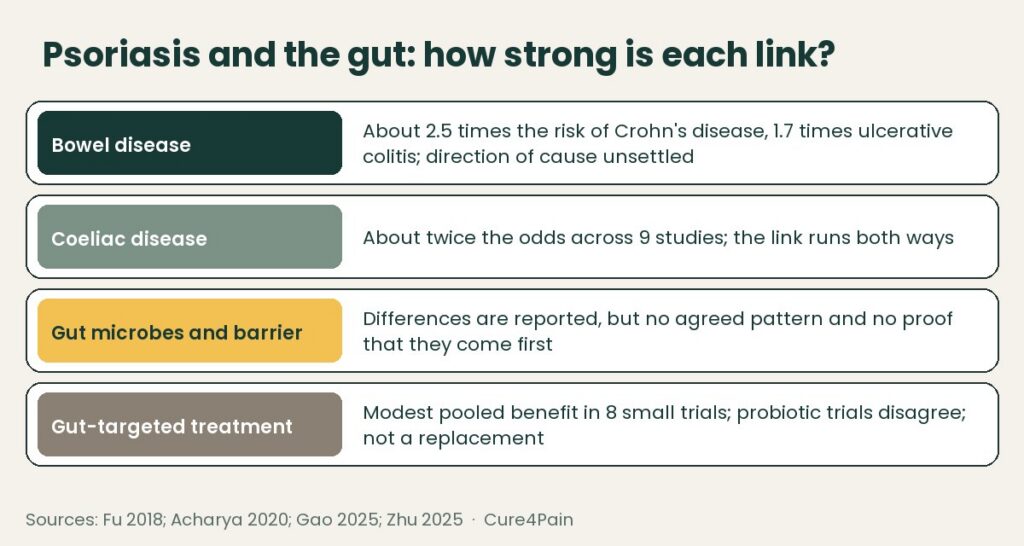
- Well documented: higher rates of Crohn’s disease, ulcerative colitis and coeliac disease in people with psoriasis [1] [2].
- Reported, but not settled: differences in gut bacteria and raised markers of gut barrier damage in people with psoriasis [3] [4].
- Not shown: that a gut change comes before psoriasis in people, or that correcting it controls the skin disease.
The practical question is whether you have a measurable gut problem, because coeliac disease, bowel inflammation and poor absorption can be tested for and managed in their own right.
What is the gut-skin connection?
The gut-skin connection, or gut-skin axis, is the idea that gut microbes and the gut’s immune system influence inflammation in the skin. A 2026 review proposes several routes: effects on the IL-17 and IL-23 immune pathway, weaker regulatory immune cells, bacteria crossing a damaged barrier, and changes in bacterial products [8]. IL-17 and IL-23 are key drivers of psoriasis, which is why modern medicines target them [7].
Researchers weigh the gut-skin connection differently. A 2026 review in Clinical, Cosmetic and Investigational Dermatology sees support from animal studies, faecal transplant experiments and genetic studies for a causal role of some bacteria [8]. A 2021 review in the Journal of Internal Medicine says changes in gut and skin bacteria have been reported in psoriasis, “but it is less clear whether and how these changes contribute” [9].
Are gut bacteria different in psoriasis?
Gut bacteria in people with psoriasis differ on average from those of healthy people, but no single pattern has been agreed. A 2025 systematic review in the journal Pathogens, of DNA-based studies from 2015 to 2024, found patterns distinct from healthy people, with “inconsistencies across studies” in the specific bacteria [3].
- Treatment changes the gut too: a 2024 systematic review found that biological medicines, conventional medicines, light therapy and probiotics all shift gut bacteria, and good treatment results went with a pattern closer to that of healthy people [10]. So a difference in gut bacteria seen at one time point cannot show whether it came before psoriasis or after it.
- Genetic studies disagree: Mendelian randomisation uses inherited gene variants to estimate cause and effect. A 2023 study estimated that a bacterial group called Eubacterium fissicatena raises the risk of psoriasis (odds ratio 1.22) [11], while a 2024 study estimated that the same group lowers it (odds ratio 0.83) [12].
Can leaky gut cause psoriasis?
Leaky gut has not been shown to cause psoriasis. Some people with psoriasis have signs of a weaker gut barrier, but studies of this measure the barrier and the skin at the same time, so they cannot show which came first. Our October 2026 PubMed search found no study that followed people from before psoriasis began.
| Study | What it found | Limits |
|---|---|---|
| Blood claudin-3, 2019 | Higher in 60 people with psoriasis than in 30 controls, and higher with more severe skin disease [4] | Cross-sectional; a research marker |
| Claudin-3 and I-FABP, 2021 | 68 of 114 people were classed as having an altered barrier; they had more gut symptoms and higher PASI (Psoriasis Area and Severity Index) scores, 19.7 against 10.3 [13] | No healthy group in the comparison; a single time point |
| Gut biopsies, 2025 | Half of people with mild to moderate psoriasis had raised permeability in the upper small intestine, in step with gut immune signals including IL-17A and with gut symptoms [14] | A research method; shows a link, not a cause |
Raised gut permeability may also be an effect of inflammation rather than its cause, and it is not necessarily harmful, according to a 2019 review in the journal Gut, which adds that it is “still unproven that restoring barrier function can ameliorate clinical manifestations” in gut or other diseases [15]. Which permeability tests exist, and what they can and cannot show, is covered in our article on leaky gut tests.
Are psoriasis and inflammatory bowel disease connected?
Yes: psoriasis and inflammatory bowel disease occur together more often than expected, in both directions. A 2018 analysis in JAMA Dermatology of 9 studies found about 2.5 times the risk of Crohn’s disease and 1.7 times the risk of ulcerative colitis in the 4 cohort studies, with about 6 million people, and about 1.7 times the odds of each in the other 5 studies [1]. The absolute numbers are small: about 0.7% of people with psoriasis had Crohn’s disease and 0.5% had ulcerative colitis, in a 2020 analysis of 93 studies in the Journal of Crohn’s and Colitis [16].
- Severity: in a 2016 study in the British Journal of Dermatology, using Danish registers of 5.55 million adults, the risk of Crohn’s disease was 1.28 times higher with mild psoriasis, 2.56 times with severe psoriasis defined by hospital visits and 3.42 times with psoriatic arthritis [17].
- Direction of cause: a 2022 genetic study in JAMA Dermatology supported an effect of inflammatory bowel disease, mainly Crohn’s disease, on psoriasis and not the other way round [18]. Another 2022 study agreed on that direction but also found a link from psoriasis to Crohn’s disease [19]. The two conditions share genes and immune pathways [17] [20].
- Treatment choice: a 2022 systematic review found that TNF inhibitors and IL-12/23 inhibitors have treated both diseases, while IL-17 inhibitors treat psoriasis but “have the potential to exacerbate” bowel disease [20]. In a trial of 59 people with Crohn’s disease, the IL-17 inhibitor secukinumab did not work and caused more side effects than placebo [21]. Bowel disease on IL-17 inhibitors is uncommon: cases were reported in 0.4% of people across 106 trials with 40,053 people [22], and the risk of new bowel disease was not different from placebo in a 2020 analysis [23].
- The other way round: biological medicines can also bring on psoriasis in people with bowel disease, called paradoxical psoriasis [16].
People with psoriasis should tell their doctor about bowel symptoms before a biological medicine is chosen, because IL-17 inhibitors “have the potential to exacerbate” bowel disease [20].
Is psoriasis linked to coeliac disease and gluten?
Psoriasis is linked with coeliac disease in both directions, while the evidence on gluten-free diets is small and uncontrolled. A 2020 analysis in the Journal of the American Academy of Dermatology found about twice the odds of coeliac disease in people with psoriasis (odds ratio 2.16, 9 studies) and 1.8 times the odds of psoriasis in people with coeliac disease (8 studies) [2]. A 2022 genetic study supported an effect of coeliac disease on psoriasis (odds ratio 1.23) but not the other way round [24].
- Gluten-free diet: the evidence is small and uncontrolled. In a 2000 study, 30 of 33 people with anti-gliadin antibodies completed 3 months gluten-free and their PASI scores fell, the 6 people without antibodies did not improve, and psoriasis worsened in 18 of the 30 on returning to their usual diet [25].
- Guideline view: the US National Psoriasis Foundation weakly recommends a gluten-free diet only for people with positive blood tests for gluten sensitivity [26].
- Test before stopping: the NHS advises eating gluten during coeliac testing, because “avoiding it could lead to an inaccurate result” [27].
- At Cure4Pain: as clinic practice, we generally advise most patients to replace wheat with jowar, bajra or other millets as a general health measure, as our psoriasis diet article explains. Within our gut tests, coeliac antibodies are done before wheat or gluten is removed.
Can psoriasis cause stomach problems?
Gut symptoms are more common with psoriasis, although studies have not shown that psoriasis itself is the cause. In a 2018 internet survey of 740 people with self-reported moderate to severe psoriasis and 1,411 without it, belly pain, bloating, diarrhoea, mucus or blood in the stool and unintentional weight loss were all more common with psoriasis, and more so with severe disease or psoriatic arthritis [28]. A 2025 biopsy study in mild to moderate psoriasis found low-grade gut inflammation that may contribute to abdominal symptoms [14].
- Medicines: nausea and diarrhoea were among the most common side effects of apremilast in a 52-week trial [29], and diarrhoea was reported in 2.5% of people on IL-17 inhibitors in trials [22]. Report these rather than stopping the medicine yourself.
- Poor absorption: in a 2006 study, an absorption test was abnormal in 60% of 55 people with psoriasis and 3% of 65 healthy people; among those affected, 6% had coeliac disease and 21% bacterial overgrowth [30]. It was a small, older study. Which nutrients run low is covered in our article on vitamin deficiencies linked to psoriasis.
Which gut tests make sense if you have psoriasis?
For people with psoriasis who have bowel symptoms, the tests that make sense look for specific, measurable problems: stool calprotectin for Crohn’s disease or ulcerative colitis, an antibody blood test for coeliac disease, and a breath test for small intestinal bacterial overgrowth. A 2018 analysis in JAMA Dermatology and a 2020 analysis in the Journal of the American Academy of Dermatology both suggest a gastroenterology opinion when bowel complaints are present [1] [2].
| Possible problem | Test | Note |
|---|---|---|
| Crohn’s disease or ulcerative colitis | Stool calprotectin, then colonoscopy where needed | NICE recommends calprotectin to help tell these from IBS in adults with recent symptoms when cancer is not suspected [31] |
| Coeliac disease | Antibody blood test while still eating gluten | Stopping gluten first can make the result inaccurate [27] |
| Small intestinal bacterial overgrowth | Breath test | Diagnosed this way in the American College of Gastroenterology guideline [32]; we found one small study [30] and no trial in psoriasis |
Commercial stool microbiome tests are different: in a 2024 study in the journal Microbiome, 21 experts reviewed reports from 6 companies on one sample and judged the interpretations premature and of limited clinical use [33].
See a doctor promptly about blood in your stool, losing weight without trying, or a change in bowel habit that is not usual for you, according to the NHS; black or dark red stool or bloody diarrhoea needs urgent advice [34].
Do probiotics help psoriasis?
Probiotics may add a modest benefit to standard psoriasis treatment, but the trials are small and disagree.
- Pooled trials, 2025: 8 randomised trials with 409 people, 6 of them of probiotics, found a modest fall in PASI scores with gut-targeted treatments. Results varied widely, the fall lost significance when either of two small trials was left out, and the authors rated the evidence as low certainty. Side effects, quality of life and C-reactive protein did not differ [5].
- A trial in favour: in a 2019 trial of 90 adults with plaque psoriasis using steroid and vitamin D analogue creams, 66.7% on a probiotic mixture and 41.9% on placebo had a fall in PASI of at least 75% at 12 weeks. The trial was company-supported, and six authors worked for those companies [35].
- A trial against: in the largest of the 8 pooled trials, a 2023 trial of 103 adults in Brazil on standard care, Lactobacillus rhamnosus for 6 months made no difference compared with placebo [6].
Probiotic trials in psoriasis used different strains, so no single product can be recommended from them. Ask your doctor first if you have a weak immune system or a serious illness.
Do antibiotics or a faecal transplant help psoriasis?
Neither antibiotics nor a faecal transplant is supported by good evidence in psoriasis at present. In a 2025 analysis of gut-targeted treatments in BMC Immunology, the strongest effect came from antibiotics, but it rests on a single trial of azithromycin in 43 people [5].
- Faecal transplant in psoriasis: we found no randomised trial in skin psoriasis (PubMed search, 30 October 2026).
- Faecal transplant in psoriatic arthritis: in an exploratory randomised trial of 31 adults on methotrexate, more people needed stronger treatment after a faecal transplant than after a sham procedure (60% against 19%), and there were no serious side effects [36]. Skin scores in this trial did not differ, according to the 2025 analysis [5]. Changing gut bacteria is therefore not automatically helpful.
How we look at the gut in psoriasis at Cure4Pain
At Cure4Pain, gut care is one part of an integrative plan used alongside guideline psoriasis treatment, never instead of it, and we look for measurable causes first.
- Digestive assessment: your gut symptoms, possible triggers and medicines. We read a panel of about 100 markers, adding tests for your condition when clinically indicated: stool tests for inflammation [31] and parasites, coeliac antibodies [27], a SIBO breath test [32] and an H. pylori test. We rarely use commercial microbiome tests.
- Gut support: gut barrier support where relevant, with Saccharomyces boulardii and broad-spectrum probiotics, prebiotics, digestive enzymes, bile support, glutamine, zinc, thiamine and magnesium, chosen for each person. Supplements are given by mouth first, with injections only when specifically needed or advised; magnesium is mainly bisglycinate, with L-threonate or citrate as advised, counted as elemental magnesium. We found no trial of this combination in psoriasis.
- Supervised gut protocols: for bacterial overgrowth, managed directly by Dr Krushal Pabari, with prescription medicines where needed and probiotics.
- Diet and habits: the food rules in our psoriasis diet article; our gut dysbiosis page lists the wider removals used in gut care, along with slow chewing, no water with meals and restorative sleep. As an observational clinic practice, we generally suggest limiting cruciferous (Brassica) vegetables such as cabbage and cauliflower; a 2024 systematic review found that daily intake, particularly with enough iodine, poses no adverse effects on thyroid function [37].
- Supervised vitamin D therapy (Coimbra Protocol): for some patients, guided by PTH and regular blood tests; see our Coimbra Protocol page. Our methods are derived from the work of Dr Coimbra. We found no randomised trial of this approach in psoriasis (PubMed search, 30 October 2026).
- Guideline treatment: according to the American Academy of Dermatology and National Psoriasis Foundation guidelines (2019 to 2021) and the UK NICE guideline (updated 2017), treatment follows severity: corticosteroid and vitamin D analogue creams, then narrowband UVB light therapy, then methotrexate, ciclosporin, acitretin or apremilast, and biological medicines such as TNF, IL-12/23, IL-17 and IL-23 inhibitors [38] [39] [40] [41]. At Cure4Pain, Dr Krushal Pabari prescribes and adjusts these medicines as per guidelines, under clinical guidance from Team Cure4Pain, in coordination with your existing consulting physician and your dermatologist for skin treatments, light therapy and biological medicines where needed; never stop or change them on your own.
- Further tests and referral: Dr Krushal Pabari recommends endoscopy or colonoscopy where the diagnosis calls for it, and we refer you to a gastroenterologist when an ulcer, cancer or other serious cause is suspected.
This is our clinic practice; individual results vary, and further studies are needed. Read more on our psoriasis page.
If you would like your skin and gut symptoms assessed together, you can book a consultation, online from anywhere or at our Mumbai clinic.
Frequently asked questions
Can leaky gut cause psoriasis?
Leaky gut has not been shown to cause psoriasis. Small studies find raised gut barrier markers in psoriasis, but they measure the barrier and the skin at the same time, and we found no study showing that the barrier change comes first. [4] [13]
Does psoriasis start in the gut?
There is no proof that psoriasis starts in the gut. According to a 2021 review in The Lancet, psoriasis comes from genetic risk and triggers such as infection, stress, smoking, obesity and alcohol; gut changes are linked with it, and genetic studies of gut bacteria disagree. [7] [11] [12]
Can psoriasis cause stomach problems?
Gut symptoms are more common in people with psoriasis, but the cause is not established. Bowel disease, coeliac disease and medicine side effects are possible explanations that can be checked. [28] [1] [2]
Should I be tested for coeliac disease if I have psoriasis?
A 2020 analysis in the Journal of the American Academy of Dermatology suggests screening questions, followed by a gastroenterology opinion, for people with psoriasis who have bowel complaints. The NHS advises eating gluten during coeliac testing, so keep eating it until any test is done. [2] [27]
Does a faecal transplant help psoriasis?
A faecal transplant is unproven for psoriasis. We found no randomised trial in skin psoriasis, and in a trial in psoriatic arthritis more people needed stronger treatment after a transplant than after a sham procedure. [36]
Should I do a gut microbiome test for psoriasis?
Commercial stool microbiome tests are not yet useful for treatment decisions: experts judged their reports premature and of limited clinical use. Tests for specific problems, such as stool calprotectin or coeliac antibodies, answer a clearer question. [33] [31]
Will improving my gut health clear my psoriasis?
No trial has shown that improving gut health clears psoriasis. Gut-targeted treatments gave a modest fall in severity scores at best, so they are used alongside standard treatment, not in place of it. [5] [26]
How long does it take to improve gut symptoms?
No trial in psoriasis has set a timeline. In our clinic, most people with gut symptoms notice meaningful improvement within 18 to 30 weeks; this is a clinic observation about gut symptoms, not skin, individual results vary, and further studies are needed.
This article is for education and does not replace medical advice. Do not start, stop or change any medicine or supplement without medical guidance.
References
1. Fu Y, et al. Association of Psoriasis With Inflammatory Bowel Disease: A Systematic Review and Meta-analysis. JAMA Dermatol 2018;154(12):1417-1423. doi:10.1001/jamadermatol.2018.3631
2. Acharya P, Mathur M. Association between psoriasis and celiac disease: A systematic review and meta-analysis. J Am Acad Dermatol 2020;82(6):1376-1385. doi:10.1016/j.jaad.2019.11.039
3. Gao Y, et al. Characterization of the Gut Microbiota in Patients with Psoriasis: A Systematic Review. Pathogens 2025;14(4). doi:10.3390/pathogens14040358
4. Sikora M, et al. Claudin-3 – a new intestinal integrity marker in patients with psoriasis: association with disease severity. J Eur Acad Dermatol Venereol 2019;33(10):1907-1912. doi:10.1111/jdv.15700
5. Zhu L, et al. Efficacy and safety of gut microbiota-targeted therapy in patients with psoriasis: a systematic review and meta-analysis of randomized controlled trials. BMC Immunol 2025;26(1):72. doi:10.1186/s12865-025-00747-y
6. Suriano ES, et al. Efficacy of an adjuvant Lactobacillus rhamnosus formula in improving skin lesions as assessed by PASI in patients with plaque psoriasis from a university-affiliated, tertiary-referral hospital in São Paulo (Brazil): a parallel, double-blind, randomized clinical trial. Arch Dermatol Res 2023;315(6):1621-1629. doi:10.1007/s00403-023-02553-1
7. Griffiths CEM, et al. Psoriasis. Lancet 2021;397(10281):1301-1315. doi:10.1016/S0140-6736(20)32549-6
8. Zhao N, et al. Gut Microbiota in Psoriasis: Evidence for Dysbiosis, Pathological Mechanisms, Causality, and Therapeutic Implications. Clin Cosmet Investig Dermatol 2026;19:630661. doi:10.2147/CCID.S630661
9. Hedin CRH, et al. Inflammatory bowel disease and psoriasis: modernizing the multidisciplinary approach. J Intern Med 2021;290(2):257-278. doi:10.1111/joim.13282
10. Korneev A, et al. Modulation of the skin and gut microbiome by psoriasis treatment: a comprehensive systematic review. Arch Dermatol Res 2024;316(7):374. doi:10.1007/s00403-024-03024-x
11. Zang C, et al. Causal Associations Between Gut Microbiota and Psoriasis: A Mendelian Randomization Study. Dermatol Ther (Heidelb) 2023;13(10):2331-2343. doi:10.1007/s13555-023-01007-w
12. Wu R, et al. Psoriasis and gut microbiota: A Mendelian randomization study. J Cell Mol Med 2024;28(1):e18023. doi:10.1111/jcmm.18023
13. Sikora M, et al. Clinical Implications of Intestinal Barrier Damage in Psoriasis. J Inflamm Res 2021;14:237-243. doi:10.2147/JIR.S292544
14. Lundquist P, et al. Mild-to-moderate psoriasis is associated with subclinical inflammation in the duodenum and a tendency of disturbed intestinal barrier. Biochim Biophys Acta Mol Basis Dis 2025;1871(3):167634. doi:10.1016/j.bbadis.2024.167634
15. Camilleri M. Leaky gut: mechanisms, measurement and clinical implications in humans. Gut 2019;68(8):1516-1526. doi:10.1136/gutjnl-2019-318427
16. Alinaghi F, et al. Global Prevalence and Bidirectional Association Between Psoriasis and Inflammatory Bowel Disease-A Systematic Review and Meta-analysis. J Crohns Colitis 2020;14(3):351-360. doi:10.1093/ecco-jcc/jjz152
17. Egeberg A, et al. Association between psoriasis and inflammatory bowel disease: a Danish nationwide cohort study. Br J Dermatol 2016;175(3):487-92. doi:10.1111/bjd.14528
18. Freuer D, et al. Association Between Inflammatory Bowel Disease and Both Psoriasis and Psoriatic Arthritis: A Bidirectional 2-Sample Mendelian Randomization Study. JAMA Dermatol 2022;158(11):1262-8. doi:10.1001/jamadermatol.2022.3682
19. Li Y, et al. Causal Association Between Inflammatory Bowel Disease and Psoriasis: A Two-Sample Bidirectional Mendelian Randomization Study. Front Immunol 2022;13:916645. doi:10.3389/fimmu.2022.916645
20. Conforti C, et al. Spotlight on the treatment armamentarium of concomitant psoriasis and inflammatory bowel disease: a systematic review. J Dermatolog Treat 2022;33(3):1279-1286. doi:10.1080/09546634.2020.1836313
21. Hueber W, et al. Secukinumab, a human anti-IL-17A monoclonal antibody, for moderate to severe Crohn’s disease: unexpected results of a randomised, double-blind placebo-controlled trial. Gut 2012;61(12):1693-700. doi:10.1136/gutjnl-2011-301668
22. Caron B, et al. Gastroenterological safety of IL-17 inhibitors: a systematic literature review. Expert Opin Drug Saf 2022;21(2):223-239. doi:10.1080/14740338.2021.1960981
23. Burisch J, et al. Risk for development of inflammatory bowel disease under inhibition of interleukin 17: A systematic review and meta-analysis. PLoS One 2020;15(5):e0233781. doi:10.1371/journal.pone.0233781
24. Li L, et al. Mendelian randomization study of the genetic interaction between psoriasis and celiac disease. Sci Rep 2022;12(1):21508. doi:10.1038/s41598-022-25217-y
25. Michaëlsson G, et al. Psoriasis patients with antibodies to gliadin can be improved by a gluten-free diet. Br J Dermatol 2000;142(1):44-51. doi:10.1046/j.1365-2133.2000.03240.x
26. Ford AR, et al. Dietary Recommendations for Adults With Psoriasis or Psoriatic Arthritis From the Medical Board of the National Psoriasis Foundation: A Systematic Review. JAMA Dermatol 2018;154(8):934-950. doi:10.1001/jamadermatol.2018.1412
27. NHS. Coeliac disease: diagnosis. nhs.uk/conditions/coeliac-disease/diagnosis
28. Feldman SR, et al. Gastrointestinal Signs and Symptoms Related to Inflammatory Bowel Disease in Patients With Moderate-to-Severe Psoriasis. J Drugs Dermatol 2018;17(12):1298-1308. PubMed 30586262
29. Paul C, et al. Efficacy and safety of apremilast, an oral phosphodiesterase 4 inhibitor, in patients with moderate-to-severe plaque psoriasis over 52 weeks: a phase III, randomized controlled trial (ESTEEM 2). Br J Dermatol 2015;173(6):1387-99. doi:10.1111/bjd.14164
30. Ojetti V, et al. Malabsorption in psoriatic patients: cause or consequence? Scand J Gastroenterol 2006;41(11):1267-71. doi:10.1080/00365520600633529
31. National Institute for Health and Care Excellence (NICE). Faecal calprotectin diagnostic tests for inflammatory diseases of the bowel (HTG320, formerly DG11). nice.org.uk/guidance/htg320
32. Pimentel M, et al. ACG Clinical Guideline: Small Intestinal Bacterial Overgrowth. Am J Gastroenterol 2020;115(2):165-178. doi:10.14309/ajg.0000000000000501
33. Rodriguez J, et al. Microbiome testing in Europe: navigating analytical, ethical and regulatory challenges. Microbiome 2024;12(1):258. doi:10.1186/s40168-024-01991-x
34. NHS. Symptoms of bowel cancer. nhs.uk/conditions/bowel-cancer/symptoms
35. Navarro-López V, et al. Efficacy and Safety of Oral Administration of a Mixture of Probiotic Strains in Patients with Psoriasis: A Randomized Controlled Clinical Trial. Acta Derm Venereol 2019;99(12):1078-1084. doi:10.2340/00015555-3305
36. Kragsnaes MS, et al. Safety and efficacy of faecal microbiota transplantation for active peripheral psoriatic arthritis: an exploratory randomised placebo-controlled trial. Ann Rheum Dis 2021;80(9):1158-1167. doi:10.1136/annrheumdis-2020-219511
37. Galanty A, et al. Do Brassica Vegetables Affect Thyroid Function?-A Comprehensive Systematic Review. Int J Mol Sci 2024;25(7). doi:10.3390/ijms25073988
38. Elmets CA, et al. Joint AAD-NPF Guidelines of care for the management and treatment of psoriasis with topical therapy and alternative medicine modalities for psoriasis severity measures. J Am Acad Dermatol 2021;84(2):432-470. doi:10.1016/j.jaad.2020.07.087
39. Menter A, et al. Joint American Academy of Dermatology-National Psoriasis Foundation guidelines of care for the management of psoriasis with systemic nonbiologic therapies. J Am Acad Dermatol 2020;82(6):1445-1486. doi:10.1016/j.jaad.2020.02.044
40. Menter A, et al. Joint AAD-NPF guidelines of care for the management and treatment of psoriasis with biologics. J Am Acad Dermatol 2019;80(4):1029-1072. doi:10.1016/j.jaad.2018.11.057
41. National Institute for Health and Care Excellence (NICE). Psoriasis: assessment and management. Clinical guideline CG153, 2012 (updated 2017). nice.org.uk/guidance/cg153