Written by AT. Chintan Dalal, N.D. · Reviewed by Dr Krushal Pabari, Clinical Team, Cure4Pain · Updated 30 October 2026
Key facts
Diet supports rheumatoid arthritis (RA) treatment but does not replace it. The 2022 American College of Rheumatology (ACR) guideline conditionally recommends a Mediterranean-style diet (vegetables, fruit, whole grains, nuts, seeds and olive oil, with moderate low-fat dairy and fish, and limits on added sugar and processed food) and conditionally recommends against other formally defined diets, citing no consistent, clinically meaningful benefit [1]. A 2026 New Zealand pilot of the AIP (autoimmune protocol) diet in 9 adults with RA reported better symptoms in 7, with no comparison group [2]. Food also matters around medicines: methotrexate opposes folic acid, and a 2013 Cochrane review of 6 trials found that folic or folinic acid supplements lowered its stomach and liver side effects without a clear loss of benefit [3]. RA is linked with higher fracture risk, largely independent of steroid use, in a 2025 analysis of 29 cohorts, so calcium and bone health belong in the plan [4].

Scientific explainer videos in our Resources section
In our Resources section, our clinical team discusses vitamin D, its cofactors and how autoimmune, lifestyle and pain conditions develop.
Can diet help rheumatoid arthritis?
Diet may help rheumatoid arthritis (RA) as a support to medicines, mainly for pain. In a 2021 meta-analysis of 7 randomised trials with 326 people, anti-inflammatory diets (the review covered Mediterranean, vegetarian, vegan and ketogenic diets) lowered pain by about 9 mm on a 100 mm scale compared with ordinary diets, but all had a high risk of bias and the evidence was rated very low [5].
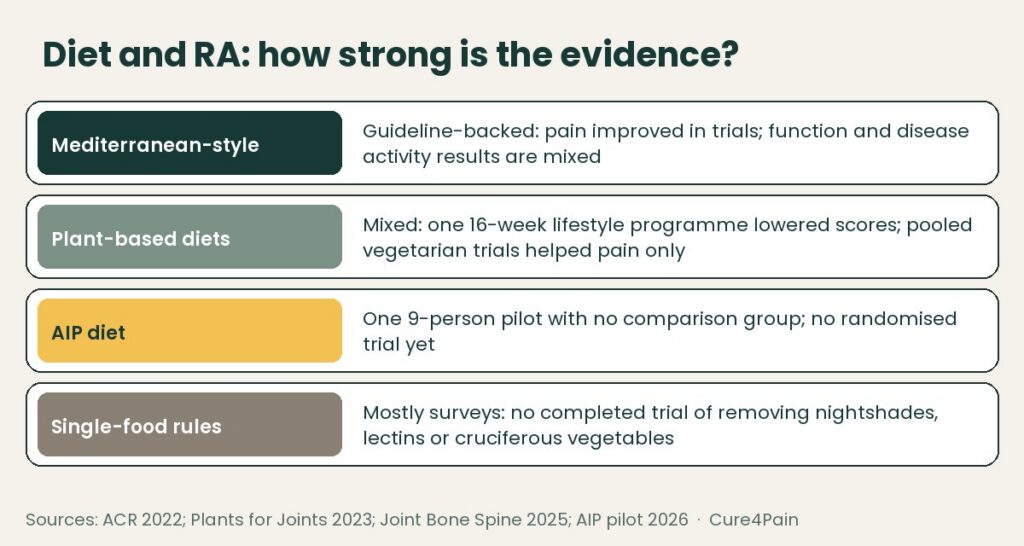
- Guideline view: the 2022 ACR guideline found low to moderate certainty of better pain with a Mediterranean-style diet, and no difference in physical function or disease activity. It conditionally recommends against other formally defined diets, including anti-inflammatory, vegetarian and whole-food plant-based diets, citing no consistent, clinically meaningful benefit and the burden of following them [1].
- European view: the 2021 EULAR lifestyle recommendations stress a healthy, balanced diet, a healthy weight and support to stop smoking [6]. Their review found moderate evidence of small effects for omega-3 in RA, and no high-level evidence of a clinically meaningful effect from any single dietary exposure [7].
- A caution on changing diet: a 2009 Cochrane review of 15 trials with 837 people with RA called the effects of diet changes uncertain, and diet groups had 10 percentage points more drop-outs and 3.2 kg more weight loss than control groups [8].
What is the best diet for rheumatoid arthritis?
A Mediterranean-style diet has the best support for rheumatoid arthritis: the 2022 American College of Rheumatology (ACR) guideline conditionally recommends it over no formally defined diet. The ACR describes it as vegetables, fruit, whole grains, nuts, seeds and olive oil, with moderate low-fat dairy and fish, and limits on added sugar, sodium, highly processed food, refined carbohydrates and saturated fat [1]. Four randomised trials of this and related diets in people with RA gave mixed results:
| Trial | Who and what | Result |
|---|---|---|
| MADEIRA 2023 | 40 women whose RA was in remission (no active disease on a standard score); personal Mediterranean plan plus activity prompts, 12 weeks | Lower DAS28 (disease activity score) than usual care [9] |
| MEDRA 2024, Ireland | 44 adults; Mediterranean diet or national healthy eating advice, 12 weeks | Better function and quality of life with Mediterranean at 12 weeks, but that group started with better function; function improved by a similar amount in both, and the authors credit better overall diet quality [10] |
| ADIRA 2020, Sweden | 50 people; anti-inflammatory foods (fatty fish, whole grains, fruit, nuts, berries) or a usual diet, crossover, 10 weeks each | No significant difference in the main analysis; lower DAS28 only among those who finished both periods [11] [12] |
| Plants for Joints 2023 | 83 adults; whole-food plant-based diet, activity and stress care, 16 weeks | DAS28 improved 0.9 points more than usual care, and weight fell 3.9 kg more [13] |
The ACR itself asks for diet research that includes different cultures [1]. The Mediterranean-style pattern translates to Indian food: millets and rice instead of refined flour, dal and vegetables at each meal, fruit, nuts and seeds, cold-pressed oils, and fish or eggs for those who eat them. Vegetarian and vegan diets alone have weaker support in RA: a 2025 meta-analysis of 7 trials found a small improvement in pain, and none in disease activity or function, with low certainty [14].
What is the AIP diet, and does it help rheumatoid arthritis?
AIP (autoimmune protocol) is a three-phase elimination diet, and whether it helps rheumatoid arthritis is not yet known: the evidence is one small pilot with no comparison group [2]. According to a 2025 review, it first removes grains, legumes, nightshades, nuts, seeds, dairy, eggs, coffee and alcohol, then reintroduces foods one by one to find personal triggers, then settles into a maintenance diet [15].
- The RA pilot: in a 2026 study, 9 adults in New Zealand with RA, about half with low disease activity at the start, followed AIP for 8 weeks. Symptom scores fell and 7 of 9 improved, while one moved from low to moderate activity; average body mass index also fell. There was no comparison group, participants were highly motivated and no blood markers of inflammation were measured [2].
- One year later: in interviews with the same 9 people, most had kept some diet changes, although they found the AIP reintroduction phase burdensome [16].
- Older elimination studies: a 2025 scoping review of 20 intervention studies of elimination diets in RA found no standard protocols and mostly dated methods [17].
- Guideline view: the 2022 ACR guideline does not name AIP, but it conditionally recommends against formally defined diets other than Mediterranean-style, listing elimination and paleo among them [1].
- Nutrient risk: excluding grains on AIP may lower intake of B vitamins, fibre and iron, and the 2025 AIP review advises planning with a dietitian [15].
For Indian vegetarians, strict AIP removes dal, millets, rice, paneer, curd, nuts and eggs, which are most of the protein on the plate. At Cure4Pain we do not ask every patient to follow strict AIP. We consider its idea of removing foods and then testing them again for suitable patients under supervision, alongside anti-inflammatory eating.
Which foods should you avoid with rheumatoid arthritis?
We found no large trial proving that any single food worsens rheumatoid arthritis. As clinic practice, Cure4Pain advises RA patients to limit alcohol and cruciferous vegetables, to replace wheat with millets, and to avoid sugar and processed foods, potato, brinjal, chillies, high-lectin foods, prawns and fish with many fine bones. The table shows what research says and what we advise at Cure4Pain, side by side. These rules follow our psoriasis diet rules.
| Food | What research shows | Our clinic practice |
|---|---|---|
| Alcohol | EULAR 2021: small amounts of alcohol are unlikely to harm, but moderate intake may bring flares in RA [6]. A 2024 meta-analysis of cohort studies linked moderate intake with a lower risk of developing RA, which cannot show cause and is not about flares [18] | We advise limiting |
| Sugar and processed foods | Soda and desserts were the foods most often said to worsen symptoms in a 2017 survey of 217 people with RA [19]; daily sugary soda was linked with seropositive RA in US women [20] | Avoided |
| Wheat and gluten | We found no trial of removing wheat alone. Trials combined it with other changes [21] [22]. The 2022 ACR guideline lists gluten-free among diets it conditionally recommends against [1], and a 2025 Moroccan guideline does not recommend it [23]. It is required in coeliac disease, according to the American College of Gastroenterology (2023) [24] | As clinic practice, we generally advise most patients to replace wheat with jowar, bajra or other millets as a general health measure |
| Nightshades (potato, brinjal, chillies, tomato) | We found no completed trial; an 8-week trial in 40 people was announced in 2024, and we found no results yet [25] | Potato, brinjal and chillies avoided; tomato allowed |
| Cruciferous vegetables (cabbage, cauliflower, broccoli, radish, mustard greens) | We found no RA diet trial; a 2024 systematic review found normal intake of these vegetables, with enough iodine, did not harm thyroid function [26] | As an observational clinic practice, we generally suggest limiting these |
| High-lectin foods (such as rajma, soy and peanuts) | A 2000 review proposed a role in RA [27]; we found no human trial | Avoided |
| Prawns and fish with many fine bones | We found no study in RA | Avoided; other fish allowed |
Trials that removed several foods together gave mixed signals. In a 2001 trial of 66 people with RA, a gluten-free vegan diet for a year brought a 20% improvement (ACR20) in 34.3% against 3.8% on a balanced diet in the intention-to-treat analysis, but did not slow joint damage on X-rays [21]. In a 2021 trial of 40 overweight or obese people with RA, pain and CRP fell on a 3-month diet without meat, gluten or dairy, with both groups losing weight [22].
If you have gut symptoms or suspect coeliac disease, ask for tests before removing wheat, because they need gluten in the diet to be accurate [28]. Dietary salt restriction helped some RA outcomes in a 2021 review [29], and the ACR pattern limits sodium [1], so pickles, papad and namkeen are best limited.
Which foods are good for rheumatoid arthritis?
Foods in a Mediterranean-style pattern have the best support for rheumatoid arthritis, in line with the 2022 ACR guideline: vegetables, fruit, whole grains, nuts, seeds and fish [1]. At Cure4Pain we use whole, home-cooked versions, adapted to our clinic rules:
| Food group | Indian examples |
|---|---|
| Millets and grains | Jowar, bajra, ragi (nachni), foxtail millet (kangni), rice |
| Pulses | Well-cooked moong, masoor and toor dal |
| Vegetables | Spinach (palak), fenugreek (methi), bottle gourd (lauki), ridge gourd (turai), pumpkin (kaddu), carrot (gajar), okra (bhindi), beetroot, cucumber (kheera), French beans, tinda, drumstick (sahjan), tomato |
| Fruit | Papaya, guava (amrood), apple, pomegranate (anaar), banana, orange |
| Nuts and seeds | Walnuts (akhrot), almonds (badam), flaxseed (alsi), pumpkin seeds, sesame (til), fox nuts (makhana) |
| Protein | Paneer and curd (dahi), eggs, chicken, fish (not prawns or fine-boned fish) |
| Fats and spices | Cold-pressed oils, ghee; turmeric (haldi), ginger (adrak), cumin (jeera), coriander (dhania), black pepper |
- Omega-3: trials of supplements in RA disagree. In a 2024 meta-analysis of 18 trials with 1,018 people, supplements reduced tender joints but not DAS28 (disease activity score) [30], while a 2024 review of 23 placebo-controlled trials found limited clinical benefit, with very low to low certainty [31]. For RA itself the 2022 ACR guideline conditionally recommends established dietary advice over adding supplements, while recognising a role for fish oil in heart health [1].
- At Cure4Pain: omega-3 is part of every plan unless there is a reason not to: from fish for people who eat it, and from algal oil for vegetarians and vegans. Our article on omega-3 and autoimmune disease explains the trials.
- Flaxseed (alsi): in a 2022 randomised 12-week trial of 120 people with RA, the 30 g a day studied lowered DAS28 and pain more than roasted wheat, with no difference between groups in CRP or ESR [32].
- Turmeric (haldi): we found no trial of cooking amounts, and the 2022 ACR guideline did not recommend turmeric supplements [1].
A 7-day Indian vegetarian rheumatoid arthritis diet chart
This 7-day Indian vegetarian diet chart for rheumatoid arthritis is a sample week built from Cure4Pain’s clinic rules: no wheat, sugar, potato, brinjal or chillies, and it leaves out cruciferous vegetables, which we generally suggest limiting. It is a sample, not a prescription: your own plan depends on your tests, weight, medicines and other conditions. Drink tea or coffee without sugar, and we advise limiting both; cook with cold-pressed oil or a little ghee, and cook sambar, poriyal and chutneys without green or red chillies or chilli powder; use ginger, black pepper and cumin instead.
- Monday: Breakfast: Ragi dosa with coconut and mint chutney; papaya. Lunch: Jowar roti (jowar bhakri), moong dal, spinach (palak) sabzi, cucumber and tomato salad, curd (dahi). Evening snack: Guava (amrood), walnuts (akhrot). Dinner: Foxtail millet (kangni) khichdi with moong dal and carrot, bottle gourd (lauki) sabzi.
- Tuesday: Breakfast: Moong dal chilla with grated carrot; curd with flaxseed (alsi). Lunch: Rice, toor dal, okra (bhindi) sabzi, beetroot salad. Evening snack: Apple, roasted pumpkin seeds. Dinner: Bajra roti (bajri bhakri), paneer bhurji with tomato, ridge gourd (turai) sabzi.
- Wednesday: Breakfast: Idli with sambar (pumpkin and drumstick). Lunch: Ragi roti (nachni bhakri), masoor dal, fenugreek (methi) sabzi, carrot salad, buttermilk (chaas). Evening snack: Pomegranate (anaar), almonds (badam). Dinner: Moong dal and rice khichdi with ghee, tinda sabzi.
- Thursday: Breakfast: Jowar upma with carrot and French beans; orange. Lunch: Bajra khichdi with vegetables, curd. Evening snack: Roasted fox nuts (makhana), coconut water. Dinner: Rice, spinach dal (palak dal), pumpkin (kaddu) sabzi.
- Friday: Breakfast: Green moong dosa (pesarattu) with coconut chutney. Lunch: Jowar roti, toor dal, French beans sabzi, cucumber raita. Evening snack: Papaya, walnuts. Dinner: Millet pulao with carrot and beans, tomato dal.
- Saturday: Breakfast: Ragi porridge (ragi malt) with banana, no sugar. Lunch: Rice, sambar with drumstick and pumpkin, beans and coconut stir-fry (poriyal), buttermilk. Evening snack: Guava, roasted pumpkin seeds. Dinner: Bajra roti, paneer and tomato curry (paneer tamatar), bottle gourd sabzi.
- Sunday: Breakfast: Poha with carrot; pomegranate. Lunch: Foxtail millet rice, moong dal, okra sabzi, beetroot and cucumber salad, curd. Evening snack: Apple, almonds. Dinner: Moong dal soup, ragi roti, fenugreek (methi) sabzi.
Swaps and notes for the week:
- If you eat eggs or meat: eggs, chicken or fish (not prawns or fine-boned fish) can replace paneer or dal at any meal.
- During supervised vitamin D therapy: milk, curd, paneer and buttermilk are replaced with low-calcium choices, as your plan specifies; ghee is allowed.
- If you take methotrexate: this chart does not replace prescribed folic acid.
- If intermittent fasting is advised for you: the same meals are fitted into the eating window your doctor sets.
What should you eat or avoid on methotrexate?
According to the NHS, no specific foods need to be avoided on methotrexate, but it advises against unpasteurised milk and soft cheeses, because of infection risk, and against too much caffeine, which can stop the medicine working as well [33].
- Folic acid: a 2013 Cochrane review of 6 trials with 624 people on methotrexate for RA found folic or folinic acid lowered stomach side effects by 26%, abnormal rises in liver enzymes by 77% and stopping methotrexate by 61% (relative reductions), with no significant effect on how well it worked [3]. The 3E Initiative, a 2009 panel of 751 rheumatologists from 17 countries, strongly recommends prescribing folic acid with methotrexate [34].
- Food folate has not been tested as a substitute: the Cochrane trials tested folic and folinic acid supplements, not food [3]. In a 2017 study of 727 Swedish people with early RA, food folate was not linked with better or worse treatment response [35], which gives no reason to cut spinach, methi or dal. The NHS advises not taking folic acid on the same day as methotrexate [36]; follow your own prescription.
- Alcohol: the NHS says drinking alcohol is usually fine on a low weekly methotrexate dose for inflammatory conditions [33]. In a 2017 study of 11,839 UK patients with RA on methotrexate, under 14 units of alcohol a week did not appear to raise liver enzyme problems, while more than 21 units a week was linked with them (hazard ratio 1.85) [37]. At Cure4Pain we advise limiting alcohol.
Do you need calcium with rheumatoid arthritis?
Yes, people with rheumatoid arthritis need enough calcium, because RA is linked with more fractures and long-term steroid tablets can cause bone loss. In a 2025 analysis of 29 cohorts, RA was linked with about 1.5 times the risk of any fracture and about 2.2 times the risk of hip fracture, largely independent of steroid use [4].
- Guidelines for people on steroids for about 3 months or more: the 2022 ACR guideline on steroid-related bone loss encourages adequate calcium and vitamin D, weight-bearing exercise and avoiding smoking and excess alcohol, and strongly recommends an early fracture-risk check with bone density testing [38]. The 2024 European Calcified Tissue Society recommendations also advise normal calcium and protein intake for adults on steroids for 3 months or longer [39].
- Indian food sources: paneer, ragi (nachni) and sesame (til) are among the richer sources in the Indian Food Composition Tables [40]. Our article on calcium supplements compares forms and official amounts.
- At Cure4Pain: bone density and fracture-risk checks follow guidelines; calcium from food is set by your tests, vitamin K2 is added where suitable, and bone medicines are prescribed by Dr Krushal Pabari when needed.
Does weight loss or intermittent fasting help rheumatoid arthritis?
Keeping a healthy weight is advised, because obesity is linked with poorer results in rheumatoid arthritis, while research on fasting is at an early stage. In a 2017 meta-analysis, people with RA and obesity had about 43% lower odds of remission, meaning no active disease on a standard score [41]. The 2021 EULAR recommendations advise working with your team to keep a healthy weight [6].
- Intermittent fasting: in a 2025 8-week randomised trial of 44 overweight or obese postmenopausal women with RA, 16:8 fasting improved body mass index, DAS28 and function but not inflammation markers [42]. This group is narrow, and the 2022 ACR guideline lists intermittent fasting among diets it conditionally recommends against [1].
- Longer fasting: a 1991 trial of 53 people with RA found that benefits of a 7 to 10 day fast followed by a year of vegetarian eating were still present after one year [43], while a 2021 review found fasting benefits mostly short-lived [29].
- Who should not fast without advice: at Cure4Pain we consider intermittent fasting for suitable patients under supervision, and we do not advise fasting without supervision for people with diabetes on medicines, pregnant or breastfeeding women, or anyone with a history of eating disorders.
Diet during supervised vitamin D therapy
During supervised vitamin D therapy (Coimbra Protocol), dairy and other high-calcium foods are limited and fluid intake is kept high, as part of the safety rules on our Coimbra Protocol page. Some patients with RA receive this therapy at Cure4Pain, after testing. Our methods are derived from the work of Dr Coimbra. No randomised trial of this approach in rheumatoid arthritis has been published, and the 2022 ACR guideline favours food first for RA itself, while recognising the role of vitamin D for bones [1]. Our article on vitamin D and rheumatoid arthritis explains the trials.
How we plan your diet at Cure4Pain
At Cure4Pain, your diet is one part of an integrative plan used alongside guideline RA treatment, never instead of it.
- Your plan: personalised to your tests, weight and blood sugar, and to your medicines. We read a panel of about 100 markers, adding tests for your condition when clinically indicated, such as rheumatoid factor and anti-CCP, the antibodies scored in the 2010 ACR/EULAR classification criteria [44], and bone density where the guideline calls for it [38].
- Your food rules: jowar, bajra or other millets in place of wheat, as a general health measure; no sugar; alcohol limited; no potato, brinjal or chillies (tomato is fine); cruciferous vegetables limited, as an observational practice; high-lectin foods avoided; paneer, eggs, fruit, chicken and most fish allowed.
- Anti-inflammatory eating and AIP: we consider anti-inflammatory eating and the AIP idea of removing and reintroducing foods for suitable patients under supervision; strict AIP is not a set rule. The 2022 ACR guideline conditionally recommends against formally defined anti-inflammatory and elimination diets [1]; an integrative plan may add options like these alongside standard care.
- Weight and fasting: a lower-calorie plan when weight loss is needed, and intermittent fasting considered for suitable patients under supervision.
- Medicines as per guidelines: the 2025 EULAR update advises starting with methotrexate, ideally with short-term steroids (glucocorticoids); leflunomide and sulfasalazine are the other conventional medicines. If the response is not enough after 3 to 6 months, a biological medicine is added: adalimumab, certolizumab pegol, etanercept, golimumab, infliximab, abatacept, rituximab, tocilizumab or sarilumab. JAK inhibitors (tofacitinib, baricitinib, filgotinib, upadacitinib) may be considered after weighing their risks. In sustained remission (no active disease on a standard score), medicines may be tapered with caution, because stopping often leads to a flare [45].
- Who manages them: at Cure4Pain, Dr Krushal Pabari prescribes and adjusts these medicines as per guidelines, under clinical guidance from Team Cure4Pain, in coordination with your existing consulting physician; never stop or change them on your own.
This is our clinic practice; individual results vary, and further studies are needed. Read more on our rheumatoid arthritis and gut health pages, and in our guide to vegetarian deficiencies and tests.
If you would like a diet plan built around your blood tests and RA treatment, you can book a consultation, online from anywhere or at our Mumbai clinic.
Frequently asked questions
What foods should you avoid with rheumatoid arthritis?
We found no large trial proving that any single food worsens RA. At Cure4Pain we advise limiting alcohol and cruciferous vegetables, replacing wheat with millets, and avoiding sugar and processed foods, potato, brinjal, chillies, high-lectin foods, prawns and fine-boned fish; these are clinic practice, and most are not tested in trials. [19] [25]
What is the best diet for rheumatoid arthritis?
A Mediterranean-style diet has the best support: the 2022 American College of Rheumatology guideline conditionally recommends it, mainly because of better pain, although function and disease activity did not clearly change. [1]
Does the AIP diet help rheumatoid arthritis?
Whether the AIP diet helps rheumatoid arthritis is not yet known. A 2026 New Zealand pilot of 9 adults reported better symptoms in 7 after 8 weeks, but it had no comparison group, and we found no randomised trial. Strict AIP removes dal, grains, dairy, nuts and eggs, so plan it with a professional if you try it. [2] [15]
Is milk or paneer good or bad for rheumatoid arthritis?
In a 2019 cohort of Swedish women, dairy was not linked with developing RA. In a 1992 double-blind trial of 94 people, two artificial diets, with or without milk proteins and yellow dyes, did not differ, although 9 people improved and then worsened on rechallenge, which suggests a small subgroup with food intolerance. At Cure4Pain milk, curd and paneer are allowed, and limited only during supervised vitamin D therapy. [46] [47]
Can rheumatoid arthritis patients eat eggs?
Yes. Eggs are part of the plan at Cure4Pain, and we found no study showing that they worsen RA. The AIP diet removes them during its elimination phase. [15]
Can rheumatoid arthritis patients eat fruit?
Yes. At Cure4Pain fruit is allowed, as whole fruit rather than juice or sweetened fruit products. In a 2024 meta-analysis of 30 cohorts, each 80 g of fruit a day was linked with a 5% lower risk of developing RA, which is about risk rather than symptoms and cannot show cause. [18]
Can rheumatoid arthritis patients eat fish or chicken?
Yes. People with RA who ate fish twice a week or more had lower disease scores in a 2018 cross-sectional study of 176 people, which cannot show cause. At Cure4Pain chicken and fish are allowed, except prawns and fish with many fine bones. [48]
Is a vegetarian diet good for rheumatoid arthritis?
A vegetarian diet may help rheumatoid arthritis pain slightly. A 2025 meta-analysis of 7 trials found a small improvement in pain and none in disease activity or function, with low certainty. A vegetarian plan needs enough protein, calcium, vitamin B12 and omega-3. [14]
What foods should I avoid on methotrexate?
According to the NHS, no specific foods need to be avoided on methotrexate, but it advises against unpasteurised milk and soft cheeses and too much caffeine. At Cure4Pain we also advise limiting alcohol. Take folic acid exactly as prescribed. [33] [36]
What is the best drink for rheumatoid arthritis?
No drink is an established treatment for RA. Water and unsweetened buttermilk suit most plans. Sugary soda is best avoided: it was linked with developing seropositive RA in US women, and it was among the foods people with RA most often said worsened symptoms. In a 2024 meta-analysis of cohort studies, tea went with a 4% higher risk of developing RA per daily cup, which cannot show cause. [20] [19] [18]
This article is for education and does not replace medical advice. Do not start, stop or change any medicine or supplement without medical guidance.
References
1. England BR, et al. 2022 American College of Rheumatology Guideline for Exercise, Rehabilitation, Diet, and Additional Integrative Interventions for Rheumatoid Arthritis. Arthritis Rheumatol 2023;75(8):1299-1311. doi:10.1002/art.42507
2. McNeill JJ, et al. The Effect of an Autoimmune Protocol (AIP) Diet in Adults With Rheumatoid Arthritis: A Single Arm Crossover Pilot Feasibility Study. Musculoskeletal Care 2026;24(2):e70214. doi:10.1002/msc.70214
3. Shea B, et al. Folic acid and folinic acid for reducing side effects in patients receiving methotrexate for rheumatoid arthritis. Cochrane Database Syst Rev 2013;2013(5):CD000951. doi:10.1002/14651858.CD000951.pub2
4. Kanis JA, et al. Rheumatoid arthritis and subsequent fracture risk: an individual person meta-analysis to update FRAX. Osteoporos Int 2025;36(4):653-671. doi:10.1007/s00198-025-07397-1
5. Schönenberger KA, et al. Effect of Anti-Inflammatory Diets on Pain in Rheumatoid Arthritis: A Systematic Review and Meta-Analysis. Nutrients 2021;13(12). doi:10.3390/nu13124221
6. Gwinnutt JM, et al. 2021 EULAR recommendations regarding lifestyle behaviours and work participation to prevent progression of rheumatic and musculoskeletal diseases. Ann Rheum Dis 2023;82(1):48-56. doi:10.1136/annrheumdis-2021-222020
7. Gwinnutt JM, et al. Effects of diet on the outcomes of rheumatic and musculoskeletal diseases (RMDs): systematic review and meta-analyses informing the 2021 EULAR recommendations for lifestyle improvements in people with RMDs. RMD Open 2022;8(2). doi:10.1136/rmdopen-2021-002167
8. Hagen KB, et al. Dietary interventions for rheumatoid arthritis. Cochrane Database Syst Rev 2009;2009(1):CD006400. doi:10.1002/14651858.CD006400.pub2
9. Papandreou P, et al. Mediterranean Diet and Physical Activity Nudges versus Usual Care in Women with Rheumatoid Arthritis: Results from the MADEIRA Randomized Controlled Trial. Nutrients 2023;15(3). doi:10.3390/nu15030676
10. Raad T, et al. Effects of a telehealth-delivered Mediterranean diet intervention in adults with Rheumatoid Arthritis (MEDRA): a randomised controlled trial. BMC Musculoskelet Disord 2024;25(1):631. doi:10.1186/s12891-024-07742-1
11. Vadell AKE, et al. Anti-inflammatory Diet In Rheumatoid Arthritis (ADIRA)-a randomized, controlled crossover trial indicating effects on disease activity. Am J Clin Nutr 2020;111(6):1203-1213. doi:10.1093/ajcn/nqaa019
12. Hulander E, et al. Proposed Anti-Inflammatory Diet Reduces Inflammation in Compliant, Weight-Stable Patients with Rheumatoid Arthritis in a Randomized Controlled Crossover Trial. J Nutr 2021;151(12):3856-3864. doi:10.1093/jn/nxab313
13. Walrabenstein W, et al. A multidisciplinary lifestyle program for rheumatoid arthritis: the ‘Plants for Joints’ randomized controlled trial. Rheumatology (Oxford) 2023;62(8):2683-2691. doi:10.1093/rheumatology/keac693
14. Jensen KY, et al. Effects of vegetarian and vegan diets on disease activity, pain, fatigue, and physical function in patients with rheumatoid arthritis: A systematic review and meta-analysis. Joint Bone Spine 2025;92(6):105958. doi:10.1016/j.jbspin.2025.105958
15. Pardali EC, et al. Autoimmune protocol diet: A personalized elimination diet for patients with autoimmune diseases. Metabol Open 2025;25:100342. doi:10.1016/j.metop.2024.100342
16. McNeill J, et al. Exploring participant experiences with the autoimmune protocol (AIP) diet in rheumatoid arthritis: a longitudinal qualitative study. J Nutr Sci 2026;15:e73. doi:10.1017/jns.2026.10135
17. McNeill J, et al. Elimination reintroduction diets and oral food challenge in adults with rheumatoid arthritis: a scoping review. Nutr Res Rev 2025;38(2):699-716. doi:10.1017/S0954422425000083
18. Dong Y, et al. Dose-Response Associations Between Diet and Risk of Rheumatoid Arthritis: A Meta-Analysis of Prospective Cohort Studies. Nutrients 2024;16(23). doi:10.3390/nu16234050
19. Tedeschi SK, et al. Diet and Rheumatoid Arthritis Symptoms: Survey Results From a Rheumatoid Arthritis Registry. Arthritis Care Res (Hoboken) 2017;69(12):1920-1925. doi:10.1002/acr.23225
20. Hu Y, et al. Sugar-sweetened soda consumption and risk of developing rheumatoid arthritis in women. Am J Clin Nutr 2014;100(3):959-67. doi:10.3945/ajcn.114.086918
21. Hafström I, et al. A vegan diet free of gluten improves the signs and symptoms of rheumatoid arthritis: the effects on arthritis correlate with a reduction in antibodies to food antigens. Rheumatology (Oxford) 2001;40(10):1175-9. doi:10.1093/rheumatology/40.10.1175
22. Guagnano MT, et al. Improvement of Inflammation and Pain after Three Months’ Exclusion Diet in Rheumatoid Arthritis Patients. Nutrients 2021;13(10). doi:10.3390/nu13103535
23. El-Kasmi H, et al. Dietary Recommendations from the Moroccan Society for Rheumatology (SMR) for Patients with Chronic Inflammatory Rheumatic Diseases. Mediterr J Rheumatol 2025;36(1):36-49. doi:10.31138/mjr.030624.dra
24. Rubio-Tapia A, et al. American College of Gastroenterology Guidelines Update: Diagnosis and Management of Celiac Disease. Am J Gastroenterol 2023;118(1):59-76. doi:10.14309/ajg.0000000000002075
25. Golmohammadi A, et al. The evaluation of nightshade elimination diet (NED) on inflammatory and rheumatologic markers of rheumatoid arthritis patients: study protocol for a randomized controlled trial. Trials 2024;25(1):531. doi:10.1186/s13063-024-08372-7
26. Galanty A, et al. Do Brassica Vegetables Affect Thyroid Function?-A Comprehensive Systematic Review. Int J Mol Sci 2024;25(7). doi:10.3390/ijms25073988
27. Cordain L, et al. Modulation of immune function by dietary lectins in rheumatoid arthritis. Br J Nutr 2000;83(3):207-17. doi:10.1017/s0007114500000271
28. NHS (UK National Health Service). Coeliac disease: diagnosis. nhs.uk/conditions/coeliac-disease/diagnosis
29. Philippou E, et al. Rheumatoid arthritis and dietary interventions: systematic review of clinical trials. Nutr Rev 2021;79(4):410-428. doi:10.1093/nutrit/nuaa033
30. Wang W, et al. Effects of omega-3 supplementation on lipid metabolism, inflammation, and disease activity in rheumatoid arthritis: a meta-analysis of randomized controlled trials. Clin Rheumatol 2024;43(8):2479-2488. doi:10.1007/s10067-024-07040-0
31. Gkiouras K, et al. Efficacy of n-3 fatty acid supplementation on rheumatoid arthritis’ disease activity indicators: a systematic review and meta-analysis of randomized placebo-controlled trials. Crit Rev Food Sci Nutr 2024;64(1):16-30. doi:10.1080/10408398.2022.2104210
32. Ghaseminasab-Parizi M, et al. The effect of flaxseed with or without anti-inflammatory diet in patients with rheumatoid arthritis, a randomized controlled trial. Eur J Nutr 2022;61(3):1377-1389. doi:10.1007/s00394-021-02707-9
33. NHS (UK National Health Service). Common questions about methotrexate. nhs.uk/medicines/methotrexate
34. Visser K, et al. Multinational evidence-based recommendations for the use of methotrexate in rheumatic disorders with a focus on rheumatoid arthritis: integrating systematic literature research and expert opinion of a broad international panel of rheumatologists in the 3E Initiative. Ann Rheum Dis 2009;68(7):1086-93. doi:10.1136/ard.2008.094474
35. Lourdudoss C, et al. Are dietary vitamin D, omega-3 fatty acids and folate associated with treatment results in patients with early rheumatoid arthritis? Data from a Swedish population-based prospective study. BMJ Open 2017;7(6):e016154. doi:10.1136/bmjopen-2017-016154
36. NHS (UK National Health Service). How and when to take methotrexate. nhs.uk/medicines/methotrexate
37. Humphreys JH, et al. Quantifying the hepatotoxic risk of alcohol consumption in patients with rheumatoid arthritis taking methotrexate. Ann Rheum Dis 2017;76(9):1509-1514. doi:10.1136/annrheumdis-2016-210629
38. Humphrey MB, et al. 2022 American College of Rheumatology Guideline for the Prevention and Treatment of Glucocorticoid-Induced Osteoporosis. Arthritis Rheumatol 2023;75(12):2088-2102. doi:10.1002/art.42646
39. Paccou J, et al. Prevention and treatment of glucocorticoid-induced osteoporosis in adults: recommendations from the European Calcified Tissue Society. Eur J Endocrinol 2024;191(6):G1-G17. doi:10.1093/ejendo/lvae146
40. Longvah T, et al. Indian Food Composition Tables 2017. National Institute of Nutrition, Indian Council of Medical Research ([nin.res.in/ebooks/IFCT2017.pdf](https://www.nin.res.in/ebooks/IFCT2017.pdf)). The foods named in this article were checked in a digitised copy of IFCT 2017, not in the book itself (npm package ifct2017/compositions, github.com/nodef/ifct2017
41. Liu Y, et al. Impact of Obesity on Remission and Disease Activity in Rheumatoid Arthritis: A Systematic Review and Meta-Analysis. Arthritis Care Res (Hoboken) 2017;69(2):157-165. doi:10.1002/acr.22932
42. Ranjbar M, et al. Effects of intermittent fasting diet in overweight and obese postmenopausal women with rheumatoid arthritis: A randomized controlled clinical trial. Complement Ther Med 2025;91:103189. doi:10.1016/j.ctim.2025.103189
43. Kjeldsen-Kragh J, et al. Controlled trial of fasting and one-year vegetarian diet in rheumatoid arthritis. Lancet 1991;338(8772):899-902. doi:10.1016/0140-6736(91)91770-u
44. Aletaha D, et al. 2010 rheumatoid arthritis classification criteria: an American College of Rheumatology/European League Against Rheumatism collaborative initiative. Ann Rheum Dis 2010;69(9):1580-8. doi:10.1136/ard.2010.138461
45. Smolen JS, et al. EULAR recommendations for the management of rheumatoid arthritis with synthetic and biologic disease-modifying antirheumatic drugs: 2025 update. Ann Rheum Dis 2026;85(6):991-1009. doi:10.1016/j.ard.2026.01.023
46. Sundström B, et al. Consumption of Meat and Dairy Products Is Not Associated with the Risk for Rheumatoid Arthritis among Women: A Population-Based Cohort Study. Nutrients 2019;11(11). doi:10.3390/nu11112825
47. van de Laar MA, van der Korst JK. Food intolerance in rheumatoid arthritis. I. A double blind, controlled trial of the clinical effects of elimination of milk allergens and azo dyes. Ann Rheum Dis 1992;51(3):298-302. doi:10.1136/ard.51.3.298
48. Tedeschi SK, et al. Relationship Between Fish Consumption and Disease Activity in Rheumatoid Arthritis. Arthritis Care Res (Hoboken) 2018;70(3):327-332. doi:10.1002/acr.23295