
Written by AT. Chintan Dalal, N.D. · Reviewed by Dr Krushal Pabari, Clinical Team, Cure4Pain · Updated 30 October 2026
Key facts
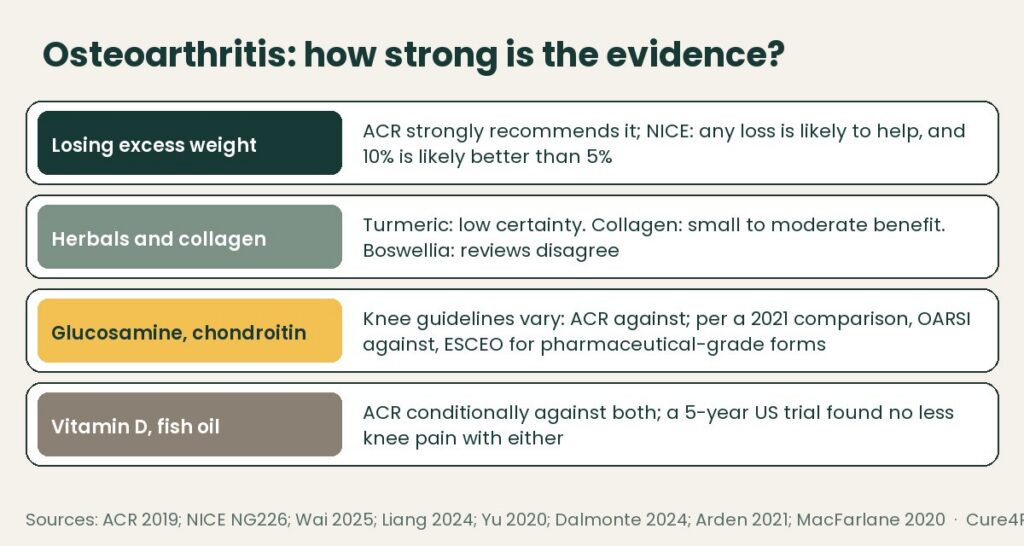
Losing excess weight has the strongest support in osteoarthritis diet research. The American College of Rheumatology (ACR) 2019 strongly recommends it for knee and hip osteoarthritis [1], and the UK’s NICE 2022 says any loss is likely to help, with 10% likely better than 5% [2]; even so, a community trial of 823 people found only a small difference in pain [3]. We found no trial showing that removing any single food eases osteoarthritis. Guidelines disagree on supplements: ACR advises against glucosamine and chondroitin for the knee, and NICE says not to offer glucosamine [1] [2]; a 2021 comparison of two other guidelines reports that OARSI strongly advises against both for the knee, while Europe’s ESCEO recommends pharmaceutical-grade forms [4]. Pooled trials found less knee pain with turmeric, on low-certainty evidence, and a small to moderate benefit with collagen [5] [6]; reviews of boswellia disagree [7] [8]. ACR conditionally advises against vitamin D and fish oil, and a 5-year US trial in adults with chronic knee pain found no less pain with either [1] [9].

Scientific explainer videos in our Resources section
In our Resources section, our clinical team discusses vitamin D, its cofactors and how autoimmune, lifestyle and pain conditions develop.
What helps osteoarthritis most: diet, weight loss or supplements?
For people with osteoarthritis who are overweight, weight loss together with exercise has the best support. Food patterns come next, on small trials, and supplements are the least certain: a 2018 review in the British Journal of Sports Medicine, covering 69 trials of 20 supplements, found no supplement with clinically important pain relief in the long term [10].
The UK’s NICE guideline (NG226) names therapeutic exercise and weight management, where appropriate, along with information and support, as the core treatments for osteoarthritis [2]. Diet and supplements are additions to that core, not a replacement for it.
Weight also goes with load on the joint: in a study of 142 overweight or obese older adults with knee osteoarthritis, each kilo lost went with about four kilos less force on the knee per step [11]. Other knee pain relief, such as exercises, heat and cold, and walking aids, is on our knee pain page.
Does losing weight help osteoarthritis? How much is enough?
Yes for knee osteoarthritis, in people who are overweight, and greater loss has generally gone with greater benefit. The UK’s NICE says any amount of weight loss is likely to help and that losing 10% of body weight is likely to be better than 5% [2]. The size of the benefit varied between trials, and the hip result is less clear.
- IDEA trial: 454 overweight older adults with knee osteoarthritis were followed for 18 months. Those on diet plus exercise lost 11.4% of their weight on average and had less pain than those on exercise alone, who lost 2.0% (3.6 against 4.7 on a 0 to 20 scale) [12].
- More loss, more benefit: in a later analysis of the IDEA trial (240 people), those who lost 20% or more had 25% less pain than those who lost 10% to 19.9%; the groups were formed by the weight people lost, not by chance, so this shows a link [13].
- Everyday settings: in a 2022 JAMA trial of a diet and exercise programme in US community settings (823 adults with knee osteoarthritis and a BMI of 27 or more, 18 months), weight fell by 8% against 2% in the comparison group, but the pain difference was 0.6 points on a 0 to 20 scale, less than the 1.6 points counted as clinically important. The authors called its importance uncertain [3].
- Hip: in a 2025 trial of 101 adults with hip osteoarthritis, a very low-calorie diet added to exercise produced 8.5% more weight loss but did not change hip pain at 6 months, although most other measures improved [14]. NICE says its weight advice could be applied to other joints, while noting that the evidence was from people with knee osteoarthritis [2].
- Keep the muscle: a 2021 analysis of 30 studies concluded that exercise is essential during weight loss to preserve lean body mass [15].
What is the best diet for osteoarthritis?
No single diet is proven best for osteoarthritis. Mediterranean-style and whole-food plant-based patterns have shown some benefit, in two small 16-week trials [16] [17].
- Mediterranean-style: in a UK trial of 99 people with osteoarthritis, 16 weeks of this diet did not change the main arthritis impact scores. Knee and hip movement and one marker of cartilage breakdown improved in the diet group, among the 54 to 61 people who attended for these measurements [16].
- Whole-food plant-based lifestyle programme: in a Dutch trial of 66 people with hip or knee osteoarthritis and metabolic syndrome, a 16-week programme of diet, activity and stress management improved symptoms by 11 points more on a 0 to 96 scale than usual care, with 5 kg more weight loss. Diet cannot be separated from the other parts of the programme [17].
These patterns translate easily into Indian food. The table gives general examples, not a tested osteoarthritis diet.
| Food group | Indian examples |
|---|---|
| Millets and grains | Jowar, bajra, ragi (nachni), foxtail millet (kangni), rice |
| Pulses | Moong, masoor and toor dal |
| Vegetables | Bottle gourd (lauki), ridge gourd (turai), pumpkin (kaddu), spinach (palak), fenugreek (methi), carrot, okra (bhindi), beetroot, cucumber, French beans, drumstick |
| Fruit | Papaya, guava, apple, pomegranate, orange |
| Nuts and seeds | Walnuts, almonds, flaxseed (alsi), pumpkin seeds |
| Protein | Curd, paneer, eggs, fish, chicken, alongside the pulses above |
| Fats and spices | Cold-pressed oils, a little ghee; turmeric, ginger, cumin, black pepper |
What foods should you avoid with osteoarthritis?
We found no trial showing that removing any single food eases osteoarthritis. Observational studies link ultra-processed foods with knee osteoarthritis and frequent soft drinks with faster knee joint narrowing in men, but they show links rather than causes, and studies on milk and dairy point in different directions [18] [19] [20] [21].
- Ultra-processed foods: in UK Biobank (163,987 people), the highest intake went with a 10% higher risk of knee osteoarthritis, but not hip osteoarthritis [18].
- Soft drinks: frequent intake went with faster narrowing of the knee joint space in men, but not in women, in a US study of 2,149 people [19].
- Milk and dairy: the studies point in different directions. More milk went with slower knee progression in women in one US study [20], while more dairy went with more hip replacements in men in an Australian study, with no link in women [21].
- Nightshades (tomato, potato, brinjal): we found no randomised trial of removing them in osteoarthritis.
- Cruciferous vegetables (cabbage, cauliflower, broccoli): as an observational clinic practice, we generally suggest limiting cruciferous (Brassica) vegetables such as cabbage and cauliflower. This is clinic practice, not a research finding. In a small study of 40 people before knee replacement, broccoli compounds reached the joint fluid, but the study did not test whether this eases symptoms [22]. A 2024 review found that eating these vegetables, particularly with enough iodine, had no adverse effect on thyroid function [23].
A sample Indian diet chart for osteoarthritis
A sample Indian diet chart for osteoarthritis can draw on millets, pulses, vegetables, fruit, nuts and curd, as in the two vegetarian days below. They are not a prescription, and we found no trial of a diet chart in osteoarthritis. Your own plan depends on your tests, weight, medicines and other conditions. Drink tea or coffee without sugar.
- Day 1: Breakfast: Moong dal chilla with mint chutney; papaya. Lunch: Jowar roti, toor dal, bottle gourd (lauki) sabzi, cucumber salad, curd. Evening snack: Guava, walnuts. Dinner: Bajra roti, paneer bhurji with tomato, spinach (palak) sabzi.
- Day 2: Breakfast: Ragi porridge with banana, no sugar; almonds. Lunch: Rice, masoor dal, okra (bhindi) sabzi, carrot salad, buttermilk. Evening snack: Apple, roasted pumpkin seeds. Dinner: Foxtail millet and moong dal khichdi with vegetables and a little ghee, cucumber raita.
If you eat eggs, chicken or fish, they can replace paneer or dal at any meal.
What is the best supplement for osteoarthritis?
No supplement is clearly the best for osteoarthritis, and guidelines do not agree. The American College of Rheumatology (ACR) 2019 advises against glucosamine and chondroitin for the knee and the UK’s NICE says not to offer glucosamine [1] [2]; a 2021 comparison of two other guidelines reports that OARSI advises against both, while Europe’s ESCEO recommends pharmaceutical-grade forms [4]. The table shows trials and guidelines side by side.
| Supplement | What trials show | What guidelines say |
|---|---|---|
| Glucosamine | Small or no benefit; better results in industry-funded trials [24] | ACR strongly against [1]; NICE: do not offer [2]; per a 2021 comparison, OARSI against, ESCEO for pharmaceutical-grade form [4] |
| Chondroitin | Small to moderate benefit on low-quality evidence [25] | ACR strongly against for knee and hip, conditionally recommended for hand [1]; per a 2021 comparison, OARSI against, ESCEO for pharmaceutical-grade form [4] |
| Turmeric, curcumin | Less knee pain; low certainty [5] | Not addressed by ACR or NICE [1] [2] |
| Boswellia | Mixed; benefit against placebo in a subgroup [8] | Not addressed by ACR or NICE [1] [2] |
| Collagen | Small to moderate benefit [6] | Not addressed by ACR or NICE [1] [2] |
| Vitamin D | Mostly no clinically important benefit [26] [9] | ACR conditionally against [1] |
| Fish oil, omega-3 | Mixed; no benefit in the largest trial [9] [27] | ACR conditionally against [1] |
Do glucosamine and chondroitin work for knee pain?
Glucosamine and chondroitin probably do little for knee osteoarthritis pain, although the research and the guidelines remain divided. According to the US National Center for Complementary and Integrative Health, it is still uncertain whether they help knee osteoarthritis symptoms [28].
- Against: in the US GAIT trial of 1,583 people, neither glucosamine, chondroitin nor both together beat placebo overall over 24 weeks [29]. A 2010 analysis of 10 large trials (3,803 people) found no clinically relevant effect on pain or joint space, with smaller effects in trials not funded by industry [24].
- For: a 2015 Cochrane review of 43 trials found chondroitin, alone or with glucosamine, improved pain by about 8 points on a 0 to 100 scale in short studies, mostly of low quality; the benefit became uncertain in large trials and those without drug company funding [25]. In a trial of 604 people, sponsored by a company that sells chondroitin, a pharmaceutical-grade product beat placebo and matched celecoxib over 6 months [30]. A 2018 analysis of trials lasting a year or longer linked glucosamine sulfate with less pain, with large uncertainty [31].
- Guidelines: the American College of Rheumatology (ACR) 2019 guideline strongly recommends against glucosamine and chondroitin for the knee and hip, citing the gap between industry-sponsored and publicly funded trials [1]. The UK’s NICE says there is no strong evidence of benefit for glucosamine [2], and the NHS no longer prescribes either [32]. According to a 2021 comparison of the two guidelines, the Osteoarthritis Research Society International (OARSI) 2019 strongly recommends against both for the knee, while the European Society for Clinical and Economic Aspects of Osteoporosis, Osteoarthritis and Musculoskeletal Diseases (ESCEO) 2019 recommends pharmaceutical-grade forms [4]. According to the US National Center for Complementary and Integrative Health, the American Academy of Orthopaedic Surgeons 2021 lists both among supplements that may help mild to moderate knee osteoarthritis, with a caution that the evidence is inconsistent [28].
- Hand: ACR conditionally recommends chondroitin for hand osteoarthritis, based on a single trial [1], and the European EULAR 2018 recommendations include it for symptom relief [33].
Does turmeric help knee pain?
Turmeric extracts reduced knee pain in pooled trials, but the certainty is low. A 2025 analysis of 17 trials found less knee pain with all preparations tested, and rated the evidence as low certainty [5]. The US National Center for Complementary and Integrative Health calls the initial evidence positive and says that higher-quality evidence is needed [34].
- Against placebo: in an Australian trial of 70 people, partly funded by the maker, a turmeric extract eased knee pain over 12 weeks but did not change joint swelling or cartilage [35].
- Indian trials: curcumin matched diclofenac over 28 days in an open-label trial of 139 people in Maharashtra, with fewer side effects (13% against 38%) [36]. A turmeric extract matched paracetamol over 6 weeks in a New Delhi trial [37]. Both trials were short and did not compare the treatments with placebo.
- Kitchen turmeric: the turmeric trials cited here tested capsules and extracts, not turmeric used in cooking.
- Safety: a US liver injury network reported 10 cases linked to turmeric products, including 5 hospital admissions and 1 death; 3 of the 7 products tested also contained piperine, from black pepper [38]. The US National Center for Complementary and Integrative Health warns that highly bioavailable forms may harm the liver [34].
Does boswellia help osteoarthritis?
Boswellia may ease osteoarthritis pain, but the reviews do not fully agree. A 2020 analysis of 7 trials (545 people) found less pain and stiffness [7]. A 2024 analysis of 13 studies in the journal Phytotherapy Research found no significant overall effect because the trials differed so much, though extracts did better than placebo in a subgroup; its authors call for higher-quality studies [8].
Does collagen help osteoarthritis?
Collagen supplements eased osteoarthritis pain and function by a small to moderate amount in a 2024 analysis of 35 trials (3,165 people) in the journal Osteoarthritis and Cartilage, rated moderate certainty for pain and high certainty for function, without more side effects than the control treatments [6]. Its summary reports pain, function and side effects; it does not report that collagen rebuilds cartilage.
Does vitamin D help osteoarthritis?
The largest trials found no clear benefit of vitamin D supplements for knee pain or, where it was measured, cartilage, including in people with low levels at the start [26] [9]. The American College of Rheumatology (ACR) 2019 guideline conditionally recommends against vitamin D, noting that pooled data gave null results [1].
- Low vitamin D at the start: in an Australian trial of 413 people with low levels, two years of monthly vitamin D did not change knee pain or cartilage volume [26].
- Other trials: a two-year US trial of 146 people found no difference [39], and neither did the VITAL trial over 5.3 years, in 1,398 older US adults selected for chronic knee pain [9].
- Where results differ: a pilot trial of 107 people from Lucknow found a small benefit [40].
Low vitamin D still matters for bone and muscle health. Our article on deficiencies and joint pain explains which symptoms a deficiency can cause. According to the US National Institutes of Health, the upper limit for vitamin D is 1,000 to 4,000 IU a day, depending on age [41].
Do omega-3 and fish oil help osteoarthritis?
The evidence on omega-3 and fish oil in osteoarthritis is mixed: the largest trial, the US VITAL trial of 1,398 older adults selected for chronic knee pain, found no effect on that pain over 5.3 years [9], while a 2023 analysis of 9 trials (2,070 people) found a small improvement in pain and function [27]. The American College of Rheumatology (ACR) 2019 guideline conditionally recommends against fish oil, noting that only one trial had tested it at the time [1].
On safety, in heart trials of 81,210 people, marine omega-3 supplements were linked with a higher risk of atrial fibrillation (an irregular heart rhythm), more so above 1 g a day [42].
Who should be careful with joint supplements?
Anyone taking regular medicines, and people with diabetes or liver problems, should ask before starting a joint supplement.
- Blood thinners: according to the US National Center for Complementary and Integrative Health, glucosamine and chondroitin have been linked with a higher risk of bleeding in people taking warfarin [28].
- Diabetes: according to the US National Center for Complementary and Integrative Health, glucosamine may raise blood sugar in some people [28].
- Liver: the US National Center for Complementary and Integrative Health says to stop turmeric or curcumin if you notice tiredness, nausea, poor appetite, dark urine or jaundice; seek medical advice as well [34].
- Pregnancy and breastfeeding: turmeric supplements may be unsafe in pregnancy [34], and little is known about glucosamine and chondroitin [28].
- Heart rhythm, bleeding or surgery: discuss omega-3 supplements first. They have been linked with atrial fibrillation [42], and according to the US National Institutes of Health, high doses might increase bleeding time [43].
How we plan diet and supplements for osteoarthritis at Cure4Pain
At Cure4Pain, nutrition is one part of an integrative plan built on the guideline core of exercise, education and weight management.
- Tests first: we read a panel of about 100 markers, adding tests for your condition when clinically indicated, such as vitamin D, B12, iron, blood sugar, thyroid, uric acid and inflammation markers. The UK’s NICE 2022 diagnoses osteoarthritis clinically and keeps imaging for atypical features or a possible other diagnosis [2]; our blood tests look at your wider health and other possible causes.
- Correcting what is low: we test and correct real deficiencies rather than prescribe supplements by default. We correct low vitamin D for bone and muscle health, not as an osteoarthritis treatment, with supplements by mouth first and injections only when specifically needed or advised.
- Eating pattern: an anti-inflammatory, protein-adequate way of eating that supports muscle and weight, adapted to your food culture, with fewer sugary drinks, sweets and ultra-processed snacks, and a realistic weight plan if needed.
- Omega-3: part of each patient’s nutrition plan, judged from your diet history, unless guidelines advise against it for you. Food comes first, with fish or fish oil for people who eat fish and algal sources for vegetarians and vegans. This is a nutrition choice, not a treatment for osteoarthritis; the ACR position above stands, and an integrative plan may add options alongside standard care.
- Cruciferous vegetables: as an observational clinic practice, we generally suggest limiting cruciferous (Brassica) vegetables such as cabbage and cauliflower; the research is above.
- Wheat: as clinic practice, we generally advise most patients to replace wheat with jowar, bajra or other millets as a general health measure, including home-made roti from processed wheat. Also, a gluten-free diet is supported for coeliac disease and positive tests, and the NHS says people with coeliac disease must stop all gluten for life [44], and our PubMed search (October 2026) found no randomised trial of removing wheat or gluten in osteoarthritis.
- Chondroitin: for hand osteoarthritis, discussed only after reviewing your other medicines.
- The rest of your plan: exercise rehabilitation, hands-on care and naturopathy, including a therapeutic diet, are described on our osteoarthritis page.
- Medicines: any change to painkillers or other medicines is made under clinical guidance from Team Cure4Pain, in coordination with your existing consulting physician; never stop or change them on your own.
- Pain and joint injections: we do not give them, and we refer when they are needed. Our article on knee injections summarises the evidence.
This is our clinic practice; individual results vary, and further studies are needed.
If you would like a nutrition plan built around your tests and your joints, you can book a consultation, online from anywhere or at our Mumbai clinic.
Frequently asked questions
What is the best diet for osteoarthritis?
No single diet is proven best for osteoarthritis. If you are overweight, losing weight with exercise has the strongest evidence. Mediterranean-style and whole-food plant-based patterns have shown some benefit in small trials. [12] [16] [17]
What foods should be avoided with osteoarthritis?
We found no trial showing that removing a single food eases osteoarthritis. Ultra-processed foods have been linked with knee osteoarthritis in a large observational study. At Cure4Pain we advise fewer sugary drinks, sweets and ultra-processed snacks. [18]
Should I take glucosamine for knee pain?
The American College of Rheumatology (ACR) 2019 guideline strongly recommends against glucosamine, citing the gap between industry-sponsored and publicly funded trials, and the UK’s NICE says not to offer it, finding no strong evidence of benefit. A 2021 comparison of guidelines reports that Europe’s ESCEO supports a pharmaceutical-grade form. Ask before starting it, especially if you have diabetes or take warfarin. [1] [2] [4] [28]
How much glucosamine do trials use?
The US GAIT trial tested 1,500 mg of glucosamine a day for 24 weeks and found no overall benefit over placebo. We do not publish doses, because a suitable plan depends on your tests and medicines. [29]
Can turmeric replace painkillers for knee pain?
Two short Indian trials found turmeric products matched diclofenac or paracetamol, but neither used a placebo. Turmeric products have also been linked with liver injury, including serious cases. Do not change any painkiller without medical guidance. [36] [37] [38]
Does collagen rebuild cartilage?
A 2024 analysis of 35 trials found small to moderate improvements in pain and function; its summary does not report that collagen rebuilds cartilage. [6]
Is milk bad for osteoarthritis?
The evidence does not settle this. One US study linked more milk with slower knee changes in women, and an Australian study linked more dairy with more hip replacements in men. Neither was a trial. [20] [21]
How much weight should I lose for knee osteoarthritis?
NICE says any weight loss is likely to help, and 10% of body weight is likely to be better than 5%. In an analysis of the IDEA trial by weight lost, people who lost 20% or more had 25% less pain than those who lost 10% to 19.9%, which shows a link. [2] [13]
This article is for education and does not replace medical advice. Do not start, stop or change any medicine or supplement without medical guidance.
References
1. Kolasinski SL, et al. 2019 American College of Rheumatology/Arthritis Foundation Guideline for the Management of Osteoarthritis of the Hand, Hip, and Knee. Arthritis Rheumatol 2020;72(2):220-233. doi:10.1002/art.41142
2. National Institute for Health and Care Excellence. Osteoarthritis in over 16s: diagnosis and management (NG226), 2022. nice.org.uk/guidance/ng226
3. Messier SP, et al. Effect of Diet and Exercise on Knee Pain in Patients With Osteoarthritis and Overweight or Obesity: A Randomized Clinical Trial. JAMA 2022;328(22):2242-2251. doi:10.1001/jama.2022.21893
4. Arden NK, et al. Non-surgical management of knee osteoarthritis: comparison of ESCEO and OARSI 2019 guidelines. Nat Rev Rheumatol 2021;17(1):59-66. doi:10.1038/s41584-020-00523-9
5. Wai HS, et al. Effect of turmeric products on knee osteoarthritis: a systematic review and network meta-analysis. BMC Complement Med Ther 2025;25(1):292. doi:10.1186/s12906-025-05045-z
6. Liang CW, et al. Efficacy and safety of collagen derivatives for osteoarthritis: A trial sequential meta-analysis. Osteoarthritis Cartilage 2024;32(5):574-584. doi:10.1016/j.joca.2023.12.010
7. Yu G, et al. Effectiveness of Boswellia and Boswellia extract for osteoarthritis patients: a systematic review and meta-analysis. BMC Complement Med Ther 2020;20(1):225. doi:10.1186/s12906-020-02985-6
8. Dalmonte T, et al. Efficacy of Extracts of Oleogum Resin of Boswellia in the Treatment of Knee Osteoarthritis: A Systematic Review and Meta-Analysis. Phytother Res 2024;38(12):5672-5689. doi:10.1002/ptr.8336
9. MacFarlane LA, et al. The Effects of Vitamin D and Marine Omega-3 Fatty Acid Supplementation on Chronic Knee Pain in Older US Adults: Results From a Randomized Trial. Arthritis Rheumatol 2020;72(11):1836-1844. doi:10.1002/art.41416
10. Liu X, et al. Dietary supplements for treating osteoarthritis: a systematic review and meta-analysis. Br J Sports Med 2018;52(3):167-175. doi:10.1136/bjsports-2016-097333
11. Messier SP, et al. Weight loss reduces knee-joint loads in overweight and obese older adults with knee osteoarthritis. Arthritis Rheum 2005;52(7):2026-32. doi:10.1002/art.21139
12. Messier SP, et al. Effects of intensive diet and exercise on knee joint loads, inflammation, and clinical outcomes among overweight and obese adults with knee osteoarthritis: the IDEA randomized clinical trial. JAMA 2013;310(12):1263-73. doi:10.1001/jama.2013.277669
13. Messier SP, et al. Intentional Weight Loss in Overweight and Obese Patients With Knee Osteoarthritis: Is More Better? Arthritis Care Res (Hoboken) 2018;70(11):1569-1575. doi:10.1002/acr.23608
14. Hall M, et al. Efficacy of a Very-Low-Calorie Weight Loss Diet Plus Exercise Compared With Exercise Alone on Hip Osteoarthritis Pain : A Randomized Controlled Trial. Ann Intern Med 2025;178(9):1227-1237. doi:10.7326/ANNALS-25-00045
15. Panunzi S, et al. Comparative efficacy of different weight loss treatments on knee osteoarthritis: A network meta-analysis. Obes Rev 2021;22(8):e13230. doi:10.1111/obr.13230
16. Dyer J, et al. Effect of a Mediterranean Type Diet on Inflammatory and Cartilage Degradation Biomarkers in Patients with Osteoarthritis. J Nutr Health Aging 2017;21(5):562-566. doi:10.1007/s12603-016-0806-y
17. Walrabenstein W, et al. A multidisciplinary lifestyle program for metabolic syndrome-associated osteoarthritis: the “Plants for Joints” randomized controlled trial. Osteoarthritis Cartilage 2023;31(11):1491-1500. doi:10.1016/j.joca.2023.05.014
18. Wei Y, et al. Ultra-processed food consumption, genetic susceptibility, and the risk of hip/knee osteoarthritis. Clin Nutr 2024;43(6):1363-1371. doi:10.1016/j.clnu.2024.04.030
19. Lu B, et al. Soft drink intake and progression of radiographic knee osteoarthritis: data from the osteoarthritis initiative. BMJ Open 2013;3(7). doi:10.1136/bmjopen-2013-002993
20. Lu B, et al. Milk consumption and progression of medial tibiofemoral knee osteoarthritis: data from the Osteoarthritis Initiative. Arthritis Care Res (Hoboken) 2014;66(6):802-9. doi:10.1002/acr.22297
21. Hussain SM, et al. Association between Dairy Product Consumption and Incidence of Total Hip Arthroplasty for Osteoarthritis. J Rheumatol 2017;44(7):1066-1070. doi:10.3899/jrheum.161395
22. Davidson R, et al. Isothiocyanates are detected in human synovial fluid following broccoli consumption and can affect the tissues of the knee joint. Sci Rep 2017;7(1):3398. doi:10.1038/s41598-017-03629-5
23. Galanty A, et al. Do Brassica Vegetables Affect Thyroid Function?-A Comprehensive Systematic Review. Int J Mol Sci 2024;25(7). doi:10.3390/ijms25073988
24. Wandel S, et al. Effects of glucosamine, chondroitin, or placebo in patients with osteoarthritis of hip or knee: network meta-analysis. BMJ 2010;341:c4675. doi:10.1136/bmj.c4675
25. Singh JA, et al. Chondroitin for osteoarthritis. Cochrane Database Syst Rev 2015;1(1):CD005614. doi:10.1002/14651858.CD005614.pub2
26. Jin X, et al. Effect of Vitamin D Supplementation on Tibial Cartilage Volume and Knee Pain Among Patients With Symptomatic Knee Osteoarthritis: A Randomized Clinical Trial. JAMA 2016;315(10):1005-13. doi:10.1001/jama.2016.1961
27. Deng W, et al. Effect of omega-3 polyunsaturated fatty acids supplementation for patients with osteoarthritis: a meta-analysis. J Orthop Surg Res 2023;18(1):381. doi:10.1186/s13018-023-03855-w
28. National Center for Complementary and Integrative Health, US National Institutes of Health. Glucosamine and Chondroitin for Osteoarthritis: What You Need To Know. nccih.nih.gov
29. Clegg DO, et al. Glucosamine, chondroitin sulfate, and the two in combination for painful knee osteoarthritis. N Engl J Med 2006;354(8):795-808. doi:10.1056/NEJMoa052771
30. Reginster JY, et al. Pharmaceutical-grade Chondroitin sulfate is as effective as celecoxib and superior to placebo in symptomatic knee osteoarthritis: the ChONdroitin versus CElecoxib versus Placebo Trial (CONCEPT). Ann Rheum Dis 2017;76(9):1537-1543. doi:10.1136/annrheumdis-2016-210860
31. Gregori D, et al. Association of Pharmacological Treatments With Long-term Pain Control in Patients With Knee Osteoarthritis: A Systematic Review and Meta-analysis. JAMA 2018;320(24):2564-2579. doi:10.1001/jama.2018.19319
32. NHS (UK National Health Service). Osteoarthritis: treatment. nhs.uk/conditions/osteoarthritis/treatment
33. Kloppenburg M, et al. 2018 update of the EULAR recommendations for the management of hand osteoarthritis. Ann Rheum Dis 2019;78(1):16-24. doi:10.1136/annrheumdis-2018-213826
34. National Center for Complementary and Integrative Health, US National Institutes of Health. Turmeric: Usefulness and Safety. nccih.nih.gov/health/turmeric
35. Wang Z, et al. Effectiveness of Curcuma longa Extract for the Treatment of Symptoms and Effusion-Synovitis of Knee Osteoarthritis : A Randomized Trial. Ann Intern Med 2020;173(11):861-869. doi:10.7326/M20-0990
36. Shep D, et al. Safety and efficacy of curcumin versus diclofenac in knee osteoarthritis: a randomized open-label parallel-arm study. Trials 2019;20(1):214. doi:10.1186/s13063-019-3327-2
37. Singhal S, et al. Bioavailable turmeric extract for knee osteoarthritis: a randomized, non-inferiority trial versus paracetamol. Trials 2021;22(1):105. doi:10.1186/s13063-021-05053-7
38. Halegoua-DeMarzio D, et al. Liver Injury Associated with Turmeric-A Growing Problem: Ten Cases from the Drug-Induced Liver Injury Network [DILIN]. Am J Med 2023;136(2):200-206. doi:10.1016/j.amjmed.2022.09.026
39. McAlindon T, et al. Effect of vitamin D supplementation on progression of knee pain and cartilage volume loss in patients with symptomatic osteoarthritis: a randomized controlled trial. JAMA 2013;309(2):155-62. doi:10.1001/jama.2012.164487
40. Sanghi D, et al. Does vitamin D improve osteoarthritis of the knee: a randomized controlled pilot trial. Clin Orthop Relat Res 2013;471(11):3556-62. doi:10.1007/s11999-013-3201-6
41. National Institutes of Health, Office of Dietary Supplements. Vitamin D: Fact Sheet for Health Professionals. ods.od.nih.gov/factsheets/VitaminD-HealthProfessional
42. Gencer B, et al. Effect of Long-Term Marine ω-3 Fatty Acids Supplementation on the Risk of Atrial Fibrillation in Randomized Controlled Trials of Cardiovascular Outcomes: A Systematic Review and Meta-Analysis. Circulation 2021;144(25):1981-1990. doi:10.1161/CIRCULATIONAHA.121.055654
43. National Institutes of Health, Office of Dietary Supplements. Omega-3 Fatty Acids: Fact Sheet for Health Professionals. ods.od.nih.gov/factsheets/Omega3FattyAcids-HealthProfessional
44. NHS (UK National Health Service). Coeliac disease: treatment. nhs.uk/conditions/coeliac-disease/treatment

