
Written by AT. Chintan Dalal, N.D. · Reviewed by Dr Krushal Pabari, Clinical Team, Cure4Pain · Updated 30 October 2026
Key facts
Thoracic spine pain, which includes pain between the shoulder blades, is common: in a 2009 systematic review of 33 general population studies, 15% to 27.5% of people reported any thoracic spine pain over a year [1]. Well-described sources of pain between the shoulder blades are the muscles, the thoracic spine and the neck, whose discs from C3-C4 down can refer pain there [2] [3] [4]. According to the NHS, back pain coming from between the shoulders is in itself a reason to see a GP [2]. Pain between the shoulder blades can also come from the heart, aorta or lungs: in a 2020 review of 27 studies, women with acute coronary syndromes had about twice the odds of men of having this pain (odds ratio 2.15) [5]. A deficiency can also be the root cause: low vitamin D and calcium can cause osteomalacia, with pain in the back and ribs, according to the NHS [6], although a 2017 meta-analysis of 3 trials found vitamin D did not help chronic nonspecific muscle and joint pain [7].

Scientific explainer videos in our Resources section
In our Resources section, our clinical team discusses vitamin D, its cofactors and how autoimmune, lifestyle and pain conditions develop.
What causes upper back pain between the shoulder blades?
Upper back pain between the shoulder blades has well-described sources in the muscles, the neck and the thoracic spine (the 12 bones between the neck and the lower back), and sometimes comes from an organ in the chest or upper abdomen. We found no good study of how often each one is responsible, and a 2009 systematic review noted that thoracic spine pain is not as well documented as neck and low back pain [1]. The spot where it hurts does not name the cause, so the history and an examination matter more than the location.
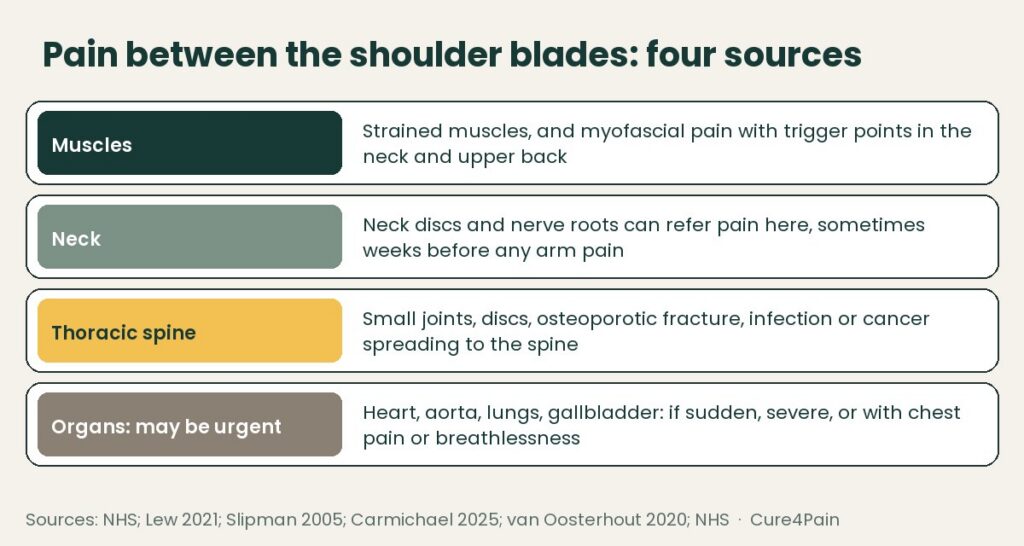
According to the NHS, pain from a strained chest muscle tends to ease when you rest the muscle [8]. Pain from an organ tends to bring other symptoms, such as chest pressure, breathlessness, sweating or fever. Neither pattern rules a serious cause in or out.
When is pain between the shoulder blades an emergency?
Pain between the shoulder blades is an emergency if it is sudden and severe, if it comes with chest pain, sudden breathlessness, severe tummy pain spreading to the back, weakness or numbness in both legs, or new bladder or bowel changes, or if it follows a serious accident. In any of these cases, call your local emergency number and do not drive yourself. The signs below come from NHS and US National Institutes of Health guidance.
- Possible heart attack: chest pain or discomfort, or pain spreading to an arm, the neck, jaw or stomach, with or without sweating, feeling sick, light-headedness or breathlessness [2] [8] [9].
- Possible aortic dissection: sudden, severe pain described as sharp, stabbing, tearing or ripping. According to the US National Library of Medicine, it is felt below the breastbone and then moves under the shoulder blades or to the back [10].
- Possible blood clot in the lung: breathing difficulty that comes on suddenly, pain in the chest or upper back, a very fast heartbeat, or passing out [11].
- Possible gallstone blockage or pancreatitis: sudden, severe tummy pain spreading to the back, especially with vomiting, a high temperature or yellow skin or eyes [12] [13].
- Possible pressure on the spinal cord or nerves: pain, tingling, weakness or numbness in both legs, loss of feeling around the genitals or anus, or new bladder or bowel changes [2]. Our neck pain page adds clumsy hands and unsteady walking.
- After a serious accident: a road accident or a similar injury [2].
If none of the signs above applies, these still should not wait, according to the NHS and NICE:
- Urgent appointment: back pain that is getting worse quickly, feeling hot, cold, shivery or generally unwell [2], or coughing up blood [11]. The NHS also lists severe back pain that starts suddenly here; between the shoulder blades, treat it as an emergency because of the causes above [10].
- See a doctor soon: weight loss you cannot explain, pain that is worse at night or does not improve with rest, or a lump or a change in the shape of your back [2].
- Within 24 hours, with cancer: a past or current cancer with severe, worsening or night-time back pain, or back pain made worse by coughing, sneezing or straining. NICE advises seeking specialist advice within 24 hours [14].
Which organs can cause pain between the shoulder blades?
The heart, aorta, lungs and gallbladder can all cause pain between the shoulder blades, so other symptoms such as chest pressure, breathlessness, sudden onset or fever count.
| Source | What the evidence says | Other clues |
|---|---|---|
| Heart | In a 2020 review of 27 studies, women with acute coronary syndromes had higher odds of this pain than men (odds ratio 2.15), but chest pain was still the most common symptom in both (men 79%, women 74%) [5] | Chest pressure, breathlessness, sweating, nausea, unusual tiredness; symptoms can be mild [9] |
| Aorta | In the international IRAD registry of aortic dissection, sudden severe sharp pain was the most common complaint in 464 people, and classic findings were often absent [15]; most of 384 people with type B dissection had acute chest or back pain [16] | Sudden onset; a majority of those 384 had high blood pressure [16] |
| Lungs and their lining | According to a 2007 review, a blood clot in the lung was found in 5% to 20% of emergency patients with pain on breathing [17]; according to the NHS, pleurisy pain may spread to the shoulders and back [18] | Sharp pain on breathing in, breathlessness, coughing up blood [11] |
| Tumour at the top of the lung (Pancoast tumour) | According to a 2013 review, Pancoast tumours are under 5% of lung cancers, with severe shoulder pain spreading to the armpit or shoulder blade [19] | Wasting of hand and arm muscles [19]; in lung cancer generally, a lasting cough [20] |
| Gallbladder | According to the US National Library of Medicine, pain from acute cholecystitis may spread to the back or below the right shoulder blade [21] | Upper right or middle belly pain for 30 minutes or more, often after a fatty meal; fever, yellow skin [21] |
A heart attack can happen without chest pain. In a 2012 report from a US registry of 1.14 million people with a heart attack, 42% of women and 30.7% of men came to hospital without chest pain [22].
Can muscles, posture or a phone cause upper back pain?
A strained muscle can: according to the NHS, a common cause of back pain is an injury such as a pulled muscle [2]. Posture and phone or screen use are linked with upper back pain, although links do not prove cause.
- Trigger points: trials have studied myofascial pain with trigger points in the neck and upper back; the results are under what helps, below [23].
- Phones and screens: in a review of 18 studies, 55.8% to 89.9% of mobile phone users reported neck and upper back complaints. The authors note the data are cross-sectional, so they cannot show that phones are the cause [24].
- Posture: a 2009 systematic review lists postural, backpack, psychological and environmental factors as linked with thoracic spine pain, on limited evidence [1].
Can neck problems cause pain between the shoulder blades?
Yes. Neck discs and pinched neck nerves can both cause pain between the shoulder blades [4] [25], and according to a 2025 scoping review, shoulder blade pain may come several weeks before the arm pain of a pinched neck nerve [25].
- Discs: when discs were tested in 41 people having cervical discography, every level from C3-C4 to C7-T1 could produce pain between the shoulder blades [4].
- Nerve roots: a 2025 scoping review of 86 studies on a pinched neck nerve found the shoulder blade area described in 72% of the 81 studies that mapped pain, most often with the C7 root. Shoulder blade pain may come several weeks before the arm pain [25].
- What to look for: neck stiffness, pain or tingling running into an arm or hand, and any of the warning signs above.
Read more on our neck pain and cervical spondylosis and pinched nerve pages, and in our article on neck problems, dizziness, vertigo and headaches.
Can the thoracic spine itself be the cause?
Yes. The thoracic spine can cause pain between the shoulder blades through its small joints and discs; the causes that must not be missed are fracture, infection and cancer.
- Small (facet) joints: in a 2004 study from a US pain clinic, facet joints were the source in 42% of people with chronic thoracic spine pain, a selected group [3].
- Discs: according to a 2000 review, symptomatic thoracic disc disease is much less common than in the neck or lower back, most people respond without surgery, and surgery is for the rare case of worsening nerve problems [26].
- Scan findings: 33 of 90 people with no thoracic pain (37%) had a thoracic disc herniation on MRI [27]. See also our article on whether a slipped disc can heal on its own.
- Osteoporotic fracture: about 25% of women after menopause have a spinal compression fracture in their lifetime, and it can cause severe back pain for months [28]. In one US population, 83% of diagnosed spinal fractures followed moderate or no trauma [29]. According to a 2020 review, pain settles within 4 to 6 weeks in about two-thirds of people [30]. See our osteoporosis page.
- Infection: in spinal tuberculosis the thoracic region is the most frequently affected, with back pain, spinal tenderness and general symptoms [31].
- Cancer: spinal metastases most often affect the thoracic spine [32]. Spinal cord compression from metastases affects almost 5% of people with cancer; its most common symptom is back pain, and it is an emergency [33]. According to the NHS, myeloma, a blood cancer, can cause bone pain in the back or ribs [34].
- Younger people: back pain and stiffness that build up gradually in teenagers and young adults raise the question of ankylosing spondylitis [35].
- Not the spine: shingles. According to the NHS, shingles brings tingling or pain in one area of skin, followed by a rash on one side of the body, usually on the chest and tummy [36].
Can low vitamin D or magnesium cause upper back pain?
Marked vitamin D and calcium deficiency can cause back pain, but a link between low vitamin D or magnesium and everyday upper back pain is unproven. According to the NHS, osteomalacia, usually caused by low vitamin D and calcium, brings pain in the back, shoulder, ribs, pelvis or legs and weak muscles [6].
- Vitamin D trials: a 2017 meta-analysis of 3 trials found no effect of vitamin D on chronic nonspecific muscle and joint pain [7]. A 2022 review reports possible benefit in fibromyalgia and chronic widespread pain, especially in people who are deficient [37]. Studies disagree, and our PubMed search (October 2026) found no vitamin D trial for upper back pain.
- Magnesium: our PubMed search (October 2026) found no magnesium trial for upper back pain. A blood test is a poor guide here: according to the US National Institutes of Health, less than 1% of the body’s magnesium is in serum, and serum levels do not accurately reflect total body magnesium [38]. Our article on magnesium, cramps and shoulder pain reviews what is known.
Our article on blood tests for chronic pain and fatigue explains which results are worth checking.
What helps upper back pain between the shoulder blades?
Once serious causes are excluded, the NHS advises staying active for back pain [2], and a 2015 Cochrane review of neck disorders supports strengthening in chronic neck pain [39], although few trials study the upper back on its own. A 2015 systematic review screened 6,988 articles on thoracic spine and chest wall pain and could use only 2 trials [40].
- Stay active and ease the pain: for back pain in general, the NHS advises continuing daily activities, using heat for muscle spasms or ice for swelling, taking an anti-inflammatory medicine such as ibuprofen if it is suitable for you (paracetamol on its own is not recommended), and stopping any exercise that makes the pain worse. If pain persists, it says group exercise, physiotherapy or manual therapy may be recommended [2].
- Strengthening, with less support for stretching alone: a 2015 Cochrane review of 27 trials in neck disorders found that strengthening the neck, shoulder and shoulder blade muscles may help chronic neck pain, alone or combined with stretching, and that stretching alone may not change pain or function, on low-quality evidence; none of the evidence was high quality [39].
- Spinal manipulation: in the one trial of recent thoracic spine pain in a 2015 systematic review, manipulation brought a small short-term reduction in pain that was not clinically important [40].
- Dry needling and release: in a 2020 meta-analysis of 28 trials in neck pain with trigger points, dry needling reduced pain and disability in the short term compared with sham, placebo, waiting list or another form of dry needling, on low to moderate evidence. It showed no difference from other physical therapy, apart from a short-term pain benefit over manual therapy, and no difference at mid-term [41]. In a 2022 trial of 108 people with neck or upper back myofascial pain, adding dry needling or high-intensity laser to exercise gave better results than exercise alone [42]. In a 2021 meta-analysis of 6 trials of neck and upper back pain, dry needling and manual trigger point therapy both helped, and neither was better [23].
- Acupuncture: a 2015 systematic review found one trial of acupuncture in recent thoracic spine pain, and it showed no difference from placebo electrotherapy [40].
- Needling safety: the lung lies close beneath these muscles. Case reports describe a collapsed lung (pneumothorax) after dry needling of the muscles around the shoulder blades [43] [44] and after acupuncture of the upper back [45]. One of these reports describes its incidence as very low [44]; in one study, experienced therapists located a rib by touch accurately in 73.3% of attempts [46]. Breathlessness, chest pain or a dry cough in the days after needling can be signs of it [43] [44] and need emergency assessment; tell the doctors about the needling.
How long does it last? According to the NHS, back pain in general usually improves within a few weeks, although it can last longer or come back, and a broken bone, cancer or infection is very rarely the reason; it still advises seeing a GP for pain from this area or pain that does not improve after a few weeks of self-care [2]. A 2017 systematic review found no study of recovery from mid-back pain in adults in the general population [47]. In a 2020 study of 90 adults having chiropractic treatment for mid-back pain, with no comparison group, 80% improved within a month and had minor pain or had recovered by one year, and 20% kept moderate to severe pain; pain lasting over 3 months made a good course less likely [48].
How we assess and treat upper back pain at Cure4Pain
At Cure4Pain, your first visit includes a full history and an examination, and our needling and exercise care for the neck includes the shoulders and upper back.
- Warning signs first: if your symptoms suggest the heart, aorta, lungs or spinal cord, you need a hospital, not a clinic appointment.
- Assessment: a full history, an examination of posture and muscles, and a review of your scans and tests.
- Myofascial dry needling and release: fine needles and hands-on release for tight muscles and trigger points in the neck, shoulders and upper back, alongside exercise. The research and safety points above apply.
- Acupuncture: used for pain and stiffness, including deep myofascial and orthopaedic acupuncture. The one trial of acupuncture in recent thoracic spine pain in a 2015 systematic review found no difference from placebo electrotherapy [40].
- Posture and exercise: strengthening of the neck, shoulder blade and upper back muscles, with a home programme.
- Nutrition: we read a panel of about 100 markers, adding tests for your condition when clinically indicated, such as vitamin D, B12 and iron, and we assess magnesium from the overall clinical picture. What is low is corrected by mouth first, with injections only when specifically needed or advised; magnesium is mainly bisglycinate, with L-threonate or citrate as advised, counted as elemental magnesium. Supplements support recovery; as described above, we found no vitamin D or magnesium trial for upper back pain.
- Daily habits: desk and screen set-up, pillow and sleep position, and stress management.
- Medicines: the NHS advice on painkillers is above. In our clinic practice they are generally avoided for upper back pain; where needed, they are used short term and prescribed by Dr Krushal Pabari, who also reviews muscle relaxants and reduces them where appropriate, under clinical guidance from Team Cure4Pain, in coordination with your existing consulting physician; never stop or change them on your own. See our article on long-term painkillers.
- Injections and surgery: we do not give pain or joint injections, and refer for one only rarely, when urgently needed. Scans, injections and surgery have their place, especially with nerve weakness or spinal cord signs.
- Length of care: this differs from person to person; the NHS and study figures are under “How long does it last?” above.
- Where: consultations are in Mumbai or online; needling and other hands-on treatment are given only at our Mumbai clinic.
This is our clinic practice; individual results vary, and further studies are needed. Read more on our neck pain and cervical spondylosis and lower back pain pages.
If you would like the source of your pain examined and explained, you can book a consultation, online from anywhere or at our Mumbai clinic.
Frequently asked questions
When should I worry about pain between my shoulder blades?
Seek emergency care if pain between the shoulder blades is sudden and severe, or comes with chest pain, sudden breathlessness, sweating, weakness or numbness in the legs, or bladder or bowel changes. The NHS also advises seeing a GP for any back pain coming from between the shoulders. [2] [8]
Can a heart attack cause pain between the shoulder blades?
Yes, a heart attack can cause pain between the shoulder blades. In a 2020 review of 27 studies, women with acute coronary syndromes had about twice the odds of men of having this pain, although chest pain was still the most common symptom in both. [5]
Does pain under the right or left shoulder blade mean something different?
Pain below the right shoulder blade can come from the gallbladder, especially with upper belly pain after a fatty meal. We found no study showing that the side of the pain separates a muscle problem from a heart or lung problem. [21]
Why does my upper back hurt when I breathe in?
Upper back pain on breathing in can come from a strained muscle, but also from pleurisy or a blood clot in the lung. The NHS advises emergency care if it comes with sudden breathlessness, and a doctor’s check for sharp pain on breathing that does not settle. [8] [18] [11]
Why does my upper back hurt after sleeping?
Sleep position may play a part in upper back pain after sleeping, but few good studies exist and we found none on the upper back alone. People with neck symptoms on waking spent more time in provocative positions in one small study, and a 2015 review of 24 trials favoured a medium-firm, self-adjusted mattress. [49] [50]
Is upper back pain different in women?
According to a 2009 systematic review, thoracic spine pain is reported more often in children and teenagers, particularly girls, and larger breast size and higher BMI went with mid-back pain after menopause in one small study. Women should also know that heart problems can show up as pain between the shoulder blades. [1] [51] [5]
Is pain between the shoulder blades in pregnancy serious?
It can be. The NHS advises contacting your GP or midwife urgently for back pain in the second or third trimester, which could be a sign of early labour, or with a fever, bleeding from the vagina, pain when you pee, or pain under the ribs. Pain below the ribs can also be a sign of pre-eclampsia and needs checking immediately, and loss of feeling in a leg, the bottom or the genitals needs emergency care. [52] [53]
What stretches help pain between the shoulder blades?
A 2015 Cochrane review of neck disorders found that stretching alone may not change pain or function, on low-quality evidence, with more support for strengthening, alone or combined with stretching. The NHS suggests exercises and stretches for back pain in general, stopping if the pain gets worse. Trials specific to the upper back are few. [39] [2] [40]
Does dry needling help upper back pain?
Dry needling reduced pain in the short term in trials of neck pain with trigger points, and helped when added to exercise in one trial of neck or upper back pain. Over the upper back it can cause a collapsed lung, a serious complication whose incidence a case report describes as very low. [41] [42] [44]
This article is for education and does not replace medical advice. Do not start, stop or change any medicine or supplement without medical guidance.
References
1. Briggs AM, et al. Thoracic spine pain in the general population: prevalence, incidence and associated factors in children, adolescents and adults. A systematic review. BMC Musculoskelet Disord 2009;10:77. doi:10.1186/1471-2474-10-77
2. NHS (UK National Health Service). Back pain. nhs.uk/conditions/back-pain
3. Manchikanti L, et al. Prevalence of facet joint pain in chronic spinal pain of cervical, thoracic, and lumbar regions. BMC Musculoskelet Disord 2004;5:15. doi:10.1186/1471-2474-5-15
4. Slipman CW, et al. Provocative cervical discography symptom mapping. Spine J 2005;5(4):381-8. doi:10.1016/j.spinee.2004.11.012
5. van Oosterhout REM, et al. Sex Differences in Symptom Presentation in Acute Coronary Syndromes: A Systematic Review and Meta-analysis. J Am Heart Assoc 2020;9(9):e014733. doi:10.1161/JAHA.119.014733
6. NHS (UK National Health Service). Rickets and osteomalacia. nhs.uk/conditions/rickets-and-osteomalacia
7. Gaikwad M, et al. Does vitamin D supplementation alleviate chronic nonspecific musculoskeletal pain? A systematic review and meta-analysis. Clin Rheumatol 2017;36(5):1201-1208. doi:10.1007/s10067-016-3205-1
8. NHS (UK National Health Service). Chest pain. nhs.uk/symptoms/chest-pain
9. National Heart, Lung, and Blood Institute, US National Institutes of Health. Heart attack: symptoms. nhlbi.nih.gov
10. MedlinePlus, US National Library of Medicine. Aortic dissection. medlineplus.gov
11. NHS (UK National Health Service). Pulmonary embolism. nhs.uk/conditions/pulmonary-embolism
12. NHS (UK National Health Service). Gallstones. nhs.uk/conditions/gallstones
13. NHS (UK National Health Service). Acute pancreatitis. nhs.uk/conditions/acute-pancreatitis
14. National Institute for Health and Care Excellence (NICE). Spinal metastases and metastatic spinal cord compression. NG234, 2023. nice.org.uk/guidance/ng234
15. Hagan PG, et al. The International Registry of Acute Aortic Dissection (IRAD): new insights into an old disease. JAMA 2000;283(7):897-903. doi:10.1001/jama.283.7.897
16. Suzuki T, et al. Clinical profiles and outcomes of acute type B aortic dissection in the current era: lessons from the International Registry of Aortic Dissection (IRAD). Circulation 2003;108 Suppl 1:II312-7. doi:10.1161/01.cir.0000087386.07204.09
17. Kass SM, et al. Pleurisy. Am Fam Physician 2007;75(9):1357-64. PubMed 17508531
18. NHS (UK National Health Service). Pleurisy. nhs.uk/conditions/pleurisy
19. Foroulis CN, et al. Superior sulcus (Pancoast) tumors: current evidence on diagnosis and radical treatment. J Thorac Dis 2013;5 Suppl 4(Suppl 4):S342-58. doi:10.3978/j.issn.2072-1439.2013.04.08
20. NHS (UK National Health Service). Symptoms of lung cancer. nhs.uk/conditions/lung-cancer/symptoms
21. MedlinePlus, US National Library of Medicine. Acute cholecystitis. medlineplus.gov
22. Canto JG, et al. Association of age and sex with myocardial infarction symptom presentation and in-hospital mortality. JAMA 2012;307(8):813-22. doi:10.1001/jama.2012.199
23. Lew J, et al. Comparison of dry needling and trigger point manual therapy in patients with neck and upper back myofascial pain syndrome: a systematic review and meta-analysis. J Man Manip Ther 2021;29(3):136-146. doi:10.1080/10669817.2020.1822618
24. Zirek E, et al. A systematic review of musculoskeletal complaints, symptoms, and pathologies related to mobile phone usage. Musculoskelet Sci Pract 2020;49:102196. doi:10.1016/j.msksp.2020.102196
25. Carmichael J, et al. Scapular pain in cervical radiculopathy: A scoping review. N Am Spine Soc J 2025;23:100619. doi:10.1016/j.xnsj.2025.100619
26. Vanichkachorn JS, Vaccaro AR. Thoracic disk disease: diagnosis and treatment. J Am Acad Orthop Surg 2000;8(3):159-69. doi:10.5435/00124635-200005000-00003
27. Wood KB, et al. Magnetic resonance imaging of the thoracic spine. Evaluation of asymptomatic individuals. J Bone Joint Surg Am 1995;77(11):1631-8. doi:10.2106/00004623-199511000-00001
28. Alexandru D, So W. Evaluation and management of vertebral compression fractures. Perm J 2012;16(4):46-51. doi:10.7812/TPP/12-037
29. Cooper C, et al. Incidence of clinically diagnosed vertebral fractures: a population-based study in Rochester, Minnesota, 1985-1989. J Bone Miner Res 1992;7(2):221-7. doi:10.1002/jbmr.5650070214
30. Madassery S. Vertebral Compression Fractures: Evaluation and Management. Semin Intervent Radiol 2020;37(2):214-219. doi:10.1055/s-0040-1709208
31. Garg RK, Somvanshi DS. Spinal tuberculosis: a review. J Spinal Cord Med 2011;34(5):440-54. doi:10.1179/2045772311Y.0000000023
32. Esperança-Martins M, et al. Multidisciplinary Approach to Spinal Metastases and Metastatic Spinal Cord Compression-A New Integrative Flowchart for Patient Management. Cancers (Basel) 2023;15(6). doi:10.3390/cancers15061796
33. Cole JS, Patchell RA. Metastatic epidural spinal cord compression. Lancet Neurol 2008;7(5):459-66. doi:10.1016/S1474-4422(08)70089-9
34. NHS (UK National Health Service). Symptoms of myeloma. nhs.uk/conditions/myeloma/symptoms
35. NHS (UK National Health Service). Ankylosing spondylitis. nhs.uk/conditions/ankylosing-spondylitis
36. NHS (UK National Health Service). Shingles. nhs.uk/conditions/shingles
37. Lombardo M, et al. The Efficacy of Vitamin D Supplementation in the Treatment of Fibromyalgia Syndrome and Chronic Musculoskeletal Pain. Nutrients 2022;14(15). doi:10.3390/nu14153010
38. National Institutes of Health, Office of Dietary Supplements. Magnesium: Fact Sheet for Health Professionals. ods.od.nih.gov
39. Gross A, et al. Exercises for mechanical neck disorders. Cochrane Database Syst Rev 2015;1(1):CD004250. doi:10.1002/14651858.CD004250.pub5
40. Southerst D, et al. The effectiveness of noninvasive interventions for musculoskeletal thoracic spine and chest wall pain: a systematic review by the Ontario Protocol for Traffic Injury Management (OPTIMa) collaboration. J Manipulative Physiol Ther 2015;38(7):521-31. doi:10.1016/j.jmpt.2015.06.001
41. Navarro-Santana MJ, et al. Effectiveness of Dry Needling for Myofascial Trigger Points Associated with Neck Pain Symptoms: An Updated Systematic Review and Meta-Analysis. J Clin Med 2020;9(10). doi:10.3390/jcm9103300
42. Ahi ED, Sirzai H. Comparison of the effectiveness of dry needling and high-intensity laser therapy in the treatment of myofascial pain syndrome: a randomized single-blind controlled study. Lasers Med Sci 2022;38(1):3. doi:10.1007/s10103-022-03687-w
43. Mintken PE, et al. Pneumothorax After Dry Needling of Intrascapular Muscles Using a Rib Bracketing Technique: Insights From the Clinician, Patient, and Clinical Expert. Phys Ther 2025;105(8). doi:10.1093/ptj/pzaf078
44. Patel N, et al. Dry Needling-Induced Pneumothorax. J Am Osteopath Assoc 2019;119(1):59-62. doi:10.7556/jaoa.2019.009
45. Nożewski J, et al. Bilateral Iatrogenic Pneumothorax After Acupuncture in a 26-Year-Old Woman Presenting With Cough, Pleuritic Chest Pain, and Tachycardia: A Case Report. Am J Case Rep 2026;27:e954143. doi:10.12659/AJCR.954143
46. Cushman DM, et al. Accuracy of rib palpation for dry needling of deep periscapular musculature, measured with ultrasound. J Bodyw Mov Ther 2021;26:7-11. doi:10.1016/j.jbmt.2020.10.008
47. Johansson MS, et al. Incidence and prognosis of mid-back pain in the general population: A systematic review. Eur J Pain 2017;21(1):20-28. doi:10.1002/ejp.884
48. Knecht C, et al. A prospective observational study on trajectories and prognostic factors of mid back pain. BMC Musculoskelet Disord 2020;21(1):554. doi:10.1186/s12891-020-03534-5
49. Cary D, et al. Examining relationships between sleep posture, waking spinal symptoms and quality of sleep: A cross sectional study. PLoS One 2021;16(11):e0260582. doi:10.1371/journal.pone.0260582
50. Radwan A, et al. Effect of different mattress designs on promoting sleep quality, pain reduction, and spinal alignment in adults with or without back pain; systematic review of controlled trials. Sleep Health 2015;1(4):257-267. doi:10.1016/j.sleh.2015.08.001
51. Spencer L, Briffa K. Breast size, thoracic kyphosis & thoracic spine pain – association & relevance of bra fitting in post-menopausal women: a correlational study. Chiropr Man Therap 2013;21(1):20. doi:10.1186/2045-709X-21-20
52. NHS (UK National Health Service). Back pain in pregnancy. nhs.uk/pregnancy
53. NHS (UK National Health Service). Pre-eclampsia. nhs.uk/conditions/pre-eclampsia

