

Written by AT. Chintan Dalal, N.D. · Reviewed by Dr Krushal Pabari, Clinical Team, Cure4Pain · Updated 30 October 2026
Key facts
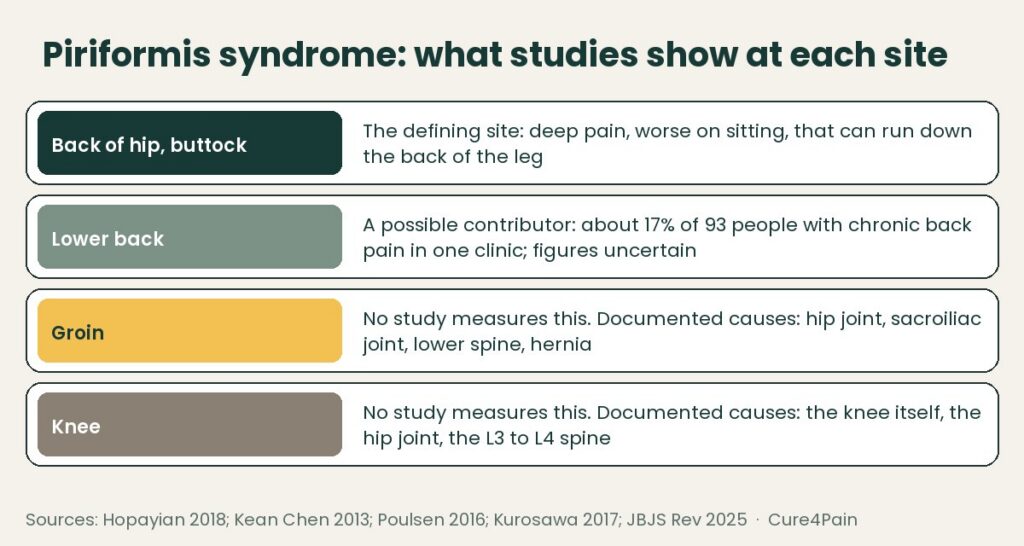
Piriformis syndrome mainly causes deep buttock pain that is worse on sitting and can run down the back of the leg; a 2018 systematic review defines it by four features, and none is in the groin or knee [1]. A link with lower back pain is possible, but how often is unclear: in a 2013 study, about 17% of 93 people with chronic low back pain met one clinical test in a single clinic [2]. In a PubMed search in October 2026, we found no study that measures how often it causes groin or knee pain; the better-documented causes there are the hip joint, the sacroiliac joint and the lower spine [3] [4] [5]. According to the NHS, sciatica on both sides, numbness around the genitals or bottom, or new bladder or bowel problems need emergency care [6].

Scientific explainer videos in our Resources section
In our Resources section, our clinical team discusses vitamin D, its cofactors and how autoimmune, lifestyle and pain conditions develop.
Can piriformis syndrome cause pain beyond the buttock?
Piriformis syndrome can cause pain beyond the buttock, along the back of the thigh and leg; further than that, the evidence thins quickly. According to a 2018 systematic review, the syndrome is defined by buttock pain, pain on sitting, tenderness near the sciatic notch and pain when the muscle is tensed. The review accepts that the piriformis can cause sciatica but says the accuracy of its symptoms and tests cannot yet be stated [1].
Several things could explain pain further away:
- The sciatic nerve: it runs from the lower back to the feet. When it is irritated, symptoms usually affect the bottom and the back of one leg, often including the foot and toes, according to the NHS [6].
- A second condition: a 2012 review in the Journal of the American Academy of Orthopaedic Surgeons says hip and spine problems can occur together, which makes the main source of pain hard to identify [7].
- A broad label: a 1999 review warned that the diagnosis is “often ascribed to almost any cause of buttock and/or hamstring symptoms” [8], and a 2024 review notes there is still no uniformly accepted case definition [9].
Our piriformis syndrome page covers symptoms, causes, stretches and treatment. This article looks only at where else the pain can be.
Can piriformis syndrome cause lower back pain?
Piriformis syndrome may contribute to lower back pain, but the back is not one of its defining sites, and how often this happens is unsettled. The figures come from small, selected groups.
- How often: in a 2013 study, 17.2% of 93 people attending a pain clinic for chronic low back pain met a modified FAIR test (bending, crossing and turning the hip inward) [2]. A 2024 review cites estimates of 5% to 6% of low back, buttock and leg pain [9]. A 2018 systematic review rated the two larger prevalence studies then available at high risk of bias [1].
- Buttock strength: in a 2023 Malaysian study of 91 people, a thicker piriformis went with a weaker gluteus maximus in those with low back pain and piriformis syndrome. Piriformis thickness itself did not differ between people with back pain with and without the syndrome [10].
- The sciatica pattern: the NHS says that with sciatica, back pain is not usually as bad as the leg pain, and that you probably do not have sciatica if you only have back pain [6].
- Both at once: in a 2026 study, 39 people with L4, L5 or S1 nerve root symptoms and a tender piriformis received a local anaesthetic injection into the muscle, and 33 improved by at least half [11]. There was no comparison group, and only people with tenderness were included.
- Middle or upper back: in a PubMed search in October 2026, we found no study linking piriformis syndrome with pain in the middle or upper back. The NHS advises seeing a GP when back pain comes from the top of the back, between the shoulders [12].
Back pain without buttock or leg symptoms has many other causes; see our lower back pain page.
Can piriformis syndrome cause hip pain?
Piriformis syndrome can cause hip pain at the back of the hip, which is the same area as the deep buttock. Two reviews in American Family Physician divide hip pain into three zones: the 2014 review places piriformis syndrome in the back zone [13], and the 2021 review places deep gluteal syndrome, which includes it, there too [14] [15].
| Where it hurts | Usual causes | Piriformis syndrome? |
|---|---|---|
| Front of the hip and groin | Hip joint (osteoarthritis, labral tear, impingement), hip flexor injury [14] | Not listed; we found no study showing it |
| Outer hip | Greater trochanteric pain syndrome: gluteal tendon problems, bursitis [14] | Not listed |
| Back of the hip and buttock | Piriformis syndrome, sacroiliac joint, spine, ischiofemoral impingement, hamstring tendon, poor leg circulation [13] [14] | Yes, its usual site |
Buttock pain does not rule out the hip joint. In a 2016 study of 108 primary care patients with hip osteoarthritis in Denmark, 77% marked the area of the greater trochanter (the bony point of the hip), 53% the groin, 42% the front or outer thigh and 38% the buttock [3].
Can piriformis syndrome cause groin pain?
Groin pain is not a recognised main feature of piriformis syndrome, and we found no study that measures how often it happens. According to a 2018 systematic review, groin pain is not one of the four defining features [1]. A PubMed title and abstract search for piriformis syndrome and groin in October 2026 returned 8 records, mostly hip pain or nerve entrapment reviews, and none measured it.
- What has been published: deep gluteal syndrome is a group of conditions that compress the sciatic or pudendal nerve, and it includes piriformis syndrome, according to a 2020 review in the Bone & Joint Journal [15]. A 2020 Japanese study of pain after hip arthroscopy describes deep gluteal syndrome as “an uncommon source of buttock and groin pain”, without measuring it [16]. A 2025 case report describes gluteal and pelvic pain from the pudendal nerve trapped beneath a split piriformis [17]; one case cannot show how often this occurs.
The better-documented causes of groin pain are these:
- The hip joint: groin pain is the most common symptom site in hip osteoarthritis, according to the American Academy of Orthopaedic Surgeons [18]. It was marked by 53% of 108 people with hip osteoarthritis in a 2016 Danish study [3], and in a 2011 study of 52 people with labral tears, the groin and the outer hip were the two most common sites [19].
- The sacroiliac joint: studies of people with pain from this joint disagree widely. Groin pain was reported by 14% of 50 people in a 2000 study [20], 44% of 50 in a 2015 study [21] and 46.5% of 127 in a 2017 study [4].
- The lower spine: in a 1997 study, 4.1% of 512 people with an L4-L5 or L5-S1 disc herniation reported groin pain [22], as did 8.1% of 124 with a herniation and 6.8% of 146 with spinal stenosis in a 2017 study [4].
- A hernia: the NHS describes a bulge or lump in the groin or upper thigh that may get bigger when you cough or sneeze and smaller when you lie down [23].
Can piriformis syndrome cause knee pain?
Research does not show piriformis syndrome causing knee pain as a stand-alone problem. A PubMed title and abstract search for piriformis syndrome and knee in October 2026 returned 15 records, and none measured how often it causes knee pain.
- What could fit: pain that starts in the buttock and passes behind the knee on its way down the leg matches how the NHS describes sciatic symptoms [6], and two case reports describe three people diagnosed with piriformis syndrome whose pain ran to the back of the knee [24] [25]. Case reports cannot show how often this occurs.
- What fits less well: pain only at the front or inner side of the knee, though this is a reading of the anatomy and not a study of piriformis syndrome. In a 2004 study of people with hip osteoarthritis, pain below the knee followed the saphenous nerve, a branch of the femoral nerve rather than the sciatic [26]. For pain on the outer side of the knee, we found no study.
The better-documented causes of knee pain, apart from the knee itself [27], are these:
- The hip joint: in a 2025 retrospective study of 1,000 people at a knee clinic, 137 (13.7%) had knee pain referred from the hip [28]. In a 2016 Danish study of people with hip osteoarthritis, 17% of 108 marked the knee, none of them the knee alone [3], and in a 2004 study, 47% of 60 awaiting hip replacement had pain below the knee [26].
- The lower spine: a 2025 review says the L3-L4 level is the one most often involved in referred knee pain, and advises checking the knee reflex, thigh strength and sensation when knee X-rays do not explain the symptoms [5]. In a 2009 study of 17 people with L3 nerve root pain, 5 had hip or knee pain, and 4 had first been treated for hip or knee joint disease [29].
Our osteoarthritis and joint pain page covers the hip and knee joints, and our article on knee injections reviews that evidence.
How is piriformis syndrome told apart from a disc, the hip joint and the sacroiliac joint?
Piriformis syndrome is told apart from a disc, the hip joint and the sacroiliac joint by the pain pattern and an examination, with tests mainly used to rule other causes out; a 2024 review says no well-accepted test confirms piriformis syndrome [9].
| Source | Typical pain | What helps, and its limits |
|---|---|---|
| Piriformis | Deep buttock, worse on sitting, tender near the sciatic notch [1]; difficulty sitting for 30 minutes is part of the history in the wider deep gluteal syndrome [30] | Examination; pain relief from an injection is used in studies [31]. MRI of the nerve is not yet a standard test [9] |
| Disc or nerve root | Leg pain worse than back pain, worse on moving, sneezing or coughing, as the NHS describes sciatica in general [6] | Examination and MRI. The straight-leg raise has low accuracy [32] and does not rule out piriformis syndrome [1] |
| Hip joint | Groin or thigh, spreading to the buttock or knee; stiffness [18] | X-ray first [14]; a guided hip injection was 94% sensitive and 95% specific across 9 studies, in a 2020 paper [33] |
| Sacroiliac joint | Buttock 94%, lower back 72%, groin 14% in a 2000 study of 50 people [20] | In a 2021 meta-analysis, assuming 1 in 5 such patients has this joint pain, a positive set of pain tests gave only 35% certainty, and a negative set gave 92% certainty that the joint is not the source; very low-quality evidence [34] |
Three cautions apply:
- A normal back MRI does not confirm piriformis syndrome. In a 2005 series of 239 people with sciatica not helped by standard care, nerve-specific MRI and MRI-guided injection led to a final diagnosis of piriformis syndrome in 67.8%, but 14 other diagnoses also appeared, including nerve entrapment elsewhere and sacroiliac joint inflammation [35]. This was a highly selected group, and this imaging is not yet a standard test [9].
- A disc finding may be incidental. Our article on whether a slipped disc can heal on its own covers disc changes in people without pain.
- The label can remain uncertain. In a 2025 review of 212 published cases, 47.6% had no finding on scans or at surgery [36].
Back pain and stiffness that develop gradually in a teenager or young adult raise a different question: ankylosing spondylitis, according to the NHS [37]. See our ankylosing spondylitis page. Spine-related leg pain is covered on our sciatica page and in our article on sciatica without surgery.
When is back, hip, groin or knee pain urgent?
Back, hip, groin or knee pain is urgent when it comes with any of these warning signs from NHS guidance, which should not be put down to a tight muscle.
- Emergency, back or leg: the NHS lists sciatica on both sides; severe or worsening weakness or numbness in both legs; numbness around or under the genitals or around the bottom; new difficulty passing urine or controlling your bladder or bowels [6]. A 2025 review of 9 international guideline papers on cauda equina syndrome found that all recommend an urgent MRI when these signs are present [38].
- Emergency, hip: the NHS lists severe hip pain after a fall or injury, being unable to walk or put weight on the leg, or tingling or loss of feeling after an injury [39].
- Emergency, testicle: the NHS lists sudden, severe testicle pain, or testicle pain with feeling sick or tummy pain [40].
- Urgent, groin: the NHS advises getting urgent medical help for a hernia with pain, a bloated tummy, vomiting, constipation or a high temperature [23].
- Urgent, knee: the NHS advises getting urgent medical help when the knee is very painful, cannot bear weight, is badly swollen, or is hot and red with a high temperature [27].
- Urgent, one leg: according to the NHS, throbbing pain and swelling in the calf or thigh may be a blood clot; with chest pain or breathlessness, call emergency services [41].
- Back pain to get checked: the NHS advises seeing a doctor about back pain with weight loss you cannot explain, back pain that is worse at night, or back pain with a fever or feeling generally unwell [12].
How we assess pain around the buttock and hip at Cure4Pain
At Cure4Pain we first work out where pain around the buttock and hip is coming from, because the same complaint can have several sources.
- Assessment: your history, an examination of the lower back, hips and buttocks, and a review of any MRI, X-ray and blood tests. For sciatica-type leg pain we test muscles from the lower back to the calf, including the piriformis, gluteal group and hamstrings.
- Tests: we read a panel of about 100 markers, adding tests for your condition when clinically indicated: for example, HLA-B27 when long-lasting low back pain that began before age 45 has some of the features of spondyloarthritis (NICE NG65) [42].
- What we often find: in our clinic, piriformis syndrome most often goes with weakened lower back and buttock muscles. This is a clinic observation. In one case-control study, a thicker piriformis went with a weaker gluteus maximus in people with low back pain and piriformis syndrome, which is an association, not a cause [10].
- When the piriformis and buttock muscles are the source: twitch-response dry needling and electroacupuncture, with basic nutritional support by mouth, based on your tests. In our clinic, many people report relief within 6 to 8 weeks, and length of care differs from person to person. This is a clinic observation about pain from these muscles, not a trial result, and people also improve with other simple care.
- What research shows on needling: in a 2019 randomised trial of 32 people with piriformis syndrome, three sessions of ultrasound-guided dry needling lowered pain by about 2 points on a 10-point scale at 1 week compared with waiting [43]; a 2024 systematic review of 7 trials of dry needling around the hip, one of them in piriformis syndrome and two in healthy athletes, found benefit but no strong evidence [44]; in a 2024 trial of 60 people with piriformis syndrome and no sham group, trigger-point acupuncture matched a steroid injection at 1 month and did better at 2 and 3 months [45], and a single small trial cannot show that it is the better choice. In a PubMed search in October 2026, we found no trial of electroacupuncture for piriformis syndrome.
- What guidelines say: the UK NICE guideline NG59 (2016) advises not offering acupuncture for low back pain with or without sciatica [46]. A 2024 JAMA Internal Medicine trial in China of 216 people with chronic sciatica from a slipped disc found less leg pain and disability with acupuncture than with sham acupuncture [47]; it did not study piriformis syndrome and does not change the NICE recommendation. An integrative plan may add options alongside standard care.
- Other sources: hip joint arthritis and spine-related sciatica are assessed and managed as described on those pages. Severe weakness or foot drop is first assessed by a spine surgeon.
- Injections and surgery: we do not give pain or joint injections. If one is the right next step, we refer you to a specialist and continue your care.
- Medicines: any change to painkillers or other medicines is made under clinical guidance from Team Cure4Pain, in coordination with your existing consulting physician; never stop or change them on your own.
This is our clinic practice; individual results vary, and further studies are needed.
If you would like your pain examined and its likely source explained, you can book a consultation, online from anywhere or at our Mumbai clinic; dry needling and electroacupuncture need an in-person visit in Mumbai.
Frequently asked questions
Can piriformis syndrome cause lower back pain?
Piriformis syndrome may contribute to lower back pain. In a 2013 study, about 17% of 93 people with chronic low back pain met one clinical test in a single clinic, but these figures are uncertain, and buttock pain rather than back pain defines the condition. [2] [1]
Can piriformis syndrome cause groin pain?
We found no study that measures how often piriformis syndrome causes groin pain. A 2020 Japanese study calls deep gluteal syndrome, which includes piriformis syndrome, an uncommon source of groin pain, while the hip joint, sacroiliac joint and lower spine are better-documented causes. [16] [15] [3] [4]
Can piriformis syndrome cause knee pain?
We found no study that measures how often piriformis syndrome causes knee pain. Pain passing behind the knee from the buttock could fit a sciatic pattern, while knee pain on its own has better-documented links with the knee, the hip joint and the L3 to L4 spine. [6] [28] [5]
Can piriformis syndrome cause pain at the front or outside of the hip?
A 2021 review in American Family Physician does not list piriformis syndrome as a usual cause of pain at the front or outside of the hip. Front of hip pain usually points to the hip joint or hip flexors, and outer hip pain to the gluteal tendons or bursa. [14]
Can piriformis syndrome cause sciatica?
Piriformis syndrome can cause sciatica. A 2018 systematic review states that piriformis muscle problems can cause sciatica, but how often remains unknown. [1]
Can piriformis syndrome cause foot numbness?
Piriformis syndrome can cause foot numbness, because the sciatic nerve runs to the foot and toes and its symptoms include numbness. Numbness also occurs with spine-related sciatica, so an examination is needed, and numbness in both legs needs urgent care. [6]
How can I tell piriformis syndrome from sciatica caused by a disc?
You often cannot tell piriformis syndrome from disc-related sciatica on your own. Buttock pain worse on sitting is typical of the piriformis, and leg pain worse on coughing or sneezing is how the NHS describes sciatica in general, but studies have not shown how accurately these features separate the two, and the two can occur together. [1] [6] [11]
This article is for education and does not replace medical advice. Do not start, stop or change any medicine or supplement without medical guidance.
References
1. Hopayian K, Danielyan A. Four symptoms define the piriformis syndrome: an updated systematic review of its clinical features. Eur J Orthop Surg Traumatol 2018;28(2):155-164. doi:10.1007/s00590-017-2031-8
2. Kean Chen C, Nizar AJ. Prevalence of piriformis syndrome in chronic low back pain patients. A clinical diagnosis with modified FAIR test. Pain Pract 2013;13(4):276-81. doi:10.1111/j.1533-2500.2012.00585.x
3. Poulsen E, et al. Pain distribution in primary care patients with hip osteoarthritis. Fam Pract 2016;33(6):601-606. doi:10.1093/fampra/cmw071
4. Kurosawa D, et al. Groin pain associated with sacroiliac joint dysfunction and lumbar disorders. Clin Neurol Neurosurg 2017;161:104-109. doi:10.1016/j.clineuro.2017.08.018
5. Lygrisse KA, et al. Knee Pain Is Not Always the Knee. JBJS Rev 2025;13(1). doi:10.2106/JBJS.RVW.24.00182
6. NHS (UK National Health Service). Sciatica. nhs.uk/conditions/sciatica
7. Devin CJ, et al. Hip-spine syndrome. J Am Acad Orthop Surg 2012;20(7):434-42. doi:10.5435/JAAOS-20-07-434
8. McCrory P, Bell S. Nerve entrapment syndromes as a cause of pain in the hip, groin and buttock. Sports Med 1999;27(4):261-74. doi:10.2165/00007256-199927040-00005
9. Lo JK, Robinson LR. Piriformis syndrome. Handb Clin Neurol 2024;201:203-226. doi:10.1016/B978-0-323-90108-6.00002-8
10. Othman IK, et al. Association of Piriformis Thickness, Hip Muscle Strength, and Low Back Pain Patients with and without Piriformis Syndrome in Malaysia. Life (Basel) 2023;13(5). doi:10.3390/life13051208
11. Topçu YB, et al. Piriformis syndrome and lumbosacral radiculopathy: An overlooked coexistence. Turk J Phys Med Rehabil 2026;72(3):290-299. doi:10.5606/tftrd.2026.17346
12. NHS (UK National Health Service). Back pain. nhs.uk/conditions/back-pain
13. Wilson JJ, Furukawa M. Evaluation of the patient with hip pain. Am Fam Physician 2014;89(1):27-34. PubMed 24444505
14. Chamberlain R. Hip Pain in Adults: Evaluation and Differential Diagnosis. Am Fam Physician 2021;103(2):81-89. PubMed 33448767
15. Park JW, et al. Deep gluteal syndrome as a cause of posterior hip pain and sciatica-like pain. Bone Joint J 2020;102-B(5):556-567. doi:10.1302/0301-620X.102B5.BJJ-2019-1212.R1
16. Uchida S, et al. Postoperative Deep Gluteal Syndrome After Hip Arthroscopic Surgery. Orthop J Sports Med 2020;8(9):2325967120951118. doi:10.1177/2325967120951118
17. Belamkar AV, et al. Surgical Decompression of Pudendal Neuralgia Due to Entrapment Beneath a Bifurcate Piriformis Muscle: A Case Report. JBJS Case Connect 2025;15(4). doi:10.2106/JBJS.CC.25.00382
18. American Academy of Orthopaedic Surgeons (OrthoInfo). Osteoarthritis of the hip. orthoinfo.org
19. Arnold DR, et al. Hip pain referral patterns in patients with labral tears: analysis based on intra-articular anesthetic injections, hip arthroscopy, and a new pain “circle” diagram. Phys Sportsmed 2011;39(1):29-35. doi:10.3810/psm.2011.02.1859
20. Slipman CW, et al. Sacroiliac joint pain referral zones. Arch Phys Med Rehabil 2000;81(3):334-8. doi:10.1016/s0003-9993(00)90080-7
21. Kurosawa D, et al. Referred pain location depends on the affected section of the sacroiliac joint. Eur Spine J 2015;24(3):521-7. doi:10.1007/s00586-014-3604-4
22. Yukawa Y, et al. Groin pain associated with lower lumbar disc herniation. Spine (Phila Pa 1976) 1997;22(15):1736-9; discussion 1740. doi:10.1097/00007632-199708010-00010
23. NHS (UK National Health Service). Hernia. nhs.uk/conditions/hernia
24. Dere K, et al. A rare cause of a piriformis syndrome. J Back Musculoskelet Rehabil 2009;22(1):55-8. doi:10.3233/BMR-2009-0213
25. Vallejo MC, et al. Piriformis syndrome in a patient after cesarean section under spinal anesthesia. Reg Anesth Pain Med 2004;29(4):364-7. doi:10.1016/j.rapm.2004.01.014
26. Khan AM, et al. Hip osteoarthritis: where is the pain? Ann R Coll Surg Engl 2004;86(2):119-21. doi:10.1308/003588404322827518
27. NHS (UK National Health Service). Knee pain. nhs.uk/symptoms/knee-pain
28. Cornelis B, et al. Beyond the knee: Why hip examination matters in patients with knee pain. J Exp Orthop 2025;12(4):e70525. doi:10.1002/jeo2.70525
29. Hirabayashi H, et al. Characteristics of L3 nerve root radiculopathy. Surg Neurol 2009;72(1):36-40; discussion 40. doi:10.1016/j.surneu.2008.08.073
30. Kizaki K, et al. Deep gluteal syndrome is defined as a non-discogenic sciatic nerve disorder with entrapment in the deep gluteal space: a systematic review. Knee Surg Sports Traumatol Arthrosc 2020;28(10):3354-3364. doi:10.1007/s00167-020-05966-x
31. Yürük D, et al. Prevalence of priformis syndrome in sciatica patients: Predictability of specific tests and radiological findings for diagnosis. Br J Pain 2024;18(5):418-424. doi:10.1177/20494637241254349
32. Nee RJ, et al. Diagnostic accuracy of the straight leg raise test for lumbosacral radicular pain: a systematic review with meta-analysis. Musculoskelet Sci Pract 2026;86:103666. doi:10.1016/j.msksp.2026.103666
33. Maldonado DR, et al. Hip-Spine Syndrome: The Diagnostic Utility of Guided Intra-articular Hip Injections. Orthopedics 2020;43(2):e65-e71. doi:10.3928/01477447-20191223-05
34. Saueressig T, et al. Diagnostic Accuracy of Clusters of Pain Provocation Tests for Detecting Sacroiliac Joint Pain: Systematic Review With Meta-analysis. J Orthop Sports Phys Ther 2021;51(9):422-431. doi:10.2519/jospt.2021.10469
35. Filler AG, et al. Sciatica of nondisc origin and piriformis syndrome: diagnosis by magnetic resonance neurography and interventional magnetic resonance imaging with outcome study of resulting treatment. J Neurosurg Spine 2005;2(2):99-115. doi:10.3171/spi.2005.2.2.0099
36. Monteleone G, et al. Piriformis syndrome: a systematic review of case reports. BMC Surg 2025;25(1):468. doi:10.1186/s12893-025-03202-2
37. NHS (UK National Health Service). Ankylosing spondylitis. nhs.uk/conditions/ankylosing-spondylitis
38. Hennessy O, et al. Assessment and early investigation of cauda equina syndrome- a systematic review of existing international guidelines and summary of the current evidence. Eur Spine J 2025;34(4):1545-1551. doi:10.1007/s00586-025-08732-0
39. NHS (UK National Health Service). Hip pain in adults. nhs.uk/symptoms/hip-pain
40. NHS (UK National Health Service). Testicle pain. nhs.uk/symptoms/testicle-pain
41. NHS (UK National Health Service). DVT (deep vein thrombosis). nhs.uk/conditions/deep-vein-thrombosis-dvt
42. National Institute for Health and Care Excellence (NICE). Spondyloarthritis in over 16s: diagnosis and management. NG65, 2017. nice.org.uk/guidance/ng65
43. Tabatabaiee A, et al. Ultrasound-guided dry needling decreases pain in patients with piriformis syndrome. Muscle Nerve 2019;60(5):558-565. doi:10.1002/mus.26671
44. Forogh B, et al. Efficacy of trigger point dry needling on pain and function of the hip joint: a systematic review of randomized clinical trials. Acupunct Med 2024;42(2):63-75. doi:10.1177/09645284231207870
45. Liu LX, et al. [Clinical study of piriformis syndrome treated with trigger-point acupuncture]. Zhen Ci Yan Jiu 2024;49(9):957-963. doi:10.13702/j.1000-0607.20230336
46. National Institute for Health and Care Excellence (NICE). Low back pain and sciatica in over 16s: assessment and management. NG59, 2016, last reviewed July 2026. nice.org.uk/guidance/ng59
47. Tu JF, et al. Acupuncture vs Sham Acupuncture for Chronic Sciatica From Herniated Disk: A Randomized Clinical Trial. JAMA Intern Med 2024;184(12):1417-1424. doi:10.1001/jamainternmed.2024.5463

