Written by AT. Chintan Dalal, N.D. · Reviewed by Dr Krushal Pabari, Clinical Team, Cure4Pain · Updated 30 October 2026
Key facts
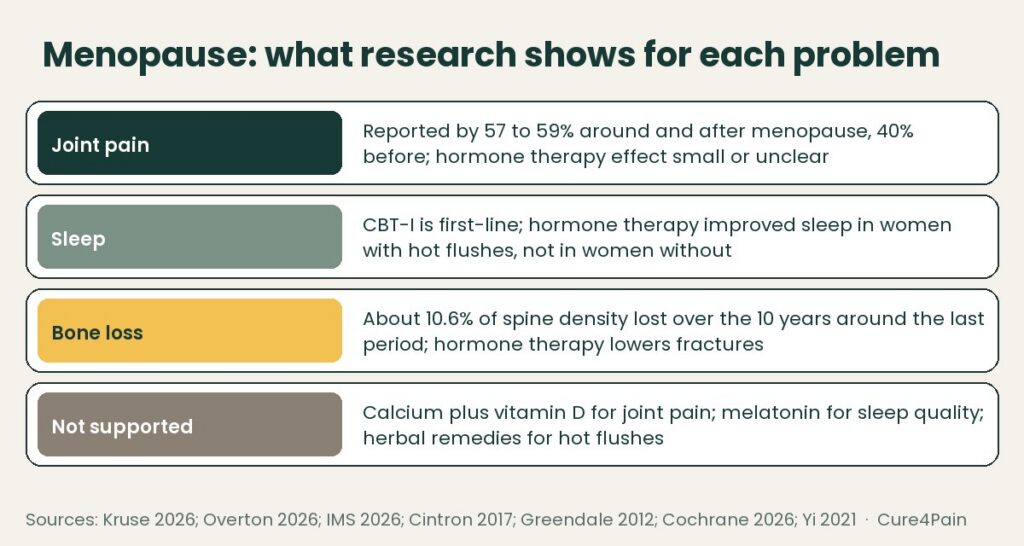
Falling oestrogen is thought to connect menopause joint pain, poor sleep and bone loss, but it does not explain all of them. In a 2026 review of 37 observational studies and 93,021 women, muscle or joint pain was reported by 59% of postmenopausal and 57% of perimenopausal women, against 40% of premenopausal women [1]. In the US SWAN study, women lost about 10.6% of their spine bone density over the 10 years around their last period [2]. The Menopause Society (2022) calls the benefit-risk balance of hormone therapy (HRT) favourable for troublesome hot flushes and for preventing bone loss in women under 60 or within 10 years of menopause who have no contraindications [3]. Hormone therapy is not an established treatment for joint pain: a 2026 review of 57 studies found no overall difference in general muscle and joint pain with its use [4]. For insomnia, the Indian Menopause Society (2026) places cognitive behavioural therapy first and says hormone therapy is not a primary therapy [5].

Scientific explainer videos in our Resources section
In our Resources section, our clinical team discusses vitamin D, its cofactors and how autoimmune, lifestyle and pain conditions develop.
Why does menopause affect joints, sleep and bones?
Menopause appears to affect joints, sleep and bones through the fall in oestrogen, alongside age and other causes. The UK NHS lists muscle aches and joint pains, trouble sleeping and loss of bone density among the symptoms of perimenopause and menopause, and says aching joints can come from lowered oestrogen [6] [7].
- Bone: The Menopause Society (2021) describes postmenopausal bone loss, related to low oestrogen, as the main contributor to osteoporosis [8].
- Joints: a 2024 review by Wright and colleagues proposed the term “musculoskeletal syndrome of menopause” [9]. The Indian Menopause Society (2026) says this remains a concept and is not an established diagnosis [5].
- Sleep: according to a 2018 review by Baker and colleagues, long-term population studies link sleep difficulties with menopausal stage and hormone changes, over and above age [10].
Why this matters in India. Menopause comes earlier on average in India: 46.2 years in a 2016 survey by the Indian Menopause Society, against about 51 in Western countries [11], and 46.6 years in a 2021 review of 10 Indian household surveys, whose authors note that the differences may partly reflect methods [12]. The Indian Menopause Society’s 2026 guideline says joint and muscle pain are more prominent than hot flushes in Asian regions, including India. It also describes “twin nutrient deficiencies” that contribute to earlier osteoporosis and fractures in Indian women: about 3 in 4 women consume less calcium than recommended and 2 in 3 are vitamin D deficient [5].
Does menopause cause joint pain?
Menopause is linked with more joint and muscle pain, but studies have not proved that it is the cause. A 2026 review of 93,021 women (Kruse) found a risk 1.40 times higher after menopause and 1.35 times higher in perimenopause than before it, yet all 37 studies were observational, results varied widely and specific conditions were under-reported [1]. A 2020 review of 16 studies (Lu) put musculoskeletal pain in perimenopausal women at 71% [13].
- How long it lasts: the NHS says menopause symptoms usually last 7 to 9 years, sometimes longer, and joint pain can continue after menopause [6].
- Hands: according to the authors of the 2022 HOPE-e study, painful hand osteoarthritis becomes more common around the age of menopause, which has led researchers to suspect low oestrogen [14].
- Breast cancer medicines: in a 2017 review of 21 studies (Beckwée), about 46% of women taking aromatase inhibitors had joint pain from the medicine [15]. Tell your doctor if your pain began after starting one.
How can you tell menopause joint pain from arthritis?
Symptoms alone cannot separate menopause joint pain from arthritis. The Indian Menopause Society (2026) says the musculoskeletal syndrome of menopause is a concept and not an established diagnosis [5], and the UK NHS advises seeing a GP if you are worried, not diagnosing it yourself [7]. The table shows the patterns the UK NHS describes [7] [16].
| What you notice | What it can suggest |
|---|---|
| Pain worse on walking, stiffness after activity, usually over age 45 | Osteoarthritis |
| Pain and stiffness on both sides of the body, worse after rest or on waking | Rheumatoid arthritis |
| Hot, swollen big toe joint with sudden, very bad pain, often overnight | Gout |
| Hot, swollen joint that is hard to move, with a high temperature | Joint infection: needs urgent care |
The NHS also advises seeing a doctor if joints stay stiff for more than 30 minutes after waking, if pain or swelling keeps coming back, or if pain stops normal activities or disturbs sleep [7]. Stiffness from osteoarthritis usually wears off within 30 minutes of getting up, while morning stiffness in rheumatoid arthritis often lasts longer [16].
Other conditions that can cause pain at this age include frozen shoulder, carpal tunnel syndrome and back pain. For low vitamin D, B12 or iron, most research on ordinary joint and muscle pain shows links, not proof of cause; see our articles on deficiencies and joint pain and blood tests for chronic pain.
Does hormone therapy help joint pain?
Hormone therapy (HRT) helped joint pain modestly in the large Women’s Health Initiative (WHI) trials, but pooled studies disagree and joint pain has not been established as a reason to start it [17] [18]. A 2026 review of 57 studies (Overton) says there is currently no guidance on using it for this purpose [4].
- Oestrogen alone: in the Women’s Health Initiative (WHI) trial of 10,739 women after hysterectomy, 76.3% on oestrogen and 79.2% on placebo had joint pain at 1 year, while joint swelling was slightly more common on oestrogen (42.1% against 39.7%). This was a post hoc analysis [17].
- Oestrogen plus progestin: in the WHI trial of 16,608 women aged 50 to 79 (mean age 63), relief of joint pain or stiffness at 1 year was reported more often on treatment than on placebo (47.1% against 38.4%) [18].
- After stopping: the Indian Menopause Society (2026) says the modest joint pain and stiffness benefit of oestrogen in the WHI does not last once treatment stops, which points to symptom relief and not a change in the joint [5].
- Pooled evidence: the 2026 review of 57 studies found no overall effect of ever using hormone therapy on general muscle and joint pain (risk ratio 1.00), and conflicting results for osteoarthritis and rheumatoid arthritis [4].
- Rheumatoid arthritis: the WHI trials found no significant difference in developing rheumatoid arthritis or in its severity [19].
Do supplements or exercise help menopause joint pain?
Calcium with low-dose vitamin D did not reduce menopause joint pain in a post hoc analysis of one large trial, the Women’s Health Initiative (WHI) [20], and a PubMed search in October 2026 found no randomised trial of glucosamine, collagen or magnesium for it. One small trial in perimenopausal women found lower joint or muscle pain scores with regular stride walking [21].
- Calcium plus vitamin D: in a post hoc analysis of 1,911 women from the Women’s Health Initiative (WHI), calcium carbonate (1,000 mg of calcium) with 400 IU of vitamin D3 a day made no difference to joint pain at 2 years: 74.6% on supplements and 75.1% on placebo had joint pain [20]. The trial used a low vitamin D dose, so it does not settle the question for other doses.
- Vitamin D levels: in a 2011 cross-sectional study of 1,993 postmenopausal women (Chlebowski), lower blood levels of vitamin D went with higher joint pain scores, and 53% were deficient (below 50 nmol/L in this study). This shows a link, not a cause [22].
- Other supplements: a PubMed search in October 2026 found no randomised trial of glucosamine, collagen or magnesium for joint pain in women at menopause. The omega-3 trials we found were in women with breast cancer on aromatase inhibitors.
- Exercise: in a 2014 trial from China (Zhang) of 157 female medical staff aged 40 to 55 with menopausal symptoms, stride walking at least 3 times a week for 12 weeks lowered the joint or muscle pain item of a menopause symptom score more than usual activity. Only 111 women completed follow-up [21].
Why does menopause make sleep worse?
Menopause makes sleep worse partly through hot flushes, a major reason but not the only one. A 2018 review by Baker and colleagues reports that 26% of women around menopause have symptoms severe enough to qualify as insomnia, and that many, though not all, hot flushes are linked with awakenings on sleep studies [10].
- Other causes: the 2018 Baker review names depression, and breathing and movement disorders in sleep, which become more common after menopause [10]. See our article on waking up tired, snoring and sleep apnoea.
- What to rule out: in menopausal women with poor sleep, the Indian Menopause Society (2026) asks doctors to exclude psychiatric illness, thyroid problems, chronic pain and medicine effects, and to treat sleep apnoea and restless legs [5].
- Pattern over time: according to the Indian Menopause Society (2026), menopausal sleep problems often start before hot flushes, peak around the last period and partly settle later [5].
What helps menopause sleep problems?
For menopause sleep problems, cognitive behavioural therapy for insomnia (CBT-I) comes first, according to the Indian Menopause Society (2026), which applies the American and European insomnia guidelines to menopausal women and says hormone therapy is not a primary therapy for insomnia [5].
- CBT-I: in the 2016 MsFLASH trial of 106 women aged 40 to 65 with insomnia and hot flushes, 6 telephone sessions lowered Insomnia Severity Index scores by 9.9 points at 8 weeks, against 4.7 with menopause education. At 24 weeks, 84% of those assessed in the CBT-I group were in the no-insomnia range, against 43% [23].
- Hormone therapy: hormone therapy improved self-reported sleep in women with hot flushes, and made no difference in women without them, in a 2017 review (Cintron) of 7 pooled trials with 15,468 women [24]. A 2022 review of 15 trials (Pan) found better self-reported sleep with hormone therapy but no change on sleep studies [25].
- Non-hormonal medicines: the Indian Menopause Society (2026) reports moderate benefit from some antidepressants and gabapentin [5].
- Melatonin: a 2021 review of menopausal women (Yi) found no significant benefit from melatonin for sleep quality in 4 trials [26].
- Vitamin D: a 2016 12-month trial (Mason) of 2,000 IU a day of vitamin D3 in overweight postmenopausal women losing weight found no overall sleep benefit. In a comparison that was not randomised, women who reached sufficient levels reported worse sleep scores than women who did not [27].
Our insomnia page sets out the full plan, and our article on vitamin D, magnesium and melatonin covers those supplements.
How much bone is lost after menopause?
Women lost about 10.6% of their bone density at the spine and 9.1% at the neck of the hip over the 10 years around their last period, in the US SWAN study of 862 women (Greendale 2012) [2]. Most of the spine loss, 7.38%, went from 1 year before to 2 years after the last period [2]. Loss was faster in women of Japanese and Chinese ancestry; the study did not include Indian women [2]. The Indian Menopause Society (2026) links low calcium and vitamin D with earlier osteoporosis and fractures in Indian women [5].
- Exercise: the Indian Menopause Society (2026) advises resistance, weight-bearing aerobic and core exercises, and says brisk walking alone is not enough for bone [5]. A 2011 Cochrane review of 43 trials found small differences in bone density against control groups (about 3.22% at the spine with combined programmes) but no significant difference in the number of fractures, which some trials reported as adverse events, and the trials were poorly reported [28].
- Calcium and vitamin D: a 2024 JAMA review of the WHI trials (Manson) does not support routine supplements for all postmenopausal women to prevent fractures, but considers them appropriate for women who fall short of recommended intakes from diet [29]. Read our article on calcium supplements and on vitamin D toxicity.
Treatment of low bone density is covered on our osteoporosis page.
When should you have a bone density test after menopause?
How early to test differs by guideline: the Indian Menopause Society (2026) advises a bone density test for all women more than 5 years past menopause, and earlier with risk factors, while the US Preventive Services Task Force (2025) advises it from age 65, or earlier at increased risk [5] [30]. A DEXA (dual-energy X-ray) scan is the standard test, according to the Indian guideline [5].
| Guideline | Who it advises testing |
|---|---|
| Indian Menopause Society 2026 [5] | All women more than 5 years past menopause; women under 5 years past it with risk factors; women in transition with other causes of bone loss; women with a fragility fracture; before starting osteoporosis medicines |
| US Preventive Services Task Force 2025 [30] | All women aged 65 or over; postmenopausal women under 65 at increased risk on a clinical risk assessment |
The Indian Menopause Society (2026) names FRAX as the preferred first tool for estimating fracture risk, while noting that its Indian model comes from a small North Indian group and probably underestimates risk [5]. For monitoring treatment, the same guideline places the next bone density scan mostly 1 to 5 years later, depending on risk, and elsewhere advises a scan every 1 to 2 years where feasible, on the same machine where possible [5].
What do guidelines say about hormone therapy?
Most bodies named here support hormone therapy for troublesome symptoms in younger women without contraindications, and some for protecting bone, but they read the heart evidence differently. The Indian Menopause Society (2026) links starting it within 10 years of menopause or before 60 with lower death and heart event rates, while a 2024 JAMA review of the WHI trials says they do not support it to prevent heart disease [5] [29].
| Source | Position on hormone therapy |
|---|---|
| The Menopause Society 2022 [3] | Favourable for hot flushes and preventing bone loss under 60 or within 10 years of menopause; less favourable when started later, because of heart disease, stroke, clots and dementia |
| Indian Menopause Society 2026 [5] | Starting within 10 years or before 60 is linked with lower death and heart event rates; after 10 years, non-hormonal bone medicines are preferred |
| UK National Osteoporosis Guideline Group 2024 [31] | A first-line option for younger postmenopausal women at high fracture risk and low risk of adverse events |
| WHI review, JAMA 2024 [29] | Appropriate for bothersome hot flushes in early menopause; trials do not support it to prevent heart disease, dementia or other chronic diseases |
The main risk figures in the 2026 Cochrane review come from one set of trials of oral hormones, the Women’s Health Initiative (WHI). Combined therapy probably lowered fractures by 22% but probably raised breast cancer risk by 27% and may have raised stroke and blood clot risk. Oestrogen alone, after hysterectomy, probably lowered fractures by 27% and probably raised stroke risk by 33%, with probably little or no difference in breast cancer. The authors caution that these results may not represent the hormone therapy used today, and only about 30% of women were aged 50 to 59 [32].
- In numbers: the UK NHS gives around 5 extra breast cancer cases per 1,000 women taking combined HRT for 5 years, and says HRT tablets, but not patches, gel or spray, slightly raise stroke risk [33].
- Who may not be a candidate: The Menopause Society (2023) names oestrogen-dependent cancers and cardiovascular disease as examples [34]. The Indian guideline says systemic hormone therapy is contraindicated in breast cancer survivors, apart from rare cases decided with the oncologist [5].
What is not supported?
Around menopause, the WHI trials do not support hormone therapy to prevent heart disease or dementia, calcium plus vitamin D did not change joint pain in a post hoc WHI analysis, and melatonin showed no significant benefit for sleep quality in a 2021 review of 4 trials [29] [20] [26]. These uses and claims also lack good evidence, or guidelines advise against them.
- Hormone blood tests to diagnose natural menopause at 45 or over: the Indian guideline does not recommend FSH, oestradiol or anti-Mullerian hormone for this, and keeps them for special situations [5].
- Herbal remedies and supplements for hot flushes: not recommended by The Menopause Society (2023) [34]. The NHS says there is very little evidence of how well they work or how safe they are [35].
- Compounded “bioidentical” hormones: these are often marketed as “natural”. A 2020 US National Academies report, written because of their growing use, calls their clinical utility a substantial public health concern, while approved products have been reviewed for safety and efficacy [36].
How we care for these problems at Cure4Pain
At Cure4Pain, we see women around menopause for bone and sleep problems, and menopause hormone therapy and bone medicines are managed in-house. An integrative plan may add options alongside standard care.
- Hormone therapy: Dr Krushal Pabari considers and prescribes menopause hormone therapy in-house after weighing the benefits and risks for each woman, under clinical guidance from Team Cure4Pain, in coordination with your existing consulting physician; never stop or change it on your own.
- Non-hormonal medicines: Dr Krushal Pabari prescribes non-hormonal menopause medicines where suitable, on the same basis.
- Bone medicines: Dr Pabari prescribes and manages bisphosphonates, denosumab and teriparatide on the same basis.
- Sleep: menopause-related sleep problems are managed in-house, as part of the plan on our insomnia page.
- Tests: we read a panel of about 100 markers, adding tests for your condition when clinically indicated. For bone these include a DEXA scan you have done once a year, FRAX, and calcium, parathyroid hormone, phosphorus, alkaline phosphatase, thyroid function, a coeliac screen and hormones, with blood tests repeated every 3 months during treatment, including ionized calcium. To rule out secondary causes of bone loss, the Indian Menopause Society (2026) lists blood count, ESR, CRP, blood sugar, calcium, creatinine, albumin, alkaline phosphatase, TSH, vitamin D and phosphorus, with parathyroid hormone on clinical judgment [5].
- Bone nutrition: supervised-dose vitamin D therapy (Coimbra Protocol-based methods), plant-based calcium in place of calcium carbonate, vitamin K2 as MK-7, magnesium mainly as bisglycinate, with L-threonate or citrate as advised, counted as elemental magnesium, collagen, protein and omega-3, with supplements by mouth first, with injections only when specifically needed or advised. Our methods are derived from the work of Dr Coimbra. We found no trial of the Coimbra Protocol in bone loss after menopause. Two trials of high doses point the other way: a single yearly dose of 500,000 IU raised falls and fractures in 2,256 women aged 70 or over at high fracture risk [37], and 10,000 IU a day for 3 years led to more forearm bone loss than 400 IU a day in healthy adults aged 55 to 70 [38]. Our osteoporosis page sets out these and other studies.
- Food: leafy cruciferous greens such as kale and broccoli stay allowed as calcium sources in our bone plan. For other cruciferous vegetables, as an observational clinic practice, we generally suggest limiting cruciferous (Brassica) vegetables such as cabbage and cauliflower; a 2024 review found no harm to the thyroid with daily intake, particularly with adequate iodine [39]. Also, we generally advise most patients to replace wheat with jowar, bajra or other millets as a general health measure, including home-made roti from processed wheat; a gluten-free diet is supported for coeliac disease and positive tests [40]. We advise limiting salt, caffeine, alcohol and soft drinks.
- Exercise and falls: supervised strength and impact training, balance work and falls prevention at home.
- Back and hands: we treat back pain around menopause, and women around menopause are among the patients we see most often with carpal tunnel syndrome; this is a clinic observation.
This is our clinic practice; individual results vary, and further studies are needed.
If you would like these symptoms looked at together, you can book a consultation, online from anywhere or at our Mumbai clinic.
Frequently asked questions
Can menopause cause joint pain?
Menopause is linked with more joint pain, and the NHS says lowered oestrogen can cause aching joints. A 2026 review found muscle or joint pain in 59% of postmenopausal women against 40% before menopause, but all the studies were observational. [1] [7]
Does HRT help joint pain?
HRT may help joint pain a little. Large Women’s Health Initiative trials found modest relief, but a 2026 review of 57 studies found no overall effect on general muscle and joint pain and says there is no guidance on using HRT for this purpose. [17] [18] [4]
What is the best treatment for menopause joint pain?
No single treatment is established for menopause joint pain. The UK NHS advises seeing a GP if you are worried, and one small trial of 157 medical staff aged 40 to 55 found lower joint or muscle pain scores with regular stride walking. [7] [21]
Which vitamins help menopause joint pain?
No vitamin has been proved to help menopause joint pain. In a post hoc analysis of the Women’s Health Initiative, calcium with low-dose vitamin D made no difference to joint pain, although lower vitamin D levels were linked with higher pain scores in a separate analysis. [20] [22]
How long does menopause insomnia last?
How long menopause insomnia lasts varies. The Indian Menopause Society says sleep problems peak around the last period and partly settle later, and the UK NHS says menopause symptoms usually last 7 to 9 years, sometimes longer. [5] [6]
Does HRT help you sleep?
HRT improved self-reported sleep in women with hot flushes, and not in women without them, in a 2017 review of 7 pooled trials. The Indian Menopause Society says HRT is not a primary therapy for insomnia and places cognitive behavioural therapy for insomnia (CBT-I) first. [24] [5]
This article is for education and does not replace medical advice. Do not start, stop or change any medicine or supplement without medical guidance.
References
1. Kruse C, et al. Musculoskeletal Manifestations of Perimenopause: A Systematic Review and Meta-Analysis of 93,021 Women. JB JS Open Access 2026;11(1). doi:10.2106/JBJS.OA.25.00254
2. Greendale GA, et al. Bone mineral density loss in relation to the final menstrual period in a multiethnic cohort: results from the Study of Women’s Health Across the Nation (SWAN). J Bone Miner Res 2012;27(1):111-8. doi:10.1002/jbmr.534
3. “The 2022 Hormone Therapy Position Statement of The North American Menopause Society” Advisory Panel. The 2022 hormone therapy position statement of The North American Menopause Society. Menopause 2022;29(7):767-794. doi:10.1097/GME.0000000000002028
4. Overton R, et al. The effect of hormone replacement therapy on musculoskeletal pain in menopausal women: A systematic review and meta-analysis. Post Reprod Health 2026;32(1):52-68. doi:10.1177/20533691251403087
5. Meeta M, et al. Clinical Practice Guidelines for Menopause: An Executive Summary and Recommendations: Indian Menopause Society 2026. J Midlife Health 2026;17(Suppl 1):S12-S116. doi:10.4103/jmh.jmh_302_25
6. NHS (UK National Health Service). Menopause and perimenopause: symptoms. nhs.uk/conditions/menopause-and-perimenopause/symptoms
7. NHS (UK National Health Service). Joint pain. nhs.uk/symptoms/joint-pain
8. Management of osteoporosis in postmenopausal women: the 2021 position statement of The North American Menopause Society. Menopause 2021;28(9):973-997. doi:10.1097/GME.0000000000001831
9. Wright VJ, et al. The musculoskeletal syndrome of menopause. Climacteric 2024;27(5):466-472. doi:10.1080/13697137.2024.2380363
10. Baker FC, et al. Sleep problems during the menopausal transition: prevalence, impact, and management challenges. Nat Sci Sleep 2018;10:73-95. doi:10.2147/NSS.S125807
11. Ahuja M. Age of menopause and determinants of menopause age: A PAN India survey by IMS. J Midlife Health 2016;7(3):126-131. doi:10.4103/0976-7800.191012
12. Prasad JB, et al. Age at menopause in India: A systematic review. Diabetes Metab Syndr 2021;15(1):373-377. doi:10.1016/j.dsx.2021.01.013
13. Lu CB, et al. Musculoskeletal Pain during the Menopausal Transition: A Systematic Review and Meta-Analysis. Neural Plast 2020;2020:8842110. doi:10.1155/2020/8842110
14. Williams JAE, et al. Hormone replacement therapy (conjugated oestrogens plus bazedoxifene) for post-menopausal women with symptomatic hand osteoarthritis: primary report from the HOPE-e randomised, placebo-controlled, feasibility study. Lancet Rheumatol 2022;4(10):e725-e737. doi:10.1016/S2665-9913(22)00218-1
15. Beckwée D, et al. Prevalence of aromatase inhibitor-induced arthralgia in breast cancer: a systematic review and meta-analysis. Support Care Cancer 2017;25(5):1673-1686. doi:10.1007/s00520-017-3613-z
16. NHS (UK National Health Service). Rheumatoid arthritis: symptoms. nhs.uk/conditions/rheumatoid-arthritis/symptoms
17. Chlebowski RT, et al. Estrogen alone and joint symptoms in the Women’s Health Initiative randomized trial. Menopause 2013;20(6):600-8. doi:10.1097/GME.0b013e31828392c4
18. Barnabei VM, et al. Menopausal symptoms and treatment-related effects of estrogen and progestin in the Women’s Health Initiative. Obstet Gynecol 2005;105(5 Pt 1):1063-73. doi:10.1097/01.AOG.0000158120.47542.18
19. Walitt B, et al. Effects of postmenopausal hormone therapy on rheumatoid arthritis: the women’s health initiative randomized controlled trials. Arthritis Rheum 2008;59(3):302-10. doi:10.1002/art.23325
20. Chlebowski RT, et al. Calcium plus vitamin D supplementation and joint symptoms in postmenopausal women in the women’s health initiative randomized trial. J Acad Nutr Diet 2013;113(10):1302-10. doi:10.1016/j.jand.2013.06.007
21. Zhang J, et al. Effects of physical exercise on health-related quality of life and blood lipids in perimenopausal women: a randomized placebo-controlled trial. Menopause 2014;21(12):1269-76. doi:10.1097/GME.0000000000000264
22. Chlebowski RT, et al. 25-hydroxyvitamin D concentration, vitamin D intake and joint symptoms in postmenopausal women. Maturitas 2011;68(1):73-8. doi:10.1016/j.maturitas.2010.10.006
23. McCurry SM, et al. Telephone-Based Cognitive Behavioral Therapy for Insomnia in Perimenopausal and Postmenopausal Women With Vasomotor Symptoms: A MsFLASH Randomized Clinical Trial. JAMA Intern Med 2016;176(7):913-20. doi:10.1001/jamainternmed.2016.1795
24. Cintron D, et al. Efficacy of menopausal hormone therapy on sleep quality: systematic review and meta-analysis. Endocrine 2017;55(3):702-711. doi:10.1007/s12020-016-1072-9
25. Pan Z, et al. Different regimens of menopausal hormone therapy for improving sleep quality: a systematic review and meta-analysis. Menopause 2022;29(5):627-635. doi:10.1097/GME.0000000000001945
26. Yi M, et al. Effects of exogenous melatonin on sleep quality and menopausal symptoms in menopausal women: a systematic review and meta-analysis of randomized controlled trials. Menopause 2021;28(6):717-725. doi:10.1097/GME.0000000000001757
27. Mason C, et al. Repletion of vitamin D associated with deterioration of sleep quality among postmenopausal women. Prev Med 2016;93:166-170. doi:10.1016/j.ypmed.2016.09.035
28. Howe TE, et al. Exercise for preventing and treating osteoporosis in postmenopausal women. Cochrane Database Syst Rev 2011;2011(7):CD000333. doi:10.1002/14651858.CD000333.pub2
29. Manson JE, et al. The Women’s Health Initiative Randomized Trials and Clinical Practice: A Review. JAMA 2024;331(20):1748-1760. doi:10.1001/jama.2024.6542
30. Nicholson WK, et al. Screening for Osteoporosis to Prevent Fractures: US Preventive Services Task Force Recommendation Statement. JAMA 2025;333(6):498-508. doi:10.1001/jama.2024.27154
31. Gregson CL, et al. The 2024 UK clinical guideline for the prevention and treatment of osteoporosis. Arch Osteoporos 2025;20(1):119. doi:10.1007/s11657-025-01588-3
32. Bofill Rodriguez M, et al. Long-term hormone therapy for perimenopausal and postmenopausal women. Cochrane Database Syst Rev 2026;9(9):CD004143. doi:10.1002/14651858.CD004143.pub7
33. NHS (UK National Health Service). Benefits and risks of hormone replacement therapy (HRT). nhs.uk/medicines/hormone-replacement-therapy-hrt
34. The 2023 nonhormone therapy position statement of The North American Menopause Society. Menopause 2023;30(6):573-590. doi:10.1097/GME.0000000000002200
35. NHS (UK National Health Service). Menopause and perimenopause: treatment. nhs.uk/conditions/menopause-and-perimenopause/treatment
36. National Academies of Sciences, Engineering, and Medicine. The Clinical Utility of Compounded Bioidentical Hormone Therapy: A Review of Safety, Effectiveness, and Use. 2020. doi:10.17226/25791
37. Sanders KM, et al. Annual high-dose oral vitamin D and falls and fractures in older women: a randomized controlled trial. JAMA 2010;303(18):1815-22. doi:10.1001/jama.2010.594
38. Burt LA, et al. Effect of High-Dose Vitamin D Supplementation on Volumetric Bone Density and Bone Strength: A Randomized Clinical Trial. JAMA 2019;322(8):736-745. doi:10.1001/jama.2019.11889
39. Galanty A, et al. Do Brassica Vegetables Affect Thyroid Function?-A Comprehensive Systematic Review. Int J Mol Sci 2024;25(7). doi:10.3390/ijms25073988
40. NHS (UK National Health Service). Coeliac disease: treatment. nhs.uk/conditions/coeliac-disease/treatment